Showing posts with label Lado Pochkhua. Show all posts

Sunday, October 20, 2013

ART: The Visual Diary of Georgian Melancholy. By Lado Pochkhua. Contemporary art from Georgia, Caucasus. (geoplatforma.blogspot.de)

(geoplatforma.blogspot.de) 'I remember in 1981 when Dinamo won the UEFA Cup Winners Cup Abkhazians were happy too; Tarba and Agirba among them. They were shooting guns celebrating the victory. Years later the same guns were fired at Georgians.' Now a resident of United States, Lado Pochkhua was the guest of the Artisterium this year, arguably presenting the most interesting part of it. Pochkhua's photo series the Anatomy of Georgian Melancholy 1993-2004 ties in perfectly with the theme of identity- the focus of Artisterium VI. 'At the age of twenty-three I lost everything: family, friends, my hometown, my house, my documents. In Tbilisi I discovered a new, disorderly and hungry life as a refugee from Abkhazia. That is, I’m no one. Zero. A person without a social function. After receiving my first package of humanitarian assistance, a US Army kit of beans and meat packed in tinfoil, I promised myself that I would get out of the trouble I had fallen into'. The photographs are taken while living in Tskneti, the suburbs of Tbilisi, where part of the refugees including Lado had settled after escaping the war in Abkhazia. The crucial point in life of the artist, as his describes it was heavy with unbearable living conditions, particularly tough winters and even more so the shock of being thrown into such a reality.


The seemingly poetic title of the series has a very interesting story- when determined to learn English and escape the intolerable surroundings of his, Lado came across and bought the Anatomy of Melancholia by Richard Burton 'where the philosopher describes types of melancholia. I began learning English with this strange book. I was translating the texts. If you ignore the witchcraft, wizards and witches- you can find the real reasons for sadness and grief- poverty, fear of the future, war, deprivation and loss of property, death of loved ones'. These are the determining factors for the themes of the black and white photos, documenting the life which none of these people had chosen or were guilty of and their dealings with it.


The exhibition begins with a close-up portrait of a smiling girl- Eka, dressed in the national costume. This is a recurring face, which later comes across as the signifier of the series- an emblem of 'the tragic discrepancy the ceremonial national dress on a beautiful girl and the overwhelming poverty around her. Today I think it portrays the life in Tskneti most precisely; this is a symbol of the life where the high hopes are crushed against the incapability of overcoming the banal problems of everyday life.'

The exhibition is accompanied with text. Often popping up from the middle of the wall, it recreates the initial sensations of the artist when he was taking the photos. Adding a very personal touch, it feels like going through an old diary.


The exposition is dominated by the snow -as if giving away the artist's most traumatic experiences of living in Tskneti - the winter. When the day gets shorter, the air is colder, the nature dies and the survival becomes especially hard and most of all, it is such an alien condition to meet completely unprepared. 'The things change their statuses in Tskneti. Simple household items attain sacred value. The list is simple. Clothes- shoes, a sweater, a jacket or a coat. The living room- an electric heater, a 'burzhuyka' stove, a kerosene lamp and candles. The kitchen- buckets of water storage, plates, spoons, forks. The Bath- tanks, bucket, a dipper. All that is necessary for survival. To die in Tskneti is much easier than to live.'


The portraits of closest and dearest, as the shared difficulties usually bond people like nothing else (many of them have attended the opening of the exhibition) gaze to the camera vibrating with life- true to the human nature focused on survival. 'In Tskneti everything becomes a spectacle, any event has an audience. Life itself, no matter how heavy, is a cure for fear and boredom'- Lado himself analyses the livelihood of his shots. The captions of kids are particularly emotive, especially of the two children playing with what once used to be a bicycle. The photos as such carry more radical messages than it seems- 'what kind of a childhood is one supposed to have when the country is governed by bastards? Like this- with the toys from garbage, with the tense eyes and the malnourishment. Let this photo be a reminder of the years of Shevardnadze's governing, who had managed to transform the population of the warm, fruitful country into refugees and destitute.' This photo being used as a poster for the exhibition speaks of the emerging trend for analysing, revaluing and concluding the newest history of Georgia.


The photo archive of what did not get printed for the exposition is shown on a slideshow accompanied by the audio of the reportages and interviews of the familiar voices concerning the Abkhazian conflict and the fall of Sokhumi. This material is a reminder of the scale of the problem- it was not the couple of people on the photos that got affected with the politics, but the lives of tens of thousands are still predetermined by this conflict. It is the recurring trauma that the people suffer from even 20 years later. The voices so detached, formal and impersonal are such a contrast to the images projecting on the wall- personal, intimate, lively and tragic at the same time.

The quotes are taken from the interview of Lado Pochkhua to the newspaper PrimeTime (14.10.2013) and the statements from the exhibition. 

+++

Georgian Art Platform is a blog conceived by Ellene Kapanadze and Lika Tarkhan-Mouravi. The aim of the blog is to introduce 'the Georgian Art' to an English speaking audience. We aim to inform and keep the reader up to date with the current developments and trends in the Georgian art market. Ellene Kapanadze graduated from the faculty of Art History, University College London, in 2013. Her main interest is contemporary art. She has interned for various London-based galleries and auction houses and feels that Georgia has a lot to offer to the international art scene. Lika Tarkhan-Mouravi studied Liberal Arts in Berlin, and did her MA in Public Policy (cultural Policy) at the Central European University in Budapest. Since 2010 she's worked for a contemporary art gallery in London, and believes that there is a growing interest in the emerging art market of the Caucasus, and particularly of Georgia.

Friday, November 19, 2010

EXHIBITION: "The Future Seeking Memories" By Lado Pochkhua (looksharper.blogspot.com)

"The Future Seeking Memories"
Assumption College, Worcester, Mass.
November 2010

Memory, I think, is a substitute for the tail that we lost for good in the happy process of evolution. It directs our movements, including migration. Apart from that there is something clearly atavistic in the very process of recollection, if only because such a process never is linear. Also, the more one remembers, the closer perhaps one is to dying.
Joseph Brodsky, Less than One: Selected Essays. 1986


I have always been sure that among the “beautiful evils” released by Pandora from her box was the gift of a bright, strong, unfailing memory: the type of memory that never releases us, screening us from the present behind a scrolling bas-relief of images and recollections of physical sensations of the past. Possession of this type of memory can make us close our eyes and sink into the past until we forget the present.

I have a memory for the minutiae, and for many years I did not know how to include it in my art. My dilemma was how to use the everyday memories, events, and stories crowding in my mind, while at the same time I knew myself to be a single person living on the periphery of the world – I could not reconcile how to monumentalize the ordinary around me in artistic language.

My mother’s family album became, upon her death, a parade of photographed activity among people, not a single one of whom is alive. Among the images of my own family’s past I found photographs of ancestors in war uniforms, women and children on picnics, promenading on beautiful alleys, splashing each other in the warm sea, celebrating holidays that have ended a long time ago in images of Soviet resorts, and out of this collected ephemera emerged the question – why should I use only my family?

I am sure the odd sensation of looking at old photographs is not a new one, but after living in several countries and different cultural spaces, I found that the private photography of the 20th century contains an amazing similarity of themes. Private lives, family lives, education, holidays, relaxation, service in the army – despite the pressures of propaganda in the last hundred years, wherein nations were encouraged to run from each other and divide, images of individual lives resemble each other to a startling degree. As I sorted through photographs from friends’ archives, flea markets, bookstores and antique shops, I realized that I could make a record of the collective space, through years, nations and wars. My motivation was both the desire to give anonymous photographs a second life and to project the future through artistry of the not-so remote past.

Photographs are the most likely material for this type of activity. As Roland Barthes postulates in his Camera Lucida, “Perhaps we have an invincible resistance to believing in the past, in History, except in the form of myth. The Photograph, for the first time, puts an end to this resistance: henceforth the past is as certain as the present, what we see on paper is as certain as what we touch. It is the advent of the Photograph…which divides the history of the world.” Photographs alone, collected and catalogued in a completed archive, could be its own form of art, but this would lead the viewer on another path, and in this body of work I used the language of painting to strengthen the photographic object into a monumental presentation.

Found photographs have impacted this work dramatically, and one photograph in particular illustrates the project as a whole. In the Budapest flea market I bought a small black and white photograph, which showed eight young girls striking a dancer’s pose in gym class, in white dresses, on a sunny day, holding over their heads eight matching volleyballs - a happy and somewhat ordinary image that could have happened in any school of the era. What struck me, however, was on the other side is the handwritten caption: 30 August 1939, Budapest – and in that confrontation of banal school photographs and the date, memorable because in twenty four hours World War II begins, the result of which a million people and tens of cities will be ruined, and in that city where this photograph was taken, that is the birth of this project. When looking at this photograph, I started to think, and wanted my audience to wonder with me: did they know about the preparations for the war, from the newspapers, radio, and cinema-scopes? Did they celebrate with their families the opportunity to return territories lost in the First World War? Or were they terrified, perhaps some among them knowing they would be leaving soon and their families were scared; and for this photograph are they closing their eyes to concentrate only on the present day, which in this case, was August 30, 1939?

St Augustine wrote, “What then is time? If no one asks me, I know what it is. If I wish to explain it to him who asks, I do not know.” The moment the painting I made, created from the real object of the date on the photograph, was named “August 30, 1939,” I gave my audience to understand that as a subject, the painting’s subject will have a relationship to time. The painting itself can be touched, transferred to digital format, printed in catalogues, exhibited; but our imagination of the event in the painting will always be channeled to 1939. But the date when this photograph was taken, the painting was created, and even the moment this text is read, those moments slide into the past. My motivation as an artist is the desire to freeze a moment that prognosticates the future, and it is almost unbearably hard to achieve.

Lado Pochkhua, October 13, 2009
Source:
looksharper.blogspot.com

Wednesday, September 08, 2010

EXHIBITION: Paradise at Proteus Gowanus with Georgian Artist Lado Pochkhua (proteusgowanus.com)

Please join us for the opening exhibition of our new yearlong theme

Paradise

Friday, September 10, 6:30-8:30 pm

Music provided by our Heavenly DJ, Friese Undine
Refreshments will be served

Whether a garden of innocence or a heaven that only the chosen few can enter, the concept of paradise has entranced us across cultures and eras. In stark contrast with the daily grind, Paradise calls to us and we respond with our imaginations. Pliny the Great added to his idyllic description of the Islands of the Gods: "These islands, however, are greatly annoyed by the putrefying bodies of monsters, which are constantly thrown up by the sea." And this is, indeed, the paradox of paradise: for every heaven, there must be a hell.

This year, Proteus Gowanus will explore the theme Paradise, examining the light and the dark sides of this alluring word and inviting our friends and visitors to join us as we roam with irony, sensuality and longing in search of paradise.

Paradise Artists:
Angelo Bellfatto, Diane Bertolo, Svetlana Boym, Dominique Cooper, Ernst Haeckel, John Hudak,
Okay Karadiyalar, KC Lack, Eva Melas, Lado Pochkua, Lance Rutledge, Adine Sagalyn, Erik Schurink, Suzan Shutan, Suzanne Silver, Josh Stern, Robert The, Friese Undine, Kit Warren, Audra Wolowiec

Paradise Correspondents:
Erik Schurink and Mahdu Kaza


more >>>

Sunday, August 16, 2009

PAINTINGS: The Long Landscape by Lado Pochkhua

Thursday, June 04, 2009

EXHIBITION: Georgian Artists in PRAGBIENNALE4 (praguebiennale.org)

Maka Razmadze's work

Georgian artists Lado Pochkhua and Andro Semeiko

George Kevle's Luxenburg and Georgia

Tuesday, May 26, 2009

PAINTING: The Black Letter. By Lado Pochkhua

My friend the georgian artist Lado Pochkhua finished some works in Budapest in his studio. All the time I would like to publishing some works here. In the last night I uploaded some works on my flickr account. And today I could see the rally in the football stadion in a short clip of civil.ge (Tens of thousend rally / and one man >>>). This painting haven't to doing anything with that. But interesting for me is the association between the expression of this painting and the painful performance for the official world from the single opposition guy in the centre of the arena today. Maybe he have seen to often the fiction of Spartacus in his childhood. For me it is not a trustfull event. Georgia need more reflectiveness! Georgia needs more trust and rest!

Lado himself my best wishes and congratulation for the exhibition in the Prague Biennale2!

more photos from the art by Lado Pochkhua >>>

Tuesday, January 27, 2009

NEW PAINTING: the geometry of the victory, 20/20 sm. acrylics, manual transfer on canvas. by lado pochkhua

more: looksharper.blogspot.com

Wednesday, January 21, 2009

VIDEO: Lado Pochkhua at ARCI Gallery about his new show of paintings


The Artist Lado Pochkhua about his new show of paintings at Arci Gallery Tbilisi, 20th of January 2009. This show was curated from the fabulous young woman Nini Palavandishvili in Tbilisi. I invited her together with Lado Pochkhua last year for organizing an exhibition in Leipzig. More can found down under the label OFF EUROPA.

Sunday, January 18, 2009

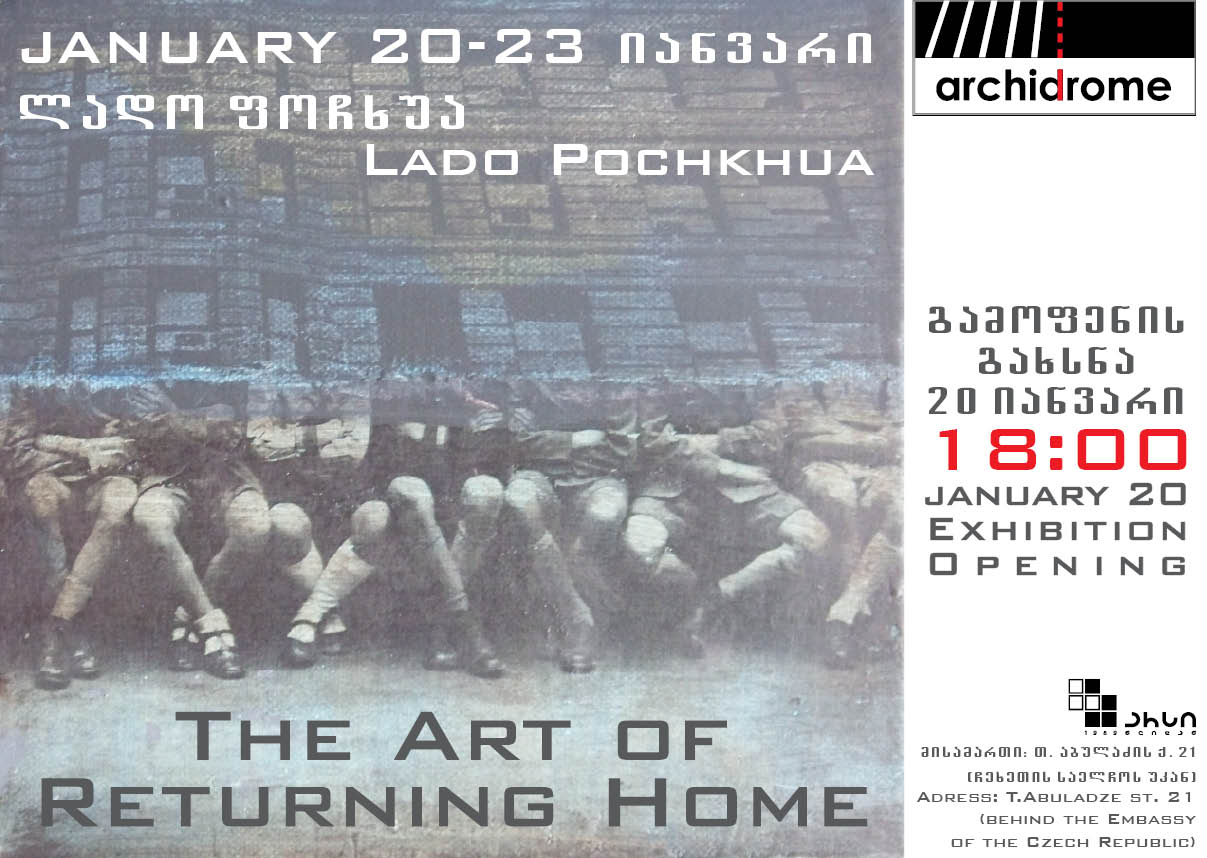
EXHIBITION: Lado Pochkhua*The Art of Returning Home@Arci Gallery_20.01.2009_18:00

OPENING EXHIBITION: Arci Gallery - Lado Pochkhua in Tbilisi. January 20 , 20:00pm


The Artist Lado Pochkhua
www.ladopochkhua.com
www.looksharper.blogspot.com

Curator: Nini Palavandishvili
archidrome.blogspot.com/
geoair.blogspot.com/

Thursday, December 18, 2008

ART: Lado Pochkhua will opening an exhibition in Tbilisi soon.

Lado likes to emphasize that he’s a product of good Soviet academic training. I’ve never met an artist so fully versed in the history of all the art that came before him. He graduated from the Sokhumi College of Art in 1994 and the Tbilisi Academy of Art in 2001. He has had personal exhibitions in TMS Gallery and Old Gallery in Tbilisi, and has participated in ten major group exhibitions, including one in the Georgian Embassy in London, UNESCO in Paris, and in the Tbilisi History Museum (Carvasla) and the National Gallery of Art. He has participated in international projects in Russia and Azerbaijan, and has lived and worked in Georgia, Russia, Azerbaijan, the United States, and Hungary, where he currently resides.


Lado Pochkhua, Georgian, born 1970.
Biography
Vladimir Pochkhua was born in Sokhumi, Georgia in 1970. He graduated from the Sokhumi College of Art in 1994 and the Tbilisi Academy of Art in 2001. He has had personal exhibitions in TMS Gallery and Old Gallery in Tbilisi, and has participated in ten major group exhibitions, including in the Georgian Embassy in London, UNESCO in Paris, and in the Tbilisi History Museum (Carvasla) and the National Gallery of Art. He has participated in international projects in Russia and Azerbaijan, and has lived and worked in Georgia, Russia, Azerbaijan, the United States, and Hungary, where he currently resides.
Jeff Taylor, art dealer, taylorartadvisors.com


more:
lado-artefact.blogspot.com/
www.ladopochkhua.com
www.looksharper.blogspot.com


Lado Pochkhua
Email:
krotart@gmail.com

Education
MFA 2001 Painting and Printmaking Tbilisi State Art Academy Tbilisi, Georgia
BFA 1993 Studio Art and Instruction Sukhumi College of Art, Sukhumi, Georgia

Exhibitions and Private Commissions
2008 Gardens, Ships, and Lessons, K. Petrys Ház Gallery, Budapest, Hungary (solo show)
Exhibition of Georgian Artists, Festival OFF EUROPA ditorei Gallerie NBL, Leipzig, Germany
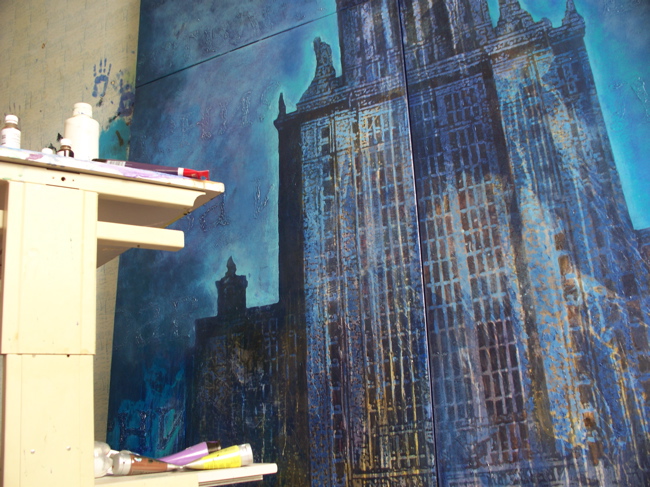
2007 Moscow University Building, mural in private collection, Dublin, Ireland
2004 Best Artists of Georgia, Georgian Embassy, London
Mural with Figure, private collection, Baku, Azerbaijan. Featured in Salon Architecture
Magazine, Russia
2003 Curriculum Vitae: a retrospective of 20th century Georgian art, Caravasla Tbilisi History Museum, Tbilisi, Georgia
2001 21 Georgian Artists, UNESCO, Paris, France
Orientalism: Inside and Outside Biennale State Exhibition Hall S. Bakhul-Zade, Baku, Azerbaijan

Gallery Affiliation
1999-2004 Old Gallery, Tbilisi, Georgia
Works on Paper, 2004 (solo show)
Invented and Borrowed Pictures, 2001 (solo show)
Utopia: Conceptualizing Thomas Moore, 2001 (group show)
Magical Geography, 2000 (solo show)
Paintings and Graphic Works, 1999 (two-person show)

2002-2003 Gallery Club 22, Tbilisi, Georgia
Waiting for the Barbarians, 2003 (solo show)
Trivial, 2002 (two-person show)

1998- 2002 TMS Gallery, Tbilisi, Georgia
Ultramarine, 1999 (group show)
Magical Geometry, 1998 (solo show)

Conferences and Awards
2006 20th International Sculpture Centre Conference, Cincinnati, OH
2000 18th International Sculpture Centre Conference, Houston, Texas

Best Graphic Artist of the Year, Georgia, for Illustrations for the Epic Poem of the Narts

Thursday, November 06, 2008

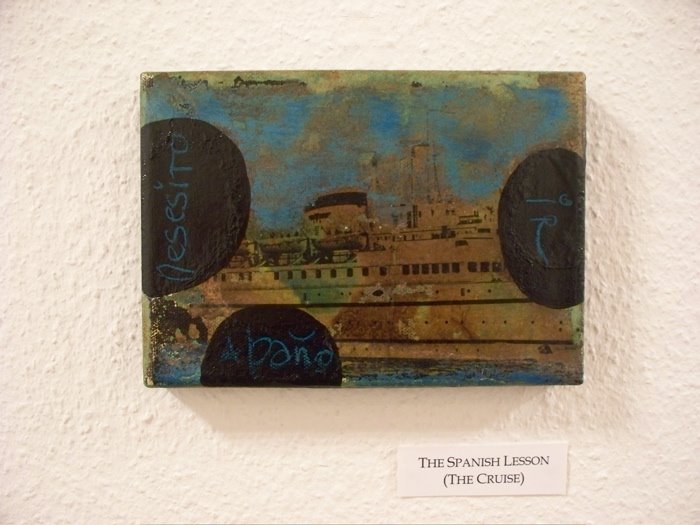
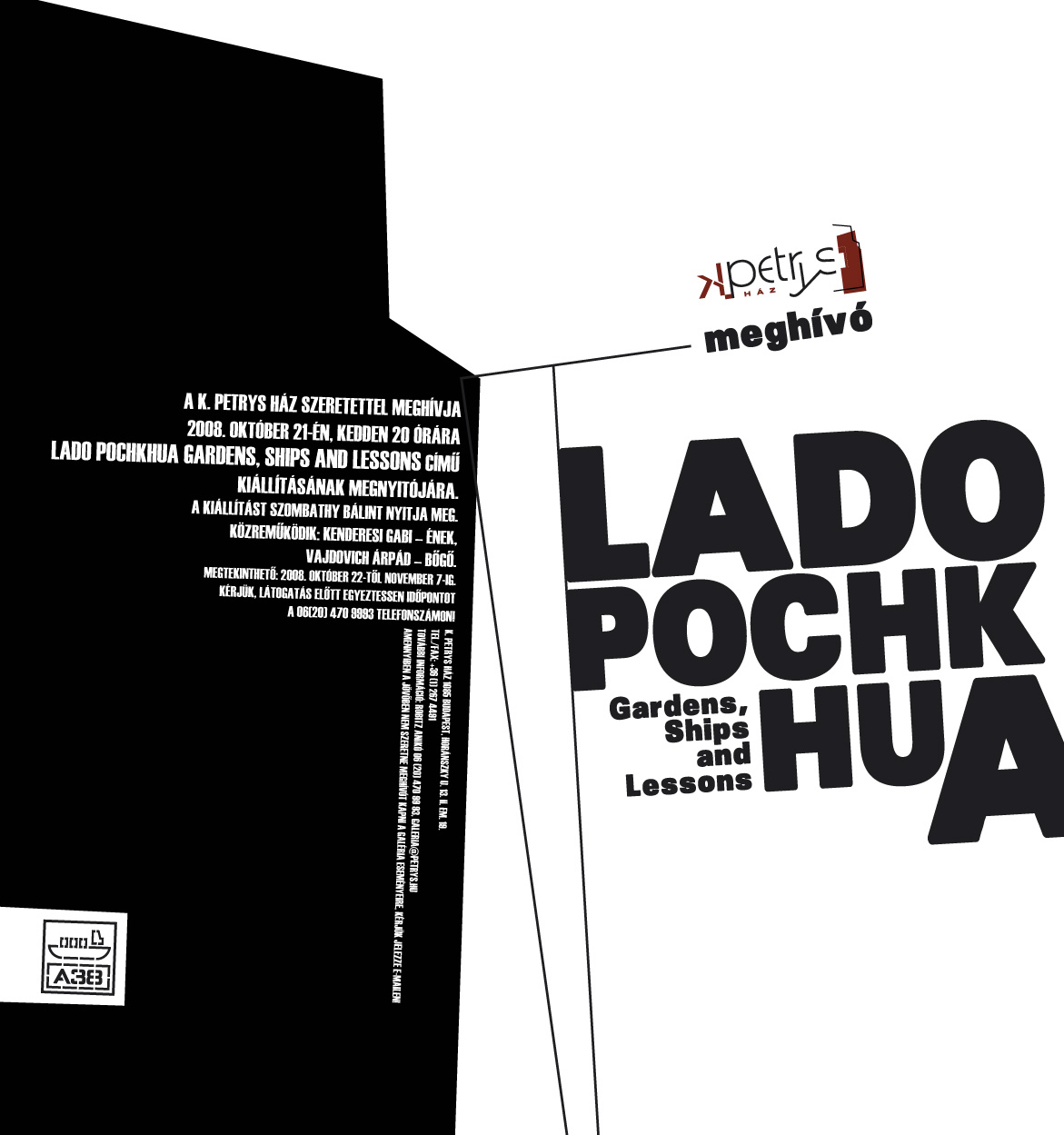
EXHIBITION: Gardens, Ships and Lessons. Paintings by Lado Pochkhua in Budapest.

Opening: Budapest, K.Petrys Haz Gallery, oct.21st.

more:
www.lado-artefact.blogspot.com
www.ladopochkhua.com
www.looksharper.blogspot.com

in artnowonline.com
in sorrealism.com

Lado Pochkhua Gardens, Ships and Lessons
2008. október 21. – 2008. november 7.
K. Petrys Ház
A kiállítást Szombathy Bálint nyitja meg kedden 20 órakor.

Slideshow about Paintings by Lado Pochkhua >>>

Lado likes to emphasize that he’s a product of good Soviet academic training. I’ve never met an artist so fully versed in the history of all the art that came before him. He graduated from the Sokhumi College of Art in 1994 and the Tbilisi Academy of Art in 2001. He has had personal exhibitions in TMS Gallery and Old Gallery in Tbilisi, and has participated in ten major group exhibitions, including one in the Georgian Embassy in London, UNESCO in Paris, and in the Tbilisi History Museum (Carvasla) and the National Gallery of Art. He has participated in international projects in Russia and Azerbaijan, and has lived and worked in Georgia, Russia, Azerbaijan, the United States, and Hungary, where he currently resides.

Friday, October 17, 2008

BUDAPEST: Exhibition by lado Pochkhua: Budapest on October 21st

Dear friends,
I would be very obliged to see you in Budapest on October 21st at my exhibition. If you can't make it, I still love you all!

Lado Pochkhua

--
www.ladopochkhua.com
www.looksharper.blogspot.com

Sunday, August 17, 2008

ART: The Anathomy Lesson. Painting by Lado Pochkhua


Monday, March 03, 2008

ART: New Paintings By Lado Pochkhua From His Studio In Hungary


Monday, February 25, 2008

ART: "Albrecht von Habsburg" - Painting by Lado Pochkhua

Paintings by Lado Pochkhua (Set)

Monday, February 11, 2008

EXHIBITION: The Georgian Lado Pochkhua In Budapest

"The Anatomy of the Melancholy " at Muveleti Terulet, Budapest.


Georgian artist brings 1930s Hungary to life
Written by Michael Logan
Monday, 04 February 2008

Melancholy and memoryscapes of the past

You do not often hear an artist admitting that the title he or she has chosen for an exhibition sounds pretentious, but that’s exactly how Georgian artist Lado Pochkhua describes the title of his latest show The Anatomy of Melancholia. Such frankness is refreshing in an art world were pretentiousness often rules the roost, and Pochkhua’s art itself is just as refreshing as his approach.
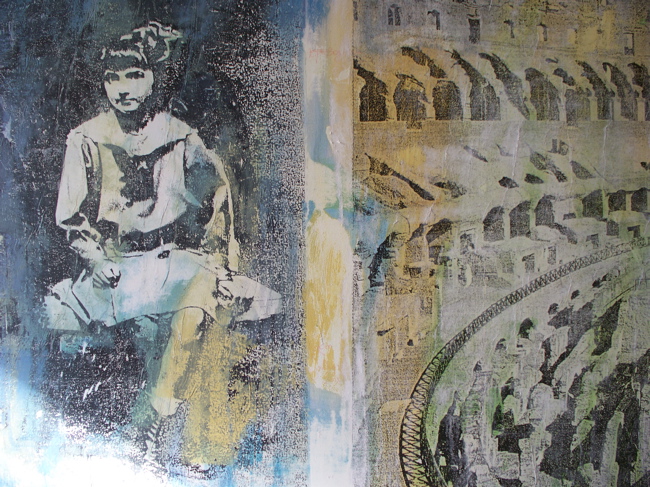
Pochkhua, 38, is an energetic figure and his enthusiasm for his field is clear. Much of his work is based on old photographs that he picks up in the flea markets of Budapest. He then either draws the images in pen and ink or transfers them onto canvas using acrylic medium. This is just the beginning, though. After that Pochkhua, who studied at the Tbilisi Academy of Art and has exhibited in US, Sweden and Georgia as well as Hungary, takes the simple image and transforms it into what he calls a “memoryscape”.
“My impulse is to take something that is vanishing and bring it new life,” he says. “I want to create a new relationship between colours, images and characters.”


1930s Hungary
At the moment many of the images Pochkhua unearths are from the 1930s. You can feel the past in his paintings, which build images of people playing tennis, youngsters at school, or gentlemen in old bathing suits into a landscape of muted colours.
While most of the time Pochkhua feels that the people in the pictures are not as important as the impression the work gives the viewer, he also occasionally unearths an image that captures as specific moment in history.
“I have an amazing image of nine girls in white dresses, standing in formation holding balls and with very happy faces,” he says. “On the rear of the photo is the date: 29 August, 1939 [just before the start of the Second World War]. They are hours from tragedy and there is no feeling of that in the picture.”


Keeping busy
And as for the “pretentious” title of the exhibition, Pochkhua took it from the title of 17th century book by Robert Barton, in which the author attempts to classify and cure all different types of melancholia. Pochkhua began reading the book when he went through an initially tough time upon arriving in a dark, unwelcoming and “melancholy” Budapest in November 2006.
Barton admitted he studied melancholia in an effort to keep busy and therefore avoid his own melancholia. The Georgian artist adopted this approach in Budapest, and has become prolific.
With no shortage of flea markets in Budapest, you can be sure that Pochkhua won’t run out of inspiration.

Source: Budapest Times


The Anatomy of Melancholia
Műveleti Terület
District VI, Andrássy út 99
Opening hours: Monday-Friday 6pm-8pm until 8 February

www.muveletiterulet.hu

Artist website: http://looksharper.blogspot.com/