Showing posts with label Flickr. Show all posts

Tuesday, December 17, 2019

PICTUREGALLERY: Georgian Artist Rusudan Khizanishvili

Rusudan's approach to both the handling of paint and compositional construction reflects a healthy knowledge of what has come before her, while at the same time clearly display a contemporary set of values and codes of practice. Graduating with a painting degree from the Tbilisi State Academy of Art, Rusudan went on to complete an MA in Media in 2005.

Georgian Artist Rusudan Khizanishvili

rusudan-khizanishvili.com
artsy.net/rusudan-khizanishvili

Thursday, June 01, 2017

PHOTOGRAPHY & VIDEO: Zikr in Pankisi Valley - Chechen enclave in northern Georgia. By Swiatoslaw Wojtkowiak

Zikr in Pankisi

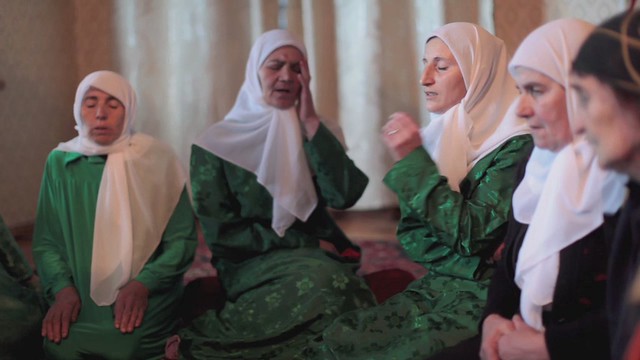
Sufi of Pankisi Valley. The women gather to sing, praise Allah and pray for peace. Their message is expressed in an explicit way by their charismatic leader and organizer, Badi : Make love not war.

You can see more here: www.pankisi.org

This is another face of islam in Caucasus, you dont see it too often , not so much as terrorist accusation by Russian regime, self fullfilling prophecy. Angry young men, their culture ridiculed, their freedom taken away, turn to fundametalism. Wahhabism is getting sponsored by Gulf countries, by Saudis, but these women, those religious communities refuse to believe wahhabist propaganda that their old traditions of Sufism are heresy. They preach peace.


Chechen sufi zikr from Swiatoslaw Wojtkowiak on Vimeo.

Zikr in Pankisi Valley - Chechen ladies from Pankisi Valley performing Sufi zikr ritual , singing message of love to God and other people, and asking for peace in Caucasus.

Saturday, October 04, 2014

KUNST: Karlo Katscharawa und Deutschland. Ausstellungseröffnung und Präsentation des Katalogs in Georgien

Ausstellung zum 20. Jubiläum des Goethe-Institut Georgien.

Vor 20 Jahren wurde das Goethe-Institut in Tbilissi gegründet. In demselben Jahr, 1994, starb ein knapp über dreißig Jahre alter Kunstkritiker und Künstler namens Karlo Katscharawa in einem Tifliser Krankenhaus an einer Gehirnblutung. Im Lebenswerk dieses zum Zeitpunkt seines Todes noch ganz jungen Mannes verkörpert sich die deutsch-georgische intellektuelle und menschliche Synthese, für die unser Haus steht, auf eine einzigartige und künstlerisch glänzende Weise.

Das Werk Karlo Katscharawas ist entscheidend beeinflusst von den Malern des deutschen Expressionismus und von den Künstlern der neoexpressionistischen deutschen Kunstrevolution der achtziger Jahre in Köln und Berlin. Es zitiert Joseph Beuys, Jörg Immendorf, August Macke, Ludwig Kirchner, Karl-Horst Hödicke. Es atmet den Geist der Märchen der Gebrüder Grimm und der deutschen Romantik. Ohne dass wir es in Deutschland wußten, gab es damals im tiefen Süden der Sowjetunion ein korrespondierendes Mitglied der neuen deutschen Kunst der achtziger Jahre, die wir in den Kölner und Stuttgarter Galerien oder im Berliner SO 36 bestaunten.

Zum 50. Geburtstag von Karlo Katscharawa und unserem 20. Jubiläum eröffnen wir, Irina, unsere gemeinsame Freundin Lika Katscharawa und unsere Partner von der Firma "Silk Road/Zinanadali" ein analoges Projekt mit den großen Leinwänden, auf denen Karlo seine Liebe zur deutschen Kunst und seine spezifisch georgische Weiterentwicklung der deutschen Kultur für die Zukunft - für eine gemeinsame Zukunft unserer Kulturen - dokumentiert und künstlerisch festgehalten hat. Auch diese Ausstellung ist Teil eines deutsch-georgischen Gemeinschaftsunternehmens, für das wir wieder mit "Silk Road/Zinandali" dankenswerterweise zusammenarbeiten dürfen und das ab 11. Oktober nicht nur in Tbilissi für die Öffentlichkeit zugänglich wird, sondern auch in Zinandali.

Goethe-Institut Georgien
11.10.2014 18.00 Uhr

Tzinandali Museum
12.10.2014 14.00 Uhr

Dauer der Ausstellungen:
12.12.2014, 10.00-18.00 Uhr Mo.-Fr. 

facebook.com


Created with flickr slideshow.

Link: Late Georgian artist’s work admired in anniversary exhibition [agenda.ge]

Wednesday, February 12, 2014

SLIDESHOW: Beyond Sochi by Thomas Dworzak. By Tamara Mirianashvili (flickr.com)

Magnum Photographer Thomas Dworzak presented his Photobook "Beyond Sochi" at the Writers' House in Tbilisi, Georgia.

Monday, August 12, 2013

PHOTOGRAPHY: Tsageri - in Racha Lekhumi. By Robert Senftleben (flickr.com)

Tsageri (2009) at the foot of the Caucasus lies Tsageri a small town, in which it can be hard to find any thing else than sweet russian bunny milk - There is cows every where in the streets - but that does not mean that the shelves are packed with milk products like in Denmark when you go to the supermarkets - To a much higher degree people we saw in Georgia seem to supply them selves from their own cow, chickens and gardens than is the case in Northern Europe.

Source: flickr.com/fromdenmarktoindia

Set: flickr.com/georgia 

Monday, June 03, 2013

BLOG: An Interview With The Photographer George Nebieridze (dreck-magazine.co.uk)

5979280053_34ea344375_bHow is it living in Tbilisi , Georgia for you? What do you like and dislike about it?
I feel alienated most of the time, having doubts in people’s honesty and friendship. It’s a city that had to be astonishingly beautiful and full of sunny smiles, but for unknown reasons it just isn’t. Of course there are things I like and love about it, a great mix of ethnicities and cultures for instance, reflected on every single corner of the town. I’d say: It’s a nice place to visit, but not to live.
I don’t know if the state is doing anything for young artists, but so much great photography is coming from your country lately? How do you explain this?
Do they have to do something for that?! I don’t think so. It’s 21st century everything is shared on the net.. Well yeah there are some high-budget contests and exhibitions, but I don’t know how that may reflect on the photography level. I’m not really into Georgian photography, to be honest. I know only several people making good snaps and most of them have been, or still do live abroad.
Did you expect all the attention when you started photographing and uploading stuff?
I didn’t and I still don’t. Making photographs is something else for me. I have to admit, photography is the thing I do for a living now, but I started all this just to document some stuff, my personal reality, moments I just want myself to remember.
What do you most enjoy photographing?
It depends, I think I have experience in most genres of photography, I’d describe myself as a variable and inconstant person, so there are days I have a desire of some tender, sweet and smooth photos, but most of the time I enjoy making rough-spirited, wild, violent and bloody images. I rarely stage photos.
What about you own magazine? Why did you start it? What’s the spirit?
CZE Magazine is my experiment of examining myself. How I am able to have skills of collecting and arranging stuff by particular themes. It’s a good way I think. I also love contacting people and by featuring their work making them slightly happier. It’s a project that I think one day will become something bigger and include people from all over the globe.
I saw lots of surroundings and lots of portraits. How do people influence surroundings and most of all how do surroundings influence people?
It’s impossible for me to shoot a portrait, not having anything surrounding it. I never get satisfied just by making a photograph of a body part, even a white paper on a background is a surrounding and adds its own spirit to a portrait. The huge part of my attraction is a background in people’s expressions, what do they do, where do they come from or who they want to be. I love watching people act. We all do that, we act different in every other place we’re in. I hate lifeless art and photography, even in some very abstract and surreal photos I try to show myself, I never get tired of saying that, every photo I make is a self-portrait, so even on a photo of a blank wall I try to discover something alive.

Saturday, March 02, 2013

PHOTOGRAPHY: Georgia by the Swiss Guy Christian Bobst


more here: christianbobstphotography.com

Christian Bobst (b. 1971, Switzerland) originally studied graphic design. During his studys he became interested in documentary photography and worked as a photographer,before he started to work for major advertising agencys in Switzerland and Germany as an Art and Creative Director from 1996 - 2010. In 2007 Christian picked up the camera again.

He is based in Zürich where he now works as a freelance Art- and Creative Director and documentary photographer.

Thursday, February 14, 2013

BERLINALE 2013: Half shadows and blooms - Highlight from Georgia (bfi.org.uk)

nice photo here in flickr >>>
(bfi.org.uk) Jonathan Romney looks beyond a lacklustre-so-far competition to highlight two unheralded gems from Germany and Georgia.

Out on a limb of its own in terms of being sheerly satisfying is In Bloom, a Georgian film co-directed by Nana Ekvtimishvili and Simon Gross. It’s a female coming-of-age story set in Tblisi in 1992, and carries an autobiographical charge on Ekvtimishvili’s part. The heroines are two adolescent classmates. One has her father’s absence to contend with (it’s not made clear at first, but he’s in prison), while the other is caught between two young admirers – a romantic suitor who gives her a gun to protect herself, and the impulsive thug that she probably should be protecting herself from.

more links:
m.screendaily.com
hollywoodreporter.com 
cineuropa.org
gnfc.ge
gnfc.ge 
variety.com
arsenal-berlin.de/pdf 
rferl.org
sueddeutsche.de 
tagesspiegel.de

Friday, January 11, 2013

PHOTOGRAPHY: Urban.citylife.Georgia . By Natia Rekhviashvili (flickr.com)

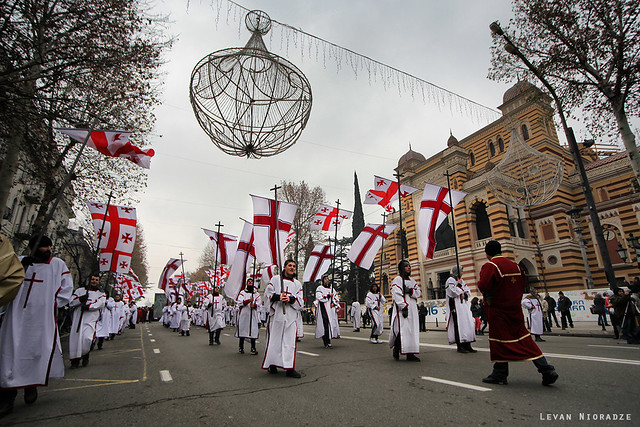
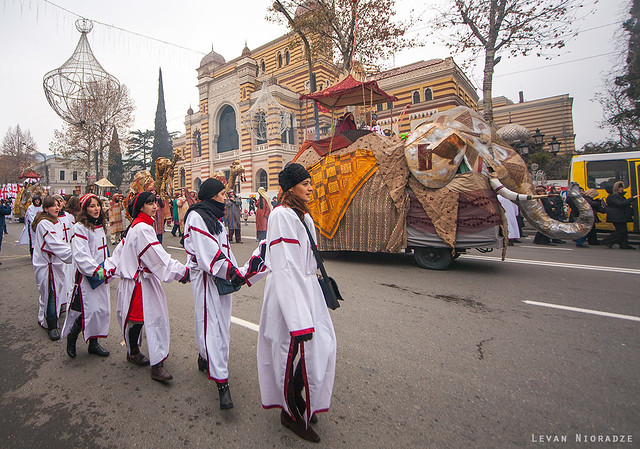
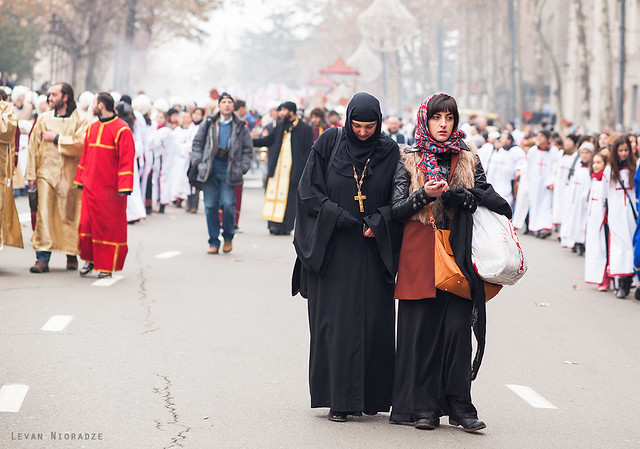
PHOTOGRAPHY: Alilo. By Levan Nioradze (flickr.com)


Wednesday, November 07, 2012

PHOTOGRAPHY: Caucasian Shepherds Diary (flickr.com)


In august 2011 I was going to the mountains near akhmeta, why it doesnt matter. it was a good decision. to be in the mountains is like a therapy, you can cry and laugh, and you are free in a beautiful landscape. this boy was the first shepherd, i ever met, and still i like him. other people said he is ugly, for me not, his heart is pure. 

more: Pankisi (Video)

Saturday, April 09, 2011

EXHIBITION: >IMAGO< (dr.-klaus-schaffner-preis) kuratiert von Nino Palavandishvili (gfzk.de)


A number of Georgian artists have left their country to build a career abroad. Many of them will never return to Georgia. Others have remained in their native country, struggling for acceptance and recognition. Very little support is given by the state or private individuals, unlike the situation in Western countries where this is still common practice. The exhibition addresses the question of how local and global contexts are reflected in the works of artists from various generations. The title “IMAGO” alludes to the picture each side has of the other world, of Georgia and Georgians, of ourselves or “the West”. First and foremost, the latter appears to carry the hope of more favourable possibilities. This image is mainly projected by the media. The exhibition examines the influence of mass media and new forms of communication, on images of identity. It also looks at the mediator role of Georgian artists, who often moderate between the differing images - between authenticity and clichés.

Mit freundlicher Unterstützung:
IFA (Instituts für Auslandsbeziehungen)
GeoAIR Galerie für Zeitgenössische Kunst Leipzig

+++

Museum of contemporar by art leipzig
Karl-Tauchnitz-Straße 9-11
D-04107 Leipzig
Telefon: +49 341.140 81-0
E-Mail: office@gfzk.de
Website: http://www.gfzk.de/

Saturday, January 15, 2011

CULTURE: Guide to Caucasian Rugs (spongobongo.com)

Source: www.spongobongo.com/Caucasia

I take a stand somewhere between the two points. I suggest that the various people of the Caucasus wove distinctive patterns and structures prior to the Russian colonization of the Caucasus but that as Czarist control solidified they sought to stimulate carpet exports to pay for their occupation so that after the 1860s we see an increase in the commercialization of the Caucasian rugs and a decrease in the cultural relevance.In the 1820s the Czarist Russians divided Trans-Caucasia. into the Russian provinces of Baku, Derbent, Sheki, Karabagh, Shirvan, Talysh, and Kuba. Riad: Caucasus.

The Russians divided the region in the manner that was easiest for them to administrate and it did not necessarily follow an ethnographic approach in the division. The Czarist Russians began to solidify their hold as early as 1805 - 1820 but they did not truly control the region for many years. With the capture of the great rebel religious leader Shamyl in 1859 and the end of the rebellion in 1864 did Czarist control truly solidify regional control. In 1865 to eliminate risk of future rebellion the Russians forced 1,2 million Caucasians to move to Turkey.

At one point I suspected that areas such as Nagorno-Karabahk which were historically Moslem were depopulated and then repopulated with Armenians. As Christians the Armenians had an easier time with the Christian Russians. Lately I have come to realize that in the Caucasus' control focused on people rather than strict geographic boundaries. So with the Church and nobility to control the Armenians and Moslem rulers and Governors over the Moslem it was possible for two people to share some measure of independent rule in the same area in the same time. This tends to run counter to the European practice.To confuse the matter even more I suggest that many of the best rugs attributed to 4th quarter 19th century are actually 1st or even second quarter 20th century. A constant problem is that Rug Collecting is more about money and ego then it is a science. My hope is that by opening my notes, thoughts, and theories I may help to stimulate others to take this subject further than I can.

+++

Los Angeles Times, May 17, 1998 [for personal use only]
Trouble Is Looming for a Centuries-Old TradeCaucasus: Regional stability, mass production and modern life are ruining business for merchants of hand-woven carpets.
By VANORA BENNETT, Times Staff Writer

DERBENT, Russia -Under the fortress walls, the merchants of this honey-colored stone city at the crossroads of three empires are doing what their ancestors have done for 800 years: laying out hand-woven carpets for sale.

During centuries of conflict under Persian, Turkish and Russian empires, rug salesmen here traditionally have done lucrative business by buying family carpets from refugees on the run from warfare across the Caucasus Mountains and along the shores of the Caspian Sea. No more.

Something disastrous has started to happen to the region's hand-made carpet trade in the last two years: Peace keeps breaking out. "Look at it now," says woebegone trader Magomed Magomedov, forlornly gesturing around. Just a dozen carpets are pinned up outside the north side of the long defensive wall that Derbent's onetime Persian masters built in the 6th century.

Half a dozen men, all as small and hunched in their flapping black clothes as Magomedov, all with the same mournful expression, are waiting for buyers. "There's almost nothing left of our trade," Magomedov says. "Modern life is killing off the hand-made carpet business."

The region's carpet-making legacy from the great carpet cultures of Persia and Turkey was institutionalized under Soviet rule. Factories mass-produced carpets with approximately traditional designs, although village women went on weaving their own--and also continued the practice, frowned on by Communist Party bosses, of giving dowries of carpets at marriage.

The huge Derbent market spread across town every weekend. But the bonanza years for carpet dealers were right after the Soviet Union collapsed. The lands around Russia's southern border, a tinderbox of Christian and Muslim ethnic groups with long memories for old feuds, went up in flames.

In the five years after the 1991 Soviet collapse, there were conflicts between Armenians and Azerbaijanis, Georgians and Abkhazian separatists, and Russians and Chechen separatists. In the early 1990s, more than a million people fled shattered villages and towns, taking with them only their bedding and carpets. With no money and no homes, the dispossessed were desperate to sell even such treasured symbols of stability and collective history as the carpets to buy food.

But now stability is returning to the region. The wars have stopped or been suspended. The refugees have sold their rugs, and many have found new homes and jobs; so have many of the traders from those days. The only carpets being made by hand and sold in Derbent are those of women here in the multiethnic republic of Dagestan.

But this domestic weaving was never intended as a money-making business and is done more for private, family purposes. Magomedov's wife, Asli, is one of the weavers. She has just dismantled the huge loom that stood all winter in front of the family television set. She, her 22-year-old daughter, Zulekha, and her two 20-year-old daughters-in-law, Gyulhara and Vilayad, worked for six months on the huge blue-and-red oblong carpet that now lies on the floor.

She's planning to start weaving again in the fall. Some of the Magomedovs' carpets are dowry offerings from the family's two new daughters-in-law. A betrothed woman's family still must provide at least one big carpet, a flat-weave rug, a runner and half a dozen cushions. Her mother and sisters can help her weave them, but the designs should be her own.

Traditional Caucasus carpets differ in design from region to region, village to village. They include both Persian motifs--intricate floral patterns--and wilder, brighter, coarser Turkish-influenced designs, with jagged flame-like shapes.

But some of the modern carpets, cushions, runners and wall hangings that decorate houses here have designs that draw as much from Western pop culture as Eastern tradition. Snoopys and Snow Whites crop up, along with compositions of pink-faced children and baskets of puppies.

Asli, who was laid off from her job at the near-bankrupt Soviet-era carpet factory a few years ago, loves weaving. She collects templates--patterns of tiny crosses on squared paper--just as some Western women collect knitting patterns. She studies them in her free moments, contemplating her next adventure in quiet creativity.

But, she complains, her work doesn't bring in much money. The most she can expect her husband to get for this winter's rug, measuring 6 feet by 10 feet, is $600."

Four of us worked on it for six months," she laments. "And that means we only earned $25 a month each. A pittance.

"The worst blow of all to the trade is the flippancy with which post-Soviet Dagestanis have begun to treat their traditions. Although it's still considered crucial to transfer carpets from family to family at marriage, her husband says, it's no longer a matter of pride to give the most beautiful and costly weaving possible.

And Russia's opening of its borders means that there's new competition in the rug business from an unexpected quarter: the West.

Inside Derbent's city walls, just yards from the deserted handmade carpet market, an altogether more flourishing trade is now going on in cheap Belgian or Belarussian carpets made with synthetic fibers.

These crackling, brownish rugs, with large swirly patterns, stand rolled up against walls, or are displayed on clotheslines or cars. Surly traders with none of the traditional carpet salesman's patter say they buy them from four or five big warehouses in Moscow and bring them down to the south for sale.

They cost only one-fifth as much as hand-woven rugs. "So what do people do before a wedding?" Magomedov asks with a mixture of indignation and resignation. "They know they've got to give carpets. But they couldn't care less what kind. So they get the cheapest possible Belgian thing and palm it off on their new family.

For people like that, respect for tradition is becoming no more than a formality."
Johnson's Russia List

+++

Guides to the Caucasian Rug
Notes on Afshan Carpets
Guide to Akstafa Rugs
Notes on Alpan rugs
Guide to Baku Rugs
Guide to Bordjalou rugs
Guide to Karachopf Gardabani Rugs
A Guide To Pin-wheel Kazak
Guide to Caucasian Flatweaves
Guide to Dagestan Rugs
Guide To Dragon Carpets
Guide to Fachralo Kazak Rugs
Guide To Gendge Rugs
Guide to Zakatala rugs
Guide to Georgian Pardaghys
Guide To Karabagh Rugs
Guide To Chelaberd Kazak Rugs
Guide to Karachopf Gardabani Rugs
Guide to Kazak Rugs
Guide to Akstafa Rugs
Guide To Kuba Rugs
Notes on Alpan rugs
Guide to Seychour Rugs
Guide To Marasali Rugs
Guide to Shahsevan
Guide To Shirvan Rugs
Talish Rugs the O'Connell Guide


more: www.morandicarpets.com

Saturday, January 08, 2011

FOTOGRAFIE: Georgien im Dezember 2010. Von Ralph Hälbig (flickr.com)

Im letzten Dezember war ich mit meiner Kollegin Katrin Molnár wieder einmal in Gerogien für eine Fernsehproduktion unterwegs. Beiläufig sind ein paar Fotos entstanden, die ich hier in einer slideshow präsentiere. Wir waren in Ruisi nahe der Stadt Gori, und für eine 15min-Produktion besuchten wir verschiedene kreative Leute vom "underground" bis zur "fashion scene", die sozusagen ihre Türen zu ihrer Stadt Tbilisi öffneten. Ziel sollte sein, ein anderes Tbilisi zu zeigen - abseits der Klischees und Werbeveranstaltungen unserer heutigen Zeit. Bald geht es in den Schnitt, und wir hoffen, dass die geringe Produktionszeit genügend ergiebiges Material hervorbrachte ...

Friday, January 07, 2011

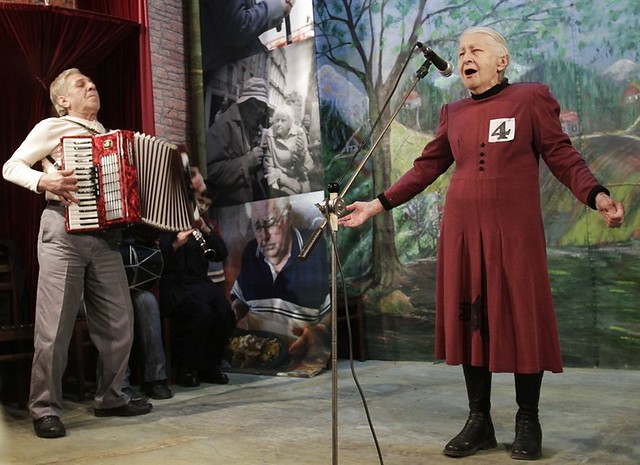
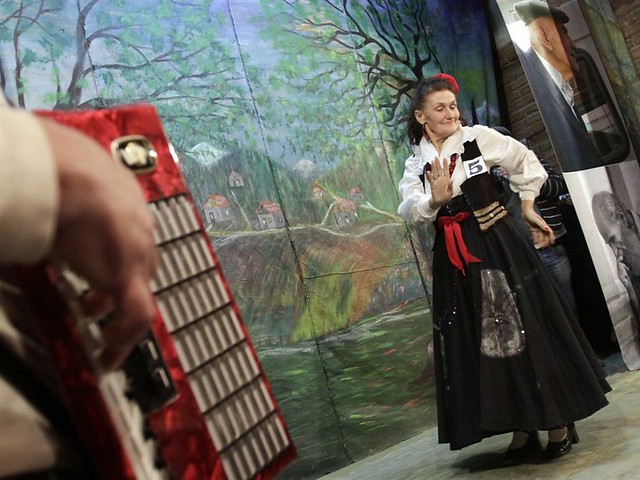
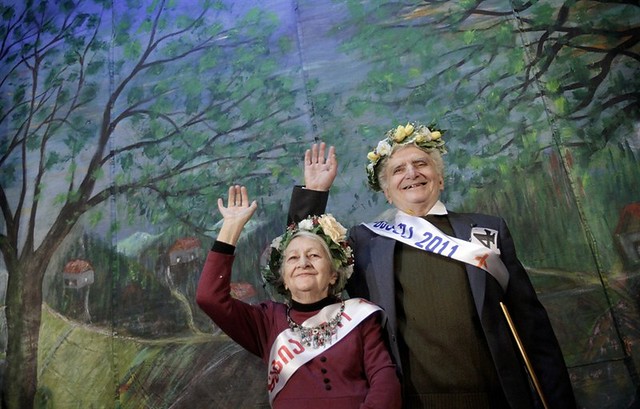
PHOTOGRAPHY: Works by David Mdzinarishvili. Tsiuri Kaka"Super Grandmother and Super Grandfather" winners selected in Tbilisi, Georgia

Carissa Ray writes: This competition to acknowledge the elderly residents of Tbilisi is pretty darn sweet. Click "Show more" below to see more contestants and the winners.
Source: photoblog.msnbc.msn.com

David Mdzinarishvili: Reuters Photographer in South Caucasus based in Tbilisi Georgia. Here I speak only for myself. more: twitter.com/#!/DavidMdzin


Tsiuri Kakabadze (R), 80, performs during the "Super Grandmother and Super Grandfather" contest in Tbilisi January 5, 2011. Twenty-four participants aged over 70 from all over Georgia attended the contest.


Marika Sikharulidze, 84, (R) and Vakhtang Goguadze, 70, wait backstage during the "Super Grandmother and Super Grandfather" contest in Tbilisi on Jan. 5.


Lira Arabuli, 72, performs during the "Super Grandmother and Super Grandfather" contest in Tbilisi on Jan. 5.


Tsiuri Kakabadze, 80, (L) and Yuri Merabov, 77, wave to spectators after winning the "Super Grandmother and Super Grandfather" contest in Tbilisi on Jan. 5.


Flickr >>>

Wednesday, January 05, 2011

ART: Wear a Pair. 100 years of tango in Europe (flickr.com)

Thursday, November 25, 2010

ART: Slideshow with paintings by Mikhail Shengelia (flickr.com)

Monday, November 08, 2010

PHOTOGRAPHY: Lagodekhi, Pona --- Herbst 2010. Von Hans Heiner Buhr

Great Light, clear autumn, nice portraits ... amazing landscape ... My german friend Hans lives for a long time in Georgia. Mostly he is in the capital of Georgia - Tbilisi. But he loves also the mountains of the Caucasus. And I think he likes the people from the eastern area called Kakheti near the border to Azerbaijan ... There are a persian influence. Kakheti is the eastern part of Georgia.

Some people explained me sometimes in Tbilisi about the difference between western part and eastern part of Georgia ... before the war 2008 when the russian army almost separated Georia in two parts near Gori ...


Wednesday, November 03, 2010

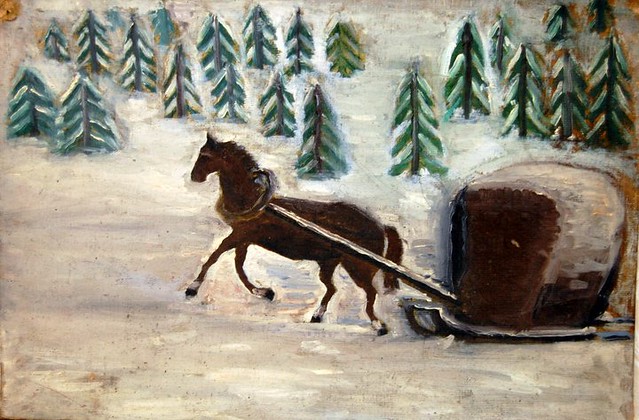
ART: Painting by Avto Meskhi, Horse sledge, 1953 (flickr.com)


Avto Meskhi is an interesting artist from Rustavi, born 1946. He is a calm person with shrewd eyes. Now he is producing abstract paintings. But here you can see an early work by him.

At first I have seen him some years ago in Tbilisi. He has fantastical face --- his physiognomy has something from the cleverness from a child ... A good friend of mine is a collector of his paintings. Never from the art scene in Tbilisi knows Avto really. I think anyone should organize a small exhibition with him.

Furthermore we should thinking about the establishment from artistists all over the world.


(Ralph Hälbig)

Saturday, October 16, 2010

PHOTOGRAPHY: Cattle Drive in Tusheti in Octobre 2010. By Ralph Hälbig (flickr.com)


Sheep, cattle, horses, dogs, campfires, mountains, meadows, sun and rain, hail and snow: See the marvellous beauty of pure life on the road over the mountains with Tushetian shepherders in Autumn 2010

Tusheti lies behind the chain of the Greater Caucasus Range in the northeast of Georgia and is the homeland of the Tushs. Twice a year the Tushetian people change the pastures for their sheep, goats, cows and horses. In the spring they move from the southern steppes in Shiraki on the Azerbaijani border crosswise through Kakheti to the north and then over the 2870 m Abano-Pass into their homeland mountain villages. On juicy meadows in rough mountain air they manufacture excellent cheese, manage their herds and maintain centuries-old traditions. At the end of September after the crop of potatoes and before in the high mountains the first snow falls again the herders break down their camps, load their horses, donkeys and trucks and drive the herds over daily stages from 20 to 30 km back to Kakheti. Apart from our regular journeys to Tusheti in the summer months we offer this adventure journey only for one date in the autumn 2010. The participants will experience grandiose landscapes, Tushetian hospitality, solitude and an adventurous course with the herds by horse or by foot over the chain of the Greater Caucasus Range. Tusheti is an Eldorado for nature friends, riders, adventurers, sport fishers, photographers, journalists and artists.
more: kaukasus-reisen.de