Showing posts with label National Gallery. Show all posts

Wednesday, August 14, 2013

EXHIBITION: Pirosmani 150 in Tbilisi (museum.ge)

Date: 23 July 2013 – 09 Sep. 2013


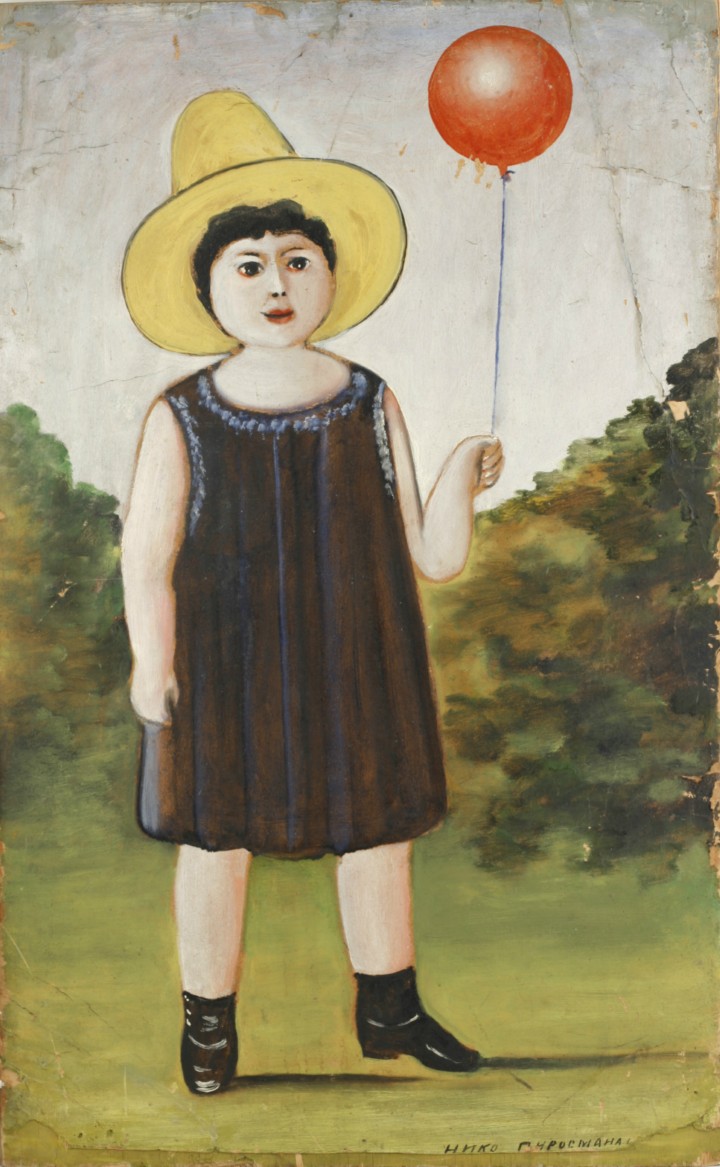
(museum.ge) The Georgian National Museum Dimitri Shevarnadze National Gallery presents a renewed exposition of Niko Pirosmani's works, considering public interest and special requests of visitors.

130 artworks by Niko Pirosmani are presented at the National Gallery from the collections of the GNM and Shalva Amiranashvili Museum of Fine Arts. Along with the works of Pirosmani (1862-1918), David Kakabadze's (1889-1952) and Lado Gudiashvili's (1896-1980) works are also exhibited in the gallery together with sculptures by Iakob Nikoladze (1876-1951) and photo materials depicting the sculptor's life and creative work from the National Archives of Georgia and Iakob Nikoladze House-Museum.

Niko Pirosmani is one of the outstanding and world recognized artists. For decades his name has been well-known outside of his native country-Georgia. Over the centuries, the growing interest in Pirosmani's works proves that this self-taught artist's paintings have never lost public interest and fascination.

From the beginning of the 20th century Pirosmani's artworks have been displayed at various exhibitions in Ukraine, Poland, Russia, Hungery, Lithuania, Belorus, France, Germany, Italy, Japan, the Netherlands, the United Kingdom, Spain, Turkey and many other countries.

Pirosmani's 150th anniversary will be celebrated in association with UNESCO according to a decision made at 36th Session of UNESCO's General Conference.

Address: Dimitri Shevardnadze National Gallery, 11 Shota Rustaveli Avenue.

Sunday, June 09, 2013

BLOG: Christina Steinbrecher Visits Georgia - VIENNAFAIR Diary (thenewcontemporary.com)


Foto 3
With Marine Mizandari (First Deputy Cultural Minister Georgia) at the opening of the Georgian Pavilion at the Venice Biennale.
(thenewcontemporary.com) "Women rule the Georgian art scene..."
Find out more on our blog in the new issue of VIENNAFAIR Diary from Georgia by Christina Steinbrecher.


Following last year’s VIENNAFAIR The New Contemporary kick-off with a curated section of the VIENNA Quintet program in which Georgia played an important role and many artists came to Vienna, we promised to visit Tibilisi. By the end of May everything was set up for the visit!

Marine Mizandari, power woman in furthering contemporary Georgian art.

After a long layover flight and arrival at 5:00 am at the hotel, I was happy to look out of the hotel window and find a beautiful green landscape surrounding Tbilisi.

Nana, art historian and advisor to the Georgian Pavilion this year, invited me for tea and fresh strawberries at her apartment, which contains a fascinating collection of her husband’s work.

Women definitely rule the Georgian art scene. Dedika filled me in on the history of her gallery and local collector habits. End of May she organized exhibitions at the former Museum of Medicine, where she invited me along for a visit.

Kote is a widely traveled scholar who raised his voice loudly in support of gay rights. We had a cup of tea and read some poetry…

On the next day, Sophia showed me around her GeoAir office and library, which she established over the years about the region. In 2007 she presented at the Georgian pavilion in Venice. Sophia talked me through her recent projects, largely inspired by the wild architecture and construction mushrooming in the city.

Irena invited me over to see part of her collection and explore new artists. She took me around the city to some treasures.

Entering Guga’s home, a similar experience as in many houses before. I saw three levels from outside but was amazed to walk through six. Guga designed most of the cafés and restaurants filled by the art crowd in the city.

Guga showed me around his collection of hand-painted film posters from the 80s, interpretations of the original American version.

Located in the heart of the city, the National Gallery showcased an outstanding exhibition of David Kakabadze.

I was happy to meet the artists group Bouillon just a couple of hours before their departure to Venice!

Xatuna, another example of strong women in the city, introduced me to her artist list.

The headquarters of the Bank of Georgia is an 18-story building on the outskirts of Georgia’s capital city Tbilisi. It opened in 1975 as the Ministry of Highway Construction of the Georgian SSR. After Georgia’s independence, the building was left temporarily unused before being acquired by the Bank of Georgia in 2007, which carried out extensive renovation work on the exterior and interior of the building.

A typical Georgian dinner with Niño and Nato at another restaurant designed by Goga. Borjomi is the perfect medicine for all sorts of problems.

At the Venice Biennale I finally got to see the performance by Bouillon. 

The link with many photographs are here >>>

Tuesday, April 23, 2013

REVIEW: Reframing the 80s" at the National Gallery in Tbilisi. By Robert Linkous (georgiatoday.ge)

(georgiatoday.ge) It has taken curator Irena Popiashvili, Rector of Tbilisi State Academy of Arts, a year and a half to pull together the eclectic, multifarious and utterly up-to-date collection of paintings, photographs, and sculpture that can be seen in “Reframing the 80s: Georgian Art at the end of the 80s and Beginning of the 90s” at the National Gallery of Art through November 20. Groundbreaking, it is Georgia’s first show devoted to the work of a single generation.

“This was the first generation to see Joseph Beuys and other German artists as contemporaries,” explained Popiashvili. “Earlier artists looked at the Impressionists.”

Niko Lomashvili’s diptych “14 Shots” was produced in 1990, at a time when violence in Tbilisi made it something of a combat zone. On the left we see a canvas saturated with brown paint and punctured by fourteen bullet holes, only two of which are at dead center. On the right: a very young girl in a loose-fitting, tattered denim jacket, staring down at a handgun clutched at waist level, and surely intent on some dark business.

If reminded of Gerhard Richter’s 1988 photorealist paintings of the Red Army Faction, we may imagine that it is Ulrike Meinhof as an adolescent revolutionary.

The political turbulence of the era is also reflected in Gia Dolidze’s large painting, “Africa” (1989). Scattered across the canvas are images of the African menagerie – giraffe, rhinoceros, alligator, lizard – but at the lower left is a military mangaudily bedecked with medals, above him is a larger and more ominous soldier, apelike in countenance, and with the unruly, bulging hairstyle ofMuammar Gaddafi, while elsewhere on the perimeter of the painting are totemic images redolent of traditional African art.

In the mid-1990s Gabriel Garcia Marquez’s One Hundred Years of Solitude was finally translated into Georgian, and the diptych “Erendira” (1996) shows that Mamuka Tsetskhladze was impressed; Erendira is a young girl who appears in the novel, and would be forced to become a teenage prostitute in a later work by the author. 

Tsetskhladze’s bare-breasted Erendira gazes at us as unabashedly as Manet’s Olympia, her mouth sensuous with red lipstick. Opposite in the diptych, though, a collage-like work, thick black horizontal and vertical lines meeting at right angles mirror perhaps too closely for comfort what Frank Stella was doing early in his career.

Literature of the era crops up again in Karlo Kacharava’s “H All Awed Be” (1989), a painting in which are written lines from the Georgian translation of Allen Ginsberg’s “Footnote to Howl,” though the connection to the primary subject of the painting – an elegant, sophisticated young woman, chicly dressed and coiffed, pensive, legs crossed, with long-fingered hands resting upon her right thigh – may be enigmatic. 

Lurking behind her, spying ominously from over her right shoulder, is a satanic creature with a Ku Klux Klan-like cross sprouting from his forehead, while to the woman’s left a somewhat surrealistic lamp with no shade bends its bulb almost close enough to her hair to singe it.

The American counterculture is evoked again in Ushangi Khumarashvili’s “Time and Happenings” (1989, mixed media on wood). Inside a frame of rough wood, Khumarashvili has produced an abstraction comprised of torn strips of canvas, splotches of paint, a windshield wiper, a long bolt, bits of wire, etc., seeming to have worked much as Robert Rauschenberg did in the days when he scavenged the streets in his Manhattan neighborhood for refuse and junk to put into his “Combines.”

In Koka Tskhvediani’s “Self-Portrait” (1992), though, the artist may have captured something of his own inimitable individuality. Portraying himself with flat ears, shaved head, hollow cheeks, and a complexion as pale as death, he gives a general impression of dour gloominess, were it not for the radiant red of his shirt and his lips, and the luminous blue of his eyes.

The bearer of a surname which resonates in Georgian history, Lado Bagrationi in “Cell” (1976) has painted himself just where the title suggests – in incarceration. During the Soviet era he refused the work that was thrust upon him, and was deemed guilty of the crime, as Popiashvili put it, of “being different.” From behind a massive door he peers forlornly out a small window, very low, at about knee level; he could be perched on a tiny stool barely adequate for a child. 

At the right is shown part of the black boot and heavy leg of a jailer, while at the left a frail hand reaches out in supplication. But perhaps there is a glimpse of hope, in the form of a window at the top of painting, through which can be seen a lovely blue sky. There is a certain paradoxical duality here, as in Magritte’s “Empire of Light;” in Bagrationi’s underworld of the prison there may be perpetual despair, but recollection of the sunnier outside world of life and freedom does not cease to exist.

But while most of the Georgian artists in “Reframing the 80s” may have turned their attention outward, Irakli Maisuradze remained attuned to Georgia’s artistic tradition. In “Wolf” (1989), “Bear” (1988), and the “Untitled” (1988) painting of a gigantic dinosaur on a stroll, he uses large simple images and plenty of bold color to create beings almost docile enough for a petting zoo. In the animal kingdom of Pirosmani they might find home turf.

The above is just a sampling, though, of the delights to be seen among the well over a hundred works that Popiashvili has assembled. She wanted this exhibition to be “as contemporary now as it was then,” she said, and she has succeeded, in spades, for there is an abundance of art that could make itself at home in the galleries of New York’s Museum of Modern Art, London’s Tate Modern, or the Centre Pompidou in Paris.

Avto Meskhi

 
more photographies: "Reframing the 80s" at the National Gallery in Tbilisi (facebook.com)
Friday, June 08, 2012

EXHIBITION: Tbilisi 2012, Stanley Greene : Chechnya (lalettredelaphotographie.com)

Med_stanley-greene001-jpgStanley Greene’s celebrated body of work has often taken him to the Caucasus. As the guest of honour of the third Tbilisi Photo Festival, we are especially pleased that the American photo-journalist will be present for the first exhibition of his work on the Caucasus featuring the war in Chechnya, barely 200 kilometres away from Grozny, just on the other side of the Greater Caucasus mountains. The organisers of the Tbilisi Photo Festival are delighted to welcome as great a photographer as Stanley Greene.

EXHIBITION
On the Road to Chechnya by Stanley Greene
May 31 to July 27, 2012
National Gallery
Tbilisi, Georgia


A trailer to promote Stanley Greene's new photo book: Black Passport. Black Passport is a visual biography. Compiled by Teun van der Heijden 

Links:

Photo Raw interviewed Stanley Greene in 2009 at the Visa pour l'Image international festival of photojournalism. More: photoraw.org

Wednesday, May 30, 2012

PHOTOGRAPHY: Vanessa Winship with her work about Black Sea in Tbilisi in the National Gallery

A Small Piece Of Eden, Georgia.


Click to EnlargeThis Place Where I Buy From A Kind Of Messenger, The Seeds For My Imagining. Here, They Are Wrapped In A Tiny Scrap Of An Old Music Manuscript. Everywhere On The Streets I See The Remnants Of These Imaginings, That Is Until The Wind Or The Rain Carries Them Away. These Are Of Course The Empty Husks Of Sunflower Seeds, Sold On The Streets By Old Women, And Are Staple Of This Whole Region.


I Went To Georgia For The First Time In 2003, Not Long After The So Called Rose Revolution. I Didn’t Go Because Of The Revolution As Such, But That Was The Context I Found Myself In. I Was On A Journey, A Dialogue With Photography And Story Telling. Georgia, Like So Many Places With A Sense Of An Ancient Past, Was A Place That Seemed To Be In Love With Its Own Idea Of Self. It Is A Place Where People Seem Comfortable In Celebrating Their Good Fortune At The Lush Beauty Of The Land, They, By Chance Inhabit.


The Density And Texture Of The Forests And Mountains, At First Sight Transport You To A Reality That Might Have Been Created By Some Alchemists Brew. It Is The Same With The Features Of The People Who Occupy This Place, Faces Ancient And Distinct, Somehow Complete. Often Confronted By Depictions Of Their Own Images Of Themselves; From The Walls Of Ancient Churches And Cathedrals, To Life Size Portraits Of Loved Ones Set In The Landscape, Painted By An Artisan To Commemorate A Life. When I Look At The Faces Of These Icons And Paintings I Recognize Both Imagery From The East And Also From The West, Rich Dark Colours Created With An Understanding Of The Brutality Of Time, They Are Not Faded. At Every Opportunity I Am Invited To Experience An Expression Of Who And What These People Have Decided They Are. Through Dance, Through Song, Through Physical Agility, Through Stories Told Over Heavily Laden Tables, Shared By Whoever Wants To Listen. Displayed With Ease, With Pleasure, And With Grace. It Is Of Course A Kind Of Fantasy Of Sorts. And Yet There Is A Kind Of Melancholia, An Underbelly That Almost Inevitably Sets Itself Against Such Exuberance. It Is A Place Literally Crumbling From The Weight Of Such Unsustainable Romance. On My Return In 2008, After A Summer At War With It’s Powerful Neighbour. I Found My Friends Exhausted But Very Much Alive, Alive In A Way That Is Only Possible When One Is So Close To The Possibility Of Death.


I Returned Once More In The Late Spring Of 2009, A Little Less Than A Year After This Conflict I Wanted To Search For The People I Felt Most Represented A Flavour Of This Collective Imagining, Both Theirs And At Once Mine. I Chose Dancers And Pilgrims, Guests At Weddings, And Young Judo Players, It Is A Work In Progress And I Must Add To These Portraits Of Human Faces, A Series Of Portraits Of The Land, The Land That Lies So Close To The Origin Of Their Story Telling.

more here: 
www.vanessawinship.com
www.vanessawinship.blogspot.com


Venue: National Gallery, 11 Sh. Rustaveli Avenue