Showing posts with label David Kakabadze. Show all posts

Monday, June 16, 2014

VORTRAG: Deutsche Kriegsgefangene in Georgien – Film und Diskussion (orient-gesellschaft.at)

Startseite(orient-gesellschaft.at) Mag. David Kakabadze, Journalist, Redakteur und Übersetzer,
Leiter der georgischen Redaktion von Radio Free Europe

Mo, 23. Juni 2014, 18.30 Uhr
Klubsaal
Eintritt: € 4,- (erm. € 2,-), für Mitglieder der ÖOG gratis

ÖSTERREICHISCHE ORIENT-GESELLSCHAFT HAMMER-PURGSTALL
1010 Wien, Dominikanerbastei 6/6
Tel.: 01 5128936
www.orient-gesellschaft.at

Sunday, January 19, 2014

ART: Nataliya Goncharovaʼs Hay Cutting and David Kakabadzeʼs Cubist Self-Portrait; a comparison. By Inge Snip (adjapsandali.wordpress.com)

(adjapsandali.wordpress.com) The start of the 20th century saw a blossoming of modern art in both Russia and Georgia, where in an intense period of time a ʻcultural evolutionʼ took place. In Russia, in rejection of the West, through neo-primitivism, a search was initiated to find new shapes, colors and conceptions. However, in Georgia no such rejection of the West took place, nevertheless, through collaboration of different art movements the same goal was set.

Two major figures who influenced the development in modern art in respectively Russia and Georgia are Nataliya Goncharova and David Kakabadze. Comparing their artworks, will lead to a more comprehensive overview of the developments of those times, as Goncharova clearly had the desire to move away from the West, and Kakabadze, on the other hand, was obsessed with accumulating as much different views on art and sciences during his life. In the following essay two of their paintings will be analyzed, the neo-primitive work ʻHay Cuttingʼ by Nataliya Goncharova in 1910, and David Kakabadzeʼs cubist self-portrait of 1914. Although both artworks are very different in style, and both artists have made works which are more alike, it is interesting to compare these two, as Goncharova was very much interested in the works of Georgian self-taught artist Niko Pirosmanishvili and was not impressed by cubism on its own, while Kakabadze was experimenting with different styles at the same time.

Hay-Cutters – Nataliya Goncharova, 1910

cutting-hayʻWe have learned much from Western artists, but from where do they draw their inspiration, if not from the East?’. In her 1912s essay on neo-primitivism, Nataliya Goncharova explains her rejection of the west and her interest in old forms of art. Already for several years before 1912, she and her partner Mikhail Larionov were intrigued with folk art, children’s paintings and self-taught artists, such as Georgian Niko Piromanishvili.

As explained by Goncharova, the need to go back to these naive forms of art, are necessary to find new forms.

Moreover, Goncharova was clearly inspired by her own countryʼs traditions and culture, and argued that the folklore colors and surroundings of the East and Russia should be part of modern art in order to create something new: ʻI aspire toward nationality and the East, not to narrow problems of art but, on the contrary, to make it all-embracing and universalʼ.

In her neo-primitivist work of 1910, ʻHay Cuttingʼ, her search for naive forms, the east and parts of the russian nationality can be evidentially traced back. Although the work obviously has elements of Cubism and Gauguin (a symbolist western artist), the rural sight depicts a very Russian subject. Furthermore, the colors, the lines, the flatness and the deformed characters show the spectator Goncharovaʼs inspiration for this artwork: primitive, naive art.


David Kakabadze, Cubist self-portrait, 1914 

ka_au2
Although both Nataliya Goncharova and David Kakabadze shared their love for the works of Georgian self-taught painter Niko Pirosmani, they differed opinion on several other subjects. For instance, Goncharova stated in her introduction on Cubism in 1912 that the artists had gone too much into theory and, in doing so, had lost the soul of art; however, David Kakabadze believed that in order to find the ʻtrueʼ art, one should study as much as one could about it. As he said while living in Paris in the 1920s: “First Theory, then practice”.

Kakabadze identified himself with masterʼs such as Leonardo da Vinci; as his desire was to not only be a painter, but also a philosopher and a scientist. His theory entailed that all is interconnected, and in order to understand all aspects of life, one ought to study all.

For him his artistic works were both a foundation for, as the result of, his search for knowledge: ʻPainting is nearly the philosophy of natureʼ.

His quest to learn as much about art and life in general already started in 1911 when he received a scholarship to study in St. Petersburg. Although he was more interested in studying at the Academy of Arts, he was not accepted there because his drawings were not well developed yet, however, he did not want to waste time and decided to study Physics. Nevertheless, he did take some classes in drawing at the studio of Lev Dmitriev-Kavkazskii, and painted among his famous ʻMother and Imeretiʼ and ʻSelf-portrait with pomegranatesʼ, his cubist self-portrait (1914).

It is important to note that Kakabadzeʼs cubism is different from European style cubism, such as Pablo Picassoʼs. Although there are some linkages with cubist artis George Braque when it comes to his analytical approach, Kakabadze was not concerned with the form, but rather with colors and unification of the forms. His obsession with color, the expressiveness of color and forms, are very distinct and could be categorized as a form of ʻGeorgian Cubismʼ.

Although both Goncharova and Kakabadze had several different influences, their artwork at times is comparable and at times is not. With Goncharova it is eminent that her artworks have influenced the manner in which Russian modern art developed before she left for Paris after the Bolsheviks took power. However, the influence of Kakabadze on the Georgian modern art field should not be disregarded either. Both had in common their desire to find new art forms, to find a true language of art, and both have attempted so in different ways – Goncharovaʼs neo-primitive and Kakabadzeʼs cubo-futurist influenced artworks are perfect examples of their strategy.

link: facebook.com/adjapsandali

Wednesday, August 14, 2013

EXHIBITION: Pirosmani 150 in Tbilisi (museum.ge)

Date: 23 July 2013 – 09 Sep. 2013


(museum.ge) The Georgian National Museum Dimitri Shevarnadze National Gallery presents a renewed exposition of Niko Pirosmani's works, considering public interest and special requests of visitors.

130 artworks by Niko Pirosmani are presented at the National Gallery from the collections of the GNM and Shalva Amiranashvili Museum of Fine Arts. Along with the works of Pirosmani (1862-1918), David Kakabadze's (1889-1952) and Lado Gudiashvili's (1896-1980) works are also exhibited in the gallery together with sculptures by Iakob Nikoladze (1876-1951) and photo materials depicting the sculptor's life and creative work from the National Archives of Georgia and Iakob Nikoladze House-Museum.

Niko Pirosmani is one of the outstanding and world recognized artists. For decades his name has been well-known outside of his native country-Georgia. Over the centuries, the growing interest in Pirosmani's works proves that this self-taught artist's paintings have never lost public interest and fascination.

From the beginning of the 20th century Pirosmani's artworks have been displayed at various exhibitions in Ukraine, Poland, Russia, Hungery, Lithuania, Belorus, France, Germany, Italy, Japan, the Netherlands, the United Kingdom, Spain, Turkey and many other countries.

Pirosmani's 150th anniversary will be celebrated in association with UNESCO according to a decision made at 36th Session of UNESCO's General Conference.

Address: Dimitri Shevardnadze National Gallery, 11 Shota Rustaveli Avenue.

Sunday, June 09, 2013

BLOG: Christina Steinbrecher Visits Georgia - VIENNAFAIR Diary (thenewcontemporary.com)


Foto 3
With Marine Mizandari (First Deputy Cultural Minister Georgia) at the opening of the Georgian Pavilion at the Venice Biennale.
(thenewcontemporary.com) "Women rule the Georgian art scene..."
Find out more on our blog in the new issue of VIENNAFAIR Diary from Georgia by Christina Steinbrecher.


Following last year’s VIENNAFAIR The New Contemporary kick-off with a curated section of the VIENNA Quintet program in which Georgia played an important role and many artists came to Vienna, we promised to visit Tibilisi. By the end of May everything was set up for the visit!

Marine Mizandari, power woman in furthering contemporary Georgian art.

After a long layover flight and arrival at 5:00 am at the hotel, I was happy to look out of the hotel window and find a beautiful green landscape surrounding Tbilisi.

Nana, art historian and advisor to the Georgian Pavilion this year, invited me for tea and fresh strawberries at her apartment, which contains a fascinating collection of her husband’s work.

Women definitely rule the Georgian art scene. Dedika filled me in on the history of her gallery and local collector habits. End of May she organized exhibitions at the former Museum of Medicine, where she invited me along for a visit.

Kote is a widely traveled scholar who raised his voice loudly in support of gay rights. We had a cup of tea and read some poetry…

On the next day, Sophia showed me around her GeoAir office and library, which she established over the years about the region. In 2007 she presented at the Georgian pavilion in Venice. Sophia talked me through her recent projects, largely inspired by the wild architecture and construction mushrooming in the city.

Irena invited me over to see part of her collection and explore new artists. She took me around the city to some treasures.

Entering Guga’s home, a similar experience as in many houses before. I saw three levels from outside but was amazed to walk through six. Guga designed most of the cafés and restaurants filled by the art crowd in the city.

Guga showed me around his collection of hand-painted film posters from the 80s, interpretations of the original American version.

Located in the heart of the city, the National Gallery showcased an outstanding exhibition of David Kakabadze.

I was happy to meet the artists group Bouillon just a couple of hours before their departure to Venice!

Xatuna, another example of strong women in the city, introduced me to her artist list.

The headquarters of the Bank of Georgia is an 18-story building on the outskirts of Georgia’s capital city Tbilisi. It opened in 1975 as the Ministry of Highway Construction of the Georgian SSR. After Georgia’s independence, the building was left temporarily unused before being acquired by the Bank of Georgia in 2007, which carried out extensive renovation work on the exterior and interior of the building.

A typical Georgian dinner with Niño and Nato at another restaurant designed by Goga. Borjomi is the perfect medicine for all sorts of problems.

At the Venice Biennale I finally got to see the performance by Bouillon. 

The link with many photographs are here >>>

Monday, April 29, 2013

MAGAZIN: Georgian Art: The West’s Most Eastern Frontier. By Jennifer Walker (artesmagazine.com)

(artesmagazine.com) History’s Crossroads Bring Rich Cultural Heritage to Multi-faceted Land

Posted on 28 March 2013 | By Jennifer Walker

www.artesmagazine.com
Fresco from Gelati Monastery, Kutaisi, 13th c.
The Former Soviet Republic of Georgia is unique in every aspect – from its varied landscape ranging from the Caucasus Mountains, the coast of the Black Sea and the deserts on the border with Azerbaijan – to its art.

Georgia’s location makes the country a crossroads of cultures, from the Asiatic influence of the Persian and Ottoman Empires, its occupation under the Russian Empire and later the Soviet Union. While geographers are uncertain whether to categorise Georgia as Europe or Asia, the country’s culture is distinctly European.

www.artesmagazine.com
Vardzia Frescoes, 12th century
To chronicle Georgian history of art in a way that parallels the West is no easy task, especially since easel painting did not exist in the country till the late 18th century. However, Georgia’s own renaissance in the 11-13th centuries yielded some extraordinary fresco work to rival the churches in Italy to its 20th century avant-gardes who moved in the same circles as Picasso, Braque and Duchamp.

Early Georgian art is best characterised by its murals and sports some of the finest examples of frescoes from its time in Europe. It’s difficult to contextualise Georgian art without looking to the church – since Georgia declared Christianity the state religion in the 330s. The new state religion marked the important beginning into the development of arts and letters in the South Caucasian country. With Christianity spreading throughout the whole of Western Europe too, Georgia’s faith allowed the country to keep its ties with Europe and many educated members were acquainted with Western philosophy and literature.

www.artesmagazine.com
Medieval Fresco of David IV, Gelati
During the middle ages, centres of culture and enlightenment were founded and some even gained international significance. It was also during this time that mural painting reached its zenith, where national schools with their own unique characters developed throughout Georgia.

While Georgian mural paintings show influences from Byzantine style, during their peak in the 11-13th centuries, Georgian hagiography really began to develop its own unique style that diverged away from the Byzantine forms.

The Georgian Orthodox and Apostolic Church promoted and sponsored the creation of artistic works of religious devotion, and the best way to get a feel for Georgian art is to travel the churches and monasteries of the country. Mostly, their subject matter includes iconography or hagiographies of Georgian saints, but works of a more secular nature do exist as well.

wwww.artesmagazine.com
Interior of the Gelati monastery
The frescoes at Davit Gareji are perhaps some of the most interesting examples of Georgian art. The cave-hewn Davit Gareji monastic complex dates as far back as the 6th century, and grew over the area into a variety of cave monasteries that soon became Georgia’s sacred spiritual and cultural centre. The monastery also housed the once flourishing Davit Gareji fresco school. One of the most noted monasteries in the complex is the monastery of Udabno, whose school began in the 10th century. The earlier frescoes show a limited palette combined with an austere style, but over time the artwork evolved into brilliantly coloured, stylised murals. Nowadays, these frescoes decorate abandoned caves on the ridge side looking out towards the deserts in Azerbaijan. Many of these are in poor condition now, due to the Mongol and Persian invasion and the military practices undertaken in the area by the Soviet Union.

The cave city of Vardzia, a monastic complex towards the Turkish border, houses another excellent set of 12th century art. Instead of focussing on the sandy, desert inspired colours of the Davit Gareji School, its palette consists of deep blues and rich colours. The frescoes at Vardzia were almost lost during the Ottoman takeover of the 16th century, when they set up large wax candles in the church to burn them, however the soot from the candles deposited a layer on the murals preserving them. It was only centuries later when a Greek monk discovered the hidden frescoes behind their carbon protective layer.

www.artesmagazine.com
Depiction of Hell, Gelati monastery
One thing that differentiates the churches of the Georgian Orthodox from those built in Russia is their stone construction. Where early Russian churches were built with wood, their Georgian equivalent were built in stone – for this reason, there was a development in the painting of wooden panelled icons in Russia, which did not pick up in Georgia.

Western art of the Middle Ages focussed predominantly on wooden panelled altarpieces, most notably in the schools of northern Europe like the Flemish school. While there is a difference in artistic style between the perspectives and palettes used in the Flemish school of art with the iconography from the Russian Orthodox Church, a cultural similarity between the two focuses on portable panels. Georgian churches, on the other hand, didn’t develop this tradition of icons; instead you’ll find frescoes on the walls of important churches and monasteries, like those in Gelati in Kutaisi or in Svetitskhoveli in Mtskheta near Tbilisi. In the Russian tradition, the iconostasis, the church alter, consists of tiers of icons swww.artesmagazine.comometimes going up to six rows, whereas in the Georgian church, this partition is only one story in height, where the principal image of the church is seen in the hemispherical half-dome of the church apse.

The expressions and colours of the frescoes are reminiscent of the murals from the early Italian renaissance, such as Fra Angelico. The frescoes of the Gelati monastery do not have the cold, hard lines of Byzantine iconography, yet are filled with expressive faces telling a story. In one chapel, there is a scene on a wooden plate depicting a hell that brings to mind the works of Bosch.

www.artesmagazine.com
Damiane, The Annunciation, 14th century
While the paintings found in Georgia’s early renaissance, the names of the painters are in general anonymous, however in the 14th century there came a painter whose works hold a special place in the history and development of mural and monument painting in Georgia – Damiane.

The artist whose works were at their most important during the first half of the 14th century combined traditional Georgian artistic traditions with the more advanced artistic trends from Palaeologue Byzantium, Russia and the Slavic countries of the Balkans.

Damiane’s new style was characterised by a keen interest in space and perspective, with a moderation of religious asceticism and contains a greater deal of freedom in the composition of his paintings.

The style adopted by Europe marked the beginning of a new artistic aesthetic that opposed the current medieval outlook. In Italy we saw the beginning of the Renaissance, and even in the Balkans, Russia and in Georgia realism started to seep into the art and began to develop more humanistic traits.

www.artesmagazine.comIn the work of Damiane, this vivid form of expression can be seen in his monumental painting, where the usual themes traditional themes in Georgian churches were expanded, bringing the life of local saints into church art. Instead of the canonical iconography seen before, these were being replaced with lifelike and expressive faces with natural proportions and deeper perspective. Classic renaissance art may not have made an obvious impression on Georgian art, but there are some hints to its influence.

Georgian artistic style diverted from European progression in the later centuries, most notably in the 17th and 18th centuries, due to the impact of neighbouring Persian influences. In the art of manuscripts and local architecture, Georgian art underwent a strong, orientalist makeover, until the influences of the Russian Empire in the late 18th century, just before the country was annexed in 1801.

www.artesmagazine.comThe most important point in late Georgian art history came in the mid to late 18th century – the arrival of easel painting. Until then, traditional easel painting didn’t exist in Georgia, and while the rest of Europe experienced an evolution of easel painted works, whose style and artistic trends had centuries to develop, Georgia witnessed an acceleration and uneven development in the art form. This was due to political, economic and social factors that make Georgia different from any other European country. Because of the late arrival of easel painting into Georgian art history; its easel paintings show no clearly defined stylistic development or regularities.

The formation and development of Georgian easel painting came from Western European art, either from direct contact or via the Russian schools. Initially easel painting took on the form of portraits of kings and noblemen. These paintings were unsigned and were formal in their composition.

Two important influences on Georgian art in this era firstly came from the Roman Catholic missionaries from Italy during the 17th-18th centuries in Georgia – who came to the aid of their Christian brethren in a time when they were surrounded by Muslim countries. During this time, the very first Georgian-Italian dictionary and Georgian grammar were printed in Rome, not to mention that while many of the Italian missionaries were also skillful painters. There was a huge cultural exchange between the two countries, and many Georgians travelled to Italy during that time.

Of course the other influence is without a doubt, Russia. During the period of the Russian Empire, many Georgians emigrated to Moscow, where they formed their own colony and many artistic and scientific contacts were established between Georgia and Europe. In Russia, Georgian painters began to work with artists of different nationalities and had the opportunity to master the “European manner” of painting.

www.artesmagazine.com
David Kakabadze, Imeretia (1917)
In the 19th century, the Tiflis Portrait School took shape, and Georgian art developed its own style, where the European techniques give way to influences from Georgian medieval painting. In the second half of the 19th century, Georgian artists begin to work professionally.

The most exciting part of Georgian art came much later, in the beginning of the 20th century when Georgian artists began studying in Paris.

Sculptor Iacob Nikoladze went to study with Rodin, and his works show a direct influence from the French master. Other homegrown artists at the time were making their name in Paris and in the European avant-garde circles; Pirosmani for example is perhaps the most famous Georgian artist.

Niko Pirosmani was a self-taught painter famed for his primitivist style. His paintings are bright with childish lines conveying themes rooted in Georgian folk culture. His work touched Spanish artist Pablo Picasso with his childish, naïve style and even influenced his work.

www.artesmagazine.comTiflis born, Georgian-Polish Ilia Zdanevich became associated with the Dada movement in Paris. Zdanevich is classified father as pre-Dada, whose ideas were considered extreme by the Dadaists themselves. He collaborated in a variety of artist’s books along with Picasso, Max Ernst, Miró and other artists at the time, as well as having his works exhibited all around from MOMA to Tbilisi, along with his brother Kiril Zdanevich who was a cubo-futurist.

One of Georgia’s most respected artists from the 20th century, David Kakabadze, was not only a force to be reckoned with in his home country, but made waves in Paris too. He experimented in a range of styles from cubism to early forms of abstraction, and he published and displayed his works alongside Braque, Gris and Picasso – yet his name has been erased from the pages of Western art history. Kakabadze was a close friend of Duchamp and together they participated in a variety of projects. Alas, after Kakabadze’s return to Soviet Georgia his name disappeared from the Western art scene, and he was trapped into making his now famous “Imeretian landscapes” in an artistic environment where only Social Realism was allowed.

www.artesmagazine.com
Throughout the era of the Soviet Union, there were always artists who tried to rebel against the constraints of Social Realism, yet many avant-garde Georgian artists died in the Stalinist purges or took to Social Realism as a way to survive. Now that the Soviet Union has fallen, Georgia’s artistic life is thriving again, with many young and exciting artists coming out of the woodwork unafraid of experimentation. It’s a part of the world that is heaving with raw passion, whose unique and ancient history is bound to put Georgia on the map in art history.

By Jennifer Walker, Contributing Writer

Author’s Note: I would like to offer a very special thank you to the National Gallery and National Museum, most notably to Nino Gedevanishvili and Mariam Dvali for their help with this article, and not to mention all the valuable knowledge on Georgian Modernism I’ve learned from the expertise of Nana Kipiani, and to Irena Popiashvili at the Tbilisi State Academy of Arts.

Saturday, January 26, 2013

TRAVEL: Jessica Hynes: Tbilisi or bust (guardian.co.uk)

(guardian.co.uk) Jessica Hynes wanted churches, art, poetry. Her sister? Not so much. Would they get through their city break to the Georgian capital without squabbling?

The Guardian homeBy Jessica Hynes 
The Guardian,

The last time I travelled with my sister Zoe was a trip to Turkey 17 years ago. She beat all the men off the backgammon table, I tried to hire a moped without a licence and nearly crashed it, and my mother got so badly sunburned she had to stay in her hotel room. This trip was infinitely more sophisticated – not, as you might think, because we are old bags, but because Tbilisi is heaven on Earth. Not just because you can still smoke, or because the food you eat in every restaurant is fresh, seasonal and unlike anything you've ever eaten, or because you can drink usakhelauri, a wonderful light semi-sweet red wine (I am cradling a bottle to open on my sister's birthday). But also because, despite relentless onslaughts over centuries from unfriendly neighbours, the Georgian culture and spirit remain undimmed.

It was the Georgians I met while filming the BBC show World's Most Dangerous Roads whose enthusiasm, kindness and pride in their country inspired me to return. My sister is a fashion designer and jumped at the chance to join me. She and I travelled a lot as children, to stay with relatives in Canada and America in the summer holidays. As adults, we have both been all over the world for work, but rarely for pleasure. With five children between us and the busy, erratic schedules of self-employed mums, a weekend away from it all felt well overdue.

My intention was to push life's stresses from my sister's head by filling it with the wonders of the city (ie, waffle on at her) – something she let me do, a wry smile at the corner of her mouth.

First up was the Kashveti Church on Rustaveli Avenue. An eclectic array of framed religious paintings climb the walls, but beneath is a grey wash, all the original religious murals gone – the Communist contribution to this beautiful place. My sister and I refrained from whipping out our cameras and capturing a rather handsome portrait of Jesus because it felt disrespectful, but trust me, he really did look a bit like James Franco.

Next door was the National Gallery of Georgia. The gallery space is huge and grand, with comfortable benches for sitting and looking, which is what we did with great pleasure, this trip being a rare chance to evade childcare. We both loved Imeretia – My Mother, a stunning portrait of painter David Kakabadze's mother doing needlework. It made me feel desperately inadequate that I have not, as yet, ever crocheted a pair of socks.

Jessica Hynes and her sister Zoe at the Kashveti Church in Tbilisi
Photograph: Temo Bardzimashvili

Tuesday, May 03, 2011

VERANSTALTUNG: Filme aus Georgien in Wien, einleitende Worte: Lasha Bakradze (euro-asian.bravehost.com)

Sonntag, 8. Mai, 14:30 - 17:30 Uhr

Euro-Asian Art Center
Margarethengürtel 96
A-1050 Wien

Die Botschaft von Georgien und die EURO-ASIAN Art Center (Gallery M and N Gallery, Tbilisi Georgia) freuen sich zur zweiten gemeinsamen Veranstaltung: Filme aus Georgien in die Euro-Asian Art Centerum 14.30 Uhr einzuladen

Einleitende Worte: Lasha Bakradze
Georgischer Publizist, Uniprofessor, Historiker und Direktor des Staatlichen Georgischen Literaturmuseums

Arce Gallerie-Café serviert gratis Espresso


Margarethengürtel 96 (Navigator 98)
A-1050 Wien
www.jmagallery.com
www.austria.mfa.gov.ge


Sofie Sakvarelidze, s.sakvarelidze@geomission.at
oder Jackie Mauersberger, office@jmagellery.com

Wir zeigen: Jim Shvante (Salt for Svaneti)
Year of release: 1930
Director: Mikheil Kalatozishvili
Screenwriter: Sergei Tretiakov
Camera: Shalva Gegelashvili, Mikheil Kalatozishvili...
Painter: David Kakabadze
Duration: 44 minutes

MIT NEUEN MUSIK VON REZO KIKNADZE. DIE MUSIK-PREMIERE AUSHERHALB GEORGIENSUND es gibt vielleicht auch eine Zugabe

Friday, November 13, 2009

PAINTING: Shalva Kikodze: Seaside, Adjara, oil on cardboard, 15 X 27, 1919 (wikipedia.org)

Drawings and paintings by Shalva Kikodze >>>

Shalva Kikodze (Georgian: შალვა ქიქოძე) (1894 – 1921) was a Georgian expressionist painter, graphic artist and theatre decorator. Together with Lado Gudiashvili and David Kakabadze, he is considered a key figure in Georgian art of the early 20th century.
He was born in a remote Georgian village Bakhvi,
Guria, then part of the Russian Empire. From 1914 to 1918, he studied at Moscow School of Painting, Sculpture and Architecture. In 1916, he took part in an expedition to the Georgian village Nabakhtevi and made copies of the 15th-century murals from the local church. He stayed in his motherland for a short period of 1918-1920, and worked chiefly as a theater decorator for Jabadari Theater in Tbilisi. Afterwards he moved to Paris, where he, together with his fellow painters, Gudiashvili and Kakabadze, held an exhibition in 1921. He died in Freiburg, Germany, on November 7 1921

Shalva Kikodze - a Georgian painter – was born

Tuesday, April 07, 2009

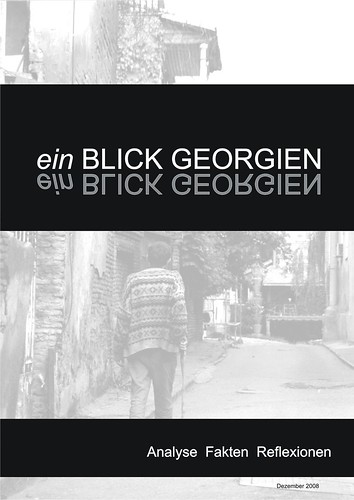
MAGAZIN: einBLICK Georgien - Analysen Fakten Reflexionen - April 2009. (Hrsg. von Marika Lapauri-Burk)


Das neue einBLICK Georgien ist erschienen. Das Heft wird zwei mal im Jahr erscheinen.

Wir wünschen Ihnen Schöne Ostertage!

Marika Lapauri-Burk, Lile e. V.


INHALTSVERZEICHNIS:

Vorwort der Herausgeber

Der 9. April 1989 – Zwanzig Jahre danach
von Marika Lapauri Burk und Dr. David Kakabadse

Der graue Vogel über dem Kaukasus
Georgien und der lange Abschied von der bisherigen Geschichte

von Dr. phil. Frank Tremmel

Otar Ioseliani und der Garten der Gemütsruhe
von Dr. phil. Zaza Schatirischwili

Grundtendenzen der russischen Politik in Abchasien im XIX. und Anfang des XX. Jahrhunderts
von Mamuka Areschidze

„Echo Moskwys“ prominente Gäste mit ihren Äußerungen zur aktuellen Lage im Kaukasus
von Marika Lapauri-Burk und Nana Jacques

Territoriale Entwicklung Georgiens unter der Herrschaft des Russischen Reiches
von Dr. Lascha Bakradse

ein Blick Georgien. Analyse, Fakten, Reflexionen. (Hrsg. von Marika Lapauri-Burk)
Preis 5,-Euro + Versand
Bestellung unter: info@lile.de


Auch noch zu haben ist das Heft vom Dezember 2008

Georgien/Russland: Twin Powers
von Dr. Zaza Schatirischwili
Zitat von Dr. Zaza Schatirischwili

„Meine Ausgangsthese ist, dass Putin ein erfolgreicher Saakaschwili, und Saakaschwili ein erfolgloser Putin ist. Diese zwei Mächte ähneln sich wie Zwillinge und spiegeln sich ineinander. Diese Analogie können wir weiter führen. Wie `ein Spiegel´- was bedeutet das? Der Spiegel spiegelt genau, aber er vertauscht Rechts und Links und umgekehrt. Genauso wollen wir Saakaschwilis `Prowestliches´ und Putins `Imperialsmus´ verstehen. Es ist doch so, dass weder der eine `prowestlich´ ist.

Nabucco - Geopolitischer Lackmustest des Kaukasus
von Gotscha Djelia
Zitat von Gotscha Djelia

„Es ist nichts unmöglich. Die Frage ist, was das für jede Seite kostet. Wie es aussieht, wird Russland für die kaukasische geopolitische Politik als `Haupt´-Belohnung das Projekt Nabucco der USA benützen. Durch seine Lebensnotwendigkeit für den Westen wird es dieses Projekt nicht blockieren können, aber es wird versuchen, die geplante Trassenführung so zu korrigieren, dass sie an Georgien vorbeiführt.“

Georgien und der russische Imperialismus
von Dr. Gia Tortladze
Zitat von Dr. Gia Tortladze

„Hier möchte ich ein Zitat einfügen, das von einem der Architekten des russischen Imperiums im Januar 1921 stammt: `Wer Georgien besitzt, der besitzt den Kaukasus, wer den Kaukasus besitzt, der besitzt die Transfermagistralen der größten Zivilisationen Europas und Asiens, wer diese Magistralen besitzt, genau der besitzt die Führung der Prozesse in der modernen Welt´“
Josef Stalin, Januar, 1921“

Buch: ein Blick Georgien. Analyse, Fakten, Reflexionen.
(Hrsg. von Marika Lapauri-Burk)
Preis 5,-Euro + Versand
Bestellung unter: info@lile.de

Verzeichnis:
Not a better future. von Gia Edzgweradze

Georgien und der russische Imperialismus.
von Dr. Gia Tortladze

Einige Erläuterungen zu Süd Ossetien.
von Prof. Dr. Iulon Gagoschidze

Georgien/Russland: Twin Powers.
von Dr. Zaza Schatirischwili

Nabucco - Geopolitischer Lackmustest des Kaukasus.
von Gotscha Djelia

Den Krieg gegen Georgien bereitete Russland vor und fing ihn selbst an.
von Andrei Ilarionov

Georgien zwischen Ethnos und Weltgesellschaft - Ein kulturphilosophischer Essay.
von Frank Tremmel

Interview mit dem Philosoph und Schriftsteller Giwi Margwelaschwili.
Geführt von Frank Tremmel und Marika Lapauri-Burk

Tuesday, March 31, 2009

DOKUMENTATION: Was geschah am 9. April 1989? 20 Jahre danach. Verspätete Auswertung historischer Ereignisse

Dokumentarfilm, Georgien 1989, Eldar Schengelaia
9.4. 2009 19:00
Kommunales Kino
Metropolis
Hamburg, Steindamm 52/54

In Anwesenheit /Gespräch
Dr. David Kakabadze und Dr. Frank Tremmel

Das Jahr 1989 markiert den Anfang einer neuen Ära. Der kalte Krieg geht zu Ende. Die Weltgeschichte wird neu geschrieben. Der Umbruch vollzieht sich mit besonderer Schärfe in der damaligen Sowjetrepublik Georgien.
Am 9. April 1989 wird in der Hauptstadt Tbilissi (Tiflis) eine friedliche Demonstration mit unbekanntem Giftgas und geschliffenen Spaten brutal niedergeschlagen. 20 Menschen werden getötet (darunter 10 Frauen und Mädchen), weitere sterben noch Wochen und Monate danach an den Folgeschäden des Giftgaseinsatzes.
Der mit mehrfach mit preisgekrönten Komödien bekannte Filmemacher – Eldar Schengelaia – bekommt von unbekannten einige Aufnahmen. Schengelaia versuchte trotz Nachrichtensperre – Botschaft vom Massaker in der Welt zu verbreiten. Wir können den Film 20 Jahre danach sehen.

Dr. David Kakabadze studierte Germanistik, Literatur- und Kulturwissenschaften in Tbilissi, Jena und Köln und ist seit 1993 bei RadioFree Europe/Radio Liberty tätig, zunächst als Redakteur, dann (seit 2005) als Leiter der georgischen Abteilung. Er hat zahlreiche Artikel über die politischen Ereignisse in Georgien in internationalen Presseorganen publiziert und ist durch sein multimediales Projekt „Tagebücher der Freiheit“ bekannt geworden. Er ist Autor der umfangreichen Filmdokumentation „Gefangen im Kaukasus“ (1999), die das Schicksal der 11 deutschen Gefangenen des 2. Weltkriegs schildert. Außerdem übersetzt er Werke der klassischen und modernen deutschen Literatur ins Georgische.
Dr. Frank Tremmel studierte Sozial- und Wirtschaftsgeschichte, Soziologie und Politologie in Hamburg, zur Zeit Mitarbeiter in der Marketingabteilung einer Hamburger Anwaltssozietät. Er arbeitet zu Fragen der Philosophischen Anthropologie und der Kulturanthropologie, beschäftigt sich vor allem mit Fragen der georgischen Kultur- und Geistesgeschichte.

Die Teilnahme von Minister für Diaspora Herrn Prof. Dr. Julon Gagoschidze wird erwartet

Weitere Info: 040 – 389 2222, 0171 851 3635 info@lile.de

link: www.lile.de

Saturday, January 31, 2009

DEBATTE: Krise im Kaukasus (voelkerkundemuseum.com)

Thementag mit internationalen Gästen
So 8. Februar 11 Uhr

Der Kaukasus hat aufgrund seiner bedeutenden Gas- und Ölvorkommen und der Transitpipelines eine immense strategische und sicherheitspolitische Bedeutung für Europa. Der Krieg in Georgien/Südossetien im August 2008 hat die bereits bestehende Krise vehement zugespitzt. Wie ist diese Entwicklung unter Berücksichtigung historischer, geostrategischer und kultureller Faktoren einzuschätzen? Wer vertritt welche Interessen in dieser Region? Welche Schlüsse ziehen internationale Menschenrechtsorganisationen aus ihren Beobachtungen? Welche Sichtweisen vertreten fortschrittliche Kreise in Russland? Was kann, was muss Europa tun, um zu einer Friedenssicherung im Kaukasus beizutragen? Antworten auf diese Fragen geben renommierte Wissenschaftler, Journalisten, Politiker und Menschenrechtsaktivisten aus Georgien, Russland, der Türkei und Deutschland.

11 Uhr
Begrüßung
Prof. Dr. W. Köpke, Direktor des Museums für Völkerkunde Hamburg

11.15 -12.15 Uhr
Der Kaukasus - historische, wirtschaftliche und geostrategische Dimensionen
Vortrag von Dr. Udo Steinbach. Der renommierte Wissenschaftler und langjährige Direktor des Deutschen-Orient-Instituts in Hamburg hat 2008, gemeinsam mit Marie-Carin von Gumppenberg, eine Aufsatzsammlung zum Kaukasus herausgegeben, die in Kürze sicherlich zu den Standardwerken über diese Region zählen wird. Er wird in seinem Überblicksvortrag in die Komplexität der Thematik einführen.

12.30 – 13.30 Uhr
Der Georgien-Konflikt aus Sicht unabhängiger Menschenrechtsbeobachter

Vortrag von Tatjana Lokschina, stellvertretende Direktorin des Büros von Human Rights Watch in Moskau. Tatjana Lokschina gilt als Tschetschenien-Expertin und erforscht und dokumentiert auf vielfältige Weise Menschenrechtsverletzungen im Kaukasus. Sie hat im Auftrag von Human Rights Watch seit Sommer 2008 dreimal Südossetien bereist und dabei Menschenrechtsverletzungen aller Konfliktparteien aufgedeckt. Sie wird in ihrem Vortrag außerdem auf die Bewertung des Kaukasuskonflikt durch unterschiedlichen sozialer Gruppen in Rußland eingehen.

14 – 15.15 Uhr
Die Krise im Kaukasus aus Sicht Georgiens. Dr. David Kakabadze studierte Germanistik, Literatur- und Kulturwissenschaften in Tibilissi, Jena und Köln und ist seit 1993 bei Radio Free Europe/Radio Liberty tätig, zunächst als Redakteur, dann (seit 2005) als Leiter der georgische Abteilung. Er hat zahlreiche Artikel über die politischen Ereignisse in Georgien in internationalen Presseorganen publiziert und ist durch sein multimediales Projekt "Tagebücher der Freiheit" bekannt geworden. Er ist Autor der umfangreichen Filmdokumentation "Gefangen im Kaukasus" (1999), die das Schicksal der 11 deutschen Gefangenen des 2. Weltkriegs schildert. Außerdem übersetzt er Werke der klassischen und modernen deutschen Literatur ins Georgische.

15.30 – 16.45 Uhr
Die Situation in Abchasien und Südossetien vor dem Hintergrund der Kaukasus-Krise
Vortrag von Prof. Mihat Celikpala.
Prof. Celikpala lehrt am Department für Internationale Beziehungen der Universität für Wirtschaft und Technologie in Ankara. In seinen Publikationen über den Kaukasus hat es sich schwerpunktmäßig mit Abchasien, der nordkaukausischen Diaspora und den Beziehungen der Türkei zum Kaukasus beschäftigt.

Bestrebungen nach politischer Richtungsänderung in Georgien
Vortrag von Hasan Kanbolat.
Hasan Kanbolat ist Kaukasusexperte am Zentrum für Strategische Forschungen Eurasiens (ASAM), Ankara, Mitglied im Beraterstab des türkischen Außenministeriums und hat zahlreiche Artikel zum Kaukasus publiziert.

17 - 18 Uhr
Was bedeutet die Krise im Kaukasus für Europa? Was muss Europa tun, um zu einer Stabilisierung im Kaukasus beizutragen?
N.N.

In Zusammenarbeit mit dem Verband Europäischer Tscherkessen.
Gefördert durch die Norddeutsche Stiftung für Umwelt und Entwicklung

Source: Völkerkundemuseum in Hamburg

Wednesday, February 13, 2008

ART: David Kakabadze and Ivane Javakhishvili

The creative work of David Kakabadze clearly tells about unique ethnogenesis of Georgian culture; here is some definitive information: David Kakabadze (1889-1952) was a painter, graphic artist, theatre and movies painter, art researcher (one of his inventions concerned the already well known category of stereoscopic picture and its equipment implementation. David had presented the materials for author’s right but the materials, as he was told, had been lost, though in some years the authorship of some Russian was acknowledged in the sphere of stereoscopic pictures... This happened in the 40th of the XX century!)

Studying at the faculty of physics and mathematics of Petersburg University David Kakabadze in parallel mastered in painting and arts history, took active part in the work of ”Georgian Students Scientific Circle” - the group of Georgian students living in Russia. This circle was headed by Ivane Javakhishvili and at the same time he taught David history of Georgian arts. It was from then that Ivane became acquainted with David Kakabadze’s painting and highly appraised his works ...

At the time of studying in Petersburg David Kakabadze was so short-handed that on October 6, 1912 Ivane Javakhishvili sent a letter to G. Zdanovich (Maiashvili), the head of the Black Stone Producers Society with the request that the Society Board grant David Kakabadze a stipend or render one-time assistance to the young intellectual. In the letter Ivane Javakhishvili characterizes David Kakabadze as an excellent student and, at the same time, a good artist. In the same letter it is also noted that in 1911 Ivane Javakhishvili had given a sample of ancient Georgian painting (a painting preserved in Georgian manuscript by Vakhtang VI and S.-S.Orbeliani) to David Kakabadze and asked him to make a copy. By the statement of Ivane Javakhishvili David Kakabadze had brilliantly executed the mission. Also by the advice of Iv.Javakhishvili the Georgian Society of History and Ethnography had entrusted David Kakabadze to make colored copies of frescos of Quinn Mariam and other historical persons preserved at the Svetitskhovelihich cathedral in Mtskheta; the work was successfully accomplished by the painter.

In the letter to Zdanovich Ivane Javakhishvili points out that since 1912 David Kakabadze under the supervision of Ivane Javakhishvili prepared the research “Development of ornamented fretwork [ornament] in Georgian goldsmith art according to Georgian icons”. The finding and publishing of this work will save such materials of Georgian cultural heritage that is priceless for our church and art and indisputably will enrich the world art treasury.

The report “Development of ornamented fretwork [ornament] in Georgian goldsmith art according to Georgian icons” David Kakabadze presented to the meeting of the Scientific Circle in October 25, 1912. All the samples of Georgian ornaments are compiled in this work and chronologically dated according to the stages of its development (it is, surely, clear what kind of research we are having to deal with - this is irreplaceable basis of knowledge – of Georgian church architecture, iconography, painting and art studies ...).

In 1915 in Tbilisi was issued “Works of Georgian Students Scientific Circle” of Petersburg University with the preface and editorship of Ivane Javakhishvili where the work “The types of Georgian icons setting” by David Kakabadze was published. In the preface Ivane Javakhishvili notes: “David Kakabadze has studied all known materials and edited pictures, made copies of setting types and investigated chronologically and configurationally, what is that that expresses the development of these types “ ...

Publishing of these materials in high polygraphic level and in several (Georgian, Russian, English, French, German, Hispanic, Italian) languages will have a great importance for the history of Georgian nation, for our cultural heredity, history of Georgian Orthodox apostolic church, for presenting, once more, of Georgia as one of the foundation makers of European Renaissance and for future generations of Georgians, as well. It is time that the civilized world became acquainted with the beginning steps of creative work of David Kakabadze.

Mamuka Matsaberidze

Website about David Kakabadze

Friday, June 01, 2007

CULTURE:


The David Kakabadze Art Gallery
Director: Georgi Lomtadze
Address: #8, Rustaveli Ave.
Phone: 5 23 29, 5 40 75


The Kutaisi Art Gallery was founded in 1976 and since then it has been making the chronicle of the cultural life of the city. It is named after David Kakabadze. In 1962 according to the decision made by the Council of Ministry of Georgia the Art Gallery was opened in Kutaisi. This Gallery existed only for a year and after its abolition the territory was delivered to the Union of Artists as exhibition halls. For 12 years of its existence personal exhibilitions of outstanding Georgian artists were held in those halls. In 1973 the reconstruction of the building suitable for the gallery began according to the project of Givi Todadze, Honoured Architect of the Republic and the architect Suliko Gagua. Paintings of Georgian artists were collected and the Republic Art Council began to buy the works of Niko Pirosmani, Jakob Nikoladze, David Kakabadze, Lado Gudiashvili, Elene Akhvlediani, Elguja Amashukeli and others. For the first 10 years about 150 exhibitions were held in the gallery that proved very intensive work of the gallery. The exhibition of Kutaisian students who study at the Art Academy is often remarkable. We must also mention personal and international exhibitions. In 1986 sculptur George Lomtadze was appointed as the director of the gallery. At that time a lot of tasks had to be solved by the gallery, the number of the exhibits kept in the funds was increased that caused some structural changes. At first there were held charged lectures for the audience which were listened to with great interest. That helped not only art propaganda but also activated the scientific work. Since 1994 the work at the Art Gallery has 3 directions: to calculate and defend the funds of the gallery, exhibitional work and art propaganda. There used to carry out professional work while discussing the exhibitions, a lot of articles and catalogues were published and they made interesting TV programs. Problems produced during market economics resist activation the work of the gallery. The administration of the gallery do their best to solve these problems and hope that the social-economic situation of the country in the future will help to realize them. Nowadays different kinds of exhibitions (personal, children's, spring, autumn, amateur and masters' of national art, classics' etc.), creative evenings, competitions are held at the Art Gallery.


Source: http://aia.iatp.org.ge/Eng/Cultura&Art/galery1.htm
CULTURE:


eBook from multimedia edition on CD
David Kakabadze - a great Georgian artist
Read about the life and creativity of a great Georgian artist. View collection of paintings and a large photo-gallery with audio. Enrich your digital library!

Download trial English version >>>
Buy LICENSE KEY >>>
Biography and article about life and creativity of the great Georgian artist. Collection of paintings and a large photo-gallery with audio.


David Kakabadze's (1889-1952) creative life was a hard one even full of contradictions which were shown in his great desire to develop the national traditions and to raise them to the new quality on the one hand and in the desire to comprehend and master the "newest" trends in the West European art of the XX century on the other hand. These contradictions, that seem "irreconcilable" at first sight, reveal his solid character, his aim and his unique creative individuality. He used oil, pencil, water-colors, metal, glass and other technical means with a great mastership. The peculiarity of his talent is revealed in his every work, in every period of his creative life, in which he planned his beforehand. First his task was inwardly "mastered", seriously decided and then it was fulfilled in the generalized artistic forms. In this way he created landscapes, searching for the equivalent to the nature. This is the explanation to the facts that he generally made a series, groups of works, in which we see different variations of working out one and the same topic, and we see no "alternation" or the stages in search of a better decision. If we take separately each variation, from this series, we'll see that it is an artistically fulfilled piece of art.


Source: http://www.chaganava.com/ebook_kakabadze.html


More:
Physical Products
How to Order CD Editions Shota Rustaveli Niko Pirosmani David Kakabadze Georgian Enamels St. George Temple St. David Garejeli Abdulmesiani Pele's Virtual Game Who is There? Relaxation Calligraphy Works Prayers Troparions Poem Miniatures Manuscript Books Abdulmesiani Nine Kola Martyrs Prayers David Garejeli Orthodox Icons & Miniatures

Group - Gallery
Lasha Kintsurashvili Irakli Medoshvili George Egnatashvili Temur Kazakhashvili Ramaz Chantladze


Downloads
How to Buy

eBooks From CD Editions
Shota Rustaveli Screensavers Wallpapers Greetings Puzzle Games Niko Pirosmani Screensavers
Wallpapers Greetings Puzzle Games David Kakabadze Screensavers Wallpapers Greetings Puzzle Games Georgian Enamels Screensavers
Wallpapers Greetings St. George Temple Screensavers Wallpapers Greetings St. David Garejeli
Screensavers Abdulmesiani Screensavers Pele's Virtual Game Who is There?

Audio-Photo Albums & Screensavers
Relaxation MP3 Seasons Lasha Kintsurashvili

Software / Games
New Fonts eBookMaestro 3fu Puzzle


More to David Kakabadze:

Kakabadze, David - Georgian artist, arts theorist and historian, inventor. more >>>