Project ArtBeat in Tbilisi presented personal exhibition of Avto Meskhi. The exposition includes mixed media works: collages, paintings and drawings made during 1984-2015. Curated by Natia Bukia.
Avto Meskhi, due to his introvert personality and moreover his tragic life is a lesser-known painter in Georgia and abroad. Accordingly, Private Acquaintance, his solo exhibition held at the gallery exactly a year ago is a very important event for the Georgian art scene.
The artist was born in Tbilisi, 1946 and lived and worked in Tbilisi and Rustavi. When Project ArtBeat discovered Meskhi he was 70 years old, he already had lost his home, where he lived with his mother and was spending last years ...
Showing posts with label Avto Meskhi. Show all posts
Showing posts with label Avto Meskhi. Show all posts
Monday, May 18, 2020
GEORGIAN ART: Avto Meskhi: Private Acquaintance / ავთო მესხი: პირადად ცნობილი - in ProjectArtBeat 2018 - curated by Natia Bukia.


Tuesday, April 23, 2013
REVIEW: Reframing the 80s" at the National Gallery in Tbilisi. By Robert Linkous (georgiatoday.ge)
(georgiatoday.ge) It has taken curator Irena Popiashvili, Rector of
Tbilisi State Academy of Arts, a year and a half to pull together the
eclectic, multifarious and utterly up-to-date collection of paintings,
photographs, and sculpture that can be seen in “Reframing the 80s:
Georgian Art at the end of the 80s and Beginning of the 90s” at the
National Gallery of Art through November 20. Groundbreaking, it is
Georgia’s first show devoted to the work of a single generation.
“This was the first generation to see Joseph Beuys
and other German artists as contemporaries,” explained Popiashvili.
“Earlier artists looked at the Impressionists.”
Niko Lomashvili’s diptych “14 Shots” was produced in
1990, at a time when violence in Tbilisi made it something of a combat
zone. On the left we see a canvas saturated with brown paint and
punctured by fourteen bullet holes, only two of which are at dead
center. On the right: a very young girl in a loose-fitting, tattered
denim jacket, staring down at a handgun clutched at waist level, and
surely intent on some dark business.
If reminded of Gerhard Richter’s 1988 photorealist
paintings of the Red Army Faction, we may imagine that it is Ulrike
Meinhof as an adolescent revolutionary.
The political turbulence of the era is also reflected
in Gia Dolidze’s large painting, “Africa” (1989). Scattered across the
canvas are images of the African menagerie – giraffe, rhinoceros,
alligator, lizard – but at the lower left is a military mangaudily
bedecked with medals, above him is a larger and more ominous soldier,
apelike in countenance, and with the unruly, bulging hairstyle ofMuammar
Gaddafi, while elsewhere on the perimeter of the painting are totemic
images redolent of traditional African art.
In the mid-1990s Gabriel Garcia Marquez’s One Hundred Years of Solitude was
finally translated into Georgian, and the diptych “Erendira” (1996)
shows that Mamuka Tsetskhladze was impressed; Erendira is a young girl
who appears in the novel, and would be forced to become a teenage
prostitute in a later work by the author.
Tsetskhladze’s bare-breasted Erendira gazes at us as
unabashedly as Manet’s Olympia, her mouth sensuous with red lipstick.
Opposite in the diptych, though, a collage-like work, thick black
horizontal and vertical lines meeting at right angles mirror perhaps too
closely for comfort what Frank Stella was doing early in his career.
Literature of the era crops up again in Karlo
Kacharava’s “H All Awed Be” (1989), a painting in which are written
lines from the Georgian translation of Allen Ginsberg’s “Footnote to
Howl,” though the connection to the primary subject of the painting – an
elegant, sophisticated young woman, chicly dressed and coiffed,
pensive, legs crossed, with long-fingered hands resting upon her right
thigh – may be enigmatic.
Lurking behind her, spying ominously from over her
right shoulder, is a satanic creature with a Ku Klux Klan-like cross
sprouting from his forehead, while to the woman’s left a somewhat
surrealistic lamp with no shade bends its bulb almost close enough to
her hair to singe it.
The American counterculture is evoked again in
Ushangi Khumarashvili’s “Time and Happenings” (1989, mixed media on
wood). Inside a frame of rough wood, Khumarashvili has produced an
abstraction comprised of torn strips of canvas, splotches of paint, a
windshield wiper, a long bolt, bits of wire, etc., seeming to have
worked much as Robert Rauschenberg did in the days when he scavenged the
streets in his Manhattan neighborhood for refuse and junk to put into
his “Combines.”
In Koka Tskhvediani’s “Self-Portrait” (1992), though,
the artist may have captured something of his own inimitable
individuality. Portraying himself with flat ears, shaved head, hollow
cheeks, and a complexion as pale as death, he gives a general impression
of dour gloominess, were it not for the radiant red of his shirt and
his lips, and the luminous blue of his eyes.
The bearer of a surname which resonates in Georgian
history, Lado Bagrationi in “Cell” (1976) has painted himself just where
the title suggests – in incarceration. During the Soviet era he refused
the work that was thrust upon him, and was deemed guilty of the crime,
as Popiashvili put it, of “being different.” From behind a massive door
he peers forlornly out a small window, very low, at about knee level; he
could be perched on a tiny stool barely adequate for a child.
At the right is shown part of the black boot and
heavy leg of a jailer, while at the left a frail hand reaches out in
supplication. But perhaps there is a glimpse of hope, in the form of a
window at the top of painting, through which can be seen a lovely blue
sky. There is a certain paradoxical duality here, as in Magritte’s
“Empire of Light;” in Bagrationi’s underworld of the prison there may be
perpetual despair, but recollection of the sunnier outside world of
life and freedom does not cease to exist.
But while most of the Georgian artists in “Reframing
the 80s” may have turned their attention outward, Irakli Maisuradze
remained attuned to Georgia’s artistic tradition. In “Wolf” (1989),
“Bear” (1988), and the “Untitled” (1988) painting of a gigantic dinosaur
on a stroll, he uses large simple images and plenty of bold color to
create beings almost docile enough for a petting zoo. In the animal
kingdom of Pirosmani they might find home turf.
The above is just a sampling, though, of the delights
to be seen among the well over a hundred works that Popiashvili has
assembled. She wanted this exhibition to be “as contemporary now as it
was then,” she said, and she has succeeded, in spades, for there is an
abundance of art that could make itself at home in the galleries of New
York’s Museum of Modern Art, London’s Tate Modern, or the Centre
Pompidou in Paris.
 |
| Avto Meskhi |
Friday, September 07, 2012
VIDEO: "Breaking News" #5 - The Georgian Artist Avto Meskhi. Video von Wato Tsereteli (youtube.com/Artareatv)
Unsere Gesellschaft, die funktioniert, die so normal ist, zu ignorieren ... Avto Meskhi ist ein extremes Beispiel für diesen Fall.
Ein Mann, ... war ein enger Freund von Avto Varazi seit mehr als 20 Jahren. Seine Malerei ist völlig einzigartig, gemalt mit seiner eigenen Fantasie. Er wohnt in der Stadt als Obdachloser im Internat als Künstler und mit der Kunst - und das ganz bewusst, wie nur wenige in Georgien. Mit seiner Art abstrakter Malerei speichert er seine Interpretation der Wirklichkeit.
Dieses Video ist Herrn Avto Meskhi und seiner engen Freundschaft zu Avto Varazi gewidmet. Hoffentlich wird sich sein sozialer Status bald ändern, wird seine Arbeit mehr geschätzt ...more: tbcartarea.ge
Wednesday, November 03, 2010
ART: Painting by Avto Meskhi, Horse sledge, 1953 (flickr.com)
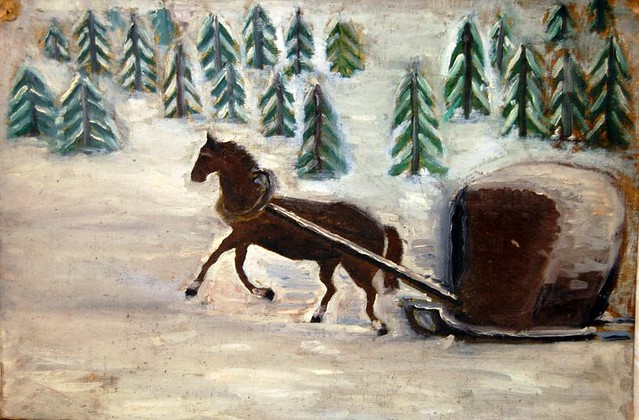
Avto Meskhi is an interesting artist from Rustavi, born 1946. He is a calm person with shrewd eyes. Now he is producing abstract paintings. But here you can see an early work by him.
At first I have seen him some years ago in Tbilisi. He has fantastical face --- his physiognomy has something from the cleverness from a child ... A good friend of mine is a collector of his paintings. Never from the art scene in Tbilisi knows Avto really. I think anyone should organize a small exhibition with him.
Furthermore we should thinking about the establishment from artistists all over the world.
(Ralph Hälbig)
Saturday, May 16, 2009
VIDEO ART: Rustavi Extravaganza. Staring Oleg Timchenko. Produced by Hans Heiner Buhr
Last year after the war beetween Russians, Georgians and other people I was together with Hans Heiner Buhr, Oleg Timchenko, Rusiko Oat, Lela Meparishvili, Otari Laliashwili, Murtaz Svelidze, Avto Meskhi and other people in Rustavi. Heiners Idea was to made an artistical short film about a russian soldier. This Russian Soldier was a long time looking for his big enemy. After more than 60 years he hunted out him in the mountains nearby the city Rustavi ... A sneakpreview can you see here. Next time more in the New Art Cafe in Tbilisi.
Friday, April 25, 2008

Sunday, February 03, 2008

Subscribe to:
Posts (Atom)