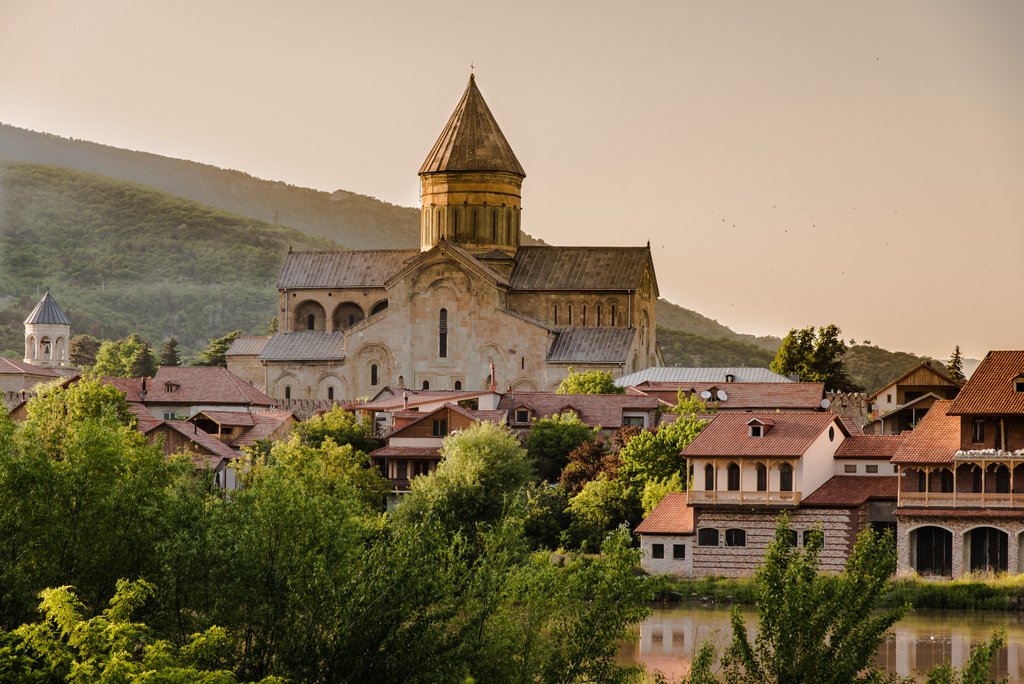
Dieses Buch [pdf] zeigt am Beispiel Georgiens und der Georgisch Orthodoxen Kirche, wie Religion und Kirche Ein? uss auf Nationenbildung nehmen. Anhand prägnanter Beispiele aus Vergangenheit und Gegenwart wird unter Einbeziehung von Theorien des "nation building" die Herausbildung der georgischen Nation als eine "imaginierte Gemeinschaft" nachvollzogen. Dem in der Forschung vernachlässigten Einfluss von Religion und Kirche räumt die Autorin dabei besonderen Stellenwert ein. Hiermit liegt erstmals eine Gesamtschau zur engen Verbindung von Nationenbildung und Orthodoxie in Georgien vor. Neben Theorien zur Nationenbildung in Hinblick auf den Zusammenhang von Nation, Sprache, Religion und Moderne, den Besonderheiten der christlichen Orthodoxie und den Grundzügen der sowjetischen Nationalitätenpolitik, werden in diesem Buch die Geschichte und Kirchengeschichte Georgiens dargestellt. Georgien wurde schon im 4. Jahrhundert christianisiert, zeitgleich bildete sich eine eigene Alphabetschrift heraus. So war schon früh der Grundstein für die Einheit von Sprache, Land und Glaube gelegt. Allerdings war die weitere georgische Geschichte geprägt von Fremdherrschaft. In dieser historischen Konstellation wurde die Orthodoxe Kirche zur Bewahrerin der Sprache und nationalen Identität Georgiens. Den Zusammenhang von Sprache, Religion und georgischer Nation zeigt die Autorin anhand christlicher Literatur, Märtyrerlegenden und Mythen zur Entstehung des Landes auf. Am Beispiel politischer Ereignisse seit der Unabhängigkeit Georgiens von der Sowjetunion wird die Verbindung von Religion und Nation in der jüngsten Vergangenheit veranschaulicht.
Taschenbuch: 254 Seiten
Verlag: ibidem-Verlag; Auflage: 1., Erstauflage (2. Januar 2010)
Sprache: Deutsch
ISBN-10: 3898218848
ISBN-13: 978-3898218849
Größe und/oder Gewicht: 20,8 x 14,6 x 1,6 cm
Die Autorin: Eva Fuchslocher studierte bis 2006 Kulturwissenschaft, Europäische Ethnologie und Soziologie an der Humboldt-Universität zu Berlin. Sie promoviert derzeit über den Zusammenhang von Religion und Nation. Neben den wissenschaftlichen Tätigkeiten arbeitet sie im Museumsbereich. Aufsätze u.a. in Hochschulen im Wettbewerb (Dietz 2009), Berliner Blätter und Freischüßler. Die Vorwortautorin: Dr. Christina von Braun ist Professorin für Kulturwissenschaft an der Humboldt-Universität zu Berlin.
AmazonShop: Books, Maps, Videos, Music & Gifts About The Caucasus
Showing posts with label Nationalism. Show all posts
Showing posts with label Nationalism. Show all posts
Thursday, December 05, 2013
EDITION: Vaterland, Sprache, Glaube: Orthodoxie und Nationenbildung am Beispiel Georgiens: 95. Von Eva Fuchslocher


Monday, June 25, 2012
VORTRAG: „Ivane Javakhishvilis langer Schatten. Zur Lage und Entwicklung der Historiographie in Georgien seit 1992.“ Von Dr. Oliver Reisner - in Jena
Am Mittwoch, dem 27.06. wird Dr. Oliver Reisner bei uns in Jena gastieren und einen Vortrag zum Thema „Ivane Javakhishvilis langer Schatten. Zur Lage und Entwicklung der Historiographie in Georgien seit 1992.“ halten. Oliver Reisner hat sich v. a. der neueren und neuesten Geschichte Georgiens gewidmet und zu den folgenden Themen gearbeitet: Nationalismus, Minderheitenrechte und Konfliktbearbeitung in Georgien, Historiographiegeschichte Kaukasiens, Geschichte der Regionalforschung. Er ist Autor der wichtigen Monographie „Die Schule der georgischen Nation“.
Oliver Reisner ist derzeit Mitglied der Delegation der Europäischen Kommission für Georgien.
Mittwoch, 27.06., 16.00Uhr, SR 206, Carl-Zeiss-Str. 3
+++
On Wednesday, the 27.06. is Dr. Oliver Reisner at us in Jena be held and one lecture on "Ivane Javakhishvilis of long shadow." Keep "to the situation and development of historiography in Georgia since 1992.". Oliver Reisner has notably dedicated to the newer and newest history of Georgia and worked on the following topics: nationalism, minorities and conflict resolution in Georgia, Caucasus historiography history, history of the regional research. He is author of the important book "The school of the Georgian nation".
Oliver Reisner is currently a member of the delegation of the European Commission for Georgia.
Wednesday, 27.06, 16.00Uhr, SR 206, Carl-Zeiss-str. 3
AmazonShop: Books, Maps, Videos, Music & Gifts About The Caucasus
Oliver Reisner ist derzeit Mitglied der Delegation der Europäischen Kommission für Georgien.
Mittwoch, 27.06., 16.00Uhr, SR 206, Carl-Zeiss-Str. 3
+++
On Wednesday, the 27.06. is Dr. Oliver Reisner at us in Jena be held and one lecture on "Ivane Javakhishvilis of long shadow." Keep "to the situation and development of historiography in Georgia since 1992.". Oliver Reisner has notably dedicated to the newer and newest history of Georgia and worked on the following topics: nationalism, minorities and conflict resolution in Georgia, Caucasus historiography history, history of the regional research. He is author of the important book "The school of the Georgian nation".
Oliver Reisner is currently a member of the delegation of the European Commission for Georgia.
Wednesday, 27.06, 16.00Uhr, SR 206, Carl-Zeiss-str. 3
AmazonShop: Books, Maps, Videos, Music & Gifts About The Caucasus
Tuesday, November 30, 2010
NEW BOOK: Cultural Archetypes and Political Change in the Caucasus. By Sergey Arutiunov (Author) & Nino Tsitsishvili (amazon.com)
Hardcover
Publisher: Nova Science Publishers (November 30, 2010)
Language: English
ISBN-10: 1607417391
ISBN-13: 978-1607417392
For the people of the Caucasus history and ancestral heritage signals something that must be taken into account and set as an example for present actions. Today the Caucasus is a region where ancient pre-Christian and pre-Islamic rites of sun-worship, fertility, animal sacrifice, traditional moral views and cultural nationalism co-exist with international programs of human rights and equity, democratic political and governance structures, international jazz festivals and youth culture. The book interrogates the Caucasus through the prism of two interrelated categories of discourse, namely 'cultural archetypes' and 'political change'. Cultural archetypes reflect the persisting significance of historical memory and association with the past in customs, rituals, religion, inherited social values, everyday activities and artistic expressions. Political change is about globalisation, transnationalism and the turbulent political transition from closed, isolated and economically disadvantaged nations to open, pluralistic and democratic societies with more economic potential based on market economies that the Caucasian nations are currently experiencing. The book searches for crossroads between the two - how political changes can be based on existing cultural values and how cultures can serve as political discourse. Since recent political changes and future of the Caucasus are related to the establishment and possibility of building Western-style liberal democracy, many scholars and politicians contemplate whether it is feasible to build Western-style democracy while simultaneously preserving local social values. Will these nations go through the same way to democracy as did the West, or will they hold on to their unique physiognomy? Can traditional expressive cultures in the Caucasus preserve unique identity while political and social values will keep changing? The book does not provide a decisive answer, but by interrogating such persisting dichotomies as 'progressive' and 'static', 'pragmatic' and 'non-pragmatic', 'individualistic' and 'collectivist' societies, it certainly furthers our understanding of the relationship between the political and cultural realms of the Caucasus nations in comparison with those of the West.
AmazonShop: Books, Maps, Videos, Music & Gifts About The Caucasus
Publisher: Nova Science Publishers (November 30, 2010)
Language: English
ISBN-10: 1607417391
ISBN-13: 978-1607417392
For the people of the Caucasus history and ancestral heritage signals something that must be taken into account and set as an example for present actions. Today the Caucasus is a region where ancient pre-Christian and pre-Islamic rites of sun-worship, fertility, animal sacrifice, traditional moral views and cultural nationalism co-exist with international programs of human rights and equity, democratic political and governance structures, international jazz festivals and youth culture. The book interrogates the Caucasus through the prism of two interrelated categories of discourse, namely 'cultural archetypes' and 'political change'. Cultural archetypes reflect the persisting significance of historical memory and association with the past in customs, rituals, religion, inherited social values, everyday activities and artistic expressions. Political change is about globalisation, transnationalism and the turbulent political transition from closed, isolated and economically disadvantaged nations to open, pluralistic and democratic societies with more economic potential based on market economies that the Caucasian nations are currently experiencing. The book searches for crossroads between the two - how political changes can be based on existing cultural values and how cultures can serve as political discourse. Since recent political changes and future of the Caucasus are related to the establishment and possibility of building Western-style liberal democracy, many scholars and politicians contemplate whether it is feasible to build Western-style democracy while simultaneously preserving local social values. Will these nations go through the same way to democracy as did the West, or will they hold on to their unique physiognomy? Can traditional expressive cultures in the Caucasus preserve unique identity while political and social values will keep changing? The book does not provide a decisive answer, but by interrogating such persisting dichotomies as 'progressive' and 'static', 'pragmatic' and 'non-pragmatic', 'individualistic' and 'collectivist' societies, it certainly furthers our understanding of the relationship between the political and cultural realms of the Caucasus nations in comparison with those of the West.
AmazonShop: Books, Maps, Videos, Music & Gifts About The Caucasus
Wednesday, February 25, 2009
NATIONALISM: Armenia: Nationalists agitate for Samtskhe-Javakheti (blog.oneworld.am)
Following the arrest of two ethnic Armenians in the Samtskhe-Javakheti region of the Republic of Georgia, nationalist groups in Armenia plan to hold a demonstration outside the Georgian Embassy in Yerevan on Wednesday. While it is unlikely to be well attended, the activity of such nationalist groups has sharply increased since the short war between Georgia and Russia last August. Chances are that this is no coincidence.
Having openly considered the possibility to use the short conflict over South Ossetia to push for separation from Georgia, nationalist think tanks and analytical centers make no secret of their desire to frustrate good relations with Armenia’s neighbor and are more noticeable than ever before. The secretively funded Mitq Youth Analytical Center, for example, has a map of a “Greater Armenia” on its office wall with the silhouette of a soldier holding a rifle into the air.
full text >>>
Having openly considered the possibility to use the short conflict over South Ossetia to push for separation from Georgia, nationalist think tanks and analytical centers make no secret of their desire to frustrate good relations with Armenia’s neighbor and are more noticeable than ever before. The secretively funded Mitq Youth Analytical Center, for example, has a map of a “Greater Armenia” on its office wall with the silhouette of a soldier holding a rifle into the air.
full text >>>
Saturday, February 14, 2009
CONFERENCE; National Identity in Eurasia: Identities & Traditions
22-24 March 2009
New College, University of Oxford
Convenor: Professor Catriona Kelly
Deadline for registration: 10 March 2009
Website >>>
Email: russian-nationalism@mod-langs.ox.ac.uk
The conference explores the institutions, ideologies, and practices that have shaped identity in the countries that once formed part of the Soviet Union and in the states and cultures that border the former superstate. It traces the history of "Eurasia" as a concept, and analyses the role of political interest groups, religious beliefs, museums, education, and everyday experience (whether under direct state control or governed by what are believed to be autonomous "traditions" in evolving concepts of ethnic, national, and transnational culture). Gathering together anthropologists, historians, political scientists, sociologists, and specialists in cultural studies from the Caucasus and Central Asia, Belorussia, France, Germany, and Russia as well as the UK and the USA, it presents a uniquely wide-ranging, cross-disciplinary forum for informed discussion of issues that are of enormous topical significance.
We are pleased to announce that the conference registration is now open. Please note that the number of places is limited. We anticipate a high demand and you are advised to register as early as possible.
Conference participants will be registered strictly on a first-come-first-served basis, without exceptions.
National Identity in Russia since 1961: Traditions & Deterritorialisation
University of Oxford
www.mod-langs.ox.ac.uk/russian/nationalism
New College, University of Oxford
Convenor: Professor Catriona Kelly
Deadline for registration: 10 March 2009
Website >>>
Email: russian-nationalism@mod-langs.ox.ac.uk
The conference explores the institutions, ideologies, and practices that have shaped identity in the countries that once formed part of the Soviet Union and in the states and cultures that border the former superstate. It traces the history of "Eurasia" as a concept, and analyses the role of political interest groups, religious beliefs, museums, education, and everyday experience (whether under direct state control or governed by what are believed to be autonomous "traditions" in evolving concepts of ethnic, national, and transnational culture). Gathering together anthropologists, historians, political scientists, sociologists, and specialists in cultural studies from the Caucasus and Central Asia, Belorussia, France, Germany, and Russia as well as the UK and the USA, it presents a uniquely wide-ranging, cross-disciplinary forum for informed discussion of issues that are of enormous topical significance.
We are pleased to announce that the conference registration is now open. Please note that the number of places is limited. We anticipate a high demand and you are advised to register as early as possible.
Conference participants will be registered strictly on a first-come-first-served basis, without exceptions.
National Identity in Russia since 1961: Traditions & Deterritorialisation
University of Oxford
www.mod-langs.ox.ac.uk/russian/nationalism
Monday, September 01, 2008
VORTRAG: Georgien: Die Macht des Nationalismus. Frankfurt a.M., 09.09.2008
Sehr geehrte Damen und Herren, liebe Mitglieder und Freunde der Deutschen
Gesellschaft für Osteuropakunde!
Im Anhang erhalten Sie die Einladung zum Vortrag am Dienstag, 09. September 2008, 18 h c.t.
Referent: Devi Dumbadze (Bochum/Tiflis)
Titel: Georgien: Die Macht des Nationalismus
Vortragsort: Frankfurt/M., Campus Bockenheim, Dantestr. 4-6, Raum 3.
Der gegenwärtige Georgienkonflikt wird in den deutschen Medien vor allem unter den Fragen des Völkerrechts, ethnisch-nationaler Spannungen, Wirtschaftsinteressen sowie der Abgrenzung von geopolitischen Einflusssphären ausführlicher erörtert.
Dieser Vortrag wird hingegen den Aspekt des in der Vergangenheit verwurzelten Nationalismus sowie seiner Rolle in diesem Konflikt thematisieren.
Nationalistische Stereotype und Denkmuster lassen sich in der georgischen Medien- bzw. Fernsehlandschaft am Beispiel "alltäglicher" Sendungen sowie des neuen Militärsenders "Sakartwelo" beobachten. Das führt zu der Frage nach den gesellschaftlichen Ursachen dieses in die sowjetische Ära zurückreichenden Nationalismus, dem aber auf der anderen Seite auch eine Intensivierung des Nationalismus in Russland gegenübersteht.
Devi Dumbadze ist Medienwissenschaftler und promoviert zur Zeit an der Ruhr-Universität Bochum zur Fernsehtheorie und georgischen Fernseh- und Sozialgeschichte.
Mit freundlichen Grüßen
Gerlind Schmidt
Zur DGO siehe: www.dgo-online.org
Abs.: Dr. Gerlind Schmidt – E-Mail: schmidt@dipf.de
c/o Deutsches Institut für Internationale Pädagogische Forschung
German Institute for International Educational Research (DIPF)
Schloßstraße 29; D - 60486 Frankfurt a. M.
Tel: ..49 (0)69 24708-0;
Fax: ..49 (0)69 24708-444
Gesellschaft für Osteuropakunde!
Im Anhang erhalten Sie die Einladung zum Vortrag am Dienstag, 09. September 2008, 18 h c.t.
Referent: Devi Dumbadze (Bochum/Tiflis)
Titel: Georgien: Die Macht des Nationalismus
Vortragsort: Frankfurt/M., Campus Bockenheim, Dantestr. 4-6, Raum 3.
Der gegenwärtige Georgienkonflikt wird in den deutschen Medien vor allem unter den Fragen des Völkerrechts, ethnisch-nationaler Spannungen, Wirtschaftsinteressen sowie der Abgrenzung von geopolitischen Einflusssphären ausführlicher erörtert.
Dieser Vortrag wird hingegen den Aspekt des in der Vergangenheit verwurzelten Nationalismus sowie seiner Rolle in diesem Konflikt thematisieren.
Nationalistische Stereotype und Denkmuster lassen sich in der georgischen Medien- bzw. Fernsehlandschaft am Beispiel "alltäglicher" Sendungen sowie des neuen Militärsenders "Sakartwelo" beobachten. Das führt zu der Frage nach den gesellschaftlichen Ursachen dieses in die sowjetische Ära zurückreichenden Nationalismus, dem aber auf der anderen Seite auch eine Intensivierung des Nationalismus in Russland gegenübersteht.
Devi Dumbadze ist Medienwissenschaftler und promoviert zur Zeit an der Ruhr-Universität Bochum zur Fernsehtheorie und georgischen Fernseh- und Sozialgeschichte.
Mit freundlichen Grüßen
Gerlind Schmidt
Zur DGO siehe: www.dgo-online.org
Abs.: Dr. Gerlind Schmidt – E-Mail: schmidt@dipf.de
c/o Deutsches Institut für Internationale Pädagogische Forschung
German Institute for International Educational Research (DIPF)
Schloßstraße 29; D - 60486 Frankfurt a. M.
Tel: ..49 (0)69 24708-0;
Fax: ..49 (0)69 24708-444
Sunday, August 05, 2007
REPORTAGE & PHOTOGRAPHY:
ARMENIAN FESTIVAL COMBINES PAGANISM AND NATIONALISM
By Onnik Krikorian 7/27/07 (EurasiaNet) with great photos
Tradition, in the South Caucasus, dies hard. With the ancient July festival of Vardavar, one small group of Armenians is seeing a chance to relive Armenia’s pagan past, and affirm the country’s national identity.
Armenia adopted Christianity as its state religion in 301 AD, thereafter destroying or converting its pagan temples. For most Armenians, this date represents the turning point for their nation, and one that would later distance it from Muslim neighbors in Iran, Azerbaijan and Turkey.
But each year at Armenia’s only remaining pagan temple, at Garni, 32 kilometers east of Yerevan, a few hundred Armenians gather to celebrate Vardavar as an event that they consider represents Armenians’ true and original faith. The festival is perhaps the most popular of all traditional and religious events in the Armenian calendar, with youngsters and adults gleefully dumping water over hapless passers-by.
The celebration has now been absorbed into the Christian calendar, but was traditionally associated with Astghik, the Armenian goddess of water, beauty, love and fertility. The festival’s name is derived from the Armenian word for rose, "vard." Early observers of Vardavar offered Astghik roses and sprinkled water on each other, or feasted near water in the hope that she would provide rain in time for harvest.
Now re-invented to represent the transfiguration of Christ, the holiday is scheduled by the Armenian Church to be held approximately 98 days after Easter.
At Garni, pagan priests placed sacrificial knives in fire, as well as rose petals in earthenware jugs of water, before reading aloud from the Ukhtagir, a collection of pre-Christian folk stories and legends immortalizing Armenia’s pagan gods written by Slak Kakosian, the founder of the Pagan Covenant, one of Armenia’s main pagan organizations. Founded in 1990, the group now claims it has over 1,000 members.
In the group’s events, nationalism and paganism mingle equally. "We are pagans," said 43-year-old Zohrab Petrosian, Kakosian’s successor. "We are Armenians, but we don’t know our true religion. Simply lighting a candle in a church or wearing a cross around our necks does not make us Christian. I’ve been a member of this organization for 10 years, but as an Armenian I’ve been pagan since the day I was born."
At the Garni Vardavar observances, one of the highest-profile attendees was Armen Avetisian, leader of the ultra-nationalist Union of Armenian Aryans, who received a three-year suspended sentence in 2005 for inciting racial hatred against Jews. [For background see the Eurasia Insight archive].
Avetisian and his followers wore black t-shirts featuring the picture of Garegin Njdeh, an Armenian national hero who lived from 1886-1955. Njdeh was a skillful military leader and anti-Bolshevik activist who developed a philosophy that blended religious and nationalist elements. His ideas have been influential in shaping the political platforms of modern-day parties, including the governing Republican Party of Armenia, as well as its junior coalition partner, the Armenian Revolutionary Federation – Dashnakstutiun.
Until recently, many of those attending the pagan festivals were affiliated with the Republican Party, but now members of other parties are starting to join in. This year, for example, apart from members of the Union of Armenian Ayrans, most other people in attendance identified themselves as members of the Armenian Revolutionary Federation – Dashnakstutiun.
The appearance of ultra-nationalists, however, raises concern in some circles that the pagan movement could make a radical departure toward the extreme right. Armenian pagans tend to dismiss the concern, though. Many at the Garni observances said politics wasn’t a factor for them. Robert Garabedian, an ethnic Armenian astrophysicist from Germany, was baptized as a pagan at the Garni event. Speaking to EurasiaNet, Garabedian said that spending Vardavar at the temple site carried a personal rather than political significance. "I’m Zoroastrian, Christian and Buddhist, and now I want to be baptized into the same religion that my [Armenian] ancestors followed," he said.
The hordes of children drenching pedestrians and motorists with water usually overshadow any such quests for meaning on Vardavar. Even so, Armenia’s pagans might take comfort in the fact that torrential rains unexpectedly hit Armenia at the festival’s end on July 15. As the rain poured down in the days that followed, one can only wonder if Astghik wasn’t listening, after all.
Editor’s Note: Onnik Krikorian is a journalist and photographer from the United Kingdom living and working in the Republic of Armenia.
There are more photographs at the following URLs: (Thanks Onnik!!!)http://oneworld.blogsome.com/2007/07/15/vardavar-garni-kotayk-region/
http://oneworld.blogsome.com/2007/07/15/vardavar-garni-kotayk-region-2/
http://oneworld.blogsome.com/2007/07/15/pagan-armenians-celebrate-vardavar/
ARMENIAN FESTIVAL COMBINES PAGANISM AND NATIONALISM
By Onnik Krikorian 7/27/07 (EurasiaNet) with great photos
Tradition, in the South Caucasus, dies hard. With the ancient July festival of Vardavar, one small group of Armenians is seeing a chance to relive Armenia’s pagan past, and affirm the country’s national identity.
Armenia adopted Christianity as its state religion in 301 AD, thereafter destroying or converting its pagan temples. For most Armenians, this date represents the turning point for their nation, and one that would later distance it from Muslim neighbors in Iran, Azerbaijan and Turkey.
But each year at Armenia’s only remaining pagan temple, at Garni, 32 kilometers east of Yerevan, a few hundred Armenians gather to celebrate Vardavar as an event that they consider represents Armenians’ true and original faith. The festival is perhaps the most popular of all traditional and religious events in the Armenian calendar, with youngsters and adults gleefully dumping water over hapless passers-by.
The celebration has now been absorbed into the Christian calendar, but was traditionally associated with Astghik, the Armenian goddess of water, beauty, love and fertility. The festival’s name is derived from the Armenian word for rose, "vard." Early observers of Vardavar offered Astghik roses and sprinkled water on each other, or feasted near water in the hope that she would provide rain in time for harvest.
Now re-invented to represent the transfiguration of Christ, the holiday is scheduled by the Armenian Church to be held approximately 98 days after Easter.
At Garni, pagan priests placed sacrificial knives in fire, as well as rose petals in earthenware jugs of water, before reading aloud from the Ukhtagir, a collection of pre-Christian folk stories and legends immortalizing Armenia’s pagan gods written by Slak Kakosian, the founder of the Pagan Covenant, one of Armenia’s main pagan organizations. Founded in 1990, the group now claims it has over 1,000 members.
In the group’s events, nationalism and paganism mingle equally. "We are pagans," said 43-year-old Zohrab Petrosian, Kakosian’s successor. "We are Armenians, but we don’t know our true religion. Simply lighting a candle in a church or wearing a cross around our necks does not make us Christian. I’ve been a member of this organization for 10 years, but as an Armenian I’ve been pagan since the day I was born."
At the Garni Vardavar observances, one of the highest-profile attendees was Armen Avetisian, leader of the ultra-nationalist Union of Armenian Aryans, who received a three-year suspended sentence in 2005 for inciting racial hatred against Jews. [For background see the Eurasia Insight archive].
Avetisian and his followers wore black t-shirts featuring the picture of Garegin Njdeh, an Armenian national hero who lived from 1886-1955. Njdeh was a skillful military leader and anti-Bolshevik activist who developed a philosophy that blended religious and nationalist elements. His ideas have been influential in shaping the political platforms of modern-day parties, including the governing Republican Party of Armenia, as well as its junior coalition partner, the Armenian Revolutionary Federation – Dashnakstutiun.
Until recently, many of those attending the pagan festivals were affiliated with the Republican Party, but now members of other parties are starting to join in. This year, for example, apart from members of the Union of Armenian Ayrans, most other people in attendance identified themselves as members of the Armenian Revolutionary Federation – Dashnakstutiun.
The appearance of ultra-nationalists, however, raises concern in some circles that the pagan movement could make a radical departure toward the extreme right. Armenian pagans tend to dismiss the concern, though. Many at the Garni observances said politics wasn’t a factor for them. Robert Garabedian, an ethnic Armenian astrophysicist from Germany, was baptized as a pagan at the Garni event. Speaking to EurasiaNet, Garabedian said that spending Vardavar at the temple site carried a personal rather than political significance. "I’m Zoroastrian, Christian and Buddhist, and now I want to be baptized into the same religion that my [Armenian] ancestors followed," he said.
The hordes of children drenching pedestrians and motorists with water usually overshadow any such quests for meaning on Vardavar. Even so, Armenia’s pagans might take comfort in the fact that torrential rains unexpectedly hit Armenia at the festival’s end on July 15. As the rain poured down in the days that followed, one can only wonder if Astghik wasn’t listening, after all.
Editor’s Note: Onnik Krikorian is a journalist and photographer from the United Kingdom living and working in the Republic of Armenia.
There are more photographs at the following URLs: (Thanks Onnik!!!)http://oneworld.blogsome.com/2007/07/15/vardavar-garni-kotayk-region/
http://oneworld.blogsome.com/2007/07/15/vardavar-garni-kotayk-region-2/
http://oneworld.blogsome.com/2007/07/15/pagan-armenians-celebrate-vardavar/
Thursday, December 21, 2006
Welche Dummheit war es, Jugoslawien nicht zu retten
IM GESPRÄCH Der Regisseur Zoran Solomun über den Verlust eines einzigartigen Staates und ein Gleichnis, das in Europa bis heute nicht begriffen wird.
Ich las eben einen interessanten Artikel über den Balkan. Der Balkan, Vielvölkergemisch, insbesondere wenn man von Ex-Jugoslawien spricht, hat so manche Ähnlichkeiten mit den Problemen des Kaukasus. Der Regisseur Zoran Solomun wagt einen Rückblick, von dem man sich wohl eine Scheibe abschneiden sollte bei der Betrachtungen der Schwierigkeiten im Kaukasus. Er beschreibt einen historischen Verlauf von Konflikten und einen andersgearteten Nationalismus, als den, den die Mitteleuropär wie Luft zum Atmen voraussetzen ... Anegesichts der Kosovofrage ist der Bezug zum Kaukasus überhaupt nicht zu unterschätzen ...
Mehr: Amerikanische Analytiker wissen eines sehr genau: Europa ist über seine Nationalismen zu kontrollieren (Freitag 49)
IM GESPRÄCH Der Regisseur Zoran Solomun über den Verlust eines einzigartigen Staates und ein Gleichnis, das in Europa bis heute nicht begriffen wird.
Ich las eben einen interessanten Artikel über den Balkan. Der Balkan, Vielvölkergemisch, insbesondere wenn man von Ex-Jugoslawien spricht, hat so manche Ähnlichkeiten mit den Problemen des Kaukasus. Der Regisseur Zoran Solomun wagt einen Rückblick, von dem man sich wohl eine Scheibe abschneiden sollte bei der Betrachtungen der Schwierigkeiten im Kaukasus. Er beschreibt einen historischen Verlauf von Konflikten und einen andersgearteten Nationalismus, als den, den die Mitteleuropär wie Luft zum Atmen voraussetzen ... Anegesichts der Kosovofrage ist der Bezug zum Kaukasus überhaupt nicht zu unterschätzen ...
Mehr: Amerikanische Analytiker wissen eines sehr genau: Europa ist über seine Nationalismen zu kontrollieren (Freitag 49)
Subscribe to:
Comments (Atom)