Showing posts with label Sukhishvili. Show all posts

Saturday, January 24, 2015

GEORGIA: Tinkering with the Country’s Dance DNA. By Monica Ellena and Justyna Mielnikiewicz (eurasianet.org)

VIDEO >>>

(eurasianet.org) Three long-limbed, statuesque women swirl across the stage in red dresses. Their drooping sleeves slash the air. Their bleached, buzz-cut heads glow in the dim light.

Always seeking a balance between tradition and innovation, the tiny South Caucasus country of Georgia is experimenting again -- this time by seeking to meld modern dance with folk dance.

Unlike in the West, dance in Georgia is not the domain of the artistic few. Intricate, gravity-defying folk dances are a national obsession, a genre believed to show the country at its best.

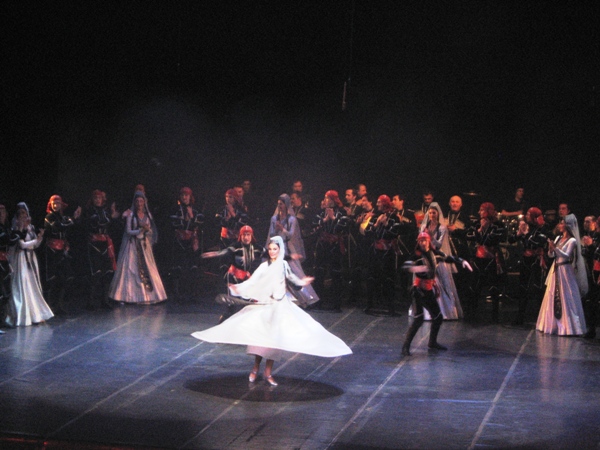
The focal point of this obsession is the state-funded Georgian National Ballet Sukhishvili, a 70-year-old company now pushing the boundaries of Georgia’s national dance identity with a privately financed modern-dance project. Called the Ramishvilebi, in honor of the Georgian National Ballet’s legendary co-founder, Nino Ramishvili, the group gives women more dynamic roles, uses a mix of jazz, electronic and Georgian traditional music, and creates more room for improvisation.

It is contemporary – female dancers initially dance in flesh-colored leotards that make them appear topless – but “[i]ts accent and soul is [sic] very Georgian,” underlined Nino Sukhishvili, the company’s 50-year-old general director, who oversees the modern-dance project’s costumes and sets.

The Georgian National Ballet Sukhishvili’s core choreography reflects the desire of Ramishvili and her husband, fellow ballet dancer Ilia Sukhishvili, to blend dance traditions from Georgia’s regions with classical ballet.

Men perform dizzying jumps and high-speed spins to a raging drumbeat or dance on their toes – the “repertory of twists, twirls and tumbles could put any modern break-dancer to the test,” The New York Times wrote in 1988, when the company first toured the US.

Women’s roles are far more demure, with much graceful gliding across the stage, but have evolved in recent years to include a military dance.

Nino Sukhishvili and her 42-year-old brother, the ensemble’s chief choreographer and artistic director, Iliko Sukhishvili (grandchildren of the ensemble’s co-founders) maintain that they want the troupe to recognize the past while keeping in step with the times.

The modern-dance performance’s symbolic trio of dancers in red evolves from a folk dance for three women (Samaia) modeled on frescoes of Georgia’s medieval Queen Tamar, they note. Its finale, which features women in strapless black dresses with red targets on their chests, draws from the traditional military dance, Khorumi.

Nonetheless, “to be true to the folk roots of our dance and create something new” is “very difficult,” conceded Iliko Sukhishvili.

One American professional dancer agrees. Overall, modern dance’s “fluid movement is at odds with the strict pattern of most Georgian dance,” noted Mira Cooks, a dancer with the New-York-City-based Battery Dance Company. In 2013, the New York troupe staged master-classes for Georgian dancers that emphasized improvisation and “breaking the rigid gender-conscious code that is typical of the Georgian dances.”

Breaking norms is a routine with which the Georgian National Ballet Sukhishvili is familiar. In the late 1920s, Nino Ramishvili danced with her later husband, Iliko Sukhishvili, in male national costume, whipping off her hat at the end to show the audience that she was a woman. The dance (Ilouri) has since become a standard performance.

Other innovations have included Latin dances, and a “folkotheque” experiment the company brought on stage in 2004 to combine Georgian and dance-club music. The experiment sparked Georgian youngsters to try out the moves themselves in Georgian discos, Nino Sukshishvili claimed.

How far most Georgian viewers are willing to go with this latest transformation of the company remains an open question, according to David Bukhrikidze, a theater critic at the news-monthly Liberali.

By “mixing traditional and electronic music as well as Georgian dance elements with modern ones,” the project “is bound to divide,” Bukhridze said.

The project is not the first modern-dance venture for Georgia, but traditionalists indeed frown upon it as non-Georgian, or simply bewildering. “A confused jumble of movements, without a clear direction,” scoffed one 42-year-old woman. “I don’t see the point, really.”

Forty-three-year-old former Sukhishvili soloist Tea Darchia, whose daughter, Mariam Matiashvili, dances in the Ramishvilebi, thinks that the group is “too early for the Georgian audience,” just like the Georgian National Ballet Sukhishvili itself “was too early for the audience in the 1940s.”

The troupe’s “productions take a few years to get to people’s heart[s], but then they are there to stay,” said Darchia, who danced with the company for 28 years.

Otar Kantaria, a 30-year-old international-development professional, already calls the modern-dance shows “pure energy,” with music that “takes Georgian sound to another level.”

Such enthusiasm also can be seen among younger dance students in this ever-dancing country.

The modern-dance group’s creators, as well as participants, stress that they only welcome the debate. Said 20-year-old Tatia Ukleba, part of the Ramishvilebi’s symbolic trio of dancers in red, “healthy criticism makes you stronger.” 

Editor's Note: 
Dance and journalism often go together. Tbilisi-based journalist Monica Ellena previously danced with an amateur contemporary dance ensemble, and graduated from university with a dissertation about American modern dance in the 1940s-1970s. Caucasus news editor Elizabeth Owen studies Georgian dance with the Georgian National Ballet Sukhishvili and dances with an amateur ensemble. Photographer Justyna Mielnikiewicz also has studied Georgian dance.

Thursday, August 15, 2013

VIDEO: Georgia Unforgettable Energy Of Freedom Georgian Dancers Promo (Sukhishvili) (youtube.com)


(youtube.com) Watch the uncensored media at use.bz
Georgia: Production Company: Formula Creative. Director: Giorgi Liponava.
Dop: Gela Chinchaladze. Music By: Iliko Sukhishvilia David Porchkhidzea David Gabunia. Executive Producer: Levan Lominadzea Dimitri Sharashidze.

Georgia: Output Corporation: Prescription Clever. Administrator: Giorgi Liponava.
Dop: Gela Chinchaladze. Music By: Iliko Sukhishvilia David Porchkhidzea David Gabunia. Manager Producer: Levan Lominadzea Dimitri Sharashidze.

Monday, May 07, 2012

VIDEO: Georgian National Ballet Sukhisvili

more: www.sukhishvili.com

Tuesday, January 08, 2008

DANCE: ballettanz magazine Januar 2008

ballettanz magazine with some articles about Georgia ...

Content January 2008 English Version >>>
Inhalt Januar 2008 Deutsche Version >>>
im heft blättern >>>
leaf through the magazine >>>

PDF >>>


with:
* A letter from Georgia In Tblissi: Thomas Thorausch on the violence of dance
* Report: Georgia – where Russian bombs fall and the people rise up against their own president. In January a new president is voted in, but otherwise everything stays the same – especially in dance. A report by Ralph Hälbig
* Nina Ananiashvili is director of the three year-old State Ballet of Georgia. She talked to Susan Yung in New York about the state of affairs in Tblissi under President Mikhail Saakashvili


ERISIONI in Tbilisi on December 12, 2007 by Tea Shaishmelashvili

Sunday, November 04, 2007

USIC-VIDEO:

Assa-Party from Georgia


Music.Ge - Mp3 Hosting
File Name: ASSA Party.mp3 File Size: 526.82 KB Views: 37 Downloads: 5 Uploader: G_i_O. Date: Oct-29-2007, Tags: ASSA , Party ,, Play Or Download ASSA Party.


DOWNLOAD.GE
ASSA PARTY Part II Track 1, 57.63MB, 25:10, 320KBPS. ASSA PARTY Part II Track 2, 41.98MB, 18:20, 320KBPS. ASSA PARTY Part II Track 3, 65.49MB, 28:36

Monday, June 18, 2007

KULTUR:


Bald auch in Dresden in der Semperoper
ERISIONI Georgian National Dance Ensemble


Das Ensemble Erisioni gastiert mit der Bühnen-Show „Legends Of The Storm – Das Geheimnis des goldenen Zeitalters" zum ersten Mal in Deutschland. Beim Sommerfestival in der Kölner Philharmonie ist Premiere für die gesungenen, getanzten und mit Akrobatik verschmolzenen kaukasischen Legenden.

Bald wird das Ensemble auch in der Semper-Oper in Dresden gastieren. Nach dem Tanzensemble Sukhisvili, welches vor drei Jahren eine weniger beachtete Tour durch Deutschland unternahm, ist mit Erisioni nun endlich eine beeindruckendes Ensemble aus Georgien auch auf einer großen und bekannten Bühne zu Gast ...


22.06.2007 GERMANY-Cologne-Philharmonie 21:00
23.06.2007
GERMANY-Cologne-Philharmonie 21:00
24.06.2007
GERMANY-Cologne-Philharmonie 20:00
26.06.2007
GERMANY-Cologne-Philharmonie 20:00
27.06.2007
GERMANY-Cologne-Philharmonie 20:00
28.06.2007
GERMANY-Cologne-Philharmonie 20:00
29.06.2007
GERMANY-Cologne-Philharmonie 21:00
30.06.2007
GERMANY-Cologne-Philharmonie 16:00
30.06.2007
GERMANY-Cologne-Philharmonie 21:00

July
01.07.2007
GERMANY-Cologne-Philharmonie 15:00
01.07.2007
GERMANY-Cologne-Philharmonie 20:00
13.07.2007
GERMANY-Dresden-Semperoper 19:30
14.07.2007
GERMANY-Dresden-Semperoper 14:30
14.07.2007
GERMANY-Dresden-Semperoper 19:30
15.07.2007
GERMANY-Dresden-Semperoper 14:30
15.07.2007
GERMANY-Dresden-Semperoper 19:30

www.legendsofthestorm.com

www.semperoper.de

http://de.music.inet.ge


Mehr Videos:

http://www.youtube.com/results?search_query=erisioni&search=Search

Monday, January 15, 2007

Dance of the Sukhisvili-Company

Today I published some photos from the National Sukhisvili Dance Company on my Flickr-Blog. On the other side I found the explanation from different georgian dance styles ...

Georgia
Kartuli - The dance Kartuli many times reminds the audience of a wedding . Kartuli is a truly romantic dance. It is performed by a dance couple and incorporates the softness and gracefulness of a woman and dignity and love of a man. It shows that even in love, men uphold their respect and manners by not touching the woman and maintaining a certain distance from her. The man’s eyes are always focused on his woman partner as if she was the only being in the whole world. Furthermore, at all times, man’s upper body stays motionless. On the other hand, the woman keeps her eyes downcast at all times and glides on the rough floor as a swan on the smooth surface of a lake. The utmost skill, which is necessary to perform Kartuli, has earned the dance a reputation of one of the most difficult dances. There were only a few great performers of Kartuli. Some of these are Nino Ramishvili and Iliko Sukhishvili, and Iamze Dolaberidze and Pridon Sulaberidze.
Khorumi – This war dance has originated in the region of Achara, which is located in the southwestern region of Georgia. The dance was originally performed by only a few man. However, over time it has grown in scale. In today’s version of Khorumi, thirty or forty dancers can participate. Although the number of performers changed, the content of the dance is still the same. The dance brings to life Georgian army of the past centuries. A few men who are searching the area for a campsite and enemy camps perform the initial "prelude" to the dance. Afterwards, they call the army onto the battlefield. The exit of the army is quite breathtaking. Its strength, simple but distinctive movements and the exactness of lines create a sense of awe on stage. The dance incorporates in itself the themes of search, war, and the celebration of victory as well as courage and glory of Georgian soldiers. Since Georgia has seen many wars throughout its history, Khorumi is a call from the past and reminds us that in order to have peace, we must have war.
Acharuli – Acharuli has also originated in the region of Achara. It is where the dance gets its name from. Acharuli is distinguished from other dances with its colorful costumes and the playful mood that simple but definite movements of both men and women create on stage. The dance is characterized with graceful, soft, and playful flirtation between the males and females. Unlike Kartuli, the relationship between men and women in this dance is more informal and lighthearted. Acharuli instills the sense of happiness in both the dancer and the audience.
Partsa – Partsa has its origins in Guria (another region in Georgia) and is characterized by its fast pace, rhythm, festive mood, and colorfulness. As a performer, I can say that during a partsa performance, a dancer feels like a bird in the sky, flying across the stage barely touching the floor. Partsa mesmerizes the audience with not only speed and gracefulness, but also with "live towers." This dance creates a mood and a desire to party.
Kazbeguri – Kazbeguri takes us to the Northern Mountains of Georgia, which is marked with a diverse culture and traditions. The relatively cold and rough atmosphere of the mountains is shown through the vigor and the strictness of the movements. This dance is performed by only men and portrays the toughness and endurance of the mountain people.
Khanjluri – Historically, Georgians tend to strive for excellence. This trend is portrayed in our folk dances. Thus, many Georgian dances are based on the idea of competition. Khanjluri is one of those dances. In this dance, shepherds, dressed in red chokhas (traditional men’s wear) compete with each other in the usage of daggers and in performing complicated movements. One performer replaces another, and the courage and skill overflows on stage. Since Khanjluri involves daggers and knives, it requires tremendous skill and practice on the part of the performers.
Khevsuruli – This mountain dance is probably the best representative of the Georgian spirit. It unites love, courage, and respect for women, toughness, competition, skill, beauty, and colorfulness into one amazing performance. The dance starts out with a flirting couple. Unexpectedly, another young men appears, also seeking the hand of the woman. A conflict breaks out and soon turns into a vigorous fighting between the two men and their supporters. The quarrel is stopped temporarily by the woman’s veil. Traditionally, when a woman throws her head veil between two men, all disagreements and fighting halts. However, as soon as the woman leaves the scene, the fighting continues even more vigorously. The young men from both sides attack each other with swords and shields. In some occasions, one man has to fight off three attackers. At the end, a woman (or women) comes in and stops the fighting with her veil once again. However, the final of the dance is "open" –meaning that the audience does not know the outcome of the fighting. As a characteristic of Georgian dances, Khevsuruli is also very technical and requires intense practice and utmost skill in order to perform the dance without hurting anyone.
Mtiuluri – Mtiuluri is also a mountain dance. Similar to Khevsuruli, Mtiuluri is also based on competition. However, in this dance, the competition is mainly between two groups of young men. It is more like a celebration of skill and art. At first, groups compete in performing complicated movements. Then, we see girl’s dance, which is followed by individual dancer's performance of amazing "tricks" on their knees and toes. At the end, everyone dances a beautiful final. This dance truly reminds us of a festival in the mountains.
Khonga and Simdi – Both of these dances have their roots in Osetia – a region in Northern Georgia. They have much in common but are also significantly different from each other. The costumes in both dances are distinguished with long sleeves. In addition, the headwear of both the women and the men are exceptionally high. The movements in both dances are also similar. However, in Khonga men dance on point, which is particularly difficult but is a beautiful sight. Khonga is performed by a few dancers and is characterized by the grace and softness of the movements. On the other hand, Simdi is danced by many couples. The beauty of Simdi is in the strict graphic outline of the dance, the contrast between black and white costumes, the softness of movements, the strictness of line formations, and the harmony created by all of the above.
Kintouri – Kintouri is one of the city dances portraying the city life in old Tbilisi, the capital of Georgia. The dance takes its name after "kintos" who were small merchants in Tbilisi. They wore black outfits with baggy pants and usually carried their goods (mostly food) on their heads around the city. When a customer chose goods, a kinto would take the silk shawl hanging from his silver belt and wrap the fruits and vegetables in them to weigh (Sited from The Georgian National Ballet). Kintos were known to be cunning, swift, and informal. Such characteristics of kinto are well shown in Kintouri. The dance is light natured and fun to watch.
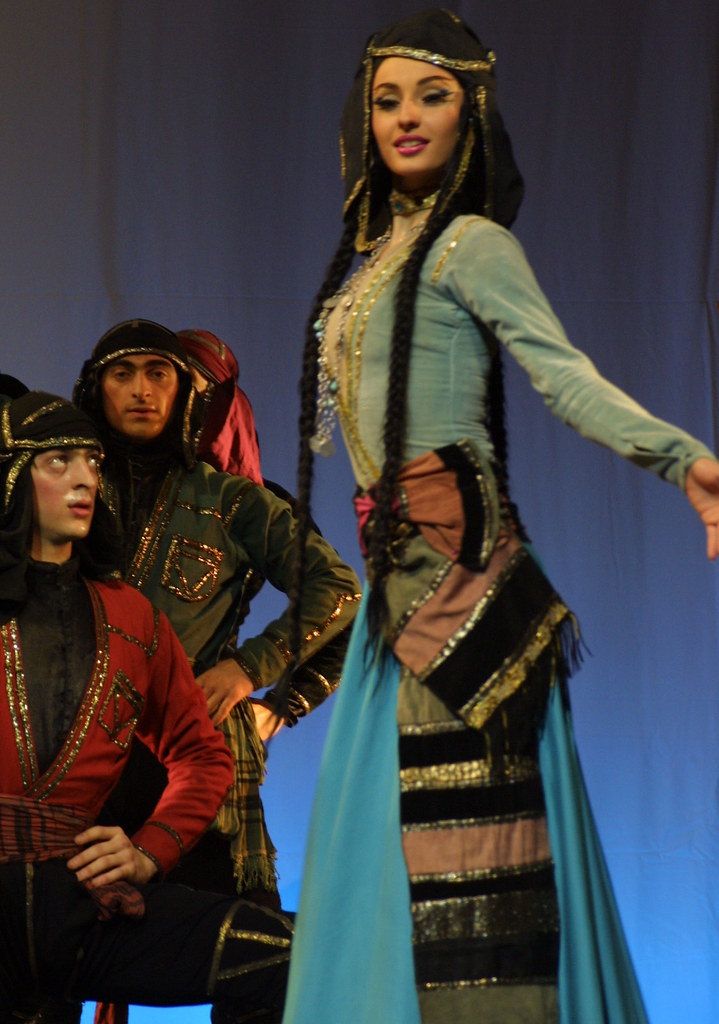
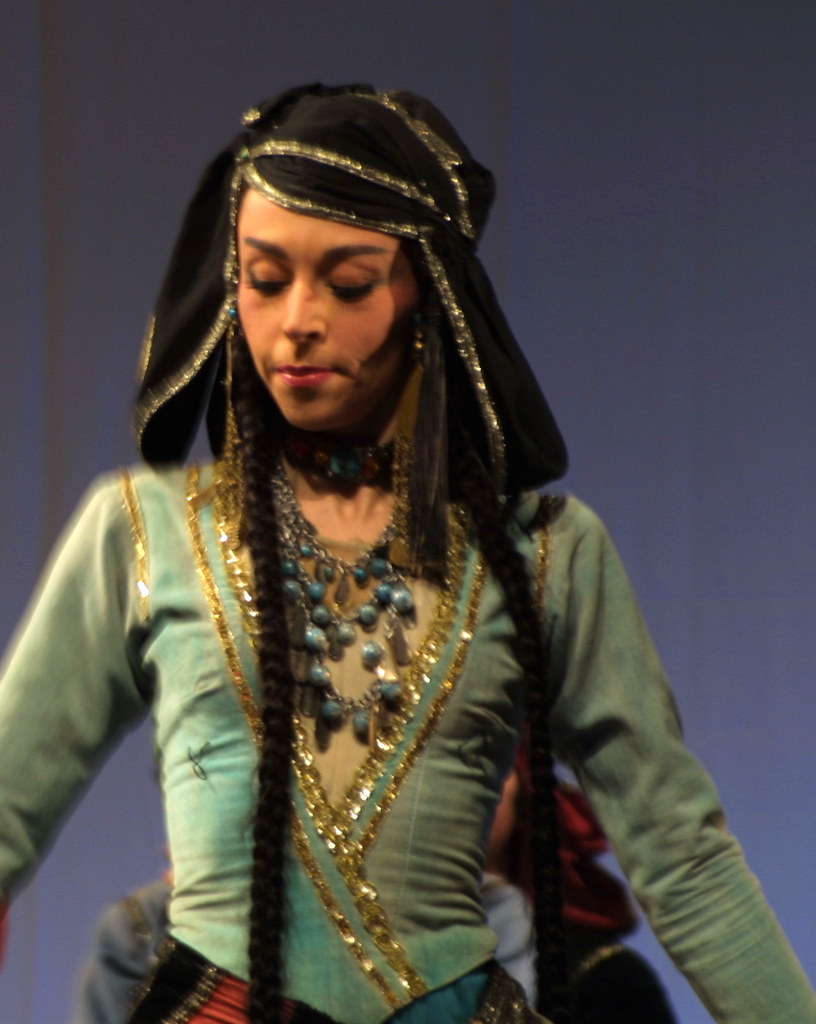
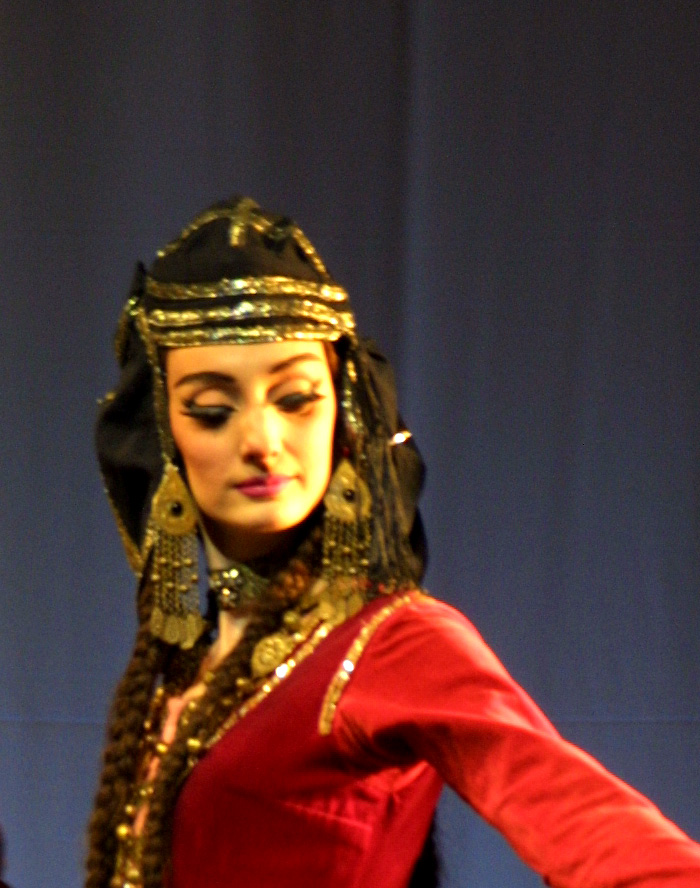
Samaia – The dance Samaia is performed by three women and originally, was considered to be a dance of Pagan times. However, today’s Samaia is a representation of King Tamar and her glory. King Tamar in many sources is mentioned as a Queen of Georgia. However, she was considered to be the king of the United Kingdom of Georgia in 12th-13th centuries and was the first woman king in Georgia’s history. There are only four frescos that keep the much-revered image of King Tamar. Simon Virsaladze based the costumes of Samaia on the King’s clothing on those frescos. In addition, the trinity idea in the dance represents King Tamar as a young princess, a wise mother and the powerful king. All these three images are united in one harmonious picture. Moreover, the simple but soft and graceful movements create an atmosphere of beauty, glory and power that surrounded the King’s reign.
Jeirani – This dance is built on the hunting episode on a doe and is beautifully choreographed by Nino Ramishvili. The dance incorporates not only classical ballet movements but also paints a breathtaking picture of a hunting scene. Everyone who saw Jeirani performed by Nino Ramishvili cannot forget the beautiful body movements, unique dance steps and the dancing spirit charged into the audience (The Georgian National Ballet).
Karachokheli – Karachokheli was a city craftsman and generally wore black chokha (traditional men's wear). They were known for hard work and, at the same time, for a carefree life. His love for life, wine (which Georgia is famous for) and beautiful women is well represented in the dance Karachokheli.
Davluri – Davluri is also a city dance, but unlike Kintouri and Karachokheli, it portrays the city aristocracy. The dance reminds us of Kartuli. However, the movements in Davluri are less complicated and the male/female relationship is less formal. The dance is performed by many couples and with the music and colorful costumes, paints a picture of an aristocratic feast on stage.


Source: http://en.wikipedia.org/wiki/List_of_dances_sorted_by_ethnicity#Georgia


Created by Ralph Hälbig.

full set: National Sukhisvili Dance Company

More about the Amazing instrumental performance

Tag: Caucasian Dance

Saturday, December 30, 2006

Sukhishvili Concert - Instrumental
Amazing instrumental performance
by the music band of sukhishvili.

Added November 26, 2006 From SCSA100

Assa

Georgian National Ballet Sukhishvili Assa Party Batumi 2006

Added December 09, 2006 From salosalome

More Photos: National Sukhisvili Dance Company

Tuesday, November 07, 2006

DANCE: Moving forward towards the past & Back towards the future

Ira Chelidze wrote in this magazine an article about the Sukhisvili-Juniors. When I read it I thought on my friend Birgit Kuch. She will write her degree about the traditionell aspect, especially about the theatrical aspects in the georgian society for example the national dancing for the nationbuilding ... I'm exciting.

"It is when blood ignites like dynamite and when art is in the genes, the rhythm follows the heartbeat and you don't wipe the tears because you are not ashamed that you're crying! When speaking about the Sukhishvilis, the margin between genuine admiration and false pathos is slender, for this form of Georgian dancing has become a national heritage and every contact with it requires great delicacy. Even more so should the junior Sukhishvilis, Nino and Iliko carry on the legacy they have inherited with particular courage and responsibility."

The georgian people hope that the Caucasian folklore will gain as much popularity in the west as the Spanish and Oriental motifs have ...

full text: http://www.magtigsm.com/magazine/2003-2/2003-2-9.html

more links:
Videos: The Georgian Legend & The Georgian Dance GEORGIAN FOLK ...
Sukhishvili (დაკვრა / Play) სიმღერები ...
Georgian Folk Dances "All the ills of mankind, all the tragic ...
I founded this expose. It looks very interesting. Violet on the ...
copyright: Ralph Hälbig Georgian Dance Compagny ...
dance clip from the mountains of the caucasus Added on March 10 ...
NEUER BLOG: Das georgische Ballett Sukhishvili ...
Links about GeorgiaCultural Dancing Crane (Geor...

tag: Dance

Tuesday, September 12, 2006

Videos:
The Georgian Legend &
The Georgian Dance
GEORGIAN FOLK
... Hungary , Czechoslovakia , Finland , Netherlands , the huge impact of Georgian ... The artists of Georgian Legend company have been trained by Erisioni,
...


in category Music
Tags Georgian Legend dance folk

Monday, August 28, 2006

More:
I suggest track 1, 2, 3, 7, 8 and 12

Friday, March 03, 2006

hSukhisvili Company klick on the photo

Friday, September 02, 2005

NEUER BLOG: Das georgische Ballett Sukhishvili - Deutschlandtournee 2005 - 2006


Das Feuer des Georgischen Tanzes- Ballett Sukhishvili WEITER >>>

Siehe auch:
* Georgian Dance Compagny Suhishvili geht ab Anfang Dezember auf ihre Deutschlandtournee!
* Perfekte Choreographie eines kaukasischen Volkes

Sunday, May 29, 2005

ARTIKEL: Perfekte Choreographie eines kaukasischen Volkes. Von Ralph Hälbig

Veröffentlicht im Eurasischen Magazin (März 2005)


Das Georgian State Dance Company-Sukhishvili", wie das Staatsballett offiziell heißt, wurde weltweit immer wieder gefeiert. Mailand, New York, Tokio, Rio waren einige Stationen ihrer vielen internationalen Tourneen. Überall zollten die Gäste frenetischen Beifall. Die Sukhisvili-Company wurde 1945 von Iliko Sukhishvili und Nino Ramishvili ins Leben gerufen. Ihr riesiger Erfolg machte Schule. In Georgien wurden viele ähnliche Tanzgruppen gegründet, die sich die Sukhisvilis zum Vorbild nahmen. Heute gehören zum georgischen Nationalballett 60 Tänzer und ein kleines Orchester mit klassischen kaukasischen Instrumenten: Duduki, Salamuri, Tshonguri, Doli, Akkordeon, Gitarre, Perkussion, Trommeln.

Die Lebenslust der Georgier, die dieses Ensemble ausstrahlt, hat ihre eigenen Mythen. Dazu zählen nicht nur ihre Gastfreundschaft, ihr ungebändigtes Freiheitsgefühl, ihr Stolz und ihre Anmut. Fried Nielsen, ehemals stellvertretender Botschafter Deutschlands in Georgien, sagte: „Die Georgier lieben das Theater, ihr Leben ist vor allem Theater.“ So sollen zum Beispiel die Georgier geschlafen haben, als Gott seine Welt an die Völker verteilte. Als sie hörten, daß sie leer ausgehen würden, unterhielten sie den Allmächtigen mit Tanz und Musik, und das so ausdauernd, daß er weich wurde. Gott gab ihnen schließlich das kleine Paradies Georgien, welches er für sich selbst zurückbehalten wollte.

Den Tanz im Blut

Der Auftritt des Nationalballetts thematisiert die reiche Geschichte Georgiens. Die Zuschauer erleben die majestätische Welt einer folkloristischen Choreographie voller Emotionen. Akrobatische Tänze liegen den Georgiern im Blut. Ihr Tanz kann so heftig werden, daß die Klingen in ihren Schwerttänzen Funken schlagen. Tanz und Musik sind hier untrennbare Zwillinge. Herausragend ist, daß die professionellen Tänzer auch äußerst begabte Schauspieler sind.

Der Tanz ist eine der besten Referenzen für das kaukasische Land. Tanzen war für die Georgier schon immer eine Überlebensform. Ohne den Tanz würden sie ihr Wesen verlieren. Das selbstbewußte Temperament der Georgier hat seine Ursache in dem typischen Vielvölkergemisch zwischen Schwarzem und Kaspischem Meer und natürlich in den zahlreichen historischen Bedrohungen von außen, denen das Volk in seiner Geschichte ausgesetzt war. Immer schon mußten sich die Georgier durchsetzen. Vor diesem Hintergrund formierte sich ein Bündel persönlicher Tugenden unter ihnen heraus. In allen Tänzen geht es um Talent, Mut und Weltklugheit, Höflichkeit, Rede und Moral. Die Tänze lassen etwas von dem Aroma des Landes und ihrer Gravität erahnen. Nicht zuletzt verführen 300 ausgezeichnete Kostüme zu einer Reise in das Kolchis, das mythische Land der Argonauten und des goldenen Vlieses, dorthin, wo Medeas Heimat ist und die Seidenstraße die Nahtstelle zwischen Orient und Okzident überquert. Die Sukhisvili-Company präsentiert auf der Bühne die seelische Spiegelung eines außergewöhnlichen Volkes.
Das Spektakel beginnt mit einem sogenannten Partsa, einem traditionellen Festtanz. Darin bilden die Männer eine lebende Pyramide. Die Tänzer stehen einander auf den Schultern und bewegen sich im Kreis. In den Dörfern hoch oben in den Bergen zieht solch eine Pyramide mit einem Musiker in ihrer Mitte zum traditionellen Heiligtum. Hält die Pyramide, heißt das, daß die Geister die Opfer des Dorfes angenommen haben – ein Glück verheißendes Vorzeichen.

Traditionelles Reglement

Auch andere Tänze folgen festen Regeln. Dem Zuschauer fällt sofort die ehrfurchtsvolle Beziehung zur Frau auf – die Ritterlichkeit und der Respekt der georgischen Männer gegenüber den Frauen. Der Mann hält Abstand und ist zurückhaltend in seinen Bewegungen. Allein die Augen und die Eleganz verraten Erregung und Leidenschaft. Verwegener sind ihre Bewegungen bei heroischen Verteidigungs-, traditionellen Hirten- oder magischen Jagdtänzen. Der „Adjaruli“ von der sonnigen Schwarzmeerküste ist hingegen ein bezaubernder Tanz, bei denen der Mann in einem Liebesduett auf das frivole und kokette Spiel der Frau eingeht. Trotz allem sind Berührungen während des Tanzes untersagt. Ein Mann muß seine Gefühle im Griff haben. Die Bewegungen jedes Tänzers folgen den Anforderungen eines allgemeinen Planes, gleichzeitig verlieren sie jedoch nicht ihre Individualität. Denn die Tänzer konkurrieren auch in der Stärke, in der Beweglichkeit, im Aufzug und in ihren ausdrucksvollen Bewegungen. Das heizt die Stimmung an.


(copyright Ralph Hälbig)


Die Rolle der weiblichen Tänzerinnen ist es, Anmut und Charme zu verkörpern. Ähnlich wie im klassischen Ballett, in dem jedes Gefühl seine eigene traditionelle Bewegung hat. Die Frauen sind zart und ruhig, sie gleiten auf kleinen Schritten dahin. Die männlichen Tänzer hingegen sind technisch virtuos und strotzen vor viriler Energie. Sie fordern sich gegenseitig zu gewaltigen Sprüngen und unglaublichen Pirouetten heraus, die der Schwerkraft trotzen. Geschwindigkeit und Präzision rauben einem den Atem. Und kaum vorstellbar ist, wie sie in ihren weichen Lederstiefeln auf ihren Zehen tanzen oder nach einer doppelten Umdrehung auf ihren Knien landen und gleich wieder hochspringen. Der Auftritt ist mitreißend und präzise bis in die Mimik.