Showing posts with label Link. Show all posts

Wednesday, June 09, 2010

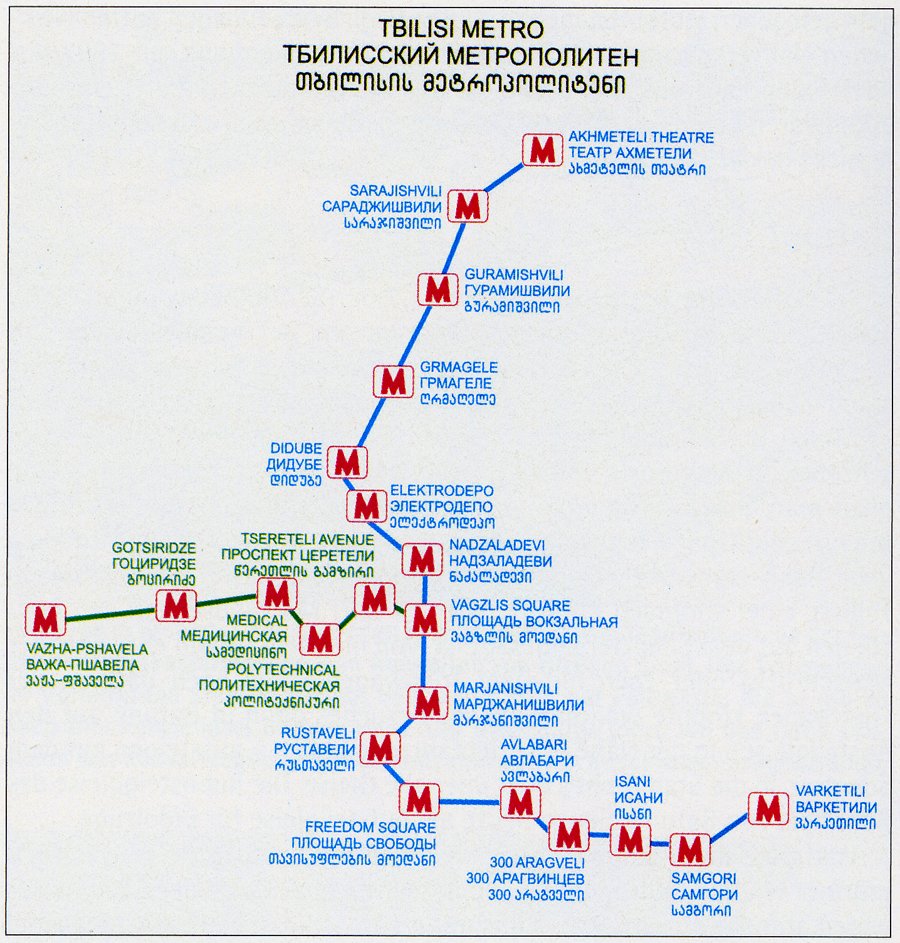
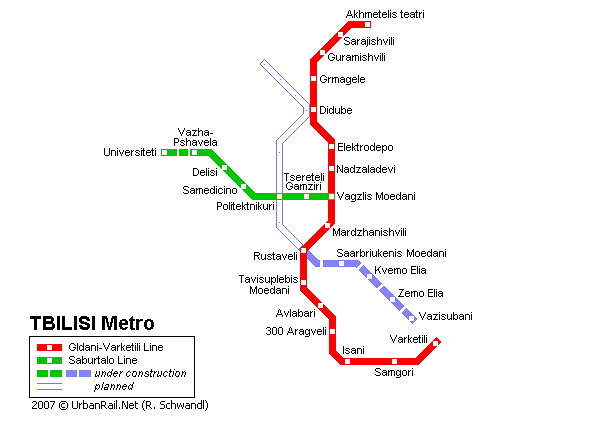
MAP: Tbilisi Metro (urbanrail.net)


Tbilisi (Tiflis) is the capital of the former Soviet republic of Georgia, situated in the Caucasus. The city has 1.2 million inhabitants and extends 40 km north - south along the river Mtkwari (Kura). The valley is surrounded by mountains what makes road traffic especially difficult. Therefore plans for a subway system were made already in the early 1950's when the city had only 750,000 inhabitants.
The first line (Gldani-Varketili Line, formerly Didube-Samgorskaya) opened in 1966 from Dibude to Rustaveli (6.3 km, 6 stations) via the city centre. A few years later it was extended towards the south to 300 Aragveli (1967) and Samgori (1971). During the 1980's it reached its current length of 19.6 km with 16 stations.
In 1979, the second line (Saburtalo Line) began operating between Vagzlis Moedani (railway station) and Victor Gotsiridze. In the year 2000 it was extended to its current terminus Vazha Pshavela. The line has a total length of 6.7 km with 6 stations.
Most station names were changed during the 1990's after the dissolution of the former USSR and the independence of Georgia. Trains in service are of the 81-717 and 81-714 series also running in Moscow and other ex-Soviet cities. Stations have 100 m long platforms for 5-car trains, although only 3 or 4-car trains are currently used.


Lines and History:

Gldani-Varketili Line - 19.6 km, 16 stations
11 Jan 1966: Dibude - Rustaveli (6.3 km, 6 stations)06 Nov 1967: Rustaveli - 300 Aragveli (ex 300 Aragvinzev)05 May 1971: 300 Aragveli - Samgori08 Nov 1985: Samgori - Varketili16 Nov 1985: Didube - Guramishvili (ex TEVZ) 07 Jan 1989: Guramishvili - Akhmetelis teatri
Saburtalo Line - 6.7 km, 6 stations
15 Sept 1979: Vagzlis Moedani (ex Pl. Vokzalna) - Victor Gotsiridze (ex Delisi) (6.2 km, 5 stations)02 April 2000: Victor Gotsiridze - Vazha Pshavela
Some (or all) station names have been changed from Russian into Georgian, so older names found on some maps are given in brackets. Other former names: Pl. Lenina for Tavisuplebis Moedani (Freedom Sq.); 26 Komissarov for Avlabari; Okyabrskaya for Nadzeladevi; Komsomolskaya for Medikal Institut.


Projects

An extension of the second line to the University and the first section of a third line is under construction, although no dates for completion are known.


- OPERATION
The Tbilisi Metro operates from 6:00 until 1:00, every 2.5 minutes during rush hours and every 4 minutes during the day.
- FARES (2007)
Single fare - GEL 0.40 (lari)
Plastic cards with multiple rides: 20 Lari (60 rides) - 145 Lari (720 rides)


Links

metro.ge (Official Website)
Official Metro Map 2007
Tbilisi Metro on Wikipedia
Metrosoyuza by Peter Donn includes nice station pictures
Tbilisi Metro at Mir metro/Metroworld by Aksenov Dmitry
Tbilisi Metro Track Map
Tbiltrans
Salinas, Julian; a.o.: METRO. TBILISI. - Portraits of metro passengers. Christoph-Merian-Verlag, Basel. 50p, ISBN 3856161481 (May 2001)

Tuesday, December 01, 2009

GERMAN IN GEORGIA: 20 years in Georgia - Rainer Kaufmann, journalist and entrepreneur (finchannel.com)

Via finchannel.com -- At Christmas 2009, it is exactly 20 years ago that the German journalist and entrepreneur Rainer Kaufmann started his commitment in Georgia.

He first came to accompanying a student exchange program and he immediately looked for ways to operate on business. Today he runs a medium sized business in Europe and Georgia and has the longest experience in Georgia, if he isn`t the only one who continuously has been active in Georgia for two decades.

Rainer Kaufmann and his wife Gabi started to get involved in tourism in the early 90s, and were the first German tour operators, who made Georgia known as a travel destination after the collapse of the Soviet Union. The company ERKA-Reisen GmbH is up to now the only German Caucasus specialist, and has brought several thousand tourists from Germany to Georgia, Armenia and Azerbaijan in the past two decades. ERKA travel has paid particular attention to bring tourists into the different regions of Georgia, especially Svaneti. More information:
www.erkareisen.de.

In Georgia, Gabi and Rainer Kaufmann invested into the tourist hotel “Kartli”, in the Vera district. Thus they are the only tour operators from Europe, who are also represented in the country with private investment. For more than 15 years Rainer Kaufmann has operated first the restaurant "Rainer's Cafe" and later "Rainer's Pizzeria and Beer Garden" in Barnov Street , now one of the most popular and successful restaurants with European cuisine in the Georgian capital. More information:
www.hotel-kartli.com.

In addition to classic European dishes the creative restaurant owner also tried to combine modern European cuisine with Georgian elements. So, in recent years, he created a number of new dishes and published them on his website
www.georgien-news.de under the title "New Georgian cuisine. At “ Rainer's Pizzeria” he currently offers his "EUROPEAN SUPRA," a dinner in the tradition of the Georgian supra, equipped , however, with dishes from all over Europe. The latest development of hotel “Kartli”: the "Khatshapuri-Burger", a mixture of American hamburgers and Georgian Khatshapuri. In Germany the couple runs an event-restaurant, which also offers Georgian specialties beside other dishes. There the Georgian supra is very popular and Rainer Kaufmann taught his kitchen team in Germany how to cook and serve it. More information: www.kaufmann-schlachthof.de.

In addition to tourism and gastronomy the skilled TV journalist was always engaged in journalism during the past two decades. More than 15 TV documentaries were produced with his assistance for several German television channels, including one of the most famous documentaries about Svaneti in 1994 (ZDF German Television - Terra X: Glacier Gold) and one part of Stalin's three-part documentary for the ZDF because of the dictator ‘s 50th death. Taking part in the research team on this film Kaufmann received an Emmy nomination for outstanding achievement in the field of research and documentation.

With several photo calendars, photo exhibitions in Georgia and Germany and especially with two book publications Kaufmann has tried to bring Georgia closer to his German countrymen in the past and at present. His latest book, "Georgia - a travel reader" has been published just at the beginning of this. It does not only deal with the culture, history, landscape and people but also with the entire political and social development of Georgia since the collapse of the USSR. A period which the author experienced , and sometimes suffered, in the country itself. Maybe he was one of the few European journalists right at the place. More information:
www.erka-verlag.de.

During the entire period of their engagement in Georgia Gabi and Rainer Kaufmann paid attention to train their employees and partners, especially in tourist regions . And all that this without any support from any government or NGO. There are circa 50 families in different regions of Georgia who can now at least partly live on various occupations they were trained on by ERKA Reisen.

Rainer Kaufmann: "If I'm proud of anything I have achieved in Georgia, then it is the fact that almost all who have been trained in one of our companies now work successfully in their jobs. Some of them are as well successful competitors. But their success is to a small extent our success ,too. "

To celebrate this anniversary ERKA-Reisen Gmbh (Bruchsal/Germany) and ERKA-Tbilissi Ltd (Tbilisi/Georgiea) invite for

Press Conference with „European Supra“.

Wednesday, december 2nd, 5 p.m. Press Conference
Wednesday, december 2 nd, 6 p.m. European Supra
Rainer`s Pizzeria, Barnovstr. 32

Please confirm your attendance
Götz-Martin Rosin: 857-538-854 or e-mail:
rosin@press-guide.com

Source: finchannel.com

Tuesday, August 11, 2009

LINKS: Telepolis - Gandalf der Graue erstellte eine Linksammlung zu Georgien (spiegelfechter.com)

Gandalf der Graue: der Spiegelfechter hat zum Thema Georgien (nicht nur) und Russland ein paar interessante Artikel veröffentlicht:

Das erste Opfer des Krieges ist die Wahrheit >>>


Katerstimmung bei der Nato >>>

Psychologische Kriegsführung >>>

Kosovo im Kaukasus >>>

Ex-Post Kriegsgründe >>>

Das Interview (erst nach massiven Protesten u. a. aus der Internetgemeinde wurde die lange Version des Interviews ARD ./. Putin zum Thema Georgien gezeigt) >>>

Hunde, die Bellen >>>

Sieg der Vernunft >>>

BBC-Dokumentation wirft Georgien Kriegsverbrechen vor >>>

Katerstimmung in Georgien >>>

Der Russe lügt >>>

Herbsttage eines Präsidenten >>>

Ein Jahr nach dem Krieg >>>

__

Weitere Artikel, in denen das Wort Georgien vorkommt >>>

Monday, April 13, 2009

BOOK: The Exploration of the Caucasus (digicoll.library.wisc.edu)

Source:

Freshfield, Douglas William
The Exploration of the Caucasus
London: Edward Arnold, 1902
2 v. illus., port., fold. maps. 29 cm.

Contents

+++++++++++++++++++

Source:

Freshfield, Douglas William
The Exploration of the Caucasus
London: Edward Arnold, 1902
3 v. illus., port., fold. maps. 29 cm.

Contents

[Cover]

[Half-title] The exploration of the Caucasus: volume II, pp. [i] ff.

[Frontispiece] Tetnuld from the north, p. [ii]

[Title page] The exploration of the Caucasus: volume II, pp. [iii]-[iv]

[Contents] Table of contents, pp. [v]-vi

[Contents] Illustrations in the text, pp. [vii]-viii

Chapter XIII: the Zanner Pass and Ukiu, pp. [1]-20

Chapter XIV: mountaineering in 1888: Dykhtau and Katuintau, Holder, J. G. pp. 21-37

Chapter XV: mountaineering in 1888: continued: Shkara, Janga, and Ushba, Cockin, J. G. pp. 38-58

Chapter XVI: search and travel in 1889, pp. 59-92

Chapter XVII: the ascent of Koshtantau, Woolley, Hermann pp. [93]-114

Chapter XVIII: Chegem, pp. 115-132

Chapter XIX: the passes of the Baksan, pp. 133-148

Chapter XX: Urusbieh and Elbruz, pp. 149-173

Chapter XXI: the sources of the Kuban, de Déchy, Maurice pp. 174-190 ff.

Chapter XXII: the solitude of Abkhasia, pp. 191-220

Appendices, pp. [221]-[222]

Appendix A: the physical history of the Caucasus, Bonney, T. G. pp. 223-232 ff.

Appendix B: topographical and travellers' notes and climbers' record, pp. 233-276

Appendix C: table of mean temperatures and rainfalls: (year 1890), pp. [277]-283

Appendix D: heights of the lower terminations of some of the principal Caucasian glaciers, pp. [284]-286

Appendix E: note on the maps and illustrations, pp. 287-288

Appendix F: a short list of books recommended to those interested in the central Caucasus, pp. 289-290

The peaks, passes & glaciers of the central Caucasus

Index, pp. [291]-295 ff.

[Cover]


more here: onlinebooks.library.upenn.edu
AmazonShop: Books, Maps, Videos, Music & Gifts About The Caucasus

GREAT WEBSITE: A trip through the eastern Caucasus. (digicoll.library.wisc.edu)

Abercromby, John: A trip through the eastern Caucasus
London: Edward Stanford, 1889
xvi, 376 p. incl. front., illus. b plates (1 fold.) group port., maps (part fold.) c 23 cm.

Contents


AmazonShop: Books, Maps, Videos, Music & Gifts About The Caucasus

Tuesday, March 03, 2009

BLOG: Russia's Coming War with Georgia

Stories with this headline are doing the rounds, mostly originating in remarks made by Pavel Felgenhauer, a Russian military analyst who writes in Novaya Gazeta. He gave regular warnings about Russian troop build-ups in Abkhazia and South Ossetia before last year's August war, so perhaps his warnings should be headed.

more >>>

Tuesday, February 10, 2009

BLOG: Welcome to the AGBU Blog! (agbublog.wordpress.com)

In one short week AGBU Blog has grown exponentially and our email subscriptions alone have more than doubled! So, welcome to all our new subscribers and we hope you enjoy the latest and greatest from this great online resource.

And since it is a blog, always feel free to leave comments at the bottom of each post, though keep in mind that AGBU will moderate all comments for offensive language, ad hominem attacks or off-topic remarks.

If you ever have any questions or comments about how the AGBU Blog can best keep you informed, please contact us using the AGBU.org Contact Us form.

Thanks for reading and we hope to see more of you online.

link: agbublog.wordpress.com

AGBU has a growing community of blogs, below please find a complete listing of blogs in the AGBU world.

Europe

  • AGBU EUROPE (en.ugab.fr) - A bilingual blog (English & French) that posts the latest news from the European chapters, committees and entities.
  • AGBU YEREVAN SUMMER INTERN PROGRAM (agbu.org/ysip) - The organization’s newest Intern Program that will keep you abreast of the latest goings-on in Armenia’s capital. More info on YSIP.
  • AGBU SUMMER CAMP IN FRANCE (ugabfrance.wordpress.com) - For over two decades, AGBU’s Summer Camp in France has offered students a venue for Armenian students to get away from the city and celebrate their heritage. For more information, visit the main UGAB France website.
  • AGBU Z’ANIMS IN PARIS, FRANCE (zanims.blog4ever.com) -

North America

South America

Southwest Asia/Middle East

  • AGBU AYA-DAMASCUS BLOG (agbudamascus.wordpress.com) - The virtual press office of AGBU’s Armenian Youth Association (AYA) of Damascus.
more links:
* youtube.com/agbuvideo
* facebook.com/pages/AGBU
* friendfeed.com/agbu
* twitter.com/agbu

Wednesday, December 10, 2008

INTERNET: A to Z of Azerbaijan / A dan Z ye Azerbaycan

Many Informations about Azerbaijan in the Internet / A to Z of Azerbaijan ...

A project by
www.Azerb.com

Wednesday, September 03, 2008

ENTRIES: Thee Articles of ArielOnline / Updated NKA website/activities

Catherine Philpott sent me: Take a look at the last thee entries of ArielOnline button - see what is happening with us & the outcome of Georgian 'holiday'

Action for Kutaisi, fund raising project launched by Mayor
Catherine Philpott, Chair of Newport Kutaisi Association was caught up in the conflict whilst in Georgia. She had passed through Gori a matter of hours before the first cluster bombs had fallen.

Local Democracy Agency report on support for refugees
The Situation in Kutaisi. Fortunately, Kutaisi was not bombed, but the situation in the whole country is tense. According to the United Nations about 100,000 people left their homes during the conflict. Within Georgia approximately 60,000 people are now considered as Internally Displaced Persons (IDPs), mainly coming from the city of Gori and the territory of South Ossetia. Most of the IDPs are in urgent need of shelter, food, water, hygiene kits and medical supplies.

Fire Brigade Visit: Pictures from Kutaisi
Catherine Philpott recently returned from Georgia visiting Tbilisi, Khaketi, Kutaisi and Batumi. In her final week the Russians invaded, attacking the seaport of Poti and became stranded in the coastal town of Batumi.

more articles >>>

Welcome to the Website of the Newport Kutaisi Association

Saturday, August 23, 2008

KOMMENTAR: Invasion in Georgien. Falsche Zugeständnisse an Moskau. (FAZ.NET)

Von Berthold Kohler

Der Autor ist verärgert und kommentiert die politischen und medialen Statements zu dem anmaßenden Verhalten der russichen Streikkräfte in Georgien. Für ihn ist und bleibt das Ganze eine Invasion und Annexion mit weitreichenden Folgen! Nicht zuletzt wird dadurch das ganze Land Georgien in einem übermäßigen Maße kontrolliert und in ihrer Entwicklung zurückgeworfen!


Von den „Randgebieten“ ist gar nicht mehr die Rede. Sind sie nach der Invasion im Geiste schon auf den Kreml überschrieben worden? Der hinterlässt dem Westen im Tausch ein zerstörtes Restgeorgien, damit die Nato etwas zum Streiten hat. Doch Hauptsache, man bleibt im Gespräch.


Der ganze Text >>>


© Crisis Group Europe Report / FAZ.NET

Friday, August 15, 2008

ARTICLE: Russian general says Poland a nuclear 'target' (telegraph.co.uk)

Poland has made itself a nuclear target for Russia’s military by hosting elements of a US anti-missile system, a senior Russian general warned.

By Damien McElroy in Tbilisi
Last Updated: 5:45PM BST 15 Aug 2008

General Anatoly Nogovitsyn said that Russia?s military doctrine sanctions the use of nuclear weapons 'against the allies of countries having nuclear weapon'

As Condoleezza Rice arrived in Georgia to finalise a peace deal and secure the withdrawal of Russian troops from the former Soviet state, Moscow issued the direct threat to another US ally.
“Poland is making itself a target. This is 100 percent” certain, Russia’s Interfax news agency quoted General Anatoly Nogovitsyn as saying.
“It becomes a target for attack. Such targets are destroyed as a first priority,” Gen Nogovitsy was quoted as saying.
He added that Russia’s military doctrine sanctions the use of nuclear weapons “against the allies of countries having nuclear weapons if they in some way help them,” Interfax said.
George W Bush, speaking in Washington accused Russian President Dmitry Medvedev of "bullying" his neighbours and said the tactics were working against Russia's interests on the international stage.
Following months of discontent over the planned siting of the US missile shield, Russia reacted furiously last night when Washington sweetened its package with an agreement to sell a Patriot defence battery to Warsaw. “The fact that this was signed in a period of very difficult crisis in the relations between Russia and the United States over the situation in Georgia shows that, of course, the missile defence system will be deployed not against Iran but against the strategic potential of Russia,” said Dmitry Rogozin, Russia’s envoy to Nato.

full text >>>

Related Content
Bush condemns Russia's 'bullying' of Georgia
Analysis: Russia raises prospect of nuclear stand off
Georgia crisis: Timeline
Georgian reporter shot on live television
Rice due in Tbilisi to secure Georgia peace plan
Russia 'destroying bases'
Poland and US agree deal for missile defence shield
Explosions in Georgian towns
Rice warns Russia over ceasefire deal
Condoleezza Rice has issued a warning to Russia ahead of a trip to France and Georgia.


Russia challenges Bush with Georgia advance
Georgian move for South Ossetia 'like 9/11'
Russian military move deeper into Georgia
Dispatch of troops 'will not save US'
Ukraine imposes restrictions on Russian navy
Journalists come under attack in Georgia

ARTICLE: Russia: Georgia can 'forget' regaining provinces

By DAVID NOWAK and CHRISTOPHER TORCHIA
Associated Press Writers, Published Thursday, August 14, 2008

TBILISI, Georgia — The foreign minister of Russia said Thursday that Georgia could "forget about" getting back its two breakaway provinces, and the former Soviet republic remained on edge as Russia sent tank columns to search out and destroy Georgian military equipment.

Monday, August 11, 2008

INIATIATIVE: Georgien-aktuell-von Eurokaukasia

Liebe Freunde,sehr geehrte Damen und Herren,

die Lage in Georgien ist zurzeit sehr instabil und besorgniserregend. Die Ereignisse überschlagen sich, die Nachrichtensender weltweit berichten diesbezüglich. Wir sind permanent dabei uns zu informieren, versuchen u.a. im ständigen Kontakt mit unseren Familien und Freunden vor Ort zu sein.
Die Berichterstattung durch die Medien ist teilweise recht unübersichtlich. Wir empfehlen Ihnen stets sich bei verschiedenen Nachrichtensendern zu informieren.

Hier ein paar wenige Vorschläge, ergänzend zu den ganz großen Nachrichtensendern:
Civil Georgia
http://www.civil.ge www.civilgeorgia.ge http://www.civilgeorgia.ge (in einigen Sprachen vorhanden, in den letzten Tagen hat man jedoch Zugriffsschwierigkeiten)
Georgien-Nachrichten
www.georgien-nachrichten.de
Gazeta Wyborcza in polnischer Sprache ist am Wochenende durch ihre aufschlussreiche Berichterstattung
aufgefallen
http://wyborcza.pl).

Sonst finden Sie diverse
aufschlussreiche Artikel zum Thema auf
www.realclearworld.com und www.lemonde.fr

Wir versuchen die Infos nach drei Kategorien zu sammeln, dies hilft einen Überblick zu bewahren und die oft widersprüchlichen Infos auch für sich zu werten:
Chronologie der Ereignisse (mit Quellenangaben) - Offizielle Stellungnahmen - Analysen.

Nun möchten wir Ihnen folgendes anbieten: Auf der Internetseite von "EuroKaukAsia"
http://www.eurokaukasia.de werden wir informative und vielfältige Beiträge (vor allem Analysen, Interviews) platzieren und/oder auf sie hinweisen.

Hierbei soll es nicht um eine Chronologie der Ereignisse sich handeln, sondern eher um eine Analyse. Uns ist wichtig, dass wir Ihnen ein, soweit dies möglich ist, objektives Bild der Lage vermitteln und Einblicke in die strategischen Implikationen des Konfliktes aus der Sicht der beteiligten Parteien einschließlich der EU und USA gewähren.
Die Beiträge werden in einigen Sprachen vorhanden sein. Wir können die Beiträge leider nicht übersetzen.
Sehr gerne können Sie uns diesbezüglich Information zukommen lassen und/oder Ihre Beiträge liefern.


Wir sind ausserdem gerade dabei eine Art 'Hotline' auf der Internetseite einzurichten, wo u.a. Telefonnummern zwecks Kontaktaufnahme angegeben werden. Rufen Sie uns an. Wir versuchen Ihnen mit u.a. praktischen Tipps (wie man z.B. am besten telefonisch nach Georgien durchkommt etc.) zu helfen.

Informieren Sie, bitte Ihre Familien und Freunde in Georgien hinsichtlich der Berichterstattung ausserhalb Georgiens. Viele Menschen dort beziehen Nachrichten nur über georgische Sender. Es ist wichtig, dass wir gegenseitig Information austauschen.

Sie können diese Nachricht sehr gerne weiterleiten!

Wir arbeiten zurzeit mit Hochdruck an der Internetseite. Bitte, schauen Sie erst in ein paar Stunden rein.

Ihr Eurokaukasia-Team


-------------------------------------------------------


Dear Ladies and Gentlemen, Dear Friends,

The situation in Georgia is currently very unstable and worrying. The events are coming thick and fast and news networks worldwide are reporting on the issue. We are constantly acquiring information and are attempting to stay in permanent contact with our families and friends on location. The reporting by the media is, in part, very difficult to navigate. We recommend you to acquire information from different news networks. Here are a few suggestions to supplement the information from the large news broadcasters:

Civil Georgia
www.civil.ge
http://www.civil.ge, www.civilgeorgia.ge http://www.civilgeorgia.ge
available in several languages, but it has been difficult to access it in the past few days);

Georgien-Nachrichten www.georgien-nachrichten.de
Gazeta Wyborcza from Poland caught our attention over the weekend with its insightful coverage
http://wyborcza.pl).

Otherwise you will find diverse informative articles on the topic at www.realclearworld.com www.nytimes.com, www.lemonde.fr and www.guardian.co.uk

We are attempting to gather information according to three categories.

This helps you to keep an overview and evaluate the often contradictory information on your own: Chronology of the events (with sources) - Official statements - Analyses.

Now we would like to offer you the following: We will place informative and diverse contributions on the Internet site of "EuroKaukasia"
www.eurokaukasia.de (in particular analyses, interviews) and/or refer to them. This is not necessarily a chronology of the events, rather an analysis. It is important for us to convey to you an objective view of the situation and offer you insights on the strategic implications of the conflict from the viewpoints of the involved parties, including the EU and USA.

The articles will be available in several languages. Unfortunately we cannot translate the articles.

You are more than welcome to send us information on this or your personal contributions or articles.

We are also in the process of setting up a kind of 'hotline' on the Internet site, where telephone numbers can be posted for contact purposes. Feel free to call us. We will try to help you with practical information (how to best contact someone in Georgia by telephone etc.)

Please inform your families and friends in Georgia about the media coverage outside Georgia. Many people there only get their news from Georgian stations. It is important that we exchange information.

We are working at full speed on the Internet site. Please check again in a few hours.

The Eurokaukasia Staff
--

Mariami Parsadanishvili
Wissenschaftliche Mitarbeiterin
Universität Konstanz
Exzellenzcluster 16/EXC 16
Osteuropäische Geschichte/Raum F 347
Fach D 11, 78457 Konstanz
Deutschland/Germany
Tel: +49 (0)7531/88-2261
Fax: +49 (0)7531/88-4158
E-Mail: Mariam.Parsadanishvili@uni-konstanz.de

Monday, July 14, 2008

HISTORY: How Stalin came to tea with 'the Lucky Stiffs' whom he'd tortured

By Simon Montefiore
Daily Mail, July 12

Can you imagine a more sinister knock on the door - and a more horrifying surprise guest? It must have been one of the most terrifying meals in history, the night the murderous dictator Josef Stalin dropped into the home of one of his victims for an unexpected dinner and ended up singing to their daughter.

It is certainly one of the most incredible events in the chronicles of the 20th Century dictators, but it also provided the inspiration for my new novel Sashenka, the story of a fascinating woman, her love affair and the unbearable choice she had to make.

For years the details of this bizarre meeting have been vague, but while researching my book I managed to track down the little girl Stalin bounced on his knee that evening while her parents looked on in horror, scared out of their wits lest she say the wrong thing to the unpredictable Soviet leader.
Enlarge Stalin in 1932 with daughter Svetlana

Deadly guest: Stalin in 1932 with his own daughter, Svetlana

Her name was Maya Kavtaradze and until recently she was an elegant old lady living in a grand apartment in Tbilisi, Georgia.

As a young Bolshevik before the Russian Revolution, her father Sergo Kavtaradze became friends with Soso Djugashvili, known to history as Stalin. Once they had such a row that Kavtaradze threw a lamp at Stalin's head. It missed and Stalin burst out laughing.

After the revolution, Kavtaradze was a Trotskyite who opposed Stalin. But for some reason, Stalin always protected his old friend.

Kavtaradze married a pretty Georgian Princess, Sophia Vachnadze, itself unusual for a Bolshevik, but in 1937 the couple were arrested as 'enemies of the People'. They were tortured and sentenced to death for planning to kill Stalin.

When the execution list was brought to the dictator, he placed dashes next to their names - a sign that he wanted them reprieved.

Maya also wrote to him protesting their innocence - her letter caught Stalin's eye and he asked Beria, his sadistic secret police chief, if the Kavtaradzes were still alive. In 1939 Stalin ordered their release.

They became what was known as 'Lucky Stiffs' - people who returned from the dead. They were reunited with Maya and given a grand apartment near the Kremlin.
Maya Kavtaradze

Inspiration: Maya Kavtaradze

One night soon afterwards, Sophia answered the door to their home and was astonished to see her husband standing there with Stalin and Beria, the man who had personally supervised their torture.

'We have guests,' said her husband, weakly. The distinguished visitors came in and proceeded to make polite small talk. At one point, Stalin mentioned the couple's arrest and torture. 'To think you wanted to kill me,' he muttered in Kavtaradze's ear.

'You believed that?' replied Kavtaradze. Stalin grinned.

The Kavtaradzes understood only too well that they must make their guests very welcome. A feast was laid out and soon they were all eating and drinking merrily before Stalin suddenly said: 'Where's Maya? I admired her letter.'

Her parents were chilled. 'It was best to keep children out of any politics and away from Stalin,' Maya told me. But the tyrant insisted. Sophia went to Maya's room and said: 'Stalin is here and he wants to meet you.'

'I don't want to,' whispered Maya. 'I hate him for what he did to you and Papa.'

'Say nothing of that,' hissed Sophia. 'You must meet him.'

Maya dressed and came out. 'When I saw him there it was like a poster brought to life,' she recalled.

Stalin greeted her warmly. 'Thank you for your letter,' he said, asking her to sit on his knee. 'Do you spoil her?' he asked her parents. 'I hope you do.'

He questioned Maya about her life when her parents were in jail. Sergo and Sophia tensed - one whisper of complaint could have doomed them all - but Maya, then aged 11, answered him carefully.

'My poor parents dreaded what I might say to him,' she said. 'He was so kind, so gentle - he kissed me on the cheek and I looked into his honey-coloured, gleaming eyes, but I was so anxious.'

Then Stalin turned to Sophia: 'We tortured you too much,' he said. Sophia knew better than to even acknowledge that they had ever been anything other than friends.

'May anyone who brings up the past lose their eyes!' she said. Stalin laughed. 'Are you happy with your home?' Stalin asked mother and daughter. 'Show me round.'

In the Twenties and early Thirties, Stalin often visited the houses of friends for dinner, but after the Terror of 1937 he visited very few private homes, making Maya's story most unusual, if not unique.

When Stalin went visiting he usually brought his own wine and food because he was suspicious of poisoning, but on this occasion food was provided by Aragvi, Moscow's famous Georgian restaurant. Needless to say, Stalin made sure someone else sampled it first.

The explanation for the visit seems to have been simply that Stalin missed old friends such as Sergo. He just wanted the chance to catch up.

Later, when Maya was tired, Stalin sang to the girl in a sweet tenor. The party continued until 10am.

When he eventually left, Stalin playfully slapped Maya's cheek. 'When princes visited the houses of peasants in old Georgia, they used to slap the face of the children so they would remember,' he told her. Maya did not forget. But she never told anyone about the visit. Gossip could be fatal.

Kavtaradze went on to become an important part of Stalin's court. During the Second World War, he was made Deputy Foreign Minister and travelled with Stalin to meet Winston Churchill at Tehran.

The Kavtaradzes outlived Stalin and Maya outlived Communism. She recently died, but her encounter not only inspired my novel, it remains one of the most bizarre untold stories of Stalin's terrible reign.


Sunday, July 13, 2008

BLOG: ARMENIA. HIGHER EDUCATION & SCIENCES

About my facebook activities I get the tipp to this blog. There are some interesting links and blog shares about Armenia, the higher education & sciences there.

Here is the link: armenhes.blogspot.com

Wednesday, April 23, 2008

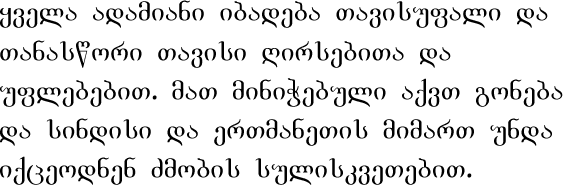
LANGUAGES: Georgian alphabet (Mkhedruli)


Origin
The Mkhedruli alphabet developed from an older Georgian alphabet known as Nuskha-khucuri between the 11th and 13th centuries. The name Mkhedruli comes from the word mkhedari which means 'of horseman'. The Nuskha-khucuri alphabet developed from the Asomtavruli alphabet.
At first Mkhedruli was used only for secular writing, while for religious writings a mixture of the two older alphabets was used. Eventually Nuskha-khucuri became the main alphabet for religious texts and Asomtavruli was used only for titles and for the first letters of sentences. This system of mixing the two alphabets was known as khucesi (priest) writing.
Eventually the two older alphabets fell out of use and Mkhedruli became the sole alphabet used to write Georgian. However, in the writings of a linguist called Akaki Shanidze (1887-1987) and in works written in his honour, letters from the Asomtavruli alphabet are used to mark proper names and the beginning of sentences. Shanidze's attempt to popularise such usage met with little success.
The first printed material in the Georgian language, in the Mkhedruli alphabet, was published in 1669. Since then the alphabet has changed very little, though a few letters were added by Anton I in the 18th century, and 5 letters were dropped in the 1860s when Ilia Chavchavadze introduced a number of reforms.

Notable features
* Type of writing system: alphabet
* Direction of writing: left to right, horizontal
* When printed, Mkhedruli letters are not connected at all, though they can be in cursive handwriting.
* The headline letters are used for titles and headlines.
* Georgian has no symbols for numerals. Each letter has a numerical value as well as a phonological one, but Indic numerals (1, 2, 3, etc) are normally used.
* The order of the Mkhedruli letters is based on that of the Greek alphabet. The Georgian consontants with no Greek equivalents come at the end of the alphabet.

Used to write
Georgian, a Kartvelian or South Caucasian language spoken by about 4.1 million people. It is spoken mainly in Georgia but also in Armenia, Azerbaijan, Iran, Kazakhstan, Kyrgyzstan, Russia, Tajikistan, Turkey, Turkmenistan, Ukraine, USA and Uzbekistan
Mingrelian, a South Caucasian language spoken in north-western Georgia by perhaps half a million people.
Laz, a South Caucasian language closely related to Mingrelian and spoken in Turkey and Georgia by about 33,000 people.
Svan, a South Caucasian language with about 30,000 speakers mainly in the northwest of Georgia.
Abkhaz, a Northwest Caucasian language, was also once written with the Mkhedruli alphabet, but is now written with the Cyrillic alphabet.

Mkhedruli alphabet


Sample text in Georgian

Transliteration
Qvela adamiani ibadeba t'avisup'ali da t'anascori tavisi ġirsebit'a da uplebebit'. Mat miničebuli ak'vt' goneba da sindisi da ert'manet'is mimart' unda ik'c'eodnen żmobis suliskvet'ebit'.
Hear a recording of this text by George Keretchashvili

Translation
All human beings are born free and equal in dignity and rights. They are endowed with reason and conscience and should act towards one another in a spirit of brotherhood. (Article 1 of the Universal Declaration of Human Rights)

Georgian language learning materials

Links
Information about the Georgian language
http://en.wikipedia.org/wiki/Georgian_language
http://www.aboutgeorgia.net/language/

The Georgian Language - a guide to pronunciation and an outline grammatical description

Online Georgian language course

Georgian language Distance Learning Course

Online Georgian dictionaries

Deda Ena (Mother Tongue) - a guide to Georgian art, literature, history, etc (in Georgian and English)

Free Georgian fonts

Online Georgian news and radio

Related languages
Abaza, Abhkaz, Adyghe, Avar, Chechen, Dargwa, Georgian, Ingush, Kabardian, Lak, Laz, Lezgian, Svan, Tabassaran, Tsez, Ubykh

Other alphabets
Armenian, Avestan, Bassa (Vah), Beitha Kukju, Coptic, Cyrillic, Elbsan, Etruscan, Fraser, Georgian (Asomtavruli & Nuskha-khucuri), Georgian (Mkhedruli), Glagolitic, Gothic, Greek, Hungarian Runes, Irish, Kayah Li, Korean, Latin, Lycian, Lydian, Manchu, Meroïtic, Mongolian, N'Ko, Ogham, Old Church Slavonic, Oirat Clear Script, Old Italic, Old Permic, Orkhon, Pollard Miao, Runic, Santali, Somali, Sutton SignWriting, Tai Dam, Thaana, Uyghur

Source: www.omniglot.com

Saturday, March 29, 2008

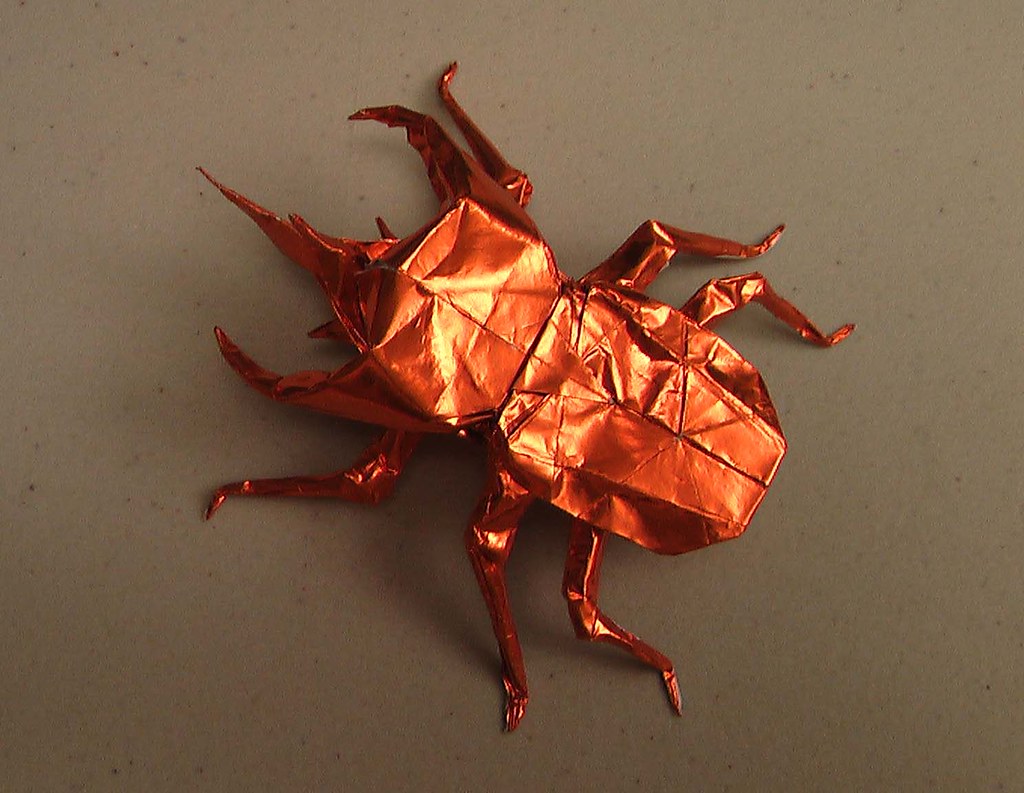
ORIGAMI: Caucasus Giant Beetle

Caucasus Giant Beetle from Origami Insects 1 by Fumiaki Kawahata.

Folded from a 10 inch sheet of Japanese foil paper.


Foto am 17. August 2007 von Isley Unruh

great origami slideshow >>>

more links:

Origami
Origami ist die japanische Bezeichnung für die Kunst des Papierfaltens (ori = falten, kami = Papier, das sich zu gami wandelt ...

Origami Deutschland e.V.
Der Verein zur Förderung des Papierfaltens stellt sich vor und bietet Basstelanleitungen, Artikel und Bilder.

Origami - Wikipedia
Lange Zeit kannte man im Origami nur eine kleine Anzahl traditioneller Modelle wie z. B. den Kranich (Japan) oder den Pajarita (Spanien).

Origami-Kunst: Bilder, Faltanleitungen, Buchtipps und mehr zum ...
Bilder von Origami Modellen, Faltanleitungen, Buchtipps und mehr zur Kunst des Papierfalten.

origami-online
Man findet Bilder, Tipps und Links zum Thema.

Diagramme Origami-Anleitungen
Origami Deutschland (>Faltanleitungen). Krimskrams-Box > Anleitung CHRISTINE EDISON hat eine verblüffend ähnliche Box entwickelt.

Tina's Origami
Find out of print and other hard to find Origami books here: ... On Origami and everything else: tina@origamiweb.com

Origami, Papierfalten, Papierarbeiten RSS Feed
Ein Blog über Buchbinden, Papierarbeiten, Origami und sonstige kreative oder auch einfach nur interessante Dinge, ergänzt mit Beiträgen zu Buchkunst.

Saturday, March 08, 2008

GEORGIEN: Der Deutsche Toppmöller ist beeindruckt von seiner "Neuen Heimat"

Vieles findet der deutsche Trainer Klaus Toppmöller, der die georgische Nationalmannschaft zur Weltmeisterschaft nach Südafrika 2010 führen will, in Deutschland einfach "lächerlich".


Viel mehr Freude macht dem Mann von der Mosel seine Arbeit als georgischer
Nationaltrainer. Schon seine ersten Tage seien überwältigend gewesen, die
Gastfreundschaft beispiellos. "Die haben mich gleich zum Staatspräsidenten
Micheil Saakaschwili gschleppt", erzählt er. Der Staatschef ist mittlerweile
sein Freund. Toppmöller, der in Georgien Mister Klaus genannt wird, ist in
Georgien ein Volksheld.

Mehr >>>

Links:

* Georgische Nationalmannschaft bei Wikipedia
* Homepage des Verbandes (en, ge)
* Georgian Soccer (en)
* Spielplan und Ergebnisse (de, en, fr, es)
* Georgian Football, ein Online-Magazin (en)

Saturday, December 22, 2007

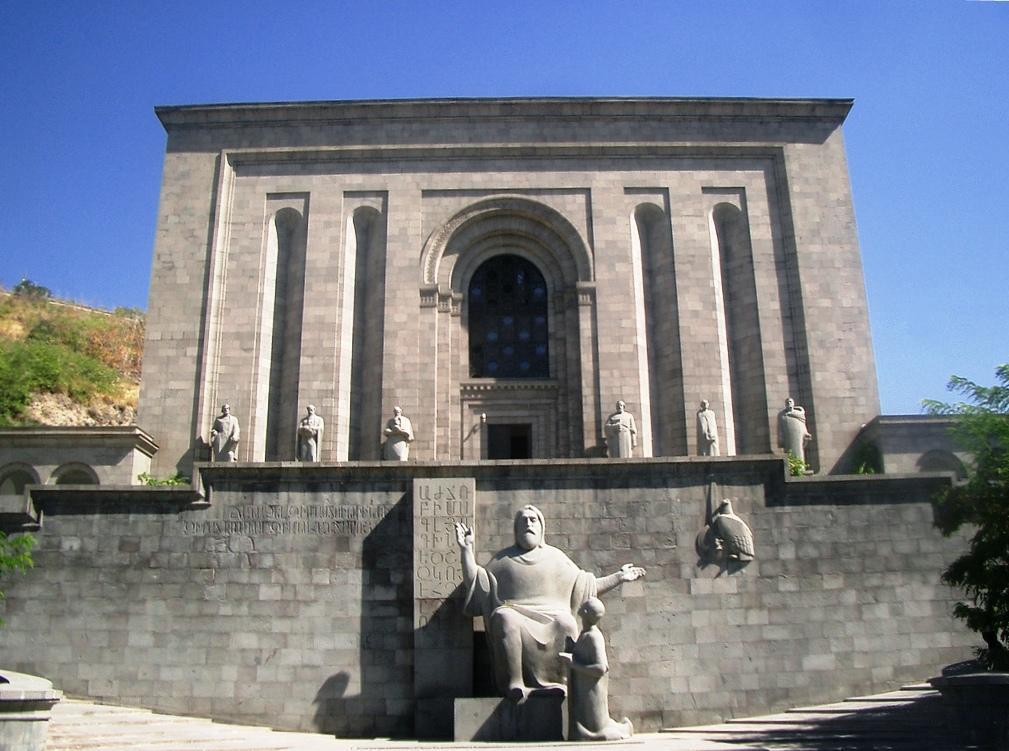
MUSEUM: Matenadaran Museum


The Matenadaran is one of the oldest and richest book-depositories in the world. Its collection of about 17000 manuscripts includes almost all the areas of ancient and medieval armenian culture and sciences - history, geography, grammar, philosophy, law, medicine, mathematics-cosmography, theory of calendar, alchemy-chemistry, translations, literature, chronology, art history, miniature, music and theatre, as well as manuscripts in Arabic, Persian, Greek, Syrian, Latin, Ethiopian, Indian, Japanese and others. In this center of cultural heritage many originals, lost in their mother languages and known only of their Armenian translations, have been saved from loss.

The history of the Matenadaran dates back to the creation of the Armenian alphabet in 405. This center of manuscripts has a history of centuries and the history continues now as well.

Visit the Virtual Matenadaran, and find out yourself: www.matenadaran.org

or www.matenadaran.am

Photo & Textes on December 20, 2007 by nersess

Wednesday, December 12, 2007

RADIO: Georgian Music on Radio Blau (live Stream) , Ding Dong, 13.12., 22:00 (german time)

Bert the Juggler & Ralph Hälbig (Guest)

www.myspace.com/radioblau

Georgian Music on Radio Blau
Ding Dong, 13.12., 22:00 (german time)


www.radioblau.de

(Livestream) !!!!!! Good time for listening !!!

Live und direkt - an jedem Ort der WeltRadioBlau online hören:
128 kB/s mpeg:
direkt / WinAmp / MediaPlayer / RealAudio
96 kB/s mpeg:
direkt / WinAmp / MediaPlayer / RealAudio
48 kB/s aacp:
direkt / WinAmp / MediaPlayer / RealAudio

Bitte beachten: außerhalb unserer Sendezeiten ist das Programm von ApolloRadio zu hören!

Der Stream ist in jedem Fall im angegebenen Format (mpeg bzw. aacp), die obigen Verknüpfungen enthalten lediglich Metadaten für die unterschiedlichen Wiedergabeprogramme. Welches davon funktioniert hängt in erster Linie von der lokalen Konfiguration ab. Im Zweifelsfall bitte die Adresse der Verknüpfung "direkt" im gewünschten Programm manuell öffnen.
Wir danken für die Unterstützung:

Primacom AG - http://www.primacom.de

ClickPlanet - http://www.clickplanet.de

täglich auf UKW99,2 MHz, sowie:94,4 MHz & 89,2 MHz (Karte)

97,9 MHz (primacom Kabel)

with LiveStream

Programm zum Ausdrucken

Telefon: 0341 - 3 01 00 06

E-Mail: radioblau@radioblau.de

ein Projekt des Radio-Verein Leipzig e.V.

Mit einem unschuldigen ding dong beginnt sie jedesmal, Bert Jugglers Reise in eine wundersame Welt der Wahrnehmung. Er mischt zeitgenössische elektronische Musik und Klassiker verschiedenster Epochen mit selbst gemachten Tönen und Geräuschen und serviert dazu Anekdoten, Kurzgeschichten und Hörspiele. Ein etwas anderes Hören stellt sich ein und ermöglicht es uns, die Wahrnehmung die Vielfalt und Schönheit von Musik neu zu erleben.