Showing posts with label Socilogy. Show all posts

Thursday, January 27, 2011

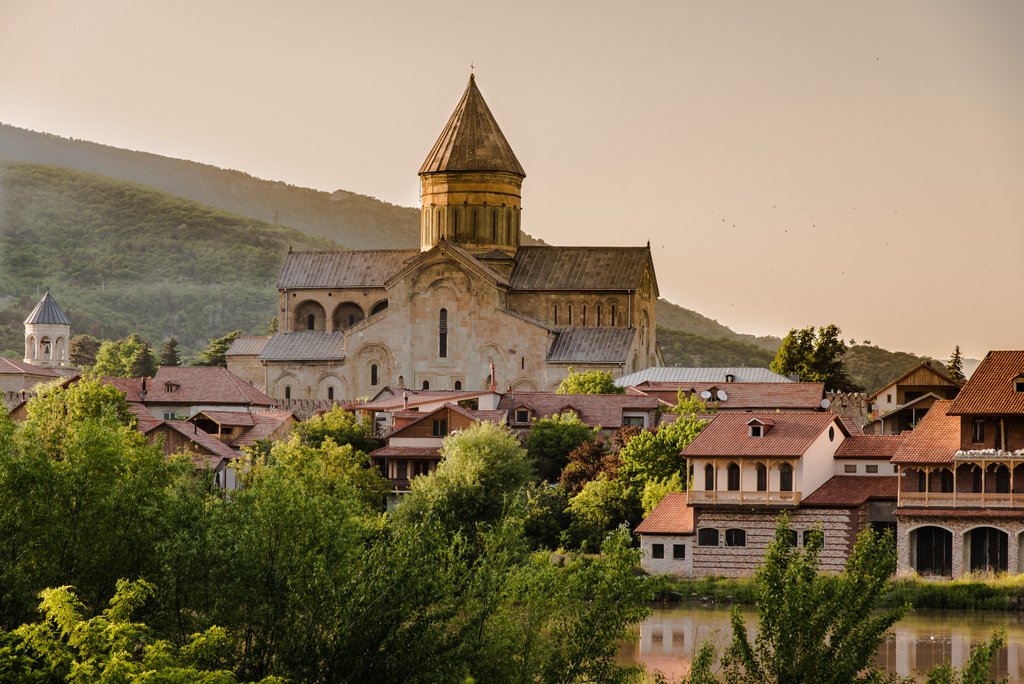
EINLADUNG ZUM LÄNDERABEND: Die Autorität der orthodoxen Kirche in Georgien (copernicus-stipendium.de)

Copernicus Berlin e.V. lädt am Mittwoch, dem 2. Februar 2011, um 19.00 Uhr zu einem Länderabend mit dem Thema "Die Autorität der orthodoxen Kirche in Georgien" in die Räume der Heinz-Schwarzkopf-Stiftung in der Sophienstraße 28/29, Berlin Mitte herzlich ein.

Die orthodoxe Kirche Georgiens ist eine der ältesten christlichen Kirchen der Welt. Bei der Nationalbildung des Landes hat sie eine wichtige Rolle gespielt. Auch heute weist die orthodoxe Kirche in Georgien nicht nur zwischen Georgiern, sondern auch zwischen Aserbaidschanern, Armeniern, Katholiken und Juden eine hohe Autorität auf. Die georgische Copernicus-Stipendiatin Nino Gugushvili studiert Sozial- und Politikwissenschaften an der Staatlichen Universität Ivane Javakhishvili in Tiflis. Nino gibt einen Einblick in ihr Heimatland und diskutiert, welche Rolle die orthodoxe Kirche in der Geschichte Georgiens hatte und welche Rolle sie heute einnimmt. Welche Probleme gab es nach dem Zerfall der Sowjetunion? In welcher Beziehung stehen Kirche und Regierung zueinander? Geht eine Gefahr aus dem religiösen Extremismus hervor? Anschließend besteht die Möglichkeit, Fragen zum Thema zu stellen und die Diskussionsrunde mit eigenen Beiträgen zu bereichern.

Der Verein lädt die Teilnehmer im Anschluss an die Veranstaltung zu weiteren Gesprächen im informellen Rahmen bei einem kleinen Buffet mit Getränken und selbst zubereiteten, osteuropäischen Spezialitäten ein. Der Eintritt ist frei.

Spenden für die Arbeit des Vereins sind willkommen. Diese Einladung kann gerne an Freunde und andere Interessenten weitergegeben werden!

Mit freundlichen Grüßen
Vorstand und PR-Team von Copernicus Berlin e.V.

Copernicus Berlin e.V.
im Internet: Webseite +++ Blog +++ bei Facebook +++ bei Twitter


Copernicus Berlin e.V. ist ein von Studenten, Absolventen und jungen Berufstätigen getragener gemeinnütziger Verein, der in den zehn Jahren seines Bestehens 69 Studenten aus 20 Ländern ein Stipendium in Berlin ermöglicht hat. Neben dem Studium an einer deutschen Universität absolvieren die Stipendiaten ein mehrmonatiges Praktikum und werden von Mentoren intensiv und persönlich betreut. Das Stipendium wird über Stiftungsgelder, Spenden und Patenschaften finanziert. Einen besonderen Aspekt des Copernicus-Stipendienprogramms ist die Unterbringung und Verpflegung der Stipendiaten in Berliner Gastfamilien.
Für weitere Informationen steht Ihnen unser Pressebeauftragter per E-Mail:
presse@copernicus-stipendium.de zur Verfügung.

Copernicus Berlin e.V., Paulinenhof, Sophienstrasse 28/29, 10178 Berlin - Vorstand: Clara Kemme, Nicole Haag, Sina-Mareen Grasmück - Vereinsregisternummer: VR 20436 B - Spendenkonto: Kontonummer 993 940 400 / Bankleitzahl 100 800 00 / Dresdner Bank

Thursday, August 12, 2010

NEW BOOK: Politik und Erinnerung. Der Diskurs über den Armeniermord in der Türkei zwischen Nationalismus und Europäisierung. Von Seyhan Bayraktar

www.transcript-verlag.de
August 2010, 314 S., kart., 29,80 €
ISBN 978-3-8376-1312-4 Reihe
Global Studies

Schlagworte:
Erinnerungspolitik, Völkermord an den Armeniern, EU und Türkei, Europäisierung, Politische Kommunikation


Adressaten: Politikwissenschaft (Internationale Beziehungen), Soziologie, Geschichtswissenschaft

Der problematische Umgang der Türkei mit dem Mord an den Armeniern während des Ersten Weltkriegs wird in der kontroversen Debatte um den EU-Beitritt der Türkei zwar viel beachtet, ist bislang aber kaum systematisch untersucht worden: Wie haben sich der Erinnerungsdiskurs und die Vergangenheitspolitik in der Türkei im Zeitverlauf entwickelt? Welche Rolle spielt nationale Identität? Wie wirkt sich der internationale Druck aus, der die Europafähigkeit der Türkei zunehmend an deren Anerkennung des Völkermordcharakters der Vertreibungspolitik koppelt?Die Vertreibung der Armenier ist zwar von einem randständigen Thema in den Mittelpunkt der gesellschaftlichen Auseinandersetzung in der Türkei gerückt. Seyhan Bayraktar kann aber anhand der beteiligten Akteure, diskursiven Rahmungen und vergangenheitspolitischen Maßnahmen zeigen, dass dieser Wandel keine paradigmatische Abkehr vom Leugnungsdiskurs bedeutet, sondern für eine zunehmend ausgefeiltere Deutung der Geschichte steht, die sowohl innen- als auch außenpolitisch strategiefähig ist.

Seyhan Bayraktar (Dr. rer. soc.) arbeitet am Forschungsbereich Öffentlichkeit und Gesellschaft (fög) der Universität Zürich. Ihre Forschungsschwerpunkte sind Politische Kommunikation, Türkei, Europäische Union, Migration und Nationalismus. www.foeg.uzh.ch

Leseprobe (PDF-Datei)

AmazonShop: Books, Maps, Videos, Music & Gifts About The Caucasus

Saturday, January 17, 2009

CONFERENCE: A Sociology for Media Society, 11.-14.06.09, International Institute of Sociology, Eriwan

Vom 11.-14. Juni 09 findet auf dem World Congress des International Institute of Sociology (IIS) 2009 in Eriwan/Yerevan ein Panel zum Thema “A Sociology for Media Society” statt. Gesucht werden theoretische Entwürfe sowie emprische Befunde zum Konzept “Mediengesellschaft”; die Konferenzsprache ist Englisch.

Die Deadline für englischsprachige Extended Abstracts oder Full Papers ist der 28. Februar.

Bitte per Email an marian.adolf@zeppelin-university.de

A Sociology for Media Society, 11.-14.06.09, International Institute of Sociology, Eriwan

Friday, August 10, 2007

SCIENCE:

International conference Socio-demographic change of European cities and its spatial consequences
Leipzig (Germany), 14-16 April 2008

Call for Papers

During the last decades, demographic and social change came up as decisive factors im-printing on the shape and development of urban structures in Europe. They affect housing markets as well as residential patterns, location decisions or the use of amen ities.
While social transformations represent a major issue of urban studies, demographic change is still relatively rarely taken notice of. This is all the more astonishing, as demography always mattered in urbanisation processes, be it as population g rowth or shrinkage, in- or out-migration, rejuvenation or ageing. The phenomena of the Second Demographic Transition population decrease, ageing, evolving diversity of migration as well as of household and life style
patterns bring about new challenges but also prospects for European cities. To stabilise and keep up attractive cities is one of these challenges. The effects of socio-demographic changes certainly differ from context to context. Throughout Europe, common trends coincide with regional fragmentation and diversification. Set against this background, it is the objective of the international conference:

Socio-demographic change of European cities and its spatial consequences in Leipzig (Germany), KUBUS conference centre, 14 - 16 April 2008

... to identify and explain current socio-demographic processes and their consequences for urban spatial structures, housing markets, segregation patterns, decision-making processes and policy instruments. What is the current impact of declining (or increas ing) population numbers, transforming household structures, ageing and immigration on urban processes at different scales and what is to be expected in future? The regional focus of the conference comprises the whole of Europe. Papers related to cities in East Central and Eastern Europe are especially welcome. We appreciate theoreti-cal, conceptual, empirical and methodological contributions from different fie lds of urban and demographic research. Since the conference wants to highlight the comparative view both in terms of content and space, cross-national comparisons are particularly appreci-ated. Conference papers should address one or several of the following umbrella topics:
1. Interplay of demographic and societal processes in European cities;
2. Qualitative and quantitative change of demographic structures in European cities;
3. Household change and its consequences in the inner and outer city ( housing de-mography );
4. Socio-demographic diversification of residential structures and neighbourhoods;
5. Residential mobility and its impact on the shape of urban spatial structures;
6. Immigration processes as drivers of urban change;
7. Simultaneousness of shrinkage and growth in urban agglomerations;
8. Effects of socio-demographic change on housing markets, infrastructure, planning processes and governance structures;
9. Instruments and strategies of municipalities, housing companies, landlords and other urban actors to cope with socio- demographic change.
Please send an abstract using the form attached here or on our project website under www.condense-project.org by 31 October 2007
to condense@fu-confirm.de.

Since the program of the conference also includes a moderated poster session you are welcome to present a poster. If you are interested please also send an abstract and indicate clearly that the abstract relates to a poster.

As a poster presenter, your attendance at the conference is obligatory since posters will be presented by you during a separate session. The decision about the acceptance of all submitted abstracts will be made until 10 December 2007. The convenors of the conference plan different publications in the aftermath of the conference (in particular in highly ranked scientific journals).

More information on postconference papers will be provided during the conference. For the conference two full days are planned for sessions. On the third day for an extra charge there will be organised an excursion.

The conference fee amounts to 150€ and 100€ for students and PhD students for early bird registration until 15 January 2008.
After that date, it amounts to 200€ resp. 120€.

The fees include conference materials, coffee/tea break catering as well as a conference dinner at the KUBUS conference centre on 14 April.

Travel and accommodation costs must be covered by the participants.

Do let us know if there are any special difficulties with the payment requests.

For further information about the conference please visit the website
www.condense-project.org or contact condense@fu-confirm.de.

Annegret Haase, Sigrun Kabisch and Annett Steinführer
(conDENSE project)
Helmholtz Centre for Environmental Research
Department of Urban and Environmental Sociology
Permoserstr. 15
04318 Leipzig (Germany)
www.ufz.de
www.condense-project.org