more: Brides From Belarus +++ thedailybeast.com +++ Photographs and text by Justyna Mielnikiewicz
Showing posts with label Rusiko Oat. Show all posts
Sunday, June 24, 2012
PRESENTATION: Photo-Project about Belarus. SEVEN different stories by 7 photographers in OAT GALLERY & ART CAFE 144 Stairs.
SEVEN different stories by 7 photographers by sputnikphotos.com
Location:
OAT GALLERY & ART CAFE 144 Stairs, Address: silamazis shesaxvevi 14
on FRIDAY, JUNE 29 th, 9 pm.
The main idea of the project is to show daily life of Belarus, as things seemingly far from politics and Lukashenko’s regime are not usually presented in mainstream media outside the country. A group of seven photographers of different nationalities went to Belarus to find out what is behind the ‘last dictatorship in Europe’ phrase everybody keeps repeating. Getting to know this country turned out to be difficult. As Victor Martinovich writes in his essay, in Belarus you constantly witness endless manifestations of a double system, there are two writers’ unions, from 1996 to 1999 there were even two parliaments ̶ life is hard and at the same time everything is clean and neat in Minsk, when you come for a visit.
Project was supported by the European Cultural Foundation.
Photos & Texts © by Photographers:
Jan Brykczyński, Andrei Liankevich, Manca Juvan, Justyna Mielnikiewicz, Rafał Milach, Adam Pańczuk, Agnieszka Rayss.
Text "A Country of Borders" © Victor Martinovich
Curator: Andrzej Kramarz
Book Concept and Graphic Design: Ania Nałęcka / Tapir Book Design
more: Brides From Belarus +++ thedailybeast.com +++ Photographs and text by Justyna Mielnikiewicz
Thursday, May 06, 2010
VORTRAG: Zeitgenössische Kunstszene im heutigen Georgien. Von Rusiko Oat in Wien (orient-gesellschaft.at)
Montag, 17.05.2010, 18:30 Uhr - 20:00 Uhr
Österreichische Orient-Gesellschaft Hammer-Purgstall, Klubsaal
Vortrag
Zeitgenössische Kunstszene im heutigen Georgien
Rusiko Oat, Kunstkuratorin, Kunstkritikerin, Leiterin der New Art Union und des Art Cafe in Tbilisi
Ich freue mich sehr auf Ihr Kommen!
Ihre Silvia de Carvalho
Adresse:
Österreichische Orient-Gesellschaft Hammer-Purgstall, Dominkanerbastei 6/6,
1010 Wien, Klubsaal
silvia de carvalho
information center for central asia and southern caucasus c/o austrian
association for the middle east
dominikanerbastei 6/6, 1010 vienna, austria
phone: ++43 1 512 89 36 /16
e-mail: silvia.carvalho@orient-gesellschaft.at
www.orient-gesellschaft.at
Österreichische Orient-Gesellschaft Hammer-Purgstall, Klubsaal
VortragZeitgenössische Kunstszene im heutigen Georgien
Rusiko Oat, Kunstkuratorin, Kunstkritikerin, Leiterin der New Art Union und des Art Cafe in Tbilisi
zuständiges Referat: Informationszentrum für Zentralasien und Südkaukasien
Abendkarte: € 4 (€ 2)
Im Anschluss an den Vortrag dürfen wir Sie auf ein Gläschen guten georgischen Wein einladen!!
Ich freue mich sehr auf Ihr Kommen!
Ihre Silvia de Carvalho
Adresse:
Österreichische Orient-Gesellschaft Hammer-Purgstall, Dominkanerbastei 6/6,
1010 Wien, Klubsaal
silvia de carvalho
information center for central asia and southern caucasus c/o austrian
association for the middle east
dominikanerbastei 6/6, 1010 vienna, austria
phone: ++43 1 512 89 36 /16
e-mail: silvia.carvalho@orient-gesellschaft.at
www.orient-gesellschaft.at
Labels:
Art,
Austria,
Georgia,
New Art Cafe,
New Art Union,
Rusiko Oat,
Silvia de Carvalho,
South-Caucasus,
Vienna
Monday, December 28, 2009
TEXT: RUINS OF OUR TIMES. By Joanna Warsza / Laura Palmer Foundation / Warsaw
The text will be published in Team Network magazine and in Obieg on-line.
Georgia and Armenia are full of landscapes of frozen moments. With the fall of the Communist regime, the trains stopped n mid-route, the cable car over one of the cnyons of Tbilisi has been abandoned halfway, and the housing estates of the never realized future found temporary settlers. Tracing the unwanted heritage of the Soviet past in the Caucasus, at times I had a strange sense of witnessing the future. The self-organized methods adopted in the years of post-collapse crises recall the most progressive contemporary theories of bottom-up structures and participatory urban planning: the cinema-theater Rossia in the middle of Yerevan found a secondary use as a market and mini-bus station, the never completed city of Gyumri in Armenia was finished by the motivated settlers themselves, the mikro-raion estates in Tbilisi have expanded with new parasite parts called kamikaze loggias. The Caucasus, following a process of Eastern Bloc Westernization, is fortunately still full of heterotopias, stunning ruins of our own age, and of self-organizing policies that tend to be forgotten in a time of ‘euroremonts’, and ‘Eurenovations.’
Ruines of the future, never accomplished project builidng, Mush, Armenia
FROZEN MOMENTS
On the western outskirts of Tbilisi one encounters a thrilling Caucasian picture. A cable-car supposed to link the unfinished University campus with the metro station was stopped at the very second the Soviet system collapsed in 1991. Since then it has been hanging in the air over a picturesque canyon, abandoned in the middle of its route, above the heads of people passing down in the valley who no longer even notice it. The Caucasus, with its tremendous landscapes, is full of this phantom heritage, when the Socialist reality became the past, when the world stopped and started again.
Coming myself from a post-Communist (though not post-Soviet country), I have been witnessing since 1989 how quickly the former Eastern Bloc, and Poland in particular, has been cleaning up its past. Westernization, pro-euroatlanticism and procapitalism (‘once Moscow, Brussels today’ policy), have become the new and only format for life. Georgians and Armenians have a good term for this phenomenon — the euroremont (‘eurenovation’). The Poles have performed especially well: we still live in the same housing blocks, but they were immediately repainted and wrapped in polystyrene, the streets were filled with endless early-capitalist vendor kiosks, and later with huge billboards and all sorts of advertising campaigns. Social Realist architecture in the big cities was quickly transformed, covered up, or lifted in order to be a part of a new narrative.
One of the very few examples of Polish Socialist Realist decay was the 10th-Anniversary Stadium in Warsaw. Built in 1955 from the rubble of a war-devastated city, it was to preserve Communism’s good name for forty years. In the early 1990s it fell into ruin, being at the same time “revived” by the Vietnamese intelligentsia and Russian traders, pioneers of capitalism, who established an open-air market. It became the only multicultural site in the city, a storehouse of biographies and urban legends, a piece of Land Art, a workcamp for anthropologists, botanists and archaeologists. It was in fact the one and only heterotopic zone in central Warsaw, free from the unwritten laws of westernisation and euroremonts.
KAMIKAZE LOGGIAS AND SELF-ORGANISED MICRORAYONS
The Georgian and Armenian situation was different. The Russians went home, but left behind their utopian infrastructures in the former republics. People started organically responding to the changes through a particular, self-organised relationship to the architecture. A refusal of the dominant structures, the provisional liberty, and scepticism as to all master plans led to participatory forms in the urban environment. Emergent movements started to occur, especially in the “microrayons” — the large-scale social-housing projects developed throughout the entire former Soviet Union, as well as in Vietnam and in Eastern Europe. A “microrayon”, or microdistrict, was initially supposed to be a self-sufficient unit affording its inhabitants comfort and the pleasure of living, thus realising Le Corbusier’s utopia of the collectivity and harmonious cohabitation through architectural and social engineering. If this happened it was not through a masterplan, but initiatives from the bottom-up.
At the beginning of the 1990s many owners of a block apartment would hire an engineer to design an extension to their home. This whole new parasite part, called a kamikaze loggia, would grow out one side of the building, expanding the living space. This was nothing new for Georgia; palimpsest structures and extensions have always been a commonly applied method of expanding a living surface in this country located on steep Caucasian slopes. One has to remember that Georgia was the “honey of the USSR” — the richest state, with quite oversized and representational houses. In the dark and poor Shevardnadze years after the fall of Communism, the extensions continued, even using found scrapmetal or other cheap materials of all kinds.
THE NON-EXISTENT MINISTRY OF A NON-EXISTENT COUNTRY
The Georgian palimpsest spirit is perhaps best reflected in an icon of Caucasian architecture, the former Georgian Ministry of Highways, (საქართველოს საავტომობილო გზების სამინისტროს შენობა) built in 1975 by architect George Chakhava, since last few years bought by a bank and standing empty, overgrown with vegetation. This fascinating building was meant to stand in harmony with the mountain villages. The structure consists of a monumental grid of interlocking concrete forms, five horizontal parts of two storeys each seeming to stand on top of each other.
The design is a reference to the concept of Ville Spatiale by Yona Friedman, who didn’t want to displace the city, but to raise a second city twenty meters above the existing one. Chakhava’s other reference was also a forest, with the cores as the trunk and the horizontal parts as the crowns, so as to provide a lot of free space for other living beings and nature. The former Ministry on Gagarin street also brings to mind the work of the Japanese Metabolists, whose flexible, and expandable structures built in the 1960s evoked processes of organic growth. With its unrealistic and multi-extensional structure, the building seems to be an unintended tribute to the most recent, early-capitalist architectural changes in the urban environment of Tbilisi, but carrying a long tradition of self-built palimpsests.
BACK TO THE FUTURE
Staying for two months in Georgia I sometimes had a strange sense of witnessing the future. The self-organized methods adopted in the years of crises after the collapse of the USSR recall the most progressive contemporary theories of bottomup structures and participatory urban planning. The Chilean architect and theoretician Alejandro Aravena created Elemental, a “do-tank” combining art, architecture and engineering, understanding the city to be a resource for building social equity. His statements, considered visionary, about buying half a house and filling the other half with years, are a kind of selffulfilling prophecy in Caucasus. People don’t ask themselves the developer-like question, “Where would you like to live?” but rather how to organize the city from its successive layers.
A project awarded a Golden Lion at the last Venice Architecture Biennale, The Afterlife of Buildings by Grzegorz Piatek and Jarosław Trybus, pictured an apocalyptic secondary use for famous Polish properties: a Warsaw airport terminal would be turned into a chicken farm, a Norman Foster building into a prison, or a financial centre into a crematory. Applying both theories the Caucasus could move ahead, full of secondary uses. One could cite the Yerevan cinema-theatre Rossia, build in 1979 as a youth palace, sports and concert complex, and museum, now turned into a huge market in the former screening rooms and hallways and a busy mini-bus station.
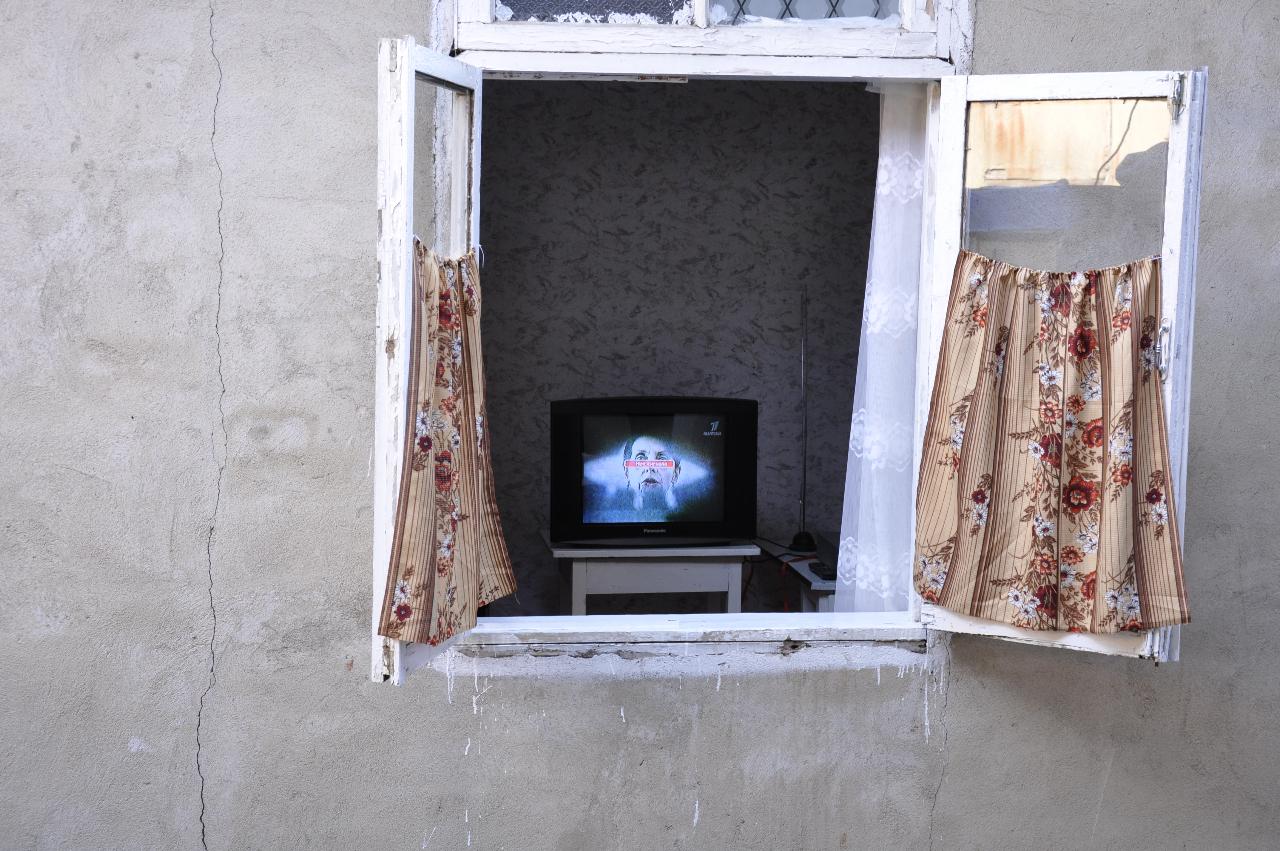
Some Caucasian artists have a great intuition of how to grasp these fantastic reality shifts. For more than ten years Georgians had no more than two hours of electricity per day — what they now call the dark years. Back then some foreign-channels were illegally broadcasting on Georgian channels frequencies. As a result two logos appeared on the screen and the quality of transmission was sometimes interrupted, bringing the image to a standstill. Rusiko Oat, a curator and the owner of the New Art Cafe in Tbilisi made an artwork resulting from the infamous electricity cuts. No Signal was an image created, as she puts it, by electro-waves. On the screen there suddenly appeared a dramatic image of the face of an old lady superimposed on a commercial and captioned with the mysterious Russian inscription Niet signala. In the logic of media marketing, this was a kind of electronic magic, allowing for one’s own interpretation of the neo-now, quite remote from the original idea of an advertising spot and bearing fantastic information.
Two Amsterdam-based artists, Rosell Heijmen and Lado Darakhvelidze, one Dutch, the other Georgian, mapped the city of Tbilisi through its endless marschrutka lines. Marschrutkas are the minibuses that serve as a means of public transport. Anyone can start a new line in a second-hand mini-van brought over from Germany. There are over 200 marschrutka tours in the city and even more in the countryside. Because they stop everywhere, they have an advantage over other public transport (regular buses and electricity have been in service only since the advent of the Saakashivili regime) but are forbidden on the main avenues. After the Rose Revolution, most of the squares and street names were changed, but the marschrutkas signs kept the old ones written in the Georgian alphabet. As a result only the citizens of Tbilisi have knowledge of where a marschrutka is heading. The destination signs somehow tell the recent history of the city. Heijmen and Darakhvelidze produced a marschrutka map in English, seeing the mini-vans as vehicles taking one back in time, letting the non-Georgian find her way, to translate the past and the present and grasp a specific reality of the city. The wide avenue leading from the airport to downtown is named after George W. Bush, and prior to his visit all the facades had been repainted and touched up only from the front side.
Sophia Tabatadze, a Georgian artist based in Berlin, has been observing the changes in post-Soviet Georgia following the transformation of one of these Tbilisi blue facades. She documented the changes on a building between 2003 and 2008. In In a Country with a Flourishing Democracy, even Plastic Flowers Will Blossom, she depicts how, while Georgia has been rushing from one system to the other, this facade has been quickly adapting and making itself look more and more European.
GHOST CITY
Gyumri is the second largest city in Armenia and suffered a terrible earthquake in 1988. In order to help those who lost their homes, the Soviet Government decided to build a new residential area called Mush, after the name of one of the Armenian cities from the Turkish genocide of 1915. The new Mush was supposed to be a large social-housing project adjacent to Gyumri. Construction began in 1988 but was never completed because of the fall of Communism in 1991. Mush stands in the middle of the fields as an unfinished city, with blocks, administration buildings, and playgrounds. The city has been left at mercy of time and weather and politics. It takes ten minutes by taxi to get there from the centre of Gyumri. A few buildings were completed by the motivated settlers themselves, who made up the variously styled windows or doors, quite often out of materials found in neighbouring empty houses. Walking through Mush one experiences a special aura. It might be a never realised “radiant future”, the obscure and difficult Armenian past, a menace of global catastrophe to come, a promise of a secondary use. Mush might recall the idea of the ‘transition towns’ created in Ireland with the aim of equipping communities for the challenges of climate change and peak oil. The chosen communities try to live in a sustainable manner and build local resilience in the near future, trying to reduce the energy use and increase their own self-reliance by repairing or re-using the old items rather than throwing them away.
Mush was brought to the arts and to public debate by Armenian artist Vahram Aghasyan who photographed the site for several months. In his thrilling series Ghost City from 2006-on going he observes the silent Mush and shows other possible scenarios to come, such as a gigantic deluge echoing the Great Flood from the Bible, which took place not far from there. In the totality of his work, as in Ruins of Our Time (deserted bus stops from the 1960s), or Ruins of Private Property (the demolition of an illegal gated community near Istanbul), he profoundly analyses the cultural and socio-political changes in Armenia through images of spectacular contemporary remnants and post-Soviet entropy.
A DERVISH ONCE SAID: BETWEEN WESTERN ALIENATION AND EASTERN SUBMISSION I’LL TAKE: A BATH*
One main critique of Edward Said’s Orientalism was that he had only examined the relations of the first and the third world, omitting the complex and never discussed hierarchical structures within the second world, meaning Eastern Europe or Euroasia. The international collective Slavs and Tatars (Kasia Korczak, Payam Sharifi, Boy Vereecken, and Victoria Camblin) takes a great lesson of emancipation from out of the culture of less visible nations and countries between the east of the former Berlin Wall and the west of the Great Wall of China, focusing on the sphere of influence shared by Slavs, Caucasians and Central Asians. Their books and installations combine scholarly research with pop culture, urban legends, their own experiences, and postcolonial studies. Their last art book Kidnapping the Mountains, addresses the complexity of identities, languages, stories and time in the Caucasus. Their previous publication, A 13th Month Against Time, was inspired by an old form of the Jalali calendar, used by the Zoroastrians and still in use in Iran and Afghanistan. Originally, in the 11th century, it added an additional month every six years. Slavs and Tatars published a calendar of the 13th month with 32 days (or pages) as a libretto of reflections on the defeatist approach to time. Their art-based research, rooted in critical theory and glamour, goes against both the superiority of Western gaze and exploration and Eastern Westerncentrism.
The Tbilisi performative-art Bouillon Group also act as selfproclaimed anthropologists, taking non-questioned culture elements as material for their artwork and seeking to reveal the conflict between comfort and nonconformity. The artists created a descriptive deconstruction of a figure of Mother Georgia, an aluminium statue overlooking Tbilisi erected in 1958 (similar ‘Mothers’ were then erected in Armenia, Ukraine and Russia), meant to protect the country. Mother Georgia holds a bowl of wine to greet those who come as friends, and a sword to defend herself from enemies. Bouillon saw the statue as a hermaphroditic and ambiguous figure, a product of Georgian circumstances.
FORMER WEST
After the long and effective process of self-applied Westernisation by many Central European countries, we now hope to witness the coming out of a cognitive East. The Warsaw Museum of Modern Art is leading a complex research project to rewrite an European art history not only with Western names, but identifying with our part of Europe. For Charles Esche, a critic and director of the Van Abbemuseum in Eindhoven, the Netherlands, to be Western stands for being short-sighted and lacking the openness and tools to experience things in their plurality. Together with several other European institutions he is launching the research platform called “Former West”. This term, never extensively employed as a counterpart to the widely used “former East”, is meant to examine what impact the events of 1989 had on the art of the “West”.
I recently participated in a conference about art-world standards where many speakers debated how to have the East change and live up to Western standards. One Ukrainian artist stood up and riposted, “And I want to ask you when the West will change?!” Eastern Europe no longer exists, though perhaps with some Georgian and Armenian exceptions.
* after the title of Slavs and Tatars’ work in: Kidnapping Mountains, Book Works, London 2009. Slavs and Tatars investigates different forms of knowledge than those available to us in the West: be it emotional, critical, spiritual, or political. Despite the rampant Islamophobia in the west, dervish and Sufism seem to remain the most palatable, ‘white’-friendly form of Islam. The dervish print addresses the East versus West divide, first as a choice and then immediately as one to be altogether avoided.
Joanna Warsza is curator on the cusp of performing and visual arts, working mostly in public space with the invisible, the ephemeral or staged situations. Recently she made two public art projects in Tbilisi, Georgia dealing with the legacy of post-soviet architecture. Director of a NGO - Laura Palmer Foundation, for projects between fiction and reality, writer for Obieg Magazine.
The research trip to Georgia and Armenia was possible with the generous help of European Culture Foundation and Open Society Institute Budapest.
www.eurocult.org
www.soros.org
links:
http://picasaweb.google.com/Laura.Palmer.Foundation
and www.artzona.pl
House of poets where SARTRE and BEAUVOIR stayed, Lake Sevan, Armenia
Bouillon group in Supra performance debating on Mother Georgia gender issues / Betlemi mikro-raioni / October 2009 / ArtZone
Georgia and Armenia are full of landscapes of frozen moments. With the fall of the Communist regime, the trains stopped n mid-route, the cable car over one of the cnyons of Tbilisi has been abandoned halfway, and the housing estates of the never realized future found temporary settlers. Tracing the unwanted heritage of the Soviet past in the Caucasus, at times I had a strange sense of witnessing the future. The self-organized methods adopted in the years of post-collapse crises recall the most progressive contemporary theories of bottom-up structures and participatory urban planning: the cinema-theater Rossia in the middle of Yerevan found a secondary use as a market and mini-bus station, the never completed city of Gyumri in Armenia was finished by the motivated settlers themselves, the mikro-raion estates in Tbilisi have expanded with new parasite parts called kamikaze loggias. The Caucasus, following a process of Eastern Bloc Westernization, is fortunately still full of heterotopias, stunning ruins of our own age, and of self-organizing policies that tend to be forgotten in a time of ‘euroremonts’, and ‘Eurenovations.’
Ruines of the future, never accomplished project builidng, Mush, ArmeniaFROZEN MOMENTS
On the western outskirts of Tbilisi one encounters a thrilling Caucasian picture. A cable-car supposed to link the unfinished University campus with the metro station was stopped at the very second the Soviet system collapsed in 1991. Since then it has been hanging in the air over a picturesque canyon, abandoned in the middle of its route, above the heads of people passing down in the valley who no longer even notice it. The Caucasus, with its tremendous landscapes, is full of this phantom heritage, when the Socialist reality became the past, when the world stopped and started again.
Coming myself from a post-Communist (though not post-Soviet country), I have been witnessing since 1989 how quickly the former Eastern Bloc, and Poland in particular, has been cleaning up its past. Westernization, pro-euroatlanticism and procapitalism (‘once Moscow, Brussels today’ policy), have become the new and only format for life. Georgians and Armenians have a good term for this phenomenon — the euroremont (‘eurenovation’). The Poles have performed especially well: we still live in the same housing blocks, but they were immediately repainted and wrapped in polystyrene, the streets were filled with endless early-capitalist vendor kiosks, and later with huge billboards and all sorts of advertising campaigns. Social Realist architecture in the big cities was quickly transformed, covered up, or lifted in order to be a part of a new narrative.
One of the very few examples of Polish Socialist Realist decay was the 10th-Anniversary Stadium in Warsaw. Built in 1955 from the rubble of a war-devastated city, it was to preserve Communism’s good name for forty years. In the early 1990s it fell into ruin, being at the same time “revived” by the Vietnamese intelligentsia and Russian traders, pioneers of capitalism, who established an open-air market. It became the only multicultural site in the city, a storehouse of biographies and urban legends, a piece of Land Art, a workcamp for anthropologists, botanists and archaeologists. It was in fact the one and only heterotopic zone in central Warsaw, free from the unwritten laws of westernisation and euroremonts.
KAMIKAZE LOGGIAS AND SELF-ORGANISED MICRORAYONS
The Georgian and Armenian situation was different. The Russians went home, but left behind their utopian infrastructures in the former republics. People started organically responding to the changes through a particular, self-organised relationship to the architecture. A refusal of the dominant structures, the provisional liberty, and scepticism as to all master plans led to participatory forms in the urban environment. Emergent movements started to occur, especially in the “microrayons” — the large-scale social-housing projects developed throughout the entire former Soviet Union, as well as in Vietnam and in Eastern Europe. A “microrayon”, or microdistrict, was initially supposed to be a self-sufficient unit affording its inhabitants comfort and the pleasure of living, thus realising Le Corbusier’s utopia of the collectivity and harmonious cohabitation through architectural and social engineering. If this happened it was not through a masterplan, but initiatives from the bottom-up.
At the beginning of the 1990s many owners of a block apartment would hire an engineer to design an extension to their home. This whole new parasite part, called a kamikaze loggia, would grow out one side of the building, expanding the living space. This was nothing new for Georgia; palimpsest structures and extensions have always been a commonly applied method of expanding a living surface in this country located on steep Caucasian slopes. One has to remember that Georgia was the “honey of the USSR” — the richest state, with quite oversized and representational houses. In the dark and poor Shevardnadze years after the fall of Communism, the extensions continued, even using found scrapmetal or other cheap materials of all kinds.
THE NON-EXISTENT MINISTRY OF A NON-EXISTENT COUNTRYThe Georgian palimpsest spirit is perhaps best reflected in an icon of Caucasian architecture, the former Georgian Ministry of Highways, (საქართველოს საავტომობილო გზების სამინისტროს შენობა) built in 1975 by architect George Chakhava, since last few years bought by a bank and standing empty, overgrown with vegetation. This fascinating building was meant to stand in harmony with the mountain villages. The structure consists of a monumental grid of interlocking concrete forms, five horizontal parts of two storeys each seeming to stand on top of each other.
The design is a reference to the concept of Ville Spatiale by Yona Friedman, who didn’t want to displace the city, but to raise a second city twenty meters above the existing one. Chakhava’s other reference was also a forest, with the cores as the trunk and the horizontal parts as the crowns, so as to provide a lot of free space for other living beings and nature. The former Ministry on Gagarin street also brings to mind the work of the Japanese Metabolists, whose flexible, and expandable structures built in the 1960s evoked processes of organic growth. With its unrealistic and multi-extensional structure, the building seems to be an unintended tribute to the most recent, early-capitalist architectural changes in the urban environment of Tbilisi, but carrying a long tradition of self-built palimpsests.
BACK TO THE FUTURE
Staying for two months in Georgia I sometimes had a strange sense of witnessing the future. The self-organized methods adopted in the years of crises after the collapse of the USSR recall the most progressive contemporary theories of bottomup structures and participatory urban planning. The Chilean architect and theoretician Alejandro Aravena created Elemental, a “do-tank” combining art, architecture and engineering, understanding the city to be a resource for building social equity. His statements, considered visionary, about buying half a house and filling the other half with years, are a kind of selffulfilling prophecy in Caucasus. People don’t ask themselves the developer-like question, “Where would you like to live?” but rather how to organize the city from its successive layers.
A project awarded a Golden Lion at the last Venice Architecture Biennale, The Afterlife of Buildings by Grzegorz Piatek and Jarosław Trybus, pictured an apocalyptic secondary use for famous Polish properties: a Warsaw airport terminal would be turned into a chicken farm, a Norman Foster building into a prison, or a financial centre into a crematory. Applying both theories the Caucasus could move ahead, full of secondary uses. One could cite the Yerevan cinema-theatre Rossia, build in 1979 as a youth palace, sports and concert complex, and museum, now turned into a huge market in the former screening rooms and hallways and a busy mini-bus station.
Some Caucasian artists have a great intuition of how to grasp these fantastic reality shifts. For more than ten years Georgians had no more than two hours of electricity per day — what they now call the dark years. Back then some foreign-channels were illegally broadcasting on Georgian channels frequencies. As a result two logos appeared on the screen and the quality of transmission was sometimes interrupted, bringing the image to a standstill. Rusiko Oat, a curator and the owner of the New Art Cafe in Tbilisi made an artwork resulting from the infamous electricity cuts. No Signal was an image created, as she puts it, by electro-waves. On the screen there suddenly appeared a dramatic image of the face of an old lady superimposed on a commercial and captioned with the mysterious Russian inscription Niet signala. In the logic of media marketing, this was a kind of electronic magic, allowing for one’s own interpretation of the neo-now, quite remote from the original idea of an advertising spot and bearing fantastic information.
Two Amsterdam-based artists, Rosell Heijmen and Lado Darakhvelidze, one Dutch, the other Georgian, mapped the city of Tbilisi through its endless marschrutka lines. Marschrutkas are the minibuses that serve as a means of public transport. Anyone can start a new line in a second-hand mini-van brought over from Germany. There are over 200 marschrutka tours in the city and even more in the countryside. Because they stop everywhere, they have an advantage over other public transport (regular buses and electricity have been in service only since the advent of the Saakashivili regime) but are forbidden on the main avenues. After the Rose Revolution, most of the squares and street names were changed, but the marschrutkas signs kept the old ones written in the Georgian alphabet. As a result only the citizens of Tbilisi have knowledge of where a marschrutka is heading. The destination signs somehow tell the recent history of the city. Heijmen and Darakhvelidze produced a marschrutka map in English, seeing the mini-vans as vehicles taking one back in time, letting the non-Georgian find her way, to translate the past and the present and grasp a specific reality of the city. The wide avenue leading from the airport to downtown is named after George W. Bush, and prior to his visit all the facades had been repainted and touched up only from the front side.
Sophia Tabatadze, a Georgian artist based in Berlin, has been observing the changes in post-Soviet Georgia following the transformation of one of these Tbilisi blue facades. She documented the changes on a building between 2003 and 2008. In In a Country with a Flourishing Democracy, even Plastic Flowers Will Blossom, she depicts how, while Georgia has been rushing from one system to the other, this facade has been quickly adapting and making itself look more and more European.
GHOST CITY
Gyumri is the second largest city in Armenia and suffered a terrible earthquake in 1988. In order to help those who lost their homes, the Soviet Government decided to build a new residential area called Mush, after the name of one of the Armenian cities from the Turkish genocide of 1915. The new Mush was supposed to be a large social-housing project adjacent to Gyumri. Construction began in 1988 but was never completed because of the fall of Communism in 1991. Mush stands in the middle of the fields as an unfinished city, with blocks, administration buildings, and playgrounds. The city has been left at mercy of time and weather and politics. It takes ten minutes by taxi to get there from the centre of Gyumri. A few buildings were completed by the motivated settlers themselves, who made up the variously styled windows or doors, quite often out of materials found in neighbouring empty houses. Walking through Mush one experiences a special aura. It might be a never realised “radiant future”, the obscure and difficult Armenian past, a menace of global catastrophe to come, a promise of a secondary use. Mush might recall the idea of the ‘transition towns’ created in Ireland with the aim of equipping communities for the challenges of climate change and peak oil. The chosen communities try to live in a sustainable manner and build local resilience in the near future, trying to reduce the energy use and increase their own self-reliance by repairing or re-using the old items rather than throwing them away.
Mush was brought to the arts and to public debate by Armenian artist Vahram Aghasyan who photographed the site for several months. In his thrilling series Ghost City from 2006-on going he observes the silent Mush and shows other possible scenarios to come, such as a gigantic deluge echoing the Great Flood from the Bible, which took place not far from there. In the totality of his work, as in Ruins of Our Time (deserted bus stops from the 1960s), or Ruins of Private Property (the demolition of an illegal gated community near Istanbul), he profoundly analyses the cultural and socio-political changes in Armenia through images of spectacular contemporary remnants and post-Soviet entropy.
A DERVISH ONCE SAID: BETWEEN WESTERN ALIENATION AND EASTERN SUBMISSION I’LL TAKE: A BATH*
One main critique of Edward Said’s Orientalism was that he had only examined the relations of the first and the third world, omitting the complex and never discussed hierarchical structures within the second world, meaning Eastern Europe or Euroasia. The international collective Slavs and Tatars (Kasia Korczak, Payam Sharifi, Boy Vereecken, and Victoria Camblin) takes a great lesson of emancipation from out of the culture of less visible nations and countries between the east of the former Berlin Wall and the west of the Great Wall of China, focusing on the sphere of influence shared by Slavs, Caucasians and Central Asians. Their books and installations combine scholarly research with pop culture, urban legends, their own experiences, and postcolonial studies. Their last art book Kidnapping the Mountains, addresses the complexity of identities, languages, stories and time in the Caucasus. Their previous publication, A 13th Month Against Time, was inspired by an old form of the Jalali calendar, used by the Zoroastrians and still in use in Iran and Afghanistan. Originally, in the 11th century, it added an additional month every six years. Slavs and Tatars published a calendar of the 13th month with 32 days (or pages) as a libretto of reflections on the defeatist approach to time. Their art-based research, rooted in critical theory and glamour, goes against both the superiority of Western gaze and exploration and Eastern Westerncentrism.
The Tbilisi performative-art Bouillon Group also act as selfproclaimed anthropologists, taking non-questioned culture elements as material for their artwork and seeking to reveal the conflict between comfort and nonconformity. The artists created a descriptive deconstruction of a figure of Mother Georgia, an aluminium statue overlooking Tbilisi erected in 1958 (similar ‘Mothers’ were then erected in Armenia, Ukraine and Russia), meant to protect the country. Mother Georgia holds a bowl of wine to greet those who come as friends, and a sword to defend herself from enemies. Bouillon saw the statue as a hermaphroditic and ambiguous figure, a product of Georgian circumstances.
FORMER WEST
After the long and effective process of self-applied Westernisation by many Central European countries, we now hope to witness the coming out of a cognitive East. The Warsaw Museum of Modern Art is leading a complex research project to rewrite an European art history not only with Western names, but identifying with our part of Europe. For Charles Esche, a critic and director of the Van Abbemuseum in Eindhoven, the Netherlands, to be Western stands for being short-sighted and lacking the openness and tools to experience things in their plurality. Together with several other European institutions he is launching the research platform called “Former West”. This term, never extensively employed as a counterpart to the widely used “former East”, is meant to examine what impact the events of 1989 had on the art of the “West”.
I recently participated in a conference about art-world standards where many speakers debated how to have the East change and live up to Western standards. One Ukrainian artist stood up and riposted, “And I want to ask you when the West will change?!” Eastern Europe no longer exists, though perhaps with some Georgian and Armenian exceptions.
* after the title of Slavs and Tatars’ work in: Kidnapping Mountains, Book Works, London 2009. Slavs and Tatars investigates different forms of knowledge than those available to us in the West: be it emotional, critical, spiritual, or political. Despite the rampant Islamophobia in the west, dervish and Sufism seem to remain the most palatable, ‘white’-friendly form of Islam. The dervish print addresses the East versus West divide, first as a choice and then immediately as one to be altogether avoided.
Joanna Warsza is curator on the cusp of performing and visual arts, working mostly in public space with the invisible, the ephemeral or staged situations. Recently she made two public art projects in Tbilisi, Georgia dealing with the legacy of post-soviet architecture. Director of a NGO - Laura Palmer Foundation, for projects between fiction and reality, writer for Obieg Magazine.
The research trip to Georgia and Armenia was possible with the generous help of European Culture Foundation and Open Society Institute Budapest.
www.eurocult.org
www.soros.org
links:
http://picasaweb.google.com/Laura.Palmer.Foundation
and www.artzona.pl
House of poets where SARTRE and BEAUVOIR stayed, Lake Sevan, Armenia
Bouillon group in Supra performance debating on Mother Georgia gender issues / Betlemi mikro-raioni / October 2009 / ArtZone
Rusiko Oat, No Signal - Art created by electro-waves / Betlemi mikro-raioni curated by Joanna Warsza / ArtZone Festival, Tbilisi, October 2009
The balcony with the view over a blue apartment building referring to Sophia Tabatadze's work In Country with Flourishing Democracy, Even Plastic Flowers Will Blossom, / Betlemi mikro-raioni curated by Joanna Warsza / ArtZone Festival, Tbilisi, October 2009
Vahram Aghasyan, Ruins of private property / Betlemi mikro-raioni curated by Joanna Warsza, Tbilisi, October 2009, ArtZone festival
slideshow >>>
Labels:
Armenia,
Art,
Bouillon group,
Georgia,
Gyumri,
Joanna Warsza,
Magazin,
Photography,
Project,
Rusiko Oat,
Sophia Tabatadze,
Vahram Aghasyan
Monday, June 08, 2009
FILM: Transkaukazja 2009 - Short Film Contest! (transkaukazja.pl)
The Other Space Foundation announces a contest for the best short movie filmed in the Caucasus. All submissions are due on or before June 24, 2009.
More information: www.transkaukazja.pl
The aim of the contest is to select the best short film during the Transkaukazja Film Festival. The winner will be selected by the audience.
Rules:
1. Everyone (individuals/companies) is welcome to enter the competition.
2. Movie has to be filmed in the Caucasus.
3. Each candidate can submit up to 3 movies.
4. The length of each movie cannot be longer than 15 minutes.
5. A candidate can use any technique for filming.
6. All the work has to be submitted on DVDs (PAL).
7. Every DVD has to be clearly labeled with:
Criteria:
Movie has to be filmed in the Caucasus .
Organizers will choose the best movies among all entries.
The best movie will be selected by the festival audience.
Deadlines and conditions of submission:
All works have to be sent in by July 24th, 2009 with a postscript "Short Film Contest - Transkaukazja 2009" to the one of the following addresses:
AZERBAIJAN:
TUTU Children's Cultural Centre
127 Narimanov Ave (former Sovetski Street), Apt 41
Crossroad with Mirzaga Aliyev Street Baku,
Azerbaijan AZ1006 (012) 5106010
Monday-Saturday: 11-17
GEORGIA:
New Art Cafe (for Rusiko Oat)
Orbeliani str. # 31 (near Kolmeurneobis moedani)
Telephone (32) 987544 Tbilisi, Georgia
Monday-Sunday: 12-24
ARMENIA:
AICA Armenia, ARTS NEWS (for Eva Khachatrian)
Arshakunyac 2, 13th floor
Yerevan 0010, Armenia
Telephone: +3741 0 54.09.76
Monday-Saturday: 12-18
POLAND:
The Other Space Foundation (Fundacja Inna Przestrzeń)
Kompleks Szkoły Łazarskiego ul. Świeradowska 43 pok. 668
02-662 Warszawa (sektor F, 6 piętro)
Telephone: +48 (0) 22 425 8747
Skype: inna.przestrzen inna@przestrzen.art.pl
Along with the work author should also send in a signed statement (if under 18, signed by parent or guardian) giving the organizers permission to show/promote the work during the Transkaukazja festival.
Contest results:
The contest results will be announced on 5th July 2009 during the Film Festival, and on 6th July 2009 on Transkaukazja website: www.transkaukazja.pl
The best movies will be shown to Warsaw audience during Transkaukazja Film Festival.
Best, Beata Szczesniak
More information: www.transkaukazja.pl
The aim of the contest is to select the best short film during the Transkaukazja Film Festival. The winner will be selected by the audience.
Rules:
1. Everyone (individuals/companies) is welcome to enter the competition.
2. Movie has to be filmed in the Caucasus.
3. Each candidate can submit up to 3 movies.
4. The length of each movie cannot be longer than 15 minutes.
5. A candidate can use any technique for filming.
6. All the work has to be submitted on DVDs (PAL).
7. Every DVD has to be clearly labeled with:
- Title of the movie,
- Place and year of the production,
- Author's first and last name,
- Author`s age and country of residence.
- Place and year of the production,
- Author's first and last name,
- Author`s age and country of residence.
8. Taking part in this competition provides The Other Space Foundation with the right to show the work during the festival.
Criteria:
Movie has to be filmed in the Caucasus .
Organizers will choose the best movies among all entries.
The best movie will be selected by the festival audience.
Deadlines and conditions of submission:
All works have to be sent in by July 24th, 2009 with a postscript "Short Film Contest - Transkaukazja 2009" to the one of the following addresses:
AZERBAIJAN:
TUTU Children's Cultural Centre
127 Narimanov Ave (former Sovetski Street), Apt 41
Crossroad with Mirzaga Aliyev Street Baku,
Azerbaijan AZ1006 (012) 5106010
Monday-Saturday: 11-17
GEORGIA:
New Art Cafe (for Rusiko Oat)
Orbeliani str. # 31 (near Kolmeurneobis moedani)
Telephone (32) 987544 Tbilisi, Georgia
Monday-Sunday: 12-24
ARMENIA:
AICA Armenia, ARTS NEWS (for Eva Khachatrian)
Arshakunyac 2, 13th floor
Yerevan 0010, Armenia
Telephone: +3741 0 54.09.76
Monday-Saturday: 12-18
POLAND:
The Other Space Foundation (Fundacja Inna Przestrzeń)
Kompleks Szkoły Łazarskiego ul. Świeradowska 43 pok. 668
02-662 Warszawa (sektor F, 6 piętro)
Telephone: +48 (0) 22 425 8747
Skype: inna.przestrzen inna@przestrzen.art.pl
Along with the work author should also send in a signed statement (if under 18, signed by parent or guardian) giving the organizers permission to show/promote the work during the Transkaukazja festival.
Contest results:
The contest results will be announced on 5th July 2009 during the Film Festival, and on 6th July 2009 on Transkaukazja website: www.transkaukazja.pl
The best movies will be shown to Warsaw audience during Transkaukazja Film Festival.
Best, Beata Szczesniak
Sunday, May 17, 2009
PHOTOBLOG: The photographer Alexander Bagration-Davidoff has got a nice blog with his work (bagrationi.wordpress.com)

Some days ago I had a nice time in the NEW ART CAFÉ from Rusiko Oat. I met there my friends Anni Chichinadze from Georgia Today and the young guy Alexander Bagrationi. With Alexander I spoke about the photography in Georgia. Some hours before this meeting he contacted me in facebook and sent it me his Photoblog. His last posted works are from the village is called “sun of suns”, in georgian “Mzetamze”. Another posted series was realized a year ago, somewhere in svanetian mountains, in upper abkhazia, which’s also called Dali’s Gorge. He likes the combination of dangerous, emotionful situations in the metaphor of georgian landscape. Aditional I asked him it is possible to meet Thomas Dvorzak. He said me that he is a good friend of him. But at the time we couldn't meet this photographer from MAGNUM AGENCY. He is at the time in Chechnya for photographing. Here you can see some photos from Alexander Bagrationi on his blog: bagrationi.wordpress.com
Thursday, November 06, 2008
ART: New Art Union in Tbilisi
NEW ART UNION (NGO) was established in 1998 (Tbilisi, Georgia) to serve as an advocate for contemporary Art, as a catalyst for the creation of significant art projects.
Such small countries, where economy is on the stage of transformation, are ready to be guided by their cultural traditions for the creation of the basis for economic growth. And, as a result, the organization New Art Union was established in order to help this process in the sphere of art, culture and education and to influence this through our projects. New Art is concerned with promoting skills and vision, necessary to bring the greatest cultural, art and educational benefits to individuals and their societies. The organization is ready to invest its resources (human and financial) to help artists become active participants in the cultural life of their community. The organization also works for eliminating the informational vacuum after Post-communist regime, for renewal of the contacts in the sphere of culture, for integration and popularization of Georgian and South Caucasus contemporary Art, for supporting the young creative potential, that will build tomorrow’s sector of culture.
Artists, art critics, curators, architects, critics, art managers, teachers, programmers, economists and lawyers are united in the organization. In 1999, exhibition hall "TAPI" was established on the basis of organization, and in 2002, the organization created gallery "New Art", where various exhibitions-projects, performances and creative actions are held. From 2000, creative studios-laboratories have been founded on the basis of the Union that develops creative-innovative methods in different spheres of art. In 2004, the organization together with Armenian and Azerbaijan colleagues, is founding international association "Art Caucasus" to assist to the development of art and art business in South Caucasus. In 2005, it established annual youthful literature contest "Alubloba". In 2006, the organization established gallery-café "New Art House".
more (pdf) >>>
with
SERGO CHAKHOIAN /CHAKHO/. BORN 1924
MIKHAIL GOGRICHIANI. BORN 1967
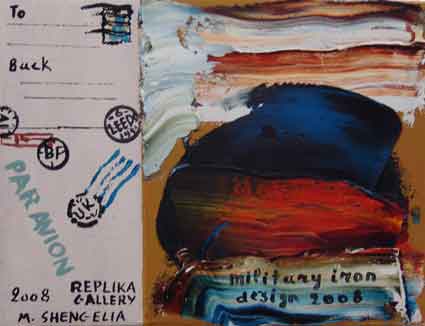
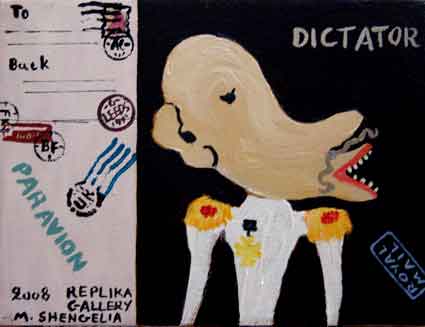
MIKHAIL SHENGELIA. BORN 1959
WAKHO BUGADZE. BORN 1964
DAVID ALEXSIDZE. BORN 1966
KONSTANTIN SULABERIDZE. BORN 1968
MAMUKA JAPARIDZE. BORN 1962
KONSTANTIN JNCHARADZE. BORN 1962
OLEG TIMCHENKO. BORN 1957
WATO TSERETELI. BORN 1975
MIKHAIL KOBULADZE. Borne 1968
TEMO JAVAKHISHVILI. Born 1951
ALEKSANDRE VARVARIDZE. Born 1974
SOPIA CHERKEZISHVILI. Born 1975
Such small countries, where economy is on the stage of transformation, are ready to be guided by their cultural traditions for the creation of the basis for economic growth. And, as a result, the organization New Art Union was established in order to help this process in the sphere of art, culture and education and to influence this through our projects. New Art is concerned with promoting skills and vision, necessary to bring the greatest cultural, art and educational benefits to individuals and their societies. The organization is ready to invest its resources (human and financial) to help artists become active participants in the cultural life of their community. The organization also works for eliminating the informational vacuum after Post-communist regime, for renewal of the contacts in the sphere of culture, for integration and popularization of Georgian and South Caucasus contemporary Art, for supporting the young creative potential, that will build tomorrow’s sector of culture.
Artists, art critics, curators, architects, critics, art managers, teachers, programmers, economists and lawyers are united in the organization. In 1999, exhibition hall "TAPI" was established on the basis of organization, and in 2002, the organization created gallery "New Art", where various exhibitions-projects, performances and creative actions are held. From 2000, creative studios-laboratories have been founded on the basis of the Union that develops creative-innovative methods in different spheres of art. In 2004, the organization together with Armenian and Azerbaijan colleagues, is founding international association "Art Caucasus" to assist to the development of art and art business in South Caucasus. In 2005, it established annual youthful literature contest "Alubloba". In 2006, the organization established gallery-café "New Art House".
more (pdf) >>>
with
SERGO CHAKHOIAN /CHAKHO/. BORN 1924
MIKHAIL GOGRICHIANI. BORN 1967
MIKHAIL SHENGELIA. BORN 1959
WAKHO BUGADZE. BORN 1964
DAVID ALEXSIDZE. BORN 1966
KONSTANTIN SULABERIDZE. BORN 1968
MAMUKA JAPARIDZE. BORN 1962
KONSTANTIN JNCHARADZE. BORN 1962
OLEG TIMCHENKO. BORN 1957
WATO TSERETELI. BORN 1975
MIKHAIL KOBULADZE. Borne 1968
TEMO JAVAKHISHVILI. Born 1951
ALEKSANDRE VARVARIDZE. Born 1974
SOPIA CHERKEZISHVILI. Born 1975
Friday, October 17, 2008
EXHIBITION: Hans Heiner Buhr will opening his new shop in the New Art Cafe in Tbilisi
Rusiko Oat is also a member from the Art Club Caucasus. In this evening she will opening the exhibition of my friend Hans Heiner Buhr in her NEW ART CAFE.Wednesday, October 15, 2008
EXHIBITION: Hans Heiner Buhr Conceptual Show at New Art Tbilisi

Dear Art Friends,
Hans Heiner Buhr likes to invite you to his Conceptual Show on Friday, 17th of October at 7pm to New Art Café Tbilisi at Rusiko and Misha!
We will have a nice time.The show goes for 12 days. Limited prints are for sale for GEL 20.Best regards, Hans Heiner Buhr
Address:
New Art Café
31, V. Orbeliani Str. (a small street between Kolkhos-Square (Flowers-Bazaar) and Sanapiro-Left Bank)
Tbilisi 0105 Georgia
Tel. 995 32 987544; 995 99 970049; 995 99 720906
See on Google Maps here:
Monday, September 08, 2008
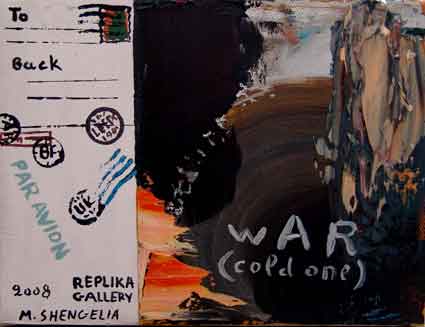
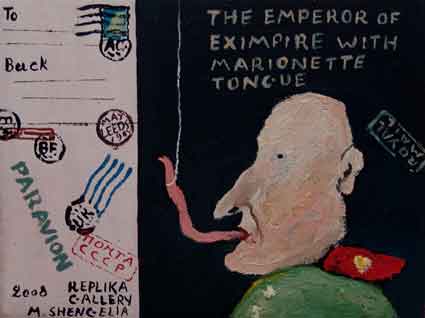
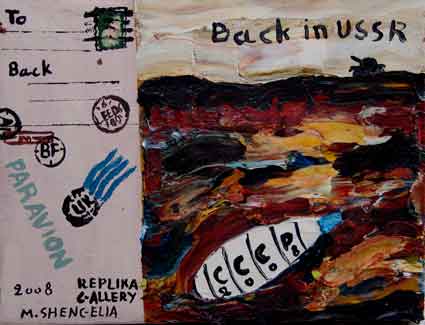
ART: Misha Shengelia "Something about war" etc.
Saturday, June 07, 2008
ART: tbilisiDEEPART magazine14 (with Rusiko Oat)
tbilisiDEEPARTmagazine, an art transport project by patricia london ante paris
subscribe now at tbilisideepart@yahoo.de
dear friends,
one of my major books is "Reziproke Hilfe in der Tier- und Menschenwelt" by peter kropotkin.
In winter i made the photos of the mandarins of tiflis and now in summer we meet again for the interviews.
its a nice reciprocal process: the Mandarins have a (underground) platform for presentation and i as a foreigner have a nice reason for communication.
Aloha ! patricia
tbilisiDEEPART magazine14 >>>
with Rusiko Oat (gallerist, collector)
subscribe now at tbilisideepart@yahoo.de
dear friends,
one of my major books is "Reziproke Hilfe in der Tier- und Menschenwelt" by peter kropotkin.
In winter i made the photos of the mandarins of tiflis and now in summer we meet again for the interviews.
its a nice reciprocal process: the Mandarins have a (underground) platform for presentation and i as a foreigner have a nice reason for communication.
Aloha ! patricia
tbilisiDEEPART magazine14 >>>
with Rusiko Oat (gallerist, collector)
Labels:
Art,
Gallery,
Georgia,
Rusiko Oat,
Tbilisi,
tbilisiDEEPART Magazin
Friday, May 30, 2008
ART: Transkaukazja 2007 in Poland
Tarnskaukazja is the Festival of Caucasian Culture. On this movie you can watch a little fragment of the Georgian multimedia-art-show (music, video-art, media-art). Curators: Rusiko Oat & Wato Tsereteli - Warsaw, Poland - 2007
From: wlodekkk
Transkaukazja - children from Chechenya and Ingushetia
Transkaukazja 2007 - caucasian festival, outdoor concert, www.transkaukazja.pl/2007
From: gwiezdnamatylda
From: wlodekkk
Transkaukazja - children from Chechenya and Ingushetia
Transkaukazja 2007 - caucasian festival, outdoor concert, www.transkaukazja.pl/2007
From: gwiezdnamatylda
Labels:
Art,
Chechnya,
Exhibition,
Ingushetia,
Poland,
Rusiko Oat,
Video,
Wato Tsereteli,
YouTube
Subscribe to:
Posts (Atom)