Showing posts with label Gyumri. Show all posts

Wednesday, August 01, 2012

CALL: Looking For Volunteers - Active Citizens in the Caucasus (european-intercultural-forum.org)


We are currently looking for volunteers for the below mentionned EVS placements. The deadline for application is postponed to 8th of August!


+++ Active Citizens in the Caucasus +++


European voluntary service in Armenia, Azerbaijan or Georgia
Dates: November 1, 2012 - October 1, 2013 (11 months)


We are currently looking for five motivated volunteers from Germany to take part in a European Voluntary Service in the Southern Caucasus. The project is already approved by the German National Agency of the Youth in Action programme and the departure of the volunteers is planned for November 1st, for 11 months.


Sending organisation: European Intercultural Forum e. V. (reference 2010-DE-31 in the EVS database ec.europa.eu/youth)


Hosting organisations:


1. Youth Initiative Center, Gyumri, Armenia (2011-PL-24): 2 placements


2. Youth Public Union "Bridge to the Future", Ganja, Azerbaijan (2012-PL-14): 2 placements


3. Academy for Peace and Development (2011-PL-33): 1 placement


The European Voluntary Service "Active Citizens in the Caucasus" proposes young people from Germany to integrate a local NGO in the Southern Caucasus for a long-term duration of 11 months. The idea is that the volunteers will discover the work of a youth non- governmental organisation, its activities, beneficiaries´ needs and working methods used to respond to them. More than that the volunteers are expected to get a full insight on the problems met by young people in a specific urban context (Ganja, Gyumri, Tbilisi) and the various support and opportunities that can be proposed to those young people to develop and foresee a brighter future.


The volunteers will get active promoting European values such as active citizenship, volunteering, social inclusion, equal chances for all by organising non-formal educational events and activities with local children and youth. The targeted local youth is in the thre placements youth with fewer opportunities: Internally Displaced People and refugees (Georgia, Azerbaijan), from deprived areas (Armenia, Azerbaijan), orphans (Armenia, Azerbaijan) and with low socio-economical profiles (all three countries).


The following types of activities are planned:


- non-formal educational activities with youth with fewer opportunities (outdoor activities, intercultural activities, linguistic clubs, artistic workshops, etc.) - 60%


- promotion of volunteering and active participation in youth clubs, schools, high schools and universities - 20%


- support to office work, local and international networking, fundraising - 20%


The activities targeted at young people will be fine-tuned according to the wishes and talents of the selected volunteers.


Complementary to the main lines given above, specific activities per placements include:


- for the placement in Georgia: proposing activities in the APD youth club for local youth and assisting the coordination of the CAUCULT project (intercultural encounters of young people from Georgia, Azerbaijan and Armenia)


- for the placements in Armenia: proposing weekly activities around the German culture and language to local youth and helping to organise arts exhibition of international artists in Gyumri


- for the placements in Azerbaijan: proposing cultural activities around the German culture and language and organising special youth sport competitions and outdoor activities during the holidays


The beneficiaries of the youth activities are:


- for the placement in Georgia: young people (14-30) who are IDPs (first and second generation) from Abkhazia of the secession war of 1992-1993


- for the placement in Armenia: young people (14-30) living in a deprived area (Gyumri, first unemployment rate in Armenia, around 30%) and orphans and disabled children placed in the local institution "Huys" (5-18)


- for the placements in Azerbaijan: young people (14-30) living in a deprived area (very low opportunities for cultural and leisure activities, gender inequality making it difficult for young women to access leisure activities), IDPs and refugees from Nagorno-Karabakh, surrounding occupied territories and Armenia (14-30), and orphans placed in the SOS Children´s village of Ganja (5-18)


Conditions: the programme covers the travel costs home-project-home of the volunteers, accommodation (in a furnished shared flat with other volunteers or in a host family), monthly food allowance based on local standards, local transportation costs, activities and materials costs, international insurance, language support, vaccination costs, preparation, monitoring and evaluation training and volunteers´ allowance (pocket money: 70 EUR per month for the placements in Armenia and Azerbaijan, 80 EUR per month for the placement in Georgia). The volunteers will work about 30-35 hours a week. Visa and residence permit costs for the placements in Armenia and Azerbaijan are as well fully covered.


Application procedures: send CV and motivation letter in English to eif.germany@googlemail.com


Deadline for application: August 8th, 2012.


Profile: resident in Germany, aged 20-30, being motivated and committed, willing to undertake cultural challenges, mature. For the placements in Azerbaijan, we highly encourage applications from male volunteers! Please mention the placement you apply for or the priority order.


European Intercultural Forum e.V.
Contact person: Tiphaine Coulardeau
eif.Germany@googlemail.com
www.european-intercultural-forum.org


--


European Intercultural Forum e.V.
Address | Prenzlauer Allee 176, 10409 Berlin - Germany
Mail | eif.germany@googlemail.com
Website | www.european-intercultural-forum.org
Support our projects! |
www.betterplace.org 
Follow us on facebook!| European Intercultural Forum e.V.

Saturday, December 04, 2010

PHOTOGRAPHY: Living in Gyumri Domiks/Everyone Shall Have the Right to Housing

Twenty two years after hitting Gyumri, the 1988 earthquake in Armenia still continues to leave victims. More than 2,000 families continue to live in domiks, small temporary houses provided for the homeless by the Soviet government for two years, or built by the homeless themselves.
Constitution of the Republic of Armenia states that “Everyone shall have the right to a standard of living adequate for himself/herself and for his/her family, including housing as well as improvement of living conditions. The state shall take the necessary measures for the exercise of this right by the citizens.”

Great Photographies: slideshow here >>>

The photo album on housing conditions in Gyumri has been published. This album is distributed for free, if you would like a copy please send me an email to
anush.babajanyan@gmail.com

Anush Babajanyan has been photographing since 2006. Two years later she began a photo essay on Armenian women with special qualities. This story is a continuing project.
In 2008 Anush
photographed Kars together with a team of photographers, as part of a project about the closed border between Armenia and Turkey.
Anush has completed a
photo essay picturing residents of the town of Gyumri who still suffer the consequences of an earthquake that took place in 1988. In 2009 Anush continued the project together with Third Nature NGO with the support of the Open Society Institute.
Anush is now photographing the
territory around lake Sevan, Armenia, which is facing ecological challenges.

email: anush.babajanyan@gmail.com

Sunday, May 09, 2010

AUFRUF: Europäische Freiwillige für Armenien gesucht! (kulturaktiv.org)

Kultur Aktiv aus Dresden sucht zwei interessierte junge Menschen, die ab Juli 2010 für 10 Monate als Europäische Freiwillige nach Armenien gehen möchten. Die Gastorganisation "Youth Initiative Centre" aus Gyumri, der zweitgrößten Stadt Armeniens, freut sich darauf, beim Aufbau einer jugendkulturellen "Deutschen Ecke" tatkräftige Unterstützung zu erhalten. Die Jugendlichen erwartet die sprichwörtlich gastfreundliche Aufnahme in ein junges international erfahrenes Team. Für Unterkunft, Verpflegung und Arbeitsplatz ist gesorgt.

Heimweh wird kaum aufkommen, schon im Juli kommt die erste kleine Kultur-Aktiv-Delegation aus Dresden zu Besuch. Im Einsatzjahr wird es dank unseres Projektes "Transkaukasija" immer wieder zu Austauschmaßnahmen kommen. Außerdem erwarten Euch in Gyumri viele unserer armenischen Freunde und Partner, mit denen wir schon seit langer Zeit in intensivem Austausch stehen.

Kontakt und weitere Informationen bei:

Marcus Oertel
marcus.oertel@kulturaktiv.org.

Wednesday, December 30, 2009

ARTIKEL: "Himmelschreiende Armut“ in Gymri. Von Michael Länge (gmuender-tagespost.de)

Pfarrer Scheide ist nach jüngstem Besuch in Nordarmenien entsetzt über Zustände und Untätigkeit des Staates

Seit mehr als fünf Jahren unterstützt die „Küche der Barmherzigkeit“ die Straßenkinder von Gymri. Eine Verbesserung sieht Pfarrer Karl-Heinz Scheide in diesen Jahren nicht. Im Gegenteil: „Was ich in Gymri erlebe, ist das Bedrückendste“, sagt er nach seinem jüngsten Besuch vor wenigen Wochen. Und ergänzt: „Ein Ausmaß an himmelschreiender Armut und Ungerechtigkeit, die ich in Armenien so noch nicht gesehen habe.“

Der ganze Artikel >>>

Info Spenden für die "Küche der Barmherzigkeit" können auf das Konto 440 752 987 bei der Kreissparkasse Ostalb (BLZ 614 500 50) einbezahlt werden.

Monday, December 28, 2009

TEXT: RUINS OF OUR TIMES. By Joanna Warsza / Laura Palmer Foundation / Warsaw

The text will be published in Team Network magazine and in Obieg on-line.

Georgia and Armenia are full of landscapes of frozen moments. With the fall of the Communist regime, the trains stopped n mid-route, the cable car over one of the cnyons of Tbilisi has been abandoned halfway, and the housing estates of the never realized future found temporary settlers. Tracing the unwanted heritage of the Soviet past in the Caucasus, at times I had a strange sense of witnessing the future. The self-organized methods adopted in the years of post-collapse crises recall the most progressive contemporary theories of bottom-up structures and participatory urban planning: the cinema-theater Rossia in the middle of Yerevan found a secondary use as a market and mini-bus station, the never completed city of Gyumri in Armenia was finished by the motivated settlers themselves, the mikro-raion estates in Tbilisi have expanded with new parasite parts called kamikaze loggias. The Caucasus, following a process of Eastern Bloc Westernization, is fortunately still full of heterotopias, stunning ruins of our own age, and of self-organizing policies that tend to be forgotten in a time of ‘euroremonts’, and ‘Eurenovations.’


Ruines of the future, never accomplished project builidng, Mush, Armenia

FROZEN MOMENTS
On the western outskirts of Tbilisi one encounters a thrilling Caucasian picture. A cable-car supposed to link the unfinished University campus with the metro station was stopped at the very second the Soviet system collapsed in 1991. Since then it has been hanging in the air over a picturesque canyon, abandoned in the middle of its route, above the heads of people passing down in the valley who no longer even notice it. The Caucasus, with its tremendous landscapes, is full of this phantom heritage, when the Socialist reality became the past, when the world stopped and started again.
Coming myself from a post-Communist (though not post-Soviet country), I have been witnessing since 1989 how quickly the former Eastern Bloc, and Poland in particular, has been cleaning up its past. Westernization, pro-euroatlanticism and procapitalism (‘once Moscow, Brussels today’ policy), have become the new and only format for life. Georgians and Armenians have a good term for this phenomenon — the euroremont (‘eurenovation’). The Poles have performed especially well: we still live in the same housing blocks, but they were immediately repainted and wrapped in polystyrene, the streets were filled with endless early-capitalist vendor kiosks, and later with huge billboards and all sorts of advertising campaigns. Social Realist architecture in the big cities was quickly transformed, covered up, or lifted in order to be a part of a new narrative.
One of the very few examples of Polish Socialist Realist decay was the 10th-Anniversary Stadium in Warsaw. Built in 1955 from the rubble of a war-devastated city, it was to preserve Communism’s good name for forty years. In the early 1990s it fell into ruin, being at the same time “revived” by the Vietnamese intelligentsia and Russian traders, pioneers of capitalism, who established an open-air market. It became the only multicultural site in the city, a storehouse of biographies and urban legends, a piece of Land Art, a workcamp for anthropologists, botanists and archaeologists. It was in fact the one and only heterotopic zone in central Warsaw, free from the unwritten laws of westernisation and euroremonts.

KAMIKAZE LOGGIAS AND SELF-ORGANISED MICRORAYONS
The Georgian and Armenian situation was different. The Russians went home, but left behind their utopian infrastructures in the former republics. People started organically responding to the changes through a particular, self-organised relationship to the architecture. A refusal of the dominant structures, the provisional liberty, and scepticism as to all master plans led to participatory forms in the urban environment. Emergent movements started to occur, especially in the “microrayons” — the large-scale social-housing projects developed throughout the entire former Soviet Union, as well as in Vietnam and in Eastern Europe. A “microrayon”, or microdistrict, was initially supposed to be a self-sufficient unit affording its inhabitants comfort and the pleasure of living, thus realising Le Corbusier’s utopia of the collectivity and harmonious cohabitation through architectural and social engineering. If this happened it was not through a masterplan, but initiatives from the bottom-up.
At the beginning of the 1990s many owners of a block apartment would hire an engineer to design an extension to their home. This whole new parasite part, called a kamikaze loggia, would grow out one side of the building, expanding the living space. This was nothing new for Georgia; palimpsest structures and extensions have always been a commonly applied method of expanding a living surface in this country located on steep Caucasian slopes. One has to remember that Georgia was the “honey of the USSR” — the richest state, with quite oversized and representational houses. In the dark and poor Shevardnadze years after the fall of Communism, the extensions continued, even using found scrapmetal or other cheap materials of all kinds.


THE NON-EXISTENT MINISTRY OF A NON-EXISTENT COUNTRY
The Georgian palimpsest spirit is perhaps best reflected in an icon of Caucasian architecture, the former Georgian Ministry of Highways, (საქართველოს საავტომობილო გზების სამინისტროს შენობა) built in 1975 by architect George Chakhava, since last few years bought by a bank and standing empty, overgrown with vegetation. This fascinating building was meant to stand in harmony with the mountain villages. The structure consists of a monumental grid of interlocking concrete forms, five horizontal parts of two storeys each seeming to stand on top of each other.
The design is a reference to the concept of Ville Spatiale by Yona Friedman, who didn’t want to displace the city, but to raise a second city twenty meters above the existing one. Chakhava’s other reference was also a forest, with the cores as the trunk and the horizontal parts as the crowns, so as to provide a lot of free space for other living beings and nature. The former Ministry on Gagarin street also brings to mind the work of the Japanese Metabolists, whose flexible, and expandable structures built in the 1960s evoked processes of organic growth. With its unrealistic and multi-extensional structure, the building seems to be an unintended tribute to the most recent, early-capitalist architectural changes in the urban environment of Tbilisi, but carrying a long tradition of self-built palimpsests.

BACK TO THE FUTURE
Staying for two months in Georgia I sometimes had a strange sense of witnessing the future. The self-organized methods adopted in the years of crises after the collapse of the USSR recall the most progressive contemporary theories of bottomup structures and participatory urban planning. The Chilean architect and theoretician Alejandro Aravena created Elemental, a “do-tank” combining art, architecture and engineering, understanding the city to be a resource for building social equity. His statements, considered visionary, about buying half a house and filling the other half with years, are a kind of selffulfilling prophecy in Caucasus. People don’t ask themselves the developer-like question, “Where would you like to live?” but rather how to organize the city from its successive layers.

A project awarded a Golden Lion at the last Venice Architecture Biennale, The Afterlife of Buildings by Grzegorz Piatek and Jarosław Trybus, pictured an apocalyptic secondary use for famous Polish properties: a Warsaw airport terminal would be turned into a chicken farm, a Norman Foster building into a prison, or a financial centre into a crematory. Applying both theories the Caucasus could move ahead, full of secondary uses. One could cite the Yerevan cinema-theatre Rossia, build in 1979 as a youth palace, sports and concert complex, and museum, now turned into a huge market in the former screening rooms and hallways and a busy mini-bus station.
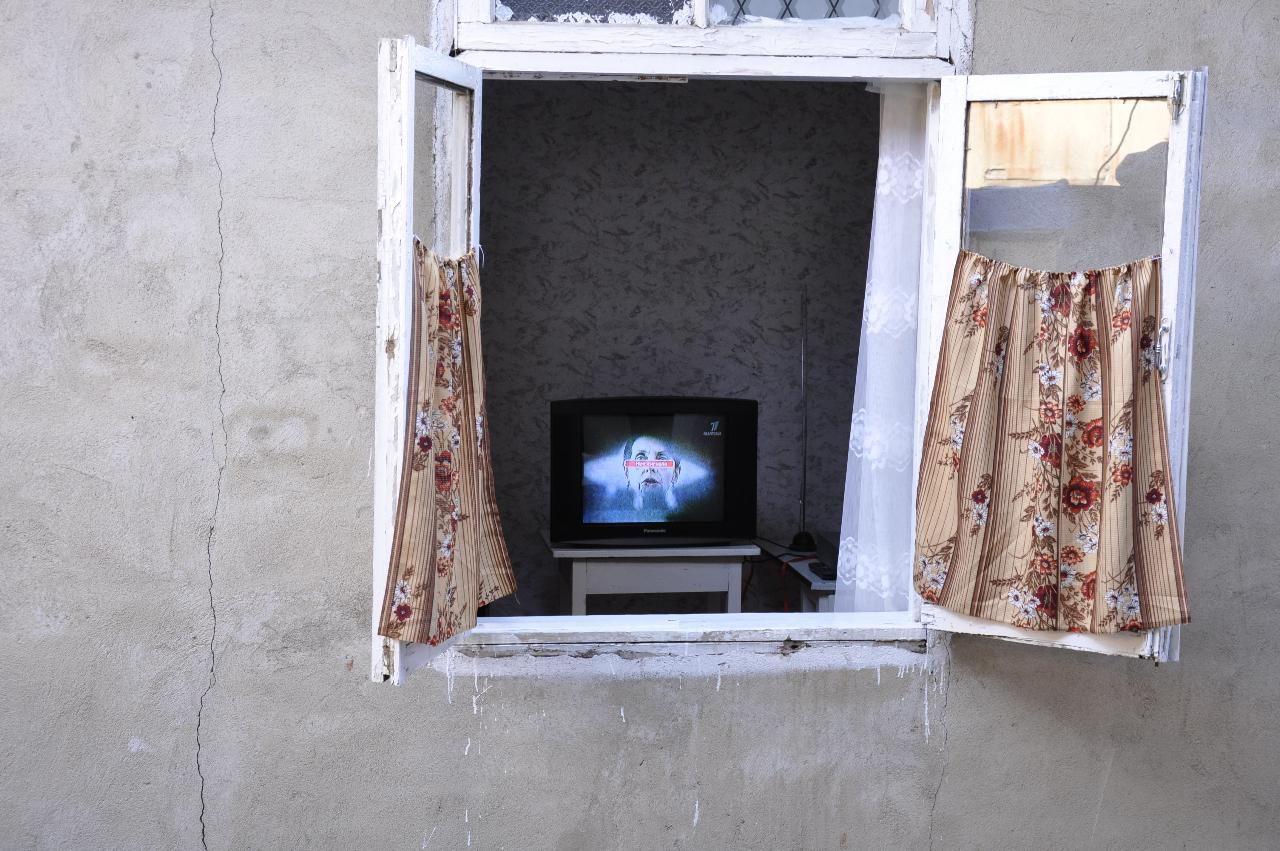
Some Caucasian artists have a great intuition of how to grasp these fantastic reality shifts. For more than ten years Georgians had no more than two hours of electricity per day — what they now call the dark years. Back then some foreign-channels were illegally broadcasting on Georgian channels frequencies. As a result two logos appeared on the screen and the quality of transmission was sometimes interrupted, bringing the image to a standstill. Rusiko Oat, a curator and the owner of the New Art Cafe in Tbilisi made an artwork resulting from the infamous electricity cuts. No Signal was an image created, as she puts it, by electro-waves. On the screen there suddenly appeared a dramatic image of the face of an old lady superimposed on a commercial and captioned with the mysterious Russian inscription Niet signala. In the logic of media marketing, this was a kind of electronic magic, allowing for one’s own interpretation of the neo-now, quite remote from the original idea of an advertising spot and bearing fantastic information.
Two Amsterdam-based artists, Rosell Heijmen and Lado Darakhvelidze, one Dutch, the other Georgian, mapped the city of Tbilisi through its endless marschrutka lines. Marschrutkas are the minibuses that serve as a means of public transport. Anyone can start a new line in a second-hand mini-van brought over from Germany. There are over 200 marschrutka tours in the city and even more in the countryside. Because they stop everywhere, they have an advantage over other public transport (regular buses and electricity have been in service only since the advent of the Saakashivili regime) but are forbidden on the main avenues. After the Rose Revolution, most of the squares and street names were changed, but the marschrutkas signs kept the old ones written in the Georgian alphabet. As a result only the citizens of Tbilisi have knowledge of where a marschrutka is heading. The destination signs somehow tell the recent history of the city. Heijmen and Darakhvelidze produced a marschrutka map in English, seeing the mini-vans as vehicles taking one back in time, letting the non-Georgian find her way, to translate the past and the present and grasp a specific reality of the city. The wide avenue leading from the airport to downtown is named after George W. Bush, and prior to his visit all the facades had been repainted and touched up only from the front side.
Sophia Tabatadze, a Georgian artist based in Berlin, has been observing the changes in post-Soviet Georgia following the transformation of one of these Tbilisi blue facades. She documented the changes on a building between 2003 and 2008. In In a Country with a Flourishing Democracy, even Plastic Flowers Will Blossom, she depicts how, while Georgia has been rushing from one system to the other, this facade has been quickly adapting and making itself look more and more European.

GHOST CITY
Gyumri is the second largest city in Armenia and suffered a terrible earthquake in 1988. In order to help those who lost their homes, the Soviet Government decided to build a new residential area called Mush, after the name of one of the Armenian cities from the Turkish genocide of 1915. The new Mush was supposed to be a large social-housing project adjacent to Gyumri. Construction began in 1988 but was never completed because of the fall of Communism in 1991. Mush stands in the middle of the fields as an unfinished city, with blocks, administration buildings, and playgrounds. The city has been left at mercy of time and weather and politics. It takes ten minutes by taxi to get there from the centre of Gyumri. A few buildings were completed by the motivated settlers themselves, who made up the variously styled windows or doors, quite often out of materials found in neighbouring empty houses. Walking through Mush one experiences a special aura. It might be a never realised “radiant future”, the obscure and difficult Armenian past, a menace of global catastrophe to come, a promise of a secondary use. Mush might recall the idea of the ‘transition towns’ created in Ireland with the aim of equipping communities for the challenges of climate change and peak oil. The chosen communities try to live in a sustainable manner and build local resilience in the near future, trying to reduce the energy use and increase their own self-reliance by repairing or re-using the old items rather than throwing them away.
Mush was brought to the arts and to public debate by Armenian artist Vahram Aghasyan who photographed the site for several months. In his thrilling series Ghost City from 2006-on going he observes the silent Mush and shows other possible scenarios to come, such as a gigantic deluge echoing the Great Flood from the Bible, which took place not far from there. In the totality of his work, as in Ruins of Our Time (deserted bus stops from the 1960s), or Ruins of Private Property (the demolition of an illegal gated community near Istanbul), he profoundly analyses the cultural and socio-political changes in Armenia through images of spectacular contemporary remnants and post-Soviet entropy.

A DERVISH ONCE SAID: BETWEEN WESTERN ALIENATION AND EASTERN SUBMISSION I’LL TAKE: A BATH*
One main critique of Edward Said’s Orientalism was that he had only examined the relations of the first and the third world, omitting the complex and never discussed hierarchical structures within the second world, meaning Eastern Europe or Euroasia. The international collective Slavs and Tatars (Kasia Korczak, Payam Sharifi, Boy Vereecken, and Victoria Camblin) takes a great lesson of emancipation from out of the culture of less visible nations and countries between the east of the former Berlin Wall and the west of the Great Wall of China, focusing on the sphere of influence shared by Slavs, Caucasians and Central Asians. Their books and installations combine scholarly research with pop culture, urban legends, their own experiences, and postcolonial studies. Their last art book Kidnapping the Mountains, addresses the complexity of identities, languages, stories and time in the Caucasus. Their previous publication, A 13th Month Against Time, was inspired by an old form of the Jalali calendar, used by the Zoroastrians and still in use in Iran and Afghanistan. Originally, in the 11th century, it added an additional month every six years. Slavs and Tatars published a calendar of the 13th month with 32 days (or pages) as a libretto of reflections on the defeatist approach to time. Their art-based research, rooted in critical theory and glamour, goes against both the superiority of Western gaze and exploration and Eastern Westerncentrism.
The Tbilisi performative-art Bouillon Group also act as selfproclaimed anthropologists, taking non-questioned culture elements as material for their artwork and seeking to reveal the conflict between comfort and nonconformity. The artists created a descriptive deconstruction of a figure of Mother Georgia, an aluminium statue overlooking Tbilisi erected in 1958 (similar ‘Mothers’ were then erected in Armenia, Ukraine and Russia), meant to protect the country. Mother Georgia holds a bowl of wine to greet those who come as friends, and a sword to defend herself from enemies. Bouillon saw the statue as a hermaphroditic and ambiguous figure, a product of Georgian circumstances.

FORMER WEST
After the long and effective process of self-applied Westernisation by many Central European countries, we now hope to witness the coming out of a cognitive East. The Warsaw Museum of Modern Art is leading a complex research project to rewrite an European art history not only with Western names, but identifying with our part of Europe. For Charles Esche, a critic and director of the Van Abbemuseum in Eindhoven, the Netherlands, to be Western stands for being short-sighted and lacking the openness and tools to experience things in their plurality. Together with several other European institutions he is launching the research platform called “Former West”. This term, never extensively employed as a counterpart to the widely used “former East”, is meant to examine what impact the events of 1989 had on the art of the “West”.
I recently participated in a conference about art-world standards where many speakers debated how to have the East change and live up to Western standards. One Ukrainian artist stood up and riposted, “And I want to ask you when the West will change?!” Eastern Europe no longer exists, though perhaps with some Georgian and Armenian exceptions.

* after the title of Slavs and Tatars’ work in: Kidnapping Mountains, Book Works, London 2009. Slavs and Tatars investigates different forms of knowledge than those available to us in the West: be it emotional, critical, spiritual, or political. Despite the rampant Islamophobia in the west, dervish and Sufism seem to remain the most palatable, ‘white’-friendly form of Islam. The dervish print addresses the East versus West divide, first as a choice and then immediately as one to be altogether avoided.

Joanna Warsza is curator on the cusp of performing and visual arts, working mostly in public space with the invisible, the ephemeral or staged situations. Recently she made two public art projects in Tbilisi, Georgia dealing with the legacy of post-soviet architecture. Director of a NGO - Laura Palmer Foundation, for projects between fiction and reality, writer for Obieg Magazine.

The research trip to Georgia and Armenia was possible with the generous help of European Culture Foundation and Open Society Institute Budapest.
www.eurocult.org
www.soros.org

links:
http://picasaweb.google.com/Laura.Palmer.Foundation
and
www.artzona.pl

House of poets where SARTRE and BEAUVOIR stayed, Lake Sevan, Armenia

Bouillon group in Supra performance debating on Mother Georgia gender issues / Betlemi mikro-raioni / October 2009 / ArtZone

Rusiko Oat, No Signal - Art created by electro-waves / Betlemi mikro-raioni curated by Joanna Warsza / ArtZone Festival, Tbilisi, October 2009

The balcony with the view over a blue apartment building referring to Sophia Tabatadze's work In Country with Flourishing Democracy, Even Plastic Flowers Will Blossom, / Betlemi mikro-raioni curated by Joanna Warsza / ArtZone Festival, Tbilisi, October 2009

Vahram Aghasyan, Ruins of private property / Betlemi mikro-raioni curated by Joanna Warsza, Tbilisi, October 2009, ArtZone festival

slideshow >>>

NEWS: 26 Nov 09 | Caucasus Reporting Service 521 until 24 Dec 09 | Caucasus Reporting Service 525 (iwpr.net)

24 Dec 09 Caucasus Reporting Service 525
Armenia: Nuclear Plant Controversy
Yerevan pushes ahead with new station in face of protests from ecologists. By Gayane Mkrtchyan in Yerevan (CRS No. 525, 24-Dec-09)
Georgian Conflict Exploitation Concerns
Some observers suspect the authorities are taking advantage of people caught up in Georgia’s wars. By Natia Kuprashvili in Tbilisi and Davit Gaimsonia in Gori (CRS No. 525, 24-Dec-09)

18 Dec 09 Caucasus Reporting Service 524
Armenia: Media Reach Out to Turkey
But commentators say they should not be too quick to let down their guard. By David Muradian and Sara Khojoian in Yerevan (CRS No. 524, 18-Dec-09)
Azeris Turn to Satellite TV in Propaganda Battle
Armenians wooed with TV news broadcasts from the enemy. By Samira Hasanli in Baku (CRS No. 524, 18-Dec-09)
Chechens Mark Ten Years of Exile
A decade after they fled their homeland, Chechens in Georgia still fear it is unsafe to go back. By Lizaveta Zhahanina in Tbilisi (CRS No. 524, 18-Dec-09)
Abkhazia Gets Recognition Boost After Poll
Bagapsh says his re-election showed Abkhaz desire to be independent. By Anaid Gogorian in Sukhum (CRS No. 524, 18-Dec-09)


11 Dec 09 Caucasus Reporting Service 523
Greens Protest Over Georgian Airport Plans
Environmentalists oppose controversial hub close to Black Sea nature reserve. By Lasha Zarginava in Poti (CRS No. 523, 09-Dec-09)

Gyumri Residents Recall Catastrophic Tremor
Destructive force of 1988 earthquake was so swift that people thought the Armenian city had been bombed. By Ashley Killough in Gyumri (CRS No. 523, 09-Dec-09)

4 Dec 09 Caucasus Reporting Service 522
Tbilisi Criticised Over Repatriation Requests
Tens of thousands of Meskhetians apply to come home, but Georgian officials accused of not doing enough to help them. By Fati Mamiashvili in Tbilisi (CRS No. 522, 04-Dec-09)

Georgia: Collapse of Armenian Church Provokes Row
Armenian minority say incident illustrates their limited rights in the country. By Lela Iremashvili in Tbilisi and Hasmik Hambardzumyan in Yerevan (CRS No. 522, 04-Dec-09)

Azeris Face Spending Crunch
Economic experts warn budget cut resulting from falling oil revenues could harm most vulnerable. By Kenan Guluzade in Baku (CRS No. 522, 03-Dec-09)

Project Highlights
Caucasus: Oct/Nov ‘09
IWPR Karabakh workshop participants find out how web journalism can enhance work of journalists and activists. By IWPR staff (4-Dec-09)


Reporting Impact
Caucasus: Oct/Nov ‘09
IWPR discussion events prompt Tbilisi officials to cooperate with Georgian NGOs on refugee issues. By IWPR staff (4-Dec-09)


26 Nov 09 Caucasus Reporting Service 521
Azerbaijan: Ethnic Azeri Immigrants in Rights Struggle
They say the country’s immigration law makes it hard for them to gain permanent residence permits. By Samira Ahmedbeyli in Baku (CRS No. 521, 24-Nov-09)
Armenia Surprised by Anti-Russian Agitation
Emails and text messages seek to spark campaign over military bases. By Naira Melkumyan in Yerevan (CRS No. 521, 24-Nov-09)
Abkhazia Sees Tourism Boom
Russians flock to breakaway territory despite accommodation shortage and poor service. By Anaid Gogorian in Sukhum (CRS No. 521, 26-Nov-09)

Monday, August 10, 2009

ART: Stranger Exhibition in Gyumri (rhiz.eu)

I would like to inform you about one more successful cooperation with row of partners and institutions with who we are going to organize Stranger Exhibition (short video screenings, and discussion) in Gyumri, http://www.rhiz.eu/artefact-38893-en.html

See attached some visual materials, poster and invitation, and thanks to this cooperation i am invited to Amsterdam to take part to the Stranger Festival as a Jury member, 5.10-19.10
And two key partners of implementation of Stranger Show in Gyumri are invited to assist and gain knowledge how to organize and coordinate such kind of events for future as well. 13.10-18.10
http://www.rhiz.eu/artefact-42213-en.html

Nevertheless i would like to come to the roots of this cooperation to Stranger Academy, and underline Amandine Boccaccini's role in this, therefore see bellow her first imitative letter to ECF and Stranger Academy staff.

Dear ECF team,

Arman Tadevosyan, who is the co-founder of 5th Floor (artistic group) in Gyumri, Armenia, could be very interested to receive your Stranger Festival DVD and organise workshops.

Could you please send your DVD to him?

Arman TADEVOSYAN
47 Ajemyan street,
3105 Gyumri
Armenia

Thanks a lot,

Best regards,

Amandine Boccaccini

Thanks

Getting Ready for finale phase of the show in Gyumri,

with best and sunny regards
Yours
Arman

http://www.rhiz.eu/institution-26632-en.html

-- Arman Tadevosyan
Artist, Co-founder and Project Manager of 5th Floor
Address:13 Ajemyan, 47 house 3
105 Gyumri, Armenia
Mobile:(+374) (93) 87 72 65
E_mail:armtadevosyan@yahoo.com

Monday, June 15, 2009

BEGEGNUNG: Harald Schluttig zu Gast in Armenien (medienkulturzentrum.de)

Vom 19. Mai bis zum 2. Juni weilte der Leiter des SAEK Fernsehstudios Harald Schluttig zu einem Studienaufenthalt in Gyumri (Armenien). Auf Einladung der Deutschen Botschaft und der Künstlergruppe 5th floor wurde seine Fotoreihe "Kabul - endloser Basar" in Gyumri anlässlich der Deutschlandwochen ausgestellt. Gemeinsam mit Jugendlichen des Kulturzentrums KASA gestaltete Harald Schluttig einen 8 minütigen Videobeitrag über die Stadt, die 1988 von einem verheerenden Erdbeben heimgesucht wurde. Kontakte zu regionalen Fernsehmachern und zum Pädagogischen Institut werden künftig einen Austausch von Videobeiträgen zwischen Gyumri und Dresden ermöglichen. Gleichzeitig ist eine Zusammenarbeit mit dem Dresdner Initiativen "Kulturaktiv" und "Geh8" geplant, die künstlerisch-kulturelle Austauschprojekte u.a. mit Armenien durchführen.

Quelle: www.medienkulturzentrum.de

Saturday, May 23, 2009

NEWS: 08 May 09 until 22 May 09 | Caucasus Reporting Service 492 und 494 (iwpr.com)

Baku Mosque Demolitions Undermine Tolerance Claims
It has led some to accuse government of clinging onto Soviet system of keeping a tight rein on believers. By Leyla Amirova in Baku (CRS No. 494, 21-May-09)
Armenia: Journalists Defiant After New Attacks
Recent attacks on journalists underline media’s struggle to report freely on politics and business. By Gayane Mkrtchian in Yerevan (CRS No. 494, 22-May-09)


Violence Mars Preparations for Armenian Poll
Several attacks on activists have revived memories of deadly clashes that followed elections last year. By Rita Karapetian in Yerevan (CRS No. 493, 15-May-09)

Outcry in Azerbaijan After Student Protest Broken Up
Campaigners condemn police crackdown on demonstrators who disrupted commemoration of ex-president’s birthday. By Sabina Vaqifqizi and Shahin Rzayev in Baku (CRS No. 493, 15-May-09)


Opposition Present Saakashvili With Deadline to Go
Georgian leader’s foes dismiss reported mutiny as a stunt put up by the authorities to distract public from protests. By Tamar Kadagidze in Tbilisi (CRS No. 492, 8-May-09)

Massacre Sparks Terror Fears in Azerbaijan
Unexplained shooting of 13 people in Baku feeds speculation about foreign ”terrorist” plots aimed at undermining stability. By Boyukaga Agayev in Baku (CRS No. 492, 8-May-09)

Pollution in Border Reservoir Worries Armenia
Future health of the vital water resource ultimately depends on restoration of ties between Armenia and Turkey. By Yeranuhi Soghoian in Gyumri (CRS No. 492, 8-May-09)

Monday, April 06, 2009

ARCHITECTURE: Gyumri Has Preserved The Aura And Architecture Of The 19th Century

by Tatul Hakobyan

The Armenian Reporter
Friday March 27, 2009

Gyumri, Armenia - The devastating earthquakes of October 22, 1926, and December 7, 1988, which claimed the lives of about 750 and 17,500 residents of Gyumri respectively, ruined most of the city's buildings except those built during the czarist era - from the second half of the 19th century to the 1920s. When you walk through the central streets of Gyumri, you feel the aura of the 19th century and become fascinated by the city's architecture. That city, however is not present-day Gyumri, it is Alexandrapol, a city which in its day used to be the second richest, most beautiful and attractive city after
Tbilisi.

full article >>>

photo gallery >>>

EXHIBITION: Harald Schluttig in Aslamazyan Sisters' Gallery of Gyumri


Thursday, April 02, 2009

PHOTOGRAPHY: "Ghost" City of freedom. By Arman Tadevosyan

From May 18 - June2, we will Host Harald Schlutig, Head of Media Cultural Center in Dresden, we will show his photos here in Gyumri, and he will give some workshops and master classes!

"Ghosts"

History is always now and the frequently celebrated call to “learn from history” can only be followed as we succeed to establish a contemporary relation to the past. Such a contemporary relation to a certain period in the past might appear very different, not least with different national points of view. With new constellations of nations, borders and coalitions the process of establishing a relevant relation to a common past becomes even more complex.

The cold war era is a common European experience as well as the time after the peaceful revolution in 1989. This background has a continuing impact on the way we tend to reflect upon present development in European and neighbouring societies. With the great number of aspects involved, especially when choosing a cross border perspective, artistic expression seems to offer unique opportunities to compress the inherent complexity into single statements of art like images or installations.

With the working title “Ghosts” we intend to realize and communicate a theme investigation on time after 1989. Emphasizing that every Nation tends to interpret its own history out of a limited and or selected set of historical facts, we want to confront perspectives in cross border cooperation between the artist run space “5th Floor” in Gyumri Armenia and “Geh8 - Art room and ateliers” in Dresden Germany. In this context we understand our specific sites as representative objectives apt to frame the content of “Ghosts”. Thereby, “5th Floor” offers a perspective out of an Armenian context, among other aspects representing the experience of the newly re-established national independence. “Geh8” on the other hand, acting on the territory of former GDR, would reflect the experience of a dissolved nation state within the re-united BDR. Both sites are in this way continuously confronted with ongoing geopolitical processes and consequences with aspects having their origin back in 1989.

The cooperation process will be based on the main intention to investigate and communicate confronting perspectives on present society and confronting ways of artistic and analytical expression. In this way the process should results in an intense interaction of artistic expression through “works of art” and analytical reflection through “corresponding interpretations through lectures, workshops and essays”.

Origin of investigation will be the urban areas “Mush 1 and Sheram” in Guymri, Armenia on the one hand and corresponding urban phenomena in the region of Dresden, Leipzig and Chemnitz, Germany on the other hand. The urban neighbourhoods “Mush 1 and Sheram” was initiated as a reaction on the earthquake in Armenia in 1988 and to solve the resulting disastrous housing situation. During construction the political situation in Armenia underwent a fundamental transformation with the dissolution of the Soviet Union and the establishment of national independence for Armenia.

In consequence the initiated housing projects of “Mush 1 and Sheram” were outdistanced by this transformation as a result of new ideals, goals and concepts. The housing project was in some parts never completed and developed in following years to a kind of ghost city. “Ghost city” as it materializes ideals of a passed order which were not further integrated in the following urban development. Through the physical presence of “Mush 1 and Sheram” the uncompleted urban areas appear as constant reminder of this turn of time, forcing a mental occupation with this appearance today. In the new federal states of Germany corresponding urban processes can be recognized. As a result of a domestic migration from east to west and structural market transformation after 1989 housing areas lost many of their former inhabitants and housing blocks erected in the GDR was suddenly standing empty and in this way resembling a different kind of ghost cities, spread over the territory of former GDR. These architectural structures tend in appearance to express a notion of a “ghost nation” – not existing anymore, but still present.


Monday, February 09, 2009

ARTIKEL: „Was ist nur aus uns Armeniern geworden?“ (nachrichten.at)

Diesem Bericht widerstehen selbst Armenier in ihrem Kommentaren. Könnte es sein, dass sie sich verletzt in ihrem Stolz fühlen? Sicher geht es nicht allen Menschen in Armenien so schlecht, wie hier beschrieben, aber Einzelfälle sind es meines Erachtens auch nicht. Warum sich das nicht einmal genauer ansehen, wie in diesem Einzelfall? Hier geht es einer alten Frau offenbar nicht gut. Sie ist hoffnungslos - das wird einfach nur beschrieben. Unverständlich für mich ist, dass hier wieder selbsternannte Hobby-Historiker von früheren Zeiten faseln ... Ich verstehe nicht was sie mir sagen wollen in ihren Kommentaren, wenn es hier doch einfach nur um ein Schicksal einer über 70jährigen Frau geht!

„Was ist nur aus uns Armeniern geworden?“
Will man die Not in Armenien nur halbwegs realistisch beschreiben, dann müsste man eigentlich neue Wörter erfinden. Die Lebensumstände in der ehemaligen Sowjetrepublik übertreffen die schlimmsten Vorstellungen.

Der ganze Text >>>

Thursday, February 05, 2009

BOOK: G. I. Gurdjieff: Armenian Roots, Global Branches

Editor: Michael Pittman

Date Of Publication: Dec 2008
Cambridge Scholars Publishing
Isbn13: 978-1-4438-0019-8
Isbn: 1-4438-0019-8

This volume presents a selection of writings based on papers originally presented at the G.I. Gurdjieff: Caucasian Influence in Contemporary Life and Thought conferences or, as they came to be called, the Armenia-Gurdjieff Conferences, which were held in Yerevan, Armenia in the summers from 2004-2007. Gurdjieff was born in Gyumri, Armenia, to an Armenian mother and a Cappadocian-Greek father, and was raised in eastern Asia Minor and the Caucasus. According to his own accounting, he spent his early years traveling in Central Asia, Asia Minor, Egypt, India, and Tibet in search of undiscovered knowledge. Eventually, after 1921, his work led him to Europe where lived, wrote, and taught until his death in 1949. Though not having received great popular attention, he remains an important figure of the twentieth century and his influence continues to grow into the twenty-first century.

A growing body of secondary literature connected to the work of Gurdjieff has been produced in fields as disparate as psychology, philosophy, literature, health, ecology, and religion. The conferences and the book aim to provide a forum of exchange about the ideas, influence, and work of Gurdjieff, while making a contribution to the reintroduction of the work of Gurdjieff to Armenia, which had been cut off from his ideas and works during the Soviet period. The articles here reflect a range of work addressing key contributions and ideas of Gurdjieff, from more academic studies of All and Everything, or Beelzebub’s Tales to His Grandson, to a discussion of the application of Gurdjieff’s ideas and principles in the education of children, to a chapter on the music and of Gurdjieff and Thomas de Hartmann.

Michael Pittman is currently Assistant Professor of Humanities and Religious Studies at Albany College of Pharmacy and Health Sciences in Albany, New York. Michael spent a year as a Volunteer Faculty Fellow in Armenia with the Civic Education Project, which led to the organization of the Armenia-Gurdjieff conferences. He completed a dissertation on Gurdjieff entitled, G.I. Gurdjieff: Medieval Textualizations of Oral Storytelling and Modern Teachings on the Soul. Michael continues to travel to Turkey and Armenia for research and teaching.

“The Armenian Gurdjieff conferences mark the significant and almost mythical return of the teachings of the greatest modern sage to his homeland. With imaginative insight and scholarly finesse, the papers in this volume confront the greatest human problem, man’s inability to take hold of reality —what Gurdjieff called sleep—and the catastrophic conditions that rise up from that cause, war, cultural irrationalism, over-consumption, and intractable hegemonies. The topics are timely, the exposition is clear and lively, and the information is crucial and compelling.”

Jon Woodson, Department of English, Howard University
Author of To Make a New Race: Gurdjieff, Toomer, and the Harlem Renaissance

more here >>>

Tuesday, January 20, 2009

PHOTOGALLERY: Gyumri. Works by Arman Tadevosyan.


I like your way of putting a whole image together out of fragments. It seems to establish a relation to how we tend to experience our world, always putting new pieces and fragments together, shaping our very personal way to look at things. In a way it also shows how different images / fragments we are confronted with. I also like the simplicity of the whole thing. The way, the single images have their own set of lighting conditions, and sometimes a perspective which slightly differ from the perspective of the other fragments. I like it especially as this is actually confronting the smooth, technically perfected production of contemporary digital images which we are getting used to through the possibilities of technical perfection.

I have the impression; you are seeking this perfection on another level. I don't know but I also have the impression; you are working more on the resulting outline of each set of fragments. In a way this has an amateuristic effect - you know like the photos of anybody who was just doing some snapshots passing by - but I like this affect it in the combination with your apparent intuitive consciousness choosing motives, standpoints and outline. In the fragments of "a bridge and a seemingly improvised housing area" You seem to have a strong content, contrasting the space of flow( traffic and public advertisement) with the space of place (were people live in the homes, shaping the lives at this place, day for day as the traffic is passing by).

Comment by: Nilsson Samuelsson

--
Arman Tadevosyan
Address:
Vardan Ajemyan street, 47 house
3105 Gyumri
Shirak Marz
Republic of Armenia
Mobile:(+374) (93) 87 72 65
E_mail: armtadevosyan@yahoo.com

Wednesday, July 16, 2008

ART: Paintings By Aleksey Manukyan (paper, acrylic 28×21 cm)


Art by Aleksey Manukyan (Album)

Self-Portrait:I was born in 1974. I took painting courses at the Art Academy of Gyumri. I live in the city of Gyumri, in Armenia. I often participate to exhibitions of different style and profile. It is conditioned by my vision and perception of art. Art and its reproduction is my preferred mode of correlation with the external world.

In my works I try to make syntheses of different styles. It helps my mind and imagination’s free conveyance.

Very often I try to analyze the reality around me with the help of synthetic art. The need of self-expression by means of reproducing art emerges every moment, every second, unwillingly. One has only to see it, feel it and shape it in an appropriate formulation.

The internal state of an artist is correspondent to its living era/ epoch. Thus art is also the reflection of time.

Art comes to life by means of fusion of the artist’s imagination and insight of reality, which is reproduced individually on style and manner. Art permits to understand and analyze yourself and the cultural world around you. It is the process of imagination on perceptive level. Thoughts of such philosophical nature give reason and force to live foster to create and help to cognate the world in a new way.

Aleksey Manukyan
28 a Trdat Tchartarapet Street, Apt 8
3125 Gyumri, Shirak Marz, Republic of Armenia
Tel: (374) + 312 33032 (work), (374) +91 073538(cell), (374) +312 64394
Email: aleksey.manukyan@gmail.com alexey_manukian@yahoo.com

print version >>>

Saturday, July 05, 2008

ART: Works by Arman Tadevosyan during last 2-3 years.

Paintings by Arman Tadevosyan (Album)

WORK EXPERIENCE
2008 Initiator of “The 5th FLOOR’’ Cultural NGO – Gyumri, Not Registered yet
2008 September Local Coordinator of volunteers
During the 6th Gyumri International Biennial
2008 July Curator of Trash art project - Kasa Foundation - Gyumri
Coordinated By Marie Pascal
2008 Founder of Cinema Club in Social Education Center - Gyumri
The first Presentation and screening will be on 16/06/2008
2008 7-28 April Curator of ARTZONE - PERPENDICULAR & PARALEL WALLS project - Gyumri, Coordinated by Amandine Boccaccini
2008 Series of Workshops in Gyumri - American Corner, KASA Foundation, Pedagogical Institute within ArtZone project
2007 Art Workshop in American Corner - Gyumri
gyumri.americancorners.am/en/events/2007/01/31/lecture31/
2007 Presentation in the “American Corner” - Gyumri
gyumri.americancorners.am/en/events/2007/10/24/event71/
2007 All different - All equal South Caucasus Tour for peace & Development
Gyumri, Akhaltskhe, Kars / www.culturalcaucasus.net/adae
2007 “Alexandrapol” Conference
As a Workshop leader/Gyumri / http://www.alexandrapol.org/
2007
International Youth Exchange program, “Out of (B) order “Kobulety.Gorgia”
As a participant of a video workshops –organized by Franky B Frank
2007
“Cultural Caucasus” international forum in Shouakhevi, Ajara
Facilitator of pottery Workshop / http://www.culturalcaucasus.net/
2007 Voluntary participation in ‘’Hope,Love,Care, program of YFPD, Gyumri
As a art specialist - HUYS orphanage
2006 Voluntary participation in “HABITAT in Armenia” house building project
Gavar/Gegharquniq Marz, Armenia
2006
Voluntary participation in the ‘Graffiti Art’
Armenian branch of “Medecins Sans Frontieres” -Greek Section
2005 Participant of trainings “Project Design and Management” - Gyumri
Sakhorov Human Rights center
2005
Armenian Apostolic Church Youth Mission
Member & art and cultural specialist
2003
Republican Youth Forum, Composers Union
Conference facilitated by the Armenian composer Robert Amirkhanyan


EXHIBITIONS - PERFORMANCES
2008 The First two Humans
Performance together with Pia Zierhut in the central Square – Cannes, France
2008 ArtZone - PERPENDICULAR & PARALEL WALLS - Gyumri
KASA foundation, American corne, Pedagogical institute, Style Gallery, ZIG ZAG store
2007 Ataraxia - STYLE GALLERY – Gyumri. Curated by Achot Achot
2007 “UNTITLED” - Consulate Italy - Gyumri
2006 Dance of Angels - Performance with Norway artists - Style Gallery - Gyumri
2006 Inside and Outside - St. Hakob church - Gyumri
2006 Your health is in your hands - Graffiti Art/Central Square - Gyumri
2005 16-28 May Society-Body-Art - 7th Annual Festival of Alternative Art. Curated by Arthur Zakharyan
http://accea.info/cover_exhibitions.php?id=142&backid=4
2004 7-21 May Dream in Dialogue - International Festival of Alternative Art curated by Vardan Azatian
http://accea.info/show.php?cat_id=70&parent_id=69&backid=69&coverid=5
2003 Republican Youth Forum - Group exhibition in Composers Union /Dilijan
2003 Last Supper, personal exhibition, In the basement of the church St HAKOB
2003 A4, Style Gallery - Gyumri


FESTIVALS - BIENNALS
2008 July Golden Apricot - International Film Festival - Armenian Panorama Competition - Yerevan
2008 May Cannes Film Festival, France - Short Film Competition / www.shortfilmcorner.com
2008 Finalist of FLIP Competition Cannes, France
2007 “Festival on Wheels’’ and “Golden Goose” International Film Festival in Kars, Turkey
http://www.europeanfilmfestival.com/
2006 5th international Biennial – Transportation Project with artists from London http://www.gyumribiennial.org/


Curriculum Vitae: Arman Tadevosyan >>>

Sunday, January 27, 2008

GESCHICHTE: Gab es den "Meter-Mann" wirklich - Sächsischer Begründer und Erbauer der Stadt Goris?

Eben rief mich Mirko Sennewald von KULTUR AKTIV e.V. aus Dresden an und fragte ob ich etwas über den "Meter-Mann" aus Armenien/Karabakh wüßte? Ein kleiner Sachse soll dort einen typischen europäischen Stadtplan angelegt haben. Mirko selbst war dort, und beschrieb diese Architektur oder besser die Anlage der Stadt selbst schon als ungewöhnlich. Letztendlich kamen wir zu dem Schluß, dass auch dafür Blogs im Internet ausgezeichnet sind, auf diesem Wege, sozusagen auf der virtuellen Suche "nach Zeugen" genaueres erfahren zu können. Also, weiß jemand etwas zu der folgenden Geschichte?

Goris: Uploaded on December 4, 2006 by parapura

Eine Geschichte über die Gründung und Architektur einer Stadt

In Folge einer neuen Reform im Jahre 1868 wurden die Regionen Sunik und Arzach aus der Provinz Yerevan genommen und der Provinz Yelizavetopol (Gyumri) hinzugefügt. Goris wurde des offizielle Zentrum der Region (arm.: Mars) Zangezur. Zu dieser Zeit war das kleine Dorf Goris, mit seiner ungünstigen Lage, kein guter Standort, um ein administratives Zentrum der Region zu sein, mit zahlreichen wichtigen staatlichen Organisationen wie das Büro des Gouverneurs, ein Gericht, ein Finanzministerium, Polizei, Krankenhaus und andere wichtige Körperschaften und Einrichtungen. Somit war es die neue Aufgabe eine bessere Lage in der Nähe zu suchen, die geeigneter zum Leben und für Koordinationszwecke (zur Orientierung wurden 3 Dörfer erwähnt: Jeiva, Artsvanik und Goris).
Der Historiker Stepan Lisitsian war fähig die Geschichte die hinter der Auswahl stand, zu erzählen, die ein kleines Dorf zum Zentrum des Mars machte. Man sagt, dass Gouverneur Karaev in Zangezur herumwanderte und bemerkte, das das kleine Plateau von Goris ein Platz für Handel, als Treffpunkt für die Großhändler und für die Reisenden sein könnte.
Das bedeutet, dass es im Ort vor der offiziellen Terminierung als Stadt Handwerker-Unternehmen, Geschäfte und Wohnhäuser gab. Später wurden Spuren gefunden die bewiesen, dass es sogar lange davor altertümliche Siedlungen gab, die die Beliebtheit bewiesen.
Im Jahre 1868, wie vom armenischen Schriftsteller Aksel Bakunts festgelegt, wurde ein Plan von Goris erstellt mit der direkten Beteiligung des Gouverneurs und das kann man ohne Zweifel als sichere Quelle nehmen.

Das alles steht aber im Widerspruch zu der weit verbreiteten Meinung, dass der Plan für Goris von einem sächsischen Architekten erstellt wurde. Obwohl diese Meinung sogar im Landvermesser Lexikon Armeniens und in benachbarte Regionen erwähnt wird (1. Ausgabe, Seite 953).

Die Grundlage für diese Information ist ein Bericht von Gh. Alischan, der schrieb, dass 1850, ein in Sachsen geborener Reisender zum Design der Stadt beitrug.

Dieser "Meter- Mann" erwähnte in seinen Notizen, dass er überrascht war, in diesem kleinen Ort, verloren in den Bergen, einen sehr warmen Empfang mit Champagner und Bordeaux-Weinen erhalten zu haben. Weiter schreibt Alischan "dass der Sachse Nachforschungen betrieb und sich Landüberblicke verschaffte".
Dies bedeutet, dass der Sachse auf dem Lande und nicht in der Stadt arbeitete, die noch nicht offiziell errichtet war. Danach besuchte der Sachse das Dorf Tegh und zog nach Karabach. Höchstwahrscheinlich lag sein Hauptinteresse darin, eine Straßenkreuzung zwischen Nachitschewan und Schuschi zu sehen, und wenn er in Goris auftauchte, tat er es auf dem Weg. Es wurden keine offiziellen Fakten gefunden, die besagen, dass die Stadt von einem Sachsen designt wurde.
Jedoch wurden in den Archiven der Stadt keine anderen Namen von anderen Planern der Stadt gefunden. Der Schreiber Aksel Bakunts behauptet fest, dass die Stadt von dem ersten Gouverneur selbst geplant wurde. Obwohl sich der Sachse und der Gouverneur offensichtlich nie begegneten, da der Gouverneur mindestens 18 Jahre bevor Goris als Zentrum des 'Mars' und als Stadt eingesetzt wurde, dort weilte.
Es wird gesagt, Goris hatte erst im Jahre 1868 einen Gouverneur und erst dann, als die administrative Reform umgesetzt wurde.
Obgleich Stepan Lisitsian Gouverneur Karaev als Designer von Goris erwähnt, gab es nie eine Straße in der Stadt, die nach Karaev benannt wurde, aber es gibt Straßen namens Staratsku und Manuchar Bek, die als die offiziellen Gründer der Stadt anerkannt werden. Gab es also den Sachsen wirklich? Und Karaev, der sich nicht weiter verdient um die Stadt gemacht hat, wird eben deswegen nicht weiter geehrt? Wer ist nun der Planer dieser Stadt? Geklärt scheint das noch nicht zu sein. Mirko Sennewald möchte nun gern wissen, ob es ein Sachse (Region im Süd-Osten Deutschlands) war?


KULTUR AKTIV e.V.
Mirko Sennewald - Geschäftsführer -
Mail/Post: Louisenstr. 29, D - 01099 Dresden
Office/Besucher: Schoenbrunnstr. 1, D - 01097 Dresden
(open daily 9:00 - 19:00)
tel: +49-(0)-351-811 37 55
mobi: +49-(0)-177-802 75 95
Fax: +49-(0)-351-811 37 54
mail: sennewald@kulturaktiv.org
skype: kulturaktiv-mobil
www.kulturaktiv.org