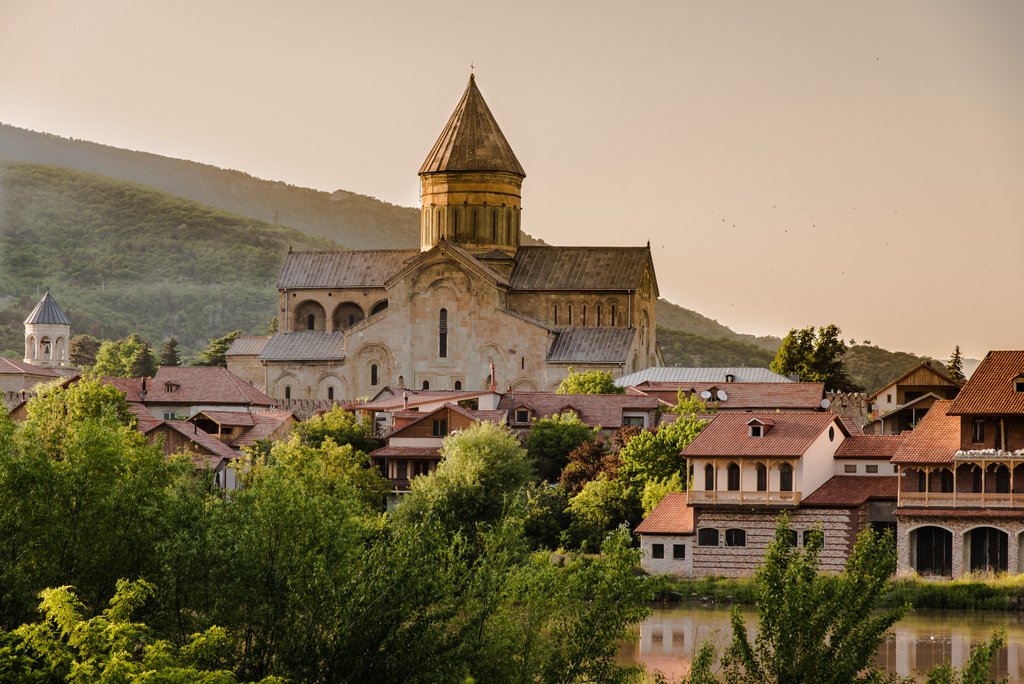
Tiflis (georgisch თბილისი Tbilissi; bis 1936: ტფილისი Tpilissi) ist die Hauptstadt Georgiens. Es ist die bevölkerungsreichste und größte Stadt des Landes. Tiflis hat mehr als eine Million Einwohner, die Gesamtfläche beträgt 726 Quadratkilometer, das bebaute Gebiet rund 70 Quadratkilometer.
Wir haben 6 Kennerinnen und Kenner der georgischen Hauptstadt Tiflis (georgisch თბილისი; Tbilissi) eingeladen, uns ihre Lieblingsorte in der Millionenstadt vorzustellen. Kommt mit uns und lasst euch von ihnen in ihre Stadt virtuell "entführen". Mit der Kulturmanagerin Tamuna Gurchiani, dem Autor Stephan Wackwitz, dem Literaturwissenschaftler und Publizisten Dr. Zaal Andronikashvili, der langjährigen Leiterin der GIZ in Georgien, Katja Kammerer, der Übersetzerin Natia Mikeladse–Bachsoliani und dem Leiter der Heinrich Böll Stiftung in Tiflis, Stefan Meister.
Alle sechs Orte finden sich auf der interaktiven Karte: uploads.knightlab.com
Showing posts with label Heinrich-Böll-Stiftung. Show all posts
Showing posts with label Heinrich-Böll-Stiftung. Show all posts
Monday, April 27, 2020
VIDEO: Klassenfahrt nach Tiflis (Georgien). Mit Tamuna Gurchiani, Stephan Wackwitz, Zaal Andronikashvili, Natia Mikeladze und Stefan Meister. via @bpb_de


Wednesday, December 12, 2018
PUBLIC LECTURE: Heinrich Boell Foundation South Caucasus regional office presents: Florian Mühlfried's "Moments of mistrust in South Caucasus". via @Boell_SC
On December 7, 2018, Heinrich Boell Foundation's South Caucasus organized a public lecture with social anthropologist Florian Muehlfried.
Moments of mistrust in South Caucasus is his article, published at Heinrich Boell Foundation's website. You can read the article here: Moments of Mistrust in the South Caucasus [ge.boell.org]
Facebook: facebook.com/hbf.caucasus
Twitter: twitter.com/Boell_SC
Website: ge.boell.org
Monday, December 03, 2018
EXCERPT: Moments of Mistrust in the South Caucasus. By Florian Muehlfried via ge.boell.org @Boell_SC
On Friday, December 7, at 4:00 pm, Heinrich-Böll-Stiftung South Caucasus
invites you to Florian Muehlfried’s public lecture "Moments of Mistrust
in South Caucasus. click here to read more: Lecture: Moments of Mistrust in South Caucasus at the book house "Ligamus".
Florian Muehlfried’s lecture is largely based on ethnographic
vignettes of mistrust, with the material mainly stemming from Abkhazia, a
breakaway self-declared republic in the Caucasus. The largely absent
international recognition of Abkhazia makes mistrust almost endemic and a
crucial part of daily life. Mistrust materializes in the assumption
that something is hidden behind the surface, e.g. a hidden agenda. This
assumption paves the way for conspiracy theories, but also allows to get
along with distrusted others who cannot be avoided. Contrasting
vignettes from Georgia show that mistrust towards facades may also
entail the opposite assumption: that there is nothing behind.
Florian Muehlfried is a social anthropologist working on the Caucasus, particularly on Georgia, for more than twenty years. His academic publications include the monographs Schemes of Mistrust: A Global Approach (forthcoming), Being a State and States of Being in Highland Georgia (2014) and Post-Soviet Feasting: The Georgian Banquet in Transition (2006, in German) as well as the edited volumes Mistrust: Ethnographic Approximations (2018), Sacred Places, Emerging Spaces: Religious Pluralism in the Post-Soviet Caucasus (2018, coedited with Tsyplylma Darieva and Kevin Tuite) and Soviet Era Anthropology in the Caucasus and Central Asia (2012, coedited with Sergey Sokolovskiy).
Address: ილიაუნის წიგნის სახლი "ლიგამუსი" / Book House "Ligamus", 32 Chavchavadze Ave., Tbilisi
[ge.boell.org] Even time cannot be trusted in Abkhazia. On mobile phones and computers that receive data from the Internet, it is one hour earlier than on mechanical watches. The Internet forces the Abkhazians into a time zone that for them has expired: the time zone of Georgia. Abkhazia is not recognised under international law, thus Abkhazian time is not accepted in virtual space. Abkhazia has fallen out of time.
© Florian Muehlfried 2019: Schemes of Mistrust: A Global Perspective. Basingstoke: Palgrave Pivot (Chapter 5). This draft has not been copy edited yet and thus will differ from the book Version.
Walking down the street, we meet a man of about fifty years in a black suit with a badge depicting a faded image of his mother, who had died a few years ago, on his shirt; he immediately starts talking about god, that he seeks Him, that people need Him, that he hopes to find Him, that he has to talk to us ... I first believe to have a Jehovah's Witness in front of me, but then he seems like too many questions and too few certainties. Later we learn that he lives alone in a village after his mother had passed away. And that, during the war, one of his ears was cut off as he was presumed dead; ears were cut off for trophies.
This note is included in my diary for August 2017 when I visited a town whose name is being disputed.[1] Some call it Gal and see it as the westernmost city of Abkhazia. Others call it Gali and thus perceive it as a Georgian city, because the “i” is the nominative ending of Georgian nouns. Its population was displaced by Abkhazian troops after they had won a war against Georgia in the autumn of 1993. Violence came suddenly, unexpectedly and massively, people had to flee overnight.[2]
The expulsion was based on Abkhazian troops’ and leaders’ distrust of the loyalty of the population of Gal/i that almost completely consisted (and now again consists) of Megrelians. They speak a language related to Georgian, and most of them live on Georgian territory across the border. As a second language, almost all Megrelians speak Georgian, the “language of the enemy”. In the second half of the 1990s, shortly after their cleansing, a large number of Megrelians were able to return to their destroyed homes. The distrust of the Abkhazians towards the Megrelians, however, remains lively still today. Abkhazian police patrol the streets, Megrelians are not recruited. Megrelians are denied Abkhazian passports – unless they profess to have been originally Abkhazian and megrelianised later on. In 2014, Megrelians residing in Abkhazia were deprived of the right to vote. The Georgian government speaks of apartheid. And in 2015, the Georgian language was banned from usage in the schools of Gal/i. Despite their poor command, Megrelian children thus have to study school subjects in the Russian language.
Georgians, too, distrust Megrelians because their group provides numerous features that could justify national independence: a separate language, a fairly clearly demarcated settlement area, periods of political sovereignty (see Broers 2001). For this reason, Georgian scholars attach great importance to concepts: whereas the Georgians are considered an ethnic group, the Megrelians are labelled as a sub-ethnic, ethnographic or ethno-territorial group (e.g. by Chitaia 1997-2001 who prefers the notion of sub-ethnicity). Beyond academic concerns, the crucial issue here is that ethnic groups may become a nation and claim sovereignty according to international law, whereas groups allocated below the threshold of ethnic identify may not, because they already belong to a (at least potential) nation. As ethnic groups with their own languages, some may fear, Megrelians may well claim sovereignty outside of the confines of the Georgian state, and this claim would be difficult to dismiss on scholarly grounds. The background to these concerns is separatism that has lead to the de facto statehood of Abkhazia and, to a lesser extent, of South Ossetia. It is these concerns that have motivated some Georgian scholars to state that Megrelians speak a dialect of Georgian, not a language (e.g. Gogebashvili 1991), although the vast majority of linguists worldwide disagree (e.g. Harris 1991).
In the district of Gal/i, mistrust is omnipresent, mutual and reciprocal. The reciprocity of mistrust perpetuates the latter and creates spirals of suspicion that are almost impossible to escape. When mistrust encounters itself, it tends to intensify and solidify, like aggression aggravates in situations of war. Yet, the citizens of Gal/i have to find ways to get along with the presence of others they distrust and that distrust them. One coping strategy is to allocate the core of mistrust beyond subjective accountability. Instead of blaming the people in one’s surrounding personally for the unbearable situation, one may assume that there is something else behind the surface, an unknown essence that drives it all and that causes mistrust to spread.
Conspiracy Theories
Visiting a Megrelian family in Gal/i. Giorgi, a Megrelian nationalist, is seated next to me. For him, the first kingdom of the Megrelians, Colchis, represents the origin of Georgian statehood. Only the Megrelians and the “hill tribes” [so-called sub-ethnic groups of Georgian highlanders such as Tushetians, Svans, or Khevsurs] are true Georgians, he postulates, the others are a mixture of Georgians, Armenians and Azerbaijanis. He has learned Abkhazian as a child and has Abkhazian friends. In front of me are two Abkhazians who speak Abkhazian among themselves and Russian with the others. In order to explain how the war between Georgia and Abkhazia came about, Giorgi tells a story he attributes to the Georgian erudite nobleman Sulchan-Saba Orbeliani:
‘A pig lives with its piglets at the foot of a tree on which an eagle nests. Comes a fox and says to the pig: Do not leave the tree [to fetch food]; the eagle is just waiting to kill your piglets. Then he goes to the eagle and says: Do not fly away [to provide food for the chicks]; the pigs are just waiting to gnaw the root of the tree until it falls over. The pig and the eagle no longer leave the tree. The first piglet dies and is fetched by the fox, the first chick dies and is fetched by the fox. At the end, everyone is dead and the fox has filled its stomach.’
Giorgi explains: A third force is at work here, which whispers, incites and only pursues its own interests. This force was behind the war in Abkhazia, this force is behind everything: Jews, Freemasons.
Such narratives allow living with those who distrust you because they are not held responsible for this distrust. And one can agree with them about invisible enemies who are to be blamed for it all. Later on, I note: “Many conspiracy theories. Armenians, Jews, freemasons are guilty of everything, but one cannot see them and there is no evidence (a hidden power that, like god, works in secret).” As much as these conspiracy theories are based on demonising groups as Freemasons, Jews or Armenians – with potentially most harmful consequences such as pogroms, ethnic cleansing, shootings, incarceration, gasification etc., they are not least ways of getting along with the “own” others, who are apparently, so it seems, not responsible, just like oneself. Thus, conspiracy theories may open up a shared space; a space that potentially nurtures conviviality, if only in its most basic form.[3] It is the “comfort of commonly perceived enemies” (Asmussen 2011: 127) that conspiracy theories provide. The secret others become scapegoats, and their joint blaming creates commonality (see Girard 2005).
A bit earlier, I had already pencilled down: “A lot of talk about god here, the quest for god, the only one who provides meaning to life.” This entry was not merely about the man in black we met on the street, but also about Davit, our host.
Looking Behind Things
Davit had fled to Georgia during the Abkhaz war, spent several years there and intended to stay. In 2001, however, he returned to Gal/i because his father had passed away and Davit had to take over the position of head of the household: “God had other plans for me.” Professionally, he works as a bank accountant. Davit is unmarried and possesses a key to the church. When taking me along, he points to an icon of St. George in a corner of the church and explains:
In the right top corner there is God, whose light falls on George. George is a saint who guides the people, symbolised by the horse he rides on. People are both good and evil, so they need divine guidance. The dragon that George kills creeping at his feet is just evil. On this icon, the flakes of the dragon are painted in bright colours. Did you notice that Georg wears the same colours in his robe? This is because he has to know evil in order to defeat it.
The latter reference emphasises the lifeworldly importance of practical knowledge, which is not acquired by observation from a distance, but by taking part. Such knowledge requires the engagement with a world that cannot be trusted. For Davit, this “dirty” knowledge is more profound than secular knowledge derived from a safe distance. At the same time, he pays close attention to natural phenomena such as the position of the sun or its rays. He has stored several photographs of the sun on his phone, even more of stones from a nearby forest. There is a place, explains Davit, where two rivers come together, a place he usually visits with his confessor. The water has a very special composition and is not drinkable. No frogs live in the water, there is no living being around, all is quiet. This is where Davit detects stones consisting of a cosmic material and marked by signs: some looking like a star chart, others like faces. Davit is fascinated by the regularity and symmetry of these signs, which to him indicate that these stones were inscribed by humans and derive from prehistoric times (“when the dinosaurs were still alive”).
For him, these artefacts are facts he can stick to, which at the same time testify to a higher power, an ancient lost knowledge, and cosmic energies (or substances). On one of the many photographs he took of the stones, a small folding rule is placed next to the object; on others he holds a square angle to the stone in order to illustrate its perfect proportions. On a portrait depicting him with a stone in his hand, an inexplicable light appears on his back. Davit has tried to find archaeologists to study these stones, their effect and location, but in vain. For him, the messages are evident, but for others they are hidden. Perhaps they can only be seen by those who have learned to look behind things. Religions are cults of mistrust as they do not accept things or people for what they seem to be. In this sense, conspiracy theories can be construed as religious, as they too represent powers as concealed. Places like Gal/i, where insecurity is endemic, such concealed powers are everywhere, and they haunt.
Even time cannot be trusted in Abkhazia. On mobile phones and computers that receive data from the Internet, it is one hour earlier than on mechanical watches. The Internet forces the Abkhazians into a time zone that for them has expired: the time zone of Georgia. Abkhazia is not recognised under international law, thus Abkhazian time is not accepted in virtual space. Abkhazia has fallen out of time.
Facade Politics
There is also the suspicious assumption that there is no nothing behind observable reality. Everything is just a facade. By means of such facades, revolutionary projects occasionally indicate the beginning of a new era. One such project was the peaceful Rose Revolution in Georgia in November 2003. With the overthrow of the then president Shevardnadze, the post-Soviet period was declared to have come to an end. A society would emerge that freed itself from the shackles of the past. It would go from darkness to light quite literally: In the more than twenty years since independence, the frequent power cuts turned the lights off; now Georgia would shine.
The remodelling of Georgia started with fountains being dressed in pastel colours. Then the TV tower in the Georgian capital Tbilisi glittered like a Christmas tree. With the arrival of the former US President George W. Bush for a state visit in 2005, the apartment buildings adjacent to the airport were freshly painted. Blue and red rays of light illuminated the facades of old city houses along the city walls at night. After the advent of light and colours, it was the time of balconies and cobblestones. The popular old town of Tbilisi, depicted in numerous novels and repeatedly painted or photographed, became the role model. From now on, every Georgian town would need a historic centre with balconies and cobblestones. A large sum of money was invested in the development of Sighnaghi, a fortress town built on a mountainside overlooking the Caucasian mountain ridge. After cobblestonisation and balconisation, this small town developed into the most popular tourist destination in the Georgian countryside. For Georgians, Sighnaghi now symbolises regional development in the form of musealisation; for tourists, it is a symbol of Georgian authenticity.
In 2007, I visited a winemaker who works in a wine cellar in the neighbouring town of Telavi. Telavi, too, has undergone a renovation of its ancient centre. Traditionally, there were no balconies in the centre at all, but now they are attached to many facades. Asphalt roads have been torn up and then paved. Shops, cafes, guesthouses and a centre for tourist information have opened. Nevertheless, there were hardly any visitors. Telavi at that moment was a ghost town. Perhaps spirits can work miracles and convey a sense of presence where before there was nothing, I was speculating. The winemaker waved this off. Against the polished facades of the renovated centre, it would become even more apparent how poorly people live. No state funds had reached them. “It's like in the Soviet Union – just a show.”
The comparison with the Soviet Union makes the post-Soviet economy of Georgia look like a planned economy. What matters is what is in the plan, what can be sold to the media and celebrated on public events. In this vein, the Tbilisi airport was built at record-breaking speed, but once opened, its roofs began to leak. And 100 hospitals were officially inaugurated within three years (2007 – 2010), but their equipment was driven from here to there depending on the schedule of press conferences organised to document the opening of a hospital (Frederiksen and Gotfredsen 2017: 113ff.).
In the Soviet Union, the realisation of plans had also been detached from reality, dramatically so and with substantial consequences. Those who, like the economist Alexander Chayanov, held on to the power of the factual and empirically-based analyses for the development of economy, had to reckon with exile and death during the early Soviet Union years (Nikulin 2011). This procedure was successful to the extent that, during the late Soviet Union years, facts and empiricism became largely irrelevant. There was no longer anything below the surface; instead, the surface was employed as a material that could be manipulated and ironised (Yurchak 2006).
In post-Soviet Georgia, too, there is nothing behind the facades – so, at least, many Georgians assume. The role model for the faking of reality is not so much the Soviet Union, however, but rather imperial Russia with its impression policy. The painted apartment blocks close to the airport, the facades of cracking old Tbilisi houses bathed in flashy colours, hospitals with no equipment, all this rather evokes the image of Potemkin villages. These fake villages, allegedly (for it may be a rumour) built by Grigory Potemkin for Catherine the Great in 1787, represent grandezza without substance, serving to hide an undesirable presence.[4] And it is this kind of impression management which became paradigmatic under the label of “Potemkin villages” that is at stake in post-Soviet Georgia as well. Mistrust here asks for substance.
Ruins
In Abkhazia as well, there is nothing behind some facades, but for another reasons: many building have been destroyed during the war with Georgia and not been renovated yet (or only poorly so). Doric columns that have nothing to support, windows through which one can see the sky from the street, bullet holes in the walls. In several cases, the facades are deliberately left standing. The twelve-story former government seat that had caught fire due to army shelling, for example, remains as a ruin in the centre of the Abkhazian capital; in front of it an empty pedestal on which Lenin once stood. Places like these are embodiments of horror that work as a reminder to the Abkhaz citizenry of a past that is yet a presence. In most other cases, however, the reason for the existence of ruins or seriously dilapidated building is much more straightforward: lack of financial means to do something with the facades. Obviously, there is nothing behind them: no intention, no excuse, no deception. No mistrust is required to observe this. Railway stations, built as palaces for the travellers, fall into disrepair, as do factory buildings, mining shafts and conveyor belts. Mining towns have turned into ghost towns. As their architecture is pompous, the effects of decay are even stronger. These sights, however, attract tourists from Western Europe to Abkhazia and serve to illustrate their travelogues on the Internet.
On Georgian facades with nothing behind, the future should shine – a colourful, happy, somewhat loony future. They are inscribed with a fictional temporal dimension. On Abkhazian facades, likewise with nothing behind, there is no discernible future, only a past as war or a present as absence. If statehood is built on citizens’ confidence in the future, then this confidence is shaken here – and thus statehood subverted on a most basic level. This lack of faith in the capacity of the state to shape the future is not limited to Abkhazia or other post-Soviet societies, of course, it is also a symptom of the West, at least since the proclaimed end of history after the collapse of the Soviet Union (Fukuyama 1992). With no future ahead, the future now takes place in the past, captured in out-dated utopias such as those of state socialism. This is one of the reasons why places like Abkhazia are so attractive to Western visitors: it is here they can encounter a past future. It radiates from the Soviet mosaics and conjures up the departure into space or utopia on earth. If there wasn’t the suspicion that this future has expired, one would want to join these travels, too.
NGO Politics
Business or betrayal? Such is the question asked by Timur Kodori in an entry on Facebook dated 24 July 2017.[5] The author is concerned about the involvement of his Abkhaz compatriots in an international project to preserve the Abkhaz language. The project is coordinated by the Georgian-based Centre for Civil Integration and Interethnic Relations and funded by the United States Development Assistance (USAID). The participating linguists hail from the University of Frankfurt; their local partner is the “Association of Businesswomen of Abkhazia.” In his post, Kodori mentions the names of the participants as well as the amount of money they received. He then raises the question whether the Abkhazians involved in this project had been bribed by the opponents of Abkhazia. “How soon will Abkhazia lose its independence as a result of such an approach and [...] again become an appendix of Georgia?”
Another indicator of betrayal is, according to Kodori, the fact that the Abkhaz participants have accepted to be photographed in front of a logo showing Abkhazia within the confines of Georgia. This logo is part of the corporate design of the Georgian NGO responsible for the project. The homepage of this NGO does not mention this project, however, not even in their Annual Reports produced during the project term 2015-2016. And maybe it is no coincidence that the “current projects” section of the NGO’s homepage was adjusted on 25 July 2017 – one day after Kodori’s post. On the websites of those involved in Frankfurt and Abkhazia, too, not a single word can be found about this project. Only the donor has published the following description:
The aim of the project is to support the interpersonal reconciliation between Georgians and Abkhazians by protecting and promoting the endangered Abkhaz language. This goal will be achieved by: (1) mobilizing the Georgian and Abkhazian representatives of science and civil society through the common interest in treasuring and revitalising the Abkhazian language, (2) bringing together young people, the potential leaders of Abkhazia and Georgia, to represent and promote universal human values as well as encouraging mutual respect, tolerance and a peaceful neighbourhood and (3) to facilitate a meaningful dialogue between various social groups regarding issues of common interest, e.g., education, science and the promotion of joint cooperation.[6]
In addition to the promotion of cooperation, this project concerns the creation of an Abkhaz language corpus and the development of software for the linguistic processing of the Abkhaz language. The required material is provided by Abkhazians (among them writers), the scientific expertise by the specialists from Frankfurt. Abkhazian linguists are not part of this cooperation, although they too are working on the documentation of the Abkhazian language and on concepts for its promotion. A linguist and teacher of Abkhaz based in the Abkhazian capital who authored one of the few textbooks available has never heard of the project. A linguist from the Abkhaz Academy of Sciences heard of this project from his dentist. The form of collaboration this project promotes is thus asymmetric: one party delivers, the other one understands.
This colonial form of knowledge production confirms the mistrust of those who feel that Abkhazia is not taken seriously. In this way, mistrust perpetuates and intensifies the rejection to work with colleagues from abroad, as cooperation is never assumed to take place among equals. A great deal of energy is needed for mistrustful engagements with external actors, energy many Abkhazians lack after decades of isolation, stagnation and depression. Better not having anything to do with something one cannot trust and that can be avoided. Given the clouds under which the project is shrouded, another mistrust finds substantiation: one should not see what it is all really about.
Once again, mistrust is ignited by surfaces. Instead of assuming that all there are facades, with no substance behind, the suspicious assumption here is that there is something hidden behind the facade, namely a political agenda based on hostile intentions. On the surface, one can see NGO-driven civic engagements, presumably without a political purpose and directed towards a universal good (in this case, the preservation, documentation and promotion of the Abkhaz language). Underneath the surface, however, a doubtful observer such as Timur Kodori identifies a dark force, here incorporated by the Georgian state and its allies. In order for this force to work, so Kodori implies, it has to come in disguise. This disguise is provided by the NGOs involved in this project, which are essentially machinations of masquerade.
For Kodori, the research project is just a cover-up of political infiltration and indoctrination. In the Russian-speaking world (that includes Abkhazia), such activity is covered by the word pokazukha, which “refers to putting on a false show to cover up the actual state of affairs“ (Sántha and Safonova 2011: 75).[7] The aim of this show is to represent a presence that isn’t real, and a reality that is not meant to be present. Trusting the visible would mean to be trapped in illusion and to fall victim to deceit. The distrust that Kodori articulates is meant to make the show fall apart.
Distrusting Facades
In many of the cases portrayed above, facades have aroused suspicion. In the case of Georgian facade politics, the suspicion is that there is nothing behind, that the surface is all there is. This absence of substance comes in stark contrast to the message that is conveyed with these facades: that of a presence, of a thriving life, of a future and a succeeding present. In the case of Abkhazians facades (that are often those of ruins), the absence of something behind at the same time denotes an absence of the future. This absence of the future is, in a way, the essence of Abkhaz ruins. Whereas in the Georgian case, the Potemkin facades denote an attempt to manipulate public perception, in the Abkhaz case, they denote a void.
Facades may also serve to hide a secret agenda. In this vein, Timur Kodori assumes that NGOs occasionally provide the facade behind which a secret political agenda unfolds. He sees the NGOs that he is targeting as Trojan horses that allow the enemy to penetrate ones own space. What he discerns is a contradiction between visible surfaces and that what is underneath. Such kind of contradiction may be explained with the help of conspiracy theories.
Doing so also allows alleviating tensions with one’s neighbours who do not need to be held accountable for past atrocities, because another clandestine power can be blamed instead. In the context of Abkhazia, this discursive strategy fosters conviviality with those that cannot be trusted. The tension that distrust creates is distracted by conjuring up joint enemies, even if fictional ones.
Bibliography
Asmussen, Jan. 2011. Conspiracy Theories and Cypriot History: The Comfort of Commonly Perceived Enemies. Cyprus Review 23 (2): 127-145.
Broers, Laurence. 2001. Who are the Mingrelians? Language, Identity and Politics in Western Georgia. Sixth Annual Convention of the Association for the Study of Nationalities 2001. Panel: Minority Identity in Georgia (unpublished paper).
Frederiksen, Martin Demant und Katrine Bendtsen Gotfredsen. 2017. Georgian Portraits: Essays on the Afterlives of a Revolution. Winchester/Washington: Zero Books.
Fukuyama, Francis. 1992. The End of History and the Last Man. New York: The Free Press.
Girard, Réne. 2005. Violence and the Sacred. New York: Continuum.
Gogebashvili, Iakob.1990 [1902]. borot’i c’adili samegrelos shesaxeb [An Evil Intention
vis-à-vis Mingrelia]. In: rcheuli txzulebani xut t’omad [Collected Works in Five Volumes]
Vol. 2. Tbilisi: ganatleba.
Harris, Alice C. 1991. Mingrelian. In: A.C. Harris (ed.): The Indigenous Languages of the Caucasus 1: The Kartvelian Languages. Delmar NY: Caravan Books: 313–394.
Nikulin, Alexander. 2011. Tragedy of a Soviet Faust: Chaianov in Central Asia. In Exploring the Edge of Empire: Soviet Era Anthropology in the Caucasus and Central Asia, ed. by F. Mühlfried and S. Sokolovskiy. Münster: LIT Verlag: 275-293.
Sántha, István and Tatiana Safonova. 2011. Pokazukha in the House of Culture: The Pattern of Behavior in Kurumkan, Eastern Buriatiia. In: Donahoe, Brian and Joachim Otto Habeck (eds.): Reconstructing the House of Culture: Community, Self, and the Making of Culture in Russia and Beyond. New York: Berghahn: 75-96.
West, Harry G., and Todd Sanders (eds.). 2003. Transparency and Conspiracy: Ethnographies of Suspicion in the New World Order. Durham, London: Duke.
Yurchak, Alexei. 2006. Everything Was Forever, Until It Was No More: The Last Soviet Generation. Princeton, NJ: Princeton University Press.
Florian Mühlfried 2019: Schemes of Mistrust: A Global Perspective. Basingstoke: Polgrave Pivot (chapter 5)
[1] This essay is largely identical with chapter five of my book on „Schemes of Mistrust: A Global Perspective” to be published with Palgrave Pivot in spring 2019. I thank the publisher and in particular my editor Mary Al-Sayed for the permission to republish my chapter in this format.
[2] In accordance with the policy of the media portal OC Media that reports on the entire Caucasus region, I do not use qualifiers such as ‘de facto’, ‘unrecognised’, or ‘partially recognised’ when discussing institutions within Abkhazia for reasons of readability. In the same vein, the simoultanous usage of the designations Abkhazia and Georgia does not imply a position on the political status of Abkhazia, but rather follows the pragmatic goal of being able to contrast situations and developments in Abkhazia and (the rest of) Georgia without straining readability with inserted brackets.
[3] See West and Sanders 2003 for the social workings of conspiracy theories.
[4] Many thanks to Sascha Roth for raising this argument.
[5] Timur Kodori is probably a pseudonym.
[6] Source: https://www.usaid.gov/georgia/working-crises-and-conflict; later on, however, this entry also disappeared.
[7] Again, my gratitude goes to Sascha Roth for bringing this to my attention.
 |
Published by Boell Foundation, 3. December 2018,
Click on logo to read the article by Florian Muehlfried
|
Florian Muehlfried is a social anthropologist working on the Caucasus, particularly on Georgia, for more than twenty years. His academic publications include the monographs Schemes of Mistrust: A Global Approach (forthcoming), Being a State and States of Being in Highland Georgia (2014) and Post-Soviet Feasting: The Georgian Banquet in Transition (2006, in German) as well as the edited volumes Mistrust: Ethnographic Approximations (2018), Sacred Places, Emerging Spaces: Religious Pluralism in the Post-Soviet Caucasus (2018, coedited with Tsyplylma Darieva and Kevin Tuite) and Soviet Era Anthropology in the Caucasus and Central Asia (2012, coedited with Sergey Sokolovskiy).
Address: ილიაუნის წიგნის სახლი "ლიგამუსი" / Book House "Ligamus", 32 Chavchavadze Ave., Tbilisi
[ge.boell.org] Even time cannot be trusted in Abkhazia. On mobile phones and computers that receive data from the Internet, it is one hour earlier than on mechanical watches. The Internet forces the Abkhazians into a time zone that for them has expired: the time zone of Georgia. Abkhazia is not recognised under international law, thus Abkhazian time is not accepted in virtual space. Abkhazia has fallen out of time.
 |
Sukhum/i, July 2015 – Creator: Anna Dziapshipa. All rights reserved.
|
Walking down the street, we meet a man of about fifty years in a black suit with a badge depicting a faded image of his mother, who had died a few years ago, on his shirt; he immediately starts talking about god, that he seeks Him, that people need Him, that he hopes to find Him, that he has to talk to us ... I first believe to have a Jehovah's Witness in front of me, but then he seems like too many questions and too few certainties. Later we learn that he lives alone in a village after his mother had passed away. And that, during the war, one of his ears was cut off as he was presumed dead; ears were cut off for trophies.
This note is included in my diary for August 2017 when I visited a town whose name is being disputed.[1] Some call it Gal and see it as the westernmost city of Abkhazia. Others call it Gali and thus perceive it as a Georgian city, because the “i” is the nominative ending of Georgian nouns. Its population was displaced by Abkhazian troops after they had won a war against Georgia in the autumn of 1993. Violence came suddenly, unexpectedly and massively, people had to flee overnight.[2]
The expulsion was based on Abkhazian troops’ and leaders’ distrust of the loyalty of the population of Gal/i that almost completely consisted (and now again consists) of Megrelians. They speak a language related to Georgian, and most of them live on Georgian territory across the border. As a second language, almost all Megrelians speak Georgian, the “language of the enemy”. In the second half of the 1990s, shortly after their cleansing, a large number of Megrelians were able to return to their destroyed homes. The distrust of the Abkhazians towards the Megrelians, however, remains lively still today. Abkhazian police patrol the streets, Megrelians are not recruited. Megrelians are denied Abkhazian passports – unless they profess to have been originally Abkhazian and megrelianised later on. In 2014, Megrelians residing in Abkhazia were deprived of the right to vote. The Georgian government speaks of apartheid. And in 2015, the Georgian language was banned from usage in the schools of Gal/i. Despite their poor command, Megrelian children thus have to study school subjects in the Russian language.
Georgians, too, distrust Megrelians because their group provides numerous features that could justify national independence: a separate language, a fairly clearly demarcated settlement area, periods of political sovereignty (see Broers 2001). For this reason, Georgian scholars attach great importance to concepts: whereas the Georgians are considered an ethnic group, the Megrelians are labelled as a sub-ethnic, ethnographic or ethno-territorial group (e.g. by Chitaia 1997-2001 who prefers the notion of sub-ethnicity). Beyond academic concerns, the crucial issue here is that ethnic groups may become a nation and claim sovereignty according to international law, whereas groups allocated below the threshold of ethnic identify may not, because they already belong to a (at least potential) nation. As ethnic groups with their own languages, some may fear, Megrelians may well claim sovereignty outside of the confines of the Georgian state, and this claim would be difficult to dismiss on scholarly grounds. The background to these concerns is separatism that has lead to the de facto statehood of Abkhazia and, to a lesser extent, of South Ossetia. It is these concerns that have motivated some Georgian scholars to state that Megrelians speak a dialect of Georgian, not a language (e.g. Gogebashvili 1991), although the vast majority of linguists worldwide disagree (e.g. Harris 1991).
In the district of Gal/i, mistrust is omnipresent, mutual and reciprocal. The reciprocity of mistrust perpetuates the latter and creates spirals of suspicion that are almost impossible to escape. When mistrust encounters itself, it tends to intensify and solidify, like aggression aggravates in situations of war. Yet, the citizens of Gal/i have to find ways to get along with the presence of others they distrust and that distrust them. One coping strategy is to allocate the core of mistrust beyond subjective accountability. Instead of blaming the people in one’s surrounding personally for the unbearable situation, one may assume that there is something else behind the surface, an unknown essence that drives it all and that causes mistrust to spread.
Conspiracy Theories
Visiting a Megrelian family in Gal/i. Giorgi, a Megrelian nationalist, is seated next to me. For him, the first kingdom of the Megrelians, Colchis, represents the origin of Georgian statehood. Only the Megrelians and the “hill tribes” [so-called sub-ethnic groups of Georgian highlanders such as Tushetians, Svans, or Khevsurs] are true Georgians, he postulates, the others are a mixture of Georgians, Armenians and Azerbaijanis. He has learned Abkhazian as a child and has Abkhazian friends. In front of me are two Abkhazians who speak Abkhazian among themselves and Russian with the others. In order to explain how the war between Georgia and Abkhazia came about, Giorgi tells a story he attributes to the Georgian erudite nobleman Sulchan-Saba Orbeliani:
‘A pig lives with its piglets at the foot of a tree on which an eagle nests. Comes a fox and says to the pig: Do not leave the tree [to fetch food]; the eagle is just waiting to kill your piglets. Then he goes to the eagle and says: Do not fly away [to provide food for the chicks]; the pigs are just waiting to gnaw the root of the tree until it falls over. The pig and the eagle no longer leave the tree. The first piglet dies and is fetched by the fox, the first chick dies and is fetched by the fox. At the end, everyone is dead and the fox has filled its stomach.’
Giorgi explains: A third force is at work here, which whispers, incites and only pursues its own interests. This force was behind the war in Abkhazia, this force is behind everything: Jews, Freemasons.
Such narratives allow living with those who distrust you because they are not held responsible for this distrust. And one can agree with them about invisible enemies who are to be blamed for it all. Later on, I note: “Many conspiracy theories. Armenians, Jews, freemasons are guilty of everything, but one cannot see them and there is no evidence (a hidden power that, like god, works in secret).” As much as these conspiracy theories are based on demonising groups as Freemasons, Jews or Armenians – with potentially most harmful consequences such as pogroms, ethnic cleansing, shootings, incarceration, gasification etc., they are not least ways of getting along with the “own” others, who are apparently, so it seems, not responsible, just like oneself. Thus, conspiracy theories may open up a shared space; a space that potentially nurtures conviviality, if only in its most basic form.[3] It is the “comfort of commonly perceived enemies” (Asmussen 2011: 127) that conspiracy theories provide. The secret others become scapegoats, and their joint blaming creates commonality (see Girard 2005).
A bit earlier, I had already pencilled down: “A lot of talk about god here, the quest for god, the only one who provides meaning to life.” This entry was not merely about the man in black we met on the street, but also about Davit, our host.
Looking Behind Things
Davit had fled to Georgia during the Abkhaz war, spent several years there and intended to stay. In 2001, however, he returned to Gal/i because his father had passed away and Davit had to take over the position of head of the household: “God had other plans for me.” Professionally, he works as a bank accountant. Davit is unmarried and possesses a key to the church. When taking me along, he points to an icon of St. George in a corner of the church and explains:
In the right top corner there is God, whose light falls on George. George is a saint who guides the people, symbolised by the horse he rides on. People are both good and evil, so they need divine guidance. The dragon that George kills creeping at his feet is just evil. On this icon, the flakes of the dragon are painted in bright colours. Did you notice that Georg wears the same colours in his robe? This is because he has to know evil in order to defeat it.
The latter reference emphasises the lifeworldly importance of practical knowledge, which is not acquired by observation from a distance, but by taking part. Such knowledge requires the engagement with a world that cannot be trusted. For Davit, this “dirty” knowledge is more profound than secular knowledge derived from a safe distance. At the same time, he pays close attention to natural phenomena such as the position of the sun or its rays. He has stored several photographs of the sun on his phone, even more of stones from a nearby forest. There is a place, explains Davit, where two rivers come together, a place he usually visits with his confessor. The water has a very special composition and is not drinkable. No frogs live in the water, there is no living being around, all is quiet. This is where Davit detects stones consisting of a cosmic material and marked by signs: some looking like a star chart, others like faces. Davit is fascinated by the regularity and symmetry of these signs, which to him indicate that these stones were inscribed by humans and derive from prehistoric times (“when the dinosaurs were still alive”).
For him, these artefacts are facts he can stick to, which at the same time testify to a higher power, an ancient lost knowledge, and cosmic energies (or substances). On one of the many photographs he took of the stones, a small folding rule is placed next to the object; on others he holds a square angle to the stone in order to illustrate its perfect proportions. On a portrait depicting him with a stone in his hand, an inexplicable light appears on his back. Davit has tried to find archaeologists to study these stones, their effect and location, but in vain. For him, the messages are evident, but for others they are hidden. Perhaps they can only be seen by those who have learned to look behind things. Religions are cults of mistrust as they do not accept things or people for what they seem to be. In this sense, conspiracy theories can be construed as religious, as they too represent powers as concealed. Places like Gal/i, where insecurity is endemic, such concealed powers are everywhere, and they haunt.
Even time cannot be trusted in Abkhazia. On mobile phones and computers that receive data from the Internet, it is one hour earlier than on mechanical watches. The Internet forces the Abkhazians into a time zone that for them has expired: the time zone of Georgia. Abkhazia is not recognised under international law, thus Abkhazian time is not accepted in virtual space. Abkhazia has fallen out of time.
Facade Politics
There is also the suspicious assumption that there is no nothing behind observable reality. Everything is just a facade. By means of such facades, revolutionary projects occasionally indicate the beginning of a new era. One such project was the peaceful Rose Revolution in Georgia in November 2003. With the overthrow of the then president Shevardnadze, the post-Soviet period was declared to have come to an end. A society would emerge that freed itself from the shackles of the past. It would go from darkness to light quite literally: In the more than twenty years since independence, the frequent power cuts turned the lights off; now Georgia would shine.
The remodelling of Georgia started with fountains being dressed in pastel colours. Then the TV tower in the Georgian capital Tbilisi glittered like a Christmas tree. With the arrival of the former US President George W. Bush for a state visit in 2005, the apartment buildings adjacent to the airport were freshly painted. Blue and red rays of light illuminated the facades of old city houses along the city walls at night. After the advent of light and colours, it was the time of balconies and cobblestones. The popular old town of Tbilisi, depicted in numerous novels and repeatedly painted or photographed, became the role model. From now on, every Georgian town would need a historic centre with balconies and cobblestones. A large sum of money was invested in the development of Sighnaghi, a fortress town built on a mountainside overlooking the Caucasian mountain ridge. After cobblestonisation and balconisation, this small town developed into the most popular tourist destination in the Georgian countryside. For Georgians, Sighnaghi now symbolises regional development in the form of musealisation; for tourists, it is a symbol of Georgian authenticity.
In 2007, I visited a winemaker who works in a wine cellar in the neighbouring town of Telavi. Telavi, too, has undergone a renovation of its ancient centre. Traditionally, there were no balconies in the centre at all, but now they are attached to many facades. Asphalt roads have been torn up and then paved. Shops, cafes, guesthouses and a centre for tourist information have opened. Nevertheless, there were hardly any visitors. Telavi at that moment was a ghost town. Perhaps spirits can work miracles and convey a sense of presence where before there was nothing, I was speculating. The winemaker waved this off. Against the polished facades of the renovated centre, it would become even more apparent how poorly people live. No state funds had reached them. “It's like in the Soviet Union – just a show.”
The comparison with the Soviet Union makes the post-Soviet economy of Georgia look like a planned economy. What matters is what is in the plan, what can be sold to the media and celebrated on public events. In this vein, the Tbilisi airport was built at record-breaking speed, but once opened, its roofs began to leak. And 100 hospitals were officially inaugurated within three years (2007 – 2010), but their equipment was driven from here to there depending on the schedule of press conferences organised to document the opening of a hospital (Frederiksen and Gotfredsen 2017: 113ff.).
In the Soviet Union, the realisation of plans had also been detached from reality, dramatically so and with substantial consequences. Those who, like the economist Alexander Chayanov, held on to the power of the factual and empirically-based analyses for the development of economy, had to reckon with exile and death during the early Soviet Union years (Nikulin 2011). This procedure was successful to the extent that, during the late Soviet Union years, facts and empiricism became largely irrelevant. There was no longer anything below the surface; instead, the surface was employed as a material that could be manipulated and ironised (Yurchak 2006).
In post-Soviet Georgia, too, there is nothing behind the facades – so, at least, many Georgians assume. The role model for the faking of reality is not so much the Soviet Union, however, but rather imperial Russia with its impression policy. The painted apartment blocks close to the airport, the facades of cracking old Tbilisi houses bathed in flashy colours, hospitals with no equipment, all this rather evokes the image of Potemkin villages. These fake villages, allegedly (for it may be a rumour) built by Grigory Potemkin for Catherine the Great in 1787, represent grandezza without substance, serving to hide an undesirable presence.[4] And it is this kind of impression management which became paradigmatic under the label of “Potemkin villages” that is at stake in post-Soviet Georgia as well. Mistrust here asks for substance.
Ruins
In Abkhazia as well, there is nothing behind some facades, but for another reasons: many building have been destroyed during the war with Georgia and not been renovated yet (or only poorly so). Doric columns that have nothing to support, windows through which one can see the sky from the street, bullet holes in the walls. In several cases, the facades are deliberately left standing. The twelve-story former government seat that had caught fire due to army shelling, for example, remains as a ruin in the centre of the Abkhazian capital; in front of it an empty pedestal on which Lenin once stood. Places like these are embodiments of horror that work as a reminder to the Abkhaz citizenry of a past that is yet a presence. In most other cases, however, the reason for the existence of ruins or seriously dilapidated building is much more straightforward: lack of financial means to do something with the facades. Obviously, there is nothing behind them: no intention, no excuse, no deception. No mistrust is required to observe this. Railway stations, built as palaces for the travellers, fall into disrepair, as do factory buildings, mining shafts and conveyor belts. Mining towns have turned into ghost towns. As their architecture is pompous, the effects of decay are even stronger. These sights, however, attract tourists from Western Europe to Abkhazia and serve to illustrate their travelogues on the Internet.
On Georgian facades with nothing behind, the future should shine – a colourful, happy, somewhat loony future. They are inscribed with a fictional temporal dimension. On Abkhazian facades, likewise with nothing behind, there is no discernible future, only a past as war or a present as absence. If statehood is built on citizens’ confidence in the future, then this confidence is shaken here – and thus statehood subverted on a most basic level. This lack of faith in the capacity of the state to shape the future is not limited to Abkhazia or other post-Soviet societies, of course, it is also a symptom of the West, at least since the proclaimed end of history after the collapse of the Soviet Union (Fukuyama 1992). With no future ahead, the future now takes place in the past, captured in out-dated utopias such as those of state socialism. This is one of the reasons why places like Abkhazia are so attractive to Western visitors: it is here they can encounter a past future. It radiates from the Soviet mosaics and conjures up the departure into space or utopia on earth. If there wasn’t the suspicion that this future has expired, one would want to join these travels, too.
NGO Politics
Business or betrayal? Such is the question asked by Timur Kodori in an entry on Facebook dated 24 July 2017.[5] The author is concerned about the involvement of his Abkhaz compatriots in an international project to preserve the Abkhaz language. The project is coordinated by the Georgian-based Centre for Civil Integration and Interethnic Relations and funded by the United States Development Assistance (USAID). The participating linguists hail from the University of Frankfurt; their local partner is the “Association of Businesswomen of Abkhazia.” In his post, Kodori mentions the names of the participants as well as the amount of money they received. He then raises the question whether the Abkhazians involved in this project had been bribed by the opponents of Abkhazia. “How soon will Abkhazia lose its independence as a result of such an approach and [...] again become an appendix of Georgia?”
Another indicator of betrayal is, according to Kodori, the fact that the Abkhaz participants have accepted to be photographed in front of a logo showing Abkhazia within the confines of Georgia. This logo is part of the corporate design of the Georgian NGO responsible for the project. The homepage of this NGO does not mention this project, however, not even in their Annual Reports produced during the project term 2015-2016. And maybe it is no coincidence that the “current projects” section of the NGO’s homepage was adjusted on 25 July 2017 – one day after Kodori’s post. On the websites of those involved in Frankfurt and Abkhazia, too, not a single word can be found about this project. Only the donor has published the following description:
The aim of the project is to support the interpersonal reconciliation between Georgians and Abkhazians by protecting and promoting the endangered Abkhaz language. This goal will be achieved by: (1) mobilizing the Georgian and Abkhazian representatives of science and civil society through the common interest in treasuring and revitalising the Abkhazian language, (2) bringing together young people, the potential leaders of Abkhazia and Georgia, to represent and promote universal human values as well as encouraging mutual respect, tolerance and a peaceful neighbourhood and (3) to facilitate a meaningful dialogue between various social groups regarding issues of common interest, e.g., education, science and the promotion of joint cooperation.[6]
In addition to the promotion of cooperation, this project concerns the creation of an Abkhaz language corpus and the development of software for the linguistic processing of the Abkhaz language. The required material is provided by Abkhazians (among them writers), the scientific expertise by the specialists from Frankfurt. Abkhazian linguists are not part of this cooperation, although they too are working on the documentation of the Abkhazian language and on concepts for its promotion. A linguist and teacher of Abkhaz based in the Abkhazian capital who authored one of the few textbooks available has never heard of the project. A linguist from the Abkhaz Academy of Sciences heard of this project from his dentist. The form of collaboration this project promotes is thus asymmetric: one party delivers, the other one understands.
This colonial form of knowledge production confirms the mistrust of those who feel that Abkhazia is not taken seriously. In this way, mistrust perpetuates and intensifies the rejection to work with colleagues from abroad, as cooperation is never assumed to take place among equals. A great deal of energy is needed for mistrustful engagements with external actors, energy many Abkhazians lack after decades of isolation, stagnation and depression. Better not having anything to do with something one cannot trust and that can be avoided. Given the clouds under which the project is shrouded, another mistrust finds substantiation: one should not see what it is all really about.
Once again, mistrust is ignited by surfaces. Instead of assuming that all there are facades, with no substance behind, the suspicious assumption here is that there is something hidden behind the facade, namely a political agenda based on hostile intentions. On the surface, one can see NGO-driven civic engagements, presumably without a political purpose and directed towards a universal good (in this case, the preservation, documentation and promotion of the Abkhaz language). Underneath the surface, however, a doubtful observer such as Timur Kodori identifies a dark force, here incorporated by the Georgian state and its allies. In order for this force to work, so Kodori implies, it has to come in disguise. This disguise is provided by the NGOs involved in this project, which are essentially machinations of masquerade.
For Kodori, the research project is just a cover-up of political infiltration and indoctrination. In the Russian-speaking world (that includes Abkhazia), such activity is covered by the word pokazukha, which “refers to putting on a false show to cover up the actual state of affairs“ (Sántha and Safonova 2011: 75).[7] The aim of this show is to represent a presence that isn’t real, and a reality that is not meant to be present. Trusting the visible would mean to be trapped in illusion and to fall victim to deceit. The distrust that Kodori articulates is meant to make the show fall apart.
Distrusting Facades
In many of the cases portrayed above, facades have aroused suspicion. In the case of Georgian facade politics, the suspicion is that there is nothing behind, that the surface is all there is. This absence of substance comes in stark contrast to the message that is conveyed with these facades: that of a presence, of a thriving life, of a future and a succeeding present. In the case of Abkhazians facades (that are often those of ruins), the absence of something behind at the same time denotes an absence of the future. This absence of the future is, in a way, the essence of Abkhaz ruins. Whereas in the Georgian case, the Potemkin facades denote an attempt to manipulate public perception, in the Abkhaz case, they denote a void.
Facades may also serve to hide a secret agenda. In this vein, Timur Kodori assumes that NGOs occasionally provide the facade behind which a secret political agenda unfolds. He sees the NGOs that he is targeting as Trojan horses that allow the enemy to penetrate ones own space. What he discerns is a contradiction between visible surfaces and that what is underneath. Such kind of contradiction may be explained with the help of conspiracy theories.
Doing so also allows alleviating tensions with one’s neighbours who do not need to be held accountable for past atrocities, because another clandestine power can be blamed instead. In the context of Abkhazia, this discursive strategy fosters conviviality with those that cannot be trusted. The tension that distrust creates is distracted by conjuring up joint enemies, even if fictional ones.
Bibliography
Asmussen, Jan. 2011. Conspiracy Theories and Cypriot History: The Comfort of Commonly Perceived Enemies. Cyprus Review 23 (2): 127-145.
Broers, Laurence. 2001. Who are the Mingrelians? Language, Identity and Politics in Western Georgia. Sixth Annual Convention of the Association for the Study of Nationalities 2001. Panel: Minority Identity in Georgia (unpublished paper).
Frederiksen, Martin Demant und Katrine Bendtsen Gotfredsen. 2017. Georgian Portraits: Essays on the Afterlives of a Revolution. Winchester/Washington: Zero Books.
Fukuyama, Francis. 1992. The End of History and the Last Man. New York: The Free Press.
Girard, Réne. 2005. Violence and the Sacred. New York: Continuum.
Gogebashvili, Iakob.1990 [1902]. borot’i c’adili samegrelos shesaxeb [An Evil Intention
vis-à-vis Mingrelia]. In: rcheuli txzulebani xut t’omad [Collected Works in Five Volumes]
Vol. 2. Tbilisi: ganatleba.
Harris, Alice C. 1991. Mingrelian. In: A.C. Harris (ed.): The Indigenous Languages of the Caucasus 1: The Kartvelian Languages. Delmar NY: Caravan Books: 313–394.
Nikulin, Alexander. 2011. Tragedy of a Soviet Faust: Chaianov in Central Asia. In Exploring the Edge of Empire: Soviet Era Anthropology in the Caucasus and Central Asia, ed. by F. Mühlfried and S. Sokolovskiy. Münster: LIT Verlag: 275-293.
Sántha, István and Tatiana Safonova. 2011. Pokazukha in the House of Culture: The Pattern of Behavior in Kurumkan, Eastern Buriatiia. In: Donahoe, Brian and Joachim Otto Habeck (eds.): Reconstructing the House of Culture: Community, Self, and the Making of Culture in Russia and Beyond. New York: Berghahn: 75-96.
West, Harry G., and Todd Sanders (eds.). 2003. Transparency and Conspiracy: Ethnographies of Suspicion in the New World Order. Durham, London: Duke.
Yurchak, Alexei. 2006. Everything Was Forever, Until It Was No More: The Last Soviet Generation. Princeton, NJ: Princeton University Press.
Florian Mühlfried 2019: Schemes of Mistrust: A Global Perspective. Basingstoke: Polgrave Pivot (chapter 5)
[1] This essay is largely identical with chapter five of my book on „Schemes of Mistrust: A Global Perspective” to be published with Palgrave Pivot in spring 2019. I thank the publisher and in particular my editor Mary Al-Sayed for the permission to republish my chapter in this format.
[2] In accordance with the policy of the media portal OC Media that reports on the entire Caucasus region, I do not use qualifiers such as ‘de facto’, ‘unrecognised’, or ‘partially recognised’ when discussing institutions within Abkhazia for reasons of readability. In the same vein, the simoultanous usage of the designations Abkhazia and Georgia does not imply a position on the political status of Abkhazia, but rather follows the pragmatic goal of being able to contrast situations and developments in Abkhazia and (the rest of) Georgia without straining readability with inserted brackets.
[3] See West and Sanders 2003 for the social workings of conspiracy theories.
[4] Many thanks to Sascha Roth for raising this argument.
[5] Timur Kodori is probably a pseudonym.
[6] Source: https://www.usaid.gov/georgia/working-crises-and-conflict; later on, however, this entry also disappeared.
[7] Again, my gratitude goes to Sascha Roth for bringing this to my attention.
Monday, November 05, 2018
BUCH: Georgien, neu buchstabiert: Politik und Kultur eines Landes auf dem Weg nach Europa. via @transcriptweb
 Veröffentlichungsort: Bielefeld
Veröffentlichungsdatum: Oktober 2018
Seitenanzahl: 204
Lizenz: All rights reserved.
Sprache der Publikation: Deutsch
ISBN: 978-3-8376-4533-0
Georgien ist ein Land, das neugierig macht. Christlich geprägt, doch bis zur Unabhängigkeit 1991 Teil der Sowjetunion, liegt es auf der Grenze zwischen Ost und West und sucht seinen ganz eigenen Weg nach Europa. Dieser Band mit kritischen Beiträgen vor allem junger georgischer Autorinnen und Autoren zeichnet das Porträt eines faszinierenden Landes voller Geschichte, Kultur und Vitalität.
Mit Texten von Maia Barkaia, Adrian Brisku, Ana Diakonidze, Giorgi Ghvinjilia, David Gogishvili, Natia Gvianishvili, Irakli Iremadze, Barbare Janelidze, Tamta Khalvashi, Nino Lejava, Levan Lortikipanidze, Giorgi Maisuradze, Luka Nakhutsrishvili, Vakhtang Natsvlishvili, Lela Rekhviashvili, Mikheil Svanidze und Tamar Tskhadadze.
Friday, October 05, 2018
GESPRÄCHSZEIT: Nino Lejava - Leiterin der Heinrich-Böll-Stiftung South Caucasus in Georgien. via @radiobremen
 |
Nino Lejava im Podcast
(Klick auf das Bild)
|
Im Norden Russland, im Südwesten die Türkei, im Südwesten der Iran – Georgien muss sich gegen mächtige Nachbarn behaupten. Aber dennoch gehört es zu den Ländern, die im Westen oft unterschätzt werden. Dort wurde einst der Weinanbau erfunden, der immer noch eine große Rolle spielt, es gibt Skigebiete, Strände am Schwarzen Meer und das Land hat sogar eine eigene Schrift. Es ist aber auch das Geburtsland Stalins und Georgien ächzt unter großen wirtschaftlichen Schwierigkeiten. Nino Lejava erlebt all das jeden Tag. In Tiflis leitet sie die Heinrich-Böll-Stiftung und beschäftigt sich intensiv mit den politischen Veränderungen im Land, zum Beispiel mit dem erfolgreichen Kampf gegen die Korruption im Land.
"Das war früher ein großes Problem. Heute ist es gerade umgekehrt, wo Georgien für viele verschiedene Länder das Musterbeispiel gibt, dass man das Problem auch bekämpfen könne, wenn der Wille da sei."
Menschen für Demokratie begeistern
Ihre Eltern schickten Nino Lejava als Kind in einen privaten Kindergarten. Dort lernte sie deutsch, was zu Sowjetzeiten noch als Bildungssprache galt. Durch ein Schüleraustauschprogramm verbrachte sie die 11. Klasse in einem bayerischen Internat, wo sich ihre Sprachkenntnisse verfestigten. Das Jura-Studium führte sie dann noch einmal nach Deutschland, nach Hamburg. Als Leiterin des Regionalbüros Südkaukasus der Heinrich-Böll-Stiftung unterstützt sie heute die Menschen in der Südkaukasus-Region, die sich für Demokratie einsetzen.
"Gerade heutzutage sehen wir auch in Deutschland wie wichtig es ist, sich tagtäglich in Deutschland für die Demokratie einzusetzen und auch Menschen für die Politik zu begeistern."
Einsatz für Naturschutz und Frieden
Auch für "grüne" Themen will Nino Lejava die Menschen in ihrem Land sensibilisieren. Georgien leide als ehemalige Sowjetrepublik immer noch unter umwelt- und naturschädlicher Wirtschaftspolitik, sagt die Juristin. Die Böden wurden ausgebeutet, das Grundwasser oft verseucht. Außerdem leidet das Land unter dem geopolitischen Konflikt mit Russland. Vor zehn Jahren noch standen sich Russen und Georgier in der Region Abchasien und Südossetien mit Panzern gegenüber. Derzeit gibt es keine Kampfhandlungen, aber "der Krieg geht voran", weiß Nino Lejava. Der Konflikt führe unter anderem dazu, dass es sehr viele Binnenflüchtlinge in Georgien gebe.
"Das prägt die Gesellschaft immer noch, weil die Menschen noch hoffen, in ihre Häuser zurückkehren zu dürfen. Aber diese Hoffnung wird immer weiter vertagt durch die politische Situation in der Region."
Gastland der Frankfurter Buchmesse
Jedes Jahr darf ein anderes Land seine Literatur und Kultur auf der Frankfurter Buchmesse präsentieren. In diesem Jahr hat Georgien die Chance, den Blick der Deutschen auf ihr Land zu ändern. Vorab erzählt Nino Lejava, die Leiterin der Böll-Stiftung in Tiflis, wie Bremen nach der georgischen Unabhängigkeitserklärung geholfen hat, ein neues Rechtssystem im Land aufzubauen, von welchen Kulturen die georgische Küche beeinflusst wurde und wie die christliche Kirche das Land immer noch prägt.
Das Gespräch zum Anhören:
"Georgien war jahrhundertelang Spielfeld von Großmächten" – Nino Lejava, Leiterin Böll-Stiftung Tiflis, [37:53]
Moderation: Jutta Günther
Dieses Thema im Programm: Bremen Zwei, 4. Oktober 2018, 18:05 Uhr
Weitere Informationen:
Alle Gespräche im Überblick
Gesprächszeit: Nino Haratischwili, Autorin am 08.10.2018, 18.05 Uhr [radiobremen]
Thursday, September 07, 2017
DOK FILM FESTIVAL: Import/Export - Georgischer Film im Grenzverkehr - Länderfokus in Leipzig 2017 (dok-leipzig.de)
(dok-leipzig.de) DOK Leipzig 30. Oktober – 5. November 2017
60. Internationales Leipziger Festival für Dokumentar- und Animationsfilm
Filme aus Georgien liegen im Trend. Seit einigen Jahren bekommen sie die Aufmerksamkeit von internationalen Filmfestivals und zunehmend auch von Weltvertrieben. Im Landesinneren schwelt unterdessen noch ein Generationenkonflikt, denn aufstrebende Filmschaffende wenden sich vom kulturellen Raum der ehemaligen Sowjetunion ab und wollen sich an breiteren europäischen Diskursen beteiligen. Wie werden dieser Wandel und die Ablösung von der sowjetischen Vergangenheit im Dokumentarischen reflektiert?
Der Länderfokus Georgien bildet die rasante Entwicklung der vergangenen Jahre ab und hinterfragt kritisch, ob sich die Machart der Filme ändert, wenn die ganze Welt auf diese zu blicken scheint.
Die Regisseurin Salomé Jashi entwirft in The Dazzling Light of Sunset ausgehend von einem lokalen TV-Sender ein Stimmungsbild einer georgischen Kleinstadt. Jashi reflektiert dabei etwas, das in vielen der ausgewählten Filme mitschwingt: die Auseinandersetzung mit dem Selbstbild der Georgier/innen, die als modern wahrgenommen werden wollen, und dem vermeintlichen Fremdbild, das einem Vorzeige-Image zuwiderlaufen könnte. Die skateboardfahrenden Jugendlichen in When the Earth Seems to Be Light verkörpern dagegen eine universelle Jugendkultur, sind dann aber doch ganz in ihrer Region verhaftet, wenn durch abrupte Gegenschnitte auf Staßentumulte das Dahindriften der jungen Leute irritieren. Es ist offenkundig, das sich nicht nur der Filmmarkt im kaukasischen Land gewandelt hat, das ganze Land befindet sich seit 1989 im Umbruch und sucht nach einem eigenen Platz zwischen Ost und West.
In den Filmen dieser sogenannten Neuen Georgischen Welle werden keine zeitgenössischen Tendenzen ausgelassen, anders als beim sowjetischen Dokumentarfilm, der viel mit suggestiver Musik und gedankenführendem Kommentartext arbeitete, um keine politisch ungewollte Interpretationen zuzulassen. Heute verwenden einige Filmschaffende beispielsweise Mittel der dokumentarischen Inszenierung und rücken in die Nähe des Spielfilms, etwa Nino Kirtadzes Don’t Breathe oder Rati Onelis Langfilm-Debüt City of the Sun. Rati Oneli fängt die schrumpfende ostgeorgische Stadt Tschiatura vor dem Hintergrund einer gewaltigen Naturkulisse ein. Wurden im umliegenden Gebirge einst Mengen an Mangan abgebaut, liegt das Bergwerk heute fast brach und hinterlässt eine geisterhaft wirkende Stadt. Bei Vakhtang Jajanidzes Exodus sind die Grenzen zwischen Dokumentarfilm und Fiktion kaum noch auszumachen.
Wenn Heinz Emigholz in 2+2=22 [The Alphabet] schließlich die deutsche Band Kreidler bei deren Albumaufnahmen in Tiflis begleitet und den Ort mit besonderem Blick auf die Architektur filmt, schafft er Bilder, die es so von der georgischen Hauptstadt noch nicht gegeben hat – ein wertvoller Blick von außen.
Begleitend zum Länderfokus gibt es eine Paneldiskussion, in dem das Aufeinanderprallen zweier unterschiedlicher Sichtweisen auf den georgischen Film thematisiert wird: der sehnsüchtige Blick des westlichen Publikums auf Geschichten osteuropäischer Länder und die zweifelnde Selbstreflexion georgischer Filmemacher/innen.
Der Länderfokus Georgien wurde kuratiert von Zaza Rusadze, Filmemacher, Produzent und Mitglied der Auswahlkommission von DOK Leipzig. Das Programm entstand in Zusammenarbeit mit der Heinrich-Böll-Stiftung.
Mit ihrer Filmreihe „Female Gazes from Georgia – Contemporary Documentaries“ fördert die Heinrich Böll Stiftung georgische Regisseurinnen und tourt durch vier weitere Städte.
In Kooperation mit der Heinrich Böll Stiftung
Filme Länderfokus
2+2=22 [The Alphabet] | Heinz Emigholz | Germany | 2017 | 82 min. | OV with English subtitles | Documentary Film
Altzaney | Nino Orjonikidze, Vano Arsenishvili | Georgia | 2009 | 31 min. | OV with English subtitles | Documentary Film
City of the Sun (original title: Mzis qalaqi) | Rati Oneli | Georgia, USA, Qatar, Netherlands | 2017 | 100 min. | OV with English subtitles | Documentary Film
Don’t Breathe (original title: La Faille) | Nino Kirtadze | France | 2014 | 86 min. | OV with English subtitles | Documentary Film
Exodus (original title: Gamosvla) | Vakhtang Jajanidze | Georgia | 2015 | 15 min. | without dialogue/ subtitles | Documentary Film
Horizon | Dato Kiknavelidze | Georgia | 2017 | 5 min. | without dialogue/ subtitles | Animated Film
Li.Le | Natia Nikolashvili | Georgia | 2017 | 10 min. | without dialogue/ subtitles | Animated Film
Madonna (original title: Madona) | Nino Gogua | Georgia | 2014 | 58 min. | OV with English subtitles | Documentary Film
Sunny Night (original title: Sonnige Nacht) | Soso Dumbadze, Lea Hartlaub | Georgia | 2017 | 85 min. | OV with English subtitles | Documentary Film
Sovdagari | Tamta Gabrichidze | Georgia | 2016 | 22 min. | OV with English subtitles | Documentary Film
The Dazzling Light of Sunset | (original title: Daisis miziduloba) | Salomé Jashi | Georgia, Germany | 2016 | 74 min. | OV with English subtitles | Documentary Film
The Machine Which Makes Everything Disappear | (original title: Manqana, romelic kvelafers gaaqrobs) | Tinatin Gurchiani | Georgia, Germany | 2012 | 101 min. | OV with English subtitles | Documentary Film
When the Earth Seems to Be Light | (original title: Roca dedamiwa msubuqia) | Salome Machaidze, Tamuna Karumidze, David Meskhi | Georgia, Germany | 2015 | 80 min. | OV with English subtitles | Documentary Film
60. Internationales Leipziger Festival für Dokumentar- und Animationsfilm
Filme aus Georgien liegen im Trend. Seit einigen Jahren bekommen sie die Aufmerksamkeit von internationalen Filmfestivals und zunehmend auch von Weltvertrieben. Im Landesinneren schwelt unterdessen noch ein Generationenkonflikt, denn aufstrebende Filmschaffende wenden sich vom kulturellen Raum der ehemaligen Sowjetunion ab und wollen sich an breiteren europäischen Diskursen beteiligen. Wie werden dieser Wandel und die Ablösung von der sowjetischen Vergangenheit im Dokumentarischen reflektiert?
Der Länderfokus Georgien bildet die rasante Entwicklung der vergangenen Jahre ab und hinterfragt kritisch, ob sich die Machart der Filme ändert, wenn die ganze Welt auf diese zu blicken scheint.
 |
The Dazzling Light of Sunset (2016); Regie: Salomé Jashi
|
 |
When the Earth Seems to Be Light (2015); Regie: Salome Machaidze, Tamuna Karumidze, David Meskhi
|
Wenn Heinz Emigholz in 2+2=22 [The Alphabet] schließlich die deutsche Band Kreidler bei deren Albumaufnahmen in Tiflis begleitet und den Ort mit besonderem Blick auf die Architektur filmt, schafft er Bilder, die es so von der georgischen Hauptstadt noch nicht gegeben hat – ein wertvoller Blick von außen.
Begleitend zum Länderfokus gibt es eine Paneldiskussion, in dem das Aufeinanderprallen zweier unterschiedlicher Sichtweisen auf den georgischen Film thematisiert wird: der sehnsüchtige Blick des westlichen Publikums auf Geschichten osteuropäischer Länder und die zweifelnde Selbstreflexion georgischer Filmemacher/innen.
Der Länderfokus Georgien wurde kuratiert von Zaza Rusadze, Filmemacher, Produzent und Mitglied der Auswahlkommission von DOK Leipzig. Das Programm entstand in Zusammenarbeit mit der Heinrich-Böll-Stiftung.
Mit ihrer Filmreihe „Female Gazes from Georgia – Contemporary Documentaries“ fördert die Heinrich Böll Stiftung georgische Regisseurinnen und tourt durch vier weitere Städte.
In Kooperation mit der Heinrich Böll Stiftung
Filme Länderfokus
2+2=22 [The Alphabet] | Heinz Emigholz | Germany | 2017 | 82 min. | OV with English subtitles | Documentary Film
Altzaney | Nino Orjonikidze, Vano Arsenishvili | Georgia | 2009 | 31 min. | OV with English subtitles | Documentary Film
City of the Sun (original title: Mzis qalaqi) | Rati Oneli | Georgia, USA, Qatar, Netherlands | 2017 | 100 min. | OV with English subtitles | Documentary Film
Don’t Breathe (original title: La Faille) | Nino Kirtadze | France | 2014 | 86 min. | OV with English subtitles | Documentary Film
Exodus (original title: Gamosvla) | Vakhtang Jajanidze | Georgia | 2015 | 15 min. | without dialogue/ subtitles | Documentary Film
Horizon | Dato Kiknavelidze | Georgia | 2017 | 5 min. | without dialogue/ subtitles | Animated Film
Li.Le | Natia Nikolashvili | Georgia | 2017 | 10 min. | without dialogue/ subtitles | Animated Film
Madonna (original title: Madona) | Nino Gogua | Georgia | 2014 | 58 min. | OV with English subtitles | Documentary Film
Sunny Night (original title: Sonnige Nacht) | Soso Dumbadze, Lea Hartlaub | Georgia | 2017 | 85 min. | OV with English subtitles | Documentary Film
Sovdagari | Tamta Gabrichidze | Georgia | 2016 | 22 min. | OV with English subtitles | Documentary Film
The Dazzling Light of Sunset | (original title: Daisis miziduloba) | Salomé Jashi | Georgia, Germany | 2016 | 74 min. | OV with English subtitles | Documentary Film
The Machine Which Makes Everything Disappear | (original title: Manqana, romelic kvelafers gaaqrobs) | Tinatin Gurchiani | Georgia, Germany | 2012 | 101 min. | OV with English subtitles | Documentary Film
When the Earth Seems to Be Light | (original title: Roca dedamiwa msubuqia) | Salome Machaidze, Tamuna Karumidze, David Meskhi | Georgia, Germany | 2015 | 80 min. | OV with English subtitles | Documentary Film
Thursday, June 01, 2017
BUCHVORSTELLUNG: "Deutschland und der Völkermord an den Armeniern" am 7. Juni 2017, 19.00 Uhr in Berlin
Mittwoch, 7. Juni 2017, 19.00 Uhr
Heinrich-Böll-Stiftung, Schumannstr. 8, 10117 Berlin
Weitere Infos und Anmeldung
Es wird ein Livestream angeboten
Mit:
Dr. Rolf Hosfeld, Leiter des Lepsiushaus, Potsdam, Forschungsstelle zum Völkermord an den Armeniern
Dr. Christin Pschichholz, wissenschaftliche Mitarbeiterin Lepsiushaus Potsdam
Prof. Sönke Neitzel, Lehrstuhl für Militärgeschichte und Kulturgeschichte der Gewalt, Universität Potsdam
Moderation: Dr. Marianne Zepp, Heinrich-Böll-Stiftung
Vor einem Jahr hat der Deutsche Bundestag den Beschluss gefasst, dass die Massentötung von Armeniern im Osmanischen Reich als Völkermord einzustufen ist. Die exemplarische Bedeutung der Ereignisse vor mehr als hundert Jahren, die ihre Ursachen in dem Streben nach einem ethnisch homogenen, religiös einheitlichen Nationalstaat hatten, ist von bedrückender Aktualität. Auch heute noch verteidigt die Türkei ihre Souveränität mit geschichtspolitischen Argumenten, denen ethnische Reinheitsideologien zugrunde liegen und die Minderheitenrechte beschränken oder ganz negieren. Bei der Debatte im Bundestag wurde auch auf die Mitverantwortung des Deutschen Reiches hingewiesen. Wie es über Jahrzehnte zur Eskalation von genozidaler Gewalt kam und wie dieses Geschehen unter den Augen internationaler und besonders deutscher Diplomatie durchgeführt werden konnte, ist ein kaum öffentlich debattiertes Kapitel der deutschen Geschichte des 20. Jahrhunderts. Dabei gibt es Aufschluss über die Entwicklung in die Katastrophen der folgenden Jahrzehnte.
 In ihrem Buch „Das Deutsche Reich und der Völkermord an den Armeniern“ haben die Herausgeber/innen Rolf Hosfeld und Christin Pschichholz die neusten Erkenntnisse zusammengestellt – eine Aufforderung, die Diskussion weiter zu führen.
Ein komplexes, ambivalentes und widersprüchliches Bild einer Zeit des Übergangs.
Während des Ersten Weltkriegs waren das Osmanische und das Deutsche Reich Kriegsverbündete. Mit dem Beginn der Armenierverfolgungen, die seit dem Frühjahr 1915, eingeleitet durch flächendeckende Deportationen und Massaker, in einen Völkermord mündeten, wurde das Deutsche Reich zwangsläufig in die Ereignisse involviert. Das betraf sowohl Militärs, die Botschaft, konsularisches Personal und andere Deutsche vor Ort als auch die nationalen politischen und militärischen Machtzentren im Deutschen Reich. Wie weit ging die Verstrickung? Gab es eine deutsche Mitverantwortung an diesem Völkermord? Gab es nennenswerten Widerspruch?
Die Autorinnen und Autoren stellen dar, wie Zivilbevölkerungen zunehmend zum Ziel militärischer und radikaler bevölkerungspolitischer Maßnahmen wurden. Es gab Befürworter und Gegner. Zusammengefasst lässt sich eine moralfreie Verpflichtung durch eine kriegsbedingte »Realpolitik« diagnostizieren, die nicht ohne Konsequenzen für die deutsche Nachkriegsmentalität blieb.
Mit Beiträgen u. a. von Aschot Hayruni, Rolf Hosfeld, Isabell V. Hull, Stefan Ihrig, Hilmar Kaiser, Hans-Lukas Kieser, Carl Alexander Krethlow, Mark Levene, Christin Pschichholz, Thomas Schmutz und Ronald Gregor Suny.
Fachkontakt
Dr. Marianne Zepp, Referat Zeitgeschichte, E-Mail zepp@boell.de:
Wir weisen darauf hin, dass im Rahmen dieser Veranstaltung Foto-/Ton- und Filmaufnahmen von TV-Sendern sowie für öffentliche und nicht-öffentliche Zwecke gemacht werden können.
Heinrich-Böll-Stiftung, Schumannstr. 8, 10117 Berlin
Weitere Infos und Anmeldung
Es wird ein Livestream angeboten
Mit:
Dr. Rolf Hosfeld, Leiter des Lepsiushaus, Potsdam, Forschungsstelle zum Völkermord an den Armeniern
Dr. Christin Pschichholz, wissenschaftliche Mitarbeiterin Lepsiushaus Potsdam
Prof. Sönke Neitzel, Lehrstuhl für Militärgeschichte und Kulturgeschichte der Gewalt, Universität Potsdam
Moderation: Dr. Marianne Zepp, Heinrich-Böll-Stiftung
Vor einem Jahr hat der Deutsche Bundestag den Beschluss gefasst, dass die Massentötung von Armeniern im Osmanischen Reich als Völkermord einzustufen ist. Die exemplarische Bedeutung der Ereignisse vor mehr als hundert Jahren, die ihre Ursachen in dem Streben nach einem ethnisch homogenen, religiös einheitlichen Nationalstaat hatten, ist von bedrückender Aktualität. Auch heute noch verteidigt die Türkei ihre Souveränität mit geschichtspolitischen Argumenten, denen ethnische Reinheitsideologien zugrunde liegen und die Minderheitenrechte beschränken oder ganz negieren. Bei der Debatte im Bundestag wurde auch auf die Mitverantwortung des Deutschen Reiches hingewiesen. Wie es über Jahrzehnte zur Eskalation von genozidaler Gewalt kam und wie dieses Geschehen unter den Augen internationaler und besonders deutscher Diplomatie durchgeführt werden konnte, ist ein kaum öffentlich debattiertes Kapitel der deutschen Geschichte des 20. Jahrhunderts. Dabei gibt es Aufschluss über die Entwicklung in die Katastrophen der folgenden Jahrzehnte.
Ein komplexes, ambivalentes und widersprüchliches Bild einer Zeit des Übergangs.
Während des Ersten Weltkriegs waren das Osmanische und das Deutsche Reich Kriegsverbündete. Mit dem Beginn der Armenierverfolgungen, die seit dem Frühjahr 1915, eingeleitet durch flächendeckende Deportationen und Massaker, in einen Völkermord mündeten, wurde das Deutsche Reich zwangsläufig in die Ereignisse involviert. Das betraf sowohl Militärs, die Botschaft, konsularisches Personal und andere Deutsche vor Ort als auch die nationalen politischen und militärischen Machtzentren im Deutschen Reich. Wie weit ging die Verstrickung? Gab es eine deutsche Mitverantwortung an diesem Völkermord? Gab es nennenswerten Widerspruch?
Die Autorinnen und Autoren stellen dar, wie Zivilbevölkerungen zunehmend zum Ziel militärischer und radikaler bevölkerungspolitischer Maßnahmen wurden. Es gab Befürworter und Gegner. Zusammengefasst lässt sich eine moralfreie Verpflichtung durch eine kriegsbedingte »Realpolitik« diagnostizieren, die nicht ohne Konsequenzen für die deutsche Nachkriegsmentalität blieb.
Mit Beiträgen u. a. von Aschot Hayruni, Rolf Hosfeld, Isabell V. Hull, Stefan Ihrig, Hilmar Kaiser, Hans-Lukas Kieser, Carl Alexander Krethlow, Mark Levene, Christin Pschichholz, Thomas Schmutz und Ronald Gregor Suny.
Fachkontakt
Dr. Marianne Zepp, Referat Zeitgeschichte, E-Mail zepp@boell.de:
Wir weisen darauf hin, dass im Rahmen dieser Veranstaltung Foto-/Ton- und Filmaufnahmen von TV-Sendern sowie für öffentliche und nicht-öffentliche Zwecke gemacht werden können.
Tuesday, August 05, 2014
KINOPREMIERE: "DIE LANGEN HELLEN TAGE" (Grzeli Nateli Dgeebi / In Bloom) von Nana Ekvtimishvili und Simon Groß in Berlin
Am Mittwoch den 13. August 2014 um 20 Uhr im Hackesche Höfe Kino Berlin
 Kinopremiere des georgischen Spielfilms "DIE LANGEN HELLEN TAGE" (Grzeli Nateli Dgeebi / In Bloom) von Nana Ekvtimishvili und Simon Groß
link: georgien.blogspot.de/In Bloom
Nach der Vorführung findet ein Filmgespräch mit den Regisseuren statt, moderiert von Nino Lejava (Leiterin Heinrich- Böll-Stiftung Tiflis) sowie ein Empfang mit Verkostung georgischer Weine, präsentiertvon Go East Reisen, und eine Ausstellung des Künstlers Zaza Tuschmalischvili (Georgia Berlin Galerie)
Wir würden uns sehr über Ihr Kommen freuen. Karten für die Kinopremiere können ab sofort im Hackeschen Höfe Kino
www.hoefekino.de
und an der Abendkasse erworben werden.
“Coming-of-Age als Wucht der Gegensätze, erzählt mit virtuoser Ruhe und betörend schönen Bildern.”
(Critic.de)
„Dielangen hellen Tage ist ein bildschön fotografierter, poetischer und kluger Film über das Erwachsenwerden zweier Mädchen im Georgien der 90er Jahre und den Mut zur Selbstbehauptung in einer Umgebung, in der sich immer der Stärkere durchsetzt.”
(Filmstarts.de)
Kontakt für Rückfragen:
Susanne Wienemann
(BeMovie Filmverleih)
s.wienemann@gmail.com
facebook.com/DieLangenHellenTage
Hackesche Höfe Kino, Rosenthaler Straße 40/41, 10178 Berlin
www.hoefekino.de
GoEast Reisen
BeMovie
www.go-east.de
www.dielangenhellentage.de
link: georgien.blogspot.de/In Bloom
Nach der Vorführung findet ein Filmgespräch mit den Regisseuren statt, moderiert von Nino Lejava (Leiterin Heinrich- Böll-Stiftung Tiflis) sowie ein Empfang mit Verkostung georgischer Weine, präsentiertvon Go East Reisen, und eine Ausstellung des Künstlers Zaza Tuschmalischvili (Georgia Berlin Galerie)
Wir würden uns sehr über Ihr Kommen freuen. Karten für die Kinopremiere können ab sofort im Hackeschen Höfe Kino
www.hoefekino.de
und an der Abendkasse erworben werden.
“Coming-of-Age als Wucht der Gegensätze, erzählt mit virtuoser Ruhe und betörend schönen Bildern.”
(Critic.de)
„Dielangen hellen Tage ist ein bildschön fotografierter, poetischer und kluger Film über das Erwachsenwerden zweier Mädchen im Georgien der 90er Jahre und den Mut zur Selbstbehauptung in einer Umgebung, in der sich immer der Stärkere durchsetzt.”
(Filmstarts.de)
Kontakt für Rückfragen:
Susanne Wienemann
(BeMovie Filmverleih)
s.wienemann@gmail.com
facebook.com/DieLangenHellenTage
Hackesche Höfe Kino, Rosenthaler Straße 40/41, 10178 Berlin
www.hoefekino.de
GoEast Reisen
BeMovie
www.go-east.de
www.dielangenhellentage.de
Wednesday, February 26, 2014
PODIUMSDISKUSSION: European Union and crisis to the East - mit George Soros, Joschka Fischer, Rebecca Harms
Datum: Donnerstag, 20. März 2014, 18.00 bis 20.00 Uhr
Ort: Heinrich-Böll-Stiftung, Schumannstraße 8, 10117 Berlin
Sprache: Englisch ohne Übersetzung
Livestream auf www.boell.de/stream
Anmeldung erforderlich unter anmeldung.boell.de
Mit:
* George Soros, Gründer, Open Society Foundation
* Joschka Fischer, politischer Berater und Gründer von Joschka Fischer & Company, ehemaliger Außenminister
* Rebecca Harms MdEP, Die Grünen/EFA
* Gernot Erler MdB, Koordinator der Bundesregierung für Russland, Zentralasien und die Länder der östlichen Partnerschaft (angefragt)
Moderation: Ralf Fücks, Vorstand, Heinrich-Böll-Stiftung
Nach der Absetzung von Viktor Janukowitsch steht die Ukraine vor richtungsweisenden Entscheidungen. Neben den drängendsten politischen Fragen – der Bildung einer handlungsfähigen Übergangsregierung, der Erlangung neuer politischer Legitimität durch demokratische Wahlen und dem politischen Ausgleich zwischen dem Osten und dem Westen des Landes – wird die wirtschaftliche Wiederbelebung eine zentrale Herausforderung für jede neue Regierung sein. Aus Sicht von Experten benötigt das Land tiefgreifende strukturelle Reformen, die aber starken etablierten Interessen zuwider laufen könnten. Einmal mehr steht die Ukraine dabei auch zwischen den vermeintlichen Alternativen einer stärkeren Anbindung an Russland oder einer Annäherung an die EU.
Die Podiumsdiskussion „European Union and crisis to the East“ diskutiert die politische und wirtschaftliche Situation in der Ukraine und fragt nach den Implikationen für das Verhältnis der EU zu Russland: Welche Rolle werden die verschiedenen Interessengruppen bei der politischen Neuausrichtung des Landes spielen? Was bedeuten die jüngsten Entwicklungen für die wirtschaftliche Verflechtung zwischen Russland und der Ukraine? In welchem Maß und mit welchen Mitteln kann und sollte die EU die wirtschaftliche Modernisierung der Ukraine unterstützen? Welche politische Perspektive soll und kann die EU der Ukraine anbieten? Und schließlich: Wie lässt sich ein produktives Verhältnis zwischen der EU, der Ukraine und Russland beschreiben?
Information: Monika Steins, E-Mail steins@boell.de, T 030.28534-244
Ort: Heinrich-Böll-Stiftung, Schumannstraße 8, 10117 Berlin
Sprache: Englisch ohne Übersetzung
Livestream auf www.boell.de/stream
Anmeldung erforderlich unter anmeldung.boell.de
Mit:
* George Soros, Gründer, Open Society Foundation
* Joschka Fischer, politischer Berater und Gründer von Joschka Fischer & Company, ehemaliger Außenminister
* Rebecca Harms MdEP, Die Grünen/EFA
* Gernot Erler MdB, Koordinator der Bundesregierung für Russland, Zentralasien und die Länder der östlichen Partnerschaft (angefragt)
Moderation: Ralf Fücks, Vorstand, Heinrich-Böll-Stiftung
Nach der Absetzung von Viktor Janukowitsch steht die Ukraine vor richtungsweisenden Entscheidungen. Neben den drängendsten politischen Fragen – der Bildung einer handlungsfähigen Übergangsregierung, der Erlangung neuer politischer Legitimität durch demokratische Wahlen und dem politischen Ausgleich zwischen dem Osten und dem Westen des Landes – wird die wirtschaftliche Wiederbelebung eine zentrale Herausforderung für jede neue Regierung sein. Aus Sicht von Experten benötigt das Land tiefgreifende strukturelle Reformen, die aber starken etablierten Interessen zuwider laufen könnten. Einmal mehr steht die Ukraine dabei auch zwischen den vermeintlichen Alternativen einer stärkeren Anbindung an Russland oder einer Annäherung an die EU.
Die Podiumsdiskussion „European Union and crisis to the East“ diskutiert die politische und wirtschaftliche Situation in der Ukraine und fragt nach den Implikationen für das Verhältnis der EU zu Russland: Welche Rolle werden die verschiedenen Interessengruppen bei der politischen Neuausrichtung des Landes spielen? Was bedeuten die jüngsten Entwicklungen für die wirtschaftliche Verflechtung zwischen Russland und der Ukraine? In welchem Maß und mit welchen Mitteln kann und sollte die EU die wirtschaftliche Modernisierung der Ukraine unterstützen? Welche politische Perspektive soll und kann die EU der Ukraine anbieten? Und schließlich: Wie lässt sich ein produktives Verhältnis zwischen der EU, der Ukraine und Russland beschreiben?
Information: Monika Steins, E-Mail steins@boell.de, T 030.28534-244
Saturday, January 04, 2014
PODCAST: Südkaukasus: Ist Demokratie machbar, Herr Nachbar? Nach den Präsidentschaftswahlen in Aserbaidschan und Georgien (ge.boell.org)
(ge.boell.org) Berlin, 5. November 2013
- Tamar Kordzaia (Abgeordnete im Parlament, Georgischer Traum - Demokratisches Georgien, Georgien);
- Zaal Andronikashvili (Literaturwissenschaftler und Blogger, ZfL Berlin/Georgien);
- Emin Milli (Direktor Meydan-TV, Aserbaidschan);
- Leyla Alieva (Politikberaterin, Präsidentin Center for National and International Studies, Aserbaidschan);
- Stefanie Schiffer (Europäischer Austausch, Berlin)
Moderation: Walter Kaufmann (Referatsleiter Ost- und Südosteuropa, hbs Berlin)
Am 9. Oktober finden in Aserbaidschan Präsidentschaftswahlen statt, das Nachbarland Georgien folgt zwei Wochen später am 27. Oktober.
Die Ausgangsbedingungen in den beiden Ländern könnten kaum unterschiedlicher sein. In Georgien führte der Sieg des Wahlbündnisses „Georgischer Traum - Demokratisches Georgien“ unter dem populären Milliardär Bidsina Iwanischwili bei den Parlamentswahlen im Oktober 2012 zum ersten demokratischen Regierungswechsel in der Geschichte des Landes. Mit den Präsidentschaftswahlen geht nun die Arä von Mikheil Saakashvili, der nicht erneut antreten darf, endgültig zu Ende. Zugleich treten Verfassungsänderungen in Kraft, die Georgien in ein parlamentarisches System verwandeln und die Machtbefugnisse des Präsidenten zugunsten des vom Parlament bestimmten Premiers stark eingrenzen. Ist Georgien damit in ruhigem Fahrwasser einer kontinuierlichen demokratischen Entwicklung angelangt? Dies zumindest behauptet der derzeitige starke Mann, Premier Iwanischwili, der sich daher nach der Präsidentschaftswahl aus der Politik zurückzuziehen will. Wird sein Rückzug erneute Instabilität auslösen?
In Aserbaidschan dagegen ist alle politische, wirtschaftliche und mediale Macht in den Händen von Präsident Ilham Aliev konzentriert. Aussichten auf einen durch demokratische Wahlen bedingten Machtwechsel bestehen keine – Aliev hat sich durch Verfassungsänderung das Recht auf eine unbeschränkte Zahl von Amtszeiten zusichern lassen. Zuletzt wurde der von den heterogenen Oppositionskräften zum gemeinsamen Kandidaten gekürte Rustam Ibraimbekov aus formalen Gründen von der Teilnahme an den Wahlen ausgeschlossen. Dennoch investiert das Regime Aliev große Summen in den „Wahlkampf“ und reagiert auf oppositionelle Initiativen nervös. Worin besteht überhaupt die Bedeutung von Präsidentschaftswahlen in Ländern ohne plurale Demokratie? Welche Dynamik besteht unter der Oberfläche einer stabil erscheinenden Autokratie?
Mit unseren Gästen werden wir über die Situation nach den Wahlen diskutieren und darüber, warum Georgien und Aserbaidschan so unterschiedliche Entwicklungspfade eingeschlagen haben. Welche Wechselwirkungen gibt es zwischen den beiden Ländern, die ihre geopolitische Partnerschaft stets betonen? Emin Millis Beitrag zu den aserbaidschanischen Wahlen wird mit Filmbeispielen illustriert.
Walter Kaufmann (deutsch) 0:00-14:05
Stefanie Schiffer (deutsch) 14:07-26:37
Tamar Kordzaia (georgisch) 28:10-39:37
Zaal Andronikashvili (deutsch) 41:17-53:25
Leyla Alieva (englisch) 55:05-1:08:50
Emin Milli (englisch) 1:09:46-1:22:03
- Tamar Kordzaia (Abgeordnete im Parlament, Georgischer Traum - Demokratisches Georgien, Georgien);
- Zaal Andronikashvili (Literaturwissenschaftler und Blogger, ZfL Berlin/Georgien);
- Emin Milli (Direktor Meydan-TV, Aserbaidschan);
- Leyla Alieva (Politikberaterin, Präsidentin Center for National and International Studies, Aserbaidschan);
- Stefanie Schiffer (Europäischer Austausch, Berlin)
Moderation: Walter Kaufmann (Referatsleiter Ost- und Südosteuropa, hbs Berlin)
Am 9. Oktober finden in Aserbaidschan Präsidentschaftswahlen statt, das Nachbarland Georgien folgt zwei Wochen später am 27. Oktober.
Die Ausgangsbedingungen in den beiden Ländern könnten kaum unterschiedlicher sein. In Georgien führte der Sieg des Wahlbündnisses „Georgischer Traum - Demokratisches Georgien“ unter dem populären Milliardär Bidsina Iwanischwili bei den Parlamentswahlen im Oktober 2012 zum ersten demokratischen Regierungswechsel in der Geschichte des Landes. Mit den Präsidentschaftswahlen geht nun die Arä von Mikheil Saakashvili, der nicht erneut antreten darf, endgültig zu Ende. Zugleich treten Verfassungsänderungen in Kraft, die Georgien in ein parlamentarisches System verwandeln und die Machtbefugnisse des Präsidenten zugunsten des vom Parlament bestimmten Premiers stark eingrenzen. Ist Georgien damit in ruhigem Fahrwasser einer kontinuierlichen demokratischen Entwicklung angelangt? Dies zumindest behauptet der derzeitige starke Mann, Premier Iwanischwili, der sich daher nach der Präsidentschaftswahl aus der Politik zurückzuziehen will. Wird sein Rückzug erneute Instabilität auslösen?
In Aserbaidschan dagegen ist alle politische, wirtschaftliche und mediale Macht in den Händen von Präsident Ilham Aliev konzentriert. Aussichten auf einen durch demokratische Wahlen bedingten Machtwechsel bestehen keine – Aliev hat sich durch Verfassungsänderung das Recht auf eine unbeschränkte Zahl von Amtszeiten zusichern lassen. Zuletzt wurde der von den heterogenen Oppositionskräften zum gemeinsamen Kandidaten gekürte Rustam Ibraimbekov aus formalen Gründen von der Teilnahme an den Wahlen ausgeschlossen. Dennoch investiert das Regime Aliev große Summen in den „Wahlkampf“ und reagiert auf oppositionelle Initiativen nervös. Worin besteht überhaupt die Bedeutung von Präsidentschaftswahlen in Ländern ohne plurale Demokratie? Welche Dynamik besteht unter der Oberfläche einer stabil erscheinenden Autokratie?
Mit unseren Gästen werden wir über die Situation nach den Wahlen diskutieren und darüber, warum Georgien und Aserbaidschan so unterschiedliche Entwicklungspfade eingeschlagen haben. Welche Wechselwirkungen gibt es zwischen den beiden Ländern, die ihre geopolitische Partnerschaft stets betonen? Emin Millis Beitrag zu den aserbaidschanischen Wahlen wird mit Filmbeispielen illustriert.
Walter Kaufmann (deutsch) 0:00-14:05
Stefanie Schiffer (deutsch) 14:07-26:37
Tamar Kordzaia (georgisch) 28:10-39:37
Zaal Andronikashvili (deutsch) 41:17-53:25
Leyla Alieva (englisch) 55:05-1:08:50
Emin Milli (englisch) 1:09:46-1:22:03

Subscribe to:
Posts (Atom)