Showing posts with label Koka Ramishvili. Show all posts

Monday, October 21, 2019

VIDEO: ERTI Gallery presents Koka Ramishvili's solo exhibition "Light Machines", curated by Karine Tissot. Project partner SOLO, Galleries X Tbilisi Photo Festival


Koka Ramishvili
Light Machines
Curator: Karine Tissot
Project Partner: SOLO
Galleries x Tbilisi Photo Festival
ERTI Gallery, 19 P. Ingorokva str / 5 9April str, 0108 Tiflis
September 15 - October 23 

Link: Koka Ramishvili's solo show "Light Machines" curated by Karine Tissot [artsy.net]

Koka Ramishvili’s Light Machines are much more than still lifes for they are systematically animated by movement – which situates the work in a perfect contradiction of a genre normally characterized by the inertia of the motif (still life). Nor can they be reduced to a mere expression of a certain experimentation since there is a deliberately studied aesthetic to them.

Between art and a sort of demonstration, Ramishvili creates geometrical shapes – sometimes inspired by the world of de Chirico or the sculptures of Brancusi –to reveal, through photography, a light that the artist breaks down into a monochrome array of soft grays. No black and white contrasts that would strictly separate the tones and reduce the world to a Manichean view of things. On the contrary, a generous array of nuances with blurred outlines offers the eye the chance to penetrate these intermediary worlds lying between bright and dark, somewhere between dreams and reality, beyond a truth that is unique, sharp, and caught in a fraction of a second by a photo journalist.

Koka Ramishvili works the light of his photos and acts on the very way light is perceived. Eschewing all spiritual meaning, he fosters a perceptual, sensory experience where time is superimposed over transparency. Everything moves towards impermanence. Everything is becoming. Process is essential. Here lies the essence of this work. In the challenge of expressing light as an abstract structure, he animates the installations of his invention so that they retain a fleeting impression. Thanks to movement, real objects shed their materiality in subtle plays of shade and light. His images thus create visions that are inaccessible to the human eye and his simplest staged scenes suddenly verge on the abstract, making the photograph nothing less than photography, in other words, a writing with light in the etymological sense of the word. On the other hand, when he is looking outside the studio to express a form of combustion in the landscape, Ramishvili will occasionally polish the image in the touching-up process. Light is manipulated after the fact. A pair of real-looking suns, for instance, appears in an immaculate sky (Ascension, pp. 22-23), and three glowing celestial bodies create a sequence on the horizon (Three Stars (Evolution), 2019, pp. 30-31), while a bright illumination takes over a face (The Shining (Face) – 2017, p. 24).

As a visual artist who has always sought to slip his thinking into multiple mediums – while making sure to master them perfectly, each according to its use – Koka Ramishvili took up photography again in 2016. Having abandoned the documentary practice seen in the early years of his career, he is now devoting himself to photography as he would were he working on a painting, that is, his compositions are first elaborated conceptually before they are executed, making his work both a form of thinking and a realization, a perfect marriage of content and form, a paragon of comprehensiveness. They promise to stretch the limits of representing the world thanks to his working of the light. Indeed, although his work follows in the wake of themes in art that go back centuries – like portraiture or landscape – Ramishvili regularly puts light at the center of his thinking and reminds us of what Laszlo Moholy-Nagy pointed out in 1925 in his foundational book, Painting Photography Film, “I am convinced that a new art of light is being born.” Until then the history of art had been punctuated by works that placed front and center the play of shadows and light, from the research of Renaissance painters into chiaroscuro to the expression of the sensation of light by Turner and Monet, although photography opened a field of possibilities that proved vaster by far.

Koka Ramishvili is following a trail first blazed by modernity a century ago. Nevertheless, his experience, renewed by the summers he has spent in Greece over the last few years, feeds into a singular approach filled with striking patches of white, reliefs formed from gentle lines, and clement skies that give voice to a harmonious world in black and white, whose light is the condition of the visible. It is indeed what makes the perception of shapes and limits of objects and spaces possible. If the role played by light in art has often been inextricably linked to the deepening of scientific knowledge and the appearance of technologies that put it to work, Koka Ramishvili raises it to the level of the main protagonist in order to speak about the essence of art and life in a singular impulse of freedom and intuition that avoids the pitfall of the cliché.

Karine Tissot, 2019

more links:
haeusler-contemporary.com/koka-ramishvili
www.kokaramishvili.org

Friday, October 10, 2014

KUNST: Zeichen und Wunder - Gruppenausstellung mit Künstlern aus der Schweiz und aus Georgien. Von Ewa Hess (blog.tagesanzeiger.ch)

(blog.tagesanzeiger.ch) Ein unsichtbarer Faden verbindet das ferne Georgien und die Schweiz. Vielleicht weil es zwei kleine Länder mit einigen sehr reichen Einwohnern sind. Und weil sie beide Kunst lieben. Die Eröffnung von «Echolot» im Ausstellungsraum Binz 39 war jedenfalls geprägt von prickelnder Nostalgie und kluger Gesellschaftsanalyse.

Was: Echolot, Gruppenausstellung mit Künstlern aus der Schweiz und aus Georgien
Wann: Donnerstag, 2. Oktober
Wo: Ausstellungsraum der Stiftung Binz 39, Sihlquai 133 in Zürich 

Die beiden Kuratorinnen von «Echolot»: Irene Grillo (Binz 39) und die georgische Nachwuchskuratorin Ana Gabelaia (rechts). Links: Gönnervereinsleiter Dr. med. Gianni Garzoli

Bice Curiger hat 1995 den georgischen Bazillus in Zürich ausgesetzt. Mit der Ausstellung «Zeichen und Wunder» im Kunsthaus feierte sie den grossen georgischen Naiven Niko Pirosmani im Kreise zeitgenössischer Westler. Auch wenn «Der Bund» damals heutige Grössen wie Robert Gober und Katharina Fritsch als minderwertig abkanzelte, Pirosmani vergass man hierzulande nie mehr. 

Von links: Thomas Haemmerli, Alena Boika: Sowjetische Mosaiken in Georgien; Frances Belser: «Love Letters to a Eurodream»; Monika Stalder: «76 Postcards»
Der frisch gewählte Leiter der Kunsthalle Zürich, Daniel Baumann, erforschte später erfolgreich den georgischen Modernismus, eine Blütezeit der Kunst in der kurzen Periode der georgischen Unabhängigkeit 1918–1921, kurz vor der Sowjetisierung des stolzen Landes. Und als Henry F. Levy, der Gründer der Binz 39 und grösster privater Künstlerförderer der Schweiz, 2011 begann, in Zusammenarbeit mit Georgien Austausch-Ateliers für Schweizer und Georgier anzubieten, wandelte sich die Verwandtschaft in einen Strom kontinuierlicher Beeinflussung und Befruchtung.


Künstler Mark Divo, Journalist, Filmer und Künstler Thomas Haemmerli, rechts: Ana Roldan vor ihrem Werk «Different Orders»


Eigentlich wollte man mit dem «Echolot» die Früchte dieses Austausches feiern. Doch als die Binz-39-Stipendiatin Ana Gabelaia ans Kuratieren der Ausstellung ging, nahm sie mit grosszügiger Geste noch einige weitere Georgien-Grenzgänger dazu. Nicht zuletzt Thomas Haemmerli, den Journalisten mit untrüglichem Gespür für Zeitphänomene, bekannt für seinen Kult-Dok-Film «Sieben Mulden und eine Leiche». Aber auch den grossen Koka Ramischwili, den in Genf lebenden georgischen Multimedia-Künstler.

Die Ausstellung geht mit einer Audio-Installation «Thermophon» von Monika Schori und Franziska Koch los. Noch bevor man die Treppe zum Ausstellungsraum hochsteigt, hört man schon den treibenden Rhythmus, der die industrielle Vergangenheit eines Quartiers von Tiflis evoziert. Lisa Biedlingmaier, eine in Zürich lebende Tochter deutsch-georgischer Aussiedler, hat Spracherwerbsituation als eine universelle Metapher der Völkerverständigung (oder eben Völker-Missverständigung) inszeniert.

Als wir die Ausstellung verlassen, steigt Henry F. Levy munteren Schrittes die von Monika Stalder mit Rauten verzierte Treppe hoch. Der 89-jährige Geschäftsmann ist als Kind von einer vermögenden jüdischen Familie aus Köln vor dem Krieg nach England gerettet worden. Seit er in der Schweiz lebt, hat der ehemalige Knopf- und Schuhfabrikant einen beträchtlichen Teil seines persönlichen Vermögens in Künstlerförderung investiert. Wer ihn gutgelaunt die steile Treppe hochsteigen sieht, sieht einen schönen Beweis für die Behauptung der österreichischen Künstlerin Maria Lassnig, die Kunst würde einen ewig jung halten. 

Künstlerin Lisa Biedlingmayer mit Andreas Hagenbach (der zurzeit eine Ausstellung an einer Ausstellung im Kunstraum Baden teilnimmt), rechts: Stiftungsgründer Henry F. Levy folgt Stalders Rautenmustern die Treppe hoch.
Die von Levy gegründete und von seiner Frau Lucia Coray bis heute geführte Förderstiftung ist so etwas wie der schnelle Brüter der Schweizer Kunstszene. Ohne Kommissionsaufwand und Einmischung der öffentlichen Hand haben Binz-Betreiber mit einer so sicheren Hand ihre Stipendiaten ausgewählt, dass kaum eine Grösse des helvetischen Kunstwunders nicht ein ehemaliger Binzler ist. Ugo Rondinone, Olaf Breuning, Nic Hess, Urs Fischer, Zilla Leutenegger, auch unsere nächstjährige Vertreterin in Venedig, Pamela Rosenkranz, gehören dazu. Kein Wunder behalten Kuratoren und Sammler den unscheinbaren Ausstellungsraum am Sihlquai 133 fest im Auge.

An der aktuellen Ausstellung bildet Haemmerlis Projekt einen Mittelpunkt. Er hat sich gemeinsam mit Alena Boika auf die Suche nach den sowjetischen Mosaiken in Georgien gemacht und immenses Archivmaterial über diese dekorativ zerfallenden Zeitzeugen aus den 70er-Jahren zusammengebracht. Ein Buch und Film zum Thema sind in Vorbereitung. Pikantes Detail: Der Star der sowjetischen Mosaikszene in Georgien war der heute in Putins Russland gefeierte Kitsch-Bildhauer Zurab Tsereteli, bekannt für sein den Fluss Moskwa in Moskau verunstaltendes Mahnmal Peters des Grossen. 

Von links: Ana Roldan: «Different Orders»; Koka Ramishvili: ein Still aus dem Video «Drawing lesson»; Lisa Biedlingmaier: «Bitten, auffordern und sich bedanken»
Damit die Schmelztigel-Stimmung noch dichter wird, hat die Schweiz-Mexikanerin (und Haemmerlis Lebensgefährtin) Ana Roldan in ihrer Arbeit «Different Orders» dem Ganzen noch einen Schuss lateinamerikanische Würze hinzugefügt. Ausgehend von den Lehren des mexikanischen Modernisten Adolfo Best Maugard hat sie den fotografierten Exponaten aus einem archäologischen Museum in Georgien eine Hyperordnung aus Zeichen und Formen aufgesetzt.

Die Vernissage platzt aus allen Nähten. Polyglotter Vernissagentalk und ernsthafte Politdiskussionen wechseln sich ab. Die blauhaarige Gabelaia und Binz' Hauskuratorin Irene Grillo machen charmant die Honneurs. Die georgische Nachwuchskuratorin fliegt schon am nächsten Tag nach Tiflis zurück. Derweil bereitet sich Künstlerin Lisa Biedlingmaier auf ihre Teilnahme am Artisterium 7 vor, so etwas wie der georgischen Biennale, nur, dass sie jedes Jahr stattfindet. Einige sind gekommen, um Haemmerlis Mosaikenschatz zu bewundern: der zwischen Tschechien und Zürich pendelnde Künstler Mark Divo («Im Bett mit Mark Divo»), Michael Steiners Drehbuchautor Michael Sauter («Sennentuntschi», «Missen-Massaker»), Künstler und Cutter Daniel Cherbuin (hat Haemmerlis Film geschnitten). Für alle Interessierten: Haemmerli hält am 16. Oktober um 18 Uhr einen Vortrag zum Thema. Nicht verpassen. 

Der Künstler Koka Ramischwili vor seiner Video-Installation, die kleinste Besucherin vor der Flimmerkunstkiste.
Koka Ramischwilis Video-Installation «Drawing Lesson», eine virtuose Verquickung von Zeichnung und Video, erfreut sich grosser Popularität, auch unter den allerjüngsten Besuchern: Wie gebannt sitzt ein kleines Mädchen vor der Flimmerkunstkiste. Das Geräusch des zeichnenden Bleistifts erzeugt eine geheimnisvolle Soundkulisse. Ramischwili ruft in Vernissagenbegeisterung die zeitgenössische Kunst zur Universalsprache unserer Zeit aus. Tückisch nach seinem Verhältnis zu den Mosaiken aus der Sowjetzeit gefragt, antwortet er mit entwaffnender Ehrlichkeit: Es stimme zwar, dass man in Georgien nicht so gerne an die Sowjetzeit erinnert werde. Doch die Mosaiken begleiteten mit ihrer suggestiven Ikonografie (Pioniere, Traktorfahrer, Arbeitshelden) die Kindheit eines so manchen Bewohners des Landes. Sie zu hassen, würde heissen, die eigene Kindheit zu verraten.

Das sind versöhnliche Töne! Vielleicht sollte man nächstens einen russisch-ukrainischen Austausch ins Zentrum einer Schau rücken. Denn dank der Kunst, da haben Ramischwili und Curiger recht, geschehen tatsächlich noch Zeichen und Wunder, verhärtete Fronten fangen an zu bröckeln.

Monday, December 02, 2013

EXHIBITION: Georgian Contemporary Art on the Vilnius Summit (geoplatforma.blogspot.de)

(geoplatforma.blogspot.de) Georgian art world is also getting ready for the Vilnius summit; Gala Gallery, sponsored by the Georgian Ministry of Culture will present the Georgian Contemporary art to the wider European audience. Gala gallery belongs to the list of the few Georgian galleries who pay attention to the concept and context of their exhibitions. The series of Kote Sulaberidze, Vakho Bughadze and Murtaz Shvelidze take the central stage in the exposition curated by Dedika Bulia and Vato Tsereteli for the Kalnas gallery, Vilnius.

Dedika Bulia: ‘All three of the painters closely cooperate with the gallery and we have accomplished many projects together. All of them are the generation of 90s. These painters share the European value system and their art reflects their pro-European orientation, but at the same time do not lose their distinctiveness.’ Gala gallery is the first to have Georgian artan opportunity to present themselves to the European audience. The owner of the gallery and the author of the concept for the exhibition, Dedika Bulia claims to aim at presenting the good quality Georgian art and those artists, who strive for producing art of European standards.


The last two exhibitions - Jump by Murtaz Shvelidze and Vakho Bughadze’s Asprovalta are the two shows that the Lithuanian team have seen while visiting Georgia, consequently choosing the Gala gallery. The Jump is a series of 13 canvases. The 12 of them, dramatically cropped portray different people in various settings fixing their shoelaces. It is fascinating to see the shoes composing portraits of people. However, the point is that individuals regardless their social standing or the lifestyle, still create artificial problems and restrictions for themselves. The series culminates in a large canvas named Jump. The girl is portrayed in the process of jumping; as the other canvases, the depicted angle is unusual- her dress and legs floating in the air are the focus. The blue sky, green grass, thin dress create careless mood- such a contrast to the tight sneakers and uncomfortable shoes. This is the freedom, all of us have a potential of that we resist for no reason.

Asprovalta by Vakho Bughadze drastically differs from Murtaz Shvelidze's lively, almost toxic colours, however, it fits in perfectly in the gloomy palette of the painter. The focus of the series is the abandoned houses and homeless dogs, which echo many social problems of today. The faintly defined high-rise buildings translate the grey feel the city has attained; the windows indicated by grey rectangles hint on the non-existent life behind them; the dog alike figures on the foreground are destined for solitude. All of this is engulfed into pinkish mist, revealing a hint of hope that keeps these creatures alive. According to the painter these series reveal the memories from the past: the life he had been living and the unclear world, a desire or waiting for change and novelty.

The Sky-24 hours by Kote Sulaberidze has been exhibited in the Gala gallery while hosting the Artisterium V. The fragment from the painting is used as a poster for the exhibition. It is quite common for the artist to compose an artwork from multiple canvases; the Sky-24 Hours is made of 24 standard sized canvases, illustrating the sky and objects flying across it on different times of a day. Sometimes this is an airplane, angels or bombs, birds and strippers. Kote Sulaberidze: ' the Sky- 24 hours is a metaphor for life. Everything happens under the sky. All of us live under the sky. The bombs fall from the sky and the almighty God is also in the sky. Sometimes it rains and at times the warm sun is shining. This contrast makes it captivating and mysteriously beautiful.' Kote Sulaberidze is always modest when he has to talk about his art. His oeuvre reflects the lyricism, enthusiasm and inexhaustible optimism of the artist. His very aesthetic art never loses the humoristic touch, even when referring to some of the most acute social problems.

Kote Jincharadze has presented an installation System of Coordination- IV dimension. ‘The installation places Georgia on the geopolitical system of coordinates of the world.The ¾ of the coordinate system are the spaces reflected in the mirror, creating intersections of the trajectories- a kind of crossroad. The vectors of 4 different colours personifying countries, cross each other corresponding to the political interests and relations of these countries.

Red- Russia
Blue- West (Europe, USA)
Green- East (Asia)
Yellow- China

The mirror offers audience the visual trajectory of Georgia’s positioning and development. Each of the spectators can choose a rectangle and place it on the surface of the mirror, therefore, stating their opinion about the aspirations of Georgia.’ According to the artist this is the visualization of the value system. The interactive artwork is a kind of sociological research, when the audience reflected in the mirror record their opinion and the desirable future for Georgia. As Kote says every time he puts up the installation, the blue squares are always winning indicating the pro-European orientation of the Georgian society.

The Constructive Dialogue by Oleg Timchenko is about the newest history of Georgia, which exceeded the locality and became world news, namely the August war of 2008. Timchenko has summarised the provoking reasons, his attitude and the aftermath mood in the video collage. 'A fragment is taken from the film-ballet Othello. The flags of USA and Russia are inserted as the background. The most tragic fragment from the dance of Vakhtang Chabukiani, personifies Georgia. It is not accidental that this is the most dramatic, culminating moment in the ballet. The pain and the feeling of despair that the dancer has masterly translated is identified with the state of Georgia.' It was vital for the exposition presented on the summit to include the politics, especially the August war.

Vato Tsereteli curates Video Art section demanded by the Lithuanian side. Vato, artist himself is a head of CCA. The Center for Contemporary Art besides hosting some very interesting exhibitions takes students for a non-formal MA program. CCA provides the vital knowledge and freedom to the future artists that academy of fine arts in Tbilisi lacks. The artist sees the center as one of his artworks. 'I find it forced to discuss the contemporary art; art does not need specifying whether it is contemporary or not. What makes art contemporary is its relation to reality and time it is created in.’

Vato during his stay in Vilnius has to deliver a public lecture. 'It will concern the creative and art practices that are little known or defined, at least in Georgia. For example, we have an educational program, which in itself is an artistic product. I would like to talk about creativity not in terms of producing art, but other processes, for example creativity in the educational system. My lecture will be about the new territories in art. Our center is an exciting synthesis of the educational and exhibition practices, which in itself is an accidental discovery and has a promising perspective. Everyone is creative, but the artist is ingenious by profession, therefore, I think they should use this and it should exceed the gallery space and integrate into other spheres. For example we have a course of art and eco-farming; this is not about Land Art or exhibiting vegetables in a museum space, but about incorporating the capabilities and being productive into that domain.

Georgian society itself is marginalised and it is not the fault of people. I think this is a deeply traumatised society as a consequence of the Soviet Union and the following, 20 years; but we have agreed that this has to change. The society has to develop itself, has to awaken the sense of responsibility and desire to participate for us to form into a democratic country. Education plays the key role that's why we have the programs and courses. In my opinion contextual knowledge is vital, any human being needs to know and realise the context they wake up to, I mean awakening to the consciousness; when you do not have a clue about the reality you live in, the geo-political environment, historical and cultural heritage, you are not adequate; hence, the anachronistic moments in art as well as life. Art that is based on imagination has the ability to help the people lacking it. Koka Ramishvili has noticed that there is no science fiction genre in Post-Soviet countries, because this part of the brain, responsible for creative thinking is dumbed out. Art has the ability to activate it, so that people recognize their potential. This might prove crucial.'-Vato Tsereteli.

For the exposition Down Up Vato Tsereteli has chosen videos the Drawing Lesson, 2001 by Koka Ramishvili, Eye Trees,2003 Mamuka Japharidze and the Gripes, 2012 by Nino Sekhniashvili.

Vato Tsereteli: 'I have selected the artworks and not the artists. These videos are referential because of their complexity and visual quality. It is personal too; these are the artists I closely cooperate with. They relate to the exhibition contextually rather than thematically. The people living between the West and Georgia have produced these videos. Therefore, they seem to unite the two realities. The intensity and the accumulated energy of these works were the main attraction for me.'

Koka Ramishvili reverses the process of drawing and the video begins with the sketch being erased. The deconstructed painting stays in the memory. Therefore, art becomes writing, the drawing becomes a notebook; the story of an individual isolated from his usual habitat is written as a result. Ramishvili has created the Drawing Lesson after moving to Geneva. This video has marked the return to image that the artist had abandoned for 10 years. Koka Ramishvili:' back then this video went against the conventional video art production. I was creating something radical and eccentric. This was the biography I was writing with the drawn pictures. The sketches themselves were of quite low quality because my focus was the montage. I have created a sculpture in a virtual space, at that stage I was exploring compression and decompression. It was important for me to show the prohibited in the West, I wanted to portray the manual labor.' It is fascinating to observe Ramishvili opposing the drawing, as the traditional medium to the innovatory video; the two seemingly incomprehensible media create the art that highlights the craftsmanship in drawing. The soundtrack, the sound of lead pencil scratching the paper points to the acoustic side of the job. Employing the montage the artist breaks the central myth of the documentary and objective nature of video.

Nino Sekhniashvili is a very interesting conceptual artist. The Nectar Gallery is one of her projects in the Georgian Art scene. The expositions always manage to surprise the audience with the unlikely emphases. This is the only gallery that hosts the risky and alternative art, like the recent exhibition of Kutaisi and Tskaltubo artists.

The video Gripes was created while living in Zurich. 'In the Finnegan’s Wake there is an episode from Aesop's fable the Fox and the Grapes. Joyce customizes this with the different language, actually, no language at all. I have put the text onto the recording in the foam plastic factory- the huge objects were floating defying the gravity laws. At the time when I lived in Zurich on scholarship, I was attending the readings in the James Joyce society, which were quite comical for me, as they sounded delirious; therefore, I decided to work on the text. Gibberish is very important to me, as I often find myself incapable of expressing my thoughts.'- says Nino Sekhniashvili.

In Mamuka Japharidze’s video the trees resemble the human faces with the help of optical illusions. The mysterious feel of the video plays with the imagination of the spectator and lets them decide the narration and culmination for themselves. Mamuka Japharidze is the artist who has directed his creative potential into farming and has an Art farm in Shindisi, where he combines art and eco-farming; he also tries to engage the students and reads the lectures about soft farming to them.

The exhibition Down Up opened on the 20th of November, Vilnius,Lithuania, Gallery Kalnas and will last for a month. 

More Art here >>>

Sunday, October 06, 2013

ART in VIENNA: Fokus: Georgia 2:00-3:00 pm, 13.10.2013 - Georgia, supported by the Ministry of Culture and Monument Protection of Georgia (thenewcontemporary.com)

MCS Logo BLACK vectDie Sonderausstellung trägt den Titel Unser Kaukasus, georgisch: Chveni Kavkasioni. Der Titel dieser Gruppenausstellung bezieht sich auf das Lied aus dem 1976 entstandenen Film von Tengiz Abuladze „Der Wunschbaum“. Die Show präsentiert Werke der folgenden Künstler: Marika Asatiani (more from Marika Asatiani und hier >>>), Natela Grigalashvili, Andro Eradze (androeradze.blogspot.de) Giorgi Khaniashvili, Nino Kvrivishvili, Mamuka Japaridze, Sophia Tabatadze, Koka Ramishvili, KoteSulaberidze, Maya Sumbadze, Giorgi Okropiridze, Guia Rigvava, Tamuna Sirbiladze, Tatia Skhirtladze.
Projektkuratorin: Irena Popiashvili

The special project exhibition is titled Our Caucasus i. e. “Chveni Kavkasioni“. The title of this group exhibition refers to the song from Tengiz Abuladze’s 1976 “The Wishing Tree”. The show presents the work of the following artists: Marika Asatiani, Natela Grigalashvili, Andro Eradze, Giorgi Khaniashvili, Nino Kvrivishvili, Mamuka Japaridze, Sophia Tabatadze, Koka Ramishvili, Kote Sulaberidze, Maya Sumbadze, Giorgi Okropiridze, Guia Rigvava, Tamuna Sirbiladze and Tatia Skhirtladze.
Project curated by Irena Popiashvili 


Irena Popiashvili (Co-founder NP Gallery, co-curator of VIENNA Duet: Our Caucasus exhibition)Moderator: Irena Popiashvili (Co-founder NP Gallery, co-curator of VIENNA Duet: Our Caucasus exhibition), an independent curator dividing her time between Tbilisi, Georgia and New York, USA. 

(thenewcontemporary.com) Currently she is a consultant at the Free University in Tbilisi and runs a public art space – Popiashvili Gvaberidze Window Project in Tbilisi Georgia. Previously a founder and co-owner of Newman Popiashvili Gallery in New York (2005-2012) she served as a director of the State Academy of Arts in Tbilisi (March- November) 2012.

VIENNA Talks showcases a broad spectrum of presentations, discussions, and debates with important representatives of the contemporary art scene. This year’s Talks provides an exciting and multifaceted platform for art professionals from different Eastern focus regions – people who rarely have the chance to meet each other – to represent their countries to the fullest and evidence the unique character of the region. Each day of VIENNA Talks will reflect upon a topical theme in contemporary art.

Location: VIENNA Talks booth C23
The discussions will be in English.

13 October 2013

VIENNA Talks School of Happiness – VIENNA Duet

2:00 – 3:00 pm: FOCUS: Georgia, supported by the Ministry of Culture and Monument Protection of Georgia


Natela Grigalashvili  from the series Doukhobors, 2013 Digital print40 x 60 cm
Natela Grigalashvili from the series Doukhobors, 2013. Digital print 40 x 60 cm


VIENNAFAIR Program
VIENNA Duet: Georgia – “Our Caucasus”. Part I 

VIENNAFAIR The New Contemporary is grateful to the Ministry of Culture and Monument Protection of Georgia and the Embassy of Georgia in Vienna for their generous support of the special project VIENNA Duet: Georgia “Our Caucasus i. e. Chveni Kavkasioni” curated by Irena Popiashvili and the artistic directors of VIENNAFAIR Christina Steinbrecher – Pfandt and Vita Zaman. “The art … Continue reading »

Maya Sumbadze  Prayer Shortcuts 1, 2013  Watercolor and ink on digital print  40 x 28,5 cm
Maya Sumbadze Prayer Shortcuts 1, 2013. Watercolor and ink on digital print 40 x 28,5 cm

Kote Sulaberidze  %22Our Caucasus%22, 2011 Watercolor, acrylic, silkscreen and tape on paper  29,7X294 cm Detail Courtesy of artist
Kote Sulaberidze My Caucasus, 2011 Watercolor, acrylic, silkscreen and tape on paper 29,7X294 cm, (detail) courtesy of the artist


V

VIENNA Duet: Georgia – “Our Caucasus”. Part II 
VIENNAFAIR The New Contemporary is grateful to the Ministry of Culture and Monument Protection of Georgia and the Embassy of Georgia in Vienna for their generous support of the special project VIENNA Duet: Georgia “Our Caucasus i. e. Chveni Kavkasioni” curated by Irena Popiashvili and the artistic directors of VIENNAFAIR Christina Steinbrecher–Pfandt and Vita Zaman.  Continue reading »


Elsewhere / VIENNAFAIR Diary 
Christina Steinbrecher Visits Georgia


Following last year’s VIENNAFAIR The New Contemporary kick-off with a curated section of the VIENNA Quintet program in which Georgia played an important role and many artists came to Vienna, we promised to visit Tibilisi. By the end of May everything was set up for the visit! Continue reading »


“Dedicated To Franz West” – An Interview With Georgian Artist Tamuna Sirbiladze
“Dedicated To Franz West” – An Interview With Georgian Artist Tamuna Sirbiladze 
We are proud to present our second video interview series. New style, more Vienna impressions! We hope you enjoy our first video – as much as we do! Continue reading »


VIENNA Duet – Länderschwerpunkte 2013: Georgien und Polen

Im Rahmen der VIENNAFAIR The New Contemporary präsentieren die künstlerischen Leiterinnen Christina Steinbrecher-Pfandt und Vita Zaman Georgien und Polen als Länderschwerpunkte und setzen damit das erfolgreich begonnene Sonderausstellungsprojekt VIENNA Quintet, das letztes Jahr zum ersten Mal auf der Kunstmesse in Wien mit KünstlerInnen aus Aserbaidschan, Kasachstan, Georgien, Ukraine und Weißrussland zu sehen war, unter den Namen VIENNA Duet fort. Die diesjährigen zwei Sonderausstellungen entstehen in enger Kooperation mit Galerien, Institutionen und Organisationen sowie ExpertInnen aus den beiden Ländern.

Die erste Sonderausstellung „Our Caucasus oder Chveni Kavkasioni“, kuratiert von den künstlerischen Leiterinnen der VIENNAFAIR The New Contemporary und Irena Popiashvili und unterstützt vom georgischen Ministerium für Kultur und Denkmalschutz, präsentiert Arbeiten von den in Wien lebenden und arbeitenden georgischen KünstlerInnen Gogi Okropiridze, Guia Rigvava, Tamuna Sirbiladze und Tatia Skhirtladze und von den in Georgien ansässigen KünstlerInnen Marika Asatiani, Andro Eradze, Giorgi Khaniashvili, Maya L. Sumbadze, Mamuka Japaridze, Sophia Tabatadze, Koka Ramishvili, Nino Kvrivishvili, Kote Sulaberidze und Natela Grigalashvili.

Der Titel der Gruppenausstellung bezieht sich auf den Film „The Wishing Tree“ von Tengiz Abuladze aus dem Jahr 1976. Der Film erzählt die Lebensgeschichte mehrerer DorfbewohnerInnen zu Beginn des 20. Jahrhunderts. Unter ihnen ist ein ungewöhnlicher Mann, der an eine bessere Zukunft und eine kommende Revolution glaubt und eine Fangemeinde unter den Dorfkindern hat. Der Refrain ihrer „Hymne“ lautet „Chveni Kavkasioni”, was „unser Kaukasus“ heißt.

Die zweite Sonderausstellung „Who Are You or The School of Happiness“, die vom Polnischen Institut Wien unterstützt wird, präsentiert unter der kuratorischen Begleitung der polnischen Kunsthistorikerin Klara Czerniewska zeitgenössische Kunstpositionen aus Polen. Teilnehmende KünstlerInnen sind: Tymek Borowski, Hubert Czerepok, Łukasz Jastrubczak, Przemek Matecki, Dominika Olszowy, Małgorzata Szymankiewicz, Maria Toboła und Jan Zamoyski. 

DATUM 10. bis 13. Oktober 2013
ORT Messe Wien, Halle A
Messeplatz 1, 1020 Wien


BESUCHERINNENINFORMATION
www.viennafair.at/de
www.thenewcontemporary.com
www.facebook.com/Viennafair


ÖFFNUNGSZEITEN
Donnerstag, 10. Oktober 2013: 11 – 19 Uhr, Freitag, 11. Oktober 2013: 11 – 21 Uhr
Samstag, 12. Oktober 2013: 11 – 19 Uhr, Sonntag, 13. Oktober 2013: 11 – 18 Uhr


EINTRITT
€ 12,50 Tageskarte für Erwachsene
€ 09,00 Tagesticket / Vorverkauf und Onlinebuchung
€ 09,00 Tagesticket für KundInnen der Erste Bank
€ 09,00 After-Work-Ticket (Donnerstag/Freitag ab 16 Uhr)
€ 09,00 Ticket für SeniorInnen bei Vorweisen eines gültigen Ausweises.
€ 29,00 4-Tagesticket


Freier Eintritt für Kinder unter 14 Jahren und Studierende ab 15 Uhr bei Vorweisen eines gültigen Studentenausweises.


Messe Wien, Halle A
Messeplatz 1, 1020 Wien
Österreich

Saturday, April 09, 2011

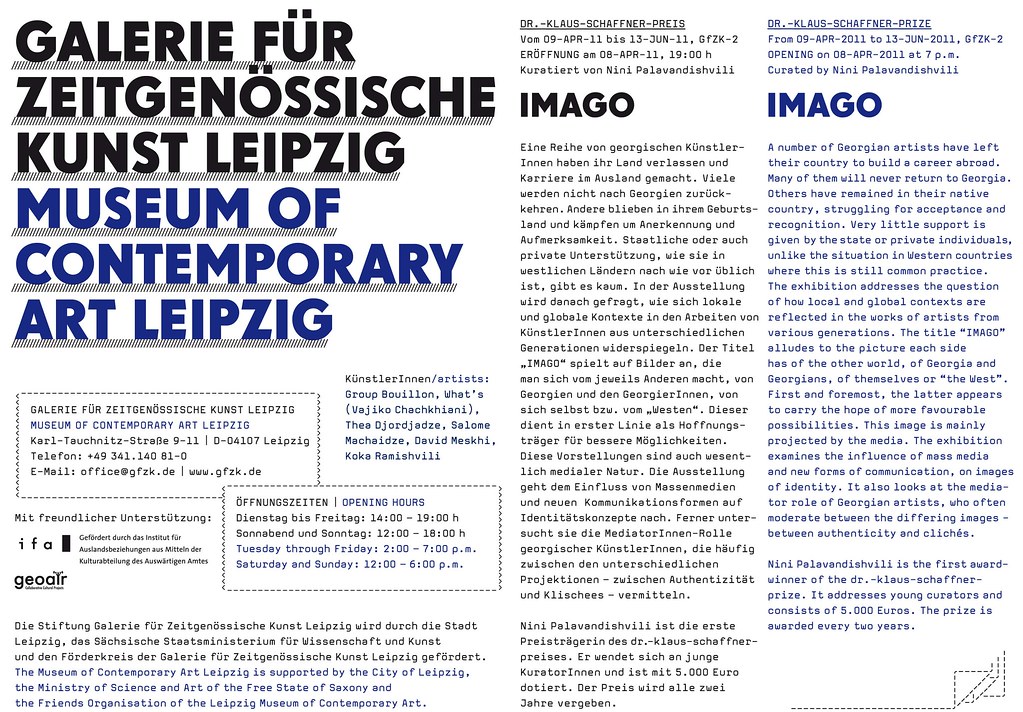
EXHIBITION: >IMAGO< (dr.-klaus-schaffner-preis) kuratiert von Nino Palavandishvili (gfzk.de)


A number of Georgian artists have left their country to build a career abroad. Many of them will never return to Georgia. Others have remained in their native country, struggling for acceptance and recognition. Very little support is given by the state or private individuals, unlike the situation in Western countries where this is still common practice. The exhibition addresses the question of how local and global contexts are reflected in the works of artists from various generations. The title “IMAGO” alludes to the picture each side has of the other world, of Georgia and Georgians, of ourselves or “the West”. First and foremost, the latter appears to carry the hope of more favourable possibilities. This image is mainly projected by the media. The exhibition examines the influence of mass media and new forms of communication, on images of identity. It also looks at the mediator role of Georgian artists, who often moderate between the differing images - between authenticity and clichés.

Mit freundlicher Unterstützung:
IFA (Instituts für Auslandsbeziehungen)
GeoAIR Galerie für Zeitgenössische Kunst Leipzig

+++

Museum of contemporar by art leipzig
Karl-Tauchnitz-Straße 9-11
D-04107 Leipzig
Telefon: +49 341.140 81-0
E-Mail: office@gfzk.de
Website: http://www.gfzk.de/

Tuesday, March 29, 2011

AUSSTELLUNG: IMAGO - Curated by Nini Palavandishvili (gfzk.de)

click on the flyer for a larger version!

Nini Palavandishvili ist die erste Preisträgerin des dr.-klaus-schaffnerpreises. Er wendet sich an junge KuratorInnen und ist mit 5.000 Euro dotiert. Der Preis wird alle zwei Jahre vergeben. (Congratulations!!!)

Vom 09-APR -2011 bis 13-JUN-2011, GfZK-2
Eröffnung am 08-APR -2011 um 19:00 h
Kuratiert von Nini Palavandishvili

From 09-APR -2011 to 13-JUN-2011, GfZK-2
Opening on 08-APR -2011 at 7 p.m.
Curated by Nini Palavandishvili

KünstlerInnen / Artists: Group Bouillon, What’s (Vajiko Chachkhiani), Thea Djordjadze, David Meskhi, Salome Machaidze, Koka Ramishvili

+++

Eine Reihe von georgischen KünstlerInnen haben ihr Land verlassen und Karriere im Ausland gemacht. Viele werden nicht nach Georgien zurückkehren. Andere blieben in ihrem Geburtsland und kämpfen um Anerkennung und Aufmerksamkeit. Staatliche oder auch private Unterstützung, wie sie in westlichen Ländern nach wie vor üblich ist, gibt es kaum. In der Ausstellung wird danach gefragt, wie sich lokale und globale Kontexte in den Arbeiten von KünstlerInnen aus unterschiedlichen Generationen widerspiegeln. Der Titel „IMAGO” spielt auf Bilder an, die man sich vom jeweils Anderen macht, von Georgien und den GeorgierInnen, von sich selbst bzw. vom „Westen“. Dieser dient in erster Linie als Hoffnungsträger für bessere Möglichkeiten. Diese Vorstellungen sind auch wesentlich medialer Natur. Die Ausstellung geht dem Einfluss von Massenmedien und neuen Kommunikationsformen auf Identitätskonzepte nach. Ferner untersucht sie die MediatorInnen-Rolle georgischer KünstlerInnen, die häufig zwischen den unterschiedlichen Projektionen – zwischen Authentizität und Klischees – vermitteln.

+++

A number of Georgian artists have left their country to build a career abroad. Many of them will never return to Georgia. Others have remained in their native country, struggling for acceptance and recognition. Very little support is given by the state or private individuals, unlike the situation in Western countries where this is still common practice. The exhibition addresses the question of how local and global contexts are reflected in the works of artists from various generations. The title “IMAGO” alludes to the picture each side has of the other world, of Georgia and Georgians, of ourselves or “the West”. First and foremost, the latter appears to carry the hope of more favourable possibilities. This image is mainly projected by the media. The exhibition examines the influence of mass media and new forms of communication, on images of identity. It also looks at the mediator role of Georgian artists, who often moderate between the differing images - between authenticity and clichés.

Mit freundlicher Unterstützung:
IFA (Instituts für Auslandsbeziehungen)
GeoAIR

Galerie für Zeitgenössische Kunst Leipzig
Museum of contemporar by art leipzig
Karl-Tauchnitz-Straße 9-11
D-04107 Leipzig
Telefon: +49 341.140 81-0
E-Mail:
office@gfzk.de www.gfzk.de

Tuesday, November 16, 2010

ART: Impressions from Koka Ramishvili at Gala Gallery Tbilisi (artclubcaucasus.blogspot.com)


more: artclubcaucasus.blogspot.com

Wednesday, October 06, 2010

FESTIVAL: Caucasian Lessons - 53rd International Leipzig Festival for Documentary and Animated Film (dokfestival-leipzig.de)

Programm: 53rd International Leipzig Festival for Documentary and Animated Film (pdf)

The Last Tightrope Dancer in Armenia" by Inna Sahakyan and Arman Yeritsyan

Eight programmes with some twenty films will give you sufficient opportunity to deal with a transit and conflict zone between Europe and Asia, between the old world order and a new region. Political stories from Georgia, the clash of traditional and post-modern lifestyles in Armenia, archaic culture and crazy poets from Azerbaijan. The focus is also on the battle in the media around the events in Southern Ossetia, the search for terrorists in Dagestan as well as the war-torn countryside in Nagorno-Karabakh, where the effects of the conflict are still felt. And finally: Figures of loss – the disintegration is omnipresent.

DOK Summit:
Borderline Truth – Strategies in Documenting the (Caucasus) Conflict
Friday, 22.10.2010, at 11 a.m. Zeitgeschichtliches Forum Leipzig


Programme 1: Transit Zone

The Caucasus as a geographical and artistic border region: an experimental collage of random fragments from Georgia, a poetic Armenian docudrama from a bull’s point of view about the post-Soviet intermediate realm.

* Border (Sahman) by Harutyun Khachatryan Armenia 2009 82:00 min.

* Tender Transitory Transport by Koka Ramishvili Georgia 2008 11:00 min.


Programme 2: Media Battle - Focus South Ossetia

The South Ossetian conflict, trigger of the Russian-Georgian war: two Russian filmmakers engage in an intensely investigative and historically extensive reckoning with their own home country and its military-political-media complex. Set against this: the war from the Russian-South Ossetian perspective of the “little” people. Two clear positions. Learning to see, to doubt.
August.

* Tshinval (Avgust. Cchinval) by Akim Salbiev Russian Federation 2009 44:00 min.

* Russian Lessons (Russkie uroki) by Andrej Nekrasov, Olga Konskaya Norway, Russian Federation, Georgia 110:00 min.


Programme 3 : Suspicion: Terrorism - Focus North Caucasus

A Chechen generation: born during the war, studied in refugee camps, a gun in every house – conversations with former terrorists now in prison. And the search for them in the mountains of Dagestan, with surprising results. Terror: on the trail of a chimera.

* Infernal Machine – A Suicide Bomber Dreaming (Adskaja mašina) by Rasim Poloskin Russian Federation 2010 51:00 min.

* Searching for Wahhabites in the Mountains of Dagestan (Poiski vachchabitov v gorach Dagestana) by Tofik Shakhverdiev Russian Federation 2010 60:00 min.


Programme 4: Life('s) Rhythms - Focus Azerbaidzhan

Mad Bashir, a crazy poet and master of improvisation in typical Azeri fashion, everyday scenes in a mountain village, and six days in the life of nomadic shepherds. A life without complaints or hurry in a country marked by many archaic traits.

* Letter to Lenin (Lenine mektub) by Orxan Agazade, Ilkin Imamov Azerbaijan 2009 23:25 min.

* Camping Ground (Köc) by Rodion Ismailov Azerbaijan, Russian Federation 2010 52:00 min.

* Rhythms of Lahij (Ritmy Lachydža) by Fariz Ahmedov Azerbaijan 2008 8:00 min.


Programme 5: Landscapes of War - Focus Nagorno-Karabakh

1988/89: expulsion of Azeris, revenge campaigns against Armenians, a symbolic conflict that has been going on to the present day. An atmospheric look at a life where donkey carts cross coffin transports. And a return to former comrades in arms: what did the war do to the people?

* A Story of People in War and Peace (Mardkayin patmutyun paterazmi yev khaghaghutyan orerits) by Vardan Hovhannisyan Armenia 2006 70:00 min.

* Post by Vitalij V. Manski Soviet Union 1990 20:00 min.


Programme 6: Yesterday. Today. - Focus Armenia

Driving through Erivan in a minibus: crowded together and drowning in a sea of ringtones, passing glimpses of tanks and protesters. And the dying art of tightrope walking as a metaphor for a country between crisis, loss of tradition and the constant will to start over again.

* The Last Tightrope Dancer in Armenia by Inna Sahakyan, Arman Yeritsyan Armenia 2009 72:00 min.

* The Young Man Who Didn’t See Anything ... Exercise 09:39 (Eritasard mardy ov vochinch chtesav kam varjutyun 09:39) by Arusyak Simonyan Armenia 2008 23:00 min.


Programme 7: Political (Hi)Stories - Focus Georgia

The chronicle of an uproar in Parliament, the short history of Georgian national television, a complex history lesson about national socialism and male fraternity illustrated by a former mercenary, and a chilling look at a holiday camp for young patriots – a land in constant unrest.

* Change by Koka Ramishvili Georgia 2006 5:00 min.

* One Side (Erti Mchare) by Davit Gugushvili Georgia, Germany 2009 32:00 min.

* The Leader is Always Right (lideri khoveltvis martalia) by Salomé Jashi Georgia 2010 43:00 min.

* When Clocks Stop (Rotsa saatebi cherdeba) by Tiko Nachkebia Georgia 2009 12:00 min.


Programme 8: Figures of Loss

Two young filmmakers ask what the loss of the whole did to the individual minds. Only shadows of memories are left of life in the Chechen city of Grozny; a fragmentary and poetic look at the Armenian city of Erivan traces deficits in its social structure.

* Collecting Shadows (Sobirateli tenej) by Maria Kravchenko Russia 2006 52:00 min.

* Down Here (Ici-Bas) by Comes Chahbazian Belgium, France 2010 55:25 min.


DOK Summit: Borderline Truth – Strategies in Documenting the (Caucasus) Conflict

Normally, the fronts are clearly separated: power and politics on the one side (the power of politics), criticism and documentary film on the other (the criticism of documentary films). However, it becomes quite obvious in the Caucasus conflict – more precisely: in the various conflicts and wars on Caucasian territory – that good and evil, true and wrong, right and not right cannot be told apart and allocated that easily any longer, neither in the field of politics nor in the conflict of image strategies.
Nevertheless, it dawns on you that the truth does not simply lie in between. The truth – sought after again and again. In documentary formats of the most different and differing types. There are conflicts that are determined and shaped by images. There are images that are determined and shaped by conflicts. Sometimes, there are not even images any more for conflicts, or words. And then again, conflicts might develop into images and discussions, get absorbed, with counter-images and protests flaring up.
Based on the infrastructural, economic and ideological conditions in the individual „Caucasian“ regions, the DOK-Summit examines in this year’s special program „Caucasian Lessons“ the significance, the functions and the means the documentary film has in a zone (and during the time) of the conflict.

Panelists:
Helena Zajicova (FAMU Prague/Czech Republic, formerly CEO/One World Film Festival)
Zaza Rusadze (Filmmaker, Tbilisi/Georgia and Berlin/Germany)
Nino Kirtadze (Filmmaker/Actor, Paris/France)
Andrey Nekrasov (Filmmaker, St.Petersburg/Russia)
Harutyun Khachatryan (Filmmaker/Erevan Golden Apricot International Film Festival, Erevan/Armenia)

Moderation: Barbara Wurm (Curator "Caucasian Lessons" DOK Leipzig)

Date: Friday, 22 October 2010
Time: 11 am – 1 pm
Venue: Zeitgeschichtliches Forum
The event will be held in English Language.
curated by Barbara Wurm


CAFÈ KAUKASUS IM TELEGRAPH
begleitend zum DOK Leipzig-Sonderprogramm "KAUKASISCHE LEKTIONEN"

20.10.2010, 19.00 Uhr
Caucasian Mentality - Fotografien von Ralph Hälbig (Eröffnung)
im Anschluss Tanznacht International
mit DJ Hidden Shadow (Leipzig)

23.10.2010, 20.30 Uhr
Telegraph World Music präsentiert:
Konzert mit Rusudan Meipariani und Zura Dzagnidze (Georgien)
im Anschluss Party mit DJ InterPaul von MirMix (Berlin)

Wednesday, September 02, 2009

AUSSTELLUNG: Tilflis Transfer - Patricia London ante Paris und georgische Künstler (tiflistransfer.blogspot.com)

Saarländisches Künstlerhaus Saarbrücken e.V.

Das Projekt „Tiflis Transfer“ wurde konzipiert von der Münchner Künstlerin Patricia London ante Paris, die sich von Oktober 2007 bis Juli 2009 in Tiflis aufhielt. Catalog as PDF here

In dieser Zeit entstanden die „Music Videos By Tbilisi Artists“ mit Beiträgen von 8 georgischen Künstlern, das von Patricia London ante Paris edierte digitale Magazin DEEPART sowie das Video „tender transitory transport“, eine Kooperation mit Nika Machaidze und Koka Ramishvili. „Tender transitory transport“ ist ein filmisches Umherschweifen in der georgischen Hauptstadt Tiflis. Die grafische Bearbeitung der Bilder korreliert mit dem gesprochenen Text und der unterlegten Musik. Die Erkundung der Stadt als Architektur, als politischer Raum und als Klimazone hat poetische Wurzeln. Es entsteht eine suggestive, psychosoziale Stadtlandschaft.

Aus der Ausstellung „New Medea Theater collectif in a digital-metafisikal state of emergency“, die Patricia London ante Paris im Juli 2009 in Tiflis im New Art kuratierte, sind in Saarbrücken die Videos „landerror“ von Koka Ramishvili und „Georgian Sexual Revolution“ von Natia Tzulukidze zu sehen, sowie Papierarbeiten von 7 georgischen Künstlern.

Um die alle bewegende Frage: „Wie kann ich die Welt sehen, wenn ich kein Visum erhalte?“ kreisen die Tifliser Architekturzeichnungen von Patricia London, denn für GeorgierInnen gibt es keine selbstverständliche Reisefreiheit.

Mit Beginn der Ausstellung startet der täglich aktualisierte Blog TIFLIS TRANSFER unter http://tiflistransfer.blogspot.com.

Termine
27.08.2009 bis 27.09.2009

Di Mi Do Fr Sa So
Büro: Di. - Fr. 10 - 18 Uhr
Galerie/Studio: Di. - So. 10 - 18 Uhr

Saarländisches Künstlerhaus Saarbrücken e.V.
Karlstraße 166111 Saarbrücken
Kontakt:Saarländisches Künstlerhaus Saarbrücken e.V.
Karlstraße 166111 Saarbrücken


info@kuenstlerhaus-saar.de
http://www.Kuenstlerhaus-saar.de

Telefon: (0681) 37 24 85