Showing posts with label Marika Asatiani. Show all posts

Tuesday, December 17, 2013

ART: In Conversation: Tara Isabella Burton interviews Marika Asatiani (whitehotmagazine.com)


(whitehotmagazine.com) In the early twentieth century, Paris was the go-to city for serious artists and dilettantes alike. But further east, across the Black Sea, another thriving capital threatened to rival Paris in both ambition and innovation. Dadaism, the avant-garde, modernism, futurism – all these movements and more found an early and welcoming home in the balmy city of Tiflis (now Tbilisi), capital of the tiny Caucasian nation of Georgia, Russia’s neighbour (and former colony) to the South.

Yet like in so many other post-Soviet countries, Georgia’s art scene in recent years has been stymied by decades of censorship. With some notable exceptions (among them the haunting works of Merab Abramishvili and of former child prodigy Rusudan Petviashvili), Georgia’s output in the latter half of the twentieth century was dominated by State-approved propaganda, whose historical interest has long outlived its aesthetic value. Kitsch and slipshod imitations of nineteenth-century painters like Pirosmani and Elene Akhlevediani abound in the Vernissage, Tbilisi’s outdoor art market, alongside once-revered artists reduced to hawking their wares to tourists for a fraction of their former value. The Persian-style palace that houses the once-prominent State Academy of Arts is still standing, but only just.

Today, however, Tbilisi’s gallery scene is undergoing something of a renewal. Artists who have trained or studied abroad, often in Paris, are returning to their homeland. The dilapidated State Academy of Arts is under new management; its new (and first female) director, Irina Popiashvili, spent decades running a gallery in New York City. Underground café-galleries have begun to spring up in apartment-house basements on the city’s labyrinthine side-streets. Artists are experimenting with alternative media – Nino “Chubika” Chubinishvili, for example, bridges the gap between art and fashion with intricate embossed leather pieces that hint at a whole cosmology of angels and demons surrounding and inhabiting the wearer’s body, while Maya Sumbadze elevates the doodle into a powerful medium for pop-art.

One such up-and-coming Georgian artist is Marika Asatiani, recently returned to Tbilisi after several years abroad. A photographer with an uncanny ability to reveal the stark emptiness of her subjects, whether brooding Georgian youths, abandoned Soviet structures, or abstract installations, Asatiani unsettles and disorients the viewer, playing with the dynamic tensions inherent in stillness, exploring what she calls the idea of “places as process, rather than something static and physical”.

To learn more about Asatiani – and about the challenges Tbilisi still presents for the artists who call it home – I interviewed her via a series of emails in September, 2012.

Tara Isabella Burton: How would you describe your process as an artist?

Marika Asatiani: I am trying to articulate subtle human experiences and ask the following –what is the meaning of words like ‘space’ and ‘place’? What is space? Do you ever experience it? What is the relationship between space and place? In [my] experience, the meaning of space often merges with that of place. Is undifferentiated and un-oriented space possible? Is there a spatiality that is not organized by the determination of frontiers?

Therefore, I [work] to use photography as a tool to research dynamic ideas about issues of spatiality; to develop my practice in such a way as to present places as process, rather than something static and physical [and to] explore not only one position, one perspective, [one] fixed center but a passage, which escapes localization and needs to be endlessly articulated. In our everyday lives, we are cluttered with images, with material objects. Therefore, I would like to explore not the[se] images/places but [rather the] space that makes these places possible. Something that is ever elusive and hard to pin down, since it is immaterial, intangible; it reminds me of [the] traditional beginning of many fairytales – “There was and there was not.”

Also, I regard places not only as a manifestation of physical, object-based world, but also as something beyond the reach of our ordinary perception, full of intangible ‘things’, pulsations, layers. [When I focus on the] shifting fixity of places, questioning their stability, I am attempting to destabilize ‘the fixed place’ in a non-violent, subtle manner and maybe point at the perceiver as a main figure who makes the world appear as it is, and through whom [the] act of perception is possible. Through repetition and certain arrangement of similar images, I [create] situations that are expressed with minimal means, whereby the viewer experiences himself, his own being in [the] here and now, along with the work he is facing. In this way, the gaze/perception is…redirected from the object/image back to the viewer as he… stands in front of the work or moves from one position to another. Ideally, it should be a direct and intimate experience, unmediated by conceptual knowledge…sensed [rather] than rationally understood.

Burton: Which of your work best represents your personal artistic approach or style and why?

Asatiani: I don’t know if I have’ a style’, I think it changes over time; today one work might best represent my practice, while another work [might best represent it] tomorrow, depending how my practice develops. It’s not really up to me, I find [the] creative process completely unpredictable, it depends what ideas come into my head.

Burton. Could you tell me a bit more about your background and training?

Asatiani: I studied sociology at the university in Tbilisi (BA level), and LSE, UK (MSc). But it was a long time ago, and I was never really interested in it. I was more interested in philosophy and psychology, so my art today has no connections with my previous studies. In 2009-10 I did my two-year residency at the Rijksakademie for Visual Arts, Amsterdam.

Burton: How do you think Georgia's art scene has changed in the past decade or two?

Asatiani: I don’t really know, because I never belonged to the Georgian arts scene (I did not go to the Art Academy in Tbilisi and I’ve also been away for the past four years) - but at the moment I don’t think there is any scene at all. [Rather], there are mostly individual artists working by themselves. There are no contemporary art galleries in Tbilisi, in a Western sense, which would represent artists both locally and internationally, and make interesting exhibitions and sell their work. Basically, there is no market for contemporary art, and the government does not see any value in developing and supporting local contemporary art scene. But it’s mostly because of [their] ignorance of contemporary art, and its lack of value in society, rather than some kind of ill-intention or censorship. Art and everything associated with it has not developed in Georgia in the same way as in Western Europe or the US, so it’s not [a natural part of contemporary] Georgian society (Stalin killed or forced to leave everyone in the arts who was progressive and avant-garde, thus horrible break took place in the development of Georgian culture, entire generation perished, those who were capable of contributing to culture, or to transfer their knowledge to further generations). Everything has to be artificially implanted now, if one wants any developments in this regard.

Burton: What other Georgian artists influence you? What about artists worldwide?

Asatiani: I don’t know if I have any particular influences (none Georgian though); at least that’s how I think and I also don’t have any favourite artists. I like certain works by certain artists however. I find that American Art of the 60s and early 70s deeply resonates with my current interests. I find approaches in contemporary Dutch art photography interesting too… I also like many works from the artists that were part of the Rijksakademie in Amsterdam.

Burton: Is Georgia - and Tbilisi in particular - a dynamic place for artists today? Is it possible to make a living as an artist there?

Asatiani: No, it’s absolutely not dynamic, and you can’t make any money from contemporary/conceptual, etc., art in Georgia, unless you’re a painter ([as] understood in a traditional sense), but certainly even in that case, you can’t live off that. So, for now, it’s quite a hopeless situation.

Burton: A particularly ‘hot topic’ among the Tbilisi intelligentsia lately has been President Saakashvili’s renovations of the Tbilisi Old Town – rebuilding facades of historic buildings in perhaps hastily-conceived approximations of the original style. These renovations and rebuilding projects have proved particularly controversial among Tbilisi’s younger generation – many of whom see the project as indicative of shifting values (indeed, objections over the renovations of the nineteenth-century Gudiashvili Square in the Sololaki district gave rise to an “Occupy Gudiashvili” movement that ended up turning into an impromptu outdoor art exhibition). What are your thoughts on the renovation of Tbilisi's historic districts?

Asatiani: It’s nice that they are renovating the districts, but it should be done with much greater care, and knowledge, and consideration of historical sketches, plans, photographs, and also better technology of renovation. But you can’t ask for something that is almost impossible for Georgia – it has no tradition of renovating buildings or entire districts, while preserving the historicity and old vibe. Also, there is no understanding and appreciation of urban planning in this country (it’s a problem of historical development) there are certain things people are absolutely not aware of in Georgia (I mean in terms of aesthetics, sense of the context, scale [and so forth]. ), while in Western capitals it would be completely natural. But even there, in some cases money buys it all.

Sunday, October 06, 2013

ART in VIENNA: Fokus: Georgia 2:00-3:00 pm, 13.10.2013 - Georgia, supported by the Ministry of Culture and Monument Protection of Georgia (thenewcontemporary.com)

MCS Logo BLACK vectDie Sonderausstellung trägt den Titel Unser Kaukasus, georgisch: Chveni Kavkasioni. Der Titel dieser Gruppenausstellung bezieht sich auf das Lied aus dem 1976 entstandenen Film von Tengiz Abuladze „Der Wunschbaum“. Die Show präsentiert Werke der folgenden Künstler: Marika Asatiani (more from Marika Asatiani und hier >>>), Natela Grigalashvili, Andro Eradze (androeradze.blogspot.de) Giorgi Khaniashvili, Nino Kvrivishvili, Mamuka Japaridze, Sophia Tabatadze, Koka Ramishvili, KoteSulaberidze, Maya Sumbadze, Giorgi Okropiridze, Guia Rigvava, Tamuna Sirbiladze, Tatia Skhirtladze.
Projektkuratorin: Irena Popiashvili

The special project exhibition is titled Our Caucasus i. e. “Chveni Kavkasioni“. The title of this group exhibition refers to the song from Tengiz Abuladze’s 1976 “The Wishing Tree”. The show presents the work of the following artists: Marika Asatiani, Natela Grigalashvili, Andro Eradze, Giorgi Khaniashvili, Nino Kvrivishvili, Mamuka Japaridze, Sophia Tabatadze, Koka Ramishvili, Kote Sulaberidze, Maya Sumbadze, Giorgi Okropiridze, Guia Rigvava, Tamuna Sirbiladze and Tatia Skhirtladze.
Project curated by Irena Popiashvili 


Irena Popiashvili (Co-founder NP Gallery, co-curator of VIENNA Duet: Our Caucasus exhibition)Moderator: Irena Popiashvili (Co-founder NP Gallery, co-curator of VIENNA Duet: Our Caucasus exhibition), an independent curator dividing her time between Tbilisi, Georgia and New York, USA. 

(thenewcontemporary.com) Currently she is a consultant at the Free University in Tbilisi and runs a public art space – Popiashvili Gvaberidze Window Project in Tbilisi Georgia. Previously a founder and co-owner of Newman Popiashvili Gallery in New York (2005-2012) she served as a director of the State Academy of Arts in Tbilisi (March- November) 2012.

VIENNA Talks showcases a broad spectrum of presentations, discussions, and debates with important representatives of the contemporary art scene. This year’s Talks provides an exciting and multifaceted platform for art professionals from different Eastern focus regions – people who rarely have the chance to meet each other – to represent their countries to the fullest and evidence the unique character of the region. Each day of VIENNA Talks will reflect upon a topical theme in contemporary art.

Location: VIENNA Talks booth C23
The discussions will be in English.

13 October 2013

VIENNA Talks School of Happiness – VIENNA Duet

2:00 – 3:00 pm: FOCUS: Georgia, supported by the Ministry of Culture and Monument Protection of Georgia


Natela Grigalashvili  from the series Doukhobors, 2013 Digital print40 x 60 cm
Natela Grigalashvili from the series Doukhobors, 2013. Digital print 40 x 60 cm


VIENNAFAIR Program
VIENNA Duet: Georgia – “Our Caucasus”. Part I 

VIENNAFAIR The New Contemporary is grateful to the Ministry of Culture and Monument Protection of Georgia and the Embassy of Georgia in Vienna for their generous support of the special project VIENNA Duet: Georgia “Our Caucasus i. e. Chveni Kavkasioni” curated by Irena Popiashvili and the artistic directors of VIENNAFAIR Christina Steinbrecher – Pfandt and Vita Zaman. “The art … Continue reading »

Maya Sumbadze  Prayer Shortcuts 1, 2013  Watercolor and ink on digital print  40 x 28,5 cm
Maya Sumbadze Prayer Shortcuts 1, 2013. Watercolor and ink on digital print 40 x 28,5 cm

Kote Sulaberidze  %22Our Caucasus%22, 2011 Watercolor, acrylic, silkscreen and tape on paper  29,7X294 cm Detail Courtesy of artist
Kote Sulaberidze My Caucasus, 2011 Watercolor, acrylic, silkscreen and tape on paper 29,7X294 cm, (detail) courtesy of the artist


V

VIENNA Duet: Georgia – “Our Caucasus”. Part II 
VIENNAFAIR The New Contemporary is grateful to the Ministry of Culture and Monument Protection of Georgia and the Embassy of Georgia in Vienna for their generous support of the special project VIENNA Duet: Georgia “Our Caucasus i. e. Chveni Kavkasioni” curated by Irena Popiashvili and the artistic directors of VIENNAFAIR Christina Steinbrecher–Pfandt and Vita Zaman.  Continue reading »


Elsewhere / VIENNAFAIR Diary 
Christina Steinbrecher Visits Georgia


Following last year’s VIENNAFAIR The New Contemporary kick-off with a curated section of the VIENNA Quintet program in which Georgia played an important role and many artists came to Vienna, we promised to visit Tibilisi. By the end of May everything was set up for the visit! Continue reading »


“Dedicated To Franz West” – An Interview With Georgian Artist Tamuna Sirbiladze
“Dedicated To Franz West” – An Interview With Georgian Artist Tamuna Sirbiladze 
We are proud to present our second video interview series. New style, more Vienna impressions! We hope you enjoy our first video – as much as we do! Continue reading »


VIENNA Duet – Länderschwerpunkte 2013: Georgien und Polen

Im Rahmen der VIENNAFAIR The New Contemporary präsentieren die künstlerischen Leiterinnen Christina Steinbrecher-Pfandt und Vita Zaman Georgien und Polen als Länderschwerpunkte und setzen damit das erfolgreich begonnene Sonderausstellungsprojekt VIENNA Quintet, das letztes Jahr zum ersten Mal auf der Kunstmesse in Wien mit KünstlerInnen aus Aserbaidschan, Kasachstan, Georgien, Ukraine und Weißrussland zu sehen war, unter den Namen VIENNA Duet fort. Die diesjährigen zwei Sonderausstellungen entstehen in enger Kooperation mit Galerien, Institutionen und Organisationen sowie ExpertInnen aus den beiden Ländern.

Die erste Sonderausstellung „Our Caucasus oder Chveni Kavkasioni“, kuratiert von den künstlerischen Leiterinnen der VIENNAFAIR The New Contemporary und Irena Popiashvili und unterstützt vom georgischen Ministerium für Kultur und Denkmalschutz, präsentiert Arbeiten von den in Wien lebenden und arbeitenden georgischen KünstlerInnen Gogi Okropiridze, Guia Rigvava, Tamuna Sirbiladze und Tatia Skhirtladze und von den in Georgien ansässigen KünstlerInnen Marika Asatiani, Andro Eradze, Giorgi Khaniashvili, Maya L. Sumbadze, Mamuka Japaridze, Sophia Tabatadze, Koka Ramishvili, Nino Kvrivishvili, Kote Sulaberidze und Natela Grigalashvili.

Der Titel der Gruppenausstellung bezieht sich auf den Film „The Wishing Tree“ von Tengiz Abuladze aus dem Jahr 1976. Der Film erzählt die Lebensgeschichte mehrerer DorfbewohnerInnen zu Beginn des 20. Jahrhunderts. Unter ihnen ist ein ungewöhnlicher Mann, der an eine bessere Zukunft und eine kommende Revolution glaubt und eine Fangemeinde unter den Dorfkindern hat. Der Refrain ihrer „Hymne“ lautet „Chveni Kavkasioni”, was „unser Kaukasus“ heißt.

Die zweite Sonderausstellung „Who Are You or The School of Happiness“, die vom Polnischen Institut Wien unterstützt wird, präsentiert unter der kuratorischen Begleitung der polnischen Kunsthistorikerin Klara Czerniewska zeitgenössische Kunstpositionen aus Polen. Teilnehmende KünstlerInnen sind: Tymek Borowski, Hubert Czerepok, Łukasz Jastrubczak, Przemek Matecki, Dominika Olszowy, Małgorzata Szymankiewicz, Maria Toboła und Jan Zamoyski. 

DATUM 10. bis 13. Oktober 2013
ORT Messe Wien, Halle A
Messeplatz 1, 1020 Wien


BESUCHERINNENINFORMATION
www.viennafair.at/de
www.thenewcontemporary.com
www.facebook.com/Viennafair


ÖFFNUNGSZEITEN
Donnerstag, 10. Oktober 2013: 11 – 19 Uhr, Freitag, 11. Oktober 2013: 11 – 21 Uhr
Samstag, 12. Oktober 2013: 11 – 19 Uhr, Sonntag, 13. Oktober 2013: 11 – 18 Uhr


EINTRITT
€ 12,50 Tageskarte für Erwachsene
€ 09,00 Tagesticket / Vorverkauf und Onlinebuchung
€ 09,00 Tagesticket für KundInnen der Erste Bank
€ 09,00 After-Work-Ticket (Donnerstag/Freitag ab 16 Uhr)
€ 09,00 Ticket für SeniorInnen bei Vorweisen eines gültigen Ausweises.
€ 29,00 4-Tagesticket


Freier Eintritt für Kinder unter 14 Jahren und Studierende ab 15 Uhr bei Vorweisen eines gültigen Studentenausweises.


Messe Wien, Halle A
Messeplatz 1, 1020 Wien
Österreich

Wednesday, April 04, 2012

MUSIC: Post Industrial Boys "next time maybe" (youtube.com)


Music: Gogi Dzodzuashvili 
Lyrics: Marika Asatiani

Friday, April 22, 2011

ART: Tbilisi Photo Festival 2011 25-31 May (europeanweek.ge)

Europe House Georgia and Tbilisi Photography House are pleased to organize the second annual Tbilisi Photo Festival which will take place during European Week in Georgia from 25-31 May 2011.

A contributing partner is the Arles Photo Festival (Les Rencontres Photographiques d'Arles) whose program, La Nuit de l'Année, will be presented on May 28 during the open air screenings in Old Tbilisi and includes the productions of leading p...hoto-agencies, newspapers, news agencies and magazines.

In addition, A Night of Photography - Tbilisi Photo Festival night screenings program - will present the works of various Georgian, Armenian, Azerbaijani, Russian, Turkish and Iranian photographers. As well as the LAF PROJECT and OSI Documentary photography program winners…

The Tbilisi Photo Festival is also pleased to host the following four exhibitions during European Week:

- KAVKAZ, by Thomas Dworzak, a member of the Magnum Agency

-CHANGES, a collection of images describing the events of the Egyptian, Tunisian, Georgian, Kyrgyz and Ukrainian revolutions by the leading photo-reporters – Alex Majoli, Yuri Kozyrev, Dominic Nahr, Lionel Charrier, Julien Daniel, Guillaume Binet, Justyna Mielnikiewicz...

- EXPLICATIONS - Modern Georgian Photography, a selection of images from the second part of 20th century until present

-DMITRY ERMAKOV COLLECION Georgian Photography of the end of 19th century - a selection of images of the collection Dmitry Ermakov, one of the pioneers of photography in Georgia.

The Georgian Museum of History and TBILISI PHOTO FESTIVAL are pleased to present this collection to a public audience for the first time ever.

+++

PRESS RELEASE

Following the success of the first Tbilisi Photo Festival which gathered 15,000 people in May
2010, the capital of Georgia is pleased to welcome this second edition. The festival will be held between 25 and 31 May 2011.


During the 'Night of Photography', on May 28 a Caucasian version of the Nuit de l'Année of
the Arles photography festival, ten screens will once again be set up in the streets and squares
of Tbilisi’s old town, showcasing the work of the greatest photographic associations, agencies, magazines and publications (AFP, Liberation, Noor, Reuters, MYOP, VII, etc.) from dusk to dawn.

But since Tbilisi is at the heart of the Caucasus,

at the point where the culture ofTurkey, Iran, Russia and other European countries meet, the city aims to be a space where young photographers from this diverse yet interlinked world will converge. The Festival’s screens will therefore also present – in between the work of the great names of photography – the images of many young photographers from Georgia, Armenia, Azerbaijan, Russia, Turkey, Iran..


The Photo Festival, an event jointly organised by Tbilisi Photography House and by Europe House georgia, will be part of the ‘European Week’ in Tbilisi. Europe house is foundation which aims to promote European values and culture in Georgia.

Four exhibitions will also attempt to illustrate the Caucasus as a meeting-point of different worlds which became intertwined with a Europe whose modernity was revealed to it in the 'click' of a camera shutter

Georgia at the Crossroads of Modernity – The XIXth-Century’s Ermakov Collection

A selection of images from the collection of Dimitri Ermakov (1848-1916) will be shown for the first time. Having only just finished restoring them to their former glory, Tbilisi's History Museum has lent a series of images taken by this pioneer of photography in the Caucasus to the organizers of the Tbilisi Photo Festival: pictures documenting the construction of the South Caucasus railway, portraits of members of the Georgian aristocracy, images of the art of bathing in Tbi l isi 's sulphur baths,
mountainous landscapes, pictures of Tbilisi and Batumi whose subtle charms are heightened by their mixture of the oriental and the European...


Changes

The Arab Spring of 2011, the coloured revolutions of the former Soviet Union... a world in revolt. This group exhibition, organised in partnership with the young and promising Parisian gallery La Petite Poule Noire, brings together the work of photographers who witnessed these dramatic events – from
Belgrade to Bishkek, Tbilisi to Tunis, via Kiev to Cairo. Alex Majoli, Dominic Nahr, Thomas Dworzak (Magnum), Yuri Kozyrev (Noor), Lionel Charrier, Julien Daniel and Guillaume Binet (MYOP), Justyna Mielnikiewicz...


Kavkaz by Thomas Dworzak

The famous Magnum photographer will present us with the first complete exhibition of his work, taken from his book Kavkaz. 'During the spring of 1993, I decided to live in Tbilisi for a few months before returning to university. It was then that I discovered the cultures of the Caucasus. Hospitality, the beauty of languages, the unbelievable speed of change during the post-Soviet period, war and conflict, courage and cruelty'

This German photographer – known for his brave work during the brutal wars in Chechnya – will show us 80 of his black-and-white photographs of the noisy and furious Caucasus which he captured with his lens.

Georgia - New Generation

Some began to take photographs during the Soviet Union, and others began later... but from the early 1990s onwards all of them devoted themselves body and soul to their art. This exhibition will introduce us to the work of the masters of modern photography such as Yuri Mechitov – who produced a series of portraits of film director Sergei Parajanov, Guram Tsibakhashvili and his Explanations – as well as to the images of young photographers such as Beso Uznadze, David Meskhi and Marika Asatiani, whose work is beginning to charm the European photography world. The highlight of this exhibition? A wonderful series of photographs produced by a real self-taught photographer named Shalva Alkhanaidze.

Lectures and discussions will also be held during this European Week in Tbilisi. Politicians and artists alike will share their visions of Europe, of its ties with Georgia and of the dramatic events which are shaping our world in the XXIst century.


Programme: www.europeanweek.ge

Curators
Lionel Charrier and Nestan Nijaradzé

in France
l.charrier@europehousegeorgia.org / + 33 679331460
in Georgia :
nijaradzenestan@hotmail.com / +995 99559592

Coordinator
Irma Inaridzé
inaridze@hotmail.com /+ 995 99 22 32 95

Contact press
in France
Charles van den Boogaerd,
charles@noecom.com / +33 6 31 17 65 69
in Georgia
Irma Inaridzé
inaridze@hotmail.com /+ 995 99 22 32 95

Logo for Tbilisi photo festival: © Zango Design

Tuesday, April 08, 2008

KUNST: Letzte Fotos vor dem Verschwinden. Marika Asatiani fotografiert den Wandel in Georgien.

Von Grit Friedrich (Deutschlandradio Kultur)

Die georgische Fotografin Marika Asatinai durchstreift ihre Heimatstadt Tiflis mit der Kamera auf der Suche nach Plätzen und Orten, die das "alte" Georgien repräsentieren. Diese wie auch viele Traditionen drohen in der neuen hektischen Betriebsamkeit der georgischen Hauptstadt zu verschwinden.
Untermalt wird der Beitrag anfangs von dem polyphomen Gesang, der noch allerorten in Georgien anzutreffen ist. Andererseits hört man Marika Asatiani auch singen, wenn sie ihre Stimme der elektronischen Musik ihres Mannes Gogi Dzodzuashvili leiht.
Profil · 02.04.2008

Beiträge zum Nachhören
HTML
FLASH
Radio zum Mitnehmen
Podcast: Sendungen
Podcast: Themen
für diesen Beitrag
Marika Asatiani - Fotografin und Musikerin aus Georgien
MP3, Flash Sendezeit: 02.04.2008 10:53

EXHIBITION: SOFT GROUND by Marika Asatiani (in Leipzig)

Marika Asatiani's Final show installation/photography

April 4 - 12, 2008

Opening: Thursday, April 3rd, 8pm

Opening hours: Tuesday - Friday 4-8pm, Saturday - Sunday 2-6pm

Atelierbesichtigungen nach Vereinbarung möglich. Press

The exhibition SOFT GROUND presents new works (photography/installation) by Marika Asatiani from Tiblisi (Georgia). Therewith the artist bid farewell to Leipzig where she was guest of the artist residency *blumen* since January 2008.
To this occasion we cordially invite you.

The exhibition SOFT GROUND shows the homonymous installation that transforms the art space *blumen* temporally into a place of vegetal growing and becoming. Within a complex mental cocoon, Asatiani connects the history of Leipzig as an intersection of historical and spatial tracks with the physical presence of empty spaces in its urban structure. The related photographic series “cornerstones” shows mugged house-corners as meeting points of two lines and as turning points at the same time. The empty buildings that mark Leipzig's city face in many places, Asatiani comprehends not only as gaps but in the contrary as fertile in-betweens and ground for new things to grow. They are projection screens of cultural and ideological, or simply esthetical expectations and narratives.


Wednesday, April 02, 2008

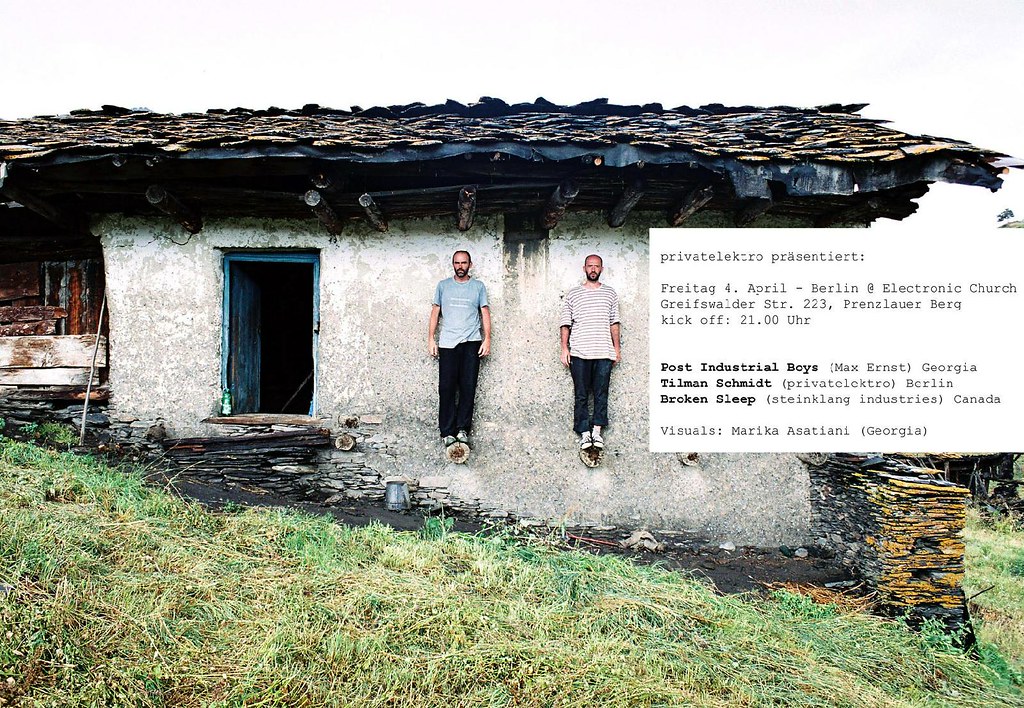
BERLIN: Concert 04th April: POSTINDUSTRIALBOYS aka Gogi.Ge.Org (live) (Georgia)

Eine nacht voll mit melancholischem elektronika sounds deepen stimmen, ambient aus kanada und filigranen elektronischen klängen aus berlin. Umrundet mit visuals der georgischen künstlerin Marika Asatiani ....


BERLIN 04th April: POSTINDUSTRIALBOYS aka Gogi.Ge.Org (live) (Georgia) with visuals by Marika Asatiani - (Georgia)


more: Tilman Schmidt (privatelektro) Berlin - live - Broken Sleep (Canada) - Ambient - live - Visuals: Marika Asatiani - (Georgia)

Adress:
Electronic Church . Greifswalder Str. 223,
tram M4 - station am friedrichshain oder marienburger str.-
attention for the number - its not inside the korridor - check out the shop! leftside 223
Berlin, Prenzlauer Berg -
kick off: 9pm google map >>>

musicians from georgia:
Post Industrial Boys (Georgien) live

http://www.de-bug.de/texte/4583.html

http://www.myspace.com/postindustrialboys


adventures in contemporary art & music & video
.............. http://www.privatelektro.de/ ..............................
.............. http://www.marek-brandt.de/ ...........................
.............. www.myspace.com/marekbrandt ...................

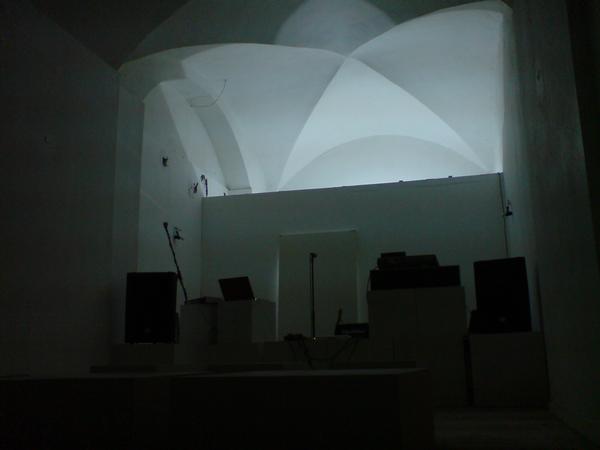
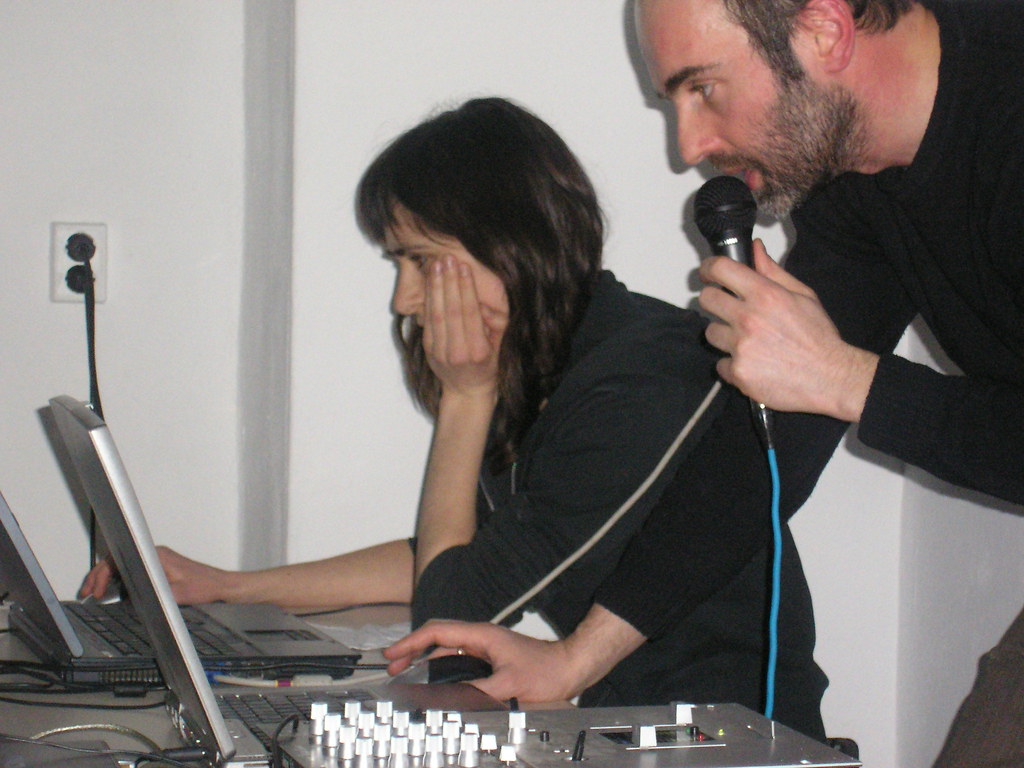
VIDEO: Post Industrial Boys (Georgia) aka Gogi.Ge.Org live in Berlin, at the electronic Church at the 4th april 2008. visuals by:Marika Asatiani (Georgia). Filmed by Marek Brandt


Von: diesinuswelle

EXHIBITION & CONCERT: MARIKA ASATIANI in Leipzig 03-04.08 & P O S T I N D U S T R I AL B O Y S aka Gogi.Ge.Org (live) in Berlin 04-04-08

Ausstellung:
SOFT GROUND von Marika Asatiani


SOFT GROUND

Abschlusspräsentation von Marika Asatiani

Installation/Fotografie
4.04. - 12.04.2008

Eröffnung: Donnerstag, 3. April 2008, 20 Uhr
Öffnungszeiten: DI-FR 16-20 Uhr, SA-SO 14-18 Uhr
Atelierbesichtigungen nach Vereinbarung möglich.
Pressemitteilung

Konzert:
P O S T I N D U S T R I AL B O Y S aka Gogi.Ge.Org (live), Georgien
mit Visuals von Marika Asatiani

POST INDUSTRIAL BOYS, Georgien
© M. Asatiani

... und live in Berlin:
Freitag, 4. April 2008
P O S T I N D U S T R I A L B O Y S aka Gogi.Ge.Org (Georgien)
mit Tilman Schmidt (privatelectro, Berlin), Broken Sleep (Kanada) und
Visuals von Marika Asatiani (Georgien)
Beginn: 21 Uhr
Ort: Electronic Church, Greifswalder Str. 223, Berlin-Prenzlauer Berg
mobil: 01799094675

mehr: www.residence-blumen.de

Tuesday, March 25, 2008

BERLIN 04th April: POSTINDUSTRIALBOYS aka Gogi.Ge.Org (live) (Georgia) with visuals by Marika Asatiani - (Georgia)

04th April: POSTINDUSTRIALBOYS aka Gogi.Ge.Org (live) (Georgia);
Tilman Schmidt (privatelektro) Berlin - live -
Broken Sleep (Canada) - Ambient - live -
Visuals: Marika Asatiani - (Georgia)
Electronic Church . Greifswalder Str. 223, Berlin, Prenzlauer Berg -
kick off: 9pm


www.myspace.com/postindustrialboys
Gogi.Ge.Org & Marika Asatiani in Leipzig 2008 (Album)


get out. lets meet.
& come back for listening hot experimental musick..
hope to see you around
privatelektro !

We hope to see there many Georgians & interesting people in electronic music, Marek Brandt & Ralph Hälbig ... The Visuals by the artist Marika Asatiani are very amazing !

contact me for more information: Ralph.Haelbig@googlemail.com leipzig . berlin .phone: +49 (0)179 9094675

privatelektro products are available at: http://distro.privatelektro.de
and: http://privatelektro-news.de/board/viewtopic.php?id=14
messageboard: (updated and working) http://forum.privatelektro.de

http://last.fm/label/privatelektro
http://myspace.com/privatelektro
contact us: info@(at)privatelektro.de
privatelektro . leipzig . hamburg . phone: +49 (0)341 5906846

Tuesday, March 11, 2008

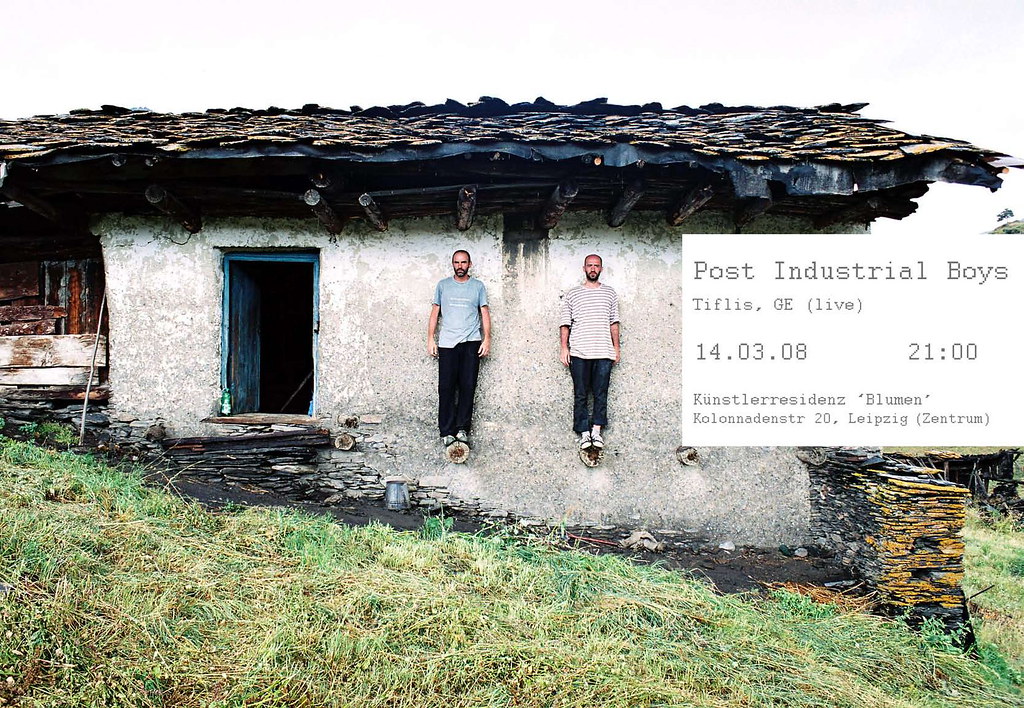
CONCERT: POSTINDUSTRIALBOYS aka Gogi.Ge.Org (live) from Georgia; Visuals: Marika Asatiani - in Leipzig

larger version >>>

Photographies by Marika Asatiani (Set)

March 14, 2008 (Friday)
time: 9 p.m.
location: Künstlerresidenz *blumen*
www.residence-blumen.de

www.gogi.ge.org
www.goslab.de

Monday, February 11, 2008

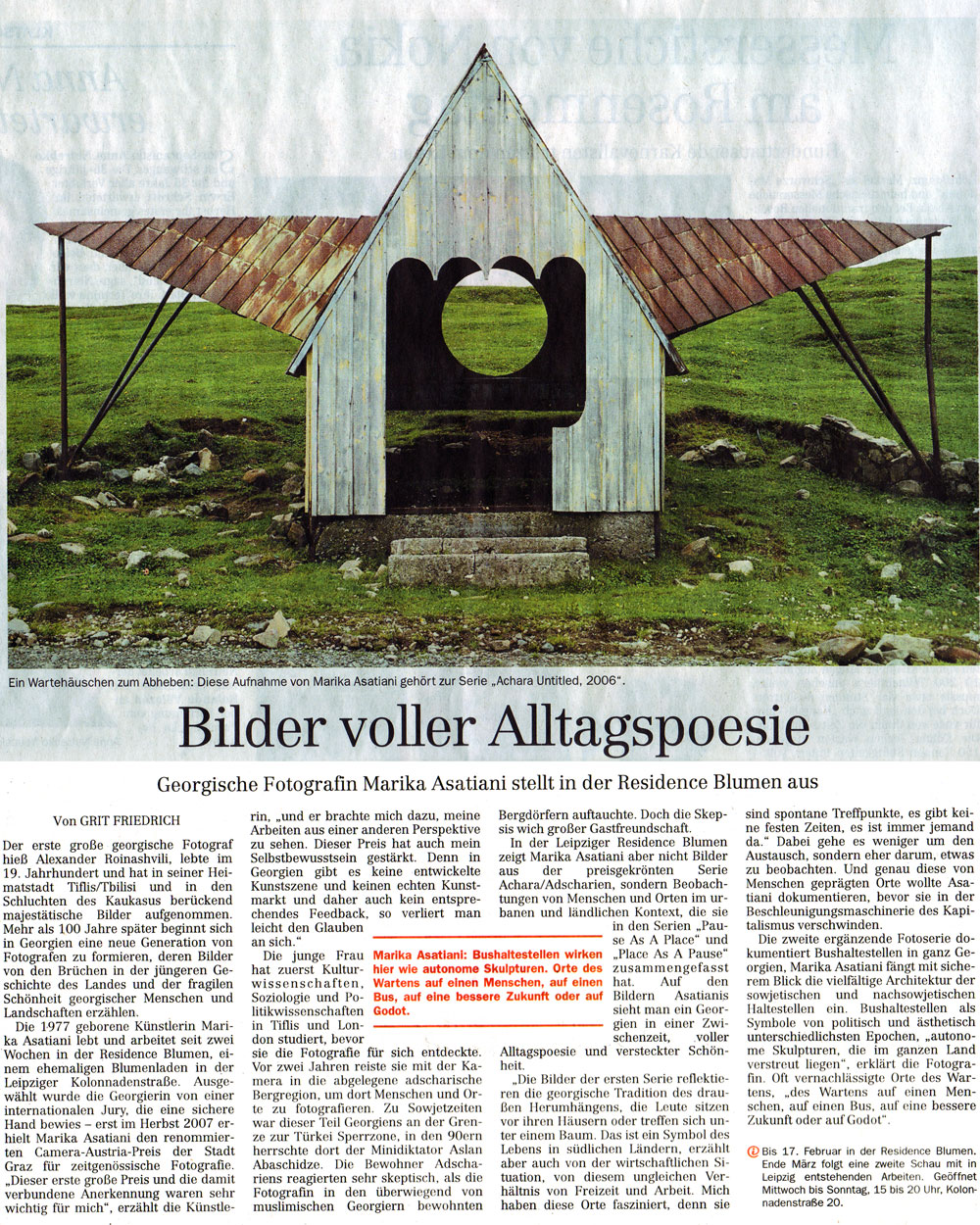
AUSSTELLUNG: Bilder voller Alltagspoesie. Georgische Fotografin Marika Asatiani stellt in der Residence Blumen aus. (in Leipzig)

Von Grit Friedrich (LVZ)

click on the photo for larger version >>>

click here for pdf >>>

Photographies by Marika Asatiani (Set)

Monday, February 04, 2008

ART: Exhibition by Marika Asatiani until 02-17-08 in Leipzig

Opening the exhibition by Marika Asatiani in Leipzig (Set)

more: open times in the Gallery >>>

Thursday, January 31, 2008

ART: Invitation For Exhibition - Marika Asatiani from Tbilisi 01-31-08

E I N L A D U N G _ Z U R _ A U S S T E L L U N G

I N V I T A T I O N _ F O R _ E X H I B I T I O N
(for english version scroll down)

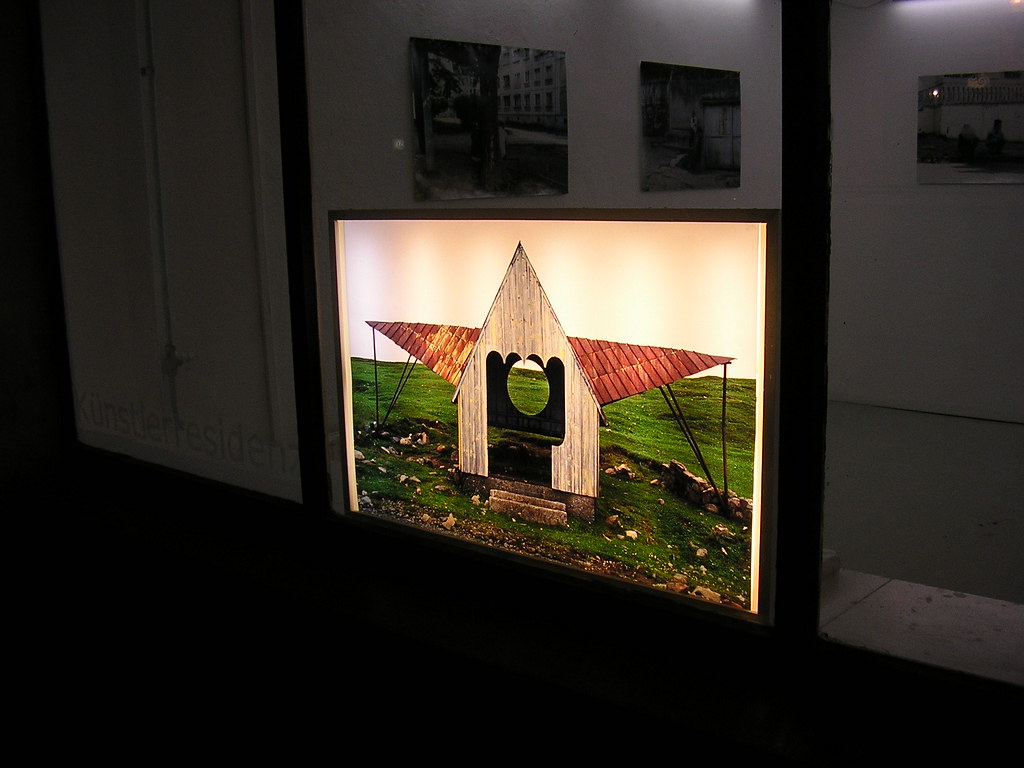
Die Künstlerresidenz *blumen* hat das Vergnügen, Marika Asatiani aus Tiflis (Georgien) zu begrüssen. In ihrer Antrittsausstellung PLACE AS A PAUSE zeigt die Künstlerin eine Auswahl aktueller Fotografien erstmals in Leipzig. Hierzu laden wir Sie/Euch herzlich ein.

M A R I K A A S A T I A N I
PLACE AS A PAUSE

1.– 17. Februar 2008
Eröffnung: Donnerstag, 31. Januar 2008 / 20 Uhr
Öffnungszeiten der Ausstellung: donnerstags – sonntags / 15-20 Uhr
Atelierbesuche nach Vereinbarung.

Marika Asatiani ist von Januar bis April 2008 Stipendiatin der Künstlerresidenz *blumen*.
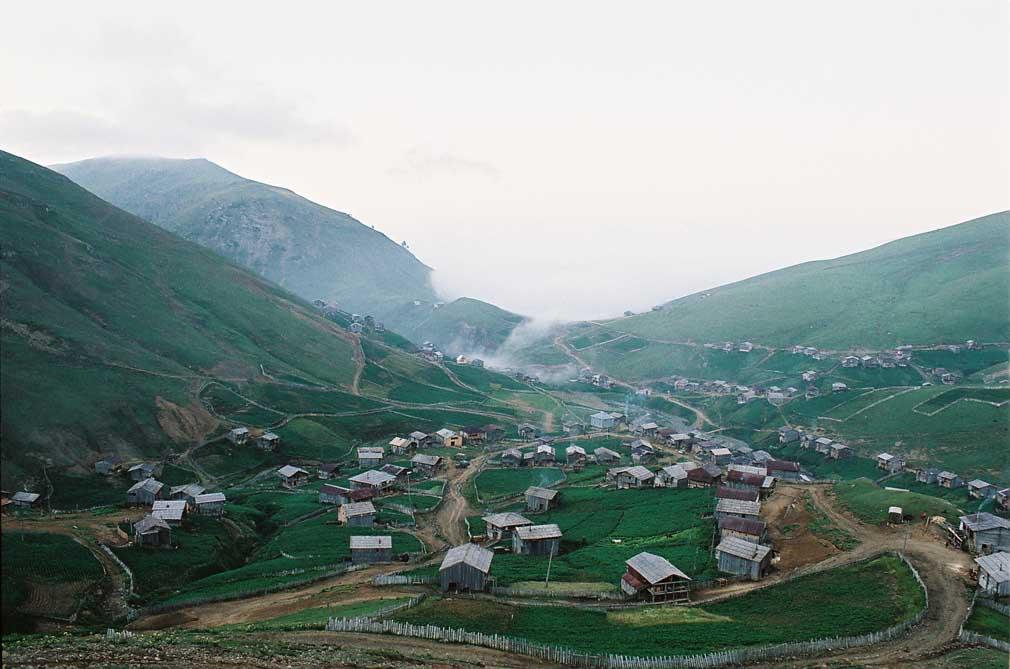
In ihren Arbeiten beschäftigt sich die Fotografin vor allem mit ihrer georgischen Heimat. Nach dem Ende der Sowjetzeit und der so genannten Rosenrevolution 2003 prägen politische und gesellschaftliche Neustrukturierungen, vor allem die rasante Adaption westlicher Lebensmodelle, die Kaukasusrepublik. Traditionelle Gewohnheiten und insbesondere das architektonische Erbe des Kommunismus bleiben als Spuren sichtbar. Die von Asatiani fotografierten Bushaltestellen sind Sinnbilder dieses Zustands, hier aber werden sie aus ihrer banalen Funktion überhöht. Als autonome Bauplastiken verweisen sie in ihren abstrusen Formen auf die eigentümliche, zum Teil chaotische Geschichte Georgiens. Auch die Aufnahmen spontaner Zusammenkünfte im öffentlichen Raum, die das Straßenbild des Landes bis heute prägen, zeigen das Überdauern kulturell gewachsener Verhaltensweisen.

Asatianis scheinbar dokumentarische Perspektive verbleibt nicht beim bloßen Registrieren ortsspezifischer Begebenheiten. Zugleich stilisiert sie die Alltagswelt. Immer wieder scheint in ihren Bildern im vermeintlich Bedeutungslosen eine ästhetische und poetische Kraft auf. Die Fotografien lassen keinen Zweifel daran, dass die beobachtete Wirklichkeit letztlich stets eine zeitlich gebundene Konstruktion ist. Mittels fokussierter Darstellung von Gesten und Orten fasst die Künstlerin die Gegenwart als Moment zwischen Vergangenem und Zukünftigem im Bild.
Marika Asatiani, 1977 in Georgien geboren, studierte Soziologie und Fotografie in Tiflis und London. Heute lebt und arbeitet die Fotografin und Videokünstlerin in Tiflis. 2007 erhielt sie den Camera-Austria-Preis für zeitgenössische Fotografie.

place a pause >>>

VORSCHAU:
POST INDUSTRIAL BOYS aka Gogi.Ge.Org, Georgien (live)
Februar 2008
Der genaue Termin wird rechtzeitig bekannt gegeben.
Mehr Infos zu Gogi.Ge.Org unter: www.goslab.de

AKTUELL
Gogi.Ge.Org war am 24. Januar, 22- 23 Uhr, zu Gast beim Leipziger "Radio Blau".
Podcast unter: www.radioblau.de


Photographies by Marika Asatiani (Set)

The artist residency *blumen* has the pleasure to welcome Marika Asatiani from Tbilisi (Georgia). The exhibition PLACE AS A PAUSE presents a choice of her recent photographies for the first time in Leipzig. To this occasion we cordially invite you.

M A R I K A A S A T I A N I
PLACE AS A PAUSE
February, 1 – 17, 2008

opening: Thursday, January, 31th at 8 p.m.
opening hours: Thursday – Sunday, 3 - 8 p.m.
Studio visits by appointment.

Marika Asatiani is participating in *blumen*’s artist-in-residence program from January till April 2008. The photographer's works show a deep involvement with her home country Georgia. After the fall of the soviet regime and the so-called Rose Revolution in 2003 the Caucasian republic was affected by social and political restructuring, especially by the adoption of western life models. Traditional habits and especially the communist heritage remain visible as traces. Bus-stops photographed by Asatiani are allegories of this state, but here they surpass their banal function. As autonomous architectural sculptures their absurd shapes refer to the peculiar, often chaotic history of the country. As well her pictures of spontaneous assemblies in public space, that shape the appearance of the street till this day, show the outlast of culturally grown behaviour.

Asatiani's documentary approach doesn't stick with the mere represention of site-specific objects and incidents. At the same time it imbues the works with universal meaning. Asatiani finds aesthetic and poetic power in what otherwise looks meaningless. Her photographs undoubtedly show that eventually the reality depicted is always a construction bound in its time. By focusing on gestures and places the artist embraces the present moment as something between past and future in a picture.

Marika Asatiani, born 1977 in Georgia, studied Sociology and Photography in Tbilisi and London. Today the photographer and video artist lives and works in Tbilisi. In 2007 she was awarded the Camera-Austria-Preis for contemporary photography.

place a pause >>>

UPCOMING:
POST INDUSTRIAL BOYS aka Gogi.Ge.Org, Georgia (live)

February 2008
exact time tba
More informations: http://www.goslab.ge/

CURRENT:
... and on "Radio Blau" (Leipzig): January 24, 2008, 10-11 p.m. (MEZ), podcast: http://www.blogger.com/www.radioblau.de


/////////////////////////////////////////////////////////

blumen* Kolonnadenstr. 20 04109 Leipzig
www.residence-blumen.de
contact@residence-blumen.de

------------------------------------------------------------

*blumen* - künstlerresidenz - Newsletter
falls Sie den Newsletter nicht bekommen möchten,
Email-Adresse unter:
http://www.residence-blumen.de/index.php?id=6&l=de
eintragen
------------------------------------------------------------
*blumen* -newsletter
to subscribe or unsubscribe please enter your email address:
http://www.residence-blumen.de/index.php?id=6&l=en

Friday, January 25, 2008

MUSIC: Modern Nomadic Electric Sounds From Slowly Georgia

Photo: Sartania-Kituashvili aka sTia

Yesterday we made a radioshow in Leipzig together with the two Georgians - the musician Gogi Dzodzuashvili & the artist Marika Asatiani in the studio from Radio Blau for one hour. In the end Gogi broadcasted four exceptionally artists from Georgia for electronic music from this very old traditionel country which is world-famous for his especially polyphonical heritage. Furthermore Nika Machaidze aka Nikakoi, Tusia Beridze aka TBA, Natia Sartania-Kituashvili aka sTia & also Gogi Dzodzuashvili himself (published his post industrial boys in Germany) were the interprets of an marvelousness evening and they brought us an individualistical and inimitable work in a musical radio-province for contemporary projects like this.
Undoubted could you listen a well-educated and intelligent view of the world. The sounds were in no case infantil and excessive technoid like whenever in the mass culture of electronic flackering in the computer scenes. Music in Georgia is on both counts a very serious approach.
The music gives me the creeps: the tone was different, well textured and dissociates from the mainstream. The voices, the poetry, the music were aloof. But, and this is very interesting & seldom, the sounds were very warmful and not difficult for our listening. The computersounds are not exalted. Easy records and compositions made the sound spaces dreamful, poetical, take somebody carry away, very inteligent sounds - it ws amazing ... I remember me on the great voice of Mesia Arabuli in one track. Traditional khevsureti voice meets modern computer sounds. This could be the future ...
I think the people have the power, the phantasy, the knowleges and the concentration to create a "huge" electric opera. I suggest a musically and performing experience between the cultures of west and east - a real life laboratory situation. I think this experiment ought to have the premiere in a old styled space. I mean the most conservative place for this is the right space - The Tbilisi Opera is the best playing ground for formant which could silently outgrow over this subliminal symbolic architecture of life.

New for me were the sounds of sTia, which you can listen here >>>

& much more here >>>

Thursday, January 24, 2008

RADIO & LIVE-STREAM: In Three Hours More About "Goslab", Georgian Electronic Music & An Exhibition In Leipzig

Gogi Dzodzuashvili from goslab & the photographer Marika AsatIani would be in the studio from Radio Blau soon

Georgian Electronic Music on Radio Blau
Ding Dong, 24.01., 22:00 (german time)


www.radioblau.de

(Livestream) !!!!!! Good time for listening !!!

täglich auf UKW99,2 MHz, sowie:94,4 MHz & 89,2 MHz (Karte)

97,9 MHz (primacom Kabel)

with LiveStream

Thursday, January 17, 2008

ART: Marika Asatiani & gogi.ge.org in Leipzig (Januar - April 2008)

Marika Asatiani wurde 1977 in Tiflis (Georgien) geboren, studierte dort und in London. Heute lebt sie in Tiflis und ist vor allem als Fotografin tätig.
2007 erhielt die Künstlerin den Camera-Austria-Preis für zeitgenössische Fotografie.

In ihren Arbeiten beschäftigt sich Asatiani mit ihrer georgischen Heimat. Ihre Bilder vermitteln Ansichten des gegenwärtigen Lebens, das von gesellschaftlichen und politischen Neustrukturierungen geprägt ist. Modernitäten zeigen sich in Georgien häufig als visuelle Einbrüche in die traditionell geprägten Landschaften. Eine Busstation wird zur autonomen Skulptur, die ihre Flügel vor uns ausbreitet, zum Trocknen aufgehangene Betttücher wirken wie abstrakte Gemälde. Die dokumentarische Perspektive Asatianis verbleibt nicht beim bloßen Registrieren ortsspezifischer Begebenheiten. Zugleich ist sie eine zusätzliche Stilisierung der Alltagswelt. So scheint immer wieder im vermeintlich Bedeutungslosen eine ästhetische und poetische Kraft auf. Ihre Fotografien lassen keinen Zweifel daran, dass die beobachtete Wirklichkeit zuletzt immer eine zeitlich gebundene Konstruktion ist.

Während ihres Residenzaufenthaltes wird die studierte Soziologin und Fotografin ihren Blick der Leipziger Stadtlandschaft und deren Bewohnern zuwenden. Im Privaten oder Öffentlichen wird sie der Erscheinungswelt des Alltags nachspüren und in den Medien Fotografie und Video augenscheinlich machen.

Antrittsausstellung
1.02. - 17.02.2008
Eröffnung: Donnerstag, 31. Januar 2008, 20 Uhr

*blumen* kunstraum und residenz deutsch english.
Kolonnadenstr. 20
04109 Leipzig, Germany
Ansprechpartner Projektleitung und Künstlerbetreuung:
Christine Rahn, Diana Bärmann, Bettina Lehmann contact@residence-blumen.de
Presse- und Öffentlichkeitsarbeit: Andrea Büttner
presse@residence-blumen.de
Finanzen und Mitgliederbetreuung:

Ludwig Henne, Sabine Sollich, Caterina Remde finanzen@residence-blumen.de
Lageplan

DANIEL BAUMANN: Marika Asatiani
Re mote Control, Tbilisi, Georgia


Konzert mit gogi.ge.org
POST INDUSTRIAL BOYS, Georgien
Februar 2008. Der genaue Termin wird rechtzeitig bekannt gegeben.
http://www.max-ernst.de/
Gogi ist einer der Musiker der Künstlervereinigung GOSLAB., über die auch schon auf arte-tv ein Beitrag kam. Ausschnitte der Reportage sehen (realvideo)

weitere Links:
credo:film
Ein Film von Salomé Machaidze in Kooperation mit GOSLAB ... Damit erinnert GOSLAB an die sowjetische Geschichte des Landes, als noch alles GOS war,
zwergWERK: programm: Goslab/Halbtotal
Goslab ist eine Gruppe georgischer FilmemacherInnen, die in Berlin eine zweite ... zu den Goslab-Filmen.
Zaza Rusadze - Goslab
Goslab [Gosudarstvenaia Laboratoria - State Lab on Russian] is a multimedia collective of Georgian artists concerned with experimentation and innovation.
taz.de - Archiv
Auch sie ist ein Mitglied von Goslab, und wie fast alle mitfeiernden GeorgierInnen ... Goslab ist ein Verbund, ein interdisziplinäres Netzwerk junger Künstler
Manöver 2005 in der nato: Experimentelles aus Georgien ...
Org und Nikakoi/Erast gehören als Gründungsmitglieder zu „goslab“, einem Netzwerk und Labor junger georgischer Künstler
MANöVER: 2005 - Kartuli Suli (Georgische Seele): PROGRAMM ...
All share an affinity to Goslab, a group of artists from Tbilisi, ... Goslab is a phantom, which manifests itself as a culture through the performances
GEORGIA & SOUTH CAUCASUS
"Gemeinsam mit dem georgischen Künstlerkollektiv GOSLAB hat Salomé Machaidze einen Film gemacht
CNN-Preis: Der BR-Nachwuchs räumt ab Wir über uns BR
Julia Nether bekam die Auszeichnung im Bereich Fernsehen für ihre Reportage über das Künstlernetzwerk Goslab im georgischen Tiflis

Thursday, November 29, 2007

ART: CAMERA-AUSTRIA-PREIS 2007 für Marika Asatiani

Die Jury des CAMERA-AUSTRIA-PREISES 2007 hat einstimmig beschlossen, den CAMERA-AUSTRIA-PREIS FÜR ZEITGENÖSSISCHE FOTOGRAFIE 2007 an Frau Marika Asatiani (geb. 1977 in Tiflis/Tbilisi, Georgien und dort wohnhaft) zu vergeben. In der Begründung der Jury heißt es, dass "Marika Asatianis ernsthafte und differenzierte Arbeit einen vielversprechenden Ansatz auch für zukünftige Projekte bietet". Der Preis, der alle zwei Jahre vergeben wird, ist mit 14.500 Euro dotiert und wird am 30. November im Kunsthaus Graz verliehen.

Daniel Baumann über Marika Asatianis im Heft 99/2007.

Quelle: www.cyberlab.at

Event
Symposion: Samstag, 1. Dezember 2007, 10:00 Uhr bis 18:00 Uhr
Das Symposion gibt Einblicke in die Geschichte und Struktur des Market Photo Workshop: Vorträge von John Fleetwood, Zanele Muholi, Nontsikelelo Veleko; Vorstellung der Camera-Austria-Preisträgerin der Stadt Graz 2007: Marika Asatiani aus Georgien spricht über ihre Arbeit.

Künstler
Bonile Bam / Jodi Bieber / Lerato Maduna / Sabelo Mlangeni / Zanele Muholi / Nontsikelelo Veleko

Ort: Camera Austria - Kunsthaus Graz, Österreich, 8020 Graz, Lendkai 1+43 316 81 55 500, www.camera-austria.at

von 01.12.2007 bis 02.03.2008

Eröffnung: 30.11.2007, 18:00

Quelle: www.eikon.at

GALLERY: Marika Asatiani (Tiflis/Georgia), January - April 2008 in Leipzig

Upcoming: The second Georgian Artist will coming after Maka Batiashvili In the beginning of next year to Leipzig. Marika Asatiani (Tiflis/Georgia), will stay in *blumen* künstlerresidenz - artist residency from January - April 2008.The artist is the award winner Camera-Austria from Graz 2007.

Daniel Baumann wrote an article about her in: www.camera-austria.at :

[...] This "stylisation of everyday life" forms the backdrop against which we – or I, at least – view the pictures of the Georgian photographer Marika Asatiani. In Camera Austria she presents pictures from three different series. more >>>


more photos from 2006: TBILISI 3. LET'S STAY ALIVE TILL MONDAY

further: photo from Marika Asatiani