more here: schader-stiftung.de
July 3rd and 4th 2014 at Schader-Forum, Darmstadt
Program – Thursday, July 3rd 2014
1:15 – 1:25 pm Welcome Address
Prof. Dr. Michèle Knodt, Technische Universität Darmstadt
Alexander Gemeinhardt M.A., Chairman of the Board, Schader-Stiftung
1:30 – 2:00 pm Keynote speech
Conflict and Cooperation in the South Caucasus
Dr. Tracey German, King’s College London
2:00 – 4:00 pm Session 1 – Historical and political framework
The North and the South in the Caucasus - Separated or Interlinked?
Dr. Uwe Halbach, Stiftung Wissenschaft und Politik, Berlin
Uncanny Threats and Secret Resistances: On the Religious Situation in Kabardino Balkaria
Prof. Dr. Raschid Alikajew, Kabardino-Balkarian State University, Nalchik
PD Dr. Florian Mühlfried, Friedrich-Schiller-Universität Jena
Straightjackets or arenas? NGOs in the institutions of competitive authoritarian regimes
in the South Caucasus
Mariella Falkenhein, Hertie School of Governance
4:00 – 4:30 pm Coffee break
4:30 – 7:30 pm Session 2 – External democracy and autocracy promotion in the Caucasus
Geopolitics of Democratic Choice: Correlations between foreign-political orientations and political regime type
Prof. Dr. Ghia Nodia, Ilia State University
EU external democracy promotion in Azerbaijan
Elsevar Mammadov, Khazar University
EU external demcracy and autocracy promotion in the Caucasus – results of a cross-country comparison
Schuschanik Minasjan, Technische Universität Darmstadt
Dr. Sigita Urdze, Technische Universität Darmstadt
Democratization through the backdoor? Functional cooperation in the Southern Caucasus
Dr. Aron Buzogány, Freie Universität Berlin
Analyses of governance strategies in the North Caucasian republics with respect to conflict regulation and development
Prof. Dr. Alexey Gunya, Kabardino-Balkarian State University, Nalchik
8:00 pm Get Together
Program – Friday July 4th 2014
9:00 – 10:30 am Session 3 – International embeddedness of the Caucasus
How serious are Armenia and Azerbaijan about integration in the European context?
Dr. Rainer Freitag-Wirminghaus, former Deutsches Orient-Institut
More than a chessboard – the role of Turkey, Iran and Russia in the Southern Caucasus
Prof. Dr. Udo Steinbach, Berlin
10:30 – 11:00 am Coffee break
11:00 – 1:00 pm Roundtable (open for public/öffentlich) – Functional triangular cooperation or competition between the EU, Russia and the Caucasus
Welcome Address
Alexander Gemeinhardt M.A., Chairman of the Board, Schader-Stiftung
Introductory speech
Prof. Dr. Michèle Knodt, Technische Universität Darmstadt
Dr. Sigita Urdze, Technische Universität Darmstadt
Chair
Prof. Dr. Marianne Kneuer, Stiftung Universität Hildesheim
Speakers
H. E. Prof. Gabriela von Habsburg, Embassador of Georgia
H. E. Dr. Vahan Hovhannesyan, Embassador of Armenia
Dr. Rizan Nabiyev, Counsellor at the Embassy of Azerbaijan
Björn Kühne, Chief of Cabinet/Political Advisor to the EUSR for the South Caucasus and the crisis in Georgia, solicited
Silvia Stöber, Journalist
Please notice: No german language translation will be provided.
Bitte beachten Sie: Wir bieten keine deutsche Übersetzung an.
Conference Childcare
Please note: We provide childcare service during the conference. Please contact us in advance:
Dr. Sigita Urdze
email: urdze@pg.tu-darmstadt.de
Fax: +49 (0)6151/ 16-4602
Email: sigita.urdze@pg.tu-darmstadt.de
Showing posts with label Ghia Nodia. Show all posts
Showing posts with label Ghia Nodia. Show all posts
Sunday, June 29, 2014
CONFERENCE: Northern and Southern Caucasus in the European Neighbourhood: Triangular functional cooperation or competition in a heterogenous region. Russia, EU and the Caucasus (schader-stiftung.de)


Sunday, February 23, 2014
NEW BOOK: Georgian Foreign Policy: The Quest for Sustainable Security (facebook.com)

There will be an official book launch on February 24 at 16:00 at the First Building at Ivane Javakhishvili Tbilisi State University, located at 1 Chavchavadze Ave.
Contributing authors include Ghia Nodia (Ilia University), Stephen Jones (Mt. Holyoke College), Kornely Kakachia (Tbilisi State University), Zaur Shiriyev (Caucasus International), Mamuka Tsereteli (Johns Hopkins University), Dr. Neil MacFarlane (Oxford University), and many others. The book will be offered for free to all interested in obtaining a copy (first come, first serve).
The Hon. Tedo Japaridze, Chairman of the Parliament Foreign Relations Committee, will offer his remarks.
Sunday, October 27, 2013
POLITIC: GOOGLE+ HANGOUT: Georgia's Presidential Elections (rferl.org)
(rferl.org) While not as dramatic as last year's parliamentary elections, Georgia's October 27 presidential polls are a milestone in the country's transition to a parliamentary republic. Although the presidency will have reduced powers under constitutional amendments adopted in 2010, a slate of 23 candidates will contest the office.
Washington-based analysts Thomas De Waal and Laura Linderman will join Tbilisi-based political analyst Ghia Nodia and Salome Asatiani of RFE/RL's Georgian Service for a live discussion of the vote. It will be moderated by RFE/RL's Brian Whitmore. (Thursday, October 24, 2013
11 am (Washington, DC) / 5 pm (Prague) / 7 pm (Tbilisi))
-----
Thomas de Waal
- is a senior associate in the Russia and Eurasia Program at the
Carnegie Endowment for International Peace, specializing primarily in
the South Caucasus region and its unresolved conflicts - Abkhazia,
Nagorno Karabakh, and South Ossetia - as well as in the wider Black Sea
region. De Waal is the author of "The Caucasus: An Introduction"
(Oxford University Press, 2010).
Laura Linderman - is the associate director of the Atlantic Council's Dinu Patriciu Eurasia Center, where she develops and shapes the Center's analytic and intellectual work on Georgia. A former Peace Corps volunteer in western Georgia, Linderman has co-authored articles on Georgian politics for the Atlantic Council and Foreign Policy.
Ghia Nodia - is the director of the International School of Caucasus Studies at Ilia State University in Tbilisi. A freelance contributor to RFE/RL's Georgian Service, Nodia served as Georgia's Minister of Education and Science from February to December 2008 and has published widely on issues of democratization, institution-building and nationalism in post-Communist countries.
Salome Asatiani - is a Prague-based broadcaster with RFE/RL's Georgian Service who has also covered Georgia for RFE/RL's Central Newsroom. Before becoming a journalist, Asatiani taught seminars at Tbilisi State University and worked as a DJ at a local rock radio station in Tbilisi.
Brian Whitmore - is Europe Desk Editor for RFE/RL's Central Newsroom in Prague and the writer of "The Power Vertical" blog
We invite you to post questions in advance and follow updates for live links to the Google+ Hangout on Twitter and Facebook.
Laura Linderman - is the associate director of the Atlantic Council's Dinu Patriciu Eurasia Center, where she develops and shapes the Center's analytic and intellectual work on Georgia. A former Peace Corps volunteer in western Georgia, Linderman has co-authored articles on Georgian politics for the Atlantic Council and Foreign Policy.
Ghia Nodia - is the director of the International School of Caucasus Studies at Ilia State University in Tbilisi. A freelance contributor to RFE/RL's Georgian Service, Nodia served as Georgia's Minister of Education and Science from February to December 2008 and has published widely on issues of democratization, institution-building and nationalism in post-Communist countries.
Salome Asatiani - is a Prague-based broadcaster with RFE/RL's Georgian Service who has also covered Georgia for RFE/RL's Central Newsroom. Before becoming a journalist, Asatiani taught seminars at Tbilisi State University and worked as a DJ at a local rock radio station in Tbilisi.
Brian Whitmore - is Europe Desk Editor for RFE/RL's Central Newsroom in Prague and the writer of "The Power Vertical" blog
We invite you to post questions in advance and follow updates for live links to the Google+ Hangout on Twitter and Facebook.
Wednesday, July 03, 2013
BBC: Georgia's mighty Orthodox Church . By Paul Rimple (bbc.co.uk)
(bbc.co.uk) When several dozen Georgian Orthodox priests led tens of thousands of
people on a violent attack against a small group of gay rights activists
in Tbilisi earlier this year, much of the rest of the country was
horrified, writes journalist Paul Rimple, who has been based in the
country for 10 years.
 Georgians pride themselves on their reputation for being hospitable and tolerant, and most consider themselves Christian.
And yet, what happened clearly illustrates the importance of the Church in Georgia.
Georgia was an early adopter of Christianity making it a state religion in 337AD. Georgians maintained their faith over the centuries despite the waves of invading hordes, including the armies of Ghengis Khan and Tamerlane.
"During communism, the church was outdated, something for old ladies," says political analyst Ghia Nodia.
That attitude quickly changed after independence in 1991, when the elected president, Zviad Gamsakhurdia, espoused a philosophy of ethnic nationalism, which the Church embraced.
"During the (Gamsakhurdia) national movement, the concept that real Georgians are Orthodox Christians spread really fast," Mr Nodia says.
Over 80% of Georgia's 4.5 million people say they belong to the Georgian Orthodox Church, however, experts claim only about 15% - 25% actively participate in rituals.
Nevertheless, the Orthodox Church remains the most trusted institution in Georgia. In a February survey carried out by the Caucasus Resource Research Center (CRRC), 95% of respondents had a favourable opinion of its work.
Beka Mindiashvili, a former theologian who is now head of the Tolerance Center at the public defender's office, attributes such high confidence in the Church to the 80-year-old Patriarch, Ilia II.
"He possesses all the right attributes. He is charismatic, he speaks slowly and each word is regarded saintly, holy," Mr Mindiashvili says.
"He is a person for everybody. To a simple person, he speaks simply; to a politician, he speaks politically; to an intellectual, he speaks of Umberto Eco and of classical music. And he acquired absolute power in the Church all by himself."
There were only about 50 priests when Ilia II became patriarch in 1977. Today there are approximately 1,700.
His first major test in power was in 1997, when a number of anti-ecumenical abbots threatened to break communion with him for being too liberal. He avoided a schism by breaking off ecumenical activities and pursuing what philosopher Zaza Piralishvili calls an "imitation of medieval rhetoric".
The Church is recognised for maintaining a neutral political
stance and Ilia II is renowned for playing a significant role as
mediator in political confrontations, which in Georgia can easily turn
violent.
Professor Iago Kachkachishvili, head of the sociology department at Tbilisi State University, says the Church's political neutrality is a myth.
"The Church's influence comes from public opinion," he says. "It uses the trust of the people as a source of strength. And every government and politician uses the Georgian Orthodox Church as a source of legitimacy."
While the constitution stipulates a separation between church and state, a 2002 concordat defined this relationship by granting the Church official recognition in Georgia and a special consultative role in the government, particularly in education.
In 2009, Mikheil Saakashvili's government awarded the Church a $15m (£10m) grant - three times the amount of the previous year - and presented luxury sports utility vehicles to each of the 10 archbishops.
Despite the lavish gifts, many conservative elements within the Church, who are pro-Russian, openly voiced their displeasure with the president. They saw his pro-Western orientation as a threat to Georgian traditions and the Church's influence on the people.
The clash of ideologies came to head in July 2011, when parliament passed a law allowing religious minority groups in Georgia to be registered as legal entities in public law giving them legal protection previously only enjoyed by the Orthodox Church.
The move was applauded in the West, but the Georgian Orthodox Church saw this as an infringement on its special status.
Although Ilia II requested the clergy to maintain neutrality in the 2012 parliamentary elections, many priests broke ranks and openly supported the coalition of billionaire Bidzina Ivanishvili, who had provided the funds to build Tbilisi's Sameba Cathedral, the largest church in Georgia.
But on 13 May, Bidzina Ivanishvili who by now was prime minister, took an independent stance and became the first Georgian politician to declare openly that sexual minorities were equal citizens of this country.
Three days later, Ilia II called on the authorities to ban the 17 May demonstration. This marked the first open confrontation between church and state and culminated in expletive-shouting priests chasing gay activists down the main streets of the capital.
Protesters broke through barricades and police were forced to bus the small number of activists out of the area for their protection.
The day after the attacks, Tbilisi artist Magda Guruli joined some 100 people who rallied in the city centre to call for justice.
She believes the response to the protest was a manifestation of the patriarch's power over the state.
"I'm here to say give me back my religion," she said. "Orthodoxy is part of our culture, but who are these people who try to influence society and try to influence their thoughts and try to cultivate blind faith?"
Georgians pride themselves on their reputation for being hospitable and tolerant, and most consider themselves Christian.
While the notion of homosexuality is not
widely understood or accepted in this deeply traditional Caucasus
nation, most Georgians were appalled by the scenes that unfolded in
Tbilisi on 17 May.
Georgia was an early adopter of Christianity making it a state religion in 337AD. Georgians maintained their faith over the centuries despite the waves of invading hordes, including the armies of Ghengis Khan and Tamerlane.
Although the Soviets permitted religion to be
practised, its reach was severely limited. In 1917, there were 2,455
working churches in Georgia, but by the mid-1980s there were only 80,
along with a few monasteries and a seminary.
That attitude quickly changed after independence in 1991, when the elected president, Zviad Gamsakhurdia, espoused a philosophy of ethnic nationalism, which the Church embraced.
"During the (Gamsakhurdia) national movement, the concept that real Georgians are Orthodox Christians spread really fast," Mr Nodia says.
Over 80% of Georgia's 4.5 million people say they belong to the Georgian Orthodox Church, however, experts claim only about 15% - 25% actively participate in rituals.
Nevertheless, the Orthodox Church remains the most trusted institution in Georgia. In a February survey carried out by the Caucasus Resource Research Center (CRRC), 95% of respondents had a favourable opinion of its work.
Beka Mindiashvili, a former theologian who is now head of the Tolerance Center at the public defender's office, attributes such high confidence in the Church to the 80-year-old Patriarch, Ilia II.
"He possesses all the right attributes. He is charismatic, he speaks slowly and each word is regarded saintly, holy," Mr Mindiashvili says.
"He is a person for everybody. To a simple person, he speaks simply; to a politician, he speaks politically; to an intellectual, he speaks of Umberto Eco and of classical music. And he acquired absolute power in the Church all by himself."
There were only about 50 priests when Ilia II became patriarch in 1977. Today there are approximately 1,700.
His first major test in power was in 1997, when a number of anti-ecumenical abbots threatened to break communion with him for being too liberal. He avoided a schism by breaking off ecumenical activities and pursuing what philosopher Zaza Piralishvili calls an "imitation of medieval rhetoric".
Examples of the Church's ultra-conservative
interventions included warnings that yoga was full of false "charms"
that lured people away from God as well as a recent mass mobilisation
against ID cards after some Georgian Orthodox leaders claimed the cards
bore the mark of the anti-Christ.
Professor Iago Kachkachishvili, head of the sociology department at Tbilisi State University, says the Church's political neutrality is a myth.
"The Church's influence comes from public opinion," he says. "It uses the trust of the people as a source of strength. And every government and politician uses the Georgian Orthodox Church as a source of legitimacy."
While the constitution stipulates a separation between church and state, a 2002 concordat defined this relationship by granting the Church official recognition in Georgia and a special consultative role in the government, particularly in education.
In 2009, Mikheil Saakashvili's government awarded the Church a $15m (£10m) grant - three times the amount of the previous year - and presented luxury sports utility vehicles to each of the 10 archbishops.
Despite the lavish gifts, many conservative elements within the Church, who are pro-Russian, openly voiced their displeasure with the president. They saw his pro-Western orientation as a threat to Georgian traditions and the Church's influence on the people.
The clash of ideologies came to head in July 2011, when parliament passed a law allowing religious minority groups in Georgia to be registered as legal entities in public law giving them legal protection previously only enjoyed by the Orthodox Church.
The move was applauded in the West, but the Georgian Orthodox Church saw this as an infringement on its special status.
Although Ilia II requested the clergy to maintain neutrality in the 2012 parliamentary elections, many priests broke ranks and openly supported the coalition of billionaire Bidzina Ivanishvili, who had provided the funds to build Tbilisi's Sameba Cathedral, the largest church in Georgia.
But on 13 May, Bidzina Ivanishvili who by now was prime minister, took an independent stance and became the first Georgian politician to declare openly that sexual minorities were equal citizens of this country.
Three days later, Ilia II called on the authorities to ban the 17 May demonstration. This marked the first open confrontation between church and state and culminated in expletive-shouting priests chasing gay activists down the main streets of the capital.
Protesters broke through barricades and police were forced to bus the small number of activists out of the area for their protection.
The day after the attacks, Tbilisi artist Magda Guruli joined some 100 people who rallied in the city centre to call for justice.
She believes the response to the protest was a manifestation of the patriarch's power over the state.
"I'm here to say give me back my religion," she said. "Orthodoxy is part of our culture, but who are these people who try to influence society and try to influence their thoughts and try to cultivate blind faith?"
Monday, October 01, 2012
INTERVIEW: "Es ist das Ende der Ära Saakaschwili" - Mit Ghia Nodia sprach Markus Bernath (derstandard.at)
(derstandard.at) Wegen der Verfassungsänderung haben Georgiens Parlamentswahlen große Bedeutung, erklärt der Politikprofessor Ghia Nodia
Die Kaukasusrepublik gibt 2013 das Präsidialsystem auf. Mit Nodia sprach Markus Bernath.
 |
| foto: standard/bernath |
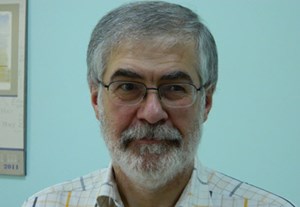
(Ghia Nodia (58) ist Politikwissenschafter und Direktor der
Internationalen Schule für Kaukasusstudien an der staatlichen
Ilia-Universität in Tiflis. 2008 war er ein Jahr lang Bildungsminister.)
STANDARD: Georgien kommt nie wirklich zu Ruhe. 2007 sollte Staatschef Saakaschwili mit Straßenprotesten gestürzt werden, 2008 war der Krieg mit Russland, jetzt ist ein Oligarch aufgetaucht, der sich eine Parteienkoalition gekauft hat und Präsident und Regierung bei den Parlamentswahlen herausfordert. Was ist los mit diesem Land?
Nodia: Wir haben kein stabiles Parteiensystem, keine stabile Zivilgesellschaft, aber wir sind gleichzeitig eine recht offene Gesellschaft. Sie können den Präsidenten und die Regierung kritisieren, es gibt freie Medien, aber weil die Stabilität fehlt, kommt es immer wieder zu Mobilisierungen ohne Ergebnisse. Die politische Kultur des "alles oder nichts" tut ihr Übriges: Schafft die Opposition es nicht, durch Wahlen an die Macht zu kommen, ist sie enttäuscht und organisiert Proteste.
STANDARD: Was bedeuten diese Parlamentswahlen nun für Georgien?
Nodia: Diese Wahlen sind aus zwei Gründen wichtig. Einmal wegen der Verfassungsänderung, die in Kraft tritt und Georgien von einem präsidialen zu einem parlamentarischen System machen wird. Das Parlament, das nun gewählt wird, hat also eine viel größere Bedeutung. Zweitens endet nächstes Jahr die Amtszeit von Präsident Saakaschwili. Wir wissen nicht genau, was danach geschieht. Ob Saakaschwili dann Premierminister wird oder ob der derzeitige Regierungschef Vano Merabischwili, wie er selbst gesagt hat, vier Jahre im Amt bleiben wird. Aber so oder so ist es das Ende der Ära Saakaschwili. Diese Wahlen legen fest, was nach Saakaschwili kommt.
STANDARD: Welche Chancen haben Bidsina Iwanischwili und seine Koalition?
Nodia: Die Umfragen hatten vorausgesagt, dass Iwanischwilis Koalition verliert, aber im neuen Parlament einen stärkeren Platz als die heutige Opposition einnehmen wird. Das war vor dem Skandal um die Folter in den Gefängnissen. Jetzt ist es sehr schwierig, Prognosen abzugeben. Mein Gefühl sagt mir, dass Saakaschwilis Partei der Nationalen Bewegung immer noch gewinnen wird, aber mit einem sehr viel kleineren Vorsprung. Die große Sorge ist, was nach den Wahlen passiert. Wenn Iwanischwili verliert - so die allgemeine Erwartung -, wird er das Ergebnis nicht akzeptieren. Dann gibt es wieder Straßenproteste.
STANDARD: Welchen Einfluss nimmt Russland auf diese Wahlen?
Nodia: Die Beobachtermission der EU hat eine Konzentrierung russischer Truppen an den georgischen Grenzen festgestellt. Einige russische Regierungsvertreter haben wegen des Folterskandals auch Kommentare über die Menschenrechtslage in Georgien abgegeben. Natürlich gibt es die Furcht, dass Russland im Fall größerer Unruhen nach den Wahlen hier wieder eingreift.
STANDARD: Was ist mit Iwanischwilis Verbindungen zu Moskau?
Nodia: Da sind wir im Bereich der Verschwörungstheorien. Die georgische Regierung wirft ihm das vor, aber einen Beweis gibt es nicht.
Tuesday, November 16, 2010
CALL: The Caucasus and Central Asia, twenty years after independences (ocamagazine.com)
Call For Papers
The Caucasus and Central Asia, twenty years after independences:
Questioning the notion of "South countries"
International conference, Almaty, August 25-27, 2011
Twenty years ago, after the collapse of the USSR, the countries of Central Asia (Kazakhstan, Kyrgyzstan, Uzbekistan, Tajikistan, Turkmenistan) and the Caucasus (Armenia, Azerbaijan, Georgia) became independent. The Central Asian republics, created between 1924 and 1936, could then - unexpectedly - enjoy a sovereignty previously unknown to them, whereas in the Caucasian states, the strong national movements that had developed during perestroika were deeply rooted in the past. During the 20th century, these Soviet socialist republics had been integrated into the unified production and trade system set up on the scale of the USSR and the principles of socialist planning. In this framework, they could take advantage of the resources and development policy of the Soviet state. Thus, despite any lacks or shortcomings they might have, the Caucasian and Central Asian republics belonged to the developed world in the bi-polar geopolitical division. The Caucasus and Central Asia served as models, if not showcases, for some Third World countries, all the more so as the USSR provided assistance to developing countries struggling against imperialism.
Since the collapse of the USSR and the East-West division, the North-South opposition seems to have become one of the major reading grids of the international scene. Whereas during the Cold war, geopolitical analyses rested on the ideological and strategic confrontation between capitalist and socialist worlds, the North-South grid, for the most part, pointed to inequalities in development. Appearing in the 1970s, the notion of "South" in fact replaced the term "third world countries" or "developing countries, as opposed to the "North", the developed and industrialised countries. Then came the expression "South countries", referring to the diversity of this heterogeneous ensemble made up of both emerging and least advanced countries. In these new divisions of today's globalised and regionalised world, where do we situate the independent states of Central Asia and the Caucasus?
Research on contemporary trends in Central Asia and the Caucasus contains few attempts at examining the analysis grids elaborated to study the South countries - despite the fact that after the crisis at the turn of the 1990s and the magnitude of its economic, political and social impact, the newly independent Central Asian and Caucasian states were included, by international institutions as well as non-governmental organisations, in the "South countries". As a result, during the 1990s, international assistance destined for the Central Asian republics and, to a lesser extent, the Caucasian republics, tended to slip from "transition" to "development" aid. In this respect, according to some analysts, Central Asia and the Caucasus followed a very original post-soviet trajectory, having entered into the globalised world by means of what could be called "third worldisation". Thus they argue that the border between the "North" and the "South countries", formerly located on the border of the USSR, was from then on situated on the southern border of Russia.
Since it opposes a former metropolis and its former colonies, an approach in terms of "South countries" falls into a post-colonial pattern; as such, it leads us to examine the USSR's imperial dimension and to mobilise the theoretical approaches (theory of dependency, post colonial studies, etc) to which we owe the notion of "South countries".
The current trajectories of Central Asia and the Caucasus also suggest that development issues be examined in the context of globalisation. In particular, these issues require an analysis of the transition paradigm developed during the 1990s by international organisations, aimed at replacing the socialist model with a political system organised on a democratic basis, an economy based on liberal capitalist principles and a Euro-Atlantic geopolitical positioning. Economic and social dynamics have tended to invalidate this teleological notion, which conditioned development and oriented the insertion of Central Asian and Caucasian republics into the mechanisms of globalisation. However, it is essential to question transition policies in order to evaluate the slippage towards the "South" which has taken place since their independence.
The present period can be likened to a moment of diversification and individualisation of societies, economies and territories, on the basis of the Newly Independent States. In this respect, an examination of contemporary transformations in all their complexity not only means keeping a close watch on the diversity of political, economic and social actors, but also trying to identify the fault lines which tend to segment Central Asian and Caucasian territories and societies.
The aim of the conference "The Caucasus and Central Asia, twenty years after independences: an examination of the notion of 'South Countries'" - is to question the relevance of heuristic tools based on territories situated in the "South" but also, the very notion itself of "South countries", so as to gain insight into the southern peripheries of post-soviet space. Its purpose is to bring together researchers in all social science disciplines (sociology, history, political science, geography, anthropology, demography and economics). This diversity should favour a confrontation of approaches and further insight into the complexity of the itineraries followed by the countries of Central Asia and the Caucasus in the past twenty years.
Themes
The formation of states: post-colonial problems?
- The formation of Republican territories: the history of borders, border policy and implementation, autonomous territories, political structuring of space;
- The structuring of political domains: creation of regional and local Republican state apparatuses at the time of incorporation into the Soviet Union; the ethnicising and confessionalising of political issues;
- The transformation of Soviet and post-Soviet elites, the emergence of new actors and new political resources (NGOs, etc.).
Inequality and poverty: societies thrust into third world status?
- Pauperisation and social differentiations; social and spatial segregation-aggregation; city-rural inequalities;
- Work migrations: socio-economic and political causes for mobility (poverty, conflicts, etc); implementation of public policies; life itineraries and strategies of migrants; social, demographic and economic consequences of migration in the country of origin and the host country;
- Questions on the definition of South countries from the point of view of demographic transition (fertility, mortality, life expectancy).
International geopolitical insertion: are the South countries being dominated?
- Global and regional power plays, in particular Russia, the former metropolis;
- The positioning of international organisations;
- The role of cross border enterprises;
- The international ambitions of certain Central Asian and Caucasian states;
- Regional alliances.
Economic globalisation: are the South countries being exploited?
- Re-orientation of economic and commercial exchanges;
- Government action in the economic sector and the role of national and international entrepreneurs: the appropriation and exploitation of Central Asian and Caucasian resources;
- Fashioning of a resource based economy and link with development;
- The informal sector and "globalisation from the bottom up".
Organisation:
The conference "The Caucasus and Central Asia, twenty years after independences: questioning the notion of 'South Countries'" will be held in Almaty on August 25th, 26th, and 27th, 2011.
Proposals for communications should be sent before January 15th, 2011 at the following address: colloque.sudsov@gmail.com. They may be written in French, English, or Russian. Please, send an abstract (about 2000 signs), and a short CV. Answers will be sent by the organisation committee before February 28th 2011.
Working languages will be English and Russian.
Organising Institutions:
Centre d'étude des mondes russe, caucasien et centre-européen (CERCEC)
(Centre National de la Recherche Scientifique (CNRS)
Ecole des Hautes Etudes en Sciences Sociales (EHESS), Paris
Institute for oriental studies, National Academy of Sciences of the Republic of Kazakhstan (Almaty) ANR (French National Research Agency)
Program "Sudsov", Paris
IFEAC (French Institute for Central Asian Studies), Tashkent
Centre franco-russe de recherche en sciences humaines et sociales, Moscow.
Organisation committee:
Sophie Hohman, CNRS-CERCEC/ INED (National Institute for Demographic Studies), Paris,
Anne Le Huérou, CNRS-CERCEC, Paris,
Isabelle Ohayon, CNRS-CERCEC, Paris,
Amandine Regamey, Paris I University/CERCEC, Paris,
Nazigul Shajmardanova, Institute for Oriental Studies, Almaty,
Silvia Serrano, Université d'Auvergne, Clermont-Ferrand, CERCEC, Paris,
Julien Thorez, CNRS- Center "Mondes iranien et indien", Paris.
International scientific committee:
Sergey Abashin, Institute of ethnology and anthropology, Russian Academy of Sciences, Moscow,
Alexandre Iskanderyan, Caucasus Institute, Erevan,
Mohamed-Reza Djalili, Graduate Institute of International and Development Studies, Geneva,
Sanat Kushkumbaev, Kazakhstan Institute for Strategic Studies, Almaty,
Vladimir Mukomel, Institute of Sociology, Russian Academy of Sciences, Moscow, Claire Mouradian, CNRS-CERCEC, Paris,
Ghia Nodia, Caucasus Institute for Peace, Democracy and Development/Ilya University, Tbilissi,
Saodat Olimova, Sharq Center, Duchanbe,
Jean Radvanyi, Centre franco-russe de recherche en sciences humaines et sociales, Moscow.
The Caucasus and Central Asia, twenty years after independences:
Questioning the notion of "South countries"
International conference, Almaty, August 25-27, 2011
Twenty years ago, after the collapse of the USSR, the countries of Central Asia (Kazakhstan, Kyrgyzstan, Uzbekistan, Tajikistan, Turkmenistan) and the Caucasus (Armenia, Azerbaijan, Georgia) became independent. The Central Asian republics, created between 1924 and 1936, could then - unexpectedly - enjoy a sovereignty previously unknown to them, whereas in the Caucasian states, the strong national movements that had developed during perestroika were deeply rooted in the past. During the 20th century, these Soviet socialist republics had been integrated into the unified production and trade system set up on the scale of the USSR and the principles of socialist planning. In this framework, they could take advantage of the resources and development policy of the Soviet state. Thus, despite any lacks or shortcomings they might have, the Caucasian and Central Asian republics belonged to the developed world in the bi-polar geopolitical division. The Caucasus and Central Asia served as models, if not showcases, for some Third World countries, all the more so as the USSR provided assistance to developing countries struggling against imperialism.
Since the collapse of the USSR and the East-West division, the North-South opposition seems to have become one of the major reading grids of the international scene. Whereas during the Cold war, geopolitical analyses rested on the ideological and strategic confrontation between capitalist and socialist worlds, the North-South grid, for the most part, pointed to inequalities in development. Appearing in the 1970s, the notion of "South" in fact replaced the term "third world countries" or "developing countries, as opposed to the "North", the developed and industrialised countries. Then came the expression "South countries", referring to the diversity of this heterogeneous ensemble made up of both emerging and least advanced countries. In these new divisions of today's globalised and regionalised world, where do we situate the independent states of Central Asia and the Caucasus?
Research on contemporary trends in Central Asia and the Caucasus contains few attempts at examining the analysis grids elaborated to study the South countries - despite the fact that after the crisis at the turn of the 1990s and the magnitude of its economic, political and social impact, the newly independent Central Asian and Caucasian states were included, by international institutions as well as non-governmental organisations, in the "South countries". As a result, during the 1990s, international assistance destined for the Central Asian republics and, to a lesser extent, the Caucasian republics, tended to slip from "transition" to "development" aid. In this respect, according to some analysts, Central Asia and the Caucasus followed a very original post-soviet trajectory, having entered into the globalised world by means of what could be called "third worldisation". Thus they argue that the border between the "North" and the "South countries", formerly located on the border of the USSR, was from then on situated on the southern border of Russia.
Since it opposes a former metropolis and its former colonies, an approach in terms of "South countries" falls into a post-colonial pattern; as such, it leads us to examine the USSR's imperial dimension and to mobilise the theoretical approaches (theory of dependency, post colonial studies, etc) to which we owe the notion of "South countries".
The current trajectories of Central Asia and the Caucasus also suggest that development issues be examined in the context of globalisation. In particular, these issues require an analysis of the transition paradigm developed during the 1990s by international organisations, aimed at replacing the socialist model with a political system organised on a democratic basis, an economy based on liberal capitalist principles and a Euro-Atlantic geopolitical positioning. Economic and social dynamics have tended to invalidate this teleological notion, which conditioned development and oriented the insertion of Central Asian and Caucasian republics into the mechanisms of globalisation. However, it is essential to question transition policies in order to evaluate the slippage towards the "South" which has taken place since their independence.
The present period can be likened to a moment of diversification and individualisation of societies, economies and territories, on the basis of the Newly Independent States. In this respect, an examination of contemporary transformations in all their complexity not only means keeping a close watch on the diversity of political, economic and social actors, but also trying to identify the fault lines which tend to segment Central Asian and Caucasian territories and societies.
The aim of the conference "The Caucasus and Central Asia, twenty years after independences: an examination of the notion of 'South Countries'" - is to question the relevance of heuristic tools based on territories situated in the "South" but also, the very notion itself of "South countries", so as to gain insight into the southern peripheries of post-soviet space. Its purpose is to bring together researchers in all social science disciplines (sociology, history, political science, geography, anthropology, demography and economics). This diversity should favour a confrontation of approaches and further insight into the complexity of the itineraries followed by the countries of Central Asia and the Caucasus in the past twenty years.
Themes
The formation of states: post-colonial problems?
- The formation of Republican territories: the history of borders, border policy and implementation, autonomous territories, political structuring of space;
- The structuring of political domains: creation of regional and local Republican state apparatuses at the time of incorporation into the Soviet Union; the ethnicising and confessionalising of political issues;
- The transformation of Soviet and post-Soviet elites, the emergence of new actors and new political resources (NGOs, etc.).
Inequality and poverty: societies thrust into third world status?
- Pauperisation and social differentiations; social and spatial segregation-aggregation; city-rural inequalities;
- Work migrations: socio-economic and political causes for mobility (poverty, conflicts, etc); implementation of public policies; life itineraries and strategies of migrants; social, demographic and economic consequences of migration in the country of origin and the host country;
- Questions on the definition of South countries from the point of view of demographic transition (fertility, mortality, life expectancy).
International geopolitical insertion: are the South countries being dominated?
- Global and regional power plays, in particular Russia, the former metropolis;
- The positioning of international organisations;
- The role of cross border enterprises;
- The international ambitions of certain Central Asian and Caucasian states;
- Regional alliances.
Economic globalisation: are the South countries being exploited?
- Re-orientation of economic and commercial exchanges;
- Government action in the economic sector and the role of national and international entrepreneurs: the appropriation and exploitation of Central Asian and Caucasian resources;
- Fashioning of a resource based economy and link with development;
- The informal sector and "globalisation from the bottom up".
Organisation:
The conference "The Caucasus and Central Asia, twenty years after independences: questioning the notion of 'South Countries'" will be held in Almaty on August 25th, 26th, and 27th, 2011.
Proposals for communications should be sent before January 15th, 2011 at the following address: colloque.sudsov@gmail.com. They may be written in French, English, or Russian. Please, send an abstract (about 2000 signs), and a short CV. Answers will be sent by the organisation committee before February 28th 2011.
Working languages will be English and Russian.
Organising Institutions:
Centre d'étude des mondes russe, caucasien et centre-européen (CERCEC)
(Centre National de la Recherche Scientifique (CNRS)
Ecole des Hautes Etudes en Sciences Sociales (EHESS), Paris
Institute for oriental studies, National Academy of Sciences of the Republic of Kazakhstan (Almaty) ANR (French National Research Agency)
Program "Sudsov", Paris
IFEAC (French Institute for Central Asian Studies), Tashkent
Centre franco-russe de recherche en sciences humaines et sociales, Moscow.
Organisation committee:
Sophie Hohman, CNRS-CERCEC/ INED (National Institute for Demographic Studies), Paris,
Anne Le Huérou, CNRS-CERCEC, Paris,
Isabelle Ohayon, CNRS-CERCEC, Paris,
Amandine Regamey, Paris I University/CERCEC, Paris,
Nazigul Shajmardanova, Institute for Oriental Studies, Almaty,
Silvia Serrano, Université d'Auvergne, Clermont-Ferrand, CERCEC, Paris,
Julien Thorez, CNRS- Center "Mondes iranien et indien", Paris.
International scientific committee:
Sergey Abashin, Institute of ethnology and anthropology, Russian Academy of Sciences, Moscow,
Alexandre Iskanderyan, Caucasus Institute, Erevan,
Mohamed-Reza Djalili, Graduate Institute of International and Development Studies, Geneva,
Sanat Kushkumbaev, Kazakhstan Institute for Strategic Studies, Almaty,
Vladimir Mukomel, Institute of Sociology, Russian Academy of Sciences, Moscow, Claire Mouradian, CNRS-CERCEC, Paris,
Ghia Nodia, Caucasus Institute for Peace, Democracy and Development/Ilya University, Tbilissi,
Saodat Olimova, Sharq Center, Duchanbe,
Jean Radvanyi, Centre franco-russe de recherche en sciences humaines et sociales, Moscow.
Tuesday, August 19, 2008
COMMENT: Schröder slams McCain on Georgia
 By Kanishk Tharoor 19 - 08 - 08
The conventional wisdom has it that this month's eruption of violence between Russia and Georgia played squarely into the hands of John McCain. With pundits and hacks fulminating about a return to the Cold War, McCain has ratcheted up the rhetoric, supposedly sending a muscular to the Kremlin. He demanded that "Russia should immediately and unconditionally cease its military operations and withdraw all forces from sovereign Georgian territory." McCain, who has in the past called Vladimir Putin a "totalitarian dictator", went on to belittle the more cautious tone struck by the Obama campaign as "bizarrely in sync with Moscow." Such claims amount to preposterous misrepresentations of Obama's position and are calculated to appeal to the cruder, blustering passions of the American people. It's not just the benighted of the developing world, after all, that seek solace in their strongmen.
One of the many misfortunes of the flare up in the Caucasus is that an opportunity to probe more deeply into the roots of the conflict is being lost amidst the rhetoric of overheated Cold War nostalgists. For cooler, informed insight on the Russia-Georgia crisis, there are few better places to turn than to openDemocracy, which has long reported on Georgia's internal problems and the failures of Georgian nationalism on their own terms. Get up to speed with oD's Caucasus archive here.

The Georgia-Russia war of August 2008 carries a vital lesson: the small territories that broke from Georgia's control in the early 1990s have their own voice, identity, and interest. They must be active participants in deciding their own future, says George Hewitt, the leading scholar of Abkhazian linguistics and history.
The new Caucasus war exposes the problem of Georgia - and of western myths about the country
The Georgia-Russia war exposes some of the flaws in the idea of citizen journalism.
A messy conflict reflects collective forgetting. It's time to recall history, break the cycle, and build the future in Abkhazia and Georgia
Also on Abkhazia in openDemocracy:
Thomas de Waal & Zeyno Baran, "Abkhazia-Georgia, Kosovo-Serbia: parallel worlds?" (2 August 2006)
Thomas de Waal, "Abkhazia's archive: fire of war, ashes of history" (20 October 2006)
Nikolaj Nielsen, "A small bomb in Gali" (8 July 2008).
Among openDemocracy's articles on Georgian politics and the region:
Neal Ascherson, "Tbilisi, Georgia: the rose revolution's rocky road" (15 July 2005)
Donald Rayfield, "Georgia and Russia: with you, without you" (3 October 2006)
Robert Parsons, "Russia and Georgia: a lover's revenge" (6 October 2006)
Vicken Cheterian, "Georgia's arms race" (4 July 2007)
Donald Rayfield, "Russia and Georgia: a war of perceptions" (24 August 2007)
Alexander Rondeli, "Georgia: politics after revolution" (14 November 2007)
Robert Parsons, "Georgia's race to the summit" (4 January 2008)
Robert Parsons,"Mikheil Saakashvili's bitter victory" (11 January 2008)
Jonathan Wheatley, "Georgia's democratic stalemate" (14 April 2008)
Robert Parsons, "Georgia, Abkhazia, Russia: the war option" (13 May 2008)
Thomas de Waal, "The Russia-Georgia tinderbox" (16 May 2008)
Robert Parsons, "Georgia's dangerous gulf" (30 May 2008)
Alexander Rondeli, "Georgia's search for itself" (8 July 2008)
Thomas de Waal, "South Ossetia: the avoidable tragedy" (11 August 2008)
Ghia Nodia, "The war for Georgia: Russia, the west, the future" (12 August 2008)
Donald Rayfield, "The Georgia-Russia conflict: lost territory, found nation" (13 August 2008).
Thursday, June 23, 2005
BOOK: Contested Borders in the Caucasus / Angefochtene Grenzen im Kaukasus - Bruno Coppieters (ed.)
A book about the caucasus
ISBN 90 5487 1172 NUGI 654D/ 1996 / 1885 / 005
Bruno Coppieters (ed.)
The contributors to this book cover the ethnic conflicts in the Caucasus over Nagorno-Karabakh, South Ossetia and Abkhazia, and the conflict in the North Caucasus between the Ingush and Ossetes. Alexei Zverev gives a broad overview of all these conflicts. Ghia Nodia's contribution focuses on the consequences of Georgian independence for the conflict with South Ossetia. Dmitri Trenin and Dmitri Danilov discuss Russia's interests and policies in the region. Eric Remacle and Olivier Paye deal with the mediation policies of the CSCE and the UN in the main conflicts there.Firouzeh Nahavandi and Abdollah Ramezanzadeh analyse Iranian policies in the region, while Freddy De Pauw describes Turkish disillusionment with its co-operation projects with Azerbaijan.The conclusions of Bruno Coppieters examine the Caucasus as an issue of regional security.
Ethnic Conflicts in the Caucasus 1988-1994 Alexei Zverev
Political Turmoil in Georgia and the Ethnic Policies of Zviad Gamsakhurdia Ghia Nodia
Russia's Security Interests and Policies in the Caucasus Region Dimitri Trenin
UN and OSCE Policies in Transcaucasia Olivier Paye and Eric Remacle
Russia's Search for an International Mandate in Transcaucasia Dimitri Danilov
Russia, Iran and Azerbaijan. The Historic Origins of Iranian Foreign Policy Firouzeh Nahavandi
Iran's Role as Mediator in the Nagorno-Karabakh Crisis Abdollah Ramezanzadeh
Turkey's Policies in Transcaucasia Freddy De Pauw
Conclusions : The Caucasus as a Security Complex Bruno Coppieters
ISBN 90 5487 1172 NUGI 654D/ 1996 / 1885 / 005
Bruno Coppieters (ed.)
The contributors to this book cover the ethnic conflicts in the Caucasus over Nagorno-Karabakh, South Ossetia and Abkhazia, and the conflict in the North Caucasus between the Ingush and Ossetes. Alexei Zverev gives a broad overview of all these conflicts. Ghia Nodia's contribution focuses on the consequences of Georgian independence for the conflict with South Ossetia. Dmitri Trenin and Dmitri Danilov discuss Russia's interests and policies in the region. Eric Remacle and Olivier Paye deal with the mediation policies of the CSCE and the UN in the main conflicts there.Firouzeh Nahavandi and Abdollah Ramezanzadeh analyse Iranian policies in the region, while Freddy De Pauw describes Turkish disillusionment with its co-operation projects with Azerbaijan.The conclusions of Bruno Coppieters examine the Caucasus as an issue of regional security.
Ethnic Conflicts in the Caucasus 1988-1994 Alexei Zverev
Political Turmoil in Georgia and the Ethnic Policies of Zviad Gamsakhurdia Ghia Nodia
Russia's Security Interests and Policies in the Caucasus Region Dimitri Trenin
UN and OSCE Policies in Transcaucasia Olivier Paye and Eric Remacle
Russia's Search for an International Mandate in Transcaucasia Dimitri Danilov
Russia, Iran and Azerbaijan. The Historic Origins of Iranian Foreign Policy Firouzeh Nahavandi
Iran's Role as Mediator in the Nagorno-Karabakh Crisis Abdollah Ramezanzadeh
Turkey's Policies in Transcaucasia Freddy De Pauw
Conclusions : The Caucasus as a Security Complex Bruno Coppieters
Subscribe to:
Posts (Atom)