Showing posts with label Archaeology. Show all posts
Showing posts with label Archaeology. Show all posts
Saturday, December 03, 2016
DOCUMENTARY: Unearthing Georgia . By Joey Close
This documentary is based around the 2016 season of the Gadachrili Gora Regional Archaeological Expedition Project known as G.R.A.P.E. It is here that professionals and students from both the University of Toronto and Tbilisi State University spent six weeks excavating the archaeological site of Gadachrili Gora in Marneuli, Georgia.
This unique archaeological site forms part of a trio of some of the earliest known Neolithic villages dating back to the 6 millennium BC of the Shulaveris-Shomu Culture. Archaeologists hope to not only further unravel the history of Gadachrili Gora and its inhabitants, but also to further understand if the origins of wine do in fact rest in the country of Georgia.


Monday, February 15, 2016
AUSSTELLUNG: Auf Entdeckungsfahrt ins antike Georgien (uni-jena.de)
(uni-jena.de) Klassische Archäologen zeigen vom 3. Februar bis 27. März Georgien-Ausstellung / Vernissage am 2. Februar
Zu einer Entdeckungsreise in das Land des Goldenen Vlieses laden Prof. Dr. Eva Winter, Prof. Dr. Annegret Plontke-Lüning, Dr. Dennis Graen und Studierende des Lehrstuhls für Klassische Archäologie der Universität Jena neugierige kleine und große Besucher in die Universität ein. Am 2. Februar wird im Ausstellungskabinett der Friedrich-Schiller-Universität, im Raum 25 des Hauptgebäudes (Fürstengraben 1), die Ausstellung "Entdeckungen im Land des Goldenen Vlieses" eröffnet. Sie trägt den Untertitel "Archäologische Funde aus Georgien in Jena" und nimmt die Besucher auf eine Zeitreise in das antike Georgien mit.
Viele neue Fundstücke
"Wir zeigen viele neue Fundstücke, die erst in den letzten Jahren ausgegraben worden sind", sagt Prof. Dr. Annegret Plontke-Lüning. Zutage gefördert wurden u. a. prachtvolle Gewandschließen oder Gürtelschnallen, die wohl als Schmuck gedient haben. Die ältesten Stücke stammen aus dem 17. Jahrhundert vor Christus, die jüngsten Artefakte aus der römischen Kaiserzeit. Den größten Teil der Fundstücke haben georgische Archäologen gemeinsam mit einem Team der Naturhistorischen Gesellschaft Nürnberg ausgegraben.
"Wir zeigen Fundstücke aus der Stadt Poti beim antiken Phasis, aus dem Jahrtausende alten Atskuri und aus dem Regionalmuseum Bordshomi in der Bergprovinz Ratscha, darunter sind außergewöhnliche Bronzen", sagt Dr. Dennis Graen. Insgesamt sind es etwa 100 Exponate, die bis zum 27. März ausgestellt werden.
Vor gut einem Semester haben Plontke-Lüning, Graen und die Studierenden Daniela Schindler, Stefanie Adler, Cynthia Weißflog, Ronja Schrand sowie Maximilian Höhn begonnen, die schon vorher in Nürnberg gezeigte Ausstellung neu zu konzipieren. Entstanden ist dabei eine ambitionierte Kabinettschau, die Georgien als Land im Schnittpunkt der Kulturen zeigt und dabei auf den Mythos vom Goldenen Vlies Bezug nimmt, der uns am ausführlichsten von Apollonios Rhodios (3. Jh.v.Chr.) überliefert wurde. Das sagenumwobene Goldene Vlies, das die Argonauten um Jason aus Kolchis holten, steht symbolhaft für den Reichtum des antiken Georgiens: Mit Widderfellen wurde Gold aus den Flüssen gewaschen.
Umfangreiches Begleitprogramm
Parallel zur Ausstellung wird ein umfangreiches Begleitprogramm geboten. Insgesamt acht Vorträge finden jeweils mittwochs um 18 Uhr statt, eine Verkostung von Weinen aus Georgien ist vorgesehen und museumspädagogische Angebote für Kinder ab vier Jahren.
Um die Exponate zeitlich und geographisch einordnen zu können, wird es einige Schautafeln geben. Zwar wird in Jena als ,besondere Orchidee' Kaukasiologie gelehrt und gehört Tiflis zu den ältesten Partneruniversitäten, dennoch dürfte nicht jeder wissen, dass Georgien zu den ältesten christlichen Ländern gehört.
Zur Eröffnung der Ausstellung am 2. Februar um 18 Uhr hält Prof. Dr. Vakhtang Licheli aus Tiflis im Hörsaal 24 des Uni-Hauptgebäudes einen Festvortrag mit dem Titel "Neue archäologische Entdeckungen in Georgien". Licheli leitet das Institut für Archäologie an der Ivane-Dshavakhishvili-Universität in Tiflis. Am Tag darauf gibt Lichelis Tochter Tamara, eine international renommierte Pianistin, um 18 Uhr in der Aula der Universität (Fürstengraben 1) ein Klavierkonzert mit Werken von Bach, Lizst, Ravel, Debussy und Werken georgischer Komponisten. Weitere Vorträge behandeln die Ausgrabungen in Georgien oder zeigen fotografische Impressionen sowie Aspekte der wechselvollen Geschichte des Landes und seiner Bewohner.
Geöffnet ist die Ausstellung "Entdeckungen im Land des Goldenen Vlieses" vom 3. Februar bis 27. März jeweils Dienstag, Mittwoch und Donnerstag 11 bis 14 Uhr, am Dienstag und Mittwoch zudem von 16 bis 18 Uhr. Der Eintritt ist frei.
Kontakt:
apl. Prof. Dr. Annegret Plontke-Lüning, Dr. Dennis Graen
Institut für Altertumswissenschaften der Friedrich-Schiller-Universität Jena
Fürstengraben 1, 07743 Jena
Tel.: 03641 / 944820
E-Mail: annegret.plontke-luening@uni-jena.de, dennis.graen@uni-jena.de
JENA TV: Grabungsfunde. Die Universitaet praesentiert Schaetze aus dem Antiken Georgien [jenatv.de]
Zu einer Entdeckungsreise in das Land des Goldenen Vlieses laden Prof. Dr. Eva Winter, Prof. Dr. Annegret Plontke-Lüning, Dr. Dennis Graen und Studierende des Lehrstuhls für Klassische Archäologie der Universität Jena neugierige kleine und große Besucher in die Universität ein. Am 2. Februar wird im Ausstellungskabinett der Friedrich-Schiller-Universität, im Raum 25 des Hauptgebäudes (Fürstengraben 1), die Ausstellung "Entdeckungen im Land des Goldenen Vlieses" eröffnet. Sie trägt den Untertitel "Archäologische Funde aus Georgien in Jena" und nimmt die Besucher auf eine Zeitreise in das antike Georgien mit.
Viele neue Fundstücke
"Wir zeigen viele neue Fundstücke, die erst in den letzten Jahren ausgegraben worden sind", sagt Prof. Dr. Annegret Plontke-Lüning. Zutage gefördert wurden u. a. prachtvolle Gewandschließen oder Gürtelschnallen, die wohl als Schmuck gedient haben. Die ältesten Stücke stammen aus dem 17. Jahrhundert vor Christus, die jüngsten Artefakte aus der römischen Kaiserzeit. Den größten Teil der Fundstücke haben georgische Archäologen gemeinsam mit einem Team der Naturhistorischen Gesellschaft Nürnberg ausgegraben.
"Wir zeigen Fundstücke aus der Stadt Poti beim antiken Phasis, aus dem Jahrtausende alten Atskuri und aus dem Regionalmuseum Bordshomi in der Bergprovinz Ratscha, darunter sind außergewöhnliche Bronzen", sagt Dr. Dennis Graen. Insgesamt sind es etwa 100 Exponate, die bis zum 27. März ausgestellt werden.
Vor gut einem Semester haben Plontke-Lüning, Graen und die Studierenden Daniela Schindler, Stefanie Adler, Cynthia Weißflog, Ronja Schrand sowie Maximilian Höhn begonnen, die schon vorher in Nürnberg gezeigte Ausstellung neu zu konzipieren. Entstanden ist dabei eine ambitionierte Kabinettschau, die Georgien als Land im Schnittpunkt der Kulturen zeigt und dabei auf den Mythos vom Goldenen Vlies Bezug nimmt, der uns am ausführlichsten von Apollonios Rhodios (3. Jh.v.Chr.) überliefert wurde. Das sagenumwobene Goldene Vlies, das die Argonauten um Jason aus Kolchis holten, steht symbolhaft für den Reichtum des antiken Georgiens: Mit Widderfellen wurde Gold aus den Flüssen gewaschen.
Umfangreiches Begleitprogramm
Parallel zur Ausstellung wird ein umfangreiches Begleitprogramm geboten. Insgesamt acht Vorträge finden jeweils mittwochs um 18 Uhr statt, eine Verkostung von Weinen aus Georgien ist vorgesehen und museumspädagogische Angebote für Kinder ab vier Jahren.
Um die Exponate zeitlich und geographisch einordnen zu können, wird es einige Schautafeln geben. Zwar wird in Jena als ,besondere Orchidee' Kaukasiologie gelehrt und gehört Tiflis zu den ältesten Partneruniversitäten, dennoch dürfte nicht jeder wissen, dass Georgien zu den ältesten christlichen Ländern gehört.
Zur Eröffnung der Ausstellung am 2. Februar um 18 Uhr hält Prof. Dr. Vakhtang Licheli aus Tiflis im Hörsaal 24 des Uni-Hauptgebäudes einen Festvortrag mit dem Titel "Neue archäologische Entdeckungen in Georgien". Licheli leitet das Institut für Archäologie an der Ivane-Dshavakhishvili-Universität in Tiflis. Am Tag darauf gibt Lichelis Tochter Tamara, eine international renommierte Pianistin, um 18 Uhr in der Aula der Universität (Fürstengraben 1) ein Klavierkonzert mit Werken von Bach, Lizst, Ravel, Debussy und Werken georgischer Komponisten. Weitere Vorträge behandeln die Ausgrabungen in Georgien oder zeigen fotografische Impressionen sowie Aspekte der wechselvollen Geschichte des Landes und seiner Bewohner.
Geöffnet ist die Ausstellung "Entdeckungen im Land des Goldenen Vlieses" vom 3. Februar bis 27. März jeweils Dienstag, Mittwoch und Donnerstag 11 bis 14 Uhr, am Dienstag und Mittwoch zudem von 16 bis 18 Uhr. Der Eintritt ist frei.
Kontakt:
apl. Prof. Dr. Annegret Plontke-Lüning, Dr. Dennis Graen
Institut für Altertumswissenschaften der Friedrich-Schiller-Universität Jena
Fürstengraben 1, 07743 Jena
Tel.: 03641 / 944820
E-Mail: annegret.plontke-luening@uni-jena.de, dennis.graen@uni-jena.de
JENA TV: Grabungsfunde. Die Universitaet praesentiert Schaetze aus dem Antiken Georgien [jenatv.de]
Sunday, December 21, 2014
FILM: Kolchis und das Goldene Vlies - Uraltes Goldbergwerk in Sakdrisi in Georgien - mit georgischem UT (youtube.com)
Saturday, May 31, 2014
BBC: Georgia's gold mine dilemma. By Rayhan Demytrie (bbc.com)
Source & Video: bbc.com/news/world-europe

What is worth more: a unique historic site or gold that lies within it?
That is a question Georgians have been grappling with since their government gave permission for industrial excavation to start at what scientists claim is the oldest known gold mine in the world.
The archaeological area, known as Sakdrisi, is a small grassy hill in the Bolnisi region, in the picturesque foothills of south-eastern Georgia.
For 10 years Professor Thomas Stoellner, a leading specialist in mining archaeology from the University of Bochum, Germany, has been studying the archaeological record at Sakdrisi together with his Georgian colleagues.
"When we went to do the first survey we found hammer stones - typical mining tools - thousands of them," says Prof Stoellner, who believes that tunnels inside the hill date back 5,400 years.
"At once I realised the importance of the site. When we got the first value carbon dates, and they were around 3,000 BC, it was clear that this was an exciting find which had never occurred in pre-historic mining."
Recently discovered artefacts including a unique set of spiral gold earrings found in neighbouring Azerbaijan can be traced to Sakdrisi, according to Prof Stoellner.
'No proof'
The Georgian government used to share this excitement and Sakdrisi was a protected cultural heritage site. But that status has been removed, and Professor Stoellner's views are being challenged.
"It's not proven that Sakdrisi is an ancient gold mine - it's just an assumption," Georgia's Prime Minister Irakli Garibashvili recently said at a meeting with university students.
Does that change in position have much to do with the mine's potential as a source of employment and revenue in the region?
Sakdrisi sits on prime territory licensed to a commercial gold mining company, RMG Gold. The Russian-owned company is a major investor in the Georgian economy.
Mr Garibashvili was keen to emphasise this: "The investor has already invested $300m [£178m; 219m euros] in the Georgian economy. This company has 3,000 employees and those people represent 3,000 families."
According to RMG's commercial director, Soso Tsabadze, their products, which include copper concentrates and gold alloys, make up about 10% of Georgia's total exports.
Although Sakdrisi hill occupies only nine hectares out of 193 hectares of licensed territory, RMG says it is vital for their operation.
"We estimate the area holds a deposit of 14 tonnes of gold, 30% of which lies immediately under the hill." says Mr Tsabadze.
"Initially Sakdrisi was cut out of the licensed territory because of the archaeological site," he explains.
"We sent experts to study how far from the site we could mine. They concluded that we would not be able to use drill and blast methods within one kilometre of the protected site.
They then posed a question: is this really an ancient archaeological site? This was a legitimate question because there was no scientific evidence."
To study the issue, the government appointed a commission, which ruled that there was no scientific proof that Sakdrisi was a gold mine and that its historic status had been granted in "gross violation" of Georgian law.
Protest camp
Civil society activists in Georgia have staged protests against the site's destruction. A few dozen young students have been camped out near Sakdrisi since mid-April.
Organisers of the protests want the government to invite an independent panel of international experts to decide on Sakdrisi.
Marina Mizandari was formerly deputy culture minister. She claims she was fired for criticising the decision to allow mining to proceed at Sakdrisi, and believes there are other ways to develop the region.
"If this archaeological heritage is maintained, it could become an educational scientific centre," she says.
"We have other ancient settlements nearby from the same epoch. We can follow the gold processing step by step, develop cultural tourism and contribute towards the sustainable development of this region."
Activists have also been seeking to attract attention to the mining industry's "disastrous" environmental record in the region, and have highlighted what appears to be poor environmental practice.
A 2012 study by researchers at Ivane Javakhishvili Tbilisi State University found that heavy metal pollutants from mining processes were entering the river system in Bolnisi.
"Mining is the biggest industry in our country and it's also the biggest pollutant," says Kakha Bakhtadze from the Caucasus Environmental NGO Network.
"The problem with Bolnisi region is that it's one of the main suppliers of agricultural produce to the capital Tbilisi. There are lots of farms here and they use water from heavily polluted local rivers to irrigate their crops."
Priorities
But, RMG director Soso Tsabadze admits, dealing with environmental issues is not a priority. He says the company has already encountered losses due to delays in production over Sakdrisi.
And so, the work is under way. Mud tracks have already been formed in the ground by trucks and digging equipment passing back and forth.
To see the historic site destroyed will be a loss for the scientific community, says Prof Thomas Stoellner. He believes the oldest stages of mining have yet to be discovered: "In Western Europe we solve such problems by doing commercial rescue archaeology - excavate everything, study the details and then, okay, if there is a decision of the government, exploit the field."
The government may have already made its decision but protesters have vowed to stay on. They are hoping an independent panel of experts will be invited to judge whether this ancient mine is worth more than the gold that lies within it.
Gold rush hits Georgian mountains, EUROPE
What is worth more: a unique historic site or gold that lies within it?
That is a question Georgians have been grappling with since their government gave permission for industrial excavation to start at what scientists claim is the oldest known gold mine in the world.
The archaeological area, known as Sakdrisi, is a small grassy hill in the Bolnisi region, in the picturesque foothills of south-eastern Georgia.
For 10 years Professor Thomas Stoellner, a leading specialist in mining archaeology from the University of Bochum, Germany, has been studying the archaeological record at Sakdrisi together with his Georgian colleagues.
"When we went to do the first survey we found hammer stones - typical mining tools - thousands of them," says Prof Stoellner, who believes that tunnels inside the hill date back 5,400 years.
"At once I realised the importance of the site. When we got the first value carbon dates, and they were around 3,000 BC, it was clear that this was an exciting find which had never occurred in pre-historic mining."
Recently discovered artefacts including a unique set of spiral gold earrings found in neighbouring Azerbaijan can be traced to Sakdrisi, according to Prof Stoellner.
'No proof'
The Georgian government used to share this excitement and Sakdrisi was a protected cultural heritage site. But that status has been removed, and Professor Stoellner's views are being challenged.
"It's not proven that Sakdrisi is an ancient gold mine - it's just an assumption," Georgia's Prime Minister Irakli Garibashvili recently said at a meeting with university students.
Does that change in position have much to do with the mine's potential as a source of employment and revenue in the region?
Sakdrisi sits on prime territory licensed to a commercial gold mining company, RMG Gold. The Russian-owned company is a major investor in the Georgian economy.
Mr Garibashvili was keen to emphasise this: "The investor has already invested $300m [£178m; 219m euros] in the Georgian economy. This company has 3,000 employees and those people represent 3,000 families."
According to RMG's commercial director, Soso Tsabadze, their products, which include copper concentrates and gold alloys, make up about 10% of Georgia's total exports.
Although Sakdrisi hill occupies only nine hectares out of 193 hectares of licensed territory, RMG says it is vital for their operation.
"We estimate the area holds a deposit of 14 tonnes of gold, 30% of which lies immediately under the hill." says Mr Tsabadze.
"Initially Sakdrisi was cut out of the licensed territory because of the archaeological site," he explains.
"We sent experts to study how far from the site we could mine. They concluded that we would not be able to use drill and blast methods within one kilometre of the protected site.
They then posed a question: is this really an ancient archaeological site? This was a legitimate question because there was no scientific evidence."
To study the issue, the government appointed a commission, which ruled that there was no scientific proof that Sakdrisi was a gold mine and that its historic status had been granted in "gross violation" of Georgian law.
Protest camp
Civil society activists in Georgia have staged protests against the site's destruction. A few dozen young students have been camped out near Sakdrisi since mid-April.
Organisers of the protests want the government to invite an independent panel of international experts to decide on Sakdrisi.
Marina Mizandari was formerly deputy culture minister. She claims she was fired for criticising the decision to allow mining to proceed at Sakdrisi, and believes there are other ways to develop the region.
"If this archaeological heritage is maintained, it could become an educational scientific centre," she says.
"We have other ancient settlements nearby from the same epoch. We can follow the gold processing step by step, develop cultural tourism and contribute towards the sustainable development of this region."
Activists have also been seeking to attract attention to the mining industry's "disastrous" environmental record in the region, and have highlighted what appears to be poor environmental practice.
A 2012 study by researchers at Ivane Javakhishvili Tbilisi State University found that heavy metal pollutants from mining processes were entering the river system in Bolnisi.
"Mining is the biggest industry in our country and it's also the biggest pollutant," says Kakha Bakhtadze from the Caucasus Environmental NGO Network.
"The problem with Bolnisi region is that it's one of the main suppliers of agricultural produce to the capital Tbilisi. There are lots of farms here and they use water from heavily polluted local rivers to irrigate their crops."
Priorities
But, RMG director Soso Tsabadze admits, dealing with environmental issues is not a priority. He says the company has already encountered losses due to delays in production over Sakdrisi.
And so, the work is under way. Mud tracks have already been formed in the ground by trucks and digging equipment passing back and forth.
To see the historic site destroyed will be a loss for the scientific community, says Prof Thomas Stoellner. He believes the oldest stages of mining have yet to be discovered: "In Western Europe we solve such problems by doing commercial rescue archaeology - excavate everything, study the details and then, okay, if there is a decision of the government, exploit the field."
The government may have already made its decision but protesters have vowed to stay on. They are hoping an independent panel of experts will be invited to judge whether this ancient mine is worth more than the gold that lies within it.
Gold rush hits Georgian mountains, EUROPE
VIDEO: Campaign to save ancient gold mine in Georgia - Sakdrisi
Civil society activists in Georgia are campaigning to save what international archaeologists believe could be the world's oldest gold mine.
Scientists say it dates back nearly 5,400 years. But the Georgian government has recently allowed commercial mining to start there, saying the site has no historical value.
Rayhan Demytrie spoke to Dr Thomas Stoellner, of the Archeologist University of Bohum, Soso Tsabadze from RMG Gold, and activist Marine Mizandari.
Saturday, May 17, 2014
GEORGIEN: Das Goldbergwerk von Sakdrisi in Georgien in Gefahr (dvarch.de)
(dvarch.de) Im Sommer 2003 bewilligte die Volkswagen-Stiftung dem Deutschen Bergbau-Museum Bochum eine Förderung des Projekts „Auf- und Ausbau interdisziplinärer Konzepte in Forschung und Lehre im Bereich der Montanarchäologie und Archäometallurgie in Georgien“, das gemeinsam mit dem Georgischen Nationalmuseum, Otar Lordkipanidze Zentrum für Archäologie durchgeführt wurde. Bereits 2004 entdeckten die georgischen und deutschen Forscher bei einer Lehrausgrabung in Georgien ein frühbronzezeitliches Goldbergwerk bei Sakdrisi aus der Zeit von 3.000 vor Christus. Es ist ein sensationeller Befund, da es sich um das älteste bekannte Goldbergwerk handelt. Die archäologischen Arbeiten wurden an der Oberfläche als auch unter Tage durchgeführt, Tausende Funde geborgen, Materialien in Bochum mit dem Elektronenmikroskop auf Struktur und Zusammensetzung analysiert und dabei ein hoher Goldgehalt nachgewiesen. Die Verwendung von Steinschlägeln legt ein hohes Alter dar, was durch 5000 Jahre Holzkohlefunde bestätigt wurde. Aufgrund seiner Bedeutung wurde Sakdrisi 2006 in die Liste von Denkmälern des georgischen Kulturerbes eingetragen. Nach einer Verordnung des georgischen Präsidenten wurde ihm ein Statut als nationales Denkmal verliehen.
Unweit der Fundstelle wird seit 1975 durch die JSC RMG Copper kommerzieller Abbau von Metallen betrieben. Diese soll auf das prähistorische Goldbergwerk von Sakdrisi ausgedehnt werden. Die Minengesellschaft beauftragte den „Klub Tazari“, unter Einbindung georgischer Archäologen, mit einer Analyse und Stellungnahme zu den wissenschaftlichen Ergebnissen. Diese unbegründeten Zweifel an dem deutsch-georgischen Forschungsprojekt wurden dem georgischen Kulturministerium übergeben, um den Denkmalstatus des Bergwerks von Sakdrisi aufzuheben und das Areal zur kommerziellen Ausbeutung freizugeben. Der DVA bezieht zu der Gefährdung eines Denkmals von internationalem Rang in Briefen an die verantwortlichen georgischen Ministerien Position.
Weiterführender Link: www.petitions24.com/sakdrisi
Position to Sakdrisi Gold Mining Complex
Unweit der Fundstelle wird seit 1975 durch die JSC RMG Copper kommerzieller Abbau von Metallen betrieben. Diese soll auf das prähistorische Goldbergwerk von Sakdrisi ausgedehnt werden. Die Minengesellschaft beauftragte den „Klub Tazari“, unter Einbindung georgischer Archäologen, mit einer Analyse und Stellungnahme zu den wissenschaftlichen Ergebnissen. Diese unbegründeten Zweifel an dem deutsch-georgischen Forschungsprojekt wurden dem georgischen Kulturministerium übergeben, um den Denkmalstatus des Bergwerks von Sakdrisi aufzuheben und das Areal zur kommerziellen Ausbeutung freizugeben. Der DVA bezieht zu der Gefährdung eines Denkmals von internationalem Rang in Briefen an die verantwortlichen georgischen Ministerien Position.
Weiterführender Link: www.petitions24.com/sakdrisi
Position to Sakdrisi Gold Mining Complex
Saturday, April 26, 2014
GLOBALIZATION: Gold mining's cultural cost. By Paul Rimple, Tbilisi (dw.de)
(dw.de) Civil society in the Republic of Georgia is up in arms about the government's decision to allow a mining company to excavate and destroy what many archaeologists contend is the oldest gold mine in the world.
Read also by Paul Rimple: Conservation
Ancient site pits locals against big business in Georgia [dw.de]
Plans by big business to destroy an ancient site south of the Georgian capital Tbilisi are causing anger among local protesters and international scientists. They say it's an ancient gold mine dating back 5,000 years.
The rolling plains of Georgia's Bolnisi region aren't just serene. They also represent one of the most significant areas worldwide for archeologists looking for ancient human remains.
In the tiny village of Dmanisi, a 1.8 million year-old human skull was recently discovered to the amazement of scientists. Nearby, a team of archeologists from the National Museum of Georgia and the German Mining Museum (DBM) unearthed Bronze Era caves.
But the area is also rich in minerals. One site, known as Sakdrisi, is even believed to be home to a 5,000-year-old gold mine. The area was part of a concession of land the Georgian government allotted for the exploration of minerals in 1994.
In 2006, Georgia's Ministry of Culture and Monument Protection added the ancient gold mine site to its list of protected cultural monuments. The archeological significance of the region had been a source of pride to the company that had the initial rights to mine the area. But that's now due to change. The Russian-owned company RMG bought the lease in 2012, and now plans to mine for gold.
The power of gold
RMG believes that rich gold deposits are directly under the ancient gold mine site and petitioned strongly for the government to lift Sakdrisi's protected status.
The Georgian Ministry of Culture formed a commission to study the site's status in May 2013. After one month of investigations, the commission ruled that no grounds exist to justify the protected status. In July 2013, the Ministry of Culture revoked its protected cultural heritage status.
The commission also held that the previous Georgian government had granted the protected status illegally, although they say they cannot find the 2006 documents that granted Sakdrisi permanent protection.
Thomas Stöllner, from DBM, challenged the commission's scientific qualifications though, requesting in an open letter that a new international committee be set up to test the site's archaeological signficance. So far the request has fallen on deaf ears.
Conflicts of interest
Gold exports are big business in Georgia. Sales of the precious metal overseas totalled 25.7 million euros ($35.5 million) in 2013, nearly 3 percent of the country's total export earnings.
RMG Commercial Director Solomon Tsabadze, a former Georgian Environment Ministry official, says the mining company provides 85 percent of the local budget through licensing fees and is the largest single employer in the region.
But civil society groups suspect collusion between the mining company and the government. Back in 1994 a Ministry of Environment official, Zurab Kutelia, issued the original mining permit for Sakdrisi. Today, he is the chairperson RMG's supervisory board and a company shareholder. On the other hand, other former mining company directors have become government officials too.
For Marine Mizandari, Georgia's former Deputy Minister of Culture, the ministry's decision to remove Sakdrisi from its list of protected sites is a serious setback.
"Why are we called the Ministry of Culture and Monument Protection of Georgia, if we don't protect our monuments of culture?" she said to DW, adding that she believes she was dismissed from her post in the culture ministry for reasons related to Sakdrisi.
Citizens stand up
Mizandari is now at the forefront of the Public Committee to Save Sakdrisi, a coalition of civil society groups and students demanding that the Culture Ministry appoint a non-partisan group of international experts to re-evaluate Sakdrisi.
But her protest work is not yet getting results. At a recent meeting with university students on the issue, Prime Minister Irakli Gharibashvili reiterated the commission's controversial findings, saying there was no proof gold had ever been mined in Sakdrisi. He stressed that RMG has already invested heavily in the Georgian economy and that protecting Sakdrisi would jeopardize the jobs of 3,000 people.
RMG has now been given the green light to begin excavating, and activists and students have organized protests against the Culture Ministry's decision in Tbilisi and near the mine site. One of their chief complaints is their exclusion from the decision-making process.
"You can stop anybody on the street and every Georgian will tell you they are proud of their history and culture," said Avtandil Ioseliani, representing Unanimity, a local NGO coalition. "I don't know what the Culture Ministry is doing, but they are not answering the questions society has."
Although Sakdrisi has lost its cultural heritage protected status, it is still an archeological site, which prevents RMG from destroying it completely. The Culture Ministry has announced that it will appoint an independent group of archeological experts to monitor the mining work done.
But mining opponents fail to see the logic in the policy, since the mining process requires blasting and the destruction of the ancient tunnels, they say.
Nikoloz Antidze, from the National Agency for Cultural Heritage and Preservation of Georgia, recalls how archeological sites were ruined when BP laid an oil pipeline across the country in last 10 years.
"State interests often override archaeological interests all over the world, not just in Georgia," he told DW.
Read also by Paul Rimple: Conservation
Ancient site pits locals against big business in Georgia [dw.de]
Plans by big business to destroy an ancient site south of the Georgian capital Tbilisi are causing anger among local protesters and international scientists. They say it's an ancient gold mine dating back 5,000 years.
The rolling plains of Georgia's Bolnisi region aren't just serene. They also represent one of the most significant areas worldwide for archeologists looking for ancient human remains.
In the tiny village of Dmanisi, a 1.8 million year-old human skull was recently discovered to the amazement of scientists. Nearby, a team of archeologists from the National Museum of Georgia and the German Mining Museum (DBM) unearthed Bronze Era caves.
But the area is also rich in minerals. One site, known as Sakdrisi, is even believed to be home to a 5,000-year-old gold mine. The area was part of a concession of land the Georgian government allotted for the exploration of minerals in 1994.
In 2006, Georgia's Ministry of Culture and Monument Protection added the ancient gold mine site to its list of protected cultural monuments. The archeological significance of the region had been a source of pride to the company that had the initial rights to mine the area. But that's now due to change. The Russian-owned company RMG bought the lease in 2012, and now plans to mine for gold.
The power of gold
RMG believes that rich gold deposits are directly under the ancient gold mine site and petitioned strongly for the government to lift Sakdrisi's protected status.
The Georgian Ministry of Culture formed a commission to study the site's status in May 2013. After one month of investigations, the commission ruled that no grounds exist to justify the protected status. In July 2013, the Ministry of Culture revoked its protected cultural heritage status.
The commission also held that the previous Georgian government had granted the protected status illegally, although they say they cannot find the 2006 documents that granted Sakdrisi permanent protection.
Thomas Stöllner, from DBM, challenged the commission's scientific qualifications though, requesting in an open letter that a new international committee be set up to test the site's archaeological signficance. So far the request has fallen on deaf ears.
Conflicts of interest
Gold exports are big business in Georgia. Sales of the precious metal overseas totalled 25.7 million euros ($35.5 million) in 2013, nearly 3 percent of the country's total export earnings.
RMG Commercial Director Solomon Tsabadze, a former Georgian Environment Ministry official, says the mining company provides 85 percent of the local budget through licensing fees and is the largest single employer in the region.
But civil society groups suspect collusion between the mining company and the government. Back in 1994 a Ministry of Environment official, Zurab Kutelia, issued the original mining permit for Sakdrisi. Today, he is the chairperson RMG's supervisory board and a company shareholder. On the other hand, other former mining company directors have become government officials too.
For Marine Mizandari, Georgia's former Deputy Minister of Culture, the ministry's decision to remove Sakdrisi from its list of protected sites is a serious setback.
"Why are we called the Ministry of Culture and Monument Protection of Georgia, if we don't protect our monuments of culture?" she said to DW, adding that she believes she was dismissed from her post in the culture ministry for reasons related to Sakdrisi.
Citizens stand up
Mizandari is now at the forefront of the Public Committee to Save Sakdrisi, a coalition of civil society groups and students demanding that the Culture Ministry appoint a non-partisan group of international experts to re-evaluate Sakdrisi.
But her protest work is not yet getting results. At a recent meeting with university students on the issue, Prime Minister Irakli Gharibashvili reiterated the commission's controversial findings, saying there was no proof gold had ever been mined in Sakdrisi. He stressed that RMG has already invested heavily in the Georgian economy and that protecting Sakdrisi would jeopardize the jobs of 3,000 people.
RMG has now been given the green light to begin excavating, and activists and students have organized protests against the Culture Ministry's decision in Tbilisi and near the mine site. One of their chief complaints is their exclusion from the decision-making process.
"You can stop anybody on the street and every Georgian will tell you they are proud of their history and culture," said Avtandil Ioseliani, representing Unanimity, a local NGO coalition. "I don't know what the Culture Ministry is doing, but they are not answering the questions society has."
Although Sakdrisi has lost its cultural heritage protected status, it is still an archeological site, which prevents RMG from destroying it completely. The Culture Ministry has announced that it will appoint an independent group of archeological experts to monitor the mining work done.
But mining opponents fail to see the logic in the policy, since the mining process requires blasting and the destruction of the ancient tunnels, they say.
Nikoloz Antidze, from the National Agency for Cultural Heritage and Preservation of Georgia, recalls how archeological sites were ruined when BP laid an oil pipeline across the country in last 10 years.
"State interests often override archaeological interests all over the world, not just in Georgia," he told DW.
Wednesday, April 23, 2014
HISTORY: Gold in the Caucasus: New Research on Gold Extraction in the Kura-Araxes Culture of the 4th and early 3rd Millennium BC (de.scribd.com)

A. Hauptmann, A. Hornschuch, F. Klein, M. Jansen, S. Senczek,
M. Schaich, G. Steffens and S. Timberlake
With an appendix on recent results by M. Jansen
full text here: de.scribd.com/Gold-in-the-Caucasus
Thursday, January 09, 2014
A LETTER FROM GEORGIA: Sakdrisi "gold mine" & Romanian gold mine protest (examiner.com)
(examiner.com) We appeal to you on behalf of The Unity of Archeologists of Georgia, regarding the sensitive issue of the so-called “Sakdrisi Oldest Gold Mine” in Bolnisi Municipality, Georgia...
Recently, the problem regarding this archeological object has become the subject of wide discussions of the certain circles of the society, not only in Georgia but also abroad.
Georgian-German archeological team, headed by Mr. Stollner and Mrs. Ghambashidze think that the object represents the ancient goldmine and, hence, it shall be granted the status of monument. However, there are quite strong scientific opinions, stating that the existence of the gold mine in Sakdrisi 5,400 years ago is not proved.
Furthermore, this summer the Ministry of Culture and Monument Protection of Georgia founded an ad hoc professional commission, which has studied the problem and formulated the conclusion that the German-Georgian archeologists has provided no reliable and scientific proofs on the existence of the prehistoric goldmine, dated back to 4th-3rd millennia B.C. Moreover, there is no doubt that in 2006 the status of cultural heritage was assigned to the so-called “Sakdrisi-Kachagiani oldest gold mine” by falsification and full negligence of the Georgian laws.
Instead of appealing the decision of the Ministry of Culture in the Court of Justice, Mr. Stollner and Mrs. Ghambashidze launched a dirty PR campaign, which obliges us, The Unity of Archeologists of Georgia to provide you with all necessary documents in order to have a full picture of the up mentioned case.
The matter of our concern is that we would like you to understand the situation more clearly:
· - If the truth is not proved, the mining company, which paid US $150 million for the license, will withdraw from Georgia;
· - This will cause firing of about 3000 direct workers and in addition unemployment of 1000 men now completing logistic works for the company;
· - Cancelling of 85% of the Bolnisi regional budget;
· - Cancelling of about US$ 30 million annually paid by the company to the state budget as different taxes;
· - Huge ecological disaster as far as liquidation of the company will cause spills of heavy metal bearing water to the Mashavera Rivar, now purified by the company;
· - Huge damage to the image of Georgia as a country creating good environment for investors.
Contact: Giorgi Gagishvili, Director, LTD ''UNITY OF ARCHAEOLOGISTS''
Georgia,Tbilisi (via Paolo Biagi's e-mail pavelius@unive.it) for relevant documents
Links:
Älteste Goldmine wird nach dubiosem Gutachten einer modernen Minengesellschaft preisgegeben [archaeologik.blogspot.de]
Georgia's Lost City of Gold
The Gold Mine of Sakdrissi: Results and analyses and a calculation of the prehistoric gold exploitation
THE So Called Ancient Gold Mine of Sakdrisi-Kachagiani – Myth or Reality?
Russian Owned Madneuli Plans New Investments In Georgia [gab-ibn.com]
Gold Race in Sakadrisi Layer [gardabaniherald.blogspot.de]
Video: Romanian Gold Mine protest
Gold in Georgia [gnmsciencecafe.wordpress.com]
Position to Sakdrisi Gold Mining Complex (Deutscher Verband für Archäologie)
Bronze Age gold in Southern Georgia [archeosciences.revues.org]
THE So Called Ancient Gold Mine of Sakdrisi-Kachagiani – Myth or Reality? [georgiatoday.ge]
Culture Heritage Which We Neglect – Ancient Mine in Sakdrisi [humanrights.ge]
Goldbergbau in Südostgeorgien – Neue Forschungen zum frühbronzezeitlichen Bergbau in Georgien [pdf]
Recently, the problem regarding this archeological object has become the subject of wide discussions of the certain circles of the society, not only in Georgia but also abroad.
Georgian-German archeological team, headed by Mr. Stollner and Mrs. Ghambashidze think that the object represents the ancient goldmine and, hence, it shall be granted the status of monument. However, there are quite strong scientific opinions, stating that the existence of the gold mine in Sakdrisi 5,400 years ago is not proved.
Furthermore, this summer the Ministry of Culture and Monument Protection of Georgia founded an ad hoc professional commission, which has studied the problem and formulated the conclusion that the German-Georgian archeologists has provided no reliable and scientific proofs on the existence of the prehistoric goldmine, dated back to 4th-3rd millennia B.C. Moreover, there is no doubt that in 2006 the status of cultural heritage was assigned to the so-called “Sakdrisi-Kachagiani oldest gold mine” by falsification and full negligence of the Georgian laws.
Instead of appealing the decision of the Ministry of Culture in the Court of Justice, Mr. Stollner and Mrs. Ghambashidze launched a dirty PR campaign, which obliges us, The Unity of Archeologists of Georgia to provide you with all necessary documents in order to have a full picture of the up mentioned case.
The matter of our concern is that we would like you to understand the situation more clearly:
· - If the truth is not proved, the mining company, which paid US $150 million for the license, will withdraw from Georgia;
· - This will cause firing of about 3000 direct workers and in addition unemployment of 1000 men now completing logistic works for the company;
· - Cancelling of 85% of the Bolnisi regional budget;
· - Cancelling of about US$ 30 million annually paid by the company to the state budget as different taxes;
· - Huge ecological disaster as far as liquidation of the company will cause spills of heavy metal bearing water to the Mashavera Rivar, now purified by the company;
· - Huge damage to the image of Georgia as a country creating good environment for investors.
Contact: Giorgi Gagishvili, Director, LTD ''UNITY OF ARCHAEOLOGISTS''
Georgia,Tbilisi (via Paolo Biagi's e-mail pavelius@unive.it) for relevant documents
Links:
Älteste Goldmine wird nach dubiosem Gutachten einer modernen Minengesellschaft preisgegeben [archaeologik.blogspot.de]
Georgia's Lost City of Gold
The Gold Mine of Sakdrissi: Results and analyses and a calculation of the prehistoric gold exploitation
THE So Called Ancient Gold Mine of Sakdrisi-Kachagiani – Myth or Reality?
Russian Owned Madneuli Plans New Investments In Georgia [gab-ibn.com]
Gold Race in Sakadrisi Layer [gardabaniherald.blogspot.de]
Video: Romanian Gold Mine protest
Gold in Georgia [gnmsciencecafe.wordpress.com]
Position to Sakdrisi Gold Mining Complex (Deutscher Verband für Archäologie)
Bronze Age gold in Southern Georgia [archeosciences.revues.org]
THE So Called Ancient Gold Mine of Sakdrisi-Kachagiani – Myth or Reality? [georgiatoday.ge]
Culture Heritage Which We Neglect – Ancient Mine in Sakdrisi [humanrights.ge]
Goldbergbau in Südostgeorgien – Neue Forschungen zum frühbronzezeitlichen Bergbau in Georgien [pdf]
Saturday, October 19, 2013
PODCAST: Alles Homo erectus? Von Michael Stang (dradio.de)

(dradio.de) Schädelfund aus Dmanisi gibt neue Hinweise auf die Frühzeit der Gattung Homo.
Von Michael Stang
Paläoanthropologie. - Als 1991 in Georgien die ersten Frühmenschenfossilien mit einem Alter von 1,8 Millionen Jahren entdeckt wurden, war klar, dass Menschen der Gattung Homo den afrikanischen Kontinent schon viel früher als gedacht verlassen hatten. Ein weiterer, erstmals vollständiger Schädel, wurde jetzt in "Science" vorgestellt und kontrovers beurteilt.
Die frühmenschlichen Fossilien aus der georgischen Ruinenstadt Dmanisi sind die ältesten Nachweise von Menschen außerhalb Afrikas. Vier Schädel nebst Skelettmaterial wurden dort, etwa 80 Kilometer von der Hauptstadt entfernt, bislang entdeckt. Alle Funde wurden auf ein Alter von 1,8 Millionen Jahren datiert. Doch nun stellt ein weiterer Schädelfund alle bisherigen Entdeckungen in den Schatten, so David Lordkipanidze, Direktor des Georgischen Nationalmuseums in Tiflis.
"Diesen Schädel haben wir bereits im Jahr 2005 entdeckt. Er gehört zum selben Individuum, dessen Kiefer wir fünf Jahre zuvor entdeckt hatten. Aber die Analysen haben uns nunmehr acht Jahre Arbeit gekostet."
Das Hirnvolumen ist mit 546 Kubikzentimetern überraschend gering; das ist gerade einmal ein Drittel im Vergleich zu heute lebenden Menschen. Trotz des kleinen Gehirns weist der Schädel ein langes Gesicht auf, besitzt massive Kiefer und lange, große Zähne. Diese seltsame Kombination an anatomischen Merkmalen hätten sie nie zuvor in einem Individuum bei einem frühen Vertreter der Gattung Homo gesehen. Aber um welche Menschenart handelt es sich nun bei dem neuen Fund? Auch wenn Schädel Nr. 5 ein wenig anders aussieht als die ersten vier, so stammen sie alle aus derselben Fundschicht, haben also vermutlich zur selben Zeit gelebt und gehörten alle zu einer Gruppe. Bei der Interpretation gibt sich der Leiter der Studie, David Lordkipanidze, zurückhaltend.
"Ich denke, dass wir nach diesen Funden in Dmanisi vorsichtig damit sein müssen, was wir unter den Begriffen Homo erectus und Homo habilis verstehen. Wir dürfen dabei nicht vergessen, dass wir hier über biologische Prozesse sprechen. Aber dieser frühe Vertreter unserer Gattung Homo - sei es nun erectus oder habilis - hat auf jeden Fall Afrika früher verlassen als wir zuvor gedacht hatten. Und bei diesem Fund handelt es sich eben nicht um einen klassischen Vertreter von Homo erectus."
Und diese Interpretation überrascht, denn der georgische Forscher ging noch vor wenigen Jahren davon aus, in Dmanisi den Vertreter einer eigenen Menschenart, einen Homo georgicus, entdeckt zu haben. Jetzt macht er eine Kehrtwende: Die Funde aus Dmanisi gehören für ihn zu einer frühen Form der Gattung Homo, wobei es für Lordkipanidze keine Rolle spielt, ob man die Funde als Homo erectus oder Homo habilis bezeichnet. Unabhängig von der Unsicherheit dieser Einordnung gebe gerade der neue Schädelfund völlig neue Einblicke in die Frühzeit unserer Gattung Homo, sagt auch Chris Stringer vom Naturhistorischen Museum in London, der einer der weltweit führenden Experten der Paläoanthropologie und Begründer der Out-of-Africa-Theorie ist.
"Ich denke, dass es ein sehr wichtiger Fund ist, schließlich ist es der am besten erhaltene Schädel samt Unterkiefer, den wir aus dieser Zeit kennen. Und er zeigt auch, wie groß die anatomische Bandbreite der Funde in Dmanisi ist."
Das war es aber auch schon mit den Gemeinsamkeiten der Interpretation zwischen dem britischen Paläoanthropologen Stringer und dem georgischen Studienautor Lordkipanidze. Denn in der Veröffentlichung werden nun alle frühen Funde der Gattung Homo aus Europa, Asien und Afrika zu einer Art summiert. Und dass, obwohl vor rund zwei Millionen Jahren in Afrika teils mehrere Menschenvertreter parallel lebten: Homo rudolfensis, Homo habilis und Homo erectus, hinzu kommen noch einige andere Spezies, deren Einteilung in den menschlichen Stammbaum noch nicht ganz geklärt ist. Jetzt sollen der neuen These zufolge alle diese alten Funde als eine biologische Form betrachtet werden. Diese Einteilung kann Chris Stringer nicht nachvollziehen.
"Ich denke, dass man zurecht sagen kann, dass einige der afrikanischen Funde, die als Homo habilis oder afrikanischer Homo erectus bezeichnet werden, innerhalb der anatomischen Bandbreite der Dmanisi-Funde liegen. Aber ich wäre sehr vorsichtig damit, gleich alles in einen Topf zu werfen. Schließlich kennen wir einige Funde, die definitiv nicht in dieses Muster passen. Vermutlich gibt es eben doch mehr als eine Linie, von daher bin ich skeptisch, wenn man die Lösung des Problems darin sieht, alle Fossilien als Variante von Homo erectus zu bezeichnen. Das wäre meiner Meinung nach doch zu einfach."
Aber, und hier schränkt Chris Stringer ein, weisen die Studienautoren zurecht darauf hin, dass es vergleichbare, gut erhaltene Schädelfunde aus Afrika aus dieser Zeit bislang nicht gibt, um diese Frage zu klären. Bleibt trotz neuer Funde wieder nur die Hoffnung auf weitere und bessere Fossilien, um zu klären, ob der Stammbaum der Menschheit tatsächlich stark verästelt war oder ob er nur wenige Seitenzweige hatte und es eine frühmenschliche Artenvielfalt überhaupt nicht gegeben hat.
Tuesday, June 04, 2013
CONGRESS: 3rd international congress of Caucasiologists "Multiculturalism and Tolerance in the Caucasus (caucasiology.tsu.ge)
 (caucasiology.tsu.ge) The
aim of Caucasiologists’ 3rd international congress “Multiculturalism and tolerance in the Caucasus” is to discuss the Caucasus as a
particular region in terms of multiculturalism; To highlight the
lingua-cultural model of the unity of the peoples in the Caucasus
including of three principal components: 1. Ibero-Caucasian; 2. Areal
Caucasian; 3. Typological research.
(caucasiology.tsu.ge) The
aim of Caucasiologists’ 3rd international congress “Multiculturalism and tolerance in the Caucasus” is to discuss the Caucasus as a
particular region in terms of multiculturalism; To highlight the
lingua-cultural model of the unity of the peoples in the Caucasus
including of three principal components: 1. Ibero-Caucasian; 2. Areal
Caucasian; 3. Typological research. 23th until 26th Octobre
1 Chavchavad
Congress topics are defined in the framework of the cultural diversity and tolerance in the Caucasus including but not limited to:
1. The Caucasus: self-identity
2. Issues of interrelationship between traditional culture and human rights of the peoples in the Caucasus
3. Linguistic and cultural diversity in the Caucasian region and tolerance
4. Cultural diversity of the Caucasus region and globalization
Fields
• Linguistics
• Sociolinguistics
• History
• Archaeology
• Ethnology
• Cultural studies
• Literature
• Folklore
• Arts
Papers will be presented either in the form of sessions or posters.
Participating in the work of the congress is possible in either the form of sessions or posters
Working languages: Georgian, English, Russian
Important Dates:
Deadline for abstract submission: July 30, 2013
Notification of acceptance: August 23, 2013
Deadline for paper submission: September 25, 2013
Abstract submission guidelines:
Volume: not exceeding 500 words in two working languages
Fonts: Sylfaen for Georgian; Times New Roman for English and Russian versions
Font size: 12 pt; line spacing 1,5
Format: both Ms Word and PDF
Abstracts written in Russian, English or Georgian should be sent to the following email address: congress@tsu.ge
Conference registration fee: $40
Format:
Plenary session report - 25 minutes
Presentation - 20 minutes
Sectional meeting report - 20 minutes
Discussion - 5 minutes
Proceedings of the congress will be published in the international trilingual scientific journal “Caucaisologic Papers”.
Those, wishing to participate in the congress, should complete the application form (see the link) and send it with an abstract as attachments to the following e-mail: congress@tsu.ge
Should you have any question please do not hesitate to contact the organizing committee at email: congress@tsu.ge
Organizing committee of the congress
Tsira Baramidze - Chair of the congress, TSU full professor;
Merab Chukhua - Scientific head of the Congress, TSU associated professor;
Nino Abesadze - Chair of the organizing committee; PhD student;
Evgenia Kurtishvili - Coordinator of the congress; PhD student;
Maka Tetradze - Chair of the information center; PhD student.
Friday, May 24, 2013
WISSENSCHAFT: Archäologische Forschungen in Süd-Armenien 2003-2004 (biainili-urartu.de)
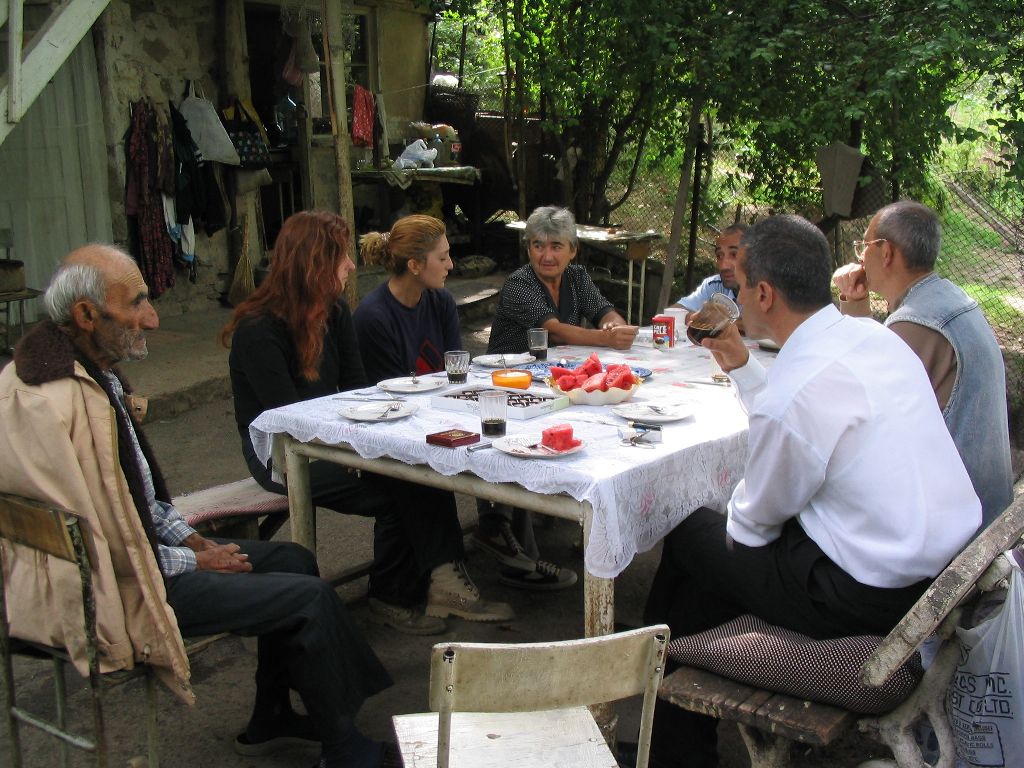
(biainili-urartu.de) Die Forschungen im Jahre 2003 konzentrierten sich auf noch nicht bereiste Regionen
in Sisian, Goris, Kapan und Meghri. Teilnehmer von deutscher Seite
waren Stephan Kroll und Esther Altmann, Teilnehmer von armenischer
Seite waren Pavel Avetisyan und Iren Kalantaryan. Wissenschaftliches
Programm der Reise 2004 war es, in Erevan im Nationalmuseum und
im Institut für Archäologie und Ethnographie Aufzeichnungen
und Funde zu studieren, die Süd-Armenien betrafen. Teilnehmer
von armenischer Seite waren Pavel Avetisyan, Ruben Badalyan, Nora
Yengiburyan und Iren Kalantaryan.
Die Durchführung
des wissenschaftlichen Programms ist folgenden Personen zu danken:
Prof. Aram Kalantaryan (Institut für Archäologie und Ethnographie der Armenischen Akademie der Wissenschaften), Dr.
Ruben Vardaryan (Nationalmuseum), Dr. Gagik G. Gyurdgyan (Kommission
für Erhaltung der Historischen und Kulturellen Denkmäler
in Erevan), seinem Vertreter in Kapan Vigen Tsotoniyan und den Mitarbeitern
im Museum Kapan, insbesondere Grischa Smbatyan und Satenik Martirosyan.
Die einzelnen Befunde werden hier in Folge vorgestellt
- Tombs-Burials
- Finds
- Kapan Museum
- Kapan Private Collections
- Goris Museum
- Sisian Museum
- Stepanakert Museum
- Bibliography
WISSENSCHAFT: Forscher dokumentieren Felsmalerei in Armenien. Von Von Gregor Klaudius, dpa (suedkurier.de)
(suedkurier.de) Das Forschungsprojekt ist aufwendig und ungewöhnlich: Archäologen aus Sachsen-Anhalt haben es sich zur Aufgabe gemacht, weltweit einzigartigen Felsmalereien in Armenien zum Weltkulturerbe-Titel der Unesco zu verhelfen.
Die Wissenschaftler um den Direktor des Landesamtes für Archäologie, Harald Meller, dokumentierten bislang etwa 500 von tausenden aus der Bronzezeit stammende Felsmalereien. Erstmals zeigt das Landesamt Fotos der Forschungsergebnisse in einer Ausstellung in Berlin.
«Das Weltkulturerbe bekommt man schwer, aber die armenischen Felsmalereien haben gute Chancen», sagt Meller in Halle. Sein Team aus 15 Vermessungsingenieuren, Archäologen und Grabungstechnikern hatte im vergangenen Sommer die Felsbilder von Ughtasar im armenischen Hochland erstmals leibhaftig in Augenschein genommen. Auf Höhen von 2000 bis 3500 Metern erforschten die Wissenschaftler 40 Hektar einer erloschenen Vulkanlandschaft, die aus tausenden Basaltbrocken besteht. Auf vielen der dunklen Gesteinsbrocken fanden sie bronzezeitliche Felsmalereien etwa von Steinböcken, Leoparden, Kriegern, Bären oder Ziegen.
Was die Bilder so einzigartig macht, ist nicht nur ihre hohe Anzahl, die über mehrere Jahrhunderte entstanden sein muss. «Die Tiere und Menschen sind sehr eindeutig aufs Charakteristische beschränkt», erklärt Sachsen-Anhalts Chefarchäologe. Die 4000 Jahre alten Felsmalereien seien sowohl gestalterisch wie auch handwerklich gekonnt in Szene gesetzt und gut erhalten.
Mit einem ferngesteuerten Mini-Helikopter haben die Experten das Gebiet in vier Wochen vermessen und fotografiert. Die Fundstätte war zwar seit Jahrzehnten bekannt, doch den Armeniern fehlte die Technik für die Erforschung. Und die Bemühungen britischer Wissenschaftler der Universität Reading reichten nicht aus, um dem Ziel rasch näher zu kommen, zum Weltkulturerbe zu gehören.
Also vereinbarten Armenien und Sachsen-Anhalt ein gemeinsames Forschungsprojekt. Sachsen-Anhalt vertritt Deutschland seit dem Jahr 1996 bei der kulturellen Zusammenarbeit. Grundlage ist ein Kulturabkommen der Bundesrepublik mit der Republik Armenien. Laut Sachsen-Anhalts Kultusministerium kooperieren das Landesamt und die Wissenschaftliche Akademie Armeniens seit dem Jahr 2008 eng miteinander bei archäologischen und Denkmalschutzprojekten. Neben den Felsmalereien von Ughtasar gehören prähistorische Goldbergwerke und rätselhafte Steinanhäufungen zu den Projekten der deutschen Forscher in Armenien.
Wenn alles klappt, will Armenien mit Hilfe der Sachsen-Anhalter binnen der nächsten zehn Jahre den Weltkulturerbe-Titel beantragen. «Dazu müssen die zentralen Fragen beantwortet werden, was es alles für Motive gibt und wie sie zueinander stehen», sagt Meller. Bislang seien die Archäologen mit Deutungen der Motive noch sehr zurückhaltend, weil der Bestand zunächst weiter erforscht werden müsse. Meller schätzt, dass sein Team bei einem erneuten Projekt in diesem Sommer noch einmal mehr als 500 Felsmalereien dokumentieren wird.
Die Aussichten auf den Weltkulturerbe-Titel für das armenische Hochland an der Grenze zu Aserbaidschan bewertet Meller als «sehr gut, weil die Felsmalereien wissenschaftlich hoch bedeutsam» seien. Grundvoraussetzung für den Titel sei eine wissenschaftliche Dokumentation der Bilder. Die Unesco als Organisation der Vereinten Nationen verleiht den Titel Weltkulturerbe an Orte, die wegen ihrer Einzigartigkeit, Authentizität und Integrität als weltbedeutend gelten. Vorgeschlagen werden die Stätten von den Staaten, in denen sie liegen.
«Armenien hat sicher gute Chancen auf den Welterbetitel, weil es in dieser Region im Gegensatz zu Europa oder den USA noch nicht viele Welterbestätten gibt», sagt Doris Hartmann vom Lehrstuhl für Materielles und Immaterielles Kulturerbe der Universität Paderborn. Für einen Welterbe-Antrag sei allerdings viel Vorarbeit notwendig, um die Besonderheiten einer Stätte herauszustellen. Die Unesco fordere sehr umfangreiche Anträge. Es gebe bereits mehrere Welterbestätten mit Felsmalereien, beispielsweise in Frankreich oder Spanien. Dass nun die armenischen Felsbilder wissenschaftlich aufgearbeitet würden, sei ein gutes Anliegen, meint Hartmann.

In einer Ausstellung unter dem Titel «Bilder für die Ewigkeit - Petroglyphen im Hochland Armeniens» im Auswärtigen Amt, das die Projektkosten größtenteils trägt, sind nun erstmals Fotos von den Felsmalereien und Forschungsarbeiten zu sehen. Die prähistorische Felskunst in den Jahrtausende alten Bergsteppen sei ein wesentlicher Teil des kulturellen Erbes Armeniens, sagt eine Sprecherin des Auswärtigen Amtes in Berlin. Zudem sei diese Bilderwelt im Gegensatz zu vielen mitteleuropäischen Felsbildregionen, die seit Jahren zum Welterbe der Unesco zählten, bis heute nahezu unbekannt.
Austellung: Auswärtiges Amt, Lichthof, Werderscher Markt 1, 10117 Berlin
Die Ausstellung kann vom 21.05. bis zum 12.06.2013, wochentags von 10 bis 18 Uhr, besichtigt werden. Der Eintritt ist frei.
Mehr Links:
Felsmalereien: Das geheimnisvolle Freilichtmuseum von Ughtasar (spiegel.de)
Die einzigartigen Bilder von Ughtasar (n24.de)
Ughtasar Petroglyphs (armeniapedia.org)
Armenische Auszeichnung für Sachsen-Anhalts Landesarchäologen (hallespektrum.de)
Mehr zu den Petroglyphen (wikipedia.org)
Die Wissenschaftler um den Direktor des Landesamtes für Archäologie, Harald Meller, dokumentierten bislang etwa 500 von tausenden aus der Bronzezeit stammende Felsmalereien. Erstmals zeigt das Landesamt Fotos der Forschungsergebnisse in einer Ausstellung in Berlin.
«Das Weltkulturerbe bekommt man schwer, aber die armenischen Felsmalereien haben gute Chancen», sagt Meller in Halle. Sein Team aus 15 Vermessungsingenieuren, Archäologen und Grabungstechnikern hatte im vergangenen Sommer die Felsbilder von Ughtasar im armenischen Hochland erstmals leibhaftig in Augenschein genommen. Auf Höhen von 2000 bis 3500 Metern erforschten die Wissenschaftler 40 Hektar einer erloschenen Vulkanlandschaft, die aus tausenden Basaltbrocken besteht. Auf vielen der dunklen Gesteinsbrocken fanden sie bronzezeitliche Felsmalereien etwa von Steinböcken, Leoparden, Kriegern, Bären oder Ziegen.
Was die Bilder so einzigartig macht, ist nicht nur ihre hohe Anzahl, die über mehrere Jahrhunderte entstanden sein muss. «Die Tiere und Menschen sind sehr eindeutig aufs Charakteristische beschränkt», erklärt Sachsen-Anhalts Chefarchäologe. Die 4000 Jahre alten Felsmalereien seien sowohl gestalterisch wie auch handwerklich gekonnt in Szene gesetzt und gut erhalten.
Mit einem ferngesteuerten Mini-Helikopter haben die Experten das Gebiet in vier Wochen vermessen und fotografiert. Die Fundstätte war zwar seit Jahrzehnten bekannt, doch den Armeniern fehlte die Technik für die Erforschung. Und die Bemühungen britischer Wissenschaftler der Universität Reading reichten nicht aus, um dem Ziel rasch näher zu kommen, zum Weltkulturerbe zu gehören.
Also vereinbarten Armenien und Sachsen-Anhalt ein gemeinsames Forschungsprojekt. Sachsen-Anhalt vertritt Deutschland seit dem Jahr 1996 bei der kulturellen Zusammenarbeit. Grundlage ist ein Kulturabkommen der Bundesrepublik mit der Republik Armenien. Laut Sachsen-Anhalts Kultusministerium kooperieren das Landesamt und die Wissenschaftliche Akademie Armeniens seit dem Jahr 2008 eng miteinander bei archäologischen und Denkmalschutzprojekten. Neben den Felsmalereien von Ughtasar gehören prähistorische Goldbergwerke und rätselhafte Steinanhäufungen zu den Projekten der deutschen Forscher in Armenien.
Wenn alles klappt, will Armenien mit Hilfe der Sachsen-Anhalter binnen der nächsten zehn Jahre den Weltkulturerbe-Titel beantragen. «Dazu müssen die zentralen Fragen beantwortet werden, was es alles für Motive gibt und wie sie zueinander stehen», sagt Meller. Bislang seien die Archäologen mit Deutungen der Motive noch sehr zurückhaltend, weil der Bestand zunächst weiter erforscht werden müsse. Meller schätzt, dass sein Team bei einem erneuten Projekt in diesem Sommer noch einmal mehr als 500 Felsmalereien dokumentieren wird.
Die Aussichten auf den Weltkulturerbe-Titel für das armenische Hochland an der Grenze zu Aserbaidschan bewertet Meller als «sehr gut, weil die Felsmalereien wissenschaftlich hoch bedeutsam» seien. Grundvoraussetzung für den Titel sei eine wissenschaftliche Dokumentation der Bilder. Die Unesco als Organisation der Vereinten Nationen verleiht den Titel Weltkulturerbe an Orte, die wegen ihrer Einzigartigkeit, Authentizität und Integrität als weltbedeutend gelten. Vorgeschlagen werden die Stätten von den Staaten, in denen sie liegen.
«Armenien hat sicher gute Chancen auf den Welterbetitel, weil es in dieser Region im Gegensatz zu Europa oder den USA noch nicht viele Welterbestätten gibt», sagt Doris Hartmann vom Lehrstuhl für Materielles und Immaterielles Kulturerbe der Universität Paderborn. Für einen Welterbe-Antrag sei allerdings viel Vorarbeit notwendig, um die Besonderheiten einer Stätte herauszustellen. Die Unesco fordere sehr umfangreiche Anträge. Es gebe bereits mehrere Welterbestätten mit Felsmalereien, beispielsweise in Frankreich oder Spanien. Dass nun die armenischen Felsbilder wissenschaftlich aufgearbeitet würden, sei ein gutes Anliegen, meint Hartmann.

In einer Ausstellung unter dem Titel «Bilder für die Ewigkeit - Petroglyphen im Hochland Armeniens» im Auswärtigen Amt, das die Projektkosten größtenteils trägt, sind nun erstmals Fotos von den Felsmalereien und Forschungsarbeiten zu sehen. Die prähistorische Felskunst in den Jahrtausende alten Bergsteppen sei ein wesentlicher Teil des kulturellen Erbes Armeniens, sagt eine Sprecherin des Auswärtigen Amtes in Berlin. Zudem sei diese Bilderwelt im Gegensatz zu vielen mitteleuropäischen Felsbildregionen, die seit Jahren zum Welterbe der Unesco zählten, bis heute nahezu unbekannt.
Austellung: Auswärtiges Amt, Lichthof, Werderscher Markt 1, 10117 Berlin
Die Ausstellung kann vom 21.05. bis zum 12.06.2013, wochentags von 10 bis 18 Uhr, besichtigt werden. Der Eintritt ist frei.
Mehr Links:
Felsmalereien: Das geheimnisvolle Freilichtmuseum von Ughtasar (spiegel.de)
Die einzigartigen Bilder von Ughtasar (n24.de)
Ughtasar Petroglyphs (armeniapedia.org)
Armenische Auszeichnung für Sachsen-Anhalts Landesarchäologen (hallespektrum.de)
Mehr zu den Petroglyphen (wikipedia.org)
Thursday, January 03, 2013
VIDEO: Ein 5000 Jahre altes Goldbergwerk in Georgien (საყდრისი) (youtube.com)
Georgien: Goldrausch im Kaukasus
31.07.2008
Von Heiko Schwarzburger
(tagesspiegel.de) Deutsche Forscher suchen in Georgien nach dem Goldenen Vlies – und finden ein 5000 Jahre altes Bergwerk.
 Es war eine Sensation: Im Jahr 2004 entdeckte ein deutsch-georgisches Forscherteam bei Grabungen im Vorkaukasus ein 5000 Jahre altes Goldbergwerk. „Wir wussten, dass die Kupferverarbeitung in dieser Gegend bis ins fünfte Jahrtausend vor der Zeitenwende zurückreicht“, sagt Thomas Stöllner, Forscher am Bergbaumuseum in Bochum und zugleich Professor für Ur- und Frühgeschichte an der Ruhr-Universität. „Aber dass wir eine so alte Goldmine finden würden, das hat uns alle überrascht.“
Vor wenigen Tagen sind die Wissenschaftler zu einer neuen Grabungskampagne aufgebrochen, um die unterirdischen Stollen und die oberirdischen Anlagen miteinander zu verbinden.
„Das ist ein wichtiger Schritt, um das Bergwerk als Ganzes zu präsentieren“, sagt Stöllner. Außerdem will er mit seinem Team ein Bergarbeiterdorf in der Nähe der Grube ans Licht holen. Die Siedlung ist ungefähr einen Kilometer von der Mine entfernt und rund 60 Hektar groß.
Im vergangenen Jahr hatten die Forscher im georgischen Sand ein Haus entdeckt, in dem sich große Mahlsteine befanden – offenbar Werkzeuge, mit denen die einstigen Bewohner des Kaukasus Gold aus dem Gestein herauslösten. Und in den Ruinen stießen sie auf große Mengen goldhaltigen Sand, die den Zweck der Siedlung eindeutig offenbarten. „Allerdings fanden wir in älteren Gräbern keine Beigaben aus Gold“, berichtet der Archäologe. „3000 vor Christus war das Edelmetall offenbar nur für herausragende Anlässe oder in anderen Regionen als Schmuck von Bedeutung.“ Schon seit 2003 sind die Wissenschaftler auf den Spuren des Sagen umwobenen Goldenen Vlieses unterwegs. In der griechischen Mythologie wird damit das Fell des goldenen Widders Chrysomeles bezeichnet, der fliegen und sprechen konnte. Als die Bewohner der Region Kolchis am unteren Rioni-Fluss im heutigen Georgien den Widder bei einem Tempelritual opferten, zogen sie ihm das goldene Fell ab. Das Vlies wurde später von den Argonauten geraubt. Ganz in der Nähe, in Sakdrissi, rund 50 Kilometer südwestlich der georgischen Hauptstadt Tiflis, fanden die Forscher um Stöllner das Goldbergwerk aus der Bronzezeit. Sie untersuchten organisches Material aus den Stollen auf bestimmte Isotope, deren Zerfallsgeschwindigkeit bekannt ist. Anhand des Mengenverhältnisses dieser Atomsorten datierten sie die Erzgrube auf 5000 Jahre. Somit dürfte sie das älteste Goldbergwerk im festen Gestein in der Alten Welt sein.
„Die alten Erzgänge sind leer“, sagt Stöllner. Er habe jedoch Spuren gefunden, die vermuten lassen, dass erst kürzlich Menschen dort waren, um das Edelmetall zu suchen. Gold ist derzeit auf dem Weltmarkt so teuer wie nie zuvor, es wird mit gut 900 US-Dollar je Feinunze gehandelt. „In Sakdrissi muss man aber sehr genau wissen, wo man suchen muss“, sagt Stöllner und schmunzelt. „Laien werden dort nichts finden.“
Den Bochumer Forscher zieht es aber nicht des Goldes wegen in den Kaukasus. Sein Interesse gilt der Archäometallurgie, die sich mit der Erforschung uralter Bergbaugebiete und Verarbeitungstechniken beschäftigt. Um etwa die Herkunft von Metallen zu bestimmen, untersucht Stöllner Schmuckstücke oder Waffen mit modernen Methoden der Ingenieurwissenschaften und der Werkstoffforschung.
Manchmal dauert es lange, bis sich der Erfolg einstellt. Der Weg nach Georgien führte die Wissenschaftler zunächst über den Nahen Osten. „Wir hatten jahrelang in Israel und in Jordanien nach Kupfervorkommen gesucht, die schon im vierten Jahrtausend vor Christus ausgebeutet wurden“, sagt Andreas Hauptmann vom Bergbaumuseum Bochum. „Für unsere Forschungen haben wir unter anderem den Jüdischen Nationalschatz analysiert – rund 400 wunderbare Metallobjekte.“ Dabei stießen sie auf Legierungen aus Kupfer, Antimon und Arsen, bei denen nicht klar war, woher die Metalle kamen. Aus den nächst gelegenen Bergwerken jedenfalls nicht. Die Überlegungen der Experten richteten sich bald auf den Kaukasus. Mitte der neunziger Jahre machte sich Hauptmann auf nach Tiflis.
Es begann ein Wettrennen gegen die Zeit. Denn infolge der rasanten Veränderungen nach dem Zerfall der Sowjetunion gelangten auch in Georgien weite Landstriche unter die Kontrolle großer Bergbaukonzerne, die verschiedene Erze in großflächigen Tagebauen abbauen. Spuren früheren Lebens drohten unwiederbringlich zerstört zu werden. Auch das alte Goldbergwerk in Sakdrissi befand sich auf dem Gelände einer Minengesellschaft und war von den Baggern bedroht. „Es ist uns gelungen, das Bergwerk unter Denkmalschutz zu stellen“, sagt Irina Gambaschidse vom Otar-Lordkipanidse-Institut, die die Grabungen von georgischer Seite aus leitet. Bei der Bergarbeitersiedlung aus dem vierten Jahrtausend vor Christus kämpfen die Wissenschaftler noch um diesen Status. „Es würde uns schon helfen, wenn wenigstens ein Teil der Anlage geschützt würde“, sagt sie.
Ergänzt werden die Arbeiten in Sakdrissi durch Studien zu frühbronzezeitlichen Siedlungen in der Region. Zudem untersuchen Mitarbeiter des georgischen Nationalmuseums die Land- und Viehwirtschaft des dritten Jahrtausends vor Christus in der Region, um ein umfassendes Bild der Lebensweise der Kaukasier in jener Zeit zu erhalten. Parallel dazu sammeln deutsche und georgische Wissenschaftler Erzproben und goldene Artefakte unmittelbar aus den Goldvorkommen sowie aus den Beständen der georgischen Museen. Auch deren Herkunft wird in Deutschland analysiert.
Dabei stehen die Wissenschaftler vor einigen Herausforderungen. Denn anders als bei Kupfer lässt sich die Herkunft des Goldes nur schwer ermitteln. Kupferkelche und kupferne Schüsseln bestehen meist aus metallischen Legierungen, dessen Kupferanteil aus einer einzigen Lagerstätte stammt. Je nachdem, wo sich diese befindet, weist die Kupferlegierung ganz bestimmte geochemische Eigenschaften auf. Dadurch lassen sich Rückschlüsse auf den Ursprungsort ziehen.
Bei Gold ist es komplizierter. Auch wenn das Edelmetall in Sakdrissi aus festem Gestein gelöst wurde, die größten Mengen wurden seinerzeit aus Flüssen gewaschen, die sich wiederum aus etlichen Zuläufen, wie Nebenflüssen, Bächen und Rinnsalen speisten. Auf diese Weise wurden die Edelmetalle aus teilweise entfernten Lagerstätten miteinander vermischt. „Dadurch verwischt der geochemische Fingerabdruck, und das erschwert die regionale Zuordnung des Goldes“, sagt Andreas Hauptmann.
Erst seit wenigen Jahren ist es möglich, die chemische Zusammensetzung von Gold genau zu erfassen und damit eine Herkunftsanalyse zu wagen. Dazu wollen Mineralogen von der Universität Frankfurt am Main noch weitere Elemente analysieren, die in winzigen Mengen an dem Gold haften. Mit den Ergebnissen, so hoffen Stöllner und seine Kollegen, können sie die dunklen Pfade des kaukasischen Goldes weiter erhellen.
+++
Mehr Infos:
Tuesday, October 23, 2012
VIDEO: Khvamli cave-castle ხვამლის ციხე-- ქვაბული 4 (youtube.com)
The film is about archaeological expedition led by archaeologist Guram Gabidzashvili in May-October 2007 to study rocky range of Khvamli massive and a cavernous fortress. This cavernous fortress was Georgian kings' treasure house in the Middle Ages. It is mentioned in the chronicle of "Life of Kartli". According to the film authors the Khvamli rock is right the place where Prometheus was chained and where golden fleece was kept.
Director: Davit Goguadze
Screenplay: Davit Goguadze
Directors of Photography: Gorgaslan Khaindrava, Nika Lebanidze, Tato Kotetishvili, Jaba Kldiashvili
Production Design: Davit Goguadze
Sound: Malkhaz (Makho) Sichinava
Editing: Malkhaz (Makho) Sichinava
Producer: Amiran Svimonishvili
ფილმი გვიამბობს არქეოლოგიური ექსპედიციის შესახებ, რომელიც არქეოლოგ გურამ გაბიძაშვილის ხელმძღვანელობით ხვამლის კლდოვანი მასივისა და კლდეში არსებული ციხე-ქვაბულის შესასწავლად მოეწყო 2007 წლის მაის-ოქტომბერში. ეს ციხე-ქვაბული შუა საუკუნეებში ქართველ მეფეთა განძთსაცავს წარმოადგენდა, ის "ქართლის ცხოვრებაშიც" არის მოხსენიებული. ფილმის ავტორთა აზრით, სწორედ ხვამლის კლდე არის ის ადგილი, სადაც უძველესი მითების მიხედვით პრომეთე იყო მიჯაჭვული და სადაც ოქროს საწმისი ინახებოდა.
დამდგმელი რეჟისორი: დავით გოგუაძე
სცენარის ავტორი: დავით გოგუაძე
დამდგმელი ოპერატორები: გორგასლან ხაინდრავა, ნიკა ლებანიძე, ტატო კოტეტიშვილი, ჯაბა კლდიაშვილი
დამდგმელი მხატვარი: დავით გოგუაძე
ხმის ოპერატორი: მალხაზ (მახო) სიჭინავა
მემონტაჟე: მალხაზ (მახო) სიჭინავა
პროდიუსერი: ამირან სვიმონიშვილი
Saturday, September 29, 2012
RESEARCH: Presentation of the Regional Scholarship Programme in Yerevan (ge.boell.org)
 (ge.boell.org) Since 2003, the Heinrich Böll Foundation has run a yearly “on site” scholarship programme for up-and-coming academics in the social sciences from all South Caucasus nations. The researchers (maximum age 35) work at their home places on individual interdisciplinary projects in the fields of contemporary history, politics, gender, critical sociology and sustainable urban development.
The scholarship program is orientated expressly at social science research in the South Caucasus.
It endeavors to:
support young social scientists in carrying out individual and interdisciplinary research;
enact a methodological and substantive renewal of the study of history and social sciences in the South Caucasus; promote regional cooperation among young academics in the South Caucasus.
This year, the Heinrich Böll Foundation South Caucasus Regional Office announces a call for applications for obtaining funding for research projects in 2013. In this regard, the Foundation is pleased to invite interested young researchers and representatives of civil society in Armenia to the presentation of its Regional Scholarship Programme in Yerevan on Wednesday, 3 October, 2012, at 18:00.
Address: 15, Charents str., Yerevan (Library of the Institute of Archeology and Ethnography of the National Academy of Sciences of Armenia)
Friday, September 07, 2012
RESTORATION: Bagrati Cathedral – Copy or Original? By Author Irina Bagauri (en.tabula.ge)
 (tabula.ge) "The authenticity of the Cathedral has been irreversibly destroyed. Bagrati Cathedral can no longer be said to contribute to the criterion for which the property was inscribed on the World Heritage List,” reads a preliminary “state of conservation” report prepared for the Thirty-Sixth Session of the UNESCO World Heritage Committee. The ancient Georgian monument is in serious jeopardy of losing its World Heritage status because of “irreversible interventions as part of major reconstruction of the structure of Bagrati Cathedral,” according to the preliminary assessment.

Specifically, the World Heritage Committee has expressed “extreme concern that a reconstruction of Bagrati Cathedral is already well advanced, largely in line with plans, rejected by the Committee at its 34th session, for a monumental re-building using reinforced concrete, including a cast concrete cupola, and installing stone facing that covers much of the original stonework.”
Nika Vacheishvili, the Director General of the National Agency for Cultural Heritage Preservation of Georgia, strongly disputes the preliminary conclusions drawn by UNESCO. He insists that the UNESCO assessment is based on incorrect information provided by experts who had not conducted a thorough study of the monument. Speaking with Tabula, Vacheishvili offered his own assessment of both the UNESCO preliminary opinion and the work completed at Bagrati Cathedral:
"That opinion, in my view, is very incompetent. Even though we tried to show every facet to an expert from the International Council on Monuments and Sites (ICOMOS) and to avoid superficial discussions regularly provided him with materials, the expert still arrived in Georgia unprepared and, therefore, the [UNESCO] document is riddled with mistakes. We have reacted to that, having sent a letter to the relevant entity. We expect that the one-sidedness that exists today will be balanced and the situation will be brought in line with the reality.
“Many things in the opinion have been regrettable lies. I do not know what turned that person blind. Those four hundred stones, which we had discovered during these recent years and found place for each of them, are not just abandoned but are being installed to the places they belonged originally. Openings in the dome, the width of the dome, the number and form of arches are documented with these very stones. It is therefore a pity that such competent organizations have drawn such incompetent conclusions. There have been instances, however, when UNESCO has disagreed with ICOMOS opinions and I hope that the case of Bagrati will be such an instance.
 “Bagrati is a very complex project and, the closer the reconstruction comes to its completion, the more convinced I become that we have embarked on the correct path; that is, a balance between the old and the new. We have smaller modern inserts which reflect the Twenty-First Century, thus avoiding sham replication of the old. There, both old and modern are appreciated. And all that is combined in the fabric of the Cathedral.”
Modern inserts imply a glass lift. For some unknown reason, the existence of this object within the religious space has caused exaggerated concern among people interested in the fate of the Cathedral even though the UNESCO opinion itself says nothing extraordinary about the glass lift. Instead, the preliminary assessment is focused mainly on other more conspicuous interventions. In comments to media, architectural restorers and art critics alike have confirmed the fact that the glass lift is the least alarming problem among interventions endangering the authenticity of the Cathedral. In order to facilitate the movement of handicapped and elderly people, lifts, like wheelchair ramps, are considered desirable in buildings of any type or age. However, in the case of Bagrati Cathedral, questions have been raised about the engineering design which envisaged installation of the lift on the façade. Whether that design was prompted by the necessity to make lift access conspicuous or just to add yet another element of décor is a topic of separate discussion.
According to modern restoration theory formulated by Italian art historian Cesare Brandi, a ruin that is part of a monument of cultural heritage represents an independent work of art whereas the entire reconstruction of a building in ruins is merely a copy of an authentic building and is not justifiable either esthetically or historically.
The initiative to reconstruct Bagrati Cathedral originated with the Georgian Patriarchate. At the request of the Georgian Patriarch, discussions on the full reconstruction of Bagrati started in the 1990s. On 21 January 2008, Georgian President Mikheil Saakashvili chose Bagrati Cathedral as the site of his inauguration for a second term. There, the President addressed the nation after his swearing-in, declaring: “We are completing the ceremony and starting to rebuild Georgia. As a symbol of Georgia’s revival and strength, we pledge – with the blessing and supervision of the Patriarch as well as with the best specialists – to start restoration works on Bagrati in the forthcoming weeks.”
This year, President Saakashvili responded publicly to criticism that erupted following ongoing reconstruction work at the Cathedral. Speaking at the 26 May inauguration ceremony of the new Georgian Parliament building in Kutaisi, the President remarked: “Many people kept telling me that the reconstruction of the Bagrati Cathedral was barbarism, that no one reconstructed the Acropolis in Greece. I think, though, that Bagrati was built for people to pray there and now it must be restored for modern Georgians to pray there as well.”
Nika Vacheishvili, in his interview with Tabula, addressed the question of whether responsible people have to make a choice between the symbolism of the Cathedral and its authenticity:
“I want to specify that the entire authenticity is preserved. Anyone who will go to the Bagrati Cathedral will see that the main glory of the Cathedral comes from the Eleventh not the Twenty-First Century. That is that nuance which has been thoroughly observed in the project. UNESCO is a very respectable organization. But, when you are one-hundred percent sure that you meet all the criteria which is certified by national as well as by renowned international experts, I think you would agree with me that we could not stay inactive for the threat of hypothetical criticism, especially taking into account the reality that the Cathedral was on the verge of perishing. Bagrati is a national symbol of unity and it would be incorrect to preserve it in the form of ruins. Therefore, instead of just being on the UNESCO World Heritage List, it is better to make something innovative that would become an example for others. And I am sure that UNESCO will appreciate that risk. So far, it has maintained that cathedrals should not be touched but only preserved. This project, however, has shown that there is a solution between the preservation of antiquity, the restoration of a cathedral and the maintenance of it as a church.”
Tabula also contacted Andrea Bruno, the Italian architect in charge of restoration of Bagrati. In Bruno’s view, the plan of Bagrati rehabilitation – the largest part of which was drawn up by Georgian architect Ivane Gremelashvili – is “innovative” and in line with modern standards. As Bruno explained:
 “The Bagrati Cathedral and the entire adjacent area, which have been distinguished for its construction stratigraphy for centuries, represent a synthesis of material and non-material values of certain importance. That treasury is acknowledged by international bodies and included in the World Heritage List. An innovative project which is being implemented on the left wing of the construction enables the reconstruction of a gallery which will house a museum in the future. Archeological items and photos of construction of the Cathedral displayed there will allow visitors to get acquainted with the history of Georgia from that angle.
“That project was presented from the very beginning as an innovative gesture in restoration, focused on identifying values of earlier structures and simplifying the reading of palimpsest of the Cathedral. I believe that after the completion of ongoing works, cultural and creative values of the Cathedral and its entire area will be shown more conspicuously.
“My creative plan, which I started to develop in January 2011 along with restoration interventions, involves the identification and study of values of the construction and that part which lies within the adjacent entire archeological area. I think that this is a necessary condition in order to fully meet the requirement of bodies in charge of preservation of cultural heritage, to increase the interest toward the monuments on the Cultural Heritage List and possibilities of determining their values. The work on these issues will start after the completion of the reconstruction process.”
The Cathedral of the Dormition, more commonly known as Bagrati Cathedral, is a monument of medieval Georgian architecture built during the reign of King Bagrat III in Kutaisi. Construction of the Cathedral started at the end of the Tenth Century and, according to the inscription discovered on the Northern façade of the Cathedral, was completed in the year 1003. The first serious damage to the Cathedral occurred during the invasion of the Ottomans in 1691, when the dome of the cathedral caved in as a result of an explosion of gunpowder. In 1770, under the order of General Gottlieb Totleben, Russian cannons fired at the Kutaisi fortress destroyed the upper part of the Cathedral. In the following centuries, the damage worsened.
In the 1950s, the restoration-conservation of the damaged monument started under the direction of Georgian architect Vakhtang Tsintsadze. The initial restoration work was divided into six stages and continued through 1994. That same year, UNESCO experts acknowledged the Bagrati Cathedral, along with the Gelati Monastery, as a World Heritage site and one of the distinguished monuments of Medieval-Age architecture.
The reconstruction work undertaken in the following years, however, has raised questions about the authenticity of the Bagrati and Gelati monuments. In 2010, both sites were demoted to the List of World Heritage in Danger. UNESCO has since repeatedly called on Georgia to halt the reconstruction. The UNESCO preliminary conservation opinion published on 1 June 2012 confirms the fears of experts that the monument may be removed from the List of World Heritage. Whether or not UNESCO will take that very drastic step should become clear during the Thirty-Sixth UNESCO session scheduled for 24 June through 6 July in Saint Petersburg. That will determine whether Georgia will preserve the reconstructed Bagrati as a historically authentic cathedral or a modern replica.
Editor’s Note: The UNESCO World Heritage Committee decided at its meeting in St. Petersburg to postpone any final resolution of the issue of Bagrati Cathedral until the year 2013. A group of international experts will arrive in Georgia in September 2012 to assess the status of the Georgian monuments on the UNESCO Cultural Heritage List.
This article first appeared in Tabula Georgian Issue # 106, published 25 June 2012.
Subscribe to:
Posts (Atom)