Showing posts with label Photoreportage. Show all posts

Wednesday, January 28, 2015

CROWDFUNDING CAMPAIGN: Lost Territories - photo project in Central Asia. By SPUTNIK PHOTOS (indiegogo.com)

(indiegogo.com) 5 photographers, 5 exciting stories from post soviet countries in Central Asia.


Lost Territories - crowdfunding campaign from SPUTNIK PHOTOS on Vimeo.

Please support this project here - indiegogo.com >>>


Who are we?

Sputnik Photos is an international collective founded in 2006 by documentary photographers from Central and Eastern Europe. We are united by a desire to observe and describe what surrounds us, as well as by our common experience of living in post-transformation countries.

Our achievements to date include important international awards, such as World Press Photo and Pictures of the Year International. Together we have organized several exhibitions around the world and published 8 photobooks. Our projects have been featured at photography festivals, in galleries and magazines worldwide. 


About our project.

We would like to invite you to support our artistic project in post-soviet countries of Central Asia. Twenty-five years after the fall of the USSR five Sputnik Photos photographers are setting out on a journey to five former soviet republics: Kazakhstan, Uzbekistan, Turkmenistan, Tajikistan and Kyrgyzstan.

For a number of years, we have been documenting changes taking place in post-communist countries, particularly in the former republics of the Soviet Union, always referring to our own individual experience of the transformation period. Recently, we have focused on Belarus, Ukraine, Moldavia, Armenia and Georgia. In the face of an increasing political tension in the region, photography documenting everyday life, and the changes and myths of the countries still falling under Russian influence, becomes even more relevant. 

Rafal Milach - from the series “Black sea of concrete.”
At the current stage, we are planning further trips to the former Soviet empire, focusing on Central Asia, and we hope you will support our efforts.

We are interested in what is happening in the countries that used to be part of the Soviet Union, and still remain under Russian influence, because their history is also our history and it concerns us directly. We are immersing ourselves in this complex and multi-faceted world. We are uncovering the nations’ nostalgia for the empire, their drive to democracy, traces of former propaganda, poverty, but also the emergence of the new and hope for a better future. We are aware that our project will give neither a diagnosis nor simple and straightforward answers to the questions relevant for the region. Yet, we want to make discoveries and show them to others. We believe that 25 years after the change is a perfect time to sum up the efforts our nations have made to date.

Your help can make it happen! 

Agnieszka Rayss - from the series "I reminesce and cry for life."
The funds raised will enable each of us to go on a single trip to one of the countries we focus on:

Kazakhstan: Agnieszka Rayss

Uzbekistan: Michał Łuczak

Turkmenistan: Rafał Milach

Tajikistan: Adam Pańczuk

Kyrgyzstan: Jan Brykczyński 

Adam Panczuk - from the sersies "I_AM_IN_VOGUE@BELARUS.BY".
The amount will cover return flights, films, their developing and scanning, accommodation and guides. In other words, a minimum that allows 5 people to make 5 independent trips and create 5 extraordinary stories. 

Jan Brykczynski - from the series "Primary forest".
The project will be rounded off in 2016 by a mobile exhibition and a photobook for audiences across the globe. It will show all the 15 countries that used to be part of the USSR. 

Michal Luczak - from the series "Spitak".
more:
sputnikphotos.com
facebook.com/sputnikphotos

Thursday, April 10, 2014

PHOTOREPORTAGE: Post-Crimea, Phantom of Armenian Separatism Haunts Georgia. By Paul Rimple and Photography by Justyna Mielnikiewicz (eurasianet.org)

Amarcum Arakyan, an ethnic Armenian, cuts the hair of Josif Petriashvili, a Georgian, in the city of Akhaltsikhe.


Slideshow with Photos are here >>>

(eurasianet.org) For many in Georgia, Russia’s annexation Crimea is reigniting fears about separatism rooted in ethnic conflict and Kremlin meddling. But now Georgians aren’t just worrying about the breakaway entities of Abkhazia and South Ossetia, they also are concerned about the loyalty of the predominantly ethnic-Armenian region of Samtskhe-Javakheti.

  While locals dismiss separatism concerns as nonsense, some say the speculation on the issue is indicative of a failure on the Georgian central government’s part to address complaints of the country’s Armenian-speaking minority in Samtskhe-Javakheti, which is roughly a three-hour drive south of the Georgian capital, Tbilisi. Officials contend progress has been made, but concede more can be done on the inclusivity issue.

A mountainous, ragtag region bordering both Turkey and Armenia, Samtskhe‐Javakheti contains roughly 250,000 ethnic Armenians; 55 percent of the region’s total population, according to Georgia’s latest census, compiled in 2002. Knowledge of the Georgian language here can run thin. At the same time, in the view of some outsiders, sympathy for Russia, which, until 2007, operated a 15,000-man base in the regional town of Akhalkalaki, can run strong.

Over the past few weeks, suspicions among Georgians about the country’s Armenian minority have risen, fueled by memories of Tbilisi’s 2008 conflict with Russia, as well as the Kremlin’s recent land-grab in Crimea. Underscoring those suspicions was the appearance of unconfirmed media reports about ethnic Armenians from Samtskhe-Javakheti allegedly applying, en masse, to receive Russian passports.

Senior Georgian government officials have denied categorically these reports, but, as Russia-Ukraine tension threatens to boil over, such media coverage, condemned as sensationalism by three local watchdog groups, could well continue. “Somebody is interested in stirring up the water,” commented Seda Melkumian, the Samtskhe‐Javakheti representative for the Ombudsman’s Office. “So far, I haven’t met one person with a Russian passport.”

Interethnic suspicion stems from a long-time tug-of-war over greater language rights for the region’s Armenian speakers; for some Georgians, it’s a campaign reminiscent of ethnic Russians’ complaints in Crimea.

But residents adamantly deny that such a struggle could encourage them to break with Tbilisi. “We aren’t separatists,” asserted Melik Raisian, a former member of the ruling Georgian Dream coalition from Akhalkalaki. “We are Georgian citizens. Why do we always have to prove we’re not separatists for wanting our rights?”

The separatist perception is generally connected to the United Javakh Democratic Alliance (“Javakh”), a nationalist movement that has called for political autonomy in the past. Many of the movements’ key members, including leader Vahag Chakhalian, were arrested in 2008 following a fatal bombing near the home of a police chief in the town of Akhalkalaki. Chakhalian was released in 2013 as part of Georgia’s mass amnesty of prisoners.

Javakh has little influence today, although many can identify with its grievances. The 2007 closure of Akhalkalaki’s Russian army base left many locals unemployed; as of 2012, the official unemployment rate stood at 7.5 percent. Many had hoped to find work on the Kars–Tbilisi–Baku railway, which goes through Javakheti, yet few have been employed.

The lack of economic opportunities drives many residents to Russia for work. Melkumian estimates that about half of Javakheti’s families have some family member in Russia. “In the villages, every family has somebody there,” she said.

That situation, though, is no different from elsewhere in Georgia, noted Ewa Chylinski, director of the European Center for Minority Issues in Tbilisi. As of this January, the Russian Federation ranked as the largest source of Georgia’s remittances, roughly $46.6 million in 2013, according to the National Bank of Georgia.

Nonetheless, the money trail does not mean a desire for independence. Chylinski rejected the notion of a separatist threat in Javakheti as “groundless.” The main problem is not autonomy, but language, she said. People cannot participate in Georgian society if they do not speak Georgian.

But for many in Samtskhe-Javakheti, that does not affect their identification with Georgia. “I’m Armenian, but I was born in Georgia. My father was born in Georgia. His father was born in Georgia and I will live in Georgia,” declared octogenarian Artush Artkopian, speaking via a teenage translator in Armenian since his knowledge of Georgian and Russian is limited.

Last year, Akhalkalaki's local council announced plans to petition the Georgian parliament to ratify the European Charter for Regional of Minority Languages, a Council of Europe convention that would make Armenian an official local language for Samtskhe-Javakheti. Getting no support in Tbilisi, where opposition from the Georgian Orthodox Church and politicians runs strong, the matter was soon dropped.

The central government, though, has taken some concrete steps to increase knowledge of Georgian. In 2010, the Ministry of Education established a program, called the “4 + 1” system,” which established a 5-percent quota for ethnic minorities in Georgian universities. Minority applicants to four-year higher educational facilities take an entrance exam in their own language, as well as an intensive one-year Georgian-language course.

Shorena Tetvadze, director of the Akhalkalaki branch of the Zurab Zhvania School of Public Administration, deems the program a success. After six years of 4 + 1, 130 ethnic Armenians graduated from Georgian universities in 2013, compared with only two in 2006, she said.

Akhalkalaki’s five grammar schools all teach Georgian, a policy the State Ministry for Reconciliation and Civic Equality calls a relative success. Three are Armenian-language schools, one is Russian and the other a Georgian school, with an enrollment of 120. Tetvadze, who is half ethnic Armenian, thinks more parents would enroll their children in the Georgian school if they did not fear assimilation. But 45 kilometers north of Akhalkalaki, in the ethnically mixed regional seat of Akhaltsikhe, 68-year-old barber Ambarcum Arakian dismissed that concern.

“Here, we’re all natives. The Georgians know Armenian and the Armenians know Georgian,” Arakian emphasized. He added that his grandson is attending university via the 4+1 program, and his granddaughter is going to a Georgian-language kindergarten “so she will know Georgian better.”

“I’m not afraid of assimilation,” he said. “We won’t lose our culture.” 

Editor's Note: Paul Rimple is a freelance reporter based in Tbilisi. Justyna Mielnikiewicz is a freelance photojournalist also based in Tbilisi.

Saturday, February 01, 2014

FEATURE: Sochi. By Alexander Gronsky (ruigphotography.com)

(ruigphotography.comAs we count down the days to the Winter Olympic Games held this year in the Black Sea resort of Sochi, INSTITUTE artist Alexander Gronsky has been observing Russia putting the finishing touches on the resort, the ice rinks, the toboggan runs, the ski slopes and the athlete accommodation. The infrastructure and security is fully prepared to welcome the international competitors in the coming days.

A significant amount of security around Sochi is a stark reminder that their is an unfortunate expectation of sabotage and even terrorism. A 'ring of steel' is there to protect all visitors according to a games spokesperson.

All eyes will be looking at Russia for the next 6 weeks to pull off a memorable winter games for the able bodied and then the disabled athletes coming to compete.

click to see all the images in the series

Friday, January 17, 2014

WEBPROJECT: A Journalist's Perspective on the South Caucasus. By Onnik Krikorian


more:
onewmphoto@gmail.com 
WEB
 
onnik-krikorian.com
www.conflict-voices.net 
 
FACEBOOK 
facebook.com/onewmphoto
facebook.com/conflictvoices 
TWITTER
 
twitter.com/onewmphoto 
twitter.com/caucasusproject 

Friday, January 03, 2014

PHOTOREPORTAGE: Four Rooms. By Giorgi Amuni Shengelia (giorgi-amuni-shengelia.ideastap.com/four-rooms)

(giorgi-amuni-shengelia.ideastap.com/four-rooms) The most of Georgian familes destroy when women leave families and can't see their children and husbands. It is too hard for children to live without their mothers

Four Rooms
Khatuna, 40, 8 monthe in Italy. She is praying. She left a child in Georgia, who got married recently. Khatuna was not able to attend her child's wedding celebration.


the reportage here:  
giorgi-amuni-shengelia.ideastap.com/four-rooms

Saturday, December 28, 2013

PHOTOGRAPHY: PROMISING WATERS. By Mila Teshaieva - Reportage from the Caspian Sea (artbooksheidelberg.com)

Mila Teshaieva - Kehrerverlag Heidelberg(artbooksheidelberg.com) »Everything is great on the Caspian Sea: the expectations for future oil and gas revenues, ambitious development projects, promises and hopes. Everything is uncertain on the Caspian Sea: the fate of the environment and the direction of its people; even the status of these promising waters is as yet undefined…« Christoph Moeskes


Blättern Sie hier ...

Seit über vier Jahren dokumentiert die Fotografin Mila Teshaieva den Wandel in den drei am Ufer des Kaspischen Meers gelegenen ehemaligen Sowjetrepubliken Aserbaidschan, Kasachstan und Turkmenistan. Der Kampf um die enormen Erdöl- und Gasvorkommen und die Suche nach einer eigenen staatlichen Identität bringen tiefgreifende Veränderungen für die Bevölkerung, Umwelt und die allgemeinen Werte der Gesellschaft mit sich. Mit ihren Bildern spürt Mila Teshaieva einer Atmosphäre der Unsicherheit nach, den Hoffnungen und den Erwartungen an einen Wandel, deren Richtung indessen ungewiss bleibt. Ihre Fotoserie hinterlässt beim Betrachter offene Fragen über die Verbindungen zwischen Staat und privater Identität, zwischen Vergangenheit und Gegenwart sowie der Grenze von Aufstieg und Fall einer Region.
 

Mila Teshaieva (* 1974 in der Ukraine) lebt in Berlin. Ihre Arbeit wurde mit zahlreichen Preisen ausgezeichnet, unter anderem mit dem Prix de la Photographie Paris, dem Humanistic Prize der Phodar Biennale, dem NPPA Best of Photojournalism, sowie dem PDN Photo Annual 2013, und wurde mehrfach in Galerien und auf Festivals in ganz Europa gezeigt. Mila Teshaieva ist Gewinnerin des Photolucida Critical Mass Book Award 2012, der das Erscheinen dieses Fotobands ermöglicht.

Autoren: Christoph Moeskes, Maya Iskenderova, Mila Teshaieva
Künstler: Mila Teshaieva


www.milateshaieva.com 


Gestaltet von Ania Nałecka
Festeinband
24 x 22 cm, 120 Seiten, 52 Farbabb.
Englisch
Lieferbar
ISBN 978-3-86828-421-8
Euro 39,90
2013 

Collector’s Edition mit 2 Prints in handgefertigter Box, 3 Sets zur Auswahl, Blattformat ca. 22 x 30 cm, in einer Auflage von 75 Exemplaren, Euro 175,–

Ausgezeichnet mit dem Prädikat "Deutscher Fotobuchpreis - Nominiert 2014"


AmazonShop: Books, Maps, Videos, Music & Gifts About The Caucasus

Thursday, October 17, 2013

FOTOREPORTAGE: Abenteuerliche Seilbahn-Stadt in Georgien. Von David Mdzinarishvili (sueddeutsche.de)

A 60-year-old cable car passes above the town of Chiatura

(sueddeutsche.deDer Weg zur Arbeit, zur Schule und zum Arzt ist in der georgischen Stadt Tschiatura luftig und klapprig. Manche Strecken sind ausschließlich mit 60 Jahre alten Seilbahnen zu bewältigen. Sie wurden gebaut, als in Tschiatura noch der Mangan-Abbau florierte. Der Fotograf David Mdzinarishvili ist für diese Fotos in einer Blechbüchse über Felsen und Schluchten gefahren.

Die Stadt Tschiatura liegt 220 Kilometer nordwestlich der georgischen Hauptstadt Tiflis am Kaukasus. Wer in der Stadt herumkommen will, hat vielerorts nur zwei Möglichkeiten: Er kann steile Felswände hinaufklettern und Schluchten herunterschlittern oder mit einer der 60 Jahre alten Seilbahnen hoch über der Stadt an Drahtseilen entlang gleiten. Mut kostet auf jeden Fall beides. Denn Technik und Material wurden nie erneuert, seit die Bergbau-Industrie nicht mehr floriert. Die Seilbahnen sind ein Relikt aus der Sowjet-Ära. Sie wurden gebaut, um den Abbau von Mangan zu erleichtern. Mit diesem Metall kann zum Beispiel Stahl gehärtet werden.

Die Seilbahnen gehören zwar den Bergbauunternehmen, werden aber als öffentliche Verkehrsmittel genutzt. Mit 15 von 21 Seilbahnen für den Personenverkehr fahren Arbeiter und Bewohner bis heute. Sie überwinden teilweise Steigungen von 48 Grad. Manchmal muss dabei mit Muskelkraft nachgeholfen werden.

A commuter pushes a 60-year-old cable car in the town of Chiatura

Das Seilbahnnetz von Tschiatura wurde seit Jahrzehnten kaum baulich verändert und renoviert. Die ersten Kabinen fuhren 1954. Im Vergleich zu hochmodernen Seilbahnen sehen sie aus wie Blechbüchsen. Die Fotos machte David Mdzinarishvili im September 2013.

A 60-year-old cable car passes above the town of Chiatura

Die Bahnen werden bis heute von Hand gesteuert. Zum Beispiel von dem 32-jährigen Georgier Lasha Ghughunishvili.

Ghughunishvili operates cable cars from his booth in the town of Chiatura

Von dieser Talstation können die Bewohner von Tschiatura in drei verschiedene Richtungen fahren. Das Bild wurde während eines Stromausfalls aufgenommen - der Verkehr war vorübergehend lahmgelegt.

People pass a cable car station that is not running during a power cut in the town of Chiatura

Die Seilbahn-Routen für den Personenverkehr sind insgesamt sechs Kilometer lang. Bis heute sind sie die schnellsten und praktischsten Fortbewegungsmittel für die Bewohner. Für Gütercontainer gibt es spezielle Strecken.

A cable car passes above the town of Chiatura

Bei den meisten Seilbahnen in Tschiatura sind zwei Kabinen an einem Seil befestigt. Sie halten und bremsen sich gegenseitig. Mit Motorkraft wird eine Kabine heruntergefahren, die andere wird von deren Gewicht zeitgleich hochgezogen.

A commuter looks out from a cable car in the town of Chiatura

Selten sitzen die Bewohner von Tschiatura allein in einer Kabine. Meistens warten die Arbeiter an den Stationen, bis auf beiden Seiten drei oder vier Menschen mit der Seilbahn fahren wollen.


Erst bei genauem Hinsehen erkennt man die beiden blauen Seilbahn-Kabinen hoch über Tschiatura. Die Landschaft ist geprägt von steilen Bergen und Schluchten.Vor fünf Jahren riss das Zugseil einer Seilbahn, das Bremssystem funktionierte nicht. Mehrere Stunden lang sollen die Passagiere über der Stadt gehangen haben, bis ein Rettungstrupp aus der Hauptstadt Tiflis anrückte. Für Besucher ist jede Fahrt eine Mutprobe.

Cable cars pass above an industrial area in Chiatura

Nicht nur die Seilbahnen, auch viele Wohnhäuser in Tschiatura sind marode. Mehr als 16.000 Menschen leben in der Stadt. Einst sollen es doppelt so viele gewesen sein, die weitgehend vom Bergbau gelebt haben. Heute stehen viele Wohnungen leer. Gas- und Wasserleitungen sind teilweise verrottet.

A cable car passes above apartment buildings in the town of Chiatura

Vor der Abfahrt verschließt eine Bahnbegleiterin die Türen. Auf einigen Strecken ist die Fahrt kostenlos, auf anderen müssen die Fahrgäste ein paar Cent zahlen. Immerhin ist der Nervenkitzel mit einer Achterbahnfahrt vergleichbar.

A conductor closes the doors of a 60-year-old cable car before its departure in the town of Chiatural

Tuesday, August 20, 2013

PHOTOREPORTAGE: Georgian Monk Builds Stairway to Heaven. By Temo Bardzimashvili (eurasianet.org)

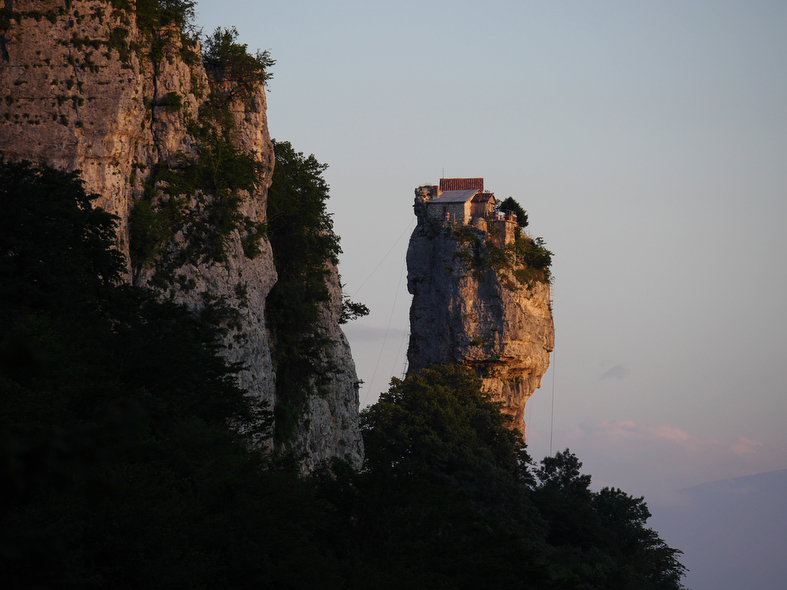
(eurasianet.org) Come summertime, getting away from it all is the dream that haunts everyone. One Georgian Orthodox monk, though, has come up with a plan for a lifetime of escape atop a 40-meter-high rock column in central Georgia’s Imereti region.

In pagan times, the towering Katskhi Pillar, located about 10 kilometers from the mining town of Chiatura, was thought to represent a local god of fertility. With the arrival of Christianity in Georgia in the 4th century, it came to represent seclusion from the hurly-burly of ordinary life.

A church was first built atop the rock between the 6th and 8th centuries -- no one knows exactly how or why. Stylites, early Christian ascetics who prayed and fasted on top of pillars, used Katskhi for their devotions until some time in the 15th century, when Georgia was struck by domestic upheaval and invasions by Ottoman Turkey. The remains of one unknown practitioner today lay buried beneath the church.

Father Maxim, a 55-year-old native of Chiatura, says that he has dreamed of living atop the Pillar, like the Stylites, since he was young. “When my friends and I used to come up here to drink outdoors, I always envied that monk who used to live there when I looked at the pillar,” he recalled.

In 1993, Father Maxim took monastic vows, and two years later decided to move to Katskhi. After spending one winter in a grotto beneath the rock column, he received money from a “friend from Tbilisi” to build a new church on its top. The Georgian Orthodox Church’s local eparchy, or regional administration, allegedly granted Father Maxim permission to erect the structure on the site.

Amidst an ongoing religious revival in Georgia, Father Maxim’s mission easily found supporters. More and more people now come to Katskhi to donate money or building materials for the church’s construction -- a generosity that makes the overall cost of the project difficult to estimate, he claims. Many local villagers also volunteer to work on the site for free.

The labor involved, though, can require a head for heights, as well as for matters spiritual. Scaffolding runs halfway up the column; an iron ladder reaches to the top. Builders use ropes to lift heavy construction materials from the ground.

Following the example of the first Stylite, Simeon, Father Maxim does not allow women on the site -- a ban also practiced at pagan shrines in Georgia’s mountain regions of Tusheti and Khevsureti.

Work on the project should be largely finished by the summer of 2011.

Before that date, Father Maxim hopes to secure a blessing from Georgian Orthodox Patriarch Ilia II that would allow the monk to live on top of Katskhi alongside his newly built church. “They told me they allowed me to come here, but not to live up there,” he recounted, laughing. “They told me I was too young then. Now they’ll probably tell me I’m too old.”

The Patriarch’s office could not be reached for comment.

But if the blessing ever comes, Father Maxim knows what he will do -- climb up Katskhi, pull the ladder up after him and live apart from the world’s tumult, once and for all. Editor's Note: Temo Bardzimashvili is a freelance photojournalist based in Tbilisi. 

Photos are here >>>

PHOTO: Monk takes devotion to new heights. By Amos Chapple & Lauren Russell (cnnphotos.blogs.cnn.com)


Amos Chapple is a freelance photographer from New Zealand whose work is represented by Lonely Planet Images and Rex Features.
(cnnphotos.blogs.cnn.com) Maxime the monk lives on a pillar. When he wants to step down out of the clouds, the 59-year-old scales a 131-foot ladder, which takes him about 20 minutes.

After living on Katskhi pillar for 20 years, Maxime’s climbs have slowed, but having worked as a crane operator in a past life, he’s never feared heights.

Photographer Amos Chapple heard about Maxime while working in the country of Georgia, and when he first arrived and asked to go up, he was told no. Only priests and some of the troubled young men learning from Maxime and living in a monastery underneath the pillar were allowed to go up.

Chapple stayed with the men at the base for four days before he was told he could ascend the pillar. He participated in prayers seven hours a day, including four-hour night prayers from 2 a.m. to sunrise. When he was finally going up to Maxime’s home, rain clouds rolled in and the sun was setting. The iron ladder was “very dicey,” Chapple said.

“I put so much time into getting permission that I said it was too late to be scared,” he said.

While with Maxime at the top, Chapple said he was worried he would run out of light for the climb down and that it would start raining, but as he looked out at the clouds at eye level and the distance between he and the ground, he appreciated the quiet of the elevated home.

“You could feel one with the weather,” he said.

Maxime said he needs the silence of the top of the pillar.

“It is up here in the silence that you can feel God's presence," he told Chapple in Russian.

Stylites, or pillar saints, began after Simeon Stylites the elder in Syria first moved atop a pillar in 423 to cut himself off from worldly temptations. Stylites were most common in eastern Europe during the latter part of the fifth century, but the practice has since been abandoned.

Katskhi pillar had sat idly since the 15th century when the Islamic Ottomans invaded Georgia. No one had even been to the top for centuries until an alpinist climbed it and found the remains of a chapel and the skeleton of a Stylite in 1944.

Maxime told Chapple he “drank, sold drugs, everything” as a young man. After serving time in prison, he decided he needed a change.

“I used to drink with friends in the hills around here and look up at this place, where the land met the sky,” Maxime told Chapple. “We knew the monks had lived up there before, and I had great respect for them.”

Maxime took monastic vows in 1993 and climbed the tower to start a new life. For the first two years, he slept in a fridge to protect himself from the elements. He now has a bed inside a cottage where he sleeps.

“It’s more about the isolation than suffering,” Chapple said.

Followers send supplies up to Maxime with a winch, and the monk comes down once or twice a week for night prayers with the men staying at the monastery.

His climbs have slowed, and once Maxime is no longer able to move up and down the ladder, he will stay at the top until he dies.

A crypt holding the bones of a Stylite who lived and died at the Katskhi pillar lies under the chapel.

When Chapple asked Maxime if his bones would be stored in the same crypt, Chapple said the monk stretched out his arms in his charismatic way and said, “Of course!”

Lauren Russell, CNN 

Amos Chapple | Maxime The Pillar Saint [thetravelphotographer.blogspot.de]

I have no chance of being a Stylite saint...(or being a saint for that matter) since I feel uncomfortable with heights. Not to the extent of being acrophobic, but enough that I think twice before looking out of a skyscraper balcony or even floor to ceiling windows.

CNN featured a photo essay by Amos Chapple on Maxime, a monk who lives on a mountain pillar in the country of Georgia. To get to his aerie where he lived for 20 years, the 59-year-old scales a 131-foot ladder, which takes him about 20 minutes.


Maxime follows the ancient tradition of the Stylites (aka Pillar-Saints), a type of Christian ascetics who in the early days of the Byzantine Empire stood on pillars preaching, fasting and praying. They believed that doing so would ensure the salvation of their souls. The first Stylite was Simeon who climbed a pillar in Syria in 423 and lived there for 39 years until his death.

The monk told Chapple that it was up on his perch that he could feel God's presence. The pillar is called Katskhi pillar, and stood unvisited since the 15th century when the Ottomans invaded Georgia. No one had even been to the top for centuries until an alpinist climbed it and found the remains of a chapel and the skeleton of a Stylite in 1944.

Amos Chapple started as a newspaper photographer in New Zealand, including two years at the country’s largest daily, The NZ Herald, before moving to London and working full-time for a project to photograph all of the world’s UNESCO World Heritage Sites. He now works freelance and, as of the past year, has been specializing in photographs of the world’s ”beautiful secrets”. It’s a kind of travel photography, but by making sure each site is little-known, and has an interesting back story, it is proving popular with newspapers and magazines throughout Europe

Monday, August 19, 2013

PHOTOGRAPHY: Inside Caucasus (112 images). By Timo Vogt (randbild.photoshelter.com)


Inside Caucasus - Images by timo vogt

PHOTOGRAPHY: Nagorny Karabakh (148 images). By Timo Vogt


Nagorny Karabakh - Images by timo vogt


Nagorno-Karabakh is a landlocked region in the South Caucasus covering the southeastern range of the Lesser Caucasus mountains. Officially still part of Azerbaijan Karabakh is in fact under control of armenian lead authorities who self-proclaimed Karabakh as a independent. A Ceasefire-Agreement has stopped a bloody secession war between Armenia and Azerbaijan in 1994. However armed clashes still continue along the "Line of Contact", while the Karabakh government slowly build an new armenian Nagorny Karabakh.

Podcast: Gespräch mit dem Kriegsfotografen Timo Vogt - 08.08.2013
Timo Vogt hat unter anderem in Syrien, Afghanistan, Georgien und Armenien gearbeitet. Die Rolle des Dokumentaristen einzuhalten, sei nicht leicht, sagt er, eine ganz ausgewogene Berichterstattung unmöglich: Man stehe immer auf einer Seite.

Thursday, August 01, 2013

PHOTOREPORTAGE: Extracting Salt In The Village Of Kvanhidatli in Dagestan. By Max Avdeev (blog.maxavdeev.com)

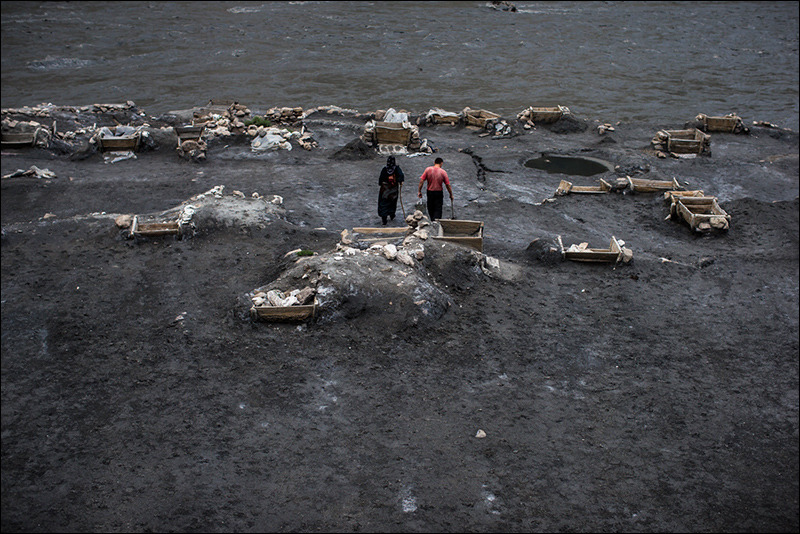
Hadizhat Shahbanova, 73, and her nephew Izudin Abakarov, 18, extract salt in the village of Kvanhidatli. They are using a technique that has been passed through generations of their family for over six centuries. A few kilometers away from their village there is a saline stream from which they draw water, then pour it onto a lump of loose earth. The earth is then dried, the salt is exuded onto the dried surface of the earth and the process is repeated several times. The salted earth is then spread onto a tray and sprayed with water from the stream again, followed by evaporation over burning twigs and roots (few if any trees grow there). A typical production cycle lasts for a week. If lucky, the family could end up with two sacks of salt in a week. Normally, it’s a sack that one can divide into 80 cans at 100 rubles each (about $3 apiece). Operations are only possible within the dry season that lasts from April to September, mostly July to August. Dagestan, Russia, June 2013. More photos here: http://www.flickr.com/photos/avdeev/sets/72157634768632480

(blog.maxavdeev.com) Hadizhat Shahbanova, 73, and her nephew Izudin Abakarov, 18, extract salt in the village of Kvanhidatli. They are using a technique that has been passed through generations of their family for over six centuries. A few kilometers away from their village there is a saline stream from which they draw water, then pour it onto a lump of loose earth. The earth is then dried, the salt is exuded onto the dried surface of the earth and the process is repeated several times. The salted earth is then spread onto a tray and sprayed with water from the stream again, followed by evaporation over burning twigs and roots (few if any trees grow there). A typical production cycle lasts for a week. If lucky, the family could end up with two sacks of salt in a week. Normally, it’s a sack that one can divide into 80 cans at 100 rubles each (about $3 apiece). Operations are only possible within the dry season that lasts from April to September, mostly July to August. Dagestan, Russia, June 2013.

More photos here: flickr.com

Friday, July 12, 2013

PROJECT: Please support "Georgian ABC book" by the Photographer Natela Grigalashvili (kisskissbankbank.com)


Georgian ABC book from Natela Grigalashvili on Vimeo.


(kisskissbankbank.com) The idea of ABC Book was born when I was working on Open Society Documentary Photography Project. The theme was the life of Georgian village. A word and a photo are united in the project but the photo is not the direct illustration of the word. Dawn, sky, , "sheni chiri me" ("I love you so much, you are so dear to me that I want to shoulder your woes") these are the words which is often used by these people and represents the part of their lives.

Here is the fabulous Photo Blog by Natela Grigalashvili natelagr.blogspot.de

I was born and raised in a Georgian village and this is the main theme of my photos. In Georgian villages we can see very tensely what the country underwent in the recent past. During the last 20 years Georgia has been through three wars. This is a country with almost half of million refugees, uneven social environment and unemployment. There is especially hard situation in the villages. But despite this the people who live there beautifully carry on their traditions, kindness and simplicity. They live simply, plant and garden, fall in love, get married and never loose hope. They never loose the joy of life and the sense of humor. I think we can learn much from these people. If I have a chance with the help of KissKissBankBank, I will continue work to finish this project and publish the book. I will be very thankful if you help me to finish the project. 

  Russian family. Marneuli

Biography: Natela Grigalashvili is a Tbilisi based professional photographer and a chronicler recording the life of the normal people in the country with her camera. She is concerned with documenting the way of living that has endured until today. She grew up in the rural environment and is very familiar with the way of people’s living there. Natela photographs her relatives, friends and simple people, who enjoy their basic life, sometimes full of happiness, sometimes burlesque. Natela Grigalashvili participated in solo and group exhibitions: ABC Book (2012), Definitions (2011), My village, Bookhouse, Tbilisi Dysfunctional Country (2004), Guest Ateliers (2003) etc. 

Homepage: natelagrigalashvili.ge


Sunday, June 16, 2013

AUSZEICHNUNG: n-ost-Reportagepreis 2013: Die Preisträger - u. a. Meinrad Schade Nagorni Karabach – Der lange Schatten des Unabhängigkeitskrieges (n-ost)

Presseinformation des Netzwerks für Osteuropa-Berichterstattung

Preisträger n-ost-Reportagepreis 2013


n-ost-Reportagepreis 2013 geht an Andrea Roedig (Text), Elke Windisch (Radio) und Meinrad Schade (Foto)


(n-ost) Berlin, 14.06.2013 – Die Preisträger des n-ost-Reportagepreises 2013 sind Andrea Roedig („Macht, dass ihr rüberkommt!“, Der Standard ALBUM, 04.08.2012) in der Kategorie Text, Elke Windisch (Bruder Europäer – Das Dubrovniker Symphonieorchester, DLF, 12.06.2012) in der Kategorie Radio und Meinrad Schade (Nagorni Karabach – Der lange Schatten des Unabhängigkeitskrieges, Neue Zürcher Zeitung, 01. – 05.10.2012) in der Kategorie Foto.


Vor 200 Gästen wurde die Auszeichnung am Donnerstag, 13. Juni 2013, im Grünen Salon der Volksbühne Berlin zum siebten Mal verliehen. Die Preise übergaben die Jurymitglieder und Laudatoren Werner D’Inka (Herausgeber F.A.Z.), Silke Engel (Korrespondentin im ARD-Hauptstadtstudio) und Lars Bauernschmitt (Hochschule Hannover).


Aus insgesamt 117 Einsendungen hatten die Juroren sechs weitere Beiträge nominiert:
Urs Mannhart (Gazprom heizt ein, Reportagen, Juni 2012) und Andreas Schneitter (Bauland, Repor-tagen, Februar 2012) in der Kategorie Text,
Stephan Ozsváth (Budapest, 15. März 2012, Nationalfeiertag. Ungarn auf der Suche nach sich selbst, RBB, MDR, WDR, 2012) und Rainer Schwochow (Geduldet – Leben im Zwischenraum, DLF, HR, 2012) in der Kategorie Radio,
Kirill Golovchenko (Kachalka. Muscle Beach, Geo, Neon u. a., 2012) und Helena Schätzle (9645 Kilometer Erinnerung, Verlag Nimbus Kunst und Bücher, 2012) in der Kategorie Foto.


Im Zentrum des Osteuropa-Abends, durch den Moderatorin Anja Heyde (ZDF-Morgenmagazin) führ-te, standen die ausgezeichneten Reportagen: Autoren und Fotografen berichteten persönlich von ihren Recherchen und stellten ihre preisverdächtigen Bildstrecken und Reportagen vor. Schauspieler Wolfgang Häntsch las Auszüge aus den drei nominierten Texten. Nach der Preisverleihung ging die Party mit den „Balkangrooves“ von DJ Pixie weiter.
Der n-ost-Reportagepreis ist in jeder Kategorie mit 2.000 Euro dotiert und geht an herausragende Osteuropa-Reportagen, die in deutschsprachigen Medien erschienen sind. Er soll Journalisten, Fotografen und Redaktionen zu qualitativer Berichterstattung ermutigen, herausragende Autoren auszeichnen und eine Debatte in Gang halten darüber, was „Osteuropa“ eigentlich ist und wie darüber erzählt und informiert wird.


Der n-ost-Reportagepreis 2013 wird unterstützt durch die Robert Bosch Stiftung sowie die METRO GROUP in Düsseldorf.


Preisträger 2013


TEXTREPORTAGE

Andrea Roedig
„Macht, dass ihr rüberkommt!“, Der Standard ALBUM, 04.08.2012
„Was sagt uns die Geschichte einer Flucht aus dem Rumänien der Ceauşescu-Zeit – heute, fünfzig Jahre später? Viel, wenn man sie so erzählt wie Andrea Roedig. Denn jede Entscheidung vernichtet Optionen. Wer geht, kann nicht zugleich bleiben. Und wer etwas gewinnt, gibt auch etwas auf. Wann und wo auch immer Menschen ihre Heimat verlassen, freiwillig oder unter Druck, wird das so sein. Davon handelt Andrea Roedigs Reportage, geschrieben in einer klaren Sprache, die sich auf die Men-schen einlässt, aber immer respektvolle Distanz wahrt.“
Laudator Werner D’Inka, Herausgeber der F.A.Z.


RADIOREPORTAGE
Elke Windisch
Bruder Europäer – Das Dubrovniker Symphonieorchester, DLF, 12.06.2012
„Eine großartige Allegorie auf die Vielvölker-Familie Europa! Die trotz aller Konflikte und Zerrissen-heit Identität stiftet. Wie in den Reihen des Symphonieorchesters Dubrovnik. Die Musiker sind so bunt wie die Stadt selbst, offen, tolerant. Sogar während des Kriegs im damaligen Jugoslawien halten sie die europäische Idee hoch: indem sie Beethovens „Neunte“ einstudieren. Die Aufführung gelingt dem Orchester erst 20 Jahre später, doch der Weg dorthin bleibt beispielhaft und zeigt, was Europa im Kern zusammenhält. Welch schöne Geschichte – eindrucksvoll, mitreißend und dicht erzählt!“
Laudatorin Silke Engel, Korrespondentin im ARD-Hauptstadtstudio, rbb

Podcast >>>

FOTOREPORTAGE
Meinrad Schade
Nagorni Karabach – Der lange Schatten des Unabhängigkeitskrieges, Neue Zürcher Zeitung, 01. – 05.10.2012
„Der Foto-Essay von Meinrad Schade verwirrt den Betrachter, weil er keine einfache, schnell lesbare Information liefert. Die Bilder sind nicht bequem konsumierbar, sondern verunsichern durch schein-bare Widersprüche und zwingen so zur längeren Auseinandersetzung mit dem Dargestellten. Die Brüche in den Fotos dienen als visuelle Übersetzungen der Stimmung in der Region. Den Betrachtern stellen sich Fragen, deren Antworten offen bleiben – so offen wie die weitere Entwicklung des Staa-tes Nagorni Karabach, den bisher niemand anerkennt.“
Laudator Lars Bauernschmitt, Hochschule Hannover


Meinrad Schade: Berg-Karabach – der lange Schatten des Unabhängigkeitskriegs 
Foto-Tableau  
1991 wollte sich die kleine Bergregion Berg-Karabach von Aserbeidschan trennen und erkämpfte mit Armeniens Hilfe die Unabhängigkeit; als Staat ist sie aber bis heute nicht anerkannt. Der Schweizer Fotograf Meinrad Schade hat sich dort umgesehen. 
Bildergalerie >>> 


Jurys 2013

TEXTREPORTAGE
Christian Böhme Journalist, ehem. Chefredakteur „Jüdische Allgemeine“
Werner D'Inka Herausgeber Frankfurter Allgemeine Zeitung
Henrik Kaufholz Redakteur Politiken, Kopenhagen
Sonja Margolina Publizistin und Autorin
Uwe Neumärker Direktor Stiftung Denkmal der ermordeten Juden Europas
Horst Pöttker Professor am Institut für Journalistik, TU Dortmund


RADIOREPORTAGE
Sabine Adler Korrespondentin in Warschau, Deutschlandfunk
Silke Engel Korrespondentin im ARD-Hauptstadtstudio, rbb
Uwe Leuschner Vice-President Business Development CIS, DB Schenker Logistics
Jürgen Webermann Reporter NDR Info
Marianne Wendt Autorin und Regisseurin für Theater, Hörfunk und Film


FOTOREPORTAGE
Lars Bauernschmitt Professor für Fotojournalismus und Dokumentarfotografie
an der Hochschule Hannover
Michael Biedowicz Bildchef ZEITmagazin
Tomasz Dąbrowski Direktor des Polnischen Instituts Berlin
Pepa Hristova Freie Fotografin
Ute Mahler Professorin für Fotografie an der HAW Hamburg, Fotografin
Daniel Nauck Fotograf und Multimediaproducer bei 2470media
Michael Trippel Fotoreporter


Unterstützt durch

Robert Bosch Stiftung, METRO GROUP
 
Pressekontakt
Sarah Portner
Netzwerk für Osteuropa-Berichterstattung n-ost
Neuenburger Straße 17
10969 Berlin
+49-30-259 32 83-11
reportagepreis@n-ost.org

Saturday, October 20, 2012

PHOTODOCUMENTARY: The Unpromised Land. By Temo Bardzimashvili


In 2009, I worked on a short story about a few Meskhetian families. After more than 60 years of exile, they had returned to Abastumani, Georgia - the same village their forefathers were deported from to Central Asia. It was then that my interest grew in this group of people, especially in their traditions and their love for soil.

In 2011, I was commissioned by the European Centre for Minority Issues, Caucasus to document the Meskhetian communities in four different countries - Georgia, Azerbaijan, Turkey, and Kyrgyzstan. The project was exhibited in Georgia. The exhibition toured Tbilisi, Kutaisi, Akhaltsikhe, Batumi, Gori, and Telavi.

The present book is a compilation of the documentary material that I have gathered from 2009 to 2011. Through the images, I have strived to present a realistic image of their lives and the way the deportation has affected them.

Working on this project has given me the opportunity to learn more about this group of people, and I hope that the present book can do the same for its readers.

Temo Bardzimashvili 


http://ngm.nationalgeographic.com/u/H6yMi6fUB_1JR964xxG8RxsYArlNNn1lR5PWutchIbgWXrnLQFl2U8mGTQoUNEP8JxWg-KK9KB7y2A/ 

Temo Bardzimashvili is a native of Tbilisi, Georgia. After finishing his graduate school in the technical fields, he became interested in photojournalism and graduated cum laude from the Caucasus School of Journalism and Media Management. Temo Bardzimashvili works mostly on long-term documentary projects focused on ethnographic, social, and travel photography. His work has been published in a number of international publications, and exhibited both in Georgia and internationally.


Introduction: Jana Sommerlund
Accompanying text: Negin Angoshtari
Book concept: Negin Angoshtari and Temo Bardzimashvili
Photos: Temo Bardzimashvili
Archive photos: From the private collections of Rafik Efendiev, Bahadır Metan Enveroğlu, Emil Gamidov, Sarvar Lazishvili (Safarov), Sona Ulfanova, and Gyunesh Tursunova.
Design: Tornike Lordkipanidze
Cover photo: A Meskhetian house in Medrese, Azerbaijan.

© All photos copyrights belong to Temo Bardzimashvili except for pages 126 through 135.

© Book copyrights belong to ECMI, Caucasus except for pages 126 through 135.

All rights reserved. No part of this publication may be reproduced or transmitted in any form or by any means without written permission from the copyright holders.

ISBN 978-9941-0-4856-2
Published by
© 2012 European Centre for Minority Issues – Caucasus

Printed in Georgia by Cezanne

+++

Introduction

As part of the massive repressions of the Soviet regime, a large group of people were deported from southern Georgia to Central Asia. They were mostly the inhabitants of Meskheti - a historical region now split between Georgia and Turkey, who throughout their history were subjected to conflicting interests and influences from the Ottoman and Russian Empires.

During the Second World War, the Soviet hostility towards the Meskhetians, and other Muslim groups in Georgia intensified. In November 1944, the Muslim population of Meskheti and Ajara region– including Karapapakhs, Kurds, Turks, Roms, Hemshins, and the Meskhetian Turks were forcefully gathered at the train stations and transported in cargo carriages to three Central Asian republics: Kazakhstan, Uzbekistan, and Kyrgyzstan.

According to the official figures, a total of 94,955 people were deported1. The journey to Central Asia lasted between 18 and 22 days. Due to the harsh transportation conditions, many of the deportees, including children and elders became ill or died. After arriving in Central Asia, the deportees were distributed between different collective farms (kolkhozs) and factories. They were provided with housing, but were prohibited from leaving their assigned districts. It is estimated that 3,000 people died during the transportation, and thousands more perished in the first years of exile due to the rough climate and the harsh living conditions 2.

Meskhetians are Sunni Muslims, and speak the Eastern Anatolian dialect of Turkish language. The Soviet rulers perceived them to be the Turkish fifth column, and they were accused of treason, espionage, smuggling, and other crimes. The deportation has made a big influence on how the Meskhetians define their identity and their lives in exile.

After Josef Stalin died, the restrictions against the Meskhetians were partially lifted. From 1956 onwards, they were allowed to resettle in any Soviet Republic except for Georgia. Many Meskhetians moved to Azerbaijan and Russia in order to be closer to their homeland, hoping one day to return to Georgia.

In 1969, a small group of Meskhetians managed to return, and to settle in Georgia’s western regions of Guria and Samtredia. These early returnees still live in the country, and feel fully integrated into the Georgian society. Over 40 families have returned afterwards and they now reside in their historical homeland in Samtskhe-Javakheti.

After the demise of the Soviet Union, and upon becoming a member of the Council of Europe in 1999, Georgia has committed itself to repatriate the deported population. In 2007, the Georgian Parliament adopted the law “On Repatriation of Persons Forcefully Sent into Exile from the Soviet Socialist Republic of Georgia by the Former USSR in the 40’s of the 20th Century”. This created a legal framework for the Meskhetian repatriation. By the end of 2010 – the official deadline for submission of applications – the Ministry of Internally Displaced Persons from the Occupied Territories, Accommodation, and Refugees has received 5,841 applications covering about 9,000 individuals. By the time of this publication about 800 Meskhetian applicants were granted repatriate status.

The majority of the Meskhetians today live in eight countries of the world: Turkey, Azerbaijan Kazakhstan, Uzbekistan, Kyrgyzstan, Russian Federation, Ukraine, and the United States of America.

Meskhetians prefer to settle compactly in family groups. This pattern of social organization represents an essential strategy to survive adversities that this group has faced during and after their deportation. In many cases, the Meskhetian settlements in the other countries resemble the composition and the structure of the villages and the communities they were deported from.

As Muslims, the majority of Meskhetians adhere to the Hanafi rite of Sunni Islam. They practice religious traditions by praying, fasting, and celebrating the main religious holidays, such as Kurban Bayram, and Ramazan Bayram. They also observe the ancient feast of Nowruz. Furthermore, the Meskhetians have preserved and practiced some of the old Christian traditions – such as placing open scissors resembling a cross on the chest of a deceased, or a bride drawing a cross with honey on her husband’s door.

The eastern Anatolian dialect of Turkish is the spoken language between the Meskhetians, regardless of where they live today. Due to the constant migration and re-settlement in several countries, many Meskhetians know several languages such as Russian, Azeri, Turkish, Kazakh, Kyrgyz, and Uzbek depending on their countries of residence. Georgian is spoken only among those who have returned and settled in Georgia.

The Meskhetian society is a rather traditional society with a clear division of gender roles. Meskhetian families are led by the eldest men, who are the heads of the families, and are traditionally treated with a profound respect from the younger members of their kin. Women have secondary status and are usually subordinated to their husbands, fathers or brothers. The father of the family is considered to be the breadwinner, while the mother is perceived to be the hearth keeper. This gender division plays an important role in the lives of many Meskhetians, especially the women who are required to seek permission from their fathers and husbands in choosing their education or work.

Meskhetians observe the births, the marriages, and the funerals with a mixture of Muslim rituals and customs specific to places of their residence. Thus, upon their integration in the local communities, many customs are adopted from Turkish, Russian, Azeri or Georgian traditions.

The author of this book focuses on the important details of the Meskhetian life. Rituals, customs, family, gender roles, work, leisure, and finally their longing for the historical homeland are depicted through documentary style of photography.

The majority of the photos presented here have been exhibited in Georgia’s capital, Tbilisi, and in the regional cities of Gori, Akhaltsikhe, Kutaisi, Batumi, and Telavi. The exhibitions were organized by the European Centre for Minority Issues (ECMI) within the framework of the EU-funded programme “Supporting the Repatriation of Persons Deported from Georgia in the 1940s and their descendants” implemented by the European Centre for Minority Issues Caucasus and Action Against Hunger, International. I hope this book will enhance the awareness on deportations and plights of the deported population among a broader public in Georgia and beyond.

Jana Sommerlund
ECMI Caucasus International Project Manager
Tbilisi, September 2012