Showing posts with label CNN. Show all posts
Showing posts with label CNN. Show all posts
Saturday, October 19, 2013
VIDEO: GEORGIA The birth of Human race Caucasus Homo erectus georgicus 1.8 million years (youtube.com)
(youtube.com) Homo erectus georgicus (Georgian: ქართველი ადამიანი) is the subspecies name sometimes used to describe fossil skulls and jaws found in Dmanisi, Georgia. Although first proposed as a separate species, it is now classified within H. erectus.[20][21][22] A partial skeleton was discovered in 2001. The fossils are about 1.8 million years old. The remains were first discovered in 1991 by Georgian scientist, David Lordkipanidze, accompanied by an international team that unearthed the remains. There have been many proposed explanations of the dispersion of H. erectus georgicus. Implements and animal bones were found alongside the ancient human remains.
At first, scientists thought they had found mandibles and skulls belonging to Homo ergaster, but size differences led them to name a new species, Homo georgicus, which was posited as a descendant of Homo habilis and ancestor of Asian Homo erectus. This classification was not upheld, and the fossil is now considered a divergent subgroup of Homo erectus, sometimes called Homo erectus georgicus.
At around 600 cubic centimetres (37 cu in) brain volume, the skull D2700 is dated to 1.77 million years old and in good condition, offering insights in comparison to the modern human cranial morphology. At the time of discovery the cranium was the smallest and most primitive Hominina skull ever discovered outside of Africa. However, in 2003 a significantly smaller brained hominid was found on the isle of Flores, H. erectus floresiensis. Homo erectus georgicus exhibits strong sexual dimorphism with males being significantly larger than females.
Subsequently, four fossil skeletons were found, showing a species primitive in its skull and upper body but with relatively advanced spines and lower limbs, providing greater mobility. They are now thought not to be a separate species, but to represent a stage soon after the transition between Homo habilis and H. erectus, and have been dated at 1.8 million years before the present, according to the leader of the project, David Lordkipanidze.The assemblage includes one of the largest Pleistocene Homo mandibles (D2600), one of the smallest Lower Pleistocene mandibles (D211), a nearly complete sub‐adult (D2735), and a completely toothless specimen (D3900).
Human habitation in the Caucasus goes back to the remotest antiquity. The hominid remains discovered in 1991 by David Lordkipanidze at Dmanisi, Kvemo Kartli (1.8 million years old) are the oldest found outside of Africa (Zatiashvili, 2008). Neanderthal remains have been found at Ortvale K'lde (1973) and elsewhere in the Caucasus (36,000-50,000 years old).


Tuesday, August 20, 2013
PHOTO: Monk takes devotion to new heights. By Amos Chapple & Lauren Russell (cnnphotos.blogs.cnn.com)
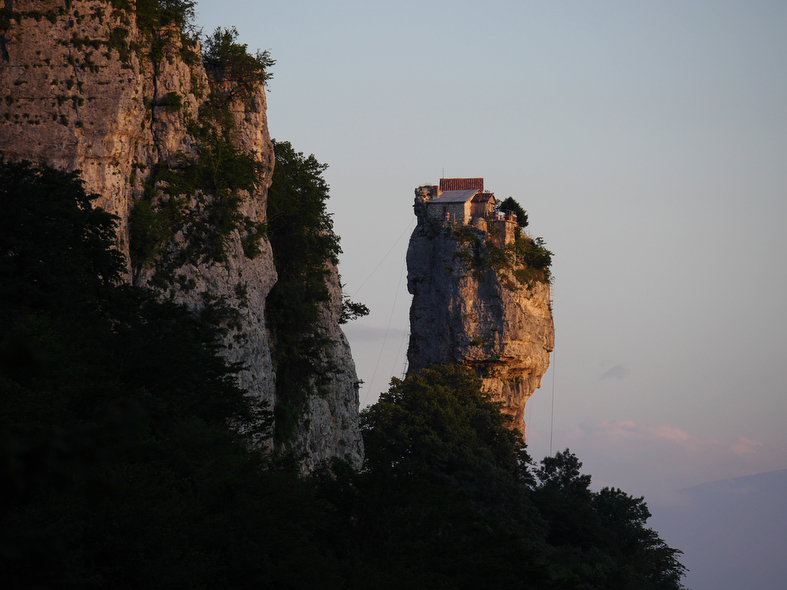
(cnnphotos.blogs.cnn.com) Maxime the monk lives on a pillar. When he wants to step down out of the clouds, the 59-year-old scales a 131-foot ladder, which takes him about 20 minutes.
After living on Katskhi pillar for 20 years, Maxime’s climbs have slowed, but having worked as a crane operator in a past life, he’s never feared heights.
Photographer Amos Chapple heard about Maxime while working in the country of Georgia, and when he first arrived and asked to go up, he was told no. Only priests and some of the troubled young men learning from Maxime and living in a monastery underneath the pillar were allowed to go up.
Chapple stayed with the men at the base for four days before he was told he could ascend the pillar. He participated in prayers seven hours a day, including four-hour night prayers from 2 a.m. to sunrise. When he was finally going up to Maxime’s home, rain clouds rolled in and the sun was setting. The iron ladder was “very dicey,” Chapple said.
“I put so much time into getting permission that I said it was too late to be scared,” he said.
While with Maxime at the top, Chapple said he was worried he would run out of light for the climb down and that it would start raining, but as he looked out at the clouds at eye level and the distance between he and the ground, he appreciated the quiet of the elevated home.
“You could feel one with the weather,” he said.
Maxime said he needs the silence of the top of the pillar.
“It is up here in the silence that you can feel God's presence," he told Chapple in Russian.
Stylites, or pillar saints, began after Simeon Stylites the elder in Syria first moved atop a pillar in 423 to cut himself off from worldly temptations. Stylites were most common in eastern Europe during the latter part of the fifth century, but the practice has since been abandoned.
Katskhi pillar had sat idly since the 15th century when the Islamic Ottomans invaded Georgia. No one had even been to the top for centuries until an alpinist climbed it and found the remains of a chapel and the skeleton of a Stylite in 1944.
Maxime told Chapple he “drank, sold drugs, everything” as a young man. After serving time in prison, he decided he needed a change.
“I used to drink with friends in the hills around here and look up at this place, where the land met the sky,” Maxime told Chapple. “We knew the monks had lived up there before, and I had great respect for them.”
Maxime took monastic vows in 1993 and climbed the tower to start a new life. For the first two years, he slept in a fridge to protect himself from the elements. He now has a bed inside a cottage where he sleeps.
“It’s more about the isolation than suffering,” Chapple said.
Followers send supplies up to Maxime with a winch, and the monk comes down once or twice a week for night prayers with the men staying at the monastery.
His climbs have slowed, and once Maxime is no longer able to move up and down the ladder, he will stay at the top until he dies.
A crypt holding the bones of a Stylite who lived and died at the Katskhi pillar lies under the chapel.
When Chapple asked Maxime if his bones would be stored in the same crypt, Chapple said the monk stretched out his arms in his charismatic way and said, “Of course!”
– Lauren Russell, CNN
Amos Chapple | Maxime The Pillar Saint [thetravelphotographer.blogspot.de]
 I have no chance of being a Stylite saint...(or being a saint for that
matter) since I feel uncomfortable with heights. Not to the extent of
being acrophobic, but enough that I think twice before looking out of a
skyscraper balcony or even floor to ceiling windows.
I have no chance of being a Stylite saint...(or being a saint for that
matter) since I feel uncomfortable with heights. Not to the extent of
being acrophobic, but enough that I think twice before looking out of a
skyscraper balcony or even floor to ceiling windows.CNN featured a photo essay by Amos Chapple on Maxime, a monk who lives on a mountain pillar in the country of Georgia. To get to his aerie where he lived for 20 years, the 59-year-old scales a 131-foot ladder, which takes him about 20 minutes.
Maxime follows the ancient tradition of the Stylites (aka Pillar-Saints), a type of Christian ascetics who in the early days of the Byzantine Empire stood on pillars preaching, fasting and praying. They believed that doing so would ensure the salvation of their souls. The first Stylite was Simeon who climbed a pillar in Syria in 423 and lived there for 39 years until his death.
The monk told Chapple that it was up on his perch that he could feel God's presence. The pillar is called Katskhi pillar, and stood unvisited since the 15th century when the Ottomans invaded Georgia. No one had even been to the top for centuries until an alpinist climbed it and found the remains of a chapel and the skeleton of a Stylite in 1944.
Amos Chapple started as a newspaper photographer in New Zealand, including two years at the country’s largest daily, The NZ Herald, before moving to London and working full-time for a project to photograph all of the world’s UNESCO World Heritage Sites. He now works freelance and, as of the past year, has been specializing in photographs of the world’s ”beautiful secrets”. It’s a kind of travel photography, but by making sure each site is little-known, and has an interesting back story, it is proving popular with newspapers and magazines throughout Europe
Thursday, August 15, 2013
VIDEO: CNN's Ivan Watson meets an American winemaker in Georgia (youtube.com)
(youtube.com) CNN's Ivan Watson meets an American winemaker trying to market Georgian wine to the world -
Saturday, December 22, 2012
DOKUMENTATION: CNN berichtet über aserbaidschanische Seidenstadt Şəki (business.blogs.cnn.com)
(business.blogs.cnn.com) In einer Folge seiner aktuellen Dokumentarserie "Along the Silk Road" berichtet der US-Sender CNN über die nordaserbaidschanische Stadt Şəki. Die Serie begibt sich auf die Spuren der berühmten Seidenstraße, einer rund 6.000 Kilometer langen antiken Handelsroute zwischen Europa und Asien. Unterwegs erkundet das CNN-Team die exportgestützte Wirtschaft von Ländern, die über erhebliche Bodenschätze und Rohstoffvorkommen verfügen und deshalb in den nächsten 25 Jahren voraussichtlich ein immenses Wachstum verzeichnen werden.
Şəki war ein wichtiges Handelszentrum der Seidenroute und Knotenpunkt zwischen dem russischen Dagestan und den nördlichen Handelsstrecken, die durch den Kaukasus verliefen.
Der CNN-Reporter Jim Boulden besichtigt die traditionelle Karawanserei, wo sich Reisende und Händler von ihrem Tagesmarsch erholen konnten, eine Kirche aus dem 12. Jahrhundert, den berühmten Khanspalast aus dem 18. Jahrhundert und spricht mit dem Leiter der gemeindebasierten Tourismusbehörde von Şəki.
The series surveys the export-driven economies, countries with vast capitals of reserve and natural resources, that economic forecasters pinpoint as ringleaders of growth for the next quarter of a century.
Catch “Along the Silk Road” every Wednesday on CNN International within Global Exchange:
1100 ET
1600 GMT
1700 CET
Follow the show on Twitter @CNNGlobalEx and use the hashtag #CNNGlobalEx to join the conversation.
Shaki, Azerbaijan (CNN) – Trading is in the life blood
of Azerbaijan. As the link to east and west it was a vital rest stop
along the old silk route. In the northwest city, Shaki, there are
reminders of the country’s rich trading history and single remaining
silk factory.
Along the Silk Road
“Along the Silk Road” explores the burgeoning trade and investment
links from the Middle East to Asia – Beijing, Mumbai, Istanbul, Kabul,
Moscow, Hong Kong, Jakarta and Dubai.The series surveys the export-driven economies, countries with vast capitals of reserve and natural resources, that economic forecasters pinpoint as ringleaders of growth for the next quarter of a century.
Catch “Along the Silk Road” every Wednesday on CNN International within Global Exchange:
1100 ET
1600 GMT
1700 CET
Follow the show on Twitter @CNNGlobalEx and use the hashtag #CNNGlobalEx to join the conversation.
Tuesday, June 19, 2012
ARTICLE: In the Back Streets of Tbilisi, A Struggle for a City's History. By Tara Isabella Burton (ireport.cnn.com)
 (ireport.cnn.com) Recently, activists and government interests have clashed over the development plans for Gudiashvili Square - one of Tbilisi's most characteristic courtyards - following the victory of an Austrian architectural firm of a government-sponsored contest to "re-design" Gudiashvili square: a redesign that in this case entailed replacing traditional Georgian delicate lattice-work balconies with Europeanized facades and a branch of Prada. While the government's characteristically Byzantine approach to the issue of property rights and redevelopment - it's still unclear who owns Gudiashvili Square's buildings, and whether any permits have been granted at all - has cloaked the redevelopments in a shadow of mystery, that hasn't stopped bulldozers - or protesters - from showing up regularly in what has become the heart of this historic battleground, crystallizing tensions between Tbilisi's residents and the government that, many say, is more interested in presenting a Disneyfied facade to foreign investors than in facilitating a sustainable renovation of Tbilisi's heritage streets and squares.
The moneyed elite in charge of renovating the bright facades of Old Tbilisi are keen to advertise a fairyland of carpet-shops, balconies, and the ubiquitous "gvino." But in the narrow alleyways and cobblestoned courtyards of Sololaki, a nineteenth-century district known for its art nouveau architecture and literary pedigree (Lermontov once had a salon here), the government's eagerness to promote Tbilisi as a "modern" European capital is leaving some worried that the city's history is getting left behind in the struggle.
The colorful, panoramic "Meidan" may be the heart of Tbilisi's tourism efforts, but Gudiashvili Square, for many Georgians, represents the city's soul.
More here: www.worldarchitecturenews.com
Saturday, June 16, 2012
VIDEO: Tradition Versus Modernization (edition.cnn.com)
Georgia is trying to modernize, but older Georgians fear traditional ways of life will be lost.
More: Eye On - CNN.com


VIDEO: Designers in Georgia hope traditional dress can become international chic. Designers in Georgia hope traditional dress can become international chic. CNN's Diana Magnay reports. (edition.cnn.com)
More on EYEON [Georgia]
Tuesday, January 11, 2011
VIDEO: Christmas Parade to Start in Tbilisi Georgia
iReport CNN — TBILISI, GEORGIA - The theatrical Alilo parade, analogous to last years’ parade, will begin at 14:00 hours in Republic Square of Tbilisi.
Orthodox Churches celebrate Christmas on the same day as Western . Oriental Orthodox churches also use their own calendars, which are generally similar to the Julian calendar. The Julian calendar began in 45 BC (709 AUC) as a reform of the Roman calendar by Julius Caesar. It was chosen after consultation with the astronomer Sosigenes of Alexandria and was probably designed to approximate the tropical year. Georgian Orthodox Christians celebrate Christmas Day on or near January 7 in the Gregorian (Western) calendar. This date works to be December 25 in the Julian calendar, which pre-dates the Gregorian calendar.
Participants in the parade will pass Rustaveli Avenue, Freedom Square, Pushkini Street and the Patriarchate of Georgia, where they will meet with the Patriarch to receive blessings.
The parade will then continue through Baratashvili Bridge. some of the parade participants will head to the Presidential Residence, where the president will give them sweets and wish them Merry Christmas. The parade will end at Trinity Cathedral. People will also give sweets and presents to parade participants along the way. All sweets and presents will later be handed over to children in orphanages.
Video >>>
Orthodox Churches celebrate Christmas on the same day as Western . Oriental Orthodox churches also use their own calendars, which are generally similar to the Julian calendar. The Julian calendar began in 45 BC (709 AUC) as a reform of the Roman calendar by Julius Caesar. It was chosen after consultation with the astronomer Sosigenes of Alexandria and was probably designed to approximate the tropical year. Georgian Orthodox Christians celebrate Christmas Day on or near January 7 in the Gregorian (Western) calendar. This date works to be December 25 in the Julian calendar, which pre-dates the Gregorian calendar.
Participants in the parade will pass Rustaveli Avenue, Freedom Square, Pushkini Street and the Patriarchate of Georgia, where they will meet with the Patriarch to receive blessings.
The parade will then continue through Baratashvili Bridge. some of the parade participants will head to the Presidential Residence, where the president will give them sweets and wish them Merry Christmas. The parade will end at Trinity Cathedral. People will also give sweets and presents to parade participants along the way. All sweets and presents will later be handed over to children in orphanages.
Video >>>
Tuesday, November 16, 2010
VIDEO: CNN International Explores the Secrets of Armenia’s Stonehenge
A stone circle located high in the highlands of Southern Armenia may in fact be the oldest stone observatory in the world, predating England’s Stonehenge. According to newly started excavations, the Armenian Stonehenge (Karahunj) has a history of 7500 years. It’s discovery has sparked a scientific debate in astronomical and astrological circles. Yerkir Media’s Gayane Avetisyan reports on the story for CNN World View.
Monday, April 19, 2010
TELEVISION: Republic of Georgia's unique ballet (cnn.com)
CNNInternational — 17. April 2010 — CNN's Ivan Watson takes an inside look at the state ballet of the Republic of Georgia.
Subscribe to:
Posts (Atom)