Showing posts with label UNESCO. Show all posts
Showing posts with label UNESCO. Show all posts
Thursday, July 06, 2017
VIDEO: Ancient Georgian traditional Qvevri wine-making method
UNESCO: Representative List of the Intangible Cultural Heritage of Humanity - 2013
URL: unesco.org/en/ancient georgian traditional qvevri wine making method
Description: Qvevri wine-making takes its name from the distinctive egg-shaped earthenware vessel -- the Qvevri -- in which wine is fermented and stored in villages and towns throughout Georgia. The tradition plays a vital role in everyday life and celebrations, and forms an inseparable part of the cultural identity of Georgian communities, with wine and vines frequently evoked in Georgian oral traditions and songs. Knowledge of this heritage is passed down by families, neighbours and friends, all of whom join in the communal harvesting and wine-making activities. Country(ies): Georgia
© Ministry of Culture and Monument Protection of Georgia, 2012
Duration: 00:09:59 - Support: DVD (0087000017)
+++
Inscribed in 2013 (8.COM) on the Representative List of the Intangible Cultural Heritage of Humanity
Qvevri wine-making is practised throughout Georgia, particularly in village communities where unique varieties of grapes are grown. The Qvevri is an egg-shaped earthenware vessel used for making, ageing and storing the wine. Knowledge and experience of Qvevri manufacture and wine-making are passed down by families, neighbours, friends and relatives, all of whom join in communal harvesting and wine-making activities. Children learn how to tend the vines, press grapes, ferment wine, collect clay and make and fire Qvevris through observing their elders. The wine-making process involves pressing the grapes and then pouring the juice, grape skins, stalks and pips into the Qvevri, which is sealed and buried in the ground so that the wine can ferment for five to six months before being drunk. Most farmers and city dwellers use this method of making wine. Wine plays a vital role in everyday life and in the celebration of secular and religious events and rituals. Wine cellars are still considered the holiest place in the family home. The tradition of Qvevri wine-making defines the lifestyle of local communities and forms an inseparable part of their cultural identity and inheritance, with wine and vines frequently evoked in Georgian oral traditions and songs.


Thursday, July 17, 2014
BERLIN: Wein - Kultur. Georgische Kulturtage (smb.museum)
(smb.museum) vom 01.08.2014 bis: 05.10.2014
Museum Europäischer Kulturen
Lansstraße 8 / Arnimallee 25
14195 Berlin
Die Ausstellung "Wein-Kultur" des Georgischen Nationalmuseums wird anlässlich der der diesjährigen Kulturtage im Museum Europäischer Kulturen präsentiert.
Wein kennt man in der Region des Kaukasus bereits seit 8000 Jahren. Bis heute ist dieses Getränk mit seiner kulturellen Bedeutung so sehr mit Georgien und seinen Menschen verbunden, dass die UNESCO die spezielle Technik des Weinausbaus in Amphoren 2013 in die Repräsentative Liste des immateriellen Kulturerbes der Menschheit aufgenommen hat.
In der Ausstellung werden Fotografien von Dimitri Ermakov (1846-1916), einem der herausragenden Fotografen Georgiens, zum Umgang mit Wein im 19. und frühen 20. Jahrhundert gezeigt. Geräte für den Weinausbau und Gefäße aus der ethnografischen Sammlung des Georgischen Nationalmuseums vervollständigen das Bild der "Wein-Kultur".
Gemeinsam mit der Botschaft von Georgien in der Bundesrepublik Deutschland, dem Ministerium für Kultur und Denkmalschutz von Georgien, dem Georgischen Nationalmuseum sowie weiteren Partnern in Georgien und Deutschland widmen sich die Kulturtage mit dieser Ausstellung und mit einem vielfältigen Veranstaltungsprogramm zur Festkultur, Musik - und Tanztradition und zeitgenössischen Literatur Georgiens.
Museum Europäischer Kulturen
Lansstraße 8 / Arnimallee 25
14195 Berlin
Die Ausstellung "Wein-Kultur" des Georgischen Nationalmuseums wird anlässlich der der diesjährigen Kulturtage im Museum Europäischer Kulturen präsentiert.
Wein kennt man in der Region des Kaukasus bereits seit 8000 Jahren. Bis heute ist dieses Getränk mit seiner kulturellen Bedeutung so sehr mit Georgien und seinen Menschen verbunden, dass die UNESCO die spezielle Technik des Weinausbaus in Amphoren 2013 in die Repräsentative Liste des immateriellen Kulturerbes der Menschheit aufgenommen hat.
In der Ausstellung werden Fotografien von Dimitri Ermakov (1846-1916), einem der herausragenden Fotografen Georgiens, zum Umgang mit Wein im 19. und frühen 20. Jahrhundert gezeigt. Geräte für den Weinausbau und Gefäße aus der ethnografischen Sammlung des Georgischen Nationalmuseums vervollständigen das Bild der "Wein-Kultur".
Gemeinsam mit der Botschaft von Georgien in der Bundesrepublik Deutschland, dem Ministerium für Kultur und Denkmalschutz von Georgien, dem Georgischen Nationalmuseum sowie weiteren Partnern in Georgien und Deutschland widmen sich die Kulturtage mit dieser Ausstellung und mit einem vielfältigen Veranstaltungsprogramm zur Festkultur, Musik - und Tanztradition und zeitgenössischen Literatur Georgiens.
Friday, December 06, 2013
UNESCO-WORLDHERRITAGE: Ancient Georgian traditional Qvevri wine-making method (unesco.org)
Florian Mühlfried in facebook: Fantastic!! Georgian kvevri-winemaking declared as intangible cultural heritage! Now let's see what this does to the quality of the wine. And what kind of oportunities it offers to research projects.
Place/country: Georgia,
Series: 2013 inscriptions on the Representative List/Inscriptions 2013 sur la Liste représentative,
Type: Documentary
Duration: 00:09:59
Author/director: Mr. Merab Kokochashvili,
Publisher/producer: Ministry of Culture and Monument Protection of Georgia,
Published in: 2013
Wednesday, December 04, 2013
AZERBAIJAN: From Yurts To Kimchi, Protecting The World's 'Intangible' Cultures. By Daisy Sindelar (rferl.org)
Yurts, Polo, And Georgian Wine Vie For UNESCO Recognition
(rferl.org) Seventy-year-old Kakesh Jumabai-Kyzy has spent her entire life working with felt.
The mother of eight lives in the mountainous Kyrgyz area of At-Bashy, where many families still tend flocks of sheep that provide the warm, fluffy wool that Jumabai-Kyzy transforms into traditional Kyrgyz clothing and the colorful felt rugs called shyrdaks.
"I learned carpet-making from my mother, and after that I continued working by myself. I make yurts, shyrdaks, kementais (wool coats for men), and kalpaks (national wool hats)," Jumabai-Kyzy says. "Dozens of my items have been sold abroad. But only my younger daughter-in-law and one of my own daughters are continuing my craft. My other children didn't learn it."
Jumabai-Kyzy is one of a dwindling number of artisans skilled in making shyrdaks and alakiyiz, an appliqued felt carpet.
The rugs, which combine rich colors and striking graphic patterns, were traditionally used for warmth and decoration in Kyrgyz households.
But Nazgul Mekeshova, a historical-legacy specialist with the Kyrgyz Culture Ministry, says the appeal of shyrdaks and alakiyiz is dying out.
"Before, the craft was thriving in our country," Mekeshova says. "For example, when young girls got married, mothers typically gave them shyrdaks and alakiyiz as gifts. But now it's foreign carpets and rugs that are selling the most at local markets. The shyrdak and alakiyiz remain only as a form of historical art."
But last year, Kyrgyzstan's unique rug-making heritage got a boost when the shyrdak and alakiyiz were recognized by the United Nations' cultural agency, UNESCO, as a cultural element in need of urgent safeguarding. UNESCO has offered protection for cultural entities for decades, most notably through its World Heritage List, which includes 981 properties -- from India's Taj Mahal to Australia's Great Barrier Reef -- deemed as having outstanding universal value.
In 2003, UNESCO passed a special convention offering protections for living, non-physical elements of culture -- something the agency calls "intangible cultural heritage." Helena Drobna, a specialist in UNESCO's culture sector, explains:
"It has to be transmitted from generation to generation, it has to be created and constantly recreated by the communities, and it has to provide them with a sense of identity and continuity -- things like oral traditions or expressions, performing arts, traditional craftsmanship, social practices and rituals, and knowledge and practices concerning nature and the universe," Drobna says.
Since then, hundreds of so-called "intangible cultural heritage elements" have applied for special UNESCO status. These include everything from Korean tightrope walking to Sicilian puppet theater to falconry, a tradition nominated by a collective group of 13 different nations.
The process of applying for addition to the UNESCO list can be grueling. Countries must demonstrate that the cultural element is essential to the identity of a community, continues to develop as it is passed through generations, and represents no threat to human rights.
Applicant countries must also describe how they plan to independently support the cultural element. UNESCO provides no automatic funding to countries that make the cultural intangible list. But Drobna says the special UNESCO designation gives many crafts and rituals the attention and momentum they need to regain importance within their community:
"The benefit of it is that it's raising awareness in the community on the local level, regional level, national level, and internationally," Drobna says. "So the idea is that as it raises awareness, it may also raise funding, in order to safeguard these elements. The local or national governments may release some funding, and they may also apply for some international support from UNESCO."
Dozens of countries have applied this year to add their intangible cultural elements to the UNESCO list.
Shrimp Fishing On Horseback
Applicants include Mongolia, which has nominated its traditional making of gers, or yurts. Belgium is hoping to call attention to its regional tradition of shrimp fishing on horseback.
The Turkish coffee culture has also been nominated, as has the South Korean tradition of making and sharing the spicy cabbage dish known as kimchi.
These cases and others are due to be considered when UNESCO convenes an intergovernmental committee for the safeguarding of intangible cultural heritage in Baku on December 2-7.
The event is expected to receive considerable publicity in Azerbaijan, whose first lady, Mehriban Aliyeva, has served as a UNESCO goodwill ambassador since 2004.
Baku is also hoping to use the December meeting to secure urgent safeguarding status for its own intangible cultural element -- chovqan, a form of polo once popular among Azeri nomads riding sturdy, short-legged Karabakh horses.
Azerbaijan's application is not without controversy. Few in the country have heard of the sport, and neighboring Iran has protested, saying polo is an international game and should not be acknowledged as a sport indigenous to any one nation.
UNESCO says its list is meant to highlight the intangible cultural heritage of individual communities, not countries -- a step that is meant to emphasize the natural diversity of most countries around the world.
But Rahman Badalov, a Baku-based philosopher and art critic, says some countries may use special designations like the UNESCO list to fuel nationalist sentiment.
He recalls the bitter "dolma dispute" between Azerbaijan and its rival neighbor, Armenia, when both tried to informally claim the savory stuffed grape leaves as their national dish.
Efforts to promote chovqan as a signature Azerbaijani sport, Badalov says, are a waste of time and money.
"It's the latest example of the government misusing budget resources," Badalov says. "They have lots of money and are looking for a kind of entertainment. Ninety-nine percent of the government's cultural initiatives are ugly, useless things. It's only cosmetic, a mask, with no content. They want to gain political favor, to show a positive side of themselves."
RFE/RL correspondents Baktygul Chynybaeva and Arifa Kazimova contributed to this piece from Bishkek and Baku
(rferl.org) Seventy-year-old Kakesh Jumabai-Kyzy has spent her entire life working with felt.
The mother of eight lives in the mountainous Kyrgyz area of At-Bashy, where many families still tend flocks of sheep that provide the warm, fluffy wool that Jumabai-Kyzy transforms into traditional Kyrgyz clothing and the colorful felt rugs called shyrdaks.
"I learned carpet-making from my mother, and after that I continued working by myself. I make yurts, shyrdaks, kementais (wool coats for men), and kalpaks (national wool hats)," Jumabai-Kyzy says. "Dozens of my items have been sold abroad. But only my younger daughter-in-law and one of my own daughters are continuing my craft. My other children didn't learn it."
Jumabai-Kyzy is one of a dwindling number of artisans skilled in making shyrdaks and alakiyiz, an appliqued felt carpet.
The rugs, which combine rich colors and striking graphic patterns, were traditionally used for warmth and decoration in Kyrgyz households.
But Nazgul Mekeshova, a historical-legacy specialist with the Kyrgyz Culture Ministry, says the appeal of shyrdaks and alakiyiz is dying out.
"Before, the craft was thriving in our country," Mekeshova says. "For example, when young girls got married, mothers typically gave them shyrdaks and alakiyiz as gifts. But now it's foreign carpets and rugs that are selling the most at local markets. The shyrdak and alakiyiz remain only as a form of historical art."
But last year, Kyrgyzstan's unique rug-making heritage got a boost when the shyrdak and alakiyiz were recognized by the United Nations' cultural agency, UNESCO, as a cultural element in need of urgent safeguarding. UNESCO has offered protection for cultural entities for decades, most notably through its World Heritage List, which includes 981 properties -- from India's Taj Mahal to Australia's Great Barrier Reef -- deemed as having outstanding universal value.
In 2003, UNESCO passed a special convention offering protections for living, non-physical elements of culture -- something the agency calls "intangible cultural heritage." Helena Drobna, a specialist in UNESCO's culture sector, explains:
"It has to be transmitted from generation to generation, it has to be created and constantly recreated by the communities, and it has to provide them with a sense of identity and continuity -- things like oral traditions or expressions, performing arts, traditional craftsmanship, social practices and rituals, and knowledge and practices concerning nature and the universe," Drobna says.
Since then, hundreds of so-called "intangible cultural heritage elements" have applied for special UNESCO status. These include everything from Korean tightrope walking to Sicilian puppet theater to falconry, a tradition nominated by a collective group of 13 different nations.
The process of applying for addition to the UNESCO list can be grueling. Countries must demonstrate that the cultural element is essential to the identity of a community, continues to develop as it is passed through generations, and represents no threat to human rights.
Applicant countries must also describe how they plan to independently support the cultural element. UNESCO provides no automatic funding to countries that make the cultural intangible list. But Drobna says the special UNESCO designation gives many crafts and rituals the attention and momentum they need to regain importance within their community:
"The benefit of it is that it's raising awareness in the community on the local level, regional level, national level, and internationally," Drobna says. "So the idea is that as it raises awareness, it may also raise funding, in order to safeguard these elements. The local or national governments may release some funding, and they may also apply for some international support from UNESCO."
Dozens of countries have applied this year to add their intangible cultural elements to the UNESCO list.
Shrimp Fishing On Horseback
Applicants include Mongolia, which has nominated its traditional making of gers, or yurts. Belgium is hoping to call attention to its regional tradition of shrimp fishing on horseback.
The Turkish coffee culture has also been nominated, as has the South Korean tradition of making and sharing the spicy cabbage dish known as kimchi.
These cases and others are due to be considered when UNESCO convenes an intergovernmental committee for the safeguarding of intangible cultural heritage in Baku on December 2-7.
The event is expected to receive considerable publicity in Azerbaijan, whose first lady, Mehriban Aliyeva, has served as a UNESCO goodwill ambassador since 2004.
Baku is also hoping to use the December meeting to secure urgent safeguarding status for its own intangible cultural element -- chovqan, a form of polo once popular among Azeri nomads riding sturdy, short-legged Karabakh horses.
Azerbaijan's application is not without controversy. Few in the country have heard of the sport, and neighboring Iran has protested, saying polo is an international game and should not be acknowledged as a sport indigenous to any one nation.
UNESCO says its list is meant to highlight the intangible cultural heritage of individual communities, not countries -- a step that is meant to emphasize the natural diversity of most countries around the world.
But Rahman Badalov, a Baku-based philosopher and art critic, says some countries may use special designations like the UNESCO list to fuel nationalist sentiment.
He recalls the bitter "dolma dispute" between Azerbaijan and its rival neighbor, Armenia, when both tried to informally claim the savory stuffed grape leaves as their national dish.
Efforts to promote chovqan as a signature Azerbaijani sport, Badalov says, are a waste of time and money.
"It's the latest example of the government misusing budget resources," Badalov says. "They have lots of money and are looking for a kind of entertainment. Ninety-nine percent of the government's cultural initiatives are ugly, useless things. It's only cosmetic, a mask, with no content. They want to gain political favor, to show a positive side of themselves."
RFE/RL correspondents Baktygul Chynybaeva and Arifa Kazimova contributed to this piece from Bishkek and Baku
AZERBAIJAN: UNESCO Adds Azerbaijani Horse Game To 'Intangible Heritage' List (rferl.org)
WATCH: The UN's cultural and educational organization, UNESCO, meets on December 2-7 to grant special designation to examples of intangible cultural heritage -- traditions, crafts, and rituals passed from generation to generation. Dozens of countries and communities are seeking recognition for their cultural traditions, ranging from the Azerbaijani horseback sport known as chovqan to the Korean spiced cabbage called kimchi. (Videos courtesy of UNESCO. Produced by RFE/RL's Daisy Sindelar and Margot Buff)
(rferl.org) BAKU -- The UN's cultural agency has named a traditional Azerbaijani horse-riding game a practice in need of urgent protection.
UNESCO, the United Nations Educational, Scientific, and Cultural Organization, decided to include the game of "chovqan" on its Intangible Cultural Heritage list at a meeting in the Azerbaijani capital, Baku, on December 3.
ALSO SEE: From Yurts To Kimchi, Protecting The World's 'Intangible' Cultures
The list comprises events from around the globe and is designed to "help demonstrate the diversity of this heritage and raise awareness about its importance."
Chovqan is a form of polo once popular among Azerbaijani nomads riding short-legged Karabakh horses.
The game is played by two competing teams of five riders and is accompanied by instrumental folk music called ''janghi.''
UNESCO said the practice and transmission of chovqan have weakened due to "socio-economic factors leading to a shortage of players, trainers, and Karabakh horses."
In 2003, UNESCO passed a special convention offering protections for living, non-physical elements of culture, what it calls "intangible cultural heritage."
Monday, November 18, 2013
FOOD & WINE: Georgia lobbies for inclusion of qvevri wine-making method in UNESCO's Intangible Heritage List (hvino.com)
(hvino.com) Georgia is working on inclusion of the country's traditional way of wine making into UNESCO's List of Intangible Cultural Heritage, the Georgian Foreign Minister Maia Panjikidze told journalists after the meeting with the Director General of UNESCO, Irina Bokova in Paris. Georgia's Foreign Minister took part in the work of the 37th session of UNESCO's General Conference.
"We want the tradition of making of the Georgian wine, which is called qvevri wine to be included into UNESCO's List of Intangible Cultural Heritage this year," Panjikidze said.The is sue of giving the status of "Intangible Cultural Heritage" to this method of wine-making was discussed in Tbilisi in February 2012 at the coordination meeting with participation of representatives from UNESCO's National Commission, Patriarchate of Georgia, different agencies, international and non-governmental organizations, as well as Georgian winemakers.
Georgia joined UNESCO Convention for the "Safeguarding of Intangible Cultural Heritage" in 2007. The Georgian folklore has already been included in the list of the world's intangible cultural heritages. Earlier, according to the Georgian president Mikheil Saakashvili's decree, the Georgian qvevri (clay jug for wine) wine was declared a monument of cultural heritage and was granted the category of national importance.
The Intangible Cultural Heritage programme was established in 2008, when the Convention for the Safeguarding of Intangible Cultural Heritage took effect. The UNESCO lists includes, for example, Armenian cross-stones khachkars and Argentinian tango.
"We want the tradition of making of the Georgian wine, which is called qvevri wine to be included into UNESCO's List of Intangible Cultural Heritage this year," Panjikidze said.The is sue of giving the status of "Intangible Cultural Heritage" to this method of wine-making was discussed in Tbilisi in February 2012 at the coordination meeting with participation of representatives from UNESCO's National Commission, Patriarchate of Georgia, different agencies, international and non-governmental organizations, as well as Georgian winemakers.
Georgia joined UNESCO Convention for the "Safeguarding of Intangible Cultural Heritage" in 2007. The Georgian folklore has already been included in the list of the world's intangible cultural heritages. Earlier, according to the Georgian president Mikheil Saakashvili's decree, the Georgian qvevri (clay jug for wine) wine was declared a monument of cultural heritage and was granted the category of national importance.
The Intangible Cultural Heritage programme was established in 2008, when the Convention for the Safeguarding of Intangible Cultural Heritage took effect. The UNESCO lists includes, for example, Armenian cross-stones khachkars and Argentinian tango.
Friday, May 24, 2013
WISSENSCHAFT: Forscher dokumentieren Felsmalerei in Armenien. Von Von Gregor Klaudius, dpa (suedkurier.de)
(suedkurier.de) Das Forschungsprojekt ist aufwendig und ungewöhnlich: Archäologen aus Sachsen-Anhalt haben es sich zur Aufgabe gemacht, weltweit einzigartigen Felsmalereien in Armenien zum Weltkulturerbe-Titel der Unesco zu verhelfen.
Die Wissenschaftler um den Direktor des Landesamtes für Archäologie, Harald Meller, dokumentierten bislang etwa 500 von tausenden aus der Bronzezeit stammende Felsmalereien. Erstmals zeigt das Landesamt Fotos der Forschungsergebnisse in einer Ausstellung in Berlin.
«Das Weltkulturerbe bekommt man schwer, aber die armenischen Felsmalereien haben gute Chancen», sagt Meller in Halle. Sein Team aus 15 Vermessungsingenieuren, Archäologen und Grabungstechnikern hatte im vergangenen Sommer die Felsbilder von Ughtasar im armenischen Hochland erstmals leibhaftig in Augenschein genommen. Auf Höhen von 2000 bis 3500 Metern erforschten die Wissenschaftler 40 Hektar einer erloschenen Vulkanlandschaft, die aus tausenden Basaltbrocken besteht. Auf vielen der dunklen Gesteinsbrocken fanden sie bronzezeitliche Felsmalereien etwa von Steinböcken, Leoparden, Kriegern, Bären oder Ziegen.
Was die Bilder so einzigartig macht, ist nicht nur ihre hohe Anzahl, die über mehrere Jahrhunderte entstanden sein muss. «Die Tiere und Menschen sind sehr eindeutig aufs Charakteristische beschränkt», erklärt Sachsen-Anhalts Chefarchäologe. Die 4000 Jahre alten Felsmalereien seien sowohl gestalterisch wie auch handwerklich gekonnt in Szene gesetzt und gut erhalten.
Mit einem ferngesteuerten Mini-Helikopter haben die Experten das Gebiet in vier Wochen vermessen und fotografiert. Die Fundstätte war zwar seit Jahrzehnten bekannt, doch den Armeniern fehlte die Technik für die Erforschung. Und die Bemühungen britischer Wissenschaftler der Universität Reading reichten nicht aus, um dem Ziel rasch näher zu kommen, zum Weltkulturerbe zu gehören.
Also vereinbarten Armenien und Sachsen-Anhalt ein gemeinsames Forschungsprojekt. Sachsen-Anhalt vertritt Deutschland seit dem Jahr 1996 bei der kulturellen Zusammenarbeit. Grundlage ist ein Kulturabkommen der Bundesrepublik mit der Republik Armenien. Laut Sachsen-Anhalts Kultusministerium kooperieren das Landesamt und die Wissenschaftliche Akademie Armeniens seit dem Jahr 2008 eng miteinander bei archäologischen und Denkmalschutzprojekten. Neben den Felsmalereien von Ughtasar gehören prähistorische Goldbergwerke und rätselhafte Steinanhäufungen zu den Projekten der deutschen Forscher in Armenien.
Wenn alles klappt, will Armenien mit Hilfe der Sachsen-Anhalter binnen der nächsten zehn Jahre den Weltkulturerbe-Titel beantragen. «Dazu müssen die zentralen Fragen beantwortet werden, was es alles für Motive gibt und wie sie zueinander stehen», sagt Meller. Bislang seien die Archäologen mit Deutungen der Motive noch sehr zurückhaltend, weil der Bestand zunächst weiter erforscht werden müsse. Meller schätzt, dass sein Team bei einem erneuten Projekt in diesem Sommer noch einmal mehr als 500 Felsmalereien dokumentieren wird.
Die Aussichten auf den Weltkulturerbe-Titel für das armenische Hochland an der Grenze zu Aserbaidschan bewertet Meller als «sehr gut, weil die Felsmalereien wissenschaftlich hoch bedeutsam» seien. Grundvoraussetzung für den Titel sei eine wissenschaftliche Dokumentation der Bilder. Die Unesco als Organisation der Vereinten Nationen verleiht den Titel Weltkulturerbe an Orte, die wegen ihrer Einzigartigkeit, Authentizität und Integrität als weltbedeutend gelten. Vorgeschlagen werden die Stätten von den Staaten, in denen sie liegen.
«Armenien hat sicher gute Chancen auf den Welterbetitel, weil es in dieser Region im Gegensatz zu Europa oder den USA noch nicht viele Welterbestätten gibt», sagt Doris Hartmann vom Lehrstuhl für Materielles und Immaterielles Kulturerbe der Universität Paderborn. Für einen Welterbe-Antrag sei allerdings viel Vorarbeit notwendig, um die Besonderheiten einer Stätte herauszustellen. Die Unesco fordere sehr umfangreiche Anträge. Es gebe bereits mehrere Welterbestätten mit Felsmalereien, beispielsweise in Frankreich oder Spanien. Dass nun die armenischen Felsbilder wissenschaftlich aufgearbeitet würden, sei ein gutes Anliegen, meint Hartmann.

In einer Ausstellung unter dem Titel «Bilder für die Ewigkeit - Petroglyphen im Hochland Armeniens» im Auswärtigen Amt, das die Projektkosten größtenteils trägt, sind nun erstmals Fotos von den Felsmalereien und Forschungsarbeiten zu sehen. Die prähistorische Felskunst in den Jahrtausende alten Bergsteppen sei ein wesentlicher Teil des kulturellen Erbes Armeniens, sagt eine Sprecherin des Auswärtigen Amtes in Berlin. Zudem sei diese Bilderwelt im Gegensatz zu vielen mitteleuropäischen Felsbildregionen, die seit Jahren zum Welterbe der Unesco zählten, bis heute nahezu unbekannt.
Austellung: Auswärtiges Amt, Lichthof, Werderscher Markt 1, 10117 Berlin
Die Ausstellung kann vom 21.05. bis zum 12.06.2013, wochentags von 10 bis 18 Uhr, besichtigt werden. Der Eintritt ist frei.
Mehr Links:
Felsmalereien: Das geheimnisvolle Freilichtmuseum von Ughtasar (spiegel.de)
Die einzigartigen Bilder von Ughtasar (n24.de)
Ughtasar Petroglyphs (armeniapedia.org)
Armenische Auszeichnung für Sachsen-Anhalts Landesarchäologen (hallespektrum.de)
Mehr zu den Petroglyphen (wikipedia.org)
Die Wissenschaftler um den Direktor des Landesamtes für Archäologie, Harald Meller, dokumentierten bislang etwa 500 von tausenden aus der Bronzezeit stammende Felsmalereien. Erstmals zeigt das Landesamt Fotos der Forschungsergebnisse in einer Ausstellung in Berlin.
«Das Weltkulturerbe bekommt man schwer, aber die armenischen Felsmalereien haben gute Chancen», sagt Meller in Halle. Sein Team aus 15 Vermessungsingenieuren, Archäologen und Grabungstechnikern hatte im vergangenen Sommer die Felsbilder von Ughtasar im armenischen Hochland erstmals leibhaftig in Augenschein genommen. Auf Höhen von 2000 bis 3500 Metern erforschten die Wissenschaftler 40 Hektar einer erloschenen Vulkanlandschaft, die aus tausenden Basaltbrocken besteht. Auf vielen der dunklen Gesteinsbrocken fanden sie bronzezeitliche Felsmalereien etwa von Steinböcken, Leoparden, Kriegern, Bären oder Ziegen.
Was die Bilder so einzigartig macht, ist nicht nur ihre hohe Anzahl, die über mehrere Jahrhunderte entstanden sein muss. «Die Tiere und Menschen sind sehr eindeutig aufs Charakteristische beschränkt», erklärt Sachsen-Anhalts Chefarchäologe. Die 4000 Jahre alten Felsmalereien seien sowohl gestalterisch wie auch handwerklich gekonnt in Szene gesetzt und gut erhalten.
Mit einem ferngesteuerten Mini-Helikopter haben die Experten das Gebiet in vier Wochen vermessen und fotografiert. Die Fundstätte war zwar seit Jahrzehnten bekannt, doch den Armeniern fehlte die Technik für die Erforschung. Und die Bemühungen britischer Wissenschaftler der Universität Reading reichten nicht aus, um dem Ziel rasch näher zu kommen, zum Weltkulturerbe zu gehören.
Also vereinbarten Armenien und Sachsen-Anhalt ein gemeinsames Forschungsprojekt. Sachsen-Anhalt vertritt Deutschland seit dem Jahr 1996 bei der kulturellen Zusammenarbeit. Grundlage ist ein Kulturabkommen der Bundesrepublik mit der Republik Armenien. Laut Sachsen-Anhalts Kultusministerium kooperieren das Landesamt und die Wissenschaftliche Akademie Armeniens seit dem Jahr 2008 eng miteinander bei archäologischen und Denkmalschutzprojekten. Neben den Felsmalereien von Ughtasar gehören prähistorische Goldbergwerke und rätselhafte Steinanhäufungen zu den Projekten der deutschen Forscher in Armenien.
Wenn alles klappt, will Armenien mit Hilfe der Sachsen-Anhalter binnen der nächsten zehn Jahre den Weltkulturerbe-Titel beantragen. «Dazu müssen die zentralen Fragen beantwortet werden, was es alles für Motive gibt und wie sie zueinander stehen», sagt Meller. Bislang seien die Archäologen mit Deutungen der Motive noch sehr zurückhaltend, weil der Bestand zunächst weiter erforscht werden müsse. Meller schätzt, dass sein Team bei einem erneuten Projekt in diesem Sommer noch einmal mehr als 500 Felsmalereien dokumentieren wird.
Die Aussichten auf den Weltkulturerbe-Titel für das armenische Hochland an der Grenze zu Aserbaidschan bewertet Meller als «sehr gut, weil die Felsmalereien wissenschaftlich hoch bedeutsam» seien. Grundvoraussetzung für den Titel sei eine wissenschaftliche Dokumentation der Bilder. Die Unesco als Organisation der Vereinten Nationen verleiht den Titel Weltkulturerbe an Orte, die wegen ihrer Einzigartigkeit, Authentizität und Integrität als weltbedeutend gelten. Vorgeschlagen werden die Stätten von den Staaten, in denen sie liegen.
«Armenien hat sicher gute Chancen auf den Welterbetitel, weil es in dieser Region im Gegensatz zu Europa oder den USA noch nicht viele Welterbestätten gibt», sagt Doris Hartmann vom Lehrstuhl für Materielles und Immaterielles Kulturerbe der Universität Paderborn. Für einen Welterbe-Antrag sei allerdings viel Vorarbeit notwendig, um die Besonderheiten einer Stätte herauszustellen. Die Unesco fordere sehr umfangreiche Anträge. Es gebe bereits mehrere Welterbestätten mit Felsmalereien, beispielsweise in Frankreich oder Spanien. Dass nun die armenischen Felsbilder wissenschaftlich aufgearbeitet würden, sei ein gutes Anliegen, meint Hartmann.

In einer Ausstellung unter dem Titel «Bilder für die Ewigkeit - Petroglyphen im Hochland Armeniens» im Auswärtigen Amt, das die Projektkosten größtenteils trägt, sind nun erstmals Fotos von den Felsmalereien und Forschungsarbeiten zu sehen. Die prähistorische Felskunst in den Jahrtausende alten Bergsteppen sei ein wesentlicher Teil des kulturellen Erbes Armeniens, sagt eine Sprecherin des Auswärtigen Amtes in Berlin. Zudem sei diese Bilderwelt im Gegensatz zu vielen mitteleuropäischen Felsbildregionen, die seit Jahren zum Welterbe der Unesco zählten, bis heute nahezu unbekannt.
Austellung: Auswärtiges Amt, Lichthof, Werderscher Markt 1, 10117 Berlin
Die Ausstellung kann vom 21.05. bis zum 12.06.2013, wochentags von 10 bis 18 Uhr, besichtigt werden. Der Eintritt ist frei.
Mehr Links:
Felsmalereien: Das geheimnisvolle Freilichtmuseum von Ughtasar (spiegel.de)
Die einzigartigen Bilder von Ughtasar (n24.de)
Ughtasar Petroglyphs (armeniapedia.org)
Armenische Auszeichnung für Sachsen-Anhalts Landesarchäologen (hallespektrum.de)
Mehr zu den Petroglyphen (wikipedia.org)
Monday, November 26, 2012
POLYPHONY: Infos zum Workshop "Mehrstimmige Lieder aus Georgien" 11.-13. Jan 2013
Der amerikanische Workshopleiter Frank Kane bietet vom 11.-13. Januar 2013 zum ersten Mal ein Singe-Wochenende „Mehrstimmige Georgische Gesänge“ in Leipzig an.
Es gibt noch einige freie Plätze – fühlt euch herzlich zum Mitmachen eingeladen.
 Wo/Wann: Haus Steinstraße in Leipzig-Südvorstadt (Steinstraße 18, 04275 Leipzig)
Fr. 11.01.1, 19:00 - 21:30
Sa. 12.01.13, 10:00 - 19:00
So. 13.01.13, 10:00 - 15:30
Sprache: Englisch mit deutscher Übersetzung
Preise: Noch bis zum 11.12. gibt es einen sehr lohnenswerten Frühbucher-Tarif.
EUR 120 (bei Anzahlung von 50 EUR bis 11.12.)
EUR 135 nach dem 11.12.
Zum Inhalt des Wochenendes
Wir werden bei diesem Seminar wunderschöne traditionelle mehrstimmige Lieder aus Georgien lernen und uns an deren Wirkung erfreuen.
Die polyphone Volksmusik aus Georgien, die von der UNESCO als ein "Meisterstück des kulturellen Erbes der Menschheit" beschrieben wurde, spielte in den letzten zwei Jahrtausenden eine entscheidende Rolle, das soziale und rituelle Leben des Landes zu gestalten, ganz besonders in Zeiten des Übergangs wie Geburt, Tod, Krankheit und Heirat.
Die Auswahl wird am Ort des Geschehens an die sängerische Vorerfahrung der Gruppe angepasst.
Über Frank Kane
Frank ist Amerikaner, lebt in Paris und studiert und praktiziert Georgischen Gesang seit 1980. Er spricht fließend georgisch und ist der Begründer des Kartuli Ensembles in New York, dem ersten Chor mit georgischer Musik außerhalb Georgiens.
Er hat eine Reihe Workshops in England und USA gegeben und ist bekannt für seine gründliche Kenntnis der georgischen Vokaltechnik und seine Fähigkeit, diese an Menschen weiterzugeben, die georgische Lieder authentisch singen möchten. Seine lebendige und gleichzeitig sehr effektive Art, Menschen an das georgische Singen heranzuführen, wurde neben eigenen Studien der georgischen Singetechnik u.a. von einer Reihe anderer progressiver Stimmlehrer beeinflusst.
Die Website zum Workshop: www.georgische-Lieder.de
(dort geht’s auch zum Anmeldeformular)
Thursday, October 25, 2012
GOURMET: Die Wiege des Weins liegt in Georgien. Von Andrzej Rybak (ftd.de)
(ftd.de) Kaukasische Rebsorten, Gärung in Tonamphoren: Georgien
besinnt sich auf eine uralte Weinkultur, die Anwärter auf das
Unesco-Welterbe ist. Unser Autor probiert auf dem Gut eines Deutschen
ungeahnt gute Tropfen.
 |
| photo: Lioba Schöneck |
Ein steinerner Turm überragt
die windschiefen Häuser von Kisiskhevi. Der Rest des Châteaus, das der
Stolz des Dorfes ist, verbirgt sich hinter einer hohen Mauer: ein
schmuckes Gebäudeensemble aus Natursteinen und Ziegeln, beschienen vom
Goldlicht der Spätnachmittagssonne. Von der Terrasse huscht der Blick
über ein breites Tal und bleibt an den mächtigen Schneegipfeln des
Kaukasus hängen. "Irgendwo hier wurde vor fast 8000 Jahren das Geheimnis der Weinherstellung entdeckt", sagt der Hausherr Burkhard Schuchmann. "Georgien ist die Wiege des Weins, nicht Griechenland, wie viele glauben."
Das Land am Schwarzen Meer
ist tief mit der Weinkultur verbunden.
Archäologen datieren die
ältesten Samen kultivierter georgischer Reben auf das sechste
Jahrtausend vor Christus. Ebenso die älteste Amphora, in der sich Spuren
von Wein fanden. In den Tälern des Südkaukasus wachsen bis heute über
500 heimische Rebsorten, die es sonst nirgends gibt. Linguisten führen
das lateinische Wort vino auf das georgische gvino zurück. Und Wein darf
bei keinem Festessen fehlen. Fast jede Familie auf dem Land stellt
ihren eigenen Rebensaft her - wie in der Frühzeit in Tonamphoren.
Schuchmann suchte eigentlich nur ein Hobby
In
den späten 90ern besannen sich auch Profiwinzer auf die bauchigen
Gefäße. Besonders in der östlichen Provinz Kachetien, wo Kisiskhevi
liegt, wird in den spitz zulaufenden Amphoren wieder Wein ausgebaut.
Damit die Gärtemperatur konstant bleibt, stecken die Kwewris bis zum
Hals in der Erde. Sie schränkt die Sauerstoffaufnahme durch die Tonwände
ein und schenkt dem Wein einen leicht mineralischen Geschmack.
Inzwischen hat sich die Methode so bewährt, dass sie für die
Unesco-Welterbeliste nominiert ist. Die Entscheidung fällt im Herbst.
"Wenn es klappt, dürften Kwewri-Weine bald bekannter sein", sagt
Schuchmann. Und es wird klappen, glaubt er.
Der Westfale, vor seiner Pensionierung
Vorstandschef beim Schienen- und Weichenhersteller Vossloh, wollte in
Georgien eigentlich nur ein paar Rebenfelder erwerben und die Trauben
zu einer guten Kellerei bringen: Wein machen, ohne sich viel
Verantwortung aufzuladen. Er bereiste das Land, nahm Bodenproben, fand
Felder - und wurde bei Vinoterra in Kisiskhevi vorstellig. Doch die
Kellerei war verschuldet und suchte einen Käufer, keine Aufträge. 2008
übernahm Schuchmann den kompletten Betrieb und vertraute einem der
Anteilseigner, dem exzellenten Weinmacher Giorgi Dakishvili, die
Produktion an. Seitdem hat der Deutsche 6,5 Mio. Euro investiert und den
Betrieb zum Château ausgebaut. Auch er stellt Weine in Tonamphoren
her.
"Kwewri-Wein ist im Geschmack etwas
ganz Besonderes", sagt der 70-Jährige zufrieden. 120 Hektar besitzt er
in Kachetien, auf denen hauptsächlich die georgischen Rebsorten
Saperawi, Rkaziteli und Mzwane wachsen. Zudem ein wenig Cabernet
Sauvignon, Merlot, Chardonnay. Ein Teil der Ernte wandert in die
Kwewris, ein anderer in moderne Edelstahltanks. 250 000 Flaschen
exzellenten Weins entstehen so im Jahr.
"Ein Ritt auf Messers Schneide"
Drei
Dutzend Amphoren sind in Schuchmanns Kellern eingegraben. In ihren
dunklen Bäuchen gären 500 bis 3500 Liter Maische aus seinen besten
Beeren. Für die Spontanfermentation sorgen rebeigene Hefen. Dakishvili
überwacht den Prozess. Da auch Schalen, Kerne und Stängel mitgären,
entwickelt der Wein mehr Tannine und Polyphenole und wird sehr
körperreich. Je nach Rebe und Machart bleibt er zwischen drei Wochen und
zehn Monaten im Kwewri. "Ein Ritt auf Messers Schneide", sagt
Dakishvili. "Wenn die Maische zu viele Stängel und Kerne enthält, kann
der Wein bitter werden."
Doch
der Kellermeister weiß genau, wie das Lesegut sortiert und zerdrückt
werden muss und wie lange es gären darf. Den Saperawi zum Beispiel
belässt er im Unterschied zu anderen Winzern nicht monatelang im Kwewri,
sondern füllt ihn nach 16 bis 20 Tagen in Edelstahltanks um. Dort sinkt
im Verlauf der sekundären Gärung der Säuregehalt, was für ein
elegantes, harmonisches Geschmacksbild sorgt. Eine jahrtausendealte
Tradition, gepaart mit modernem Know-how.
Trinkreif
ist der Saperawi danach noch lange nicht. Erst wenn er zwei Jahre
später aus den alten Eichenfässern, die Schuchmann aus Frankreich
importiert hat, ungefiltert in Flaschen abgefüllt wird, erfährt man, was
aus ihm geworden ist: ein dunkelroter Wein, der nach Kirsche,
Zedernholz und Minze duftet, bevor er mit sattem Kirscharoma und zarter
Pfeffernote über die Zunge rollt.
Südossetien-Konflikt veränderte auch die Weinherstellung
Der
weiße Kisi ist noch ungewöhnlicher. Normalerweise wird Weißwein
lediglich aus Traubenmost gewonnen, doch beim Kisi gärt die ganze
Maische wie sonst nur bei Rotwein üblich. Nach der Gärung bleibt er
weitere sechs Monate im Kwewri und wandert anschließend für ein Jahr ins
Barrique. Goldgelb fließt er hinterher ins Glas mit einem Bouquet von
reifem Pfirsich und leisen Kieferakzenten.
Die
Kunde vom georgischen Kwewri hat bereits Winzer in Österreich, Italien,
Slowenien und den USA erreicht. Sie importierten Tongefäße und bauen
nun Wein auf die uralte Weise aus. "Die Herkunft der Methode wird meist
gar nicht erwähnt", sagt Nika Rurua, Kulturminister in Tbilisi. "Aber
wenn die Unesco unser Menschheitserbe anerkennt, werden die Hersteller
den Ursprung benennen müssen."
Von dem neuen
Renommee würden auch die Töpfer profitieren. Ihr Kwewri-Handwerk war in
der Sowjetzeit fast ausgestorben, denn der Arbeiter- und Bauernstaat
hatte seine georgischen Winzer auf Massenware aus Stahltanks
eingeschworen. Erst als Russland 2006 im Zuge des Südossetien-Konflikts
die Grenze zu Georgien schloss und die Weinwirtschaft über Nacht vor dem
Nichts stand, war der Zeitpunkt für die Umkehr reif: Nur im
qualitätsbewussten Westen konnte man neue Märkte erobern. Von dieser
Erkenntnis bis zur Besinnung auf die Kwewri-Tradition war es nicht mehr
weit.
Jetzt muss nur noch die Nachfrage
steigen. Dann könnte es bald wieder mehr als die verbliebenen zwei
Töpfereien geben, in denen übermannshohe Amphoren entstehen, die so mit
Bienenwachs ausgekleidet werden, dass der Ton nicht zu viel atmet und
nicht zu wenig. Für Kwewri-Macher jedes Mal eine Herausforderung.
Auch
die Winzer selbst arbeiten noch an der Wiedergeburt des georgischen
Weins. Schuchmann bildet Nachwuchs aus und sponsert eine staatliche
Weinschule. Mehrere Auszeichnungen haben seine Weine schon bekommen,
darunter Gold beim Wettbewerb Mundus Vini 2010 und beim International
Wine Award 2011. Sogar Georgiens Präsident Michail Saakaschwili hat das
Château, zu dem ein feines Restaurant und ein kleines Hotel gehören,
schon besucht. Er war erstaunt, dass Wein aus seiner Heimat so gut
schmecken kann.
| www.schuchmann-wines.com |
| erhältlich z. B. über Geovino, www.geovino.de |
Friday, September 07, 2012
RESTORATION: Bagrati Cathedral – Copy or Original? By Author Irina Bagauri (en.tabula.ge)
 (tabula.ge) "The authenticity of the Cathedral has been irreversibly destroyed. Bagrati Cathedral can no longer be said to contribute to the criterion for which the property was inscribed on the World Heritage List,” reads a preliminary “state of conservation” report prepared for the Thirty-Sixth Session of the UNESCO World Heritage Committee. The ancient Georgian monument is in serious jeopardy of losing its World Heritage status because of “irreversible interventions as part of major reconstruction of the structure of Bagrati Cathedral,” according to the preliminary assessment.

Specifically, the World Heritage Committee has expressed “extreme concern that a reconstruction of Bagrati Cathedral is already well advanced, largely in line with plans, rejected by the Committee at its 34th session, for a monumental re-building using reinforced concrete, including a cast concrete cupola, and installing stone facing that covers much of the original stonework.”
Nika Vacheishvili, the Director General of the National Agency for Cultural Heritage Preservation of Georgia, strongly disputes the preliminary conclusions drawn by UNESCO. He insists that the UNESCO assessment is based on incorrect information provided by experts who had not conducted a thorough study of the monument. Speaking with Tabula, Vacheishvili offered his own assessment of both the UNESCO preliminary opinion and the work completed at Bagrati Cathedral:
"That opinion, in my view, is very incompetent. Even though we tried to show every facet to an expert from the International Council on Monuments and Sites (ICOMOS) and to avoid superficial discussions regularly provided him with materials, the expert still arrived in Georgia unprepared and, therefore, the [UNESCO] document is riddled with mistakes. We have reacted to that, having sent a letter to the relevant entity. We expect that the one-sidedness that exists today will be balanced and the situation will be brought in line with the reality.
“Many things in the opinion have been regrettable lies. I do not know what turned that person blind. Those four hundred stones, which we had discovered during these recent years and found place for each of them, are not just abandoned but are being installed to the places they belonged originally. Openings in the dome, the width of the dome, the number and form of arches are documented with these very stones. It is therefore a pity that such competent organizations have drawn such incompetent conclusions. There have been instances, however, when UNESCO has disagreed with ICOMOS opinions and I hope that the case of Bagrati will be such an instance.
 “Bagrati is a very complex project and, the closer the reconstruction comes to its completion, the more convinced I become that we have embarked on the correct path; that is, a balance between the old and the new. We have smaller modern inserts which reflect the Twenty-First Century, thus avoiding sham replication of the old. There, both old and modern are appreciated. And all that is combined in the fabric of the Cathedral.”
Modern inserts imply a glass lift. For some unknown reason, the existence of this object within the religious space has caused exaggerated concern among people interested in the fate of the Cathedral even though the UNESCO opinion itself says nothing extraordinary about the glass lift. Instead, the preliminary assessment is focused mainly on other more conspicuous interventions. In comments to media, architectural restorers and art critics alike have confirmed the fact that the glass lift is the least alarming problem among interventions endangering the authenticity of the Cathedral. In order to facilitate the movement of handicapped and elderly people, lifts, like wheelchair ramps, are considered desirable in buildings of any type or age. However, in the case of Bagrati Cathedral, questions have been raised about the engineering design which envisaged installation of the lift on the façade. Whether that design was prompted by the necessity to make lift access conspicuous or just to add yet another element of décor is a topic of separate discussion.
According to modern restoration theory formulated by Italian art historian Cesare Brandi, a ruin that is part of a monument of cultural heritage represents an independent work of art whereas the entire reconstruction of a building in ruins is merely a copy of an authentic building and is not justifiable either esthetically or historically.
The initiative to reconstruct Bagrati Cathedral originated with the Georgian Patriarchate. At the request of the Georgian Patriarch, discussions on the full reconstruction of Bagrati started in the 1990s. On 21 January 2008, Georgian President Mikheil Saakashvili chose Bagrati Cathedral as the site of his inauguration for a second term. There, the President addressed the nation after his swearing-in, declaring: “We are completing the ceremony and starting to rebuild Georgia. As a symbol of Georgia’s revival and strength, we pledge – with the blessing and supervision of the Patriarch as well as with the best specialists – to start restoration works on Bagrati in the forthcoming weeks.”
This year, President Saakashvili responded publicly to criticism that erupted following ongoing reconstruction work at the Cathedral. Speaking at the 26 May inauguration ceremony of the new Georgian Parliament building in Kutaisi, the President remarked: “Many people kept telling me that the reconstruction of the Bagrati Cathedral was barbarism, that no one reconstructed the Acropolis in Greece. I think, though, that Bagrati was built for people to pray there and now it must be restored for modern Georgians to pray there as well.”
Nika Vacheishvili, in his interview with Tabula, addressed the question of whether responsible people have to make a choice between the symbolism of the Cathedral and its authenticity:
“I want to specify that the entire authenticity is preserved. Anyone who will go to the Bagrati Cathedral will see that the main glory of the Cathedral comes from the Eleventh not the Twenty-First Century. That is that nuance which has been thoroughly observed in the project. UNESCO is a very respectable organization. But, when you are one-hundred percent sure that you meet all the criteria which is certified by national as well as by renowned international experts, I think you would agree with me that we could not stay inactive for the threat of hypothetical criticism, especially taking into account the reality that the Cathedral was on the verge of perishing. Bagrati is a national symbol of unity and it would be incorrect to preserve it in the form of ruins. Therefore, instead of just being on the UNESCO World Heritage List, it is better to make something innovative that would become an example for others. And I am sure that UNESCO will appreciate that risk. So far, it has maintained that cathedrals should not be touched but only preserved. This project, however, has shown that there is a solution between the preservation of antiquity, the restoration of a cathedral and the maintenance of it as a church.”
Tabula also contacted Andrea Bruno, the Italian architect in charge of restoration of Bagrati. In Bruno’s view, the plan of Bagrati rehabilitation – the largest part of which was drawn up by Georgian architect Ivane Gremelashvili – is “innovative” and in line with modern standards. As Bruno explained:
 “The Bagrati Cathedral and the entire adjacent area, which have been distinguished for its construction stratigraphy for centuries, represent a synthesis of material and non-material values of certain importance. That treasury is acknowledged by international bodies and included in the World Heritage List. An innovative project which is being implemented on the left wing of the construction enables the reconstruction of a gallery which will house a museum in the future. Archeological items and photos of construction of the Cathedral displayed there will allow visitors to get acquainted with the history of Georgia from that angle.
“That project was presented from the very beginning as an innovative gesture in restoration, focused on identifying values of earlier structures and simplifying the reading of palimpsest of the Cathedral. I believe that after the completion of ongoing works, cultural and creative values of the Cathedral and its entire area will be shown more conspicuously.
“My creative plan, which I started to develop in January 2011 along with restoration interventions, involves the identification and study of values of the construction and that part which lies within the adjacent entire archeological area. I think that this is a necessary condition in order to fully meet the requirement of bodies in charge of preservation of cultural heritage, to increase the interest toward the monuments on the Cultural Heritage List and possibilities of determining their values. The work on these issues will start after the completion of the reconstruction process.”
The Cathedral of the Dormition, more commonly known as Bagrati Cathedral, is a monument of medieval Georgian architecture built during the reign of King Bagrat III in Kutaisi. Construction of the Cathedral started at the end of the Tenth Century and, according to the inscription discovered on the Northern façade of the Cathedral, was completed in the year 1003. The first serious damage to the Cathedral occurred during the invasion of the Ottomans in 1691, when the dome of the cathedral caved in as a result of an explosion of gunpowder. In 1770, under the order of General Gottlieb Totleben, Russian cannons fired at the Kutaisi fortress destroyed the upper part of the Cathedral. In the following centuries, the damage worsened.
In the 1950s, the restoration-conservation of the damaged monument started under the direction of Georgian architect Vakhtang Tsintsadze. The initial restoration work was divided into six stages and continued through 1994. That same year, UNESCO experts acknowledged the Bagrati Cathedral, along with the Gelati Monastery, as a World Heritage site and one of the distinguished monuments of Medieval-Age architecture.
The reconstruction work undertaken in the following years, however, has raised questions about the authenticity of the Bagrati and Gelati monuments. In 2010, both sites were demoted to the List of World Heritage in Danger. UNESCO has since repeatedly called on Georgia to halt the reconstruction. The UNESCO preliminary conservation opinion published on 1 June 2012 confirms the fears of experts that the monument may be removed from the List of World Heritage. Whether or not UNESCO will take that very drastic step should become clear during the Thirty-Sixth UNESCO session scheduled for 24 June through 6 July in Saint Petersburg. That will determine whether Georgia will preserve the reconstructed Bagrati as a historically authentic cathedral or a modern replica.
Editor’s Note: The UNESCO World Heritage Committee decided at its meeting in St. Petersburg to postpone any final resolution of the issue of Bagrati Cathedral until the year 2013. A group of international experts will arrive in Georgia in September 2012 to assess the status of the Georgian monuments on the UNESCO Cultural Heritage List.
This article first appeared in Tabula Georgian Issue # 106, published 25 June 2012.
Thursday, August 16, 2012
BLOG: Svaneti, as good as it gets! Text and photo Eistein Guldseth, 2012 (gotocaucasus.com)
 |
| The dramatic nature of Svaneti is dominated by the mighty Mount Ushba with it's caracteristic double-speared summit at 4710 meters. It's regarded as one of the most difficult mountains to climb in the Caucasus. |
(gotocaucasus.com) SVANETI IS THE MOST EXTREME part of Georgia. I have been traveling in Georgia since 2004, but there has always been something stopping me from carrying out my Svaneti trip. One year there was terrible weather, another year the region was seized by Gen. Kvitsianis paramilitary forces. Something has always been in the way. But this year we went, and what a trip it was. But the backdrop was rather tragic:
Four Ukrainian climbers had an accident on Mt. Ushba the week before. Two of them died. During the rescue operation, two Chech climbers who disappeared after an accident in 1974 were also found.
How to get there
From Tbilisi you drive to Zugdidi, and take the road to Mestia wich is the centre of Svaneti. It is about 130 kms drive. No need for any 4WD. But beware of falling rocks when its raining. You can also go by plane, as the city has a small airport. But it's not Mestia you want to see. That is Ushguli, the World heritage site, and for that you need a 4WD. It's 44 km into the mountains and at 2200 meters altitude. More about that later.
First you go to Hotel Mestia.
Mestia is a dustbowl, but Hotel Mestia as an oasis. Here you get high quality food and great accomodations. The first thing you do is go to Vitali Japaridze at Hotel Mestia and order his Svaneti special "kubdari", a bread with very spicy meat inside. All food is cooked on a traditional stove with firewood. The hotel is a perfect basecamp for trekking. Vitali will give you all information you need. If you prefer more modest accomodations there are a lot of guesthouses available for self household.
Svaneti is for trekkers and climbers.
The hardcore climbers try Mt. Ushba. It's 4710 meters high summit has claimed many lives through the years. Most professionals these days hire local guides. There is of course Mt. Shkhara in Ushguli. It's considered to be Georgia's highest mountain (5068 m) and Europe’s fourth highest after Elbrus (5643m), Dychtau (5204m) and Koshtan (5151 m) according to Summitpost org. You can also hire a guide and spend four days trekiking from Mestia to Ushguli. You can also drive from Mestia to Ushguli. For that 44km trip (one way) you need a 4WD, patience and 3 hours. The track is easy. There are lots of possibilities, just ask Vitaly, or check out internet. For me Ushguli was the ultimate goal.
On UNESCOS word heritage site list
I quote the UNESCO site here: "The mountainous region of Upper Svaneti occupies the upper reaches of the lnguri river basin, between the Caucasus and Svaneti ranges. The characteristic landscape of Upper Svaneti is formed by small villages, dominated by their church towers and situated on the mountain slopes, with a natural environment of gorges and alpine valleys and a backdrop of snow-covered mountains. The most notable feature of the settlements is the abundance of towers, especially in Mestia and the frontier villages, such as Ushguli and Latali".
Wednesday, June 13, 2012
CULTURE: Georgia on the List of World Heritage in Danger (whc.unesco.org)
(whc.unesco.org) This document contains information on the state of conservation of thirty four natural and cultural properties inscribed on the List of World Heritage in Danger. The World Heritage Centre and Advisory Bodies therefore submit herewith reports for review by the Committee. Where appropriate, the World Heritage Centre or the Advisory Bodies will provide additional information during the session of the Committee.
here: whc.unesco.org (pdf)
30. Bagrati Cathedral and Gelati Monastery (Georgia) (C 710)
Year(s) of inscription on the List of World Heritage in Danger: 2010
Year of inscription on the World Heritage List: 1994
Criteria: (iv)
Threats for which the property was inscribed on the List of World Heritage in Danger
Irreversible interventions as part of major reconstruction of the structure of Bagrati Cathedral
Desired state of conservation for the removal of the property from the List of World Heritage in Danger
Adopted in Decision - 34COM 7B.88
See page whc.unesco.org/4196
Corrective measures identified
Adopted in Decision - 34COM 7B.88
See page whc.unesco.org/4196
Timeframe for the implementation of the corrective measures
Adopted in Decision - 34COM 7B.88
See page whc.unesco.org/4196
Previous Committee Decisions
See page whc.unesco.org/documents
International Assistance N/A
UNESCO extra-budgetary funds N/A
Previous monitoring missions
November 2003, June 2008 and and March 2010: Joint World Heritage Centre / ICOMOS reactive monitoring missions
Factors affecting the property identified in previous reports
a) General need for interior and exterior conservation work on the monuments;
b) Insufficient coordination between the Georgian Church and the national authorities;
c) Lack of co-ordinated management system;
d) Major reconstruction of the structure of Bagrati Cathedral.
Illustrative material
See page whc.unesco.org/710
Current conservation issues
At its 34th session the Committee requested the State Party to halt work on a monumental, stone-clad, reinforced concrete reconstruction of Bagrati Cathedral that had been started without its approval and decided to inscribe the property on the World Heritage List in Danger. At the 35th session, the Committee noted that work on reconstructing the Cathedral according to the monumental scheme had been halted.
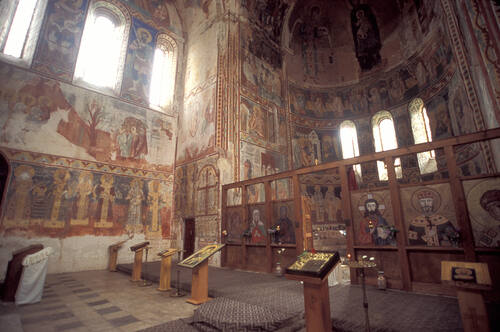 The Committee also took note that according to the international conservation architect appointed as a consultant for the Bagrati Cathedral that the incomplete structural condition of the Bagrati Cathedral was not sustainable, that it might not be feasible to reverse what has been recently built as the interventions are almost irreversible, and that a lightweight roof could be mounted on the existing concrete columns.
The Committee requested the State Party to produce a Rehabilitation Strategy that could allow the building to be brought back into use, while reversing the maximum amount of recent work and incorporating fragments of the original building where they form part of the walls.
The Rehabilitation Strategy was to be presented to the Committee for approval before a detailed rehabilitation project was submitted, and before any further work on the Cathedral was undertaken.
As also requested by the Committee at its 35th session, a joint World Heritage Centre/ICOMOS reactive monitoring mission visited the property from 22 to 28 April 2012 to discuss the Rehabilitation Strategy and to consider the overall state of conservation of the property.
At the time of drafting this report, only a preliminary mission report has been received. However, the report shows that a monumental re-building of the Cathedral using modern materials was well underway at the time of the mission.
The State Party submitted a State of Conservation Report on 31 January 2012. The report did not mention the fact that re-building work was well under way. The report addressed progress made with the drafting of the Rehabilitation Strategy for Bagrati Cathedral, with conservation work at Gelati monastery, and with drafting a retrospective Statement of Outstanding Universal Value. Further documents relating to the re-building of the Cathedral were submitted on 15 May 2012, after the mission had taken place. They included a revised Rehabilitation Strategy, details of the engineering work carried out, and a partial report on archaeological investigations, but no detailed plans of the re-building project.
a) Rehabilitation Strategy for Bagrati Cathedral
The State Party submitted a first draft of a Rehabilitation Strategy in January 2012. This was drafted following a round table discussion organised at the request of the State Party at the World Heritage Centre on 9 November 2011 and attended by representatives of the State Party, the World Heritage Centre, ICOMOS and ICCROM.
This meeting agreed that the purpose of the Rehabilitation Strategy was to set out a rationale for a project to allow the Cathedral to be brought back into use.
It was agreed that as the conservation history of Bagrati Cathedral is complex, and as recent interventions have to an extent limited certain options, the Rehabilitation Strategy needed to set out the necessary evidence to justify any rebuilding approach that was being suggested.
The meeting discussed a possible alternative approach to the monumental concrete option which could be based on a combination of reinforcement of the original parts of the fabric that had already been implemented (and agreed as being non-reversible), rebuilding using the four hundred or so stone blocks on site, where detailed evidence exists in the central and eastern part, and the insertion of modern construction in the west where evidence is lacking. The roof would be supported by lightweight steelwork and the whole construction would respect detailed archaeological research and allow for conservation of the original fabric. This approach would have the advantage of reversibility of the new construction.
The first draft of the Rehabilitation Strategy submitted by the State Party in January 2012 set out an approach based on recreating the eastern and central part of the Cathedral for which evidence exists, and completing the building with new structures at the western end where there is no evidence or little original material remains.
The draft Strategy was reviewed by ICOMOS who considered that in some places there was a need for further information and analysis in order to provide a clearer understanding as to the extent of the interventions to the fabric so far, the technical and conservation issues that these create. In general terms, ICOMOS considered that Strategy needed to be clearer on what could be reversed and what could not be reversed and how much of the existing recent work was needed from a structural point of view, what would be modified, and how new strengthening would be addressed. ICOMOS also considered that there was a certain amount of overlap between the strategy and the resulting project which needed to be resolved in the document. ICOMOS stressed that no approval had been given for the re-building project – as inferred in the draft strategy.
It was agreed that the reactive monitoring mission should discuss these comments with the State Party, so that a revised Rehabilitation Strategy could be submitted to the Committee at its forthcoming session.
This aim has however been overtaken by the resumption of work on the Cathedral which appears to have started after the last session of the Committee.
A second draft of the Rehabilitation Strategy was submitted by the State Party on 15 May 2012. However, as by this time reconstruction work was well under way, the purpose of the strategy as a document that could inform a reconstruction project is no longer relevant. The document has become a justification for work already carried out. In it the State Party concludes that the impact on the Outstanding Universal Value is negligible.
b) Stabilisation works of the Bagrati Cathedral
Although the State Party report states that some urgent stabilization works were undertaken to the west wall necessary for further supporting structures that might be needed for the rehabilitation strategy, as explained in a letter to the World Heritage Centre of 27 September 2011 to which the World Heritage Centre responded in the affirmative on 5 October 2011, the mission observed a very different situation.
Work on re-building the Cathedral was seen to be progressing non-stop to achieve a full reconstruction of the building, using stone-clad reinforced cement in the central and eastern parts, together with modern interventions in the western part, mostly along the lines of the original monumental project combined with the plans drawn up by the international conservation architect. A cast concrete cupola had already been partially raised up. The State Party confirmed to the mission that the inauguration of the Cathedral is being planned for September 2012.
The idea of restoring those parts of the building where evidence exists, on the basis of careful documentation and research, and conservation of the original fabric, has been abandoned.
c) Structural additions:
The mission was provided with information on the major structural interventions undertaken so far, and these have been confirmed in further information received from the State Party. These are:
- Completion of consolidation work on interior and exterior foundations of the load bearing walls;
- Creation of four central concrete pillars on the bases of the original ones;
- Installation of underground reinforced concrete beams, connecting the four pillars with the underground foundation of the exterior walls, which according to Georgian engineers, are placed under the archaeological level;
- Covering of the interior surface of the church walls with stone cladding, on a reinforced base – a totally irreversible process.
Although these works were stated to be necessary for the stability of the church in an earthquake zone, in reality these drastic interventions actually allowed the realisation of the first phase of the reconstruction project, in providing the necessary stability to allow for the proposed concrete cupola and the new roof.
d) Re-construction:
The mission observed the following work being undertaken:
- Western part:
In this end of the church, where inadequate original material and evidence exists for a full reconstruction, reinforced concrete beams have been installed in order to support the new stone and metal roof.
- North-west corner:
A metal construction has been prepared (with iron inserts into the original fabric), to support the new staircase and a lift that will lead to a first floor museum.
- Central part:
A reinforced concrete dome has been installed, theoretically supported by the four central concrete pillars together with concrete arches to supplement the concrete pillars, although the latter are still under construction. All the new (interior and exterior) surfaces are stone-clad. The only non-clad surface is in the area of the proposed museum. The gaps in the interior of the fabric are grouted with cement.
- Northern and southern wings:
Raised over the historical porticos with their famous stone reliefs, are reinforced concrete constructions, with iron supports for the metal roof covering.
- Eastern end:
This is being completed by continuing the reconstruction work of the 1950’s. It is being roofed over in a similar way to the rest of the building.
The mission observed that the current work has not been based on conservation of the existing fabric, some of which was acknowledged as being in an extremely fragile state during the previous mission in 2010, has not respected the archaeological layers, is not reversible.
Furthermore all these interventions have completely ignored the evidence brought to light by recent archaeological research. This identified the precise place of almost 400 of the original building stones that survived on the site. Of these, only two or three have been placed in their original position as examples.
In the Mission’s view the necessary stabilisation of the Cathedral could have been achieved in other less drastic ways and should have been submitted as part of the rehabilitation strategy for discussion.
The second draft of the Rehabilitation Strategy submitted by the State Party attempts to justify the reconstruction now being undertaken and states that the reconstruction will respect and rescue all the original material that existed at the time of inscription. However, the mission noted that only two of the four hundred fallen blocks were being re-used. The covering of the original fabric under a contemporary stone cladding on a reinforced concrete base will irreversibly damage the authenticity of the original structure, and also eliminate any historical evidence of the past interventions that are part of the history of the church.
In order to support the new reinforced concrete dome, excavations have been made in the central part of the church, to install additional sub-foundations for the parametric walls and large reinforced concrete beams have destroyed much of the archaeological layers, including, it appears, important discoveries of tombs inside the church, as reported in the media.
The overall approach was not considered by the mission to respect the aim to rehabilitate the church in a way that respected its fabric, archaeological layers and overall its Outstanding Universal Value, as had been envisaged by the Committee.
The second draft of the Rehabilitation Strategy states that at the time of inscription the monument was not totally in a ruined condition with parts reconstructed. This was accepted at the time of inscription but it is no justification for a monumental re-building that is being carried out without prior approval either as a strategy or in terms of detail by the Committee.
A detailed appraisal of this second draft Rehabilitation Strategy will be undertaken by ICOMOS and submitted to the State Party.
e) Topological and Archaeological Surveys around Bagrati Cathedral
The State Party report provides details of work undertaken to increase knowledge of the wider archaeological area around the Cathedral. In addition to topographic and cadastral surveys of the site carried out in early 2011, a non-intrusive archaeological survey of the entire Bagrati Cathedral part of the property was undertaken in November-December 2011. The results of this survey revealed a high density of archaeological layers in the survey area, including evidence of fortifications and royal residences.
The mission considered that the resulting data is highly important for understanding the significance of the context of the property. Such evidence could have been used as the basis of a Master Plan for the property and its setting to allow understanding of the way the area has evolved.
f) Gelati Monastery conservation work
The State Party reports that conservation works were continued within the framework of the Gelati Monastery Conservation Master Plan. The mission assessed the on-going works, which focused in 2011 on the Rehabilitation of the palace of Bishop Gabriel.
Through a cooperation agreement between the Restoration Faculty at the State Academy of Fine Arts (NACHPG) and Lugano University, and with the financial support of the Swiss National Science Foundation, international conservation specialists were involved in the stone and wall painting conservation programme during 2010-2011. Within the framework of a complex programme for the systematic conservation and restoration of the interior wall-paintings and mosaics in Gelati Monastery churches. As a result of this co-operation the following works were undertaken:
- Assessment of condition of mural paintings in the St. Marine chapel of the main church of Gelati;
- Stone condition assessment of the St. George church of Gelati and risk mapping;
- Conservation of carved stone frame around the entrance door of the St. George church of Gelati.
With the support of the NACHPG, it is planned to continue the involvement of these international specialists and with their associated students in future stone and wall painting conservation work.
The mission noted that the State Party has made significant progress in implementing the requested corrective measures regarding this component of the property.
A clear institutional coordination mechanism, ensuring that the conservation of the Gelati Monastery receives priority consideration within relevant governmental decision-making processes, has been established. A complex programme for the structural conservation and restoration of the churches in Gelati Monastery is being implemented.
The Gelati Monastery master plan presented in 2010 gives adequate answers to problems relating to the needs of the monastic community, and of the visitors to the monastic complex. The mission confirms that there is a proper organization of the functions inside the monastery grounds, taking into consideration the fact that the property is a living monument.
As already mentioned by the 2010 mission, there is also provision in case of a rising number of the monks, for them to be established in a nearby place, outside of the monastery grounds. The master plan dissociates the visitors’ facilities from the monks’ life, proposing that the new visitors’ buildings be erected outside the monastery grounds, while the visitors would follow an organized route inside the monastic complex.
g) Retrospective Statement of Outstanding Universal Value
The draft retrospective statement of Outstanding Universal Value submitted by the State Party is still under review by the Advisory Bodies.
Conclusions
The World Heritage Centre and the Advisory Bodies note the observations of the mission that notwithstanding the agreement between the World Heritage Centre and the State Party in November 2011 that only emergency work might be undertaken to stabilise the building, in reality a full-blown re-construction of the Cathedral is well underway, largely according to the monumental concrete and stone clad plans rejected by the Committee at its 34th session, but with a lighter modern construction at the western end.
The mission also noted that although exemplary investigative work has been undertaken on the monument and its surroundings, no attempt has been made to undertake an archaeological reconstruction using original stones, where they exist, nor to to conserve the original fabric, some of which was in a fragile state, and apparently no attempt has been made to protect the archaeological layers where reinforced concrete beams have been installed below ground, and the recently discovered tombs.
The World Heritage Centre and the Advisory Bodies note with disappointment that in spite of apparently positive meetings in 2011 between the State Party, the World Heritage Centre and the Advisory Bodies on the basis of a clear understanding that the Reconstruction Strategy should be developed and presented to the Committee for approval before any re-construction work was undertaken, and that such a strategy should acknowledge the need for a careful analysis of the existing fabric, and that some of the recent interventions should be reversed to give maximum exposure of the original stone, this strategic approach has apparently been ignored. Similarly, the Committee’s explicit request made at its 35th session, that it approve such a strategy before any commitment to rebuild was not respected. The World Heritage Centre and the Advisory Bodies also note that after almost complete implementation of the monumental project, the State Party has submitted in May 2012 a second draft of the Rehabilitation Strategy that attempts to justify the work underway without however providing an explanation as to why a solution that respects the original fabric and is reversible has not been developed. The World Heritage Centre and the Advisory Bodies recommend that the Committee express deep regret that the opportunity to undertake a careful, reversible reconstruction of the majority of the building based on clear evidence of what previously existed, with sensitive new work introduced where evidence is lacking, which could have allowed the Cathedral to be re-used and valued as part of contemporary society has not been taken. They consider that the decision to inaugurate a new reconstructed Cathedral of Bagrati in September 2012 has prevailed over the commitment of the State Party to implement the Committee's decisions to allow future removal of the property from the List of World Heritage in Danger, as well as over the responsibility to sustain the Outstanding Universal Value of the property.
While the State Party has made significant progress in implementing the corrective measures regarding the Gelati Monastery, they consider that the work undertaken at Bagrati Cathedral does not respect the Corrective Measures agreed by the Committee nor will it contribute towards achieving the Desired State of Conservation. The new work has overwhelmed the original masonry to such an extent that the authenticity of the Cathedral has been irreversibly destroyed. Bagrati Cathedral can no longer be said to contribute to the criterion for which the property was inscribed on the World Heritage List.
Draft Decision: 36 COM 7A.30
The World Heritage Committee,
1. Having examined Document WHC-12/36.COM/7A.Add,
2. Recalling Decision 35 COM 7A.29, adopted at its 35th session (UNESCO, 2011),
3. Welcomes the progress in the implementation of the rehabilitation programme and the conservation master plan for Gelati Monastery, as well as the progress in the establishment of a clear institutional coordination mechanism within the framework of the State Programme for Cultural Heritage in Georgia, involving all stakeholders concerned;
4. Notes with extreme concern that a reconstruction of Bagrati Cathedral is already well advanced, largely in line with plans, rejected by the Committee at its 34th session, for a monumental re-building using reinforced concrete, including a cast concrete cupola, and installing stone facing that covers much of the original stonework;
5. Further notes that, notwithstanding exemplary topological and archaeological surveys of the buildings, no attempt has been made to re-use the majority of the surviving fallen stones in their original places, in spite of the precise locations for some 400 stones having been identified;
6. Deeply regrets that no conservation of the original stonework has been undertaken, prior to the new work being started and that such work will now be impossible due to the irreversible nature of the recent interventions;
7. Expresses its great concern that, notwithstanding the production of a draft Rehabilitation Strategy for Bagrati Cathedral , as requested by the Committee, the subsequent comments by the Advisory Bodies, and the appointment of an international conservation architect, a strategic approach that would have optimised the retention of original stonework and allowed new interventions to be reversible and readily understood, has not been retained, and considers that the opportunity to bring the Bagrati Cathedral back into use, while at the same time sustaining its contribution to the Outstanding Universal Value of the property has been lost;
8. Also considers that the Bagrati Cathedral has been altered to such an extent that its authenticity has been irreversibly compromised and that it no longer contributes to the justification for the criterion for which the property was inscribed;
9. Deeply regrets that the decisions of the Committee at its 34th and 35th sessions have failed to protect Bagrati Cathedral;
10. Requests the State Party to submit, by 1 February 2013, a request for a major boundary modification for the property to allow Gelati Monastery to justify the criterion on its own;
11. Further encourages the State Party to seek the advice of the World Heritage Centre and the Advisory Bodies in developing the boundary modification;
12. Decides to retain Bagrati Cathedral and Gelati Monastery (Georgia) on the World Heritage List in Danger.
+++
31. Historical Monuments of Mtskheta (Georgia) (C 708)
Year of inscription on the World Heritage List 1994
Criteria (iii) (iv)
Year(s) of inscription on the List of World Heritage in Danger 2009 to present
Threats for which the property was inscribed on the List of World Heritage in Danger
a) Lack of a management mechanism;
b) Privatisation of surrounding land;
c) Loss of authenticity of some components due to restoration works conducted with unacceptable methods.
Desired state of conservation for the removal of the property from the List of World Heritage in Danger
Adopted, see page whc.unesco.org/4103
Corrective measures identified
Adopted, see page whc.unesco.org/4103
Previous Committee Decisions
See page whc.unesco.org/documents
International Assistance
Global amount granted to the property: USD 97,660
For details, see page whc.unesco.org/assistance
UNESCO extra-budgetary funds N/A
Previous monitoring missions November 2003, June 2008, March 2010 and April 2012:
Joint World Heritage Centre / ICOMOS reactive monitoring missions.
Factors affecting the property identified in previous reports
a) Lack of a management mechanism;
b) Lack of definition of property and buffer zones;
c) Privatisation of surrounding land;
d) Natural erosion of stone;
e) Loss of authenticity in recent works carried out by the Church;
f) Insufficient coordination between the Georgian Church and the national authorities.
Illustrative material
See page whc.unesco.org/708
Current conservation issues
 On 31 January 2012 the State Party submitted a detailed state of conservation report that addresses progress with the implementation of the corrective measures, including conservation work at Jvari Monastery, surveys of Svctitskhoveli Cathedral, clarification of boundaries and progress with the Management Plan. Details are also provided regarding a proposed visitor centre at Jvari Monastery.
A joint World Heritage Centre / ICOMOS reactive monitoring mission visited the property between 23 and 28 April 2012, as requested by the World Heritage Committee at its 35th session (UNESCO, 2011).
a) Boundaries issues
The State Party has submitted to the World Heritage Centre updated retrospective cartographic documentation clarifying the boundaries of the property. However, the mission reported that there has not yet been any definition of the buffer zone. This work is seen as a pre-condition for the development of the Management Plan and for possible minor boundary modification of the property.
b) Management Plan
The State Party reported that the drafting of the Management Plan will take place during 2012 within the framework of an approved International Assistance Request and with the support of the National Agency for Cultural Heritage Preservation. This project will also consider the management system for the property and the possibility of establishing working groups to allow for the participation of representatives of the church authorities, NGOs and the Mtskheta civil society. The mission stressed the need for the Management Plan to acknowledge that the property is an ensemble of religious monuments within a very sensitive historical environment and thus needs to be managed as a cultural landscape.
c) Long-term consolidation, conservation and monitoring measures
The State Party reported that during 2012, a comprehensive conservation assessment of archaeological components of the property was undertaken and recommendations set out for their management. Conservation work was carried out on the roof, walls and stone plaques of the Jvari monastery, with the participation of an ICCROM expert, and of the wall paintings in the southern part of Svetitskhoveli Cathedral. At the Cathedral, another capacity-training project headed by an international expert addressed the production of up to date measured drawings during 2010-2011. This resulted in a full set of measured drawings for the Cathedral that will form the basis for developping of a comprehensive conservation plan. At Samtavro nunnery, a project is being prepared to strengthen the southern support wall taking into account the 2010 mission recommendations.
The State Party reported that in 2011 the National Agency for Cultural Heritage Preservation had allocated a special budget for monitoring of the property. In addition, a special project was implemented for monitoring the groundwater fluctuations around Svetitskhoveli Cathedral. It is anticipated that by the end of 2012, additional monitoring mechanisms will be proposed for all elements of the property.
d) Proposal for a Visitor Centre at Jvari Monastery
The State Party included in its report revised plans for the visitor centre at Jvari Monastery. These are said to take into account the comments made by ICOMOS on the initial plans in 2011. These plans will now be reviewed by ICOMOS and comments sent to the State Party.
e) Urban Land-Use Master Plan
At the initiative of the local authorities, work has begun on a systematic data collection of the urban topology, related development and other studies. This data will form the basis for an Urban Master Plan of the town which is being prepared and is due to be completed by the end of the year.
f) Urban development pressure
The 2010 mission report highlighted the need for special care to be given to the sensitive area extending along the river Mtkvari bank, between the Svetitskhoveli Cathedral and Jvari church. It recommended that the area where the rivers converge should not be developed and that the historic landscape be restored. However, the 2012 mission noted that the State departments, in cooperation with the local authorities have proceeded with the construction of new administrative buildings (Police and Courts buildings and Conference Hall) in this area. The 2012 mission was also informed that a new Museum building is to be erected on the same area, the plans of which have already been approved, as well as a hotel complex. The mission also saw a new tourist information building in front of the entrance of the Svetitskhoveli Cathedral, constructed in inappropriate style without any respect of the property’s value.
The 2012 mission noted that these considerable developments have been undertaken within one of the most sensitive areas of the property, in the visual corridor between the Svetitskhoveli Cathedral and the Jvari hill, is currently being assessed independently of the directions that may be developed by the Urban Master Plan and the Management Plan that are both under preparation. The mission further noted that although all these interventions have an immediate impact on the property, they have not been notified to the World Heritage Centre, in line with Paragraph 172 of the Operational Guidelines.
g) State Programme for Cultural Heritage in Georgia - towards a strategic World Heritage country programming
The World Heritage Centre has been informed by the World Bank that a “Regional Development Program: An Integrated Approach to Urban Regeneration, Cultural and Natural Heritage for Economic Growth and Job Creation” is under implementation in Georgia. On 23 April 2012, the Minister of Finance of Georgia presented an “Innovative Approach to Regional Development” during a meeting organised by the Cultural Heritage and Sustainable Tourism Thematic Group, the Europe and Central Asia (ECA) Sustainable Development Department and the South Caucasus Regional Management Unit at the World Bank Headquarters.
The 2012 mission has been informed that the Governor of Mtskheta discussed with the World Bank representative the possibility to extend this project to Mtskheta. The mission recommended to the authorities to establish, in coordination with the World Heritage Centre and the Advisory Bodies, a global approach for all projects and activities which could be developed for the World Heritage properties in Georgia.
During the meeting with the Deputy Minister of Foreign Affairs of Georgia and the National Commission of Georgia for UNESCO, the mission underlined the urgency to develop this global approach towards a strategic World Heritage country programming in coherence and alignment with the State Programme for the protection of Georgian cultural heritage prepared by the National Agency for Cultural Heritage Preservation. It was discussed that this country-based approach could be developed using the 5C Strategic Objectives in order to achieve greater coherence, efficiency and effectiveness at country level of all activities related to the protection, management and use of the World Heritage properties, and to avoid fragmentation and duplication of projects and activities.
Conclusions
The World Heritage Centre and the Advisory Bodies note the detailed report from the State Party which includes and assessment of what has so far been achieved – identified as strengths, and its conclusion that the main weakness is the lack of a Management Plan and of a consolidated vision for the development of the property, both of which will be addressed this year.
The World Heritage Centre and the Advisory Bodies wish to highlight to the Committee their concern that despite the 2010 mission recommendation regarding the sensitive area extending along the river Mtkvari bank, between the Svetitskhoveli Cathedral and Jvari church, the State Party authorised new constructions in this area and plans new developments which will impact on the Outstanding Universal Value of the property, without any submission of these projects to the World Heritage Centre, in conformity with Paragraph 172 of the Operational Guidelines, for review and comments prior to any approval.
The World Heritage Centre and the Advisory Bodies underscore the fact that Mtskheta is an ensemble of religious monuments within a very sensitive historical environment. Taking into account that the most sensitive areas of Mtskheta’s landscape are being compromised by new buildings, they recommend that the World Heritage Committee retains the Historical Monuments of Mtskheta (Georgia) on the List of World Heritage in Danger.
The World Heritage Centre and the Advisory Bodies suggest that the World Heritage Committee might recommend that the State Party develop a national law for all World Heritage properties in Georgia, as well as initiate a “5C strategic World Heritage country programme” proposal. This could serve as a consolidated basis for cooperation within the country to enhance the implementation of its commitments within the framework of the World Heritage Convention and take into account the need for a more sustainable longer-term approach. It could be developed on the basis of the analysis of the challenges, corrective measures and the national priorities and strategies as set out in the Periodic Report.
Draft Decision: 36 COM 7A.31
The World Heritage Committee,
1. Having examined Document WHC-12/36.COM/7A.Add,
2. Recalling Decision 35 COM 7A.30 adopted at its 35th session (UNESCO, 2011),
3. Acknowledges the detailed information provided by the State Party on the progress made to implement the corrective measures and urges the State Party to continue its work on all the corrective measures adopted at its 34th session (Seville, 2010);
4. Also urges the State Party to define the buffer zone of the property to allow a clear understanding of the archaeological and visually sensitive areas around the property and to submit this proposal as a minor boundary modification of the property;
5. Expresses its great concern regarding developments being undertaken by the State Party in the vicinity of the property within the area of the river Mtkvari bank, between the Svctitskhoveli Cathedral and Jvari church, and further urges the State Party to halt developments within the property and its setting until details of proposed developments, together with Heritage Impact Assessments, have been submitted to the World Heritage Centre, in conformity with Paragraph 172 of the Operational Guidelines, for review and comments by the Advisory Bodies before any irreversible decisions have been made;
6. Notes that the State Party intends to complete a Management Plan for the property by the end of 2012, requests the State Party to ensure that this Plan recognises that the property is an ensemble of religious monuments within a very sensitive historical environment, and also requests it to submit the draft of this plan to the World Heritage Centre for review by the Advisory Bodies;
7. Invites the State Party to consider the development of a national law for all World Heritage properties in Georgia;
8. Further requests the State Party, in coordination with the World Heritage Centre and Advisory Bodies, to develop a “5C strategic World Heritage country programme” proposal, based on the State Programme for the protection of Georgian cultural heritage, to serve as a consolidated basis for cooperation within the State Party to enhance the implementation of its commitments within the framework of the World Heritage Convention;
9. Requests furthermore the State Party to submit to the World Heritage Centre, by 1 February 2013, an updated report on the state of conservation of the property and the implementation of the above, for examination by the World Heritage Committee at its 37th session in 2013;
10. Decides to retain the Historical Monuments of Mtskheta (Georgia) on the List of World Heritage in Danger.
Timeframe for the implementation of the corrective measures
Adopted, see page whc.unesco.org/4103
Subscribe to:
Posts (Atom)