Showing posts with label Ushba. Show all posts

Monday, January 29, 2018

VIDEO: Climb Ushba and make a first descent on skis - via @thenorthface ‏


Late season 2017. Samuel Anthamatten, Markus Eder, & Leo Slemett head to Svaneti Georgia to hopefully climb Ushba and make a first descent on skis. This mystical 4710m mountain in the Caucasus Mountains is very remote and must be accessed on foot. Before the ascent the crew gets to warm up the legs and experience some of the best skiing they have ever had in a wild heli-ski session in epic conditions.

Direction: Guido Perrini
Actors: Samuel Anthamatten, Leo Slemett, Markus Eder
Production: Timeline Missions
Production Country: Switzerland, 2017


The 4710-meter-high Mount Ushba has long held a strong attraction for the Swiss freerider Samuel Anthamatten. In July 2017, he traveled to Georgia with Léo Slemett, winner of the Freeride World Tour 2017, and the South Tyrolean freerider Markus Eder, to descend the most distinguishable peak of the Caucasus Mountains for the first time on skis and to find out if the Caucasian powder delivers on its promises.


Main photography by Tero Repo


Sam Anthamatten Interview | The North Face Skier on His Quest to Make History on Mount Ushba. By Stuart Kenny [mpora.com]

Tuesday, September 05, 2017

VIDEO: უშბის სარკე • Ushba's Mirror. Attempt and heavy stonefalls. By Archil Badriashvili


More Videos by Archil Badriashvili

Thursday, August 16, 2012

BLOG: Svaneti, as good as it gets! Text and photo Eistein Guldseth, 2012 (gotocaucasus.com)

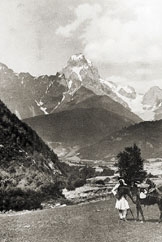
The dramatic nature of Svaneti is dominated by the mighty Mount Ushba with it's caracteristic double-speared summit at 4710 meters. It's regarded as one of the most difficult mountains to climb in the Caucasus.
Original Post With Perfect Photos!! >>>

(gotocaucasus.com) SVANETI IS THE MOST EXTREME part of Georgia. I have been traveling in Georgia since 2004, but there has always been something stopping me from carrying out my Svaneti trip. One year there was terrible weather, another year the region was seized by Gen. Kvitsianis paramilitary forces. Something has always been in the way. But this year we went, and what a trip it was. But the backdrop was rather tragic:

Four Ukrainian climbers had an accident on Mt. Ushba the week before. Two of them died. During the rescue operation, two Chech climbers who disappeared after an accident in 1974 were also found.

How to get there

From Tbilisi you drive to Zugdidi, and take the road to Mestia wich is the centre of Svaneti. It is about 130 kms drive. No need for any 4WD. But beware of falling rocks when its raining. You can also go by plane, as the city has a small airport. But it's not Mestia you want to see. That is Ushguli, the World heritage site, and for that you need a 4WD. It's 44 km into the mountains and at 2200 meters altitude. More about that later.

First you go to Hotel Mestia.

Mestia is a dustbowl, but Hotel Mestia as an oasis. Here you get high quality food and great accomodations. The first thing you do is go to Vitali Japaridze at Hotel Mestia and order his Svaneti special "kubdari", a bread with very spicy meat inside. All food is cooked on a traditional stove with firewood. The hotel is a perfect basecamp for trekking. Vitali will give you all information you need. If you prefer more modest accomodations there are a lot of guesthouses available for self household.

Svaneti is for trekkers and climbers.

The hardcore climbers try Mt. Ushba. It's 4710 meters high summit has claimed many lives through the years. Most professionals these days hire local guides. There is of course Mt. Shkhara in Ushguli. It's considered to be Georgia's highest mountain (5068 m) and Europe’s fourth highest after Elbrus (5643m), Dychtau (5204m) and Koshtan (5151 m) according to Summitpost org. You can also hire a guide and spend four days trekiking from Mestia to Ushguli. You can also drive from Mestia to Ushguli. For that 44km trip (one way) you need a 4WD, patience and 3 hours. The track is easy. There are lots of possibilities, just ask Vitaly, or check out internet. For me Ushguli was the ultimate goal.

On UNESCOS word heritage site list

I quote the UNESCO site here: "The mountainous region of Upper Svaneti occupies the upper reaches of the lnguri river basin, between the Caucasus and Svaneti ranges. The characteristic landscape of Upper Svaneti is formed by small villages, dominated by their church towers and situated on the mountain slopes, with a natural environment of gorges and alpine valleys and a backdrop of snow-covered mountains. The most notable feature of the settlements is the abundance of towers, especially in Mestia and the frontier villages, such as Ushguli and Latali".

Wednesday, August 15, 2012

CLIMBING: 2011: Ushba (4,710m), south pillar, Harakternik. By Lindsay Griffin, Mountain INFO (aaj.americanalpineclub.org)

(aaj.americanalpineclub.org) By Lindsay Griffin, Mountain INFO, from information supplied by Anna Piunova, mountain.ru 

Ushba (4,710m), south pillar, Harakternik. 

http://aaj.americanalpineclub.org/wp-content/uploads/2012/05/PiunovaUshbaSpillarRL4Inchweb.jpg
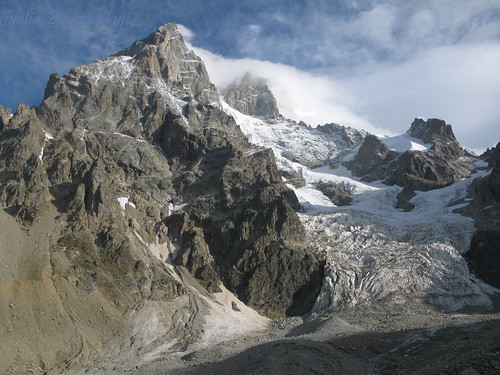
Ushba from south. Northwest summit (4,694m, left) and Southeast (Main) summit (4,710m). Normal route to Northwest summit (Almer-Cockin, 1888, 4A) reaches gap between summits from far side. (1) Artsishevsiy, 1971, 5B. (2) Grigorenko-Prigoda, 1972, 5B. (3) Myshliaev, 1962, 5B. (4) Voloshanovskiy, 2010. (5) Monogarov, 1960, 5B. (6) Harakternik, 2011, 6A. (7) Kensitskiy, 1972, 5B. (8) Kustovskiy, 1962, 6B. Supplied by Anna Piunova
Ukrainians Igor Chaplinsky, Michel Formin, and Vitali Todorenko climbed directly up the famous south pillar of Ushba, adding 130m of possibly new ground on the steep central section. The center of the pillar was climbed to two-thirds height in 1960 by Monogarov and his team, who then slanted up left, leaving the final prow unclimbed. In 1962 the left flank of the pillar was climbed by Myshliaev (who joined the upper section of the Monogarov route) and the right side by the celebrated Kustovskiy route. In 2010 a Ukrainian team led by Mishel Voloshanovskiy climbed a little left of the Monogarov, joining it as it slants left, and claimed a new line. However, it appears they were close to or on a little-known route climbed in 1981 by Golubev and partners, who also slanted left at Monogarov’s bolts. The climbing history of one of the most famous mountains in the Caucasus is thus complex and not well documented. In 2011 a team from Krasnoyarsk claimed a new line on Ushba, only to find it had been done before. Chaplinksky, Formin, and Todorenko followed the (possibly new) line climbed by Voloshanovskiy but, instead of slanting left, continued up the prow directly to the top of the south pillar.


The south face is ca 1,500m high. In early July the three Ukrainians first climbed 900m up easy rock (2-3) and glacial terrain, followed by 300m on the crest of the ridge to where things became difficult. About nine pitches (max 5b) led to the base of the pillar. The next three pitches gave largely free climbing, up to 6c, with short sections of A2 and A3 (skyhooks and Iron Hawks/birdbeaks). About four more pitches, up to 6c and A3, took them to an overhanging section. To this point they had followed the line climbed in 2010. The next 130m provided the crux, beginning with a 25m overhanging wall (A3). More 6b and aid took them to the top of the pillar.

On the upper section most ascents follow the right side of the final buttress, the Red Corner. These Ukrainians climbed the center in four fine pitches of 6a. They bivouacked on the final ridge and reached the summit at 8 a.m. on July 7. Starting down by the classic 1903 Heibling-Schulz Route (5A) on the southeast and east flanks, they found the snow too dangerous and bivouacked again, continuing their descent early next morning. Total time spent on the mountain was five days, and the route was named Harakternik (6A, 6c and A3). They had been lucky with the weather, which was still a bit wintry, being hampered only by a strong wind.

Thursday, August 02, 2012

KAUKASUS: Der Ushba im Historischen Alpenarchiv (historisches-alpenarchiv.org)

Uschba Nordgipfel, 1936


Uschba, 1936


Auf dem Uschba, 1935


An der Uschba Südwand, 1935


Abstieg vom Uschba Nordgipfel, 1936


Abseilen an der Uschba Südwand, 1935


Weiteres Archivmaterial: www.historisches-alpenarchiv.org

BIOGRAFIE: Das Uschba-Mädl Cenzi von Ficker. Von Gerhard Schirmer (bergnews.com)

Das Uschba-Mädl Cenzi con Ficker
(bergnews.com) 1903 wurde unter der Leitung von Dr. Willi Rickmer-Rickmers eine Kaukasus-Expedition ausgerüstet, an der auch die sehr gewandte Bergsteigerin Cenzi von Ficker teilnahm. Das wichtigste Ziel dieser Kundfahrt war die erste Ersteigung des Uschba-Südgipfels, der eine Seehöhe von 4698 m aufweist.


Der Kaukasus hatte die Bergsteiger schon sehr früh fasziniert. So konnten beispielsweise bereits 1888 Engländer in der Besengi-Gruppe den Schchara ersteigen, 1890 stand der Italiener Vittorio Sella auf dem Zichwarga-Ostgipfel (Laboda- und Sugan-Gruppe) und 1891 erreichten Gottfried Merzbacher und Ludwig Purtscheller den höchsten Punkt des Sullukol-Basch in der Dschailük-Gruppe. Der Uschba-Nordgipfel fiel bereits 1888, der wilde und schwierige Südgipfel war jedoch noch bis 1903 Neuland.


Der geschenkte Berg
Rickmers Expedition wurde jedoch zunächst vom Pech verfolgt. Am 21. Juli stürzte A. Schulze in der Uschba-Schlusswand als Führender einige Meter ins Seil. Er zog sich einige Verletzungen zu und musste abgeseilt werden. Cenzi von Ficker versorgte den Verunglückten, dann stieg man ins Standlager ab. Doch der zähe Schulze gab sich nicht so leicht geschlagen, bereits am 26. Juli stand er gemeinsam mit Helbling, Reichert, Schuster und Weber auf dem Gipfel; die Cenzi war allerdings nicht dabei. Nur 18 Tage danach gelang dann der Seilschaft Georg Leuchs, Hans Pfann und Ludwig Distel die erste vollständige Uschba-Überschreitung von Norden nach Süden. Und dann geschah etwas Seltsames, in der Chronik des Bergsteigens vollkommen Einmaliges: Fürst Tatarchan Dadeschkeliani von Swanetien, der vom Können und vom Mut Cenzi von Fickers tief beeindruckt war, schenkte ihr den Berg Uschba! (Die Schenkungsurkunde bekam später das alpine Museum in München - historisches-alpenarchiv.org) Ganz ohne Gipfelsieg fuhr die Cenzi damals aber nicht nach Hause, sie nahm an der ersten Ersteigung des Schtawler (3976 m) und eines bis dahin namenlosen Gipfels (3860 m) teil, der ihr als "Tsentsi-Tau" zum ewigen Denkmal wurde.


Leilakette vom Gul - Tau (ca. 3200 m) in der Uschbagruppe (Kaukasus)
Schenkungsurkunde Uschba für Cenzi von Ficker


Cenzi von Ficker, die in eine Innsbrucker Gelehrtenfamilie hineingeboren wurde, kam durch ihren Bruder Heinz schon früh mit dem Bergsteigen in Berührung. Über ihn lernte sie zahlreiche Vertreter der damaligen alpinen Elite wie etwa Anton Schönbichler, Otto Ampferer oder Karl Berger kennen, die die ebenso hübsche wie talentierte Cenzi stets gerne auf schwierige Bergtouren im Karwendel und Wetterstein mitnahmen. 1908 heiratete sie den Wiener Rechtsanwalt Dr. Hannes Sild, einen gleichfalls sehr bekannten Bergsteiger, der ihren Bruder Heinz in dessen "führenden" Rolle ablöste.


Der Weltkrieg machte vorerst alle privaten Pläne zunichte. Hannes Sild kämpfte als Offizier bei den Kaiserjägern erst in Galizien, dann an der Dolomitenfront, wo er schließlich 1917 so schwer verwundet wurde, dass er aus dem Kampfgeschehen ausscheiden musste.


Der Uschba aus dem Betschotal um 1929.Schicksalsschläge
Nach Kriegsende - Hannes war inzwischen glücklicherweise wieder genesen - meisterte das Ehepaar die schweren wirtschaftlichen Folgen, die der Zusammenbruch der Monarchie nach sich zog, und brachte es rasch zu beruflichem Erfolg und privatem Wohlstand. Die beiden gingen wieder in die Berge und nahmen dabei auch ihre drei Söhne mit, aus denen bald ebenfalls tüchtige Bergsteiger wurden.


1937 brach über die bisher so glückliche Familie Sild das Unglück herein. Im Hochschwab-Gebiet verunglückte der Sohn Uli tödlich, und wenige Monate später starb der bereits todkranke Vater Hannes. Im Zweiten Weltkrieg fielen die beiden jüngeren Söhne Henning und Meinhart, und damit war die Familie Sild - bis auf die Mutter - ausgelöscht.


In den Folgejahren versuchte Cenzi Sild verzweifelt, der Einsamkeit zu entfliehen. Noch erfreute sie sich bester Gesundheit, und so zog sie ins Karwendelhaus, wo sie den mit ihr eng verbundenen Bewirtschaftern jahrelang eine wertvolle Hilfe war. 1956 erlebte sie urplötzlich einen totalen Zusammenbruch ihrer Kräfte, von dem sie sich nicht mehr erholen sollte. Die Familie Dr. Drexel, mit der sie eng befreundet war, nahm die Schwerkranke auf Burg Stauf bei Nürnberg auf, wo sie nur sechs Tage vor ihrem 78. Geburtstag friedlich entschlafen ist.


Steckbrief
Cenzi Sild, geb. von Ficker, geboren am 1. 9. 1878 in Innsbruck, gestorben am 26. 8. 1956 auf Burg Stauf bei Nürnberg
Gatte: Dr. Hannes Sild, Rechtsanwalt, gest. 1937
Söhne: Uli (abgestürzt 1937), Henning, Meinhart (beide im Zweiten Weltkrieg getötet)


Links
austria-lexikon.at//Biographien/Cenci von Ficker
historisches-alpenarchiv.org/gedenkblatt.pdf
Vergessene Erfolge: Die Anfänge des Damen-Kletterns.pdf
raetia.com/Frauen im Aufstieg.pdf
rb-media.net

Thursday, May 31, 2012

DOKUMENTARFILM: Die Swanen - Leben mit den Ahnen (arte.tv)


Seit Jahrhunderten siedelt der georgische Volksstamm der Swanen in einem Hochtal, umschlossen von den rund 5.000 Meter hohen Gipfeln des Kaukasus-Massivs. Isoliert durch die Abgeschiedenheit der Berge, haben die Swanen bis heute eine eigene Kultur und eine eigene Sprache bewahren können. Die Wirtschaftsweise der Menschen hat sich hier seit Jahrhunderten kaum verändert. Noch heute transportieren die Swanen schwere Lasten auf den traditionellen Ochsenschlitten über das unwegsame Gelände. Mit einfachen Geräten ringen sie ihren kargen Böden das Nötigste zum Leben ab.


Die frühe Christianisierung der Swanen führte zur Entwicklung volkseigener Praktiken. Neben einem ausgeprägten Ikonenkult pflegen die Menschen hier ein besonderes Verhältnis zu ihren Verstorbenen. Sie glauben fest daran, dass die Seelen der Toten in regelmäßigen Abständen wieder zurückkehren und sich die Ahnen weiter um das Heil der Lebenden kümmern. Das ist ein Grund, warum die Swanen ihr Land so gut wie nie verlassen.


Die rund 40 Dörfer Swanetiens sind geprägt von mittelalterlichen Wehrtürmen. Fast jeder Hof hat einen solchen Turm. In Kriegszeiten oder während Blutfehden boten sie den Sippen Schutz vor ihren Feinden. Obwohl Swanetien offiziell zu Georgien gehört, haben die Swanen eine eigene lokale Gerichtsbarkeit. In Streitfällen schlichtet ein Ältestenrat. Kapitalverbrechen wie Mord oder Totschlag bedeuten auch heute noch Fehde und Blutrache. Swanetien steht für ein Leben wie in vormodernen Zeiten.


(Deutschland, 2011, 43mn)
ZDF


Erstausstrahlungstermin: Heute, 16:45


weitere Ausstrahlungstermine: Mittwoch, 6. Juni 2012, 08:55


Link: videos.arte.tv

Tuesday, May 22, 2012

TRAVEL: Svaneti – Europe’s Paradise Rediscovered (parexcellencemagazine.com)


grand-hotel-ushba
Grand Hotel Ushba - as close to heaven as you can get


(parexcellencemagazine.com) "During the first hotel season, I think the only complaint we got were from guests about the word 'probably' in our slogan 'Probably the best hotel location on earth'. All those who complained thought we we should take away that word; they strongly believed that they had stayed at the "best hotel location on earth”. - Richard Bærug.


Norwegian-born Richard Bærug is proud of having got involved in a what first seemed to be a modest hotel project in the most beautiful and mountainous part of Georgia and Europe – the remote and somewhat mystical region of Svaneti. During a hiking tour in the summer of 2009 he bounced into the local Argvliani family that possessed two buildings, one of which they wanted to turn into a small hotel. They immidiately decided to cooperate.


"I have been working in the travel industry for many years, but I have never seen such a location as this," Bærug admits.


Precisely one year after they met - on 14 June 2010 the doors of Grand Hotel Ushba were opened for guests at this peaceful mountain resort in the Becho valley at the very foot of the impressive Queen of the Caucasian mountains, Mountain Ushba (4710 m). It has become a target destination for those that have done and seen "everything” and want to bring their travel experiences to new and unbelievable altitudes and emotions.


The mother in the local Svanetian family, Vardo Ushkhvani is the soul of the house. A 66-year young school teacher, she is an excellent chef and a multitalented and strong woman. She makes excellent and delicious „kubdari” (bread filled with spicy meat), „khachapuri” (cheese bread), „achma” (multi-layered cheesebread), „ostri” (meat with tomatoes and onion), „khinkali” (dumlings), excellent cheese, a series of tasty juices and not to forget her own salt and spices collected on the beautiful Svanetian meadows. The Svan cuisine is combined with some of the most extraordinary Georgian wines like Kindzmarauli, Khvanchkara, Saperavi and Mukuzani to mention a few.


Vardo is the key person in several activities offered at the hotel. She organises cooking courses and she teaches people to make the unique Svan hats. Her youngest son Levan is an experienced mountain guide and brings hotel guests to some of the most beautiful spots in the Caucasian mountain world. June is the month when nature explodes in an incredibly symphony of intensive flower colours. The alpine meadows have to be seen in order to believe their beauty, this is also the time when the yellow and white rhodedendron forests wake up around and next to the hotel. The family has several horses and they can be recommended on the steep hike up to the fabulous Mukhere mountain above the mountain village of Latali. During the Middle Ages the mountain used to house what was known as Europe’s highest located monastry at 2700 meters. Now the charming church is restored and from the remains of the monastery a breath-taking view towards most of the highest peaks in the Caucasus opens up. No wonder the munks chose this place to be as close to God as possible.


Ever dreamt about finding gold? Svaneti is the right place to try your luck. According to legends gold drew the argonauts and the greeks to the Caucasus, and on the banks of the strong and sometimes furious Engure river most people can find pieces of gold during one hour of digging.


The older son of the Argvliani family, Arkadi is a multitalented artist and artisan who also make sure that excellent crosscountry skiing tracks are prepared for both guests and locals in the magnificent snow landscape in the upper Becho valley around the hotel. The snow season streches from November till the end of April. Slalom and downhill skiing is possible at the neighbouring resort of Hatsval. Mountain biking and mountain climbing are examples of other activities out in the amazing Svanetian nature.


Svaneti has for ages been considered as a haven of peace, too remote and high for enemies to reach. It was to Svaneti historically Georgian queens and kings brought their most astonishing icons and other valuable items in times of war and unrest. Here they were safe. This historical fact is also one of the reason why the Museum in Mestia has an extraordinary collection of orthodox icons and other historical treasures. Visiting some of the small Svanetian churches with the most beautiful icons and wall-paintings reinforces the feeling of being blessed as a traveller.


Svaneti has kept much of the traditions that elsewhere in Europe have been lost. Paying a visit to the mountain village of Ushgul is like travelling back in time. Wandering around the spectacular Svan towers – the skyscrapers of the Middle Ages – man looses the feeling of time or on the contrary feels that he or she is brought back to the Middle Ages. Needless to say, Ushgul is on UNESCO’s World Heritage list.


Some Facts about the Svaneti region of the Republic of Georgia:


Svaneti, is a historic province in Georgia, in the northwestern part of the country. Located on the southern slopes of the central Greater Caucasus, Svaneti is the highest inhabited area in Europe. Since 1996 the Upper Svaneti region has been included in the UNESCO's World Heritage List "considering that the region of Upper Svaneti is of outstanding universal value being an exceptional landscape that has preserved to a remarkable degree its original medieval appearance, notable for the distribution, form, and architecture of its human settlements." "The Upper Svaneti region of the Caucasus is an exceptional example of mountain scenery with medieval-type villages and tower-houses preserved by its long isolation. The characteristic landscape of Upper Svaneti is formed by small villages, dominated by their church towers and situated on the mountain slopes, with a natural environment of gorges and alpine valleys and a backdrop of snow-covered mountains."


"The wealth of monumental and minor art (metal work, manuscript illustrations, textiles and embroidery, wood-carving, icon painting, ancient forms of musical and oral folklore, vernacular architecture) are of paramount importance for the study of Georgia and the Caucasus. The monumental mural painting of Svaneti is of great importance in the study of the origins and development of Georgian and eastern Christian art." UNESCO World Heritage Centre whc.unesco.org


Mt. Ushba ( 4710 meters from the sea level), described as "the Queen of Caucasus", is the most spectaculous and rough mountain of Caucasus. Ushba is known as the "Matterhorn of the Caucasus" for its spire-shaped double summit. From the point of view of mountain climbing Ushba is considered to be the most dramatic to ascend and is considered as one of the most difficult peak in the world.


About Grand Hotel Ushba:


Grand Hotel Ushba was opened on 14 June 2010 at the foot of one of Europe's highest mountain, Mt. Ushba. The hotel has a total of 7 guest rooms, all designed in a simple and tasteful way. All the guest rooms have a mountain view. The Ushba Suite has an overwhelming view towards the Ushba summit (4710 m) in the northeastern direction.


Some of the Activities offered by Grand Hotel Ushba guests are:


Mountain climbing tours
Skiing: Off-piste skiing and Cross-country skiing
Mountain hiking, flower hiking and mineral water hike
Horseriding and biking
Trips: trip to Ushguli (UNESCO World Heritage site), museum trip to Mestia, a helicopter trip above the mountain world of Svaneti with views towards Ushba and other peaks and trips outside Svaneti
A church tour and a concert with Svan song and music
Courses: cooking course, the Svan language course and Svan felt hat making course
Other activities: wine tasting, gold digging and a visit to a Svan farm

To learn more about Grand Hotel Ushba in the Svaneti region of Georgia please visit the website: www.grandhotelushba.com
 
Follow Grand Hotel Ushba on Twitter: twitter.com/grandhotelushba
 
Catch up with the latest news via Facebook: GrandHotelUshba
 
Blog: grandhotelushba.blogspot.com

Wednesday, August 04, 2010

VIDEO: North Ushba from Georiga (youtube.com)

Thursday, November 05, 2009

HISTORY: Wie die Berge zu ihren Namen kamen ... (derstandard.at)

Eine liebenswürdige Ausnahme im Nomenklaturenkrieg ist eine Namensschenkung im Kaukasus. 1903 war die Bergsteigerin Cenzi von Ficker, Tochter einer Tiroler Gelehrtenfamilie, Mitglied einer erfolgreichen Expedition zum Südgipfel des Uschba (4737 Meter) im Kaukasus. Ihr schenkte - beeindruckt von der attraktiven Alpinistin - der Fürst der kaukasischen Region Swanetien, Tatarchan Dadeschkeliani, urkundlich beglaubigt den Berg Uschba. Cenzi von Ficker gelang zum Abschluss der Expedition noch die Erstbesteigung eines bis dahin namenlosen 3860 Meter hohen Gipfels, der seither als "Tsentsi Tau" im Register des Alpine Club of London vermerkt ist.

photo by Natia Zhorzheta, Ushba in Svaneti

Tuesday, March 11, 2008

PHOTOGALLERY: Svaneti by Vittorio Sella in 1886-1890


Svaneti by Vittorio Sella in 1886-1890 (Set)

Vittorio Sella, a famous Italian mountaineer and photographer of the 19th century, spent considerable time exploring the wonders of Svaneti. Photographs taken during his travels there reveal the people who have also been influenced by their natural environment. They are tall like their mountains and their eyes are as blue as the Svanetian sky. Vittorio Sella travelled to Svaneti and Racha three times and mounted 30 peaks. He compiled a valuable material on Georgia. His photographs were exhibited in London in 1890 and received the highest award by the Royal Geographic Society.

In 1889-1890 the famous mountain-climber and pioneer of photography, Count Vittorio Sella made a number of climbs in Svaneti. Earlier he participated in the expeditions in the Alps, Africa and Asia, Alaska. He created an impressive series,which was later exhibited by the British Geographical Society. His studies, pictures and diaries were collected by his ancestor Lodovico Sella.

The interest toward Sella's figure revived, when the famous public figure end documentary film director Rezo Tabukashvili found and managed to bring to Tbilisi the collection of pictures taken by Sella in Svaneti and Racha.
One of the Caucasian peaks still bear the name of Vittorio Sella. These pictures represent the best samples of the photography of late XIX century. According to the famous American photographer Ansel Adams, the purity of Sella's interpretation inspires religious reverence. V. Sella photos are kept in the State CinemaPhotoPhono Archive.

Svanetia Land in Caucasus.
Italian photographer and alpinist Vittorio Sella in his book gave the description of Mt. Ushba seen from the upper course of the Ingur river, Svanetia: "Behind this village a much more ancient sovereign dominated the valley from on high: Mt. Ushba, the mountain of rain. At dusk this soaring peak is sublime in the elegance of its indomitable forms, if at first glance it is surprising, upon closer observation its fantastic lines simply fascinate one. The white pyramid of Mt. Tetnuld in the distance and the long snowy crest moving towards Mt. Shkhara are the background of a stupendously grandiose picture. "
Blocked off to the north by the Greater Caucasus and to the south and east by the Sva-netskiy range, the peaks of which rise to 4,000 meters, the region has been virtually isolated since ancient times. In 253 B.C. the Georgian tsar Saurmag called the capital of Svanetia, Mestia, "the abode of silence and calm, " and sent his rebellious subjects there in exile. The region was never dominated hy feudatory princes; but a high price was paid for this independence. The inhabitants of the valley had to fight to the last man in cruel wars, barricaded in their typical fortress-like houses - singular towers made of square blocks of stone without windows. Many of these constructions still remain, especially in Mestiya; most of them were built in the period bridging the 12th and 13th centuries, during the golden age of Svanetia. According to legend, families found refuse from vendettas in these towers, remaining shut up there with arms and provisions for years on end. To this day Svanetian society has a tribal structure, the main cell of which, the clan, consists of 20-30 families (200-.?00 persons) that jealously preserve their ancient traditions. Mountaineering is also a part of Svanetian tradition, in 1903 a courageous hunter, Muratbi Kibolani, together with two Englishmen, was the first to climb Mt. Ushha from this side. The locals did not believe him, since they felt it was impossible to gain the top of the mountain, so Kibolani climbed the peak by himself and lit a fire to give proof of his feat. But the most famous alpinist in Svanetia was Michael Kherghiani, who took part in the first ascents of all the most difficult peaks in the Caucasus system. Together with V. Onischenko, he climbed some of the most arduous routes in the Alps, such as the Walker spur in the Grandes ]orasses and the Petit Dru. He died in the Dolomites in 1969 in Su Alto group.

AmazonShop: Books, Maps, Videos, Music & Gifts About The Caucasus

Wednesday, September 12, 2007

PHOTOGRAPHY:

Ushba - in the Caucasian Mountains of Georgia


Ushba is one of the most notable peaks of the Caucasus Mountains. It is located in the Svaneti region of Georgia, just south of the border with the Kabardino-Balkaria region of Russia. Although it does not rank in the 10 highest peaks of the range, Ushba is known as the "Matterhorn of the Caucasus" for its picturesque, spire-shaped double summit. Due to its steep profile and unstable weather[citation needed], Ushba is considered by many climbers as the most difficult ascent in the Caucasus. A high number of climbing fatalities occur each year.[citation needed]

Ushba's south summit is slightly higher than its north summit, which has an elevation of 4,690 m (15,387 ft). The north summit was first climbed in 1888 by John Garford Cokklin and Ulrich Almer, while the south summit saw its first ascent in 1903 by a German-Swiss-Austrian expedition led by B. Rickmer-Rickmers.[1]

Ushba's north summit is more accessible than the south summit: the standard route, the Northeast Ridge, ascends from the Russian side of the range to a high plateau and thence to the summit. (Hence a summit ascent on this route technically involves crossing the border.)

Sunday, June 10, 2007

TRAVEL:


Ushguli - Svanetia

At 2200m this is sometimes referred to as the highest village in Europe. It is located at the feet of Shkhara one of the higher Caucasian summits. Unlike many other villages high in the mountains it is still inhabited and thriving. About 70 families (about 200 people) live in the area and there is a small school. For 6 months of the year snow covers the whole are and often the road to Mestia is closed. The school however is open and life goes on. Typical Svanetian protective towers are found throughout the village with goats, pigs and cows happily mingling with the local population on the narrow cobbled lanes. A short walk above the village leads to a small hilltop where the Ushguli Chapel is located. This dates back to the 12th century and contains some very old frescoes. From here a magnificent, broad valley leads to the foot of Shkhara in 3 hours walking through flower strewn alpine meadows.
The superb location of Ushguli and the unique lifestyle of the people in the village make this a popular destination to visit. The road from Mestia to Ushguli is rough and requires a 4WD vehicle with a journey time of about 2 to 3 hours. It is often blocked in the winter months.


Source: http://swan666.livejournal.com/666.html

Thursday, May 17, 2007

BLOG:

GEO_SYN-CHRONI-CITY

Monday, January 15, 2007

SCIENCE: CENTRE FOR ARCHAEOLOGICAL RESEARCH

CENTRE FOR ARCHAEOLOGICAL RESEARCH
Georgian Academy of Sciences, 14 Uznadze St., Tbilisi 380002
Republic of Georgia
CenterArchTrans
Caucasus Journal of Anthropological Archaeology 

Ushba Svanetia Watchtowers Mountains Maps Svans Art Alpine trek Creator

To my dear friends and colleagues:Sakartvelo (Georgia) is an ancient land teeming with complex, often sparring cultures. Svaneti, the most beautiful and picturesque alpine region, is situated on the southern slope of the Main Caucasus Range, its virgin waters cascading steeply downward from stunning mountains such as the twin peaked Ushba, through glaciated highland valleys to form the rivers Enguri, Kodori and Tskhenistsqali.
This timeless, unique land has preserved until the present day the unrepeatable splendour of nature's first creations, magnified in stark relief through its rugged landscapes, painting a rare, exotic picture of the harmonic convergence of cultural and geo-historical legacies, resplendent in its many-faceted flora and fauna. Ancient turrets rise to vie with lofty crags. Svaneti artistic creations of gold and bronze, copper and earthen wares, knitting and handicrafts give testament to its native ingenuity, encoding its myths of creation in folklore handed down from time immemorial, echoed in the plaintive strains of Svan music.
In ancient times the Greco-Roman civilized world evinced great interest in Svaneti (witness the myths of Jason and the Golden Fleece [Colchis was the home of Medea and a special center of sorcery. Strabo explains the legend of the Golden Fleece for which Jason sought by saying that the natives strained the gold from their mountain streams through fleecy skins.] and Prometheus and the Caucasus [Aeschyllus and Apollodoros described the location, appearance and dimensions of the double-vaulted mountain where Prometheus was bound, evoking highly symbolic images reminiscent of Svanetian mythology associated with Mount Ushba.]).
In the 19th century Svaneti became the object of inexhaustible interest for writers, artists, and travellers from around the world. Hence Svaneti has acquired various non-de-plumes such as "The Land of a Thousand Towers and Glaciers", "The Treasury of National Culture", "A Living Scientific Laboratory" and other noble designations.

The study of the cultural legacy of Svaneti through the excavation, reconstruction and interpretation of its physical remains is led by a special expedition of the Center for Archaeological Research of the Academy of Sciences of Georgia, which has already brought to light over 200 significant artifacts from the Neolithic, Bronze, Greco-Roman and Middle Ages; mining and metallurgical complexes; structures erected for cult worship, defense fortifications, burial sites and living settlements.

In the course of these excavations there have been discovered several thousand examples of artistic handicraft work, the product of various epochs, which clearly show the key roles which the natural environment of the mountains, its flora and fauna, and domesticated and wild animals played in the religious cult of the Svanetians. These handicraft wares at the same time reveal vital information regarding the exploitation of natural resources by the local populace, the development of ancient metallurgical engineering processes, artistic tastes, and trade capabilities in the region. These materials are routinely processed and analyzed at the on-site storage center for the expedition in Svaneti (Mestia Settlement).
At the present time, archaeological research in Svaneti (and for that matter, in the whole of Georgia) has been suspended in connection with the continuing economic financial crisis. The expedition simply does not possess adequate governmental, corporate or institutional funding to cover expenditures and necessities in order to carry out basic field research on a material-technical basis.
It sorely needs a contemporary computer configuration (integrating server-monitors-high res. scanner-printers-copiers-faxes-modems-digital still & video cameras) with compatible architectural CAD software for the purpose of amplifying archaeological reconstructions, generating graphics, enhancing photographic procedures and reconfiguring designated exhibits (artifacts), whatever the size or the scope of the finds.
The Svaneti Expedition (if reconstituted) additionally needs mountain-climbing equipment and clothes, sleeping bags and tents; electrical generators and an array of western-standard lighting equipment (cables, fixtures, replacement bulbs) for the proper illumination of the old mine workings (galleries); materials for the rigging and re-shoring of the mine workings infrastructures; horses and equestrian supplies, an all-terrain jeep for reconaissance; a truck with independent suspension to ensure the safe transfer of archaeological remains; and for the pick-up and delivery of fuel a small tanking trailer is also required. The purchase of relevant equipment, such as basic spellunking gear, handheld satellite telemetry devices for zeroing in on (and re-locating old) finds and the cartographic tools necessary to chart them, would be a step in the right direction. Finally, the Archaeological Institute seeks to acquire instrumentation to facilitate radio-carbon dating procedures and X-ray analysis of material finds.
The Archaeological Expedition of Svaneti has presently at its command for the reception of foreign colleagues and invited guests, the following: an archaeological base, basic transportation, lodging (under communal living conditions), flats in Tbilisi and Svaneti, and interpreters.
My dear friends: Georgia has recently taken its first steps towards eventual integration into the European Economic and Political Union. It has already established promising scientific, cultural and economic contacts with the United States of America. The Expedition Center of Svaneti for Archaeological Research is looking for serious sponsors to help underwrite the expense of mounting future expeditions. We hope to collaborate together with leading archaeologists and anthropologists in the sphere of researching the physical and spiritual culture of Svaneti.
We also seek legal representation for contractual purposes and a university publisher for a proposed English language translation of my book Ancient Svanetia, which is available for your review (in Georgian) upon request. Please respond on a timely basis, indicating if your institution has an interest in participating in digs this summer, and/or assisting our Archaeological Center in Tbilisi and Museum in Mestia, which would like to create a travelling exhibition of Svanetian artifacts in the United States during the forthcoming year. Come to Sakartvelo and enjoy the wonders of exotic Svaneti.


With the highest respect,

Shota Chartolani
Head of Expedition of Svaneti
Doctor of Historical Sciences
Professor
Center for Archaeological Research
Uznadze Street, No. 14
Tbilisi 380002, Georgia
FAX: 995-, 8832, 96-67-68


Uploaded on June 29, 2006 by Patricia Scherer
The Georgian translation for Ushba is something like "terrible mountain" I think.

(ush = terrible, ba = mountain).

Shkhelda valley and Ushba region

Ushba - the most beautiful and difficult mountain of Caucasus, the Queen, which is proudly reigning above of all the Main Caucasian Mountain Range. More than the one hundred years history of ascensions of this mountain has retained many heroic and dramatic episodes. All the annals of Russian and world sportive mountain climbing is deeply connected with this strange name - Ushba, the name, which even local people - Swanetians, who live at the foot of it, can not explain clearly... One version of translation of this name from Svanetian language is "The road to nowhere", the other is "The place of the witches' sabbath.


Ascension of Ushba is difficult both technically and psychologically, the mountain gets on the climber, tries to break him, to force him to give up before the Summit. It is impossible to tell, what the climber feels standing on top, among curling clouds there, where two worlds are merging the reality and the eternity... Only one thing I can tell you - all my climbs of Ushba are the brightest moments of my life. Without this Mountain for me it wouldn't be fairy to repeat the words of my favorite writer: «Well, the world is wonderful and surprising, there is something more in it than commerce, much more… »


The easiest route is Normal to the North Summit from Russia - AD+


More: http://www.summitpost.org/mountain/rock/153969/ushba.html


Ushba plateau region is very impressive and rather extreme place. It’s very unique place with terrible mountains shape - Ushba, Chatyn, Shkhelda and Schurovskogo peaks. Very interesting for photo and video expeditions.

>>> Wonderful Climbing Photos
All photos are Copyrighted (by Vladimir Kopylov (c) and from Russian Mountaineering Federation) and could not be reproduced without written permission.
Mt. Elbrus Caucasus heli-skiing & heliboarding program.

>>> Peak Ushba. 4710 m. Red Corner Category 5 A.Season July-August11 days

www.iridium-travel.com