Showing posts with label Italy. Show all posts

Tuesday, December 10, 2013

VORTRAG: Im Naturmuseum Südtirol: Die Pflanzenwelt in Georgien. Von Martin Engelhardt (museen-suedtirol.it)

Unweit des Kasbeks(museen-suedtirol.it) Georgien besitzt sieben verschiedene Klimazonen

Bozen - Der außergewöhnlichen Artenvielfalt der Pflanzenwelt in Georgien ist an diesem Freitagabend ein Bildervortrag im Naturmuseum Südtirol in Bozen gewidmet; der Eintritt dazu ist kostenlos.

Georgien besitzt sieben verschiedene Klimazonen mit etwa 4200 Arten höherer Pflanzen, von denen rund ein Viertel endemisch sind, also in einer klar abgegrenzten Umgebung vorkommen. Nirgendwo sonst in Europa ist die Landschaft in einem so ursprünglichen Zustand erhalten geblieben wie in Georgien.

Am Freitag, dem 13. Dezember, berichtet Martin Engelhardt ab 18.00 Uhr im Naturmuseum Südtirol in seinem Bildervortrag "Die Pflanzenwelt von Georgien" über die faszinierende Artenvielfalt in diesem kleinen Land. Martin Engelhardt arbeitet am Staatlichen Museum für Naturkunde in Stuttgart; er ist freiberuflich als Botaniker und Gutachter in den Bereichen Natur- und Artenschutz tätig. Der Vortrag ist Teil des Treffens des Arbeitskreises zur Flora von Südtirol und kann von allen Interessierten kostenlos besucht werden.


Georgien ist ein "Hotspot" der Biodiversität. Das kleine Land besitzt sieben verschiedene Klimazonen mit etwa 4200 Arten höherer Pflanzen, von denen etwa 25% endemisch sind. Nirgendwo in Europa ist die Landschaft in einem so ursprünglichen Zustand erhalten geblieben.

Martin Engelhardt arbeitet am Staatlichen Museum für Naturkunde in Stuttgart. Er ist freiberuflich als Botaniker und Gutachter in den Bereichen Natur- und Artenschutz tätig.

 
In deutscher Sprache. Gäste willkommen.


Informationen: Thomas Wilhalm, Tel. 0471 412971
Freier Eintritt

Naturmuseum Südtirol
Bindergasse 1, Bozen
Tel.: +39 0471 412964, Fax: +39 0471 412979
info@naturmuseum.it
www.naturmuseum.it

Di–So, Feiertage 10–18 Uhr
Geschlossen am 1. Januar, 1. Mai, 25. Dezember
Schulen ab 9.00 Uhr (Vormerkung erforderlich)


Botanikreise nach Georgien über Kaukasus-Reisen

Wednesday, October 16, 2013

ART: Kamikaze Loggia. Pavilion of Georgia at Venice Art Biennale 2013 (youtube.com)


(youtube.com) The Pavilion of Georgia at the Venice Art Biennale 2013 is an extension to an old building in the Arsenale site of the Biennial. The structure is called a "kamikaze loggia [facebook.com]", designed by Gio Sumbadze, who is a researcher of the typology of these vernacular architectural additions, which have been created since the 1990s after the fall of the Soviet Union to increase the living space. It's said that a Russian journalist named them "kamikaze", drawing a parallel between the romantic and suicidal character of these extensions and the typical ending of most Georgian family names "-adze". In the case of the Georgian Pavilion, the "kamikaze loggia" hosts an exhibition of the artists the Bouillon Group, Thea Djordjadze, Nikoloz Lutidze, Gela Patashuri with Ei Arakawa and Sergei Tcherepnin, and Gio Sumbadze. The exhibition, curated by Joanna Warsza, looks at the creation of informal architecture such as the "kamikaze loggia" and aims at presenting the extraordinary range of informality, bottom-up solutions and the concept of self-organization in Georgian art and architecture.


more links:
e-flux.com
geoplatforma.blogspot.de 
art-magazin.de
Biennale in Venedig: Georgische „Kamikaze“-Architektur [de.blouinartinfo.com]
i-april.de
landerart-italy2013.weebly.com
artslant.tumblr.com
moussemagazine.it
designcontext.net
culture.pl 

Saturday, September 28, 2013

CULTURE: The Artist "Pasto" Vazha Mikaberdize

Pasto (Vazha Mikaberdize) - Born in Tbilisi, Georgia, 1967. Studied at the Tbilisi Academy of Arts from 1984-1992. In 1993 he moved to Italy and continued his studies in Riaci Academy in Florence from 1993 to 1995. Currently he lives and works in Pietrasanta, Italy. 

WORKS: Prasto works with materials like plaster, wood, bronze, stainless steel, ceramic. In his works he often refers to the balanced shapes to create the mobile sculptures. His works are part of many private art collections in Italy and abroad.

SELECTED SOLO SHOWS: 2012: Private art space, Parma. Italy. 2000: Galleria La Subbia, Pietrasanta, Italy. 1996: Le Colombier, Ville d' Avrey, France.

SELECTED GROUP SHOWS: 2011: Galerie "Laurianazirkel" Zurich, Switzerland 2008: Artisterium (International exhibition of contemporary art), Tbilisi, Georgia 1997: Galleria Piuma, Milano, Italy

COMMISIONS AND PUBLIC PROJECTS: 2007: International sculpture project Monument to George Balanchine, Tbilisi, St. Petersburg, New York Sponsored by DLA PIPER, ERNST & YOUNG, GEORGIAN CHARITY FOUNDATION "KARTU" AND MADNEULI. 2006: Sculpture installation DLA PIPER, Moscow 2005: Sculptor installation ERNST & YOUNG, Moscow 2004: Monument to Sergey Parajanov Tbilisi 1996: Monument to Niko Pirosmani, Mirzaani, Georgia Commissioned by Ministry of Culture of Georgia.

Wednesday, November 28, 2012

FILMFESTIVAL: Open Doors 2013: im Fokus steht Transkaukasien (pardolive.ch)

(pardolive.ch) Die elfte Durchführung von Open Doors widmet sich dieses Jahr dem Transkaukasus. Die Programmreihe des Festival del film Locarno, die Filmschaffende und Filme unterstützt und ins Rampenlicht rückt, die aus Ländern des Südens und des Ostens stammen, in denen die unabhängige Filmindustrie auf noch unsicherem Fundament steht, erhält zudem ein neues Konzept.

Mit der Unterstützung der Direktion für Entwicklung und Zusammenarbeit (DEZA) des Departements für auswärtige Angelegenheiten widmet sich Open Doors alljährlich einer anderen Weltregion. Nach Afrika im Jahr 2012 und Indien 2011 steht im Zentrum der nächsten Durchführung dem Transkaukasus, die Grenzregion zwischen Asien und Europa. Ab heute können Filmprojekte aus Armenien, Aserbeidschan und Georgien, die sich in der Phase der Entwicklung befinden, dafür angemeldet werden. Das Festival wählt rund ein Dutzend Werke aus den eingereichten Projekten für die Teilnahme an Open Doors 2013 aus. Der Koproduktions-Workshop (10.–13. August) hat zum Ziel, mögliche Partner – vornehmlich aus Europa – mit den ausgewählten Regisseuren und Produzenten zu verknüpfen, um Letzteren zu helfen, die notwendigen finanziellen Mittel für ihre Projekte zu finden.

Open Doors geht mit neuem Konzept in sein zweites Jahrzehnt: Die Initiative, die es den Finalisten unter den Regisseuren und Produzenten ermöglicht, Partner zu finden, beinhaltet neu auch Workshops mit Branchenvertretern. Der Morgen ist One-to-one-Begegnungen vorbehalten, während der Nachmittag unter dem Zeichen von Ausbildung und Information steht. Nach Ablauf der vier Tage werden die Open-Doors-Preise an die besten Projekte vergeben. Der Hauptpreis in der Höhe von 50 000 Schweizer Franken (rund 40 000 Euro) wird finanziert durch Open Doors in Zusammenarbeit mit der Stadt Bellinzona und dem Schweizer Fonds zur Produktionsunterstützung Visions Sud Est. Zwei weitere Preise stellen das CNC (Centre national du cinéma et de l’image animée) sowie ARTE zur Verfügung.

Nebst den Angeboten für die Branchenvertreter bietet Open Doors auch ein Programm, das sich ans Festivalpublikum richtet: die Open Doors Screenings, an denen eine Auswahl der wichtigsten Filme der nationalen Kinos der Region gezeigt wird.

Die Programmreihe wird in enger Zusammenarbeit mit dem Industry Office des Festival del film Locarno organisiert und von folgenden Partnern unterstützt: ACE (Ateliers du Cinéma Européen), EAVE (European Audiovisual Entrepreneurs) sowie Producers Network Marché du Film (Festival de Cannes).

Für diese Ausgabe von Open Doors kann das Festival sich auf die Zusammenarbeit mit Joël Chapron abstützen – einem ausgewiesenen Kenner des Filmschaffens in Russland, Zentralasien und Osteuropa.

Die Anmeldungen für 2013 sind ab heute möglich unter www.opendoors.pardo.ch und sind Projekten vorbehalten, die aus Armenien, Aserbeidschan und Georgien stammen. 

+++
Open Doors 2013 – focus on the South Caucasus: Armenia, Azerbaijan and Georgia 

With support from the Swiss Agency for Development and Cooperation (SDC) of the Swiss Foreign Ministry, for the last ten years the Open Doors section has worked to highlight filmmakers and films from countries whose cinema is still developing, and is committed to enabling them to find co-production partners for their new projects.

This initiative, focusing on a different region every year, operates in two modes. On the one hand, the Open Doors Co-production Lab brings professionals from the chosen region together with potential partners, mostly from Europe, to foster support for projects that would otherwise be difficult to make. Every year, following a call for submissions, the Festival selects a dozen new projects from the chosen region. 

At the end of the three-day workshop, a prize of 50,000 CHF (approx 40,000 Euros), funded by the Open Doors initiative, will be handed out by the Open Doors Jury. Two further awards will be offered by the CNC (Centre national du cinéma et de l’image animée) and ARTE.

On the other hand, especially meant for the public audience, the Open Doors Screenings present a selection of films particularly representative of the cinematographic and cultural universe of the chosen region.  
Since its inception, Open Doors has showcased projects from Cuba and Argentina, countries in the Mekong, the Maghreb, South-East Asia (Indonesia, Malaysia, Singapore, Thailand), the Near and Middle East (Mashrek), Latin America, Greater China, central Asia, India and Sub-Saharan Francophone Africa in 2012.

For its next edition, Open Doors will focus the South Caucasus: Armenia, Azerbaijan and Georgia.

Submissions are now open. Click here to submit a film project.  

Deadline for submissions is March 5th, 2013.

+++

Das 66. Festival del film Locarno findet vom 7. bis 17. August 2013 statt.

Friday, November 09, 2012

DOK-SERIE: Seidenstrasse. Von Venedig nach Xi'an mit Peter Gysling. - über Georgien und Aserbaidschan (sendungen.sf.tv)

(sf.tv/seidenstrasse) Die Seidenstrasse ist ein Netz von Strassen, die das Mittelmeer mit Ostasien verbindet. Auf ihr brachten einst Karawanen Seide, Schiesspulver und Papier von China nach Europa. Wo sich einst Karawanen durch den Staub schleppten, entstehen heute Schnellstrassen und Eisenbahnlinien. Folgen Sie unseren Reportern von Venedig nach Xi’an. In unserem Webdok und im Fernsehen, ab 9. November 2012, jeweils freitags, 21 Uhr, auf SF1.

DOK - Seidenstrasse vom 09.11.2012

Link: Interaktive WEB-Dokumentation

Peter Gysling nimmt das Fernsehpublikum mit auf ein grosses Abenteuer: Er bereist eine der Nordrouten der Seidenstrasse, von Venedig nach Xi‘an. Die erste Etappe führt von Venedig in Italien bis nach Trabzon in der Türkei. 

Von Venedig nach Xi'an mit Peter Gysling

Eine Gondel vor der Rialtobrücke in VenedigFolge 1: Von geschichtsbewussten Kostümkünstlern, geschäftstüchtigen Chinesen, modernen und traditionellen Türken
Freitag, 9. November 2012, 21.00 Uhr auf SF1

Wiederholungen:
Samstag, 10. November 2012, 05.45 Uhr auf SF1
Sonntag, 11. November 2012, 14.05 Uhr auf SF1
Mittwoch, 02. Januar 2013, 20.15 Uhr auf 3sat
Sonntag, 06. Januar 2013, 15.45 Uhr auf 3sat

Mehr: sendungen.sf.tv/seidenstrasse

Monday, October 29, 2012

ARCHITEKTUR: Blumig oder blümerant? Public Service Hall in Tbilisi

(detail.de) von am Das weltweit größte Public Service Center wurde gerade fertiggestellt – das Gebäude könnte daneben, architektonisch gesehen, auch gleich noch den Rekord für die größte von Menschenhand gefertigte Blume für sich verbuchen.

Blumig oder blümerant? Public Service Hall in Tbilisi

Entworfen wurde die Tbilisi Public Service Hall, in Georgien direkt am Ufer des Flusses Kura in Tbilisi gelegen, vom italienischen Architekturbüro Fuksas Studio (Massimiliano und Doriana Fuksas).
 
Eine Ansammlung von sieben Gebäuden, über die elf gigantische Blütenblätter wie zum Schutz – oder auch, um die einzelnen Gebäude unter einen “Hut” zu bringen, angeordnet sind. Die Blätter, auf Stahlsäulen in Baumform angebracht, sind nicht nur von außen von weitem zu sehen, sondern bestimmen auch den Blick von Innen aus den einzelnen Gebäuden. Sicherlich ein Hingucker – der symbolisch vielleicht auch den Services innerhalb der Gebäude – der georgischen Nationalbang, dem Energieministerium und weiteren Behörden eine blumige Zukunft versprechen soll.

more pics: detail.de

Saturday, June 09, 2012

REISE: Alitalia wird Italien und Georgien mit den Direkt-Flügen verbinden

Als erste Fluggesellschaft wird ALITALIA Rom mit Tiflis mit direkten Flügen verbinden. Die ersten Flüge erfolgen am 2. Juli 2012.

Das Unternehmen wird zweimal pro Woche von Tiflis nach Rom (Dienstag und Sonntag) zu fliegen, während die Flüge von Rom nach Tiflis Montag und Samstag geplant sind. Die Flüge erfolgen mit Airbus A320-Flugzeugen in zwei Klassen. Darüber hinaus werden georgische Passagiere die Gelegenheit haben, diesen Flug als Transitland benutzen zu können.

Laut dem Alitalia-Management, sind diese neuen Flüge zwischen Italien und Georgien "eine Reaktion" auf die gestiegene Nachfrage des Luftverkehrs zwischen den beiden Ländern und der Entwicklung der Länder in wirtschaftlicher und kultureller Hinsicht.

Alitalia ist die wichtigste italienische Fluggesellschaft, die mehr als 24 Millionen Passagiere (in 2011) transportierte. Es verfügt über eine Flotte von 149 Flugzeugen und ein Netzwerk von 95 Destinationen in Italien und der Welt (Sommersaison 2012). Es ist ein Mitglied der Sky Team Allianz und gehört zu den großen Joint Venture transatlantischen Luftverkehr Gruppe von Air France - KLM und Delta Air Lines.

Im Jahr 2011 erhielt Alitalia den Preis für die Beste Airline Küche. Die Auszeichnung wurde von dem amerikanischen Monatsmagazin Global Traveller verliehen, die eine Befragung von über 36.000 Vielflieger in der Reise- und Tourismusbranche initiert hat.

Sunday, February 26, 2012

EXHIBITION: The Key to Armenia's Survival. By Roderick Conway Morris (nytimes.com)

VENICE — Armenian civilization is one of the most ancient of those surviving in the Middle East, but for large parts of its history Armenia has been a nation without a country. This has given the spoken and written word, the primary means through which Armenian identity has been preserved, enormous prominence in its people’s culture.

An Armenian merchant portrayed by Giovanni Grevembroch in the 18th century.

Over the centuries this emphasis has fostered a particular regard for books and the means of producing them. Scribes added notes on the proper care and conservation of books and advice on hiding them during dangerous times, even on “ransoming” them should they fall into the wrong hands. A late 19th-century English traveler observed that the Armenians prized the printing press with the same “affection and reverence as the Persian highlanders value a rifle or sporting gun.”
In 1511 to 1512 (the exact date is uncertain), the first Armenian book was printed in Venice. The event was especially significant for this scattered nation, which did not acquire a modern homeland until 1918 and then only in a small part of its ancestral lands.
The anniversary is the occasion for “Armenia: Imprints of a Civilization,” an impressive exhibition organized by Gabriella Ulluhogian, Boghos Levon Zekiyan and Vartan Karapetian of more than 200 works spanning more than 1,000 years of Armenian written culture. These range from inscriptions and illuminated manuscripts to printed and illustrated books, including many unique and rare pieces from collections in Armenia and Europe.
The show opens with the atmospheric painting of 1889 by the Armenian artist Ivan Aivazovski, “The Descent of Noah From Mount Ararat,” from the National Gallery in Yerevan. It shows the Old Testament patriarch leading his family and a procession of animals across the plain, still watery from the subsiding Flood, to re-people the earth.
The extraordinary grip that this mountain has had on the Armenian imagination is tellingly demonstrated by subsequent sections on sculpture, the Armenian Church and the Ark — the conical domes of Armenian churches seeming eternally to replicate this geographical feature that symbolizes the salvation of the human race.
Christianity reached Armenia as early as the first or early second century. And Armenia lays claim to having been the first nation that adopted the faith as a state religion, sometime between 293 and 314, a date traditionally recorded by the Armenian Church as 301.
There followed, in around 404 or 405, an initiative that has been one of the cornerstones of the endurance of the Armenian ethnos: the invention of a distinctive alphabet capable of rendering the language’s complex phonetic system. This made possible the translation of the Bible — the majestic 10th-century Gospel of Trebizond is on show here — and the foundation of Armenian literature in all its manifestations, sacred and secular.
The desire to illustrate the gospels and other Christian texts was the primary impetus for the development of Armenian art, which drew on an unusually wide range of sources thanks to the country’s position at the crossroads of several civilizations.
As Dickran Kouymjian writes in his essay in the exhibition’s substantial and wide-ranging catalog, which is available in English, French and Italian: “Armenian artists were remarkably open to artistic trends in Byzantium, the Latin West, the Islamic Near East and even Central Asia and China.”
A sumptuous display of these illuminated books brings together some of the finest surviving examples from the ninth to the 15th centuries, and it is curious to discover that even after the advent of printing, the tradition of illumination continued in Armenian monasteries for a further two and a half centuries.
The acme of the Armenian miniature was reached in the 13th century, during the Armenian Kingdom of Cilicia, which ruled over a substantial part of Asia Minor (1198-1375), until it was overthrown by the Mamluks of Egypt.
Armenian contacts with Venice date to the period when the nascent lagoon republic was a remote western outpost of Byzantium, where Armenians held senior positions in the administration and the military. In the sixth century the Armenian governor Narses is credited with introducing the cult of Theodore, or Todoro, Venice’s first patron saint and Isaac the Armenian is recorded as the founder of the ancient Santa Maria Assunta basilica on the island of Torcello.
Contacts became frequent during the Kingdom of Cilicia as Venetian merchants expanded their activities in the Levant and their Armenian counterparts sought opportunities in Europe.
In 1235 the Venetian nobleman Marco Ziani left a house to the Armenian community at San Zulian near Piazza San Marco, which came to be called the Casa Armena and provided a focal point for Venice’s ever more numerous Armenian residents and visitors.
The testament drawn up in 1354 by the governess of this house, “Maria the Armenian,” indicates that by that time there was not only a thriving community of merchants, but also clerics and an archbishop, to whom she left three of her six peacocks. Later the church of Santa Croce was founded on the same site, still today an Armenian place of worship. Both Marco Ziani and Maria’s wills are on show.
A precious copy of the first Armenian book printed in 1511-1512, a religious work titled the Book of Friday, is also on display. The innovation led to the setting up of a host of Armenian presses all over the world. The fruits of these — from locations as far-flung as Amsterdam, Paris, Vienna and St. Petersburg to Istanbul, Isfahan, Madras and Singapore — form the absorbing last section of the exhibition.
Venice was given a further boost as the global center of Armenian culture by the arrival in the lagoon of Abbot Mekhitar and his monks in 1715. This visionary was born in Sivas (ancient Sebastia) in Anatolia, and had spent time in Echmiadzin and Istanbul. Later he took the community he had created to Methoni in the Peloponnese, which had been conquered by the Venetians in the 1680s. But the prospect of the town’s recapture by the Ottomans led to Mekhitar’s decision to take refuge in Venice. In 1717 he and his followers were granted a lease on the island of San Lazzaro, which has been their headquarters ever since.
Under Mekhitar, San Lazzaro became the epicenter of a worldwide Armenian cultural revival. The community created a study center and library, was responsible for printing scores of books in Venice and elsewhere, and established an international network of schools, where a high proportion of Armenia’s religious and secular elite received an education into modern times.
The Armenian Academy of San Lazzaro has published Bazmavep, a literary, historical and scientific journal since 1843, one of the oldest continuous periodicals of its kind. And the first Armenian newspaper-magazine was Azdara (The Monitor), founded in Madras in 1794.
San Lazzaro’s most famous foreign student was Lord Byron, who learned Armenian there with the scholar Harutiun Avgerian, with whom he collaborated on the production of an Armenian and English grammar, containing translations by the poet.
Armenia: Imprints of a Civilization. Correr Museum, VeniceThrough April 10.

Source: www.nytimes.com

Sunday, September 05, 2010

CONFERENCE: "European Security and the Caucasus" - October 17-21, 2010 in Florence, Italy (fondazione-delbianco.org)

The main focus of the conference will be directed, on one hand,toward the Caucasian security and the role of Europe in this, on theother, toward the place of the Caucasus in the process of creation ofEuropean security architecture, and the threats originating from thisregion. At the same time, attention will be paid both tointraregional processes and problems (conflicts, poverty,deficiencies of governance, democratisation, interethnic relations,etc.), and to external geopolitical and geostrategic factors, suchas: strategic agendas of neighbouring countries and other regionalactors, world economic crisis, emergence of religious radicalism,etc.

Following sessions will take place at the conference:
¢ Internal and external threats to security in the Caucasus:,
¢ New architecture of European security and the Caucasus,
¢ Conflicts in the Caucasus and the prospects for their resolution,
¢ Religion, culture and ethnicity in contemporary globalised world,Europe and the Caucasus,
¢ Democratic transformation in the Caucasus and the European 'softpower',
¢ Images and perceptions of the countries and the peoples of theCaucasus in European societies and political elites,
¢ Legacy of the past: history of the Caucasus and its impact on thecurrent situation and the future of the region,


Paper proposals of no longer than 250 words should be send toorganizersby 25th of August, 2010, along with the following information:


author's full name (and that of co-author's, when relevant), city andcountry, organizational affiliation, e-mail, and, paper title. Pleasealso indicate, in which section you would like to participate, andwhether you will need any equipment.


The abstracts should be sent tothe following addresses: leilakhubashvili@gmail.com


Working languages of the Conference are: English, Russian, and Georgian.
The duration of paper presentations should be limited to 10-15minutes., The organising committee is not supposed to cover anyaccommodation or travel expenses, but will provide necessaryassistance with finding suitable accommodation.

Saturday, July 18, 2009

CONCERT-TOUR: Tutarchela will give concerts in the next two weeks in Europe. (myspace.com/tutarchelafromgeorgia)

The girls' choir “Tutarchela” was established at the beginning of 2004 in Rustavi, under the guidance of Mrs. Tamar Buadze. The choir consists of 13 singers. Most of the girls have graduated from Tbilisi State conservatory's choir-conducting department. The group performs European and classic songs, folk songs of different countries as well as the folk songs of all the regions of Georgia.

Tomorrow I will go to Lörrach. I am the tourmanager for this common concert tour:


19. Jul. 2009 18:00
Lörrach Lörrach
20. Jul. 2009 20:00
Kaufmanns Schlachthof Bruchsal, Baden-Württemberg
24. Jul. 2009 20:00
Alte Synago Hagenow, Mecklenburg-Vorpommern
24. Jul. 2009 20:00
I-Taufers i.M.
27. Jul. 2009 20:00
xxx Adendorf
28. Jul. 2009 14:00
Zehntscheuer Lüneburg
29. Jul. 2009 20:00
Kirche Neetze

more: www.myspace.com/tutarchelafromgeorgia

Sunday, May 31, 2009

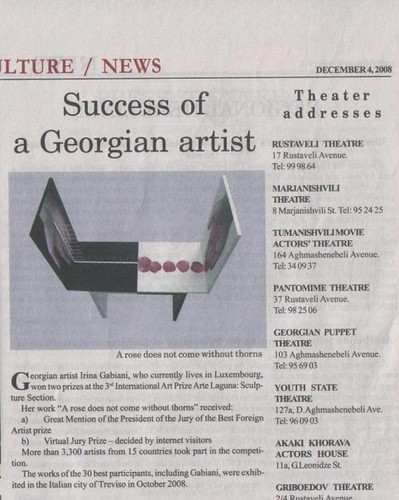
ART: 3rd International Art Prize Arte Laguna for the Georgian Artist: Irina Gabiani (artelagunaprize.com)

Today I had a nice chat with Irina. She has got a huge price in Italy for her artwork. It is amazing! Congratulation for her! More you can read here in the catalog >>>

More Photos from the art are here >>>

PREMI: 3rd International Art Prize Arte Laguna

Special Mention of the President of the Jury for the best foreign Artist (sculpture section)

Virtual Jury Special Prize (sculpture section)

Irina Gabiani was born in Tbilisi, Georgia, in 1971.After studying at the Academy in Tbilisi, Irina moved to Amsterdam where she studied at the Gerrit Rietveld Academy (“Free direction” and “Contemporary jewellery”). Irina has lived and worked in Luxembourg since 1998.

The Universe in its holistic essence is the focus of the research of the artist according to whom we all belong to a unique system, to a “big organism” imagined as a kind of complex, interrelated chain, of which we, and everything around us, are a part.

Trying to see beyond what we can perceive with our eyes, going beyond the vision of the world as we use to know, the artist researches the innumerable similarities between the infinitely big and the infinitely small within matter. The two “worlds” look as though they mirror one another. The more we know matter and understand its complexity which escapes us at a simple glance, the more the infinitely small leads us to the universe. For this reason, especially in her recent works, images of the micro and macro universes appear one next to the other and, sometimes, the images from the micro exceed the dimension of those from the macro. Discovering infinite worlds within our every-day surroundings leads the artist to believe that there are other parallel realities in time and space.

In her works, Irina uses drawing, painting, photography and sculpture, often in porcelain or ceramics.

Web site: irina-gabiani.livejournal.com


Tuesday, March 10, 2009

MUSIC: Course of Armenian Duduk by Gevorg Dabaghyan. 20 March 2009 - 22 March 2009

Armenian News Network / Groong, March 9, 2009

By Minas Lourian

In collaboration with the music section of the Studies and Documentation Centre of Armenian Culture, Venice, directed by Minas Lourian, the Intercultural Institute of Comparative Music Studies (Cini Foundation) has organized, for the fourth consecutive year, a course on the duduk, a double-reed woodwind instrument made of apricot wood. A symbol of the Armenian musical tradition, the duduk (conventionally called the "Armenian oboe") is a very popular instrument with a warm slightly nasal tone creating evocative sounds. It is played to accompany songs and dancing in all the regions of Armenia and is the principal instrument at weddings and funerals. In 2005 the duduk (or dziranapogh in Armenian) was decreed a masterpiece representing the Armenian musical tradition in the UNESCO "Programme of Masterpieces of the Oral and Intangible Heritage of Humanity".

Gevorg Dabaghyan
is a major living expert on this very ancient instrument. He has founded several ensembles, including Shoghaken, a group dedicated to conserving the very rich Armenian folk music heritage. Liturgical music also features prominently in Dabaghyan's vast repertory and is a fundamental part of a thousand-year old tradition characterised by strong Christian roots, going back to when Armenia was the first country to proclaim Christianity as its state religion in 301.

Participants are required to enrol:
musica.comparata@cini.it
Minas Lourian can be reached at Minas Lourian

Location Centro Studi e Documentazione della Cultura Armena - Biblioteca
Zenobiana del Temanza
Corte Zappa, Dorsoduro 1602, I- 30123 VENEZIA (ITALY)

Time Friday 20 March, 2.00-6.00 pm/Saturday 21 and Sunday 22 March, 11.00
am - 3.00 pm

http://www.cini.it/en/event/detail/2/256

http://www.dabaghyan.com/


VIDEO: Dreams (Anurjner) By Gevorg Dabaghyan


AmazonShop: Books, Maps, Videos, Music & Gifts About The Caucasus

Monday, September 17, 2007

MUSEUM:

Städtepartnerschaft zwischen Belgirate und Sighnaghi

Das Museum wurde in einer Berghütte auf dem Colle Motta Rossa realisiert, einem Ort, an dem einige Partisanen, wie Pore Musolishvili aus Sighnaghi in Georgien, niedergemetzelt wurden. In den Jahren, die auf den Zweiten Weltkrieg folgten, vereinten sich Belgirate und Sighnaghi zu einer Städtepartnerschaft und aus Georgien wurden typische Produkte und Erzeugnisse eingeführt (Gemälde, Teppiche, Geschirr, usw.), die in der im Jahr 1978 in ein Museum verwandelten Berghütte gesammelt wurden.

Auskünfte
Via P. Musolishvili - 28832 Belgirate (Vb)
Tel. +39.0322.7244 – Fax: +39.0322.7751
E-mail: comune@belgirate.com - info@comune.belgirate.vb.it


Uploaded on July 17, 2006 by Susan Astray

A Year in Georgia (Set)