Showing posts with label Traffic. Show all posts

Monday, February 19, 2018

CALL FOR APPLICATION: The Marshrutka Project Summer School 2: Eurasian Mobilities in a Global Perspective (marshrutka.net)

Source: marshrutka.net
Organisers: Leibniz Institute for Regional Geography (IfL), Leipzig, Germany
Tbilisi State University (TSU), Tbilisi, Georgia
Location: Tbilisi and Kazbegi, Georgia
Dates: June 25-30, 2018


Photo: Nicholas Johnson: Marshrutka from Yerevan / Flickr Gallery: flickr.com/georgienblogspotcom
Summer School Goals
The PhD Summer School is embedded in the research project Fluid mobilities for cities in transformation: spatial dynamics of marshrutkas in Central Asia and the Caucasus (Marshrutka Project). Within the scope of the project, we want to gain insights into transformation processes through the lens of changing mobility practices.

The summer school on Eurasian Mobilities in a Global Perspective invites advanced doctoral students, post-doctoral and early career-researchers from diverse disciplines, such as geography, urban studies, anthropology, social and political sciences, to contribute to two thematic packages:
– Mobilities and socio-spatial change in Eurasian Cities
– Informal transport and ride-sharing the global North and South
The primary goal of the summer school is to initiate collaborative publication projects related to the two thematic packages. We therefore expect a full paper draft to be submitted timely before the start of the summer school, in order to advance the joint publication project in relevant high-profile journals. Building on this, the summer school offers [1] an opportunity to share, discuss, and receive feedback for publication drafts, [2] training sessions on publishing and career planning, [3] thematic keynote talks, and [4] mobility-themed field trips, and last but not least, [5] a few day’s long retreat to the mountainous town Stepantsminda (Kazbegi).

The summer school is designed to encourage transnational interdisciplinary discussions, and provide high-impact feedback and networking opportunities for its participants. Besides offering a unique and understudied thematic focus, we offer a cosy and thorough working environment. The summer school participants will consist of five project-funded PhD students and two post-doctoral researchers, ten external doctoral students and early career researchers (please see information on funding opportunities below), ten senior academic project partners from Kyrgyz, Kazakh, Tajik, Russian, Georgian and German academic institutions, international and local keynote speakers, trainers and stakeholders.

About the Marshrutka Project

Minibuses locally known as marshrutkas are a common sight in urban and rural landscapes of Central Asia and the Caucasus. The Marshrutka project deals with the role of the marshrutka mobility phenomenon in the production of post-Soviet urban spaces, in and beyond Central Asia and the Caucasus. It provides an empirically founded contribution to the larger discussion on post-Soviet transformation, and fosters a still under-represented view on post-Soviet transformation, highlighting – through the lens of the marshrutka phenomenon – the bottom-up and everyday emergence of new orders in the fields of economy, morale, urban development and migration. The project is carried out by means of five complementary PhD projects under supervision of academic project partners; in addition, a post-doc based at the IfL in Leipzig is charged with a cross-cutting research project and ensures the conceptual coherence of the project. The project sees its outcomes in terms of a solid and sustainable transfer of knowledge and methods, from German partners towards the academic institutions in the target regions, and vice versa, strengthened local research capacities and infrastructures, and long-lasting research cooperation. The project has started in late 2015, and will be entering into its final phase in 2018. The summer school is therefore designed in order to build upon the research progress done so far, and transform it into high-profile publications, and, furthermore, to strengthen and expand the marshrutka research networks with follow-up projects in mind.

Thematic Focus

The summer school focuses on two thematic packages: [1] Mobilities and multiple transformations in Eurasian Cities and [2] Informal transport and ride-sharing the global North and South. Each package corresponds to the Marshrutka projects’ contribution to two sets of literature: [1] urban geography, anthropology, and political economy of post-socialist states, and [2] critical mobility and critical urban transport studies.

The thematic package mobilities and socio-spatial change in Eurasian Cities will address how changing urban mobility governance and mobility practices relate to – shape and are shaped by – social, economic and political transformations on urban, national and regional levels. This thematic package will focus on, but not be limited, to cities on Eurasian peripheries, primarily Central Asian and South Caucasus cities.
– Sub-topics of the thematic package may include
– Mobility governance and urban economy
– Urban transport and social inequalities
– Transport, urban citizenship and claiming public space
– Intersections of mobility and migration

Informal transport and ride-sharing in the global North and South thematic package will put the research on informal transport, be it marshrutkas, ride-sharing or private taxi sector in Eurasian cities, in dialogue with the research on informal paratransit and new digitally powered ride-sourcing mobility offers in different global regions. This thematic package explicitly welcomes diversity in geographical coverage, and comparisons across cities, as well as across old and new modes of informal transport and ride-sharing practices. Sub-topics of the thematic package include:
– Theories and methods of studying paratransit/informal transport
– Digitalisation of mobility offers
– Transport workers mobilisations
– New chances and inequalities of new mobility offers


Submission guidelines

The application should include a motivation letter, a short CV and an abstract (not more than 500 words) of the paper you are planning to present at the summer school.

Please submit the application to Henri Schauer (H_Schauer@ifl-leipzig.de) by the 15th of March, 2018.
Selected applicants will be contacted by the 10th of April, 2018.
The full paper drafts should be submitted by May 30th, 2018.

Travel grants

The participation of the Summer School is free of charge. We offer travel grants of up to 400€ to eight selected applicants.

Call for Papers as Pdf-file: CfA draft_Summer School Final [pdf]

Sunday, August 18, 2013

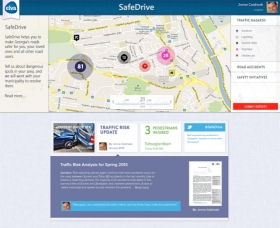
PARTNERSHIP: Friendly Roads: An Innovative Citizen Engagement Project to Make Georgia’s Roads Safer (safedrive.ge)

(safedrive.ge) Georgia’s unsafe roads are one of the most urgent public health problems facing the country. Last year alone, 605 people were killed in traffic accidents, with an additional 7734 persons injured. Traffic accidents are a top five cause of death in Georgia and they are the leading cause of death among youth aged 5 to 29. 

In order to combat this leading cause of death and disability and make Georgia’s roads safer for all road users, the Partnership for Road Safety and Elva Community Engagement are launching an innovative citizen engagement project titled "Friendly Roads", with support of the East West Management Institute and USAID. The project will allow citizens throughout all regions of Georgia to report hazardous traffic infrastructure and traffic accidents in their neighbourhood using SMS and a website. On the website www.megobruligzebi.ge all these citizen reports will be shown on an interactive map together with official data on traffic accidents, to create the first publicly accessible overview of traffic hazards in Georgia.

The project will encourage safe driving behaviour and will allow citizens to easily report and spot the most dangerous traffic infrastructure (the so-called “black spots”) in their neighbourhood and commuting routes. Using this accessible overview of hazardous traffic infrastructure, the campaign will work towards influencing decision makers at local and national levels to take evidence-based and targeted action to prevent further accidents using citizen reporting and resolving black spots. The website www.megobruligzebi.ge will be launched in the coming weeks.

Let’s work together to prevent traffic related deaths and injuries in Georgia!

For more details and instructions on how you can participate in the campaign, please, contact at info@safedrive.ge, jonne@myelva.com, georoadsafety@gmail.com or at 995 558240401, +995 599062211.

This project is made possible by the generous support of the American people through the United States Agency for International Development (USAID). The contents are the responsibility of the implementing organisations and do not necessarily reflect the views of USAID or the United States Government.

more: safedrive.ge/en

Saturday, January 19, 2013

DOKU: BBC World's Most Dangerous Roads - Series 3 - Georgia (myvideo.ge)

Saturday, December 01, 2012

ARTICLE: Georgia Proposes to Unblock the Trans-Caucasus Railway Publication: Eurasia Daily Monitor Volume: 9 Issue: 207, By: Giorgi Menabde

(jamestown.org) One of the closest associates of Georgia’s Prime Minister Bidzina Ivanishvili, State Minister for Reintegration Paata Zakareishvili, has unveiled the government’s idea to unblock the railway link that connected Russia with the South Caucasus republics in Soviet times.
In an interview with the Moscow paper Kommersant (kommersant.ru), Mr. Zakareishvili stated that this question had not been discussed officially by the government yet, but “preliminary consultations between members of the cabinet of ministers had taken place.”

The state minister’s statement appears to be an important message for Moscow by Ivanishvili that is signaling readiness to take into account Moscow’s interests in the region. This initiative comes from the package of “friendly gestures” that the new Georgian authorities devised to soften tensions in the relations with the neighboring country. Ivanishvili’s decision to renounce the Georgian boycott of the 2014 Winter Olympics in Sochi also comes from the same package (civil.ge). President Mikhail Saakashvili insists on boycotting the Sochi Olympics. Many observers in Tbilisi reckon that by rescinding the Olympics boycott, the government disavows the parliament’s decision on May 20, 2011 to recognize the events of the 19th century in the Northwestern Caucasus as the “Circassian Genocide.” Many Circassian organizations called for a boycott of the Olympic Games that will take place on the Red Meadow (Krasnaya Polyana), which has symbolic meaning for the Circassian people as the site of the final battle of the Russo-Circassian war.

Apart from that, Prime Minister Ivanishvili, having confirmed the impossibility of resuming diplomatic relations with Russia “until the occupation of Abkhazia and South Ossetia is over,” still appointed Zurab Abashidze as his representative for Georgian-Russian affairs. Abashidze was Georgia’s ambassador to Russia in 1998–2004 (dfwatch.net) and is considered to be one of the most pro-Russian diplomats in Georgia. Former Georgian representative to the UN, Irakly Alasania, became the minister of defense. Alasania was the only Georgian politician that the Russian Minister for Foreign Affairs Sergei Lavrov met in person after the Russian-Georgian war of 2008.

Will the Georgian authorities be able to implement the plan to restore a railway connection with Russia? Moscow and Yerevan have demanded that Tbilisi restore the railway link, which was cut on August 14, 1992, the very first day of the war in Abkhazia. However, the Georgian leadership under both Presidents Eduard Shevardnadze and Saakashvili tied the reopening of the railway with the issue of the Georgian refugees’ ability to return to Abkhazia. This issue became the main cause of a ruined agreement between Shevardnadze and Putin in the spring of 2003 (dossier.bymedia.net), during the leaders’ meeting in Sochi. Zakareishvili now states that he seeks “to depoliticize” this issue and stop tying economic and transportation topics with political and humanitarian ones. Georgian refugees’ leaders have lashed out at him for this. Former vice-speaker of the parliament of Georgia, Paata Davitaia, called the position of the state minister for reintegration “defeatist.”

The second problem with the reopening of the railway is the projected negative reaction of Azerbaijan. Restoration of the direct railway link between Russia and Armenia via Abkhazian and Georgian territory will decrease Armenia’s isolation and boost its positions in the Karabakh conflict. Public figures close to the Azerbaijani authorities have already signaled (news.day.az) that Baku could review its position on Georgian territorial integrity if Tbilisi continues its “double dealings.” Additionally, Azerbaijan is worried that the resumption of the Trans-Caucasian railway connection might have a negative impact on the construction of the railway that will soon connect Baku, Tbilisi, Akhalkalaki, Kars and Istanbul (turkishweekly.net). Furthermore, Ivanishvili’s government will have to take into account that the Azerbaijani state energy company SOCAR is a monopolistic supplier of natural gas to Georgia and holds a key role in the country’s petroleum market. After warnings from Azeri politicians and experts, Prime Minister Ivanishivili personally visited the local office of SOCAR in Georgia to express his respect for the Azerbaijani state company and reaffirm his commitment to the previously reached agreements (1in.am/eng).

The situation is further complicated by the fact that other important geopolitical players in the region are in no hurry to express their opinion about the reopening of the railway link. Both Moscow and Yerevan have kept silent on the issue. The de-facto authorities in Sukhumi have also not commented on the initiative. Yet, Abkhazia’s stance on the issue has probably not changed since the Shevardnadze-Putin meeting in Sochi in 2003. The Abkhazian de-facto authorities were not happy with the idea of restoring the railway link, since they feared it would lead to the return of Georgian refugees. Therefore, while agreeing to allow passage of goods via their territory, they have invariably been opposed to the resumption of passenger traffic. In fact, Abkhazia’s sector of the railway has never been well-suited for accommodating any significant cargo traffic. During Soviet times it was used mainly for ferrying passengers, while cargo traffic from Russia to the South Caucasus, including Armenia, was routed via Azerbaijan.

Ivanishivili’s government cannot provide an answer to another question as well—how will Georgia’s economy benefit from the railway’s unblocking without an end to the unofficial Russian embargo on Georgian goods to Russia? Will Moscow agree to allow in Georgian imports in exchange for the railway reopening, or will the Kremlin require even more concessions from Tbilisi, for example Georgia’s accession into the Customs Union of Russia, Belarus and Kazakhstan?

It appears that talks about these issues will start only after Moscow reacts in some way to Tbilisi’s “historic initiative” of the resumption of the railroad connection. This sector of railway has remained in absolute neglect for the past 20 years—it has been devastated by looting and natural decay. The railway will certainly need significant investments, even if all political obstacles are successfully removed. Therefore, the question of “who is going to pay” will remain topical even after resolution of political problems surrounding the question.

Friday, May 04, 2012

PHOTOESSAY: The New Silk Road. By Brett Forrest. Photograph by Alex Webb (ngm.nationalgeographic.com)

(ngm.nationalgeographic.com) A railroad through the southern Caucasus will soon connect Europe and Asia, fueling dreams and discord in the region.

TurkeyThe dynamite comes from Ankara. Ten tons, and it takes two days. The truck climbs carefully, screwing 2,500 feet up the mountains of northeastern Turkey, where the clouded sun makes faraway ice fields roll like a distant sea. This is beautiful, forbidding country, through which a new railroad will soon run.

Arslan Ustael awaits the dynamite in the snow, with night temperatures reaching 40 below. Standing before the rail tunnel, Ustael says that in this weather your spit freezes before it hits the ground. He is a young man still, 30, and free with Turkish good humor, even up here in the cold clouds waiting for the dynamite that will make the volcanic mountain agreeable to his demand to bore a tunnel through it. Free with good humor because he knows this is an undertaking that could make a young engineer's career: building the Baku-Tbilisi-Kars (BTK) railway, an "Iron Silk Road" that will connect the oil-rich Caspian Sea region to Turkey—and beyond to Europe.

The travels of antiquity are tiring to contemplate. The 750-mile stretch of land between the Black Sea and the Caspian Sea is known as the Caucasus, named for the mountain range through which Ustael is digging his tunnel. Before the region got swallowed up by the Russian Empire, the Caucasus served as a transit point between Europe and Asia; the old Silk Road passed through it. Yet transport between West and East has never been easy. For centuries, to get from one sea to the other, you had to paddle north up the Don River from the Sea of Azov, portage over the steppe, then drift down the Volga to the Caspian. Only when the Russians began building railroads over the Caucasus in the 19th century could you travel more directly across the region.

The Iron Silk Road will launch a new chapter in the history of the Caucasus. After the Soviet Union collapsed in 1991, the newly independent republics of the southern Caucasus—Georgia, Armenia, and Azerbaijan—regained strategic importance. A realization of the enormity of the oil and natural gas reserves lying beneath and along the Caspian Sea ignited a scramble to lay pipelines across the southern Caucasus to bring those resources to the European market. Today the pipelines are operational, and the BTK is being built to grease a trade boom, transporting European goods east and petroleum products west across the southern Caucasus. Once completed, by 2012, the railway will begin at the Azerbaijani capital of Baku and travel through the Georgian city of Tbilisi, before carrying on to Kars, a Turkish post town on the southwestern lip of the Caucasus region.

The participation of Turkey signals a new alignment in a region often viewed as Russia's backyard. Like the Baku-Tbilisi-Ceyhan (BTC) pipeline—which opened in 2005 to bring oil from Baku to the Turkish port city of Ceyhan, on the Mediterranean—the BTK railway is the result of an alliance between Turkey, Georgia, and Azerbaijan; neighboring Armenia was deliberately left out of the party. And like the pipeline, this east-west corridor will provide an alternative to going through Russia to the north or Iran to the south. It is a more than $600-million project of economic development, social engineering, or shrewd geopolitics, depending on your point of view, which in the southern Caucasus shifts as quickly as the snow that obscures the mountain road.

For Ustael, chief of the tunnel operation on the Turkish-Georgian border, this railroad has become something else: a road to loneliness. Back in Trabzon, a temperate, Turkish Black Sea coastal town, his girlfriend's face clouded when she imagined two years in the Caucasus Mountains, for that is how long it will take to build this tunnel. She just couldn't do it. Ustael exhales, stirs the sugar through his tea. A man must make choices. Smoke hangs over the canteen. Workers chalky with tunnel dust stare distantly at the men in sun and shorts chasing a ball across the TV. Through the windows, another blizzard is mixing up the air. In World War I, 90,000 Ottoman soldiers waited in these mountains for the Russians to come. "Some froze to death without firing a shot," Ustael says. He grabs a hard hat and walks to the door. Tunnel work progresses in round-the-clock, three-hour shifts.

Work is likewise endless for the Turkish state, toiling to gain acceptance into the European Union (EU). Turks look indignantly at countries like Bulgaria and Romania that have already been accepted, places with much less developed economies and greater corruption. Turkey, the Cold War NATO ally, meanwhile, waits for an invitation that may never come. This "raises questions of fairness, at least," says N. Ahmet Kuşhanoğlu, the Turkish deputy director of transport in charge of railways. "Turkey's face is turned westward since two centuries." Now Turkey is looking east in order to make itself indispensable to the West. Once the Marmaray rail tunnel opens in 2013 beneath the Bosporus in Istanbul, trains from Baku will reach all the way to London. "It is easy to see that this railway shall serve Europe also," says Kuşhanoğlu.

Looking directly east, Turkey has lately sought to repair relations with its neighbor Armenia. In 1993 it had closed the border and shut down its rail service with Armenia as a sign of loyalty to Azerbaijan—a close Turkish ally with the same Muslim religion—after Christian Armenia helped ethnic Armenians in the Azerbaijan enclave of Nagor­no-Karabakh wage a bloody war to secede. Last year in Zurich, under the watchful eyes of the EU and the U.S., Turkey signed an agreement with Armenia to mend diplomatic ties and reopen the border. But the Armenians then demanded that Turkey acknowledge that the 1915 massacres of its people constituted genocide, which Turkey is loath to do. For their part, the Turks began insisting on some resolution to the Nagorno-Karabakh conflict. Since neither is likely to happen anytime soon, the deal—and the opportunity for a rapprochement—collapsed last spring.

A bridge between Turkey and Armenia actually does exist, though most of it has crumbled into the Akhuryan River, which cuts deeply through a gorge that serves as the border between the two countries. The Silk Road city of Ani stands abandoned along this part of the border, its mosques and churches intact after a thousand years, its bazaars echoing in a winter wind. Beyond an electric fence and across the river, Armenian guard towers keep watch over the ruins.

Some 50 miles north of Ani, Ustael's workers continue to dig 13 feet every day. Once completed, the tunnel will run for a mile and a half, 1,300 feet beneath the surface. It will be one of the longest in Turkey, Ustael says, and everyone will know his name. "Maybe then I can go work someplace warm."

Ustael spends his downtime in Kars, 42 miles south of the border, the two-hour drive made eventful by the slippery fact of coming down the mountain. Along icy roads, the car twists through slopeside villages, past minarets and the mud roofs of stone huts overgrown with grass. A vast westward migration of people in search of jobs has robbed these villages of all but the least mobile. Foxes forage at the roadside, headlights igniting their eyes.

In Kars, the site of great 19th-century battles between Ottoman Turks and Russians, the hilltop citadel remains. The women stay indoors. The men walk arm in arm down the streets, savoring a drink of raki in the saloons that exist in this region of lax Islam. Raki tastes like the anise-flavored pastis of France, but there is little European refinement in Kars. That could change when the BTK links this city to Baku, its wealthy antipode on the Caspian, injecting new revenue into the local economy. The governor of Kars, Ahmet Kara, talks of how the railroad will transform Kars into a city "important in the world's eyes." Behind Kara hangs a photo of Mustafa Kemal, or Atat�rk, the first president of Turkey, who turned the Ottoman Empire into a modern, secular state, encouraging Western ways and outlawing the fez.

With a knit cap on his head and bundled in a thick anorak, Ustael watches a drill needle the far wall of the tunnel, making small stones out of solid rock. A front loader strains up the tunnel's incline, its bucket carrying a ton of freshly dislodged stone. It emerges from the tunnel and rolls into the blizzard, driving past Ustael toward a waiting truck. He says he wants to contribute to modern Turkey, to help bridge East and West. When the dynamite arrives, he laughs when he sees that it was made in China; it has already crossed this border once before.

There will be no explosions today. The mountain rock is soft enough for the drill to do its work without dynamite. Ustael looks down the tunnel toward Georgia. "We haven't found gold yet," he jokes. The stones tumble from the front loader into the truck, the crash almost drowning out his voice. "The Silk Road will live again."

They're not hiring in Akhalkalaki. There's no gold here either. Not much glitters in the hardscrabble hills near this town in the Georgian south. This is where the old railroad from Georgia's capital city of Tbilisi terminates. Beginning here, 60 miles of new rail will be laid, running south through Ustael's mountain tunnel to Kars. Another 75 miles of existing rail will be rehabilitated. Work begins with the thaw.

Akhalkalaki is in Georgia, but most of its residents are ethnically Armenian—and desperately poor. The factories in Akhalkalaki were dismantled after the Soviet collapse, their components sold off in the new capitalism. Since the agricultural collectives shut down, once fertile lands have overgrown with weeds. Bandits clipped the aluminum wires and copper connectors that helped propel rail cars, selling the metal in Iran and Turkey. The economy took a big hit in 2007, when the Russians closed a military base here.

There is to work, so the men go to Moscow, where they step into the orange jumpsuits of the street cleaner, sending money back home. Many who have stayed feel neglected by the central Georgian government. Protests have been frequent. Very few people in Akhalkalaki and the surrounding Javakheti region speak Georgian, and in the schools there is no one to teach the language. During the 1990s the prospect loomed that Javakheti could be Georgia's next breakaway region, like Abkhazia and South Ossetia in the north, which declared independence in the early 1990s but remain largely unrecognized.

Now Georgia is counting on the BTK railway to boost economic activity and help integrate this turbulent Armenian enclave into the rest of the country. When plans to open the railway were first announced, Georgia's Armenians opposed its construction, citing the unfairness of its bypassing Armenia. But today in Akhalkalaki there is a small hope that the new railroad will alleviate this long postcommunist endurance.

Grigoriy Lazarev stands guard at Akhalkalaki's outdoor bazaar. He takes potatoes on consignment from a local farmer, barters them for mandarins, then sells the fruit at the bazaar for 40 tetri a kilo, or about ten cents a pound. He would like to work on the railroad. "I am a mechanic, a welder, a master engineer," he says. "Selling mandarins is not good for my psyche." He stands before a pile of fruit in the trunk of his green Moskvitch, looking left and right at the many others who also sell mandarins here. In Soviet days this street had order, Lazarev says. "But everybody became sellers." He is 58 years old, has only enough teeth to chew soft food like citrus fruit. He has two young children, and a few tetri jangle in his coat pocket.

When Lazarev drove two hours to the town of Kartsakhi to apply for work on the railroad, the contractors turned him away. He visited the camp forming on the outskirts of Akhalkalaki, where Turkish and Azerbaijani skilled workers will soon congregate. You cannot operate a Komatsu excavator, they said. You do not speak Georgian.

The ministers in Tbilisi say Akhalkalaki will be the site of a critical station on the Iron Silk Road, where trains will switch between European and Russian rail gauges. For people in Akhalkalaki, it is difficult to imagine how they will benefit. Like Lazarev, many hundreds of locals have petitioned for railroad work, yet such work remains elusive.

Conditions have improved since Mikheil Saakashvili assumed the Georgian presidency—people in Akhalkalaki will admit that. Under Eduard Shevardnadze, they had electricity only five hours a day—while they slept—long enough for bread to bake in time for morning. It was subsistence living: no TV, poor roads, little interaction with Tbilisi, and a rationing of the wood that fueled the house stoves that kept people from freezing in their beds. Now there are a few good roads and electricity all day, if not running water in every home. It is often cold in Akhalkalaki, even indoors, and the abiding stress makes the people wander these streets weakly, nothing like the powerful Narts, the fabled giants that inhabited the Caucasus before humans arrived and that inspired them to carve mountains into kingdoms and then into nations.

Just 19 years old as a nation, Georgia is struggling through its adolescence. Seven years ago the Rose Revolution engendered all manner of youthful aspiration. Membership in NATO. Inclusion in the European Union. Bringing the breakaway regions of Abkhazia and South Ossetia under firm federal control. Reworking relations with Russia. Saakashvili wanted it all, wanted it quickly. If not for Georgia's northerly neighbor, he might have gotten it all.

The Russians have long felt a sense of entitlement toward Georgia, for they were the ones who folded Georgian nobility into their ranks during the 19th century, forming many principalities into a single governable entity, a Christian fortification in a region otherwise allied with the Ottomans or Persians. Russia also feels a deep emotional attachment to a land romanticized by Aleksandr Pushkin and Leo Tolstoy. But benevolence is a matter of perspective. Soon after Alexander I attempted to adopt Georgia in 1801, the widowed Georgian queen greeted the tsar's envoy with a dagger in the side, killing him.

More recently tensions spiked as Russia, fed up with Georgia's Western desires, closed the border between the two countries in 2006. Russia worries that if Georgia gains entry to the Western institutions it so esteems, this could inspire similar freethinking in the northern Caucasus—including the Russian regions of Dagestan, Ingushetiya, and Chechnya—which continues to shudder with explosions and assassinations that threaten Moscow's territorial hold.

The long-running tensions between Russia and Georgia escalated into war in the summer of 2008. Russia moved to assert control over the breakaway regions. Its troops routed Georgia's army, and Russia recognized South Ossetia and Abkhazia as new nations. It was a reminder that a small skirmish in these borderlands could spark a global showdown. Yet the EU and the U.S. were notably indisposed to intervene. Since the war, Georgia's pro-Western policy has stalled. Though the border between the two countries reopened last March, tensions are still high.

Like Prometheus, whom the gods chained to the Caucasus as punishment for giving humanity the power of fire, Georgia cannot escape its coordinates. Yet its position on the map may be its strongest asset. For NATO, the southern Caucasus is now viewed as a needed route for supplying the war in Afghanistan, ever since terrorist attacks in November 2008 began threatening the supply route through Pakistan's Khyber Pass. For Turkey, an important trade partner, Georgia is the gate to Central Asia. Armenia and Russia cannot trade with each other without going through Georgia. And Azerbaijani oil cannot reach the Mediterranean without passing through Georgia, earning the country $65 million in annual transit fees.

Georgia is a small player at the table, left to stack small chips. Indeed, the most significant impact of the Iron Silk Road on Georgia may prove to be the dismay it will create in the Black Sea ports of Batumi and Poti, the country's most dynamic economic centers, once freight can be diverted to Turkey instead. Still, Georgia can hope that if there's another conflict with Russia, European countries will cry foul if their trade through the southern Caucasus is disrupted.

In Akhalkalaki, Grigoriy Lazarev packs up his scale and its rusted one- and five-kilogram weights, and slowly walks away from the bazaar. He passes a funeral procession running along the main thoroughfare, a photo of the deceased man affixed to the windshield of a sedan. Arms linked, men walk up the mud of the street, women up the mud of the sidewalk.

Lazarev's small house was built in 1850, in the time of hard-willed Nicholas I. The roof leans severely, threatening to cave. Lazarev cannot pay to fix it. He and his family live off his mother's 90-lari (about $50) monthly pension. Still, when they have guests, Lazarev's wife, Liza, busies herself setting the table with what food they possess. A daughter, Gohar, sits at an old upright piano and practices her lessons, filling the small room with music and missteps. Lazarev grieves over his bad luck with the railroad and more generally, but not so loudly that his family will hear.

He rummages through a wardrobe and returns to the table. In his hand is a felt-backed shoulder board, its green fabric faded nearly to gray. It is the emblem of a lieutenant, an engineer with the Russian border service. "My grandfather served under Nicholas II," Lazarev says. "He built roads to Akhaltsikhe and Batumi." Lazarev smiles, a rare incident, and then the room goes dark. The electricity has gone out in Akhalkalaki, and the Lazarevs fall silent, but for the sound of the old piano.

It is electricity that initially impresses in Baku, its roadway lamps gilding the new asphalt from airport to city. Baku no longer supplies half the world's petroleum needs, as it did at the opening of the 20th century. But it feels like it does. In the past three years all manner of luxe stores have opened along the boulevard Neftchiler Prospekti, their windows reflecting the Caspian waters. Plans are progressing on a $4.5-billion, carbon-neutral resort on Zira Island, in the bay beyond the city. A Four Seasons Hotel will open shortly to house the guests drawn to Baku by the wealth of the state oil monopoly, located across the street. In the five years since the BTC pipeline began pumping oil out of the Caspian and money into Baku, Azerbaijan's economy has grown by more than 100 percent.

In the years after the former Turkish president, Süleyman Demirel, broached the topic of the Iron Silk Road in a Tbilisi speech in the late 1990s, the parties involved attempted to secure international funding for its construction. But the Armenian diaspora blocked all financing efforts, arguing convincingly that the routing of the railroad, like that of the oil pipeline before it, was a punitive gesture linked to Nagorno-Karabakh. Washington, the EU, and the World Bank stayed away. When the oil spigot turned on in 2005, briefly making Azerbaijan the world's fastest growing economy, the hesitance of international financiers no longer mattered. Azerbaijan can now afford its own portion of the railroad, upgrading 313 miles of outdated lines to the Georgian border. It is also loaning Georgia a few hundred million dollars for its section on neighborly terms—25 years at one percent annually. Magnanimity is a pleasure of abundance.

No train passed through Musa Panahov's hometown in the Azerbaijani west, so he went out looking for one. He graduated from the Moscow Transportation Institute during the time of Leonid Brezhnev, then joined the Soviet railroad fraternity. The Soviet Union administered the world's largest, by volume, rail system; all strategic goods were transported by train. This centrally commanded network was a key part of the national security infrastructure, protected and privileged. Train employees had their own separate hospitals, their own schools, even their own militia. "We had everything except a foreign ministry," says Panahov, now Azerbaijan's deputy minister of transport.

Railroads are less important in Azerbaijan today. Oil and gas predominate, according to the plan of the late Heydar Aliyev, the country's third president and primary citizen, who by force of will forged Azerbaijan into what it is today: the relatively secure, relatively independent economic dictator of the region. Aliyev possessed the foresight to invite foreign firms to cooperate in Caspian development, and he understood the importance of the Iron Silk Road. Panahov is the man laying another plank in Aliyev's plan for Azerbaijanis' continued independence.

Panahov, 51, unrolls a map of the southern Caucasus across a table in his office and slowly runs his fingers from east to west, from sea to sea. At this table he negotiated with transport ministers from Georgia and Turkey in discussions that lasted until early in the morning. Cherubic but with graying hair, he speaks in a soft voice as he delineates the numbers. Total length of the Iron Silk Road: 500 miles. Total annual cargo capacity: 25 million tons. He speaks of the Azerbaijanis who fled to Turkey to escape communism. "It gives me a sense of happiness to connect brothers again," he says.

Azerbaijan became a Muslim parliamentary republic in 1918 and enjoyed that status for a cou­ple of years. Since the breakup of the Soviet Union, however, little about Azerbaijan is visibly Muslim or parliamentarian. It is difficult to locate a minaret or an honest vote in Baku, less so a Bentley. Prosperity and social equality need not be strangers, but when a country has oil, it is tempting to focus on the former at the expense of the latter. More tempting still when the world needs what it has to give. The BTC is the only pipeline that delivers non-Russian, non-OPEC, non-Arabic oil to Mediterranean tankers. With the global oil supply diminishing, Azerbaijani influence has only risen.

Social justice is not a topic of public debate in Azerbaijan. More important to those in power is the fact that this small nation has managed to survive—and now thrive—in a difficult neighborhood. As one official said, "The optimists live in Georgia, the people who are complaining all the time live in Armenia, but the realists live in Azerbaijan."

Or rather in Baku. A short ride on the existing rail leading northwest from the capital reveals not political realists but reality itself, the hovels that house those who have not felt the benefits of Baku's oil boom. A quarter of Azerbaijanis live below the poverty line.

These train cars retain the cracked gloss of Soviet adornment, frills and curtains that are rough to the touch, landscape paintings that hang in the spaces between the windows. A sorority of railway workers in starched uniforms tends to the train as it rolls through a world cleanly separated from Bakuvian luxury. One woman shovels coal into a furnace that heats the car's interior.

Musa Panahov knows these trains, knows they do not rival their German, Japanese, or American counterparts. He is a railway man in an oil country. "But oil and gas will end someday," he says, smiling. "The railroad will live always." 

Brett Forrest reports frequently from the former Soviet Union. Photographer Alex Webb’s most recent book is Istanbul: City of a Hundred Names.

Wednesday, April 18, 2012

VERKEHR: Chiatura - Seilbahnen und anderer Stadtverkehr (tramwayforum.at)

Tschiatura war einst die Stadt mit der größten Manganerzproduktion der Welt. Vor dem Ersten Weltkrieg lieferten die städtischen Bergwerke 40 % der Weltproduktion.


Doch nach dem Zusammenbruch der Sowjetunion wurde die Förderung schlagartig zurückgefahren. Um 1990 lebten in der Stadt ca. 30.000 Einwohner. Doch - ich zitiere Wikipedia - "1992 ist in Tschiatura die Gas-, Wasser und Stromversorgung zusammengebrochen. Strom gibt es seit 2004 wieder. Das Gas- und Wasserleitungsnetz ist inzwischen völlig verrottet. Wasser fließt alle 3 - 5 Tage für etwa 30 Minuten. Trinkwasser muss in Kanistern aus Quellen und einigen wenigen Brunnen in der Stadt herbeigeschafft werden. Wohnungen, auch in Hochhäusern, werden mit Holzöfen beheizt. Durch die Situation hat sich die Einwohnerzahl fast halbiert."


Für eine sterbende Stadt ist die Stadt aber durchaus sehr lebendig. Dafür, dass die Menschen seit fast 20 Jahren praktisch am Campingplatz leben, sind sie recht gut drauf. Man sieht den Verfall aber an den großen Plattenbauten, wo viele Wohnungen leerstehen.


Im Stadtverkehr hatte Chiatura ein kleines O-Bus-Netz (eröffnet 1967) mit einer ca. 30 km langen Überlandstrecke nach Sachkhere (eröffnet 1969) - Fotos aus 2006 gibts dort: saktransporti.mashke.org - Leider wurde das O-Bus-Netz 2008 endgültig eingestellt.


Was aber auch im Stadtverkehr einiges hermacht, sind die Seilbahnen, die aufgrund der großen Reliefenergie einen großteil der Stadt erschließen. Hiermit biege ich gerade noch die Kurve zum Tramwayforum: Seilbahnen werden auf englisch auch aerial tramways genannt. Ich habe auf die Schnelle ca. 10 Seilbahnen mit Personenverkehr gezählt, nicht alle davon waren (z.Zt meines Besuches) in Betrieb. Mit zweien bin ich gefahren, das war sogar gratis! Mindestens zwei Seilbahntalstationen sind tatsächlich als Umsteigeknoten ausgeführt. Also gehen wir es an! Quelle & Mehr Bilder: www.tramwayforum.at


Wednesday, August 10, 2011

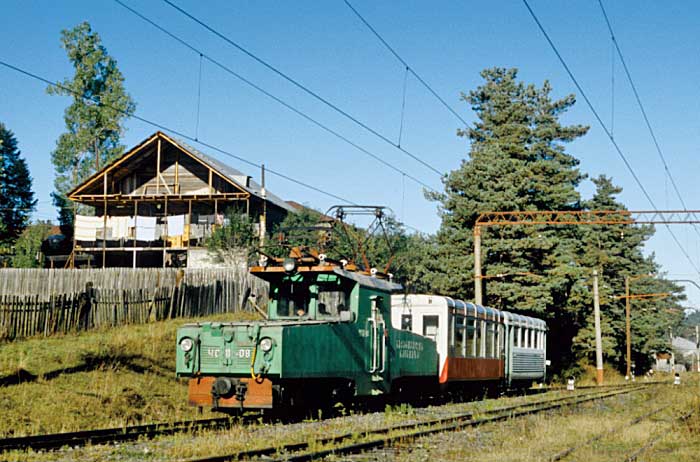
VIDEO: Kaukasisches Bahnabenteuer - Mit sowjetischen Lok-Veteranen durch Georgien (ardmediathek.de)


VIDEO >>> (Video aus der Mediathek verfügbar bis: 01.09.2011 16.56 Uhr)
VIDEO >>> (Video auf youtube)

Ein Film von Roland Steinhauer

Georgien gilt für Georgier als der schönste Teil der Erde. Der ist allerdings etwas renovierungsbedürftig. Vor allem, was die Eisenbahn anbelangt. Für Eisenbahnfreunde freilich kein Nachteil: Hier sind alte Eisenbahn-Veteranen aus Sowjetzeiten noch vor Güter- und Personenzügen im Einsatz. Sowohl die Strecke zwischen der Hauptstadt Tiflis und Poti, dem größten Schwarzmeerhafen Georgiens, als auch zahlreiche Nebenstrecken entlang des Kaukasus bieten Eisenbahnrelikte in Hülle und Fülle, also Romantik und Abenteuer gleichermaßen.Wer als Eisenbahnfreund in Georgien unterwegs ist, darf nicht in Tiflis bleiben. Mit den "normalen" E-Lok_Veteranen vom Typ WL 10 oder WL 11 geht es entlang der Hauptstrecke Tiflis-Poti zu den wirklichen Elektro-Sauriern: In Kutaisi sind die WL22 immer noch im regelmäßigen Dienst Richtung Tkibuli und Tskhaltubo. Und als Höhepunkt einer jeden Eisenbahnreise muss natürlich ein Ticket in Borjomi gelöst werden. Von dort schlängeln sich 37 Kilometer lang und an jedem dicken Baum anhaltend die Züge nach Bakuriani durch den Kleinen Kaukasus. Gezogen von den letzten Exemplaren der tschechischen Grubenbahn-Lokomotiven vom Typ TschS11.

Quelle: SWR

www.swr.de/eisenbahn-romantik

mehr Bilder und Kommentare >>>

Wednesday, March 09, 2011

ARTICLE: How to Make Tbilisi Greener. By Koka Kalandadze. (finchannel.com)

The FINANCIAL -- (Tbilisi, Georgia) Planting trees, developing parks, installing solar panels or even constructing eco-friendly buildings are just a small part of what we could do to make our city environment greener. But taking into account that 90% of total emissions are made by transport in Tbilisi then you could easily imagine what impact the introduction of green/fuel efficient transport would have on the city en masse.

Although fuel efficient transport such as bicycles or motor-scooters have poor public perception in Tbilisi , worsening of the city’s air quality, which is already noticeable, needs to be addressed somehow. Therefore the development of bicycle lanes and tram lines is inevitable. This would cut reliance on public transportation, reduce CO² emissions, and simultaneously minimize greater petroleum usage that would lead to healthier people’s lifestyles in the end.

Retail petroleum prices have been rising steadily over the past few months reaching 2.30 GEL (1.30 USD) per litre last week, tracking crude oil prices as claimed by oil importers in Georgia.

The developments in the Middle East are also having greater impact on the rise of oil prices. Hence the cost of owning and operating vehicles is drastically increasing. At the same time people are also getting plagued by congested traffic and longer commute times in
Tbilisi . The only alternative, that people in many developed countries of Central Europe/Asia have already chosen, is moving to bicycles or motor-scooters.

In Amsterdam bikes have overtaken cars’ usage. Studies showed that in the period 2005 to 2007 residents used their bicycle an average of 0.87 times a day and their car 0.84 times.

In Japan, a country with a population of roughly 128 million, people who own bicycles amount to about 90 million, or about two for every three Japanese. In addition approximately 11 million bicycles are sold in Japan every year. Young women in high heels, men in black suits and teenagers on cell phones all ride bikes. Even mothers are frequently using them to go shopping, taking their children to day care and then running errands.

Bicycle lanes in Japan are mainly between the road and sidewalk.

In 2009 Tokyo launched a public bike programme similar to ones found in many European cities in which bicycles are left in designated areas and people can pick them up and use them and drop them off in different designated areas. People who use the system in Tokyo have to pay a ¥1,000 registration fee and pay ¥100 for every 10 minutes of use.

A similar system could also work in
Tbilisi once bicycle racks are installed all over the city. As Khvicha Sanaia from Tbilisi municipality transport division told The FINANCIAL, there’s an idea of building bicycle lanes in Tbilisi in the coming years although no precise plans exist yet regarding how that will be accomplished. “It will not be used solely for transportation purposes, but also for the development of bicycle tourism in Georgia,” he said.

“Specifically, we are currently administering a nationwide Fuel Economy Project as part of the Global Fuel Economy Initiative’s 50by50 campaign, which aims to reduce car emissions by 50% by 2050,” Humfrey Legge from Caucasus Environment NGO network (CENN) said.

CENN is holding an event on 22 April (Earth Day) at Europe House, to showcase fuel efficient cars on sale in
Tbilisi .

“Fuel efficient transport such as bicycles and motorcycles have poor public perception in
Tbilisi , this is compounded by a lack of infrastructure for these methods of transport. Unfortunately, without increased public interest in these methods of transport the Government is unlikely to invest in such infrastructure and without investment there will be little increased interest from the public,” he said.

“The
Tbilisi Municipality should take the lead in green infrastructural initiatives in the city; however it’s essential that local populations, environmental civil society and local businesses are all involved through extensive consultations about any project,” claimed Legge.

“The development of bicycle lanes and tram lines in
Tbilisi would have an extremely positive effect on the city for a number of reasons. Firstly these kinds of initiatives will ease congestion and facilitate cheap, easy travel within the city, increasing residents’ mobility.

Secondly, they will reduce environmental degradation as they support non-petrochemical forms of transport, simultaneously reducing CO² emissions and improving air quality in
Tbilisi .

Finally, the construction of green transport routes will have highly beneficial effects on the local population’s health, encouraging exercise, reducing noise pollution and reducing the levels of harmful chemicals emitted from car exhausts,” noted Legge.

In
Tbilisi fuel efficient cars are imported by several companies including Strada Motors which imports Fiat (Italian) automobiles, consuming between 4.5-5 litres per 100 km. As Tea Iremadze, Marketing Manager at Strada Auto told The FINANCIAL, such automobiles were introduced roughly two months ago and now over 20 units of them are sold. Their price ranges between 8.5-9 EUR according to Iremadze.

“It’s true that the depletion of global oil reserves, increasing insecurity in oil exporting countries and climate change all indicate rising gasoline prices over the coming years; however rising prices are not always enough to convince people to make green choices in their transport methods. To change attitudes in
Tbilisi we have to offer viable, cheap, attractive alternatives to cars with low fuel efficiency,” said Legge.

“The first step towards a greener transport system in
Tbilisi is development of traffic optimization. This includes infrastructural road expansion, as well as strategic traffic management and city-wide integrated transport policies.

The second step needs to be the installation of effective and accurate monitoring and enforcement systems for air quality, imported cars and fuel quality. Once authorities can understand the exact level of pollution in
Tbilisi appropriate targets can be set and enforced accordingly.

Other steps include the expansion and improvement of public transports systems, phased increases in fuel taxes, public information campaigns about green transport and government subsidies for fuel efficient and hybrid electric vehicles (HEVs),” concluded Legge.

You can join the
Tbilisi Bike Lane Initiative on: www.facebook.com/TbilisiBike

source: finchannel.com

Wednesday, January 12, 2011

TRANSPORT: Baku-Tbilisi-Kars railroad to restore silk way (news.az)


'Construction of the Baku-Tbilisi-Kars railroad is a step to restoration of the historical Silk way'.


The construction of the Baku-Tbilisi-Kars railroad is a step to restoration of the historical Silk way, Turkish Transport Minister Binali Yildirim told a session of the railway structures in Beijing.

1news.az reports with reference to the State Railway Company of Turkey that Yildirim said: I believe the implementation of the project will raise the social level of population in all the three countries and strengthen cooperation between our countries”, he said.

“The implementation of the project of BTK railway line started in 2007 and envisions rehabilitation and reconstruction of the 178 kilometer Marabda – Akhalkalaki line in Georgia, construction of a new railway line from Akhalkalaki to Kars station extending to 98 km. The 30-kilometer highway Akhalkalaki-Kartsakhi (Turkish border) locates in the Georgian direction and 68-kilometer section extends from Kartkhahi in the Turkish side to Kars”, Yildirim said.

In addition, the Marmarai railway tunnel to ensure direct connection with the European railway network is under construction in Istanbul under the Bosporus strait in line with the project of the Turkish railroad development. After the Baku-Tbilisi-Kars project is completed, the railroad will become an important railway corridor Europe-Caucasus-Asia”, said the Turkish transport minister.

source: news.az

Wednesday, June 09, 2010

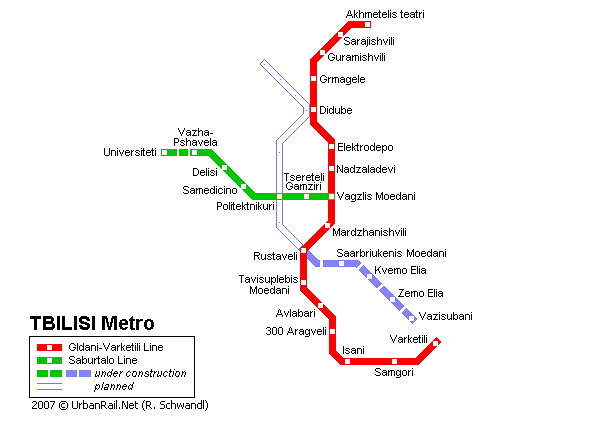
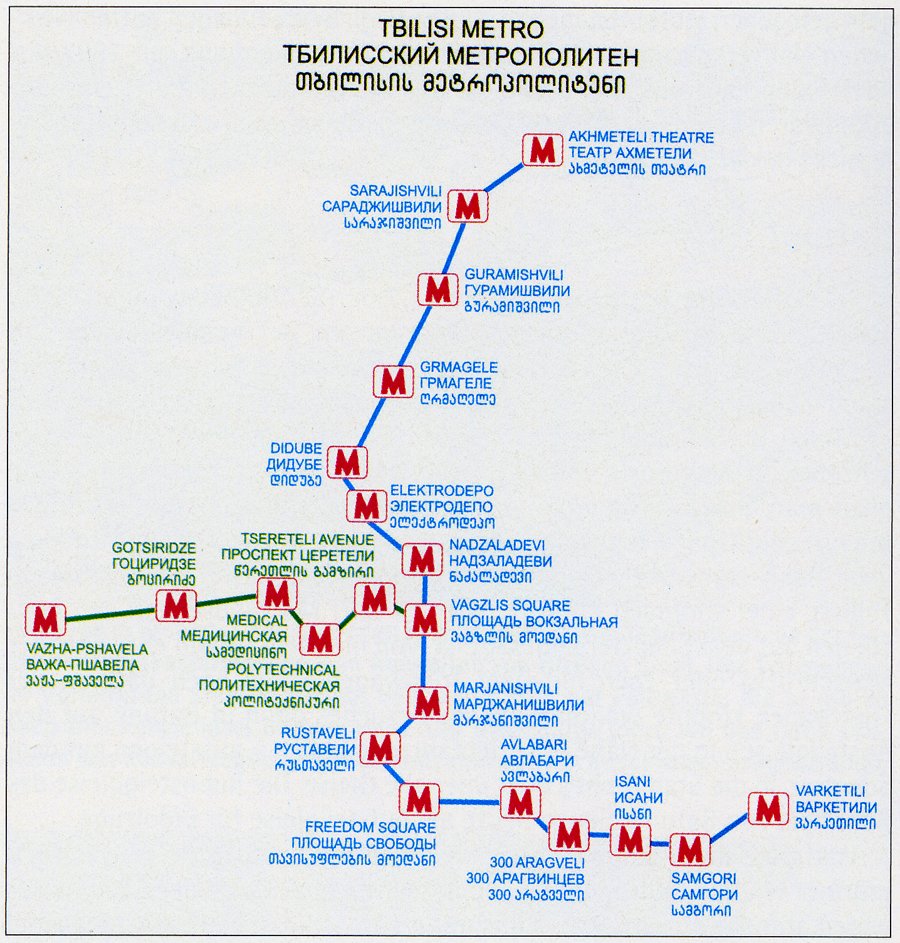
MAP: Tbilisi Metro (urbanrail.net)


Tbilisi (Tiflis) is the capital of the former Soviet republic of Georgia, situated in the Caucasus. The city has 1.2 million inhabitants and extends 40 km north - south along the river Mtkwari (Kura). The valley is surrounded by mountains what makes road traffic especially difficult. Therefore plans for a subway system were made already in the early 1950's when the city had only 750,000 inhabitants.
The first line (Gldani-Varketili Line, formerly Didube-Samgorskaya) opened in 1966 from Dibude to Rustaveli (6.3 km, 6 stations) via the city centre. A few years later it was extended towards the south to 300 Aragveli (1967) and Samgori (1971). During the 1980's it reached its current length of 19.6 km with 16 stations.
In 1979, the second line (Saburtalo Line) began operating between Vagzlis Moedani (railway station) and Victor Gotsiridze. In the year 2000 it was extended to its current terminus Vazha Pshavela. The line has a total length of 6.7 km with 6 stations.
Most station names were changed during the 1990's after the dissolution of the former USSR and the independence of Georgia. Trains in service are of the 81-717 and 81-714 series also running in Moscow and other ex-Soviet cities. Stations have 100 m long platforms for 5-car trains, although only 3 or 4-car trains are currently used.


Lines and History:

Gldani-Varketili Line - 19.6 km, 16 stations
11 Jan 1966: Dibude - Rustaveli (6.3 km, 6 stations)06 Nov 1967: Rustaveli - 300 Aragveli (ex 300 Aragvinzev)05 May 1971: 300 Aragveli - Samgori08 Nov 1985: Samgori - Varketili16 Nov 1985: Didube - Guramishvili (ex TEVZ) 07 Jan 1989: Guramishvili - Akhmetelis teatri
Saburtalo Line - 6.7 km, 6 stations
15 Sept 1979: Vagzlis Moedani (ex Pl. Vokzalna) - Victor Gotsiridze (ex Delisi) (6.2 km, 5 stations)02 April 2000: Victor Gotsiridze - Vazha Pshavela
Some (or all) station names have been changed from Russian into Georgian, so older names found on some maps are given in brackets. Other former names: Pl. Lenina for Tavisuplebis Moedani (Freedom Sq.); 26 Komissarov for Avlabari; Okyabrskaya for Nadzeladevi; Komsomolskaya for Medikal Institut.


Projects

An extension of the second line to the University and the first section of a third line is under construction, although no dates for completion are known.


- OPERATION
The Tbilisi Metro operates from 6:00 until 1:00, every 2.5 minutes during rush hours and every 4 minutes during the day.
- FARES (2007)
Single fare - GEL 0.40 (lari)
Plastic cards with multiple rides: 20 Lari (60 rides) - 145 Lari (720 rides)


Links

metro.ge (Official Website)
Official Metro Map 2007
Tbilisi Metro on Wikipedia
Metrosoyuza by Peter Donn includes nice station pictures
Tbilisi Metro at Mir metro/Metroworld by Aksenov Dmitry
Tbilisi Metro Track Map
Tbiltrans
Salinas, Julian; a.o.: METRO. TBILISI. - Portraits of metro passengers. Christoph-Merian-Verlag, Basel. 50p, ISBN 3856161481 (May 2001)

Wednesday, March 04, 2009

DEVELOPMENT: Polzug Intermodal fährt ersten containerblockzug im Kaukasus (fruchtportal.de)

Zwischen Georgiens Hafenstadt Poti und Baku, Aserbaidschans Hauptstadt am Kaspischen Meer, der TRACECA Route entlang, fährt jetzt Nach einem Jahr der Planung und intensiven Verhandlungen ein Containerblockzug. Die HHLA-Beteiligung Polzug Intermodal baut eine regelmäßige Verbindung auf.

Polzug-Geschäftsführer Walter Schulze-Freyberg freut sich über die neue Verbindung: "Der Kaukasus und Zentralasien sind Wachstumsmärkte. Das Interesse an unserem Blockzug durch den Kaukasus ist riesengroß!"

Ziel ist es, kurzfristig einen fahrplangebundenen Schienencontainerverkehr zwischen Poti und Baku aufzubauen. Die Einrichtung einer Blockzugverbindung wird von politischer Seite unterstützt, auch die georgische und azerische Eisenbahn sehen im Containerverkehr ein zukunftsträchtiges Geschäftsfeld.

Die Route durch den Kaukasus nach Zentralasien ist eine attraktive Alternative zu den Routen von den Nordseehäfen über Polen/Weißrussland und die Ukraine/Russland, sowie von den Baltischen Seehäfen über Russland. Von Baku erfolgt die Weiterverladung per Feeder über das Kaspische Meer nach Aktau, wo bereits die Bahnwagen für den Weiterversand Richtung Zentralasien warten.

Quelle: www.fruchtportal.de