Showing posts with label Ekkehard Maaß. Show all posts

Tuesday, September 24, 2019

LITERATUR: Giwi Margwelaschwili - Grenzgänger in den Real- und Buchwelten im Literarischen Salon Ekke Maaß in Berlin

am 05. Oktober | 20 Uhr mit:

* Giwi live per skype und einem Interview aus dem Jahre 2017 (6 Minuten)
* Stephan Wackwitz: Eure Freiheit, Unsere Freiheit - Was wir von Osteuropa lernen können
* Prof. Carsten Gansel, Universität Gießen: Leben im Ontotext - Vorschlag Giwi Marwelschwilis für den Literaturnobelpreis
* Ekkehard Maaß: Muzal, Kapitän Wakusch, Der ungeworfene Handschuh, Die Medea von Kolchis in Kolchos - Werkschau und Lesung

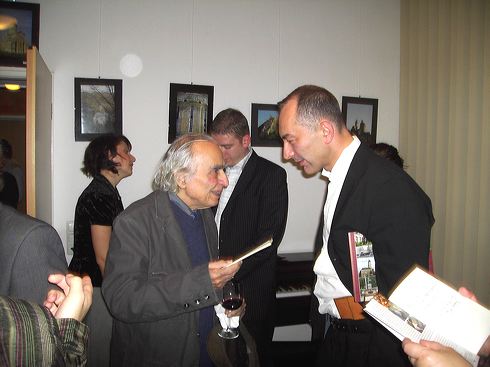
Foto: Ralph Hälbig (2009)
Giwi ist ein waschechter Berliner und deutscher Autor. Er ist mit mehr als 40 dicken Bänden ein Mont Everest unter den Leuten seiner Zunft und der größte Denker, der mir begegnete. 1927 in Berlin-Wilmersdorf als Sohn georgischer Emigranten geboren, überlebte er Hitlerei und Krieg mit dem Swing. 1946 mit seinem Vater vom NKWD in den sowjetischen Sektor entführt, verbrachte er zwei Jahre in den sowjetischen Speziallagern Hohenschönhausen und Sachsenhausen, dann wurde er nach Georgien verschleppt. Von der Ermordung seines Vaters erfuhr er erst 1989.

Das Thema seiner Romane und Erzählungen ist die theoretische Verallgemeinerung seines Lebens in zwei totalitären Gesellschaften: dem Nationalsozialismus und der kommunistischen Diktatur in der Sowjetunion, die Ost-West-Konfrontation im Kalten Krieg und die Erforschung des textweltlichen Seins des Menschen. Seine Maxime „Stoppt den tödlichen Text!“ lehrt an den Schicksalen von Buchpersonen den Widerstand gegen die gefährlichen monothematischen Weltanschauungen und ist hoch aktuell.

Giwis Bücher erschienen nach seiner Rückkehr nach Deutschland u. a. im Suhrkamp Verlag und seit 2007 im Berliner Verbrecher Verlag.

Literarischer Salon Ekke Maaß | Deutsch-Kaukasische Gesellschaft
Schönfliesser Strasse 21 | 10439 Berlin | Tel: +49 30 4457006 | Mobil +49 171 1773543
Mail: d-k-g@gmx.net | Internet: www.d-k-g.de | www.giwi-margwelaschwili.de | www.ekkemaass.de

Wednesday, August 09, 2017

VIDEO: Philipp Ammon - Georgien zwischen Eigenstaatlichkeit und russischer Okkupation - (Georgische Botschaft Berlin, 29.11.2016)

Die Wurzel des russisch-georgischen Konflikts vom 18. Jahrhundert bis zum Ende der ersten georgischen Republik (1921)"

2015 Kitab-Verlag Klagenfurt - Wien
www.kitab-verlag.com
Office@kitab-verlag.com
ISBN 978-3-902878-45-8

Buchpräsentation in der Botschaft Georgiens zu Berlin
Begrüßung: Kulturattaché Dudana Mazmanishvili
Moderation: Ekkehard Maaß
Vortrag: Philipp Ammon
Dankeswort: Botschafter Georgiens in der Bundesrepublik Deutschland, Prof. Lado Chanturia, 29.11.2016


Sunday, January 16, 2011

VORTRAG: Die Völker des Kaukasus – zwischen russischer Kolonialpolitik, nationalstaatlicher Entwicklung und Multiethnizität (jura.uni-wuerzburg.de)

Am Dienstag, 25.01.2011, 19:30 Uhr hält Herr Ekkehard Maaß (Deutsch-Kaukasische Gesellschaft, Mitglied des Integrationsbeirates Berlin-Pankow) einen Vortrag zum Thema „Die Völker des Kaukasus – zwischen russischer Kolonialpolitik, nationalstaatlicher Entwicklung und Multiethnizität“.

Er findet statt in ÜR 14 (Am Hubland, Philosophiegebäude).
Würzburg
Für das GSiK-Zertifikat zählt der Veranstaltungsbesuch als Vortrag.


Link: www.uni-wuerzburg.de

more >>>

Saturday, August 07, 2010

TBILISI: Droht die Schließung des Kaukasischen Hauses durch die Georgische Regierung? (caucasianhouse.ge)

Sehr geehrte Damen und Herren,

dem Kaukasischen Haus in Tbilissi droht die Schließung, siehe Anlagen.
Es setzt sich seit mehr als 20 Jahren für den interkulturellen Austausch der kaukasischen Völker und für die Einhaltung der Menschenrechte in Georgien ein.

Die Projekte des Kaukasischen Hauses werden u. a. von der Heinrich-Böll-Stiftung unterstützt.

Anmerkung von mir: Naira Gelaschwili - die Direktorin des "Kaukasischen Hauses" ist eine Schriftstellerin, Friedensaktivistin, engagierte Kaukasus-Expertin, die über Jahre diese Institution mit ihren Mitstreitern beseelt hat. Auch über die Landesgrenzen hinaus ist sie bekannt. Zahlreiche Artikel- auch in der deutschen Presse - spricht für ihr Engagement und ihre exzellenten Verbindungen. Warum soll diese Institution jetzt geschlossen werden? (Ralph Hälbig)

Aus dem kaukasischen Teufelskreis (Berliner Zeitung)

Naira Gelaschwili, Direktorin des Kulturzentrums „Kaukasisches Haus“, warf Saakaschwili und seiner Umgebung vor, dass sie nach dem Krieg mit seinen für Georgien katastrophalen Folgen nichts anderes im Sinn hätten als den Machterhalten (welt.de) >>>

Im Kaukasischen Haus wird mit verschiedenen Kultur­angeboten versucht, Nationalisierung und Militarisierung im Kaukasus zu verhindern. Interview mit Naira Gelaschwili >>>

Georgische Schriftstellerin Naira Gelaschwili über den Krieg: "Die Leute sind gebrochen" (taz.de) >>>

Die Georgierin, die Brücken in den Kaukasus baut. Naira Gelaschwili übersetzt nicht nur Hölderlin (welt.de) >>>

Der Kaukasus ist – auch dank solcher engagierten Menschen wie Naira Gelaschwili – ein kultureller Ort, dessen Vielfalt kaum zu überschauen ist. >>>

Naira Gelaschvili >>>

«Das ist pure Kriegspropaganda. Präsident Michail Saakaschwili fördert ganz gezielt die antirussische Stimmung», sagt die Leiterin des kulturpolitisch engagierten Kaukasus-Hauses in Tiflis, Naira Gelaschwili. (n24.de) >>> und (n-tv.de) >>>

Die georgische Übersetzerin und Menschenrechtsaktivistin Naira Gelaschwili gewährt Einblicke in die Politik Georgiens ... (zeit.de) >>>

Die georgische Kaukasus-Expertin Naira Gelaschwili hat vor einer weiteren «Russifizierung» der uralten Bergvölker durch Moskau gewarnt (dpa.de) >>>

Für weitere Informationen bin ich gern zur Auskunft bereit.

Mit freundlichen Grüßen

Ekkehard Maaß
Deutsch-Kaukasische Gesellschaft e. V.
Schönfließer Straße 21, 10439 Berlin
Tel 030 4457006 / mobil 0171 1773543
Spendenkonto HypoVereinsbank
BLZ 10020890 / Kto 5619661
http://www.d-k-g.de/

+++

Decree of the President of Georgia
#497
July 14, 2010
Tbilisi
About Legal Entity of Public Law

According article 5, paragraph B, sub-paragraph of the Law of Georgia on “About Legal Entity of Public Law” , on the basis of the Caucasian House – The Center for Cultural Relations of Georgia establish “The Smirnov’s Museum” – the Legal Entity of Public Law (furthr – Museum).
The Museum is the assignee of the Center for Cultural Relation - The Caucasian House.
The Ministry of Culture and Monument defense have to provide:
a) the state control of the museum;
b) Ratification of the statute of the Museum and appoint the syndic (representative person) on representation.
This Decree will be taken in action right after publication.

Mikheil Saakashvili

+++

Explanation for Society of the Caucasian House

An ordinance of President of Georgia on establishing a legal entity of public law, the Smirnoff Museum, on the basis of the Caucasian House and making it the legal successor of the House caused deep anxiety among the public. Calls and letters of sympathy and readiness to provide help come to the Caucasian House from its friends, people who realize the significance and appreciate the activity of the House, from everywhere – south or north Caucasus, abroad, although we have not yet made any comment concerning the ordinance, neither have we informed our foreign friends and donor organization about it. We will do this along with further developments.

Dear Friends! First, let us to thank you for this support and interest. This has made us feel again that the society exists, reasons and is ready to fight; that people have adequately assessed that the abolition of Caucasian House is a real drama, a disturbing symbol, especially in the context of the disaster caused by the 2008 August war when Russia once again invaded Georgia and occupied a very significant part of our country, once again disintegrated the Caucasus.

At the same time I would like to calm you down and remind you that there was a governmental entity, the Caucasian House and a non-governmental organization, the Center for Cultural Relations Caucasian House. The employees of governmental Caucasian House, as physical persons, founded the NGO in 1999, which still exists now.

The governmental Caucasian House was the legal successor of that organization (Translators’ Board), which in 1985 was bequeathed with four rooms of the so-called Smirnoff house together with Tamamshev and Smirnoff valuable family objects. The remaining four apartments in this dilapidated, nearly ruined two-storey house were sold earlier by Smirnoffs themselves and thus, represented private property.

A friend of the Caucasian House, the European Horizon Foundation, which highly appreciated a peace and cultural-educational activity of the organization, carried out the renovation and reconstruction of the entire building in 1998-2002, whilst the Krupp Foundation, upon the request of Horizon, restored the Smirnoff-Tamamshev heirlooms. At the same time, the Horizon Foundation “provided a debt to the municipality to buy out the three apartments sold by Smirnoffs. The fourth apartment, after the renovation had been completed, was sold by the owner himself to Naira Gelashvili. Since then this space has been used by the Caucasian House.

Both these organizations – the governmental and non-governmental Caucasian Houses – represented a single strong cultural-educational and peace centre with close ties with the entire Caucasus and Europe as well as eastern countries and were implementing a diverse conceptual programme with a special focus on Caucasian projects.

The ordinance of President of Georgia envisages the abolition of the governmental Caucasian House which along with other budget organizations was deprived of public financing back in 2005. This, we believe, was a mistake on the part of the state because of the significance and the standing it enjoyed in the Caucasus and Europe as a peace organization. Especially, given that the budget funding was symbolic (about 20 000 Lari a year).

Giorgi Gabashvili, the minister of culture of that time, told us then that although the funding of the Caucasian House was terminated, the organization, being of special state importance, would receive the same amount in the form of a so-called programme financing. The minister also promised that the ministry of culture would spare no efforts to reinstate the status of a legal entity of public law to the Caucasian House and officially approve its ownership over the building which was saved from wrecking and restored as the office of the Caucasian House by the Horizon Foundation in 1998-2000 under the agreement with the Ministry of Culture. This agreement explicitly states that should the Caucasian House be forced to leave this renovated and well-furnished building, the Foundation reserves the right to appeal to a relevant court in the Netherlands to claim the recovery of the amount spent for the restoration.

The minister, however, delivered only on the first half of his promise, leaving the second half un-kept.

Why was the reinstatement of the Caucasian House so important when it was actually maintained by the non-governmental organization? It was important because, the governmental Caucasian House was officially and legally linked to the building, whilst the non-governmental Caucasian House had an agreement with it on mutual use. This somewhat unique model operated perfectly and was also significant in some way for the state as the entire peace policy of the Caucasian House, which boosted confidence to it throughout the Caucasus, was associated with the state.

However, after the abolition of the non-governmental organization, the Caucasian House was left without a legal right on the building which was restored and well-furnished by it and all current and utilities costs of which has been paid by its donor organization, the Horizon Foundation.

Such a situation has arisen anxiety among all the donors and first and foremost, the Horizon Foundation. The Foundation has repeatedly addressed the president, ministers of culture, Giorgi Gabashvili and Nika Rurua, with questions and practical suggestions, but in vain. No reply followed from any of them. Such a disregard – instead of gratefulness – was an embarrassment and disappointment for the board of this Foundation, consisting of German, Dutch, British members, indeed noble people, intellectuals. One of significant causes for these people, who fell in love with Georgia, was the support of the Caucasian House and the country, as a whole.

Let me recall that in addition to the rehabilitation of the Caucasian House and the building in the Nukriani village (which houses the branch of the Caucasian House), the Horizon Foundation restored small monasteries and icons of Svaneti, saved Yermakoff’s unique archive where the works are still in progress, financed archeological excavations at Nekresi, for ten years has funded the education and psychological rehabilitation of children refugees from Abkhazia and Tskhinvali region, the Caucasus public university, our publishing house working in Caucasusian and European languages, so on and so forth. The Foundation was willing to finance restoration works at Davit Gareji Monastery and many other projects, but its heart has been broken.

The offence reached its climax when the 24 Hours newspaper, in the spring of 2008 (that is, before the August war), without any double-checking published a letter from famous representatives of Russian intelligentsia to President of Georgia, in which these ladies and gentlemen, who had never before uttered a word about the wanton acts committed by Russia in the Caucasus and Georgia, voiced their concern about the Smirnoff Museum alleging that it is in tatters and urgently needs to be saved and that the Caucasian House has intruded into the territory of the Smirnoff museum.

As it transpired, this misleading collective letter was spearheaded by Aleksandr Svatikov, one of the members of the Russian Club which operates in Tbilisi, and a former protector of the museum, who has overtly or covertly been fighting against the Caucasian House since its inception, as he believed that an organization with such a name shall not exist.

Upon the publication of this letter, the Ministry of Culture declared on the TV, without any consultation with us, that he intends to grant a state status to Smirnoff Museum, i.e. separate it from the Caucasian House.

It also transpired that the Ministry of Culture which stopped replying to any of the Caucasian House’s letters, was actively cooperating with the Russian Club and Mr. Aleksandr Svatikov – the person who lost any confidence among the employees of the Caucasian House. It should also be noted here, that due to created tense situation the department for the protection of cultural monuments officially demanded that we seal the museum and work under the regime which required the sealing and opening of the museum every working day. In agreement with the department two seals were attached to the entrance door – one by the protector of the funds, Aleksand Svatikov, and another seal by the administration of the House. However it came to happen that starting from that very day Aleksand Svatikov refused to open the museum until after the ministry of culture had officially granted the status of the museum to it. Actually, this was disobedience to the organization where he worked on the one hand, and, on the other, a sort of blackmail to the ministry of culture.

Since March 2009, the leadership of the Caucasian House has repeatedly sent notifications to the Ministry of Culture that such a behaviour of Aleksand Svatikov seriously endangers unique items kept in the museum, but during a year and a half a relevant department of the ministry of culture has not responded to the alarm raised by us and therefore, the Smirnoff-Tamamshev museum remains sealed to date and we have no idea of what has happened to objects and manuscripts kept there. We doubted – not without reason – that all this has been done deliberately to blame the Caucasian House of all the faults and create such a situation around it, which is being witnessed now by the Caucasian House, Georgian society, partner organizations all over the Caucasus and beyond it.

The fruit of the cooperation with the Russian Club was also the album, Smirnoff’s House, published by the Ministry of Culture and the Russian Club in 2008. One cannot find any trace of the Caucasian House and European foundations, i.e. Georgian-European trace in this Album and it also says nothing of the fact that the Smirnoff museum is part of the Caucasian House and that it was saved and revived by the House and its friends and without this care both the House and the museum would have been long destroyed.

In this regard, the Horizon Foundation sent a letter of protest to the ministry of culture which was again left unanswered.

Conspiratorial activities of the government created impression that it intended to replace the Caucasian House with not just Smirnoff museum but by the house of Russian culture. One would wonder how could either Smirnoff museum or the house of Russian culture implement common Caucasian projects? For example, how could they contribute to intensification of the Georgian-Caucasus relations, publication of literary works in Caucasian languages, provide an impartial description of modern conflicts in the Caucasus or historic Russia-Caucasus relations?

The situation today is the following: the Horizon Foundation proposes the government to consider the money it paid for the restoration of the building (more than half a million US dollars) as the buy-out amount and grant the ownership of the restored building to the NGO Caucasian House whilst taking themselves the Smirnoff-Tamamshev museum placed in three rooms. Or take the entire building and refund the money paid for the restoration in order to buy a new building for the Caucasian House. It is exactly this condition that is provided in the agreement between the Horizon Foundation and the Ministry of Culture (in 1998-99): should the Caucasian House be forced to leave the building restored for it, the government of Georgia shall return the amount paid for the restoration to the Foundation.

Thus, our dear friends, we, the employees of the Caucasian House, whom the government ignores for a long time now, are waiting, hoping that the reason may prevail and the Caucasus and Georgia may not lose a unique centre for dialogue, meetings, peace, education and culture, the house which since long ago has cherished the idea of saving the Caucasian solidarity; may not destroy a microcosm so dear to all the peaceful Caucasians, many refugee children and national minorities.

As regards the NGO Caucasian House, it will carry on its activity but if it leaves the building, problems will emerge in the implementation of such projects as Weekend School for internally displaced and socially vulnerable children, Culture Calendar, Conversations about Caucasus and others.

It seems as if from its inception the Caucasian House and we – its staff - have been doomed to continuous attacks from Russian or Georgia special services or all types of obscurantist.

Along with the steps taken by the government in the forthcoming days we will invite you to the Caucasian House to have a public discussion on the issue and agree upon further actions.

Thank you once again for your support.

Press service of the Caucasian house
27 July 2010

Thursday, January 28, 2010

VERANSTALTUNG: Lesung und Gespräch mit German Sadulaev aus Tschetschenien in Berlin. (d-k-g.de)

Sehr geehrte Damen und Herren, liebe Freunde,

der tschetschenische Schriftsteller German Sadulaev, der zurzeit Gast des Literarischen Colloquiums Berlin ist, hat kurzfristig zu einer Veranstaltung zugesagt.

Wir laden Sie herzlich am 30. Januar, 18 Uhr,
zu Lesung und Gespräch mit German Sadulaev ein.

Ort: Tschetschenisches Kulturzentrum, Prinzenallee 25/26, 13359 Berlin, 3. Hinterhof (Medienhof)

German Sadulaev wurde 1973 in Tschetschenien geboren, wo er seine Kindheit verlebte.
Zurzeit ist er Anwalt und Autor in St. Petersburg. Kürzlich erschien im Ammanverlag sein Buch "Ich bin ein Tschetschene".

German Sadulaev wird das Buch und sein in russischer Sprache erschienenen Erzählband "Bitsch boshii" vorstellen. Anschließend laden wir ein zu Tee und Gesprächen.

Mit freundlichen Grüßen Ekkehard Maaß

Deutsch-Kaukasische Gesellschaft e. V.
Schönfließer Straße 21, 10439 Berlin
Tel 030 4457006 / mobil 0171 1773543
Spendenkonto HypoVereinsbank
BLZ 10020890 / Kto 5619661
http://www.d-k-g.de/


Friday, November 13, 2009

VORTRAG: Gespräch mit Oleg Orlov, Vorsitzender der russischen Menschenrechtsorganisation MEMORIAL (gfbv.de)

Wir laden ein zu Vortrag und Gespräch mit Oleg Orlov, Vorsitzender der russischen Menschenrechtsorganisation MEMORIAL.
MEMORIAL erhält in diesem Jahr den Victor-Gollancz-Preis der Gesellschaft für bedrohte Völker, den Oleg Orlov am 14. November 2009 in Göttingen entgegennehmen wird


Oleg Orlov führt zur Zeit einen Prozess gegen den tschetschenischen Präsidenten Ramsan Kadyrow, den er für die Morde an Menschenrechtlern verantwortlich nannte.

Zeit: Sonntag, den 15. 11. 2009, Beginn 18.00
Ort: Tschetschenisches Kulturzentrum, Prinzenallee 25/26, Berlin-Wedding


Pressetermine für Sonntag Abend können über uns angefragt werden.

Mit freundlichen Grüßen Ekkehard Maaß

Deutsch-Kaukasische Gesellschaft e. V.
Schönfließer Straße 21, 10439 Berlin
Tel 030 4457006 / mobil 0171 1773543
Spendenkonto HypoVereinsbank
BLZ 10020890 / Kto 5619661
www.d-k-g.de

VORTRAG: Gespräch mit Oleg Orlov, Vorsitzender der russischen Menschenrechtsorganisation MEMORIAL

Wir laden ein zu Vortrag und Gespräch mit Oleg Orlov, Vorsitzender der russischen Menschenrechtsorganisation MEMORIAL.
MEMORIAL erhält in diesem Jahr den Victor-Gollancz-Preis der Gesellschaft für bedrohte Völker, den Oleg Orlov am 14. November 2009 in Göttingen entgegennehmen wird. (
http://www.gfbv.de/pressemit.php?id=2071).
Oleg Orlov führt zur Zeit einen Prozess gegen den tschetschenischen Präsidenten Ramsan Kadyrow, den er für die Morde an Menschenrechtlern verantwortlich nannte.

Zeit: Sonntag, den 15. 11. 2009, Beginn 18.00
Ort: Tschetschenisches Kulturzentrum, Prinzenallee 25/26, Berlin-Wedding


Pressetermine für Sonntag Abend können über uns angefragt werden.

Mit freundlichen Grüßen Ekkehard Maaß

Deutsch-Kaukasische Gesellschaft e. V.
Schönfließer Straße 21, 10439 Berlin
Tel 030 4457006 / mobil 0171 1773543
Spendenkonto HypoVereinsbank
BLZ 10020890 / Kto 5619661
www.d-k-g.de

Sunday, August 23, 2009

TERMIN: Ausstellung und Vortrag zum Tschetschenienkrieg, Hamburg, 28.8.2009

Eine Fotoausstellung an der Universität Hamburg, 3.8. - 28.8. 2009

Bereits am 3. August 2009 wurde die Fotoausstellung „Studieren im Krieg. Wenn Bildung warten muss“ in den Räumen der Universität Hamburg eröffnet. Zum Abschluss der Ausstellung lädt der Hamburger Ableger des Vereins „Studieren ohne Grenzen“ für den 28. August ab 17 Uhr zu einer Vortragsveranstaltung im Institut für Erziehungswissenschaften der Universität Hamburg ein.

Ekkehard Maaß, Vorsitzender der Deutsch-Kaukasischen Gesellschaft, wird zur Menschrechtssituation und Bildung in Tschetschenien referieren, Anzor Amaev, ein ehemaliger Student aus Tschetschenien, berichtet als Zeitzeuge über die Situation von Studierenden in Krisengebieten, Felix Weth, Gründer von Studieren ohne Grenzen, wird über die Arbeit des Vereins in Tschetschenien und im Kongo reden. Anschließend wird der Dokumentarfilm „Coca“ des Schweizer Regisseurs Eric Bergkraut gezeigt, der die Tschetschenienkriege behandelt.

Die Ausstellung, die den gesamten August im Foyer der Fakultät für Erziehungswissenschaft, auf dem Campus der Universität Hamburg zu sehen ist, zeigt Fotografien aus den beiden Tschetschenienkriegen von Stanley Greene. Greenes Arbeit wurde 2001 mit dem dritten Preis des World Press Photo Award ausgezeichnet.

Der Verein Studieren ohne Grenzen fördert junge Menschen, die sich für den Wiederaufbau ihres Landes einsetzen. Während ihres Studiums unterrichten die kongolesischen Stipendiaten Analphabeten in den umliegenden Dörfern, nach ihrem Studium planen sie Projekte wie ein medizinisches Zentrum in ihrem Heimatdorf zu errichten oder eine Hygiene- und Gesundheitsberatung szentrum für Frauen aufzubauen.
Unterstützt wird der Verein unter anderem von Vaclav Havel, Herta Däubler-Gmelin, Daniel Cohn-Bendit und Gernot Erler.

Ort der Vortragsveranstaltung: Seminarraum 05 in der Fakultät für Erziehungswissenschaft, von Melle Park 8 (Campus der Universität Hamburg). Der Raum schließt direkt an Foyer und Ausstellung an.

Datum: 28.08. ab 17 Uhr.

Ort und Datum der Ausstellung: 03. - 28. August, Foyer der Fakultät für Erziehungswissensch aft, vor der Melle Park 8.
Geöffnet Montags bis Freitags 9-20 Uhr, Samstags 10-14 Uhr. Eintritt frei.

Monday, November 17, 2008

LITERATUR: Verdienstkreuz für Giwi Margwelschawili

Sehr geehrte Damen und Herren, liebe Freunde,

Giwi Margwelschawili wird heute, 15.30, von Herrn Staatssekretär André Schmitz in seinem Dienstzimmer 4 C 3, Brunnenstraße 188, das Verdienstkreuz am Bande überreicht.

Am 27.11.2008 ist Buchpremiere und Lesung mit Giwi Margwelaschwili aus "Vom Tod eines alten Lesers", Verbrecher Verlag, Buchhandlung Buch & Service im Auswärtigen Amt, Werderscher Markt 1, 10117 BerlinBeginn 19.00 Uhr

Ein alter Mann wird tot aufgefunden, sein Kopf liegt auf dem Buch, in dem er eben noch ein Gedicht gelesen hatte. Der Geist des alten Mannes jedoch lebt in dem Gedicht weiter, darauf hoffend, die Leserinnen und Leser auf die verborgenen Schönheiten des lyrischen Textes aufmerksam machen zu können. In einer anderen Erzählung sieht sich die Buch- und Versweltverwaltung genötigt, einen alten Diktator, dem es in seinem Geschichtsbucheintrag zu eng geworden ist, mit der Selbstlektüre seiner Werke zu beschäftigen – bis er um Gnade bittet! Kann sie außerdem den Reiter vom Bodensee davor retten, nach der Überwindung der Gefahr doch noch sterben zu müssen? In den sechs Erzählungen Margwelaschwilis wird die Welt der Texte, wie wir sie kennen, auf den Kopf gestellt und kräftig durchgeschüttelt. Und das sehr zur Unterhaltung seiner Leserinnen und Leser!
Eine Veranstaltung im Rahmen der Berlin-Brandenburgischen Buchwochen.

Sie sind herzlich eingeladen, Giwi zu gratulieren, wenn nicht heute, dann auf der Lesung.

Am 18. 11. 2008 gibt eine Lesung von Apti Bisultanov und mir in der Lettrétage, Methfesselstraße 23-25,10965 Berlin (U-B Platz der Luftbrücke), Beginn 20 Uhr

Ekkehard Maaß
Deutsch-Kaukasische Gesellschaft e. V.
Schönfließer Straße 21, 10439 Berlin
Tel 030 4457006 / mobil 0171 1773543
Spendenkonto HypoVereinsbank
BLZ 10020890 / Kto 5619661

Thursday, November 13, 2008

VERANSTALTUNGEN: Diskussionen und Lesungen - organisiert von der Deutsch-Kaukasische Gesellschaft e.V. (Berlin)

Sehr geehrte Damen und Herren, liebe Mitglieder, liebe Freunde,
ich weise Sie gern auf folgende Veranstaltungen hin:

16. 11. 2008
Treffen von Svetlana Gannushkina (Memorial Moskau / Netzwerk Migration und Recht) mit tschetschenischen Flüchtlingen im Tschetschenischen Kulturzentrum, Prinzenallee 25/26, 3. Hof, 13359 Berlin-Wedding; Beginn 11 Uhr

17. 11. 2008
Podiumsdiskussion zu dem Krieg in Südossetien mit Swetlana Gannuschkina (Memorial Moskau), zwei Frauen aus Zchinvali, Peter Franck (amnesty international), Walter Kaufmann (ehem. Leiter des Büros der Heinrich-Böll-Stiftung in Tbilissi), Moderation Barbara Oertel
Ort: taz-Café in der Rudi-Dutschke-Straße 23 (U-Bahnhof Kochstraße); Beginn 19.30

18. 11. 2008
Lesung von Apti Bisultanov und Ekkehard Maaß in der Lettrétage, Methfesselstraße 23-25,10965 Berlin (U-B Platz der Luftbrücke), Beginn 20 Uhr

Ekkehard Maaß
Deutsch-Kaukasische Gesellschaft e. V.
Schönfließer Straße 21, 10439 Berlin
Tel 030 4457006 / mobil 0171 1773543
Spendenkonto HypoVereinsbank
BLZ 10020890 / Kto 5619661

Saturday, September 06, 2008

KULTUR: Veranstaltungen der Deutsch-Kaukasische Gesellschaft e. V. (Berlin)

Sehr geehrte Damen und Herren, liebe Freunde,

wir möchten Sie über folgende Veranstaltungen informieren:

6. September 2008
Meeting zum Tag der Unabhängigkeit Tschetscheniens 1991
Ort: Pariser Platz vor dem Brandenburger Tor
Zeit: 14 bis 16 Uhr


Ab 11. September 2008


DAS ZERBROCHENE PARADIES - neun Filme aus und über Georgien.

11. September:
19.00 "Wie die Luft zum Atmen" Von Ruth Olshan

In dem Film sieht und hört man THE SHIN und TUTARCHELA, die beide im September/Oktober Konzerte in Frankreich/Deutschland/Österreich geben.
www.myspace.com/shinthe
www.myspace.com/tutarchelafromgeorgia

20.30 "In Georgien", in Anwesenheit des Regisseurs Jürgen Böttcher

Zur Einführung spricht Ekkehard Maaß, Vorsitzender der Deutsch Kaukasischen Gesellschaft, zur aktuellen Situation in Georgien

22.15 "Pirosmani"

12. September:
19.45 Gastfreundliches Georgien
20.00 "Das Salz Svanetiens" (georgischer Stummfilm, Jürgen Kurz begleitet live am präparierten Flügel)
21.15 Pirosmani

KINO KROKODIL, Greifenhagener Str. 32, 10437 Berlin
www.kino-krokodil.de

Mit freundlichen Grüßen,
Ekkehard Maaß

Deutsch-Kaukasische Gesellschaft e. V.
Schönfließer Straße 21, 10439 Berlin
Tel 030 4457006 / mobil 0171 1773543
Spendenkonto HypoVereinsbank
BLZ 10020890 / Kto 5619661
www.d-k-g.de

Tuesday, September 18, 2007

LITERATUR: Officer Pembry von Giwi Margwelaschwili

Empfehlung von Marika Lapauri-Burk

NEW!
Erscheint am 13. September 2007 Leseprobe

Gebundene Ausgabe: 160 Seiten
Verlag: Verbrecher Verlag; Auflage: 1 (September 2007)
Sprache: Deutsch
ISBN-10: 3935843909
ISBN-13: 978-3935843904
Größe und/oder Gewicht: 20,4 x 13,2 x 1,8 cm

Kurzbeschreibung
Officer Pembry ist überrumpelt – in einem rund einhundert Jahre alten Thriller namens »Das Schweigen der Lämmer« soll seine Zukunft eingeschrieben sein. Er soll einem intelligenten Kannibalen namens Hannibal Lecter zum Opfer fallen, wenn dieser aus dem Gefängnis ausbricht. So jedenfalls behauptet es der Beamte Meinleser von der Prospektiven Kriminalpolizei, der alles andere als verrückt zu sein scheint. Pembry muss also, um seinem Schicksal entgehen zu können, zur Lektüre greifen, und das Buch gegen den Strich lesen, um seine Haut zu retten. Giwi Margwelaschwili legt erstmals seit zehn Jahren wieder einen Roman über die «Lese-Lebenswelt« vor, ein intelligentes Spiel mit Lesewirklichkeiten und der Bedeutung von Lektüre für die Leser und die Gelesenen. »Officer Pembry« ist ein spannender SciFi-Krimi und zugleich literarischer Hochgenuss.

Über den Autor
Giwi Margwelaschwili, wurde 1927 als Sohn georgischer Emigranten in Berlin geboren. Seine Mutter starb, als er vier Jahre alt war. Sein Vater lehrte Philosophie und Orientalistik. 1946 wurde er zusammen mit seinem Sohn vom sowjetischen Geheimdienst NKWD entführt. Der Vater wurde ermordet, Giwi Margwelaschwili in Sachsenhausen interniert, anschließend nach Georgien verschleppt. Dort lehrte er Deutsch. Erst 1987 konnte er nach Deutschland ausreisen. Ihn begleitete eine Unzahl von in der Emigration auf Deutsch geschriebenen Romanen und Erzählungen. 1994 erhielt er die deutsche Staatsbürgerschaft und ein Ehrenstipendium des Bundespräsidenten. 1995 erhielt er den »Brandenburgischen Literatur- Ehrenpreis« für sein Gesamtwerk, 2006 die Goethe-Medaille. Er ist Mitglied des P.E.N. und lebt in Berlin. Werke u.a.: »Muzal – ein georgischer Roman«, »Das böse Kapitel«, »Kapitän Wakusch«, »Der ungeworfene Handschuh«.


Giwi mit dem georgischen Dichter Otar Magradze, Berlin, 2006

Startseite Leben Neuerscheinung Werkschau Veröffentlichungen Rezensionen Philosophie Ontotextologie Dokumentarfilme über G. M. Fotogalerie Lese & Hörproben Kontakt

Wunderbare Website zu Giwi Margwelaschwili von der Deutsch-Kaukasische Gesellschaft e. V.

Kontakt zu Giwi Margwelaschwili
Ekkehard Maaß, Deutsch-Kaukasische Gesellschaft e. V., Schönfließer Strasse 21, 10439 BerlinTel +49 30 4457006, Fax +49 30 44678203 mobil +49 171 1773543 E-mail:
d-k-g@gmx.net Internet: www.d-k-g.de


Weitere Links:

Giwi Margwelaschwili
Die offizielle Website des internationalen literaturfestivals berlin.

Deutsch-Kaukasische Gesellschaft e.V.
Giwi Margwelaschwili Achmed Zakaev · FOTOGALERIE · MUSIK · FILME · LITERATUR · LINKS ·

1 Laudatio 21. 3. 2006 für Giwi Margwelaschwili anlässlich der ...

In der letzten Ausgabe von Lettre International Archiv LI 06
Giwi Margwelaschwili Das Erinnerungswelt-Schachturnier / Ohne Impressionalien.


AmazonShop: Books, Maps, Videos, Music & Gifts About The Caucasus