Podcast >>>
(dradio.de) Georgien
kann als letzter weißer Fleck auf dem europäischen Buchmarkt gelten.
Also haben sich die Kulturpolitiker in Tiflis ein ambitioniertes Ziel
gesetzt: Die kleine Kaukasusrepublik soll 2016 Gastland der Frankfurter
Buchmesse werden.
Gedränge herrschte dieser Tage auf dem Tifliser Expo-Gelände. Die
georgische Buchmesse kann zwar nicht mit der Größe einer Leipziger
Buchmesse mithalten, noch reicht für alle Aussteller eine Halle von der
Größe eines Fußballfeldes. Doch wie in Leipzig ist es vor allem eine von
den Lesern geliebte Messe. Die kommen und kaufen und sind neugierig auf
die Neuerscheinungen des Jahres. Kein Stuhl ist mehr frei, als die
Schriftstellerin Ana Kordsaia aus dem von ihr ins Georgische übersetzten
Roman "Stadt der Diebe" von Cornelia Funke vorträgt. Besucht wurde die
Messe auch von den Teilnehmern eines internationalen Verlegerforums, das
gerade in Tiflis zu Ende ging und dessen Ziel Medea Metreveli so
beschreibt:
Zum dritten Mal bereits habe ein solches Forum in
Tiflis stattgefunden, erklärt die engagierte, im georgischen
Kulturministerium für die Förderung der Literatur zuständigen
Abteilungsleiterin. Es solle vor allem georgische und ausländische
Verleger zusammenbringen, denn ihr kleines Land habe das ambitionierte
Ziel, 2016 Gastland der Frankfurter Buchmesse zu werden. Doch sei es
nicht nur darum gegangen, dafür frühzeitig Kontakte zu knüpfen, sondern
auch darum, konkrete Projekte zu planen, an denen nun gemeinsam mit
ausländischen Verlegern gearbeitet werden soll.
So sollen vor
allem die Zahl von literarischen Übersetzungen aus dem Georgischen
erhöht und Übersetzer qualifiziert werden. Ein Vorhaben, an dem das
georgische Kulturministerium seit geraumer Zeit intensiv arbeitet und
für das trotz angespanntem Staatshaushalt sehr viel. Geld investiert
werden soll. Das ist auch zwingend notwendig, will Georgien seiner
Literatur auf den hart umkämpften europäischen Buchmärkten endlich
international Geltung verschaffen. Auf denen, konstatiert Joachim Unseld
von der Frankfurter Verlagsanstalt, als eine der letzten noch zu
entdeckenden "terra incognita"
"Für
mich ist es das erste Mal, dass ich in Georgien bin. Das hat natürlich
einen Grund, weil ich gerade in Leipzig einen Band mit jungen
georgischen Erzählerinnen herausgebracht habe und nun natürlich wissen
wollte, was es mit georgischer Literatur insgesamt auf sich hat. Und so
gesehen war das ein voller Erfolg, diese zwei Tage des Forums mit
internationalen und georgischen Verlegern zusammen zu sein, zu sprechen,
sich kennenzulernen."
Es ist eine Sisyphos-Aufgabe, die
das Land zur Umsetzung des ambitionierten Ziels zu leisten haben wird.
Auch, weil das Land gerade einmal 4,5 Millionen Einwohner. Nur wenig
mehr sprechen die Sprache, die auf einem eigenen Alphabet beruht und
über eine sehr schöne und an Spitzenklöppelei erinnernde Schrift verfügt
und die Zahl guter Übersetzer aus dieser kleinen Sprache verschwindend
gering ist. Umso mehr überraschte die aus England, Frankreich, Italien,
China und Deutschland angereisten Verleger die Vielfalt und Qualität der
vorgestellten Programme georgischer Verlage. Das Treffen sei für ihn
aber auch noch aus einem anderen Grund interessant gewesen, meint Tom
Müller vom Aufbau-Verlag.
"Es war
sehr spannend auch, weil ja nicht nur deutsche Verleger hier waren,
sondern auch aus England, aus Frankreich, eine türkische Agentin, dass
man gleichzeitig noch so einen europäischen Blick auf die Manuskripte
mit bekommen konnte. Wir sind sehr vielen Autoren begegnet, haben sehr
viele Texte vorgestellt bekommen."
In denen spiegeln sich
längst all die Umbrüche wieder, die sich derzeit auch in der georgischen
Gesellschaft vollziehen. Sie reflektieren die fünf Kriege, die das Land
seit dem Zusammenbruch der Sowjetunion durchleben musste und junge
Autoren beginnen bisher geltende Tabus zu brechen, etwa, wenn sie über
den Umgang mit Behinderten in der georgischen Gesellschaft schreiben.
Gleichzeitig strahlt die georgische Verlegerszene eine Vitalität aus,
der alle Anwesenden beeindruckte. Das habe sicher jeder Teilnehmer des
Forums ebenso deutlich gespürt wie er selbst, meint der Verleger Joachim
Unseld.
"Das Ganze ist natürlich
politisch sozial ein Land im Aufbruch. Man sieht hier überall, dass
etwas am Wachsen ist, dass Änderungen dort sind, die Demokratisierung
ist hier doch wirklich angekommen, die Öffnung zum Ausland hin, die
Internationalisierung und das sieht man bei den Verlagen sehr deutlich,
das sehr große Interesse auch an internationaler Literatur und auch der
Wille, ich mit uns in Verbindung zu setzen - also eine gute Kooperation
denke ich."
Der Erfahrungsaustausch machte den georgischen
Teilnehmern aber auch sehr deutlich, wie viel noch zu tun bleibt, um
der Aufgabe eines Gastlandes des weltgrößten Buchmesse gewachsen zu
sein. Mit Spannung erwartet Georgiens nun den in wenigen Tagen
bevorstehenden Besuch der Chefs der Frankfurter Buchmesse.
Monday, May 27, 2013
PODCAST: Der Beginn einer wunderbaren Freundschaft? Das Forum deutschsprachiger Verleger in Tiflis. Von Mirko Schwanitz (dradio.de)
ARTICLE: Blood and Tragedy: The Caucasus in the Literary Imagination. By Alexander Nazaryan (newyorker.com)
(newyorker.com) At the beginning of “The Cossacks,” Leo Tolstoy’s early novel about imperial Russia’s military campaign in the Caucasus, the protagonist Olenin muses about the battles to come: “All his dreams about the future were connected with… Circassian maids, mountains, precipices, fearsome torrents and dangers.” He imagines, with predictable vigor, “killing and subduing a countless number of mountaineers.” Much less predictably, he identifies himself with the Central Asian people he is being sent to subjugate: “He was himself one of the mountaineers, helping them to defend their independence against the Russians.”
That subjugation of the Caucasus would continue for another two centuries, culminating in the two successive wars waged by Yeltsin and Putin. From somewhere within that region—it is not clear where, exactly—emerged the Tsarnaev family, immigrating (apparently) to the Boston area about a decade ago. On Monday, the two Tsarnaev brothers—Dzhokhar and Tamerlan—allegedly committed the first act of terror on American soil since 9/11.
Whether the two accused bombers had specific
grievances about the plight of their native Chechnya is unclear. But as
the details of their lives emerge, people will inevitably be searching
for links between the two young men and the conflict-riven place they
come from. It’s a conflict that started with the Cossack encroachments
of the eighteenth century and continued with imperial invasions under
Catherine the Great, mass deportations by Stalin, and the post-Soviet
cruelties of the contemporary Kremlin.
And the Caucasus—a region loosely encompassing Armenia, Georgia, Azerbaijan, Chechnya, Dagestan, Ossetia, and Ingushetia—has always occupied a mystical place in Russian literature. It is a region of rough natural beauty but also a place of exile, where those who ran afoul of the tsar were sent to ponder their fealty to the empire. A place to conquer but also a place before which to stand in awe. If Russia has a cultural subconscious, it lies east of the Don River.
For Russian writers of the nineteenth century, being banished to the Caucasus was usually a sign that one was on the path to glory. Pushkin’s democratic poem “Ode to Liberty” earned him banishment to “the south” for the next three years, where he wrote “A Prisoner in the Caucasus.” Removed from his beloved Petersburg, he nevertheless found inspiration in this foreign land where, as the work’s dedication has it, “warlike raiders roam the hills / and a wild imagination / lies in ambush in the empty silence.”
It may be ironic that writers, like Pushkin, who badly wanted Mother Russia to catch up to her Western European neighbors could at the same time celebrate the unabashedly pre-modern ways of the mountains. There is Orientalism at work here, sure, but also something else—an anxiety about progress, a suspicion that the Caucasian way of life, with its horses, mountains, and wine, is somehow more true to the human condition.
After Pushkin died, the poet Mikhail Lermontov wrote “Death of the Poet,” in 1837, resurrecting some of the themes that Pushkin trumpeted, provoking the ire of Nicholas I, who sent him away to military service the Caucasus. This again proved auspicious: three years later, Lermontov published his greatest work, “A Hero of Our Time,” and briefly enjoyed his literary celebrity. Like his hero Pushkin, he became entangled in a duel, and was killed, in 1841.
The tale of a romantic officer, “Hero” is at its best in describing the landscape of the Caucasus and the people who live there. (However, Lermontov also repeated stereotypes of Caucasians as violent, lascivious tricksters. As one character says, “What a people…. They can’t even say ‘bread’ in Russian, but they’ve learned how to say ‘Officer, tip for vodka!’ ”) The land is the real hero: beguiling, alien, always faintly exuding death.
Of nighttime passage through the mountains, Lermontov writes, “To the right and left of us were gloomy, mysterious chasms, into which the mists crept down, billowing and writhing like serpents…. All was quiet in the heavens and on the earth, as it is in the human heart at morning prayer.” Reading the book today, I am reminded, oddly enough, of “Apocalypse Now,” of journeys that are as perilous within as they are without.
The morning prayer is a reference to Islam, which makes its appearance in Caucasian narratives less as a cultural force than as a descriptive trope, local color to paint characters with. Tolstoy—who went to the Caucasus willingly in the eighteen-fifties, as a soldier with the Cossacks to tidy up the remains of a dissolute youth—wrote in his novel “Hadji Murat” that the titular character possessed an “oriental, Muslim dignity.” In tales like “The Prisoner of the Caucasus,” he presents Muslim rites journalistically, as curiosities that are sure to pique the interest of readers in Moscow and Petersburg.
But for whatever simplicities he employed, Tolstoy understood the travails heaped upon the Chechens and their brethren better than the poets who came before him. In fact, as the New York Times noted, in 2009, he is probably the most revered Russian writer in Chechnya, where a museum (supported by Chechen authorities close to the Kremlin and thus eager to build the peace) to him stands. As a great-great-grandson of Tolstoy told the Times, “The Chechen people think that Tolstoy wrote most truthfully of the events that happened then and the character of the mountain peoples, their striving to be independent, for freedom, and their religious, ethnic and other particularities…Tolstoy, in spite of the fact that he was an aristocrat, a Russian count, was very democratic and open. He had friends among the Chechens.” Surely that arises in good part from Tolstoy’s ability to understand, and even sympathize with, Chechens’ animosity toward “those Russian dogs”—a sentiment that no amount of money can erase.
Ironically, it was when Russia was ruled by a Georgian—Stalin—that cruelty toward people of the Caucasus was most vehemently recrudescent. In 1944, he simply deported about a half a million of them eastward from land on which they had lived for centuries. The only reason this mass displacement is little remembered is because there were so many other atrocities taking place.
It is surprising, then, that one of the most sensitive portrayals of the region comes from that cruel age. “An Armenian Sketchbook” was published nearly a decade after Stalin’s death (and has recently been translated into English by the New York Review Classics), by Vasily Grossman, a writer who had suffered much during Stalin’s life, and was himself to shortly die from cancer. “Armenian Sketchbook” is a minor work—but that is only because Grossman’s major work, “Life and Fate,” is the twentieth-century equivalent of “War and Peace.”
Indeed, much like Tolstoy, Grossman understands the Caucasus as more than just the plaything of empires. Grossman cannot help but be astounded by the landscape, writing that “The whole of Armenia is awash with light.” And though the comity of the Soviet era was enforced by iron rule, he finds a hospitality that is absent in earlier narratives of the region: “What more do I need? On the street people greet me with a smile…. People share their stories with me; they tell me about their lives, about their sorrows…. It’s all right here. I’m accepted; I’m one of them.”
This kind of simplistic celebration of Armenians played unwittingly but conveniently into the Kremlin’s propagandistic purpose (even if Grossman was far from an establishment cheerleader himself). Maybe the saddest feature of all the literature about the Caucusus is that almost none of what is widely read and celebrated is written by Caucasians themselves.
The dissolution of the Soviet Union gave rise to the tumult that the Tsarnaev family apparently fled in hopes of a calmer life in the United States. The story of the Tsarnaev brothers—if they are indeed responsible for the bombing in Boston—spills well out of the boundaries of the Caucasian region. But it is tied to the stories of blood, lust, and tragedy that Russians have been writing about for centuries.
Alexander Nazaryan is on the editorial board of the New York Daily News, where he edits the Page Views book blog.
Photograph: Library of Congress
Labels:
Alexander Nazaryan,
Armenia,
Azerbaijan,
Caucasus,
Chechnya,
Dagestan,
Georgia,
History,
Ingushetia,
Leo Tolstoy,
Literature,
New Yorker,
Ossetia
FOOD & WINE: "Toque Verte", a high-end catering company established and run by the Georgia-bornn Tamar Makharadze in New York. (fusioncuisinenyc.com)
Dear Georgians and Lover of Georgia,
I am exceedingly happy to introduce "Toque Verte", a high-end catering company established and run by the Georgia-born, tremendously talented, and fiercely creative Tamar Makharadze. The New York City-based Chef Tamar is a graduate of the French Culinary Institute and has extensive experience in various areas of the culinary industry, some of which, impressively, predate her formal culinary education.
Tamar's "Toque Verte" is a full-service catering company specializing in private cocktail events and private dinner parties, and provides services in the comfort and privacy of the clients' premises as well at the venues of their choice.
For more information, photos, and testimonials, please visit: www.fusioncuisinenyc.com
And please spread the word! :)
Contact: Toque Verte
23 west 73rd street
New York, NY 10023
Tel: 1 347-688-0868
Tamar.Robinson@ToqueVerte.com
source: GeorgiaLovers@groups.facebook.com
This group is intended for efficient announcement of general news, upcoming events, and various notices related to Georgians living in the northeastern US, as well as of Georgian cultural happenings in the area. Hope this will serve as a great tool for the speedy and centralized dissemination of valuable information and will bring together many Georgians and Georgiaphiles in the virtual space.
Labels:
America,
catering,
Facebook,
Food and Wine,
New York,
Tamar Makharadze
Friday, May 24, 2013
GEORGIEN: Ermittlungen gegen Priester nach Ausschreitungen gegen Homosexuelle (dpa - nzz.ch)
(dpa - nzz.ch) Nach schweren Krawallen gegen eine
Demonstration von Homosexuellen in Georgien ermittelt die Justiz der
Südkaukasusrepublik gegen zwei orthodoxe Priester. Sie sollen Tausende von
Gläubigen aufgehetzt haben. Den Geistlichen drohen nun bis zu zwei Jahre
Gefängnis, wie das Innenministerium in Tbilissi am Donnerstag mitteilte. Die
Menge war angeblich deshalb so aggressiv gegen die Schwulen und Lesben
aufgetreten, weil die Homosexuellen von Kirchenseite mit Kinderschändern
gleichgestellt worden waren. Die orthodoxe Kirche geniesst enormen Einfluss in
der Ex-Sowjetrepublik.
Auf einem Video soll zu sehen sein, wie einer der Priester Todesdrohungen gegen Homosexuelle bei der Kundgebung am 17. Mai ausspricht. Bisher waren vier junge Leute wegen ihrer Beteiligung an den Ausschreitungen jeweils zu umgerechnet etwa 45 Euro Geldstrafe verurteilt worden. Bei den Krawallen in der Hauptstadt Tbilissi waren etwa 30 Personen verletzt worden. Homosexualität ist in Georgien zwar nicht verboten, wird aber von weiten Teilen der Bevölkerung abgelehnt.
Labels:
Demonstrators,
Georgian Orthodox Church,
Homophobia,
Justice,
NZZ
SÜDKAUKASUS: Kampf der Eliten in Georgien. Von Daniel Wechlin, Moskau (nzz.ch)
(nzz.ch) In Georgien geht die Justiz weiter gegen Weggefährten von Präsident Saakaschwili vor. Ob dahinter lediglich die Ahndung von Verbrechen steht, ist fraglich.
Der georgische Präsident Micheil Saakaschwili sieht in der Südkaukasus-Republik Vorboten eines autoritären Regimes. Mit dem Hinweis auf die Regierung von Bidsina Iwanischwili sagte er in einem Fernsehinterview, dass in Georgien Kräfte am Werk seien, die das Land international zu isolierten suchten und von Rachegelüsten getrieben seien. Die Demokratie sei gefährdet. Hintergrund der Äusserungen sind die Festnahme von Wano Merabischwili, dem Generalsekretär von Saakaschwilis Partei, und von Surab Tschiaberaschwili, dem Gouverneur Kachetiens. Den Weggefährten Saakaschwilis werden Amtsmissbrauch und Korruption vorgeworfen. Wie die Staatsanwaltschaft am Donnerstag bestätigte, wurde Tschiaberaschwili auf Kaution freigelassen. Merabischwili hingegen soll bis zum Auftakt des Verfahrens in zwei Monaten in Untersuchungshaft bleiben.
Die Vorwürfe gegen die beiden prominenten Politiker ist der vorläufige Höhepunkt in den Ermittlungen der georgischen Justiz gegen vormalige Regierungsmitglieder seit dem Machtwechsel im vergangenen Oktober. Die Partei von Präsident Saakaschwili büsste damals nach acht Jahren ihr Machtmonopol ein und verlor in der Volkskammer die Mehrheit an Iwanischwilis Koalition Georgischer Traum. Der schillernde Milliardär Iwanischwili wurde Ministerpräsident. Die neue Regierung liess wegen angeblicher Rechtsverstösse zahlreiche Politiker und Militärs festnehmen. Der Rechtsstaatlichkeit werde damit entsprochen, behauptet Iwanischwili. Saakaschwili spricht von Repression und politisch motivierter Justiz.
Besonders die Festnahme von Merabischwili, einem früheren Regierungschef, dürfte das politische Klima in Georgien weiter anheizen. Der 45-Jährige wird als Kandidat für die im Oktober anstehende Wahl von Saakaschwilis Nachfolger gehandelt. Iwanischwili hat als Präsidentschaftskandidat seinen Bildungsminister Georgi Margwelaschwili vorgeschlagen. Was hinter den Anschuldigungen gegen Merabischwili steht, ist noch schwierig abzuschätzen. Einerseits erhält er für seine Zeit an der Spitze des Innenministeriums Lob für die Durchführung einer Polizeireform sowie für die Korruptionsbekämpfung. Andererseits wird er für sein hartes Durchgreifen gegen die Opposition gefürchtet, etwa anlässlich einer Anti-Regierungs-Demonstration im Mai 2011 in Tbilissi, an der Todesopfer zu beklagen waren.
Mehr zum Thema «Kampf der Eliten in Georgien»
WISSENSCHAFT: Archäologische Forschungen in Süd-Armenien 2003-2004 (biainili-urartu.de)
(biainili-urartu.de) Die Forschungen im Jahre 2003 konzentrierten sich auf noch nicht bereiste Regionen
in Sisian, Goris, Kapan und Meghri. Teilnehmer von deutscher Seite
waren Stephan Kroll und Esther Altmann, Teilnehmer von armenischer
Seite waren Pavel Avetisyan und Iren Kalantaryan. Wissenschaftliches
Programm der Reise 2004 war es, in Erevan im Nationalmuseum und
im Institut für Archäologie und Ethnographie Aufzeichnungen
und Funde zu studieren, die Süd-Armenien betrafen. Teilnehmer
von armenischer Seite waren Pavel Avetisyan, Ruben Badalyan, Nora
Yengiburyan und Iren Kalantaryan.
Die Durchführung
des wissenschaftlichen Programms ist folgenden Personen zu danken:
Prof. Aram Kalantaryan (Institut für Archäologie und Ethnographie der Armenischen Akademie der Wissenschaften), Dr.
Ruben Vardaryan (Nationalmuseum), Dr. Gagik G. Gyurdgyan (Kommission
für Erhaltung der Historischen und Kulturellen Denkmäler
in Erevan), seinem Vertreter in Kapan Vigen Tsotoniyan und den Mitarbeitern
im Museum Kapan, insbesondere Grischa Smbatyan und Satenik Martirosyan.
Die einzelnen Befunde werden hier in Folge vorgestellt
- Tombs-Burials
- Finds
- Kapan Museum
- Kapan Private Collections
- Goris Museum
- Sisian Museum
- Stepanakert Museum
- Bibliography
RESEARCH: Armenian Rock Art Research Academy - Tir (armrockart.nt.am)

(armrockart.nt.am) Our
ancestors' rock-carving endeavors have spanned the period
between the
7th and
1st Millennia BC, as attested by historical-cultural
comparisons. In one of fundamental problems of Rock-Art
researches
(Petroglyphology),
their dating, we attach importance to complex materialogical -
traceological, cosmological and mythological studies, and in general,
all types of complex approaches. We believe that the classification of
available material is a prerequisite for the development of this branch
of science. This can be done through nearly 365 parameters and
properties, grouped in six categories: monument, rock,
surface, furrow, image, clusters.
The
most significant elements of mentality and existence of prehistoric man
have been reflected in artifacts, which in prehistoric/pre-script times
involved Rock-Art as well. As a specific form of expression of emotions
and information, rock-carvings represent a medium of communication. And
if back then Rock-Art possessed recording, storage and conveying
functions, for us now it has aesthetic and cognitive
functions. These are the bases that allow us to designate petroglyphs as
reliable sources, and, therefore, means of revealing the past.
In
considering Rock-Art we put it in historical-archaeological culture
context, and try to define and determine the Rock-Art tradition
and Rock-Art culture. Attaining this aim is possible only through
a classification which takes into account the influence of almost all
known natural and human factors, beginning from the formation of
rock-fragments through to engraving and up to our days. We believe that
due to such theoretical and practical classification we will be able to
reveal the meaning, role and function of each rock-carving, each group
of rock-images and, finally, of Rock-Art in general.
Rock-Art of Armenia was mentioned for the first time by
Movses
Khorenatsi, the founder of Armenian historiography (5th ce.
AD), followed by Anania Shirakatsi,
Armenian philosopher, astronomer and mathematician (7th ce. AD).
Although rock-carvings were discovered as early as in the beginning of
the 20th century (Mesrovb Ter-Movsessyan, 1902,
Levon Lisitsyan, 1972,
Ashkharhbek Kalantar,
1935), real academic
work has only been undertaken since the early 1960s. Thus
far, it has been primarily Armenian archaeologists (Haroutyun
Martirossyan, Sandro Sardaryan,
Grigor Karakhanyan and others) who have published four volumes of their studies (with 1320 images of rock-carvings)
on the subject in association with the Institute of
Archaeology and Ethnography of Academy of Sciences of Armenia. This area of research is currently coordinated by the
Institute of History and by the “Armenian Rock Art Research Academy –
Tir”.
The
Republic of Armenia (RA), which comprises one tenth of the territory of the Armenian Highland,
has a plenitude of rock-carvings. Five large Rock-Art areas
are well known and nearly 20 thousand carved rock-pieces have been
discovered so far. 12000 of these are located in the vicinity of the Geghama
and Vardenis Mountain Ranges (2500-3200 m above sea level) and
more than 6000 in the Syunik Mountains
(3000-3400 m) in the south of RA. Another 2000 have been found on the slopes of
Aragats
(1100-3000 m), the highest peak of RA (4094 m) and on the slopes of Navasar, near the second peak of RA
-- Kaputjugh (3904 m). There are also
hundreds of rock-carvings in the Qarvachar Region of Artsakh.
A
great number of rock-carvings has been found in Western
Armenian
provinces in modern Turkey and in the Kobustan area of Azerbaijan. All
of the carvings located in Azerbaijan and eastern Turkey are similar in
subject, style and technique to those in RA, and similar to those
presented here (Photos) which are all from the Geghama Mountains.
Almost
all aspects of human life are reflected in Rock-Art. Most images depict
men in scenes of hunting and fighting, cultivating land,
competing and dancing. Different animals, especially goats, deer and
panthers,
as
well as the
mythological creatures – “vishaps” (dragon-like steles) are
pictured. Some rock-images reflect the adoration of maternity, the
ancestors, heroes, spirits, fertility and time. Geographic
elements are also featured: rivers, lakes, springs etc., followed by
astronomical bodies and phenomena: the Sun, the Moon, stars, stellar
constellations and starry sky, bolide, comet, and lightning. There are
many images of carriages and various structures, maps, water-grids,
starry sky, as well as carved compasses, solar and lunar calendars.
Like
rock art monuments elsewhere in the world, the petroglyphs of
Armenia, by their great number, styles and diverse content,
occupy a unique place in our cultural heritage from the ancient world.
CULTURE: Ughtasar: The Petroglyphs of Armenia. By Maro Siranosian (haytoug.org)

(haytoug.org) The petroglyphs, or rock engravings, of Ughtasar can be found all over Yerevan; they are inscribed onto silver jewelry, painted onto coffee cups, traced into hand-made pottery, and they adorn the walls of cafes. Reaching the actual petroglyphs of Ughtasar (“ught” meaning camel and “sar” meaning mountain, due to the resemblance of its peaks to the humps of a camel) can be a bit of a challenge, and as with most of Armenia’s noteworthy sites this provides half of the trip’s excitement and intrigue.
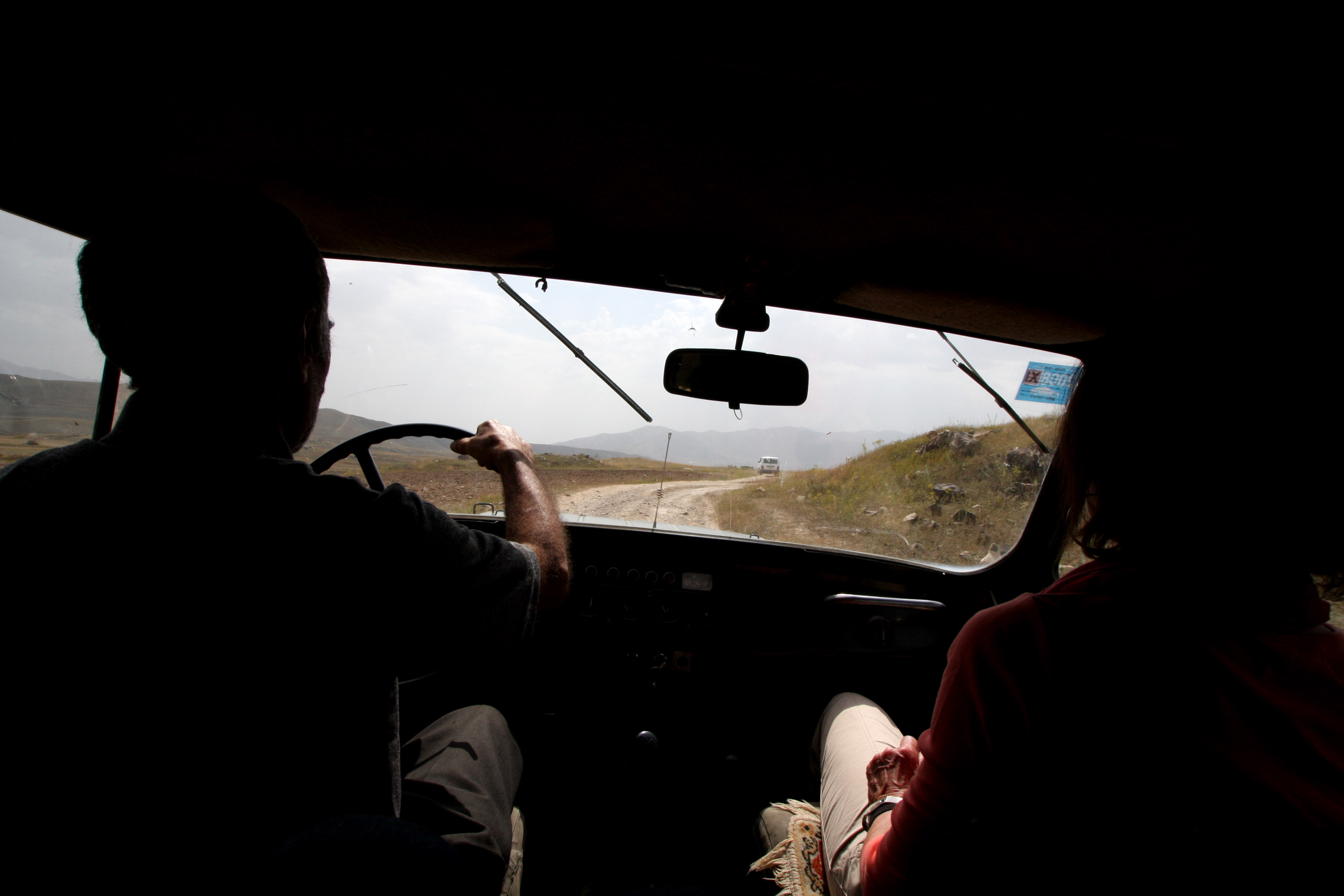
Located in the Syunik mountain range about 20 miles from Sisian in southern Armenia, the petroglyphs can only be accessed by an uphill climb in a Soviet-era UAZ. UAZ stands for Ulyanovsky Avtomobilny Zavod, or the Ulyanovsk Automobile Plant where the sturdy Russian 4×4 is manufactured. The trek up the mountain is much like riding Disneyland’s beloved Indiana Jones Adventure 200 times without stopping. Your slight, unassuming Armenian driver will be transformed into a superb navigator at the helm, maneuvering through ditches and over large boulders with ease as you bounce around the back of the UAZ desperately trying to absorb some of the pristine scenery without knocking your head against the window too many times. At some point after the first hour of driving you have no choice but to get out of the vehicle and continue on foot, as the road becomes too steep for even the tank-like UAZ to scale it with so many passengers. This is the part of the trip when some members of your party, possibly your father or mother, will start cursing the moment they agreed to come here with you in the first place; this was, after all, supposed to be a vacation.
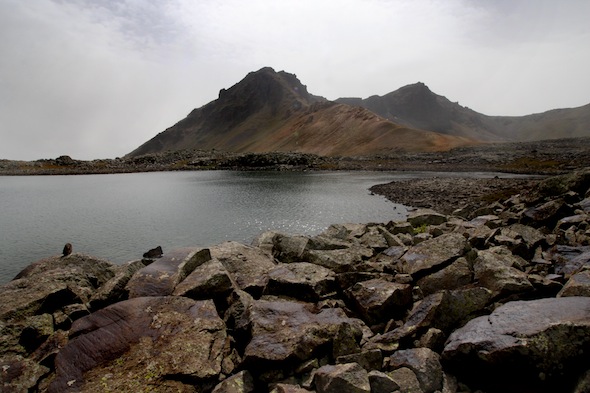
After you pass the worst of it and can climb back into the car, it’s only a short drive to the lake and the petroglyphs at the top of the mountain. The first glimpse of the small, crystalline glacial lake makes the drive worth it, no matter how much you may have been knocked around: it is glass-like and still, providing a perfect mirror of the sky and the surrounding peaks, and over 2,000 decorated rock fragments extend to the foot of the mountain. If the sun is shining, the rocks glisten with a greenish iridescence. The petroglyphs, some believed to date back to the Paleolithic Era (12,000 BCE), are carved onto dark brownish-black volcanic stones left behind by an extinct volcano. Although the site was discovered in the early 20th century, it was not really studied until the 1920s and again in the late 1960s; it is still not fully understood today.
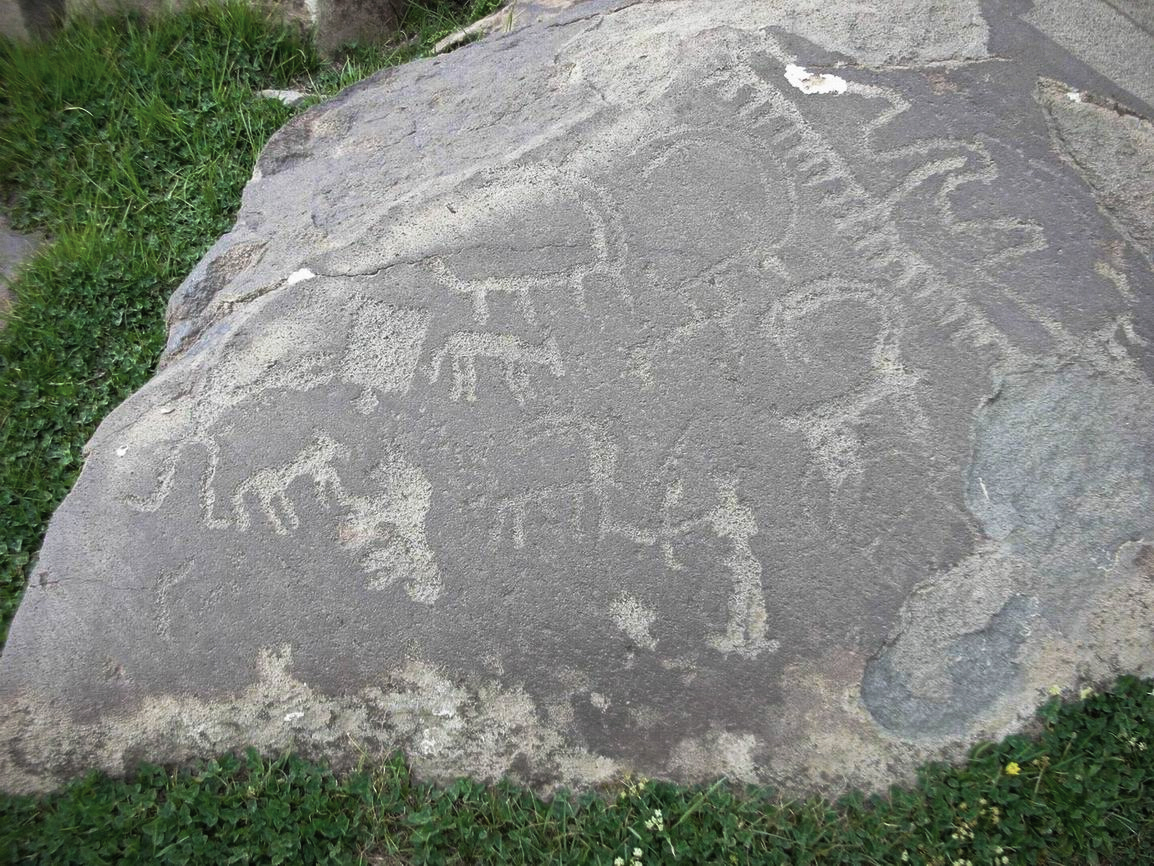
The carvings on the rock fragments depict hunting scenes, a wide array of animals, spirals, circles and geometric shapes, and even zodiac signs. Research suggests that the area served as a temporary dwelling for nomadic cattle-herding tribes, and studies of the rock carvings indicate that they were in use for hundreds of years, with peoples of later eras adding their ownengravings to the stones. According to the research of Hamlet Martirosyan, the pictograms of Ughtasar represent a writing system called “goat writing”.
Many scholars believe that this was due to the large number of goats drawn on the stones, but according to Martirosyan it is because in the ancient Armenian language, the words “goat” and “writing” were homonyms (words of differing meaning that sound the same). They would use these homonyms to express concepts through pictures, thus the abstract concept of “writing” (which in ancient Armenian can be expressed with words like “shar” – arrange, “sarel” – compile, “tsir” – a line) found its reflection in the representation of a goat (“zar”), because the words for “writing” and “goat” sounded the same. As English speakers, we can think of it as representing the pronoun “you” with a picture of a ewe (a female sheep). Goats are a prevalent theme on the stones, possibly because the word “dig” in ancient Armenian meant goat and was close enough to “diq,” the ancient word for gods. By combining abstract signs with the images of animals and people in horizontal or vertical rows, prehistoric engravers were able to convey specific messages.
The true beauty of Ughtasar lies in its seemingly untouched nature. You won’t find traces of khorovadz (barbeque) fires next to the lake or trash sprinkled among the rocks; there isn’t a visitor center selling mugs and postcards; there are no tour guides hounding you to listen to the history of the petroglyphs. You are free to roam the mountainside and sit among the prehistoric graphic expressions, pondering what might have caused ancient Armenians to scale the uninviting peaks and leave their mark. At about 10,500 feet above sea level, the air is some of the cleanest you’ll breathe in Armenia outside of a climb to the top of Mount Aragats, Armenia’s highest point. Due to its elevation the climate is always crisp and patches of snow speckle the mountain year-round.
Today, the mountain perch hosts annual spiritual gatherings and retreats. Surrounded by the marks of peoples past, modern visitors partake in the same natural beauty, serenity, and mystery that the lake has provided for thousands of years.
When you finally reach Sisian again after practically tumbling down the mountainside, you feel like you’ve just returned from a trip to the moon or some equally far-flung and unreachable place. You feel as if you’re waking from a dream, a dream whose constant jerking scenery caused you to fall from your bed, hitting your head a few times along the way. You are left with some amazing bruises to help you recall it instantly for days to come.
Labels:
Armenia,
Culture,
History,
Maro Siranosian,
Petroglyphs,
Sisian,
Syunik mountain,
Ughtasar
WISSENSCHAFT: Forscher dokumentieren Felsmalerei in Armenien. Von Von Gregor Klaudius, dpa (suedkurier.de)
(suedkurier.de) Das Forschungsprojekt ist aufwendig und ungewöhnlich: Archäologen aus Sachsen-Anhalt haben es sich zur Aufgabe gemacht, weltweit einzigartigen Felsmalereien in Armenien zum Weltkulturerbe-Titel der Unesco zu verhelfen.
Die Wissenschaftler um den Direktor des Landesamtes für Archäologie, Harald Meller, dokumentierten bislang etwa 500 von tausenden aus der Bronzezeit stammende Felsmalereien. Erstmals zeigt das Landesamt Fotos der Forschungsergebnisse in einer Ausstellung in Berlin.
«Das Weltkulturerbe bekommt man schwer, aber die armenischen Felsmalereien haben gute Chancen», sagt Meller in Halle. Sein Team aus 15 Vermessungsingenieuren, Archäologen und Grabungstechnikern hatte im vergangenen Sommer die Felsbilder von Ughtasar im armenischen Hochland erstmals leibhaftig in Augenschein genommen. Auf Höhen von 2000 bis 3500 Metern erforschten die Wissenschaftler 40 Hektar einer erloschenen Vulkanlandschaft, die aus tausenden Basaltbrocken besteht. Auf vielen der dunklen Gesteinsbrocken fanden sie bronzezeitliche Felsmalereien etwa von Steinböcken, Leoparden, Kriegern, Bären oder Ziegen.
Was die Bilder so einzigartig macht, ist nicht nur ihre hohe Anzahl, die über mehrere Jahrhunderte entstanden sein muss. «Die Tiere und Menschen sind sehr eindeutig aufs Charakteristische beschränkt», erklärt Sachsen-Anhalts Chefarchäologe. Die 4000 Jahre alten Felsmalereien seien sowohl gestalterisch wie auch handwerklich gekonnt in Szene gesetzt und gut erhalten.
Mit einem ferngesteuerten Mini-Helikopter haben die Experten das Gebiet in vier Wochen vermessen und fotografiert. Die Fundstätte war zwar seit Jahrzehnten bekannt, doch den Armeniern fehlte die Technik für die Erforschung. Und die Bemühungen britischer Wissenschaftler der Universität Reading reichten nicht aus, um dem Ziel rasch näher zu kommen, zum Weltkulturerbe zu gehören.
Also vereinbarten Armenien und Sachsen-Anhalt ein gemeinsames Forschungsprojekt. Sachsen-Anhalt vertritt Deutschland seit dem Jahr 1996 bei der kulturellen Zusammenarbeit. Grundlage ist ein Kulturabkommen der Bundesrepublik mit der Republik Armenien. Laut Sachsen-Anhalts Kultusministerium kooperieren das Landesamt und die Wissenschaftliche Akademie Armeniens seit dem Jahr 2008 eng miteinander bei archäologischen und Denkmalschutzprojekten. Neben den Felsmalereien von Ughtasar gehören prähistorische Goldbergwerke und rätselhafte Steinanhäufungen zu den Projekten der deutschen Forscher in Armenien.
Wenn alles klappt, will Armenien mit Hilfe der Sachsen-Anhalter binnen der nächsten zehn Jahre den Weltkulturerbe-Titel beantragen. «Dazu müssen die zentralen Fragen beantwortet werden, was es alles für Motive gibt und wie sie zueinander stehen», sagt Meller. Bislang seien die Archäologen mit Deutungen der Motive noch sehr zurückhaltend, weil der Bestand zunächst weiter erforscht werden müsse. Meller schätzt, dass sein Team bei einem erneuten Projekt in diesem Sommer noch einmal mehr als 500 Felsmalereien dokumentieren wird.
Die Aussichten auf den Weltkulturerbe-Titel für das armenische Hochland an der Grenze zu Aserbaidschan bewertet Meller als «sehr gut, weil die Felsmalereien wissenschaftlich hoch bedeutsam» seien. Grundvoraussetzung für den Titel sei eine wissenschaftliche Dokumentation der Bilder. Die Unesco als Organisation der Vereinten Nationen verleiht den Titel Weltkulturerbe an Orte, die wegen ihrer Einzigartigkeit, Authentizität und Integrität als weltbedeutend gelten. Vorgeschlagen werden die Stätten von den Staaten, in denen sie liegen.
«Armenien hat sicher gute Chancen auf den Welterbetitel, weil es in dieser Region im Gegensatz zu Europa oder den USA noch nicht viele Welterbestätten gibt», sagt Doris Hartmann vom Lehrstuhl für Materielles und Immaterielles Kulturerbe der Universität Paderborn. Für einen Welterbe-Antrag sei allerdings viel Vorarbeit notwendig, um die Besonderheiten einer Stätte herauszustellen. Die Unesco fordere sehr umfangreiche Anträge. Es gebe bereits mehrere Welterbestätten mit Felsmalereien, beispielsweise in Frankreich oder Spanien. Dass nun die armenischen Felsbilder wissenschaftlich aufgearbeitet würden, sei ein gutes Anliegen, meint Hartmann.
In einer Ausstellung unter dem Titel «Bilder für die Ewigkeit - Petroglyphen im Hochland Armeniens» im Auswärtigen Amt, das die Projektkosten größtenteils trägt, sind nun erstmals Fotos von den Felsmalereien und Forschungsarbeiten zu sehen. Die prähistorische Felskunst in den Jahrtausende alten Bergsteppen sei ein wesentlicher Teil des kulturellen Erbes Armeniens, sagt eine Sprecherin des Auswärtigen Amtes in Berlin. Zudem sei diese Bilderwelt im Gegensatz zu vielen mitteleuropäischen Felsbildregionen, die seit Jahren zum Welterbe der Unesco zählten, bis heute nahezu unbekannt.
Austellung: Auswärtiges Amt, Lichthof, Werderscher Markt 1, 10117 Berlin
Die Ausstellung kann vom 21.05. bis zum 12.06.2013, wochentags von 10 bis 18 Uhr, besichtigt werden. Der Eintritt ist frei.
Mehr Links:
Felsmalereien: Das geheimnisvolle Freilichtmuseum von Ughtasar (spiegel.de)
Die einzigartigen Bilder von Ughtasar (n24.de)
Ughtasar Petroglyphs (armeniapedia.org)
Armenische Auszeichnung für Sachsen-Anhalts Landesarchäologen (hallespektrum.de)
Mehr zu den Petroglyphen (wikipedia.org)
ESSENTIAL PHOTOGRAPHY: The Tbilisi Photo Festival. By Nathan Thornburgh (roadsandkingdoms.com)
Photo: A Salafi woman with a child, met in the street. Dagestan.Photo by: Maria Turchenkova, Hidden War in the Land of Mountains
(roadsandkingdoms.com) Tbilisi, hillbound city of stone bridges and medieval churches, has alsobecome in recent years a city of photography, a place that some of the best photographers in the world call home. This is partially a fault of geography: it is nestled between the ever-wars of the north Caucasus and the intrigues of Iran, not far from Iraq or Afghanistan. There are additional benefits for photojournalists: low rents, a strong local grappa called chacha, and the ability to smoke almost anywhere at anytime.
But any conversation about why Tbilisi is known for photography should start with Nestan Nijaradze and the Tbilisi Photo Festival that she helps run. Nestan is one of the last true muses of this earth: descendant of Imeretian aristocracy, educated in Paris, ardent defender of humanist Georgia. She has been Artistic Co-Director of the festival from the beginning, and it has always been beautiful, always a crossroad of east and west and north and south. This year it features the kind of brave work it always has—not least the North Caucasus projects shown below. But the 2013 festival, which starts May 28, is more than exposition this year, more than education. This year it’s a referendum on the soul of Georgia.
Here’s why: On May 17, a small silent protest in support of anti-homophobia groups took place as planned in the center of Tbilisi. It was met by a mob of thousands, egged on by Orthodox Christian priests baying for violence. The crowd overwhelmed police lines, attacked the peaceful protesters and, when they were being evacuated, savaged the buses with stones and bricks and bottles. It was a minor miracle that no one died. But the notion that some of us have, that Tbilisi can be a city of both tradition and tolerance, suffered a terrible blow.
I reached Nestan at home in Tbilisi over the weekend.
Roads & Kingdoms: What the hell happened on May 17?
Nestan Nijaradze: We were expecting that one day there would be something like this, that the church would take control of the crowd. We saw terrible scenes—people beating each other, and priests encouraging it. There were priests running in the streets, battling, with chairs in their hands.
Yesterday there was another protest, and again this violence. We were a thousand people, not more. But of course we have to continue. It’s very possible that this would become a radical orthodox country.
R&K: What were they saying as all this was happening?
NN: They were saying, you have sold our country, our traditions. There were saying, you are all—I only know how to say it in French—enculé, fucked in the ass.
But there were also heterosexual people like I am, and we were like, sorry, we are very banal.
R&K: The open-air “night of photography” is a big part of your festival, and it’s on the street. Is that going to change?
NN: We are doing still photo night, still with the Arles Festival, our partner from the beginning.
During this one night in old Tbilisi, we bring in the whole world. We have around 10,000 people who come to this event. The program is already closed, it’s edited. But yesterday morning I got a call from a Georgian magazine, and they asked if they can give us photos from May 17. And of course, we’ll find room. We’ll be able to show this thing to a huge public.
R&K: What’s the value, in times like this, of having a photo festival?
NN: We don’t have a photo festival just to have a photo festival. We want to make the public more mature; to give a larger vision of modernity and the modern world, what’s going on, in Georgia, in the region, the Caucasus, the larger region from Iran and Afghanistan, or Europe; to show it’s not only Georgia, there are not only our own problems. The modern world is a huge structure with a very, very complicated reality. We want to bring it here.
We want to do this through the best photographers, but also through the emerging photographers we find in every corner here when we go looking. There is a group of female photographers who are bringing very interesting work from the north Caucasus. A group of Ukrainians working on Chernobyl. Georgians, Azeris, Armenians. Kurdish Iraqi slideshows on Kirkuk ten years after the invasion and petrol smugglers on the border. Also huge maps of the countries that we put in the program.
R&K: Are you afraid of being targeted?
NN: You know, it’s always possible. We have a transgender series. One by [NOOR photographer] Pep Bonet, another by a young French photographer.
We are expecting of course, that there might be a reaction. We are ready for that, but it doesn’t mean we’re going to cancel the exhibition because of crazy priests running through the street encouraging absolutely stupid young men to beat others.
It’s very important to show the reality of [sexual minorities]. For transsexuals, they’re making this decision that are obliged to be in the sex industry, because it’s the only way for them to continue to exist.
We are not a human rights organization. But we are trying to focus on these stories.
Some of the work is about nightlife and prostitution and drugs, but it’s also about the violence of the world these people are living in. It’s about the economic condition, and how they suffer. The job is to bring this world to this public that suffers from a narrow vision of reality, that has no wish to understand that the modern world is much more complicated and scary.
R&K: Have you talked directly with church leaders about this?
NN: No, no, no. We are trying to be smart. The problem of May 17, first of all, was that all Georgia media was presenting the wrong idea, that the protest was going to be a gay pride parade. It wasn’t: it was a silent march in support of the organizations that protect the rights of sexual minorities. But all the press, during ten days beforehand, they were saying gaypride gaypride gaypride.
We are not looking for any scandals. Even in the titles we put on the show, they are not so easily understood as being about transsexuals, for example. It’s not because we want to complicate it. We are spreading the info without making any big stories about what we’re going to do.
We are ready for anything. But if we think too much about it, it will be impossible to continue. And we have to continue. The festival is just days away.
R&K: Tell me about this work on the North Caucasus in the festival.
NN: We have a few traditions for the festival that we try to maintain from the very beginning. One of them is to try to always show something on the Caucasus. It attracts international public, international media and it’s a chance to show more about the region where Georgia is located. Not just the South Caucasus, but the North, because it’s very important for us, historically.
So in the past we’ve had [Thomas] Dworzak on the Kavkaz, and [Stanley] Greene on Chechnya.
It’s also a tradition to show one country through the work of young photographers. It’s a very interesting trick to show a country through photography. This year’s festival starts a few months before the Sochi Olympics, and Sochi was very political from the beginning, especially for us. So we were thinking okay, why not give the place and space to this huge international event? At the same time, we know what is going on around Sochi, how far it is from the glamour place of winter skiing.
It raises the question: does the larger public know that the Winter Olympics will be held in a very complicated region that still has great risks?
The images are also very interesting, because you see for the last four or five years, the North Caucasus is mostly photographed by Russian photographers. So our shows from the North Caucasus are all Russian photographers, except for Andrea Bruce in Ingushetia.
There are new names, like Maria Turchenkova with her Dagestan work, and Maria Plotnikova in Sochi, and Grozny Nine Cities, which is a joint project of three young photojournalists: Olga Kravets, Maria Morina, and Oksana Yushko. We see the Grozny and Chechnya that pretends to be in normal life, but of course, there’s more to the story.
And, because of the Sochi connection, we decided to include the Sochi Project; they will make a presentation.
R&K: There’s also been a change in government in Georgia since the last festival. The government is a major sponsor. Has that hurt the festival?
NN: You know, it’s incredible timing. It was a really hard year. All the people we were partnering with in government changed. The people in City Hall changed, but they are still supporting us. We never deal directly with the government. Nobody ever asked us what we are doing. Nobody touches us. Nobody asks. They know we’re doing things at a very high level.
This year was the hardest one. But we are doing it, and we are convinced that this is the most important one yet.
[Top image by Oksana Yushko from Grozny Nine Cities]
Nathan Thornburgh is the co-founder of Roads & Kingdoms and the intrepid voice behind @roadskingdoms. He is a former editor and foreign correspondent at TIME Magazine.
facebook: facebook.com
![]() |
(roadsandkingdoms.com) Tbilisi, hillbound city of stone bridges and medieval churches, has alsobecome in recent years a city of photography, a place that some of the best photographers in the world call home. This is partially a fault of geography: it is nestled between the ever-wars of the north Caucasus and the intrigues of Iran, not far from Iraq or Afghanistan. There are additional benefits for photojournalists: low rents, a strong local grappa called chacha, and the ability to smoke almost anywhere at anytime.
But any conversation about why Tbilisi is known for photography should start with Nestan Nijaradze and the Tbilisi Photo Festival that she helps run. Nestan is one of the last true muses of this earth: descendant of Imeretian aristocracy, educated in Paris, ardent defender of humanist Georgia. She has been Artistic Co-Director of the festival from the beginning, and it has always been beautiful, always a crossroad of east and west and north and south. This year it features the kind of brave work it always has—not least the North Caucasus projects shown below. But the 2013 festival, which starts May 28, is more than exposition this year, more than education. This year it’s a referendum on the soul of Georgia.
Here’s why: On May 17, a small silent protest in support of anti-homophobia groups took place as planned in the center of Tbilisi. It was met by a mob of thousands, egged on by Orthodox Christian priests baying for violence. The crowd overwhelmed police lines, attacked the peaceful protesters and, when they were being evacuated, savaged the buses with stones and bricks and bottles. It was a minor miracle that no one died. But the notion that some of us have, that Tbilisi can be a city of both tradition and tolerance, suffered a terrible blow.
I reached Nestan at home in Tbilisi over the weekend.
Roads & Kingdoms: What the hell happened on May 17?
Nestan Nijaradze: We were expecting that one day there would be something like this, that the church would take control of the crowd. We saw terrible scenes—people beating each other, and priests encouraging it. There were priests running in the streets, battling, with chairs in their hands.
Yesterday there was another protest, and again this violence. We were a thousand people, not more. But of course we have to continue. It’s very possible that this would become a radical orthodox country.
R&K: What were they saying as all this was happening?
NN: They were saying, you have sold our country, our traditions. There were saying, you are all—I only know how to say it in French—enculé, fucked in the ass.
But there were also heterosexual people like I am, and we were like, sorry, we are very banal.
R&K: The open-air “night of photography” is a big part of your festival, and it’s on the street. Is that going to change?
NN: We are doing still photo night, still with the Arles Festival, our partner from the beginning.
During this one night in old Tbilisi, we bring in the whole world. We have around 10,000 people who come to this event. The program is already closed, it’s edited. But yesterday morning I got a call from a Georgian magazine, and they asked if they can give us photos from May 17. And of course, we’ll find room. We’ll be able to show this thing to a huge public.
R&K: What’s the value, in times like this, of having a photo festival?
NN: We don’t have a photo festival just to have a photo festival. We want to make the public more mature; to give a larger vision of modernity and the modern world, what’s going on, in Georgia, in the region, the Caucasus, the larger region from Iran and Afghanistan, or Europe; to show it’s not only Georgia, there are not only our own problems. The modern world is a huge structure with a very, very complicated reality. We want to bring it here.
We want to do this through the best photographers, but also through the emerging photographers we find in every corner here when we go looking. There is a group of female photographers who are bringing very interesting work from the north Caucasus. A group of Ukrainians working on Chernobyl. Georgians, Azeris, Armenians. Kurdish Iraqi slideshows on Kirkuk ten years after the invasion and petrol smugglers on the border. Also huge maps of the countries that we put in the program.
R&K: Are you afraid of being targeted?
NN: You know, it’s always possible. We have a transgender series. One by [NOOR photographer] Pep Bonet, another by a young French photographer.
We are expecting of course, that there might be a reaction. We are ready for that, but it doesn’t mean we’re going to cancel the exhibition because of crazy priests running through the street encouraging absolutely stupid young men to beat others.
It’s very important to show the reality of [sexual minorities]. For transsexuals, they’re making this decision that are obliged to be in the sex industry, because it’s the only way for them to continue to exist.
We are not a human rights organization. But we are trying to focus on these stories.
Some of the work is about nightlife and prostitution and drugs, but it’s also about the violence of the world these people are living in. It’s about the economic condition, and how they suffer. The job is to bring this world to this public that suffers from a narrow vision of reality, that has no wish to understand that the modern world is much more complicated and scary.
R&K: Have you talked directly with church leaders about this?
NN: No, no, no. We are trying to be smart. The problem of May 17, first of all, was that all Georgia media was presenting the wrong idea, that the protest was going to be a gay pride parade. It wasn’t: it was a silent march in support of the organizations that protect the rights of sexual minorities. But all the press, during ten days beforehand, they were saying gaypride gaypride gaypride.
We are not looking for any scandals. Even in the titles we put on the show, they are not so easily understood as being about transsexuals, for example. It’s not because we want to complicate it. We are spreading the info without making any big stories about what we’re going to do.
We are ready for anything. But if we think too much about it, it will be impossible to continue. And we have to continue. The festival is just days away.
R&K: Tell me about this work on the North Caucasus in the festival.
NN: We have a few traditions for the festival that we try to maintain from the very beginning. One of them is to try to always show something on the Caucasus. It attracts international public, international media and it’s a chance to show more about the region where Georgia is located. Not just the South Caucasus, but the North, because it’s very important for us, historically.
So in the past we’ve had [Thomas] Dworzak on the Kavkaz, and [Stanley] Greene on Chechnya.
It’s also a tradition to show one country through the work of young photographers. It’s a very interesting trick to show a country through photography. This year’s festival starts a few months before the Sochi Olympics, and Sochi was very political from the beginning, especially for us. So we were thinking okay, why not give the place and space to this huge international event? At the same time, we know what is going on around Sochi, how far it is from the glamour place of winter skiing.
It raises the question: does the larger public know that the Winter Olympics will be held in a very complicated region that still has great risks?
The images are also very interesting, because you see for the last four or five years, the North Caucasus is mostly photographed by Russian photographers. So our shows from the North Caucasus are all Russian photographers, except for Andrea Bruce in Ingushetia.
There are new names, like Maria Turchenkova with her Dagestan work, and Maria Plotnikova in Sochi, and Grozny Nine Cities, which is a joint project of three young photojournalists: Olga Kravets, Maria Morina, and Oksana Yushko. We see the Grozny and Chechnya that pretends to be in normal life, but of course, there’s more to the story.
And, because of the Sochi connection, we decided to include the Sochi Project; they will make a presentation.
R&K: There’s also been a change in government in Georgia since the last festival. The government is a major sponsor. Has that hurt the festival?
NN: You know, it’s incredible timing. It was a really hard year. All the people we were partnering with in government changed. The people in City Hall changed, but they are still supporting us. We never deal directly with the government. Nobody ever asked us what we are doing. Nobody touches us. Nobody asks. They know we’re doing things at a very high level.
This year was the hardest one. But we are doing it, and we are convinced that this is the most important one yet.
[Top image by Oksana Yushko from Grozny Nine Cities]
Nathan Thornburgh is the co-founder of Roads & Kingdoms and the intrepid voice behind @roadskingdoms. He is a former editor and foreign correspondent at TIME Magazine.
facebook: facebook.com
FILM RELEASE: "Lost and Found in Armenia" - comes out in theaters on June 7th.
“Lost & Found in Armenia” is the
story of Bill (Jamie Kennedy), an
American tourist who vacations to Turkey to get his mind off a bad break up. In
a comedic and dangerous turn of events, Bill unknowingly ends up in a small
village in Armenia, where he is accused of being a Turkish spy. It is in that
small village, he meets a beautiful Armenian girl (Angela Sarafyan), who helps him escape from misfortune.
“Lost
& Found in Armenia” is a Red Tie
Films production with Award-winning director Gor
Kirakosian (Big
Story in a Small City) and award-winning producer Valerie
McCaffrey (American
History X, Neo Ned) along with Maral Djerejian (Sideways) and starring comedian Jamie Kennedy (Malibu’s
Most Wanted, Scream)
and Angela Sarafyan (A Beautiful
Life, The
Twilight Saga: Breaking Dawn). Shooting Locations were in San Diego, Los
Angeles, and Armenia. Red Tie Films is the first Armenian-American production
team to shoot in Armenia.
+++
We're excited to announce that the film "Lost and Found in Armenia", starring Jamie Kennedy, comes out in theaters on June 7th. This is the first Armenian-American movie ever filmed in Armenia, and the majority of the film is in Armenian with English subtitles. We're big fans of the film, its message, and the impact that it can have on the Armenian community.
Since your audience is primarily Armenian, we thought it would be great to share it with you in hopes that we can garner enough support to get the movie to expand nation wide. The film opens throughout Los Angeles, as well as Washington, DC, Boston, Detroit, New Jersey / Philadelphia, and Fresno.
Thank you for support. Please share and spread the word, and let us know if you have any questions or requests.
Website (with links for tickets): www.lostandfoundinarmenia.net
Facebook: facebook.com/lostinarmenia
Twitter: twitter.com/lostinarmenia
_______________________________
Breanna Hughes
Plastick Media, LLC.
5355 Cartwright Avenue, Suite 108 // North Hollywood, CA 91601
323.230.0854 | 323.218.0708 | breanna@plastickmedia.com | www.plastickmedia.com
Wednesday, May 22, 2013
EVENT: Georgian Day in Hilton the Hague in Netherland on Tuesday, May 28, 2013
On the occasion of the Georgian Independence Day the Ambassador of Georgia H.E. Shota Gvineria has the honor to
request your company at the "Georgian Day" on Tuesday, May 28, 2013 at 18:00 in Hilton the Hague
Official launch of the Netherlands-Georgia Business Council will be held during the event
Reception will be accompanied by Georgian Music, Wine and Cuisine
(please see the full program of the "Georgian Day" below)
R.S.V.P. by email: thehague.emb@mfa.gov.ge or Tel: 070 3029080
Maka Batiashvili are inviting on her exhibition at the "Georgian Day" in Netherland in the Hague on Tuesday, May 28, 2013 at 18:00
In Hilton the Hague
Address: Zeestraat 35, 2518 AA The Hague, Netherlands
Maka batashvili will be also there ...
Program of the Georgian Day in Hilton the Hague
17:30 - Welcome drinks
18:00 - Music performance by the famous Georgian Folk Group “Chveneburebi”
18:30 - Official Launch of the Netherlands-Georgia Business Council:
* opening remarks by the Ambassador of Georgia H.E. Shota Gvineria
* presentation by the National Tourism Administration
* presentation by the Georgian National Investment Agency
* presentation by the NGBC
19:00 - Music performance by the Georgian Folk Group “Chveneburebi”
19:15 - Networking reception with Georgian music, food and drinks
Official Launch of the Netherlands-Georgia Business Council (www.NGBC.nl)
On April 5th, 2012, a successful kick-off event was held in the Chamber of Commerce The Hague. More than 80 Dutch companies have shown interest in the NGBC activities and expressed their readiness for cooperation. The fact that the Netherlands was number one investor to Georgia during two consecutive years, in 2011 and 2012, is an additional source of inspiration for NGBC. During the past three years investments from the Netherlands in Georgia have grown by 60%, and Dutch companies are becoming more and more active in Georgia, as they become more aware of the huge potential available in the country. This promising dynamics was one of the motivating factors for the NGBC to start operation since the beginning of 2013. Today we are ready to offer you our services with the aim to boost your interests towards Georgia through providing tailor made information about the unexplored opportunities.
Wine tasting (www.nwa.ge)
The National Wine Agency under the Ministry of Agriculture of Georgia is an organization responsible for assisting the development of Wine Sector of Georgia through establishment of quality control mechanism and organizing promotional activities to increase international awareness of the unique character of Georgian Wines. In cooperation with the leading Georgian wine producers, National Wine Agency will offer you the possibility to taste a wide range of distinctive wine varieties. Don’t miss the opportunity to experience exceptional flavors of the indigenous grape breads brought to you directly from the birthplace of wine.
Exhibition (maka.batiashvili.net)
Maka Batiashvili, born in 1975, finished her studies at the State Academy of Arts in Tbilisi in 1997. Since then she has been presenting her artworks in various group and solo exhibitions across the globe. Maka is a great illustration of the new generation of modern Georgian artists who specializes in oil paintings, graphic, installation and video works.
Music (www.chveneburebi.com; www.youtube.com/CHVENEBUREBI)
Georgian Folk Group “Chveneburebi” consists of 8 members. Each of them is originally from a different part of Georgia. This fact helps them to keep authentic tradition and manner of singing. Besides singing, each member of the group can dance and play the Georgian folk instruments. Each of them can sing all polyphonic voices and is distinguished by the special voice tembre. Therefore, “Chveneburebi” has maintained the real, authentic character and manner of performance. The repertoire contains Pure Georgian folk music and ethno-musical compositions composed by the group (additionally supported by the standard drum, keyboard and bass guitar).
Investments & Tourism EXPO (www.investingeorgia.org; www.gnta.org)
Throughout the “Georgian day” an exposition about the opportunities for your business and pleasure in Georgia will be brought to your attention by the National Investment Agency and National Tourism Administration of Georgia.
Labels:
Art,
Chveneburebi,
Embassy,
Food and Wine,
Georgian Folk,
Investment,
Maka Batiashvili,
Music,
Netherland,
Painter,
Painting,
Ten Hague
OPENING EXHIBITION: Group Show in New York with Azeri Photographer Rena Effendi in New York - Tomorrow, May 23rd (rauschenbergfoundation.org)
(rauschenbergfoundation.org) May 24–June 29, 2013
Rauschenberg Project Space
455 West 19th Street
11 am to 6 pm, Tuesday through Saturday
Free admission
Curated by Laurel Reuter, director of the North Dakota Museum of Art, the exhibition Songs for Spirit Lake will reflect the ongoing conversation between six artists who created artwork on or about the Spirit Lake Sioux Reservation in North Dakota.
The artists are Rena Effendi, Bill Harbort, John Hitchcock, Terry Jelsing, Mary Lucier, and Tim Schouten. Under the aegis of the Robert Rauschenberg Foundation's Artistic Innovation and Collaboration Grant Program, this first in-progress exhibition allows each artist to create work that responds to their continuing conversations with the inhabitants of Spirit Lake.
Exhibition Theme
In November 2012, these artists were introduced to the Spirit Lake community through an exhibition of their own work. Installed in the gymnasium at the Cankdeska Cikana Community College in the village of Fort Totten, it was the first contemporary art exhibition ever mounted on the reservation.
North Dakota Museum of Art's exhibition encompasses work that each artist made in response to their conversations with each other and their experiences with the people and landscape of the reservation. In Songs for Spirit Lake, the artists explore how people live within the landscape; who the people are; and their patterns of intermingling the past and present in contemporary life through photography, painting, installation, and video. Additionally, the exhibition includes a live performance by musicians from the reservation who, for the first time, will play traditional drum songs together.
Exhibited in the context of New York City's Rauschenberg Project Space, Songs for Spirit Lake invites a new, broad audience to engage with the voices and traditions of the Spirit Lake community as conveyed through the eyes of the artists. This endeavor parallels not only the North Dakota Museum of Art's mission to address global concerns—ideas as relevant to people living on the Northern Plains as they are to people from around the world—but also the legacy of Robert Rauschenberg, who sought to create social and cultural awareness through artistic collaboration and innovation.
About the North Dakota Museum of Art
The North Dakota Museum of Art, a private, nonprofit institution, is located on the campus of the University of North Dakota. Founded as a contemporary art museum, it serves by legislative act as the official art museum of the State of North Dakota.
Songs for Spirit Lake will run May 24 through June 29, 2013, at the Rauschenberg Project Space located at 455 West 19th Street, New York City. The Rauschenberg Project Space is open to the public from 11 am to 6 pm, Tuesday through Saturday, and admission is free.
Please Direct All Media and Press-Related Image Requests To:
Christa Carr
Media Relations
CCarr@RauschenbergFoundation.orgTelephone: 203.275.7565
Labels:
America,
Art,
Artists,
Azeri,
Exhibition,
New York,
Photographer,
Photography,
Rauschenberg Foundation,
Rena Effendi
Subscribe to:
Posts (Atom)