In the annals of Russian-American summitry, Moscow has never before choreographed a welcoming ceremony for the visiting United States president in this fashion. The dramatic run-up to the arrival of US President Barack Obama in Moscow on Monday underscores the complexities of the context in which the two countries are going through at the summit.
full text >>>
Ambassador M K Bhadrakumar was a career diplomat in the Indian Foreign Service. His assignments included the Soviet Union, South Korea, Sri Lanka, Germany, Afghanistan, Pakistan, Uzbekistan, Kuwait and Turkey.
Friday, July 10, 2009


COMMENT: Ice age in Caucasus (news-en.trend.az)
Trend News commentator Polad Hamidov
Renewal of military cooperation between Russia and NATO froze next conflicts in Caucasus, including Georgian-Abkhazian and Georgian-Ossetian. Intensive relations of the Alliance with the Russian Federation lasting almost 10 months from August events of 2008 were the only factor promoting urgency of conflicts geopolitically.
full comment >>>
Renewal of military cooperation between Russia and NATO froze next conflicts in Caucasus, including Georgian-Abkhazian and Georgian-Ossetian. Intensive relations of the Alliance with the Russian Federation lasting almost 10 months from August events of 2008 were the only factor promoting urgency of conflicts geopolitically.
full comment >>>
ARTICLE: Mikheil Saakashvili: Georgia on his mind, Moscow on his back (independent.co.uk)
After the disaster of last summer's war, the charismatic president of the former Soviet republic hopes it won't be sacrificed to improve US-Russian relations. Shaun Walker meets Mikheil Saakashvili
ANALYSIS: Georgia's pluralistic feudalism: a frontline report
By Ilia Roubanis, 3 - 07 - 2009
Georgia's leader-fixated politics lacks an institutional base and competing visions of the country's future. No wonder the gap between the rhetoric and reality of democracy is so sharp, finds Ilia Roubanis in Tbilisi.
full article >>>
Georgia's leader-fixated politics lacks an institutional base and competing visions of the country's future. No wonder the gap between the rhetoric and reality of democracy is so sharp, finds Ilia Roubanis in Tbilisi.
full article >>>
GEOPOLITIC: The Forgotten South Caucasus: Where Oil and Water Mix (circleofblue.org)
A "New Great Game" of Geopolitical Control Surfaces in Russia’s Old Backyard
by Nadya Ivanova
Maps by Hannah Nester and Eric DaighCircle of Blue
Almost 20 years after Georgia, Armenia and Azerbaijan bounced back to full national sovereignty following decades of Soviet control, the winds of change in the South Caucasus have largely faded, leaving behind a region whose geopolitical identity and long-term stability remain uncertain. Once off the radar of Soviet geopolitical analyses, water management problems are now emerging as a cross-cutting issue critical to the stability of volatile regional relations and delicate geopolitical dynamics in the area.
It is often assumed that competition for water will trigger conflict. But in the South Caucasus — a globally strategic corner of the world where Russia, Eastern Europe, the Middle East and Central Asia converge — a proposal to clean up and share management of the region’s largest river basin could well serve as a new route to political stability. And the consequences, diplomats and scientists say, could have strategic importance far beyond – to Europe, Russia, and the United States.
full text >>>
by Nadya Ivanova
Maps by Hannah Nester and Eric DaighCircle of Blue
Almost 20 years after Georgia, Armenia and Azerbaijan bounced back to full national sovereignty following decades of Soviet control, the winds of change in the South Caucasus have largely faded, leaving behind a region whose geopolitical identity and long-term stability remain uncertain. Once off the radar of Soviet geopolitical analyses, water management problems are now emerging as a cross-cutting issue critical to the stability of volatile regional relations and delicate geopolitical dynamics in the area.
It is often assumed that competition for water will trigger conflict. But in the South Caucasus — a globally strategic corner of the world where Russia, Eastern Europe, the Middle East and Central Asia converge — a proposal to clean up and share management of the region’s largest river basin could well serve as a new route to political stability. And the consequences, diplomats and scientists say, could have strategic importance far beyond – to Europe, Russia, and the United States.
full text >>>
ENERGY: Gazprom threat to Nabucco overstated? (upi.com)
TBILISI, Georgia, July 8 (UPI) -- The gas deal between Russian energy giant Gazprom and Azerbaijan will have only a minor impact on the heralded Nabucco pipeline, Georgian analysts say.
The State Oil Co. of Azerbaijan Republic and energy monopoly Gazprom signed a deal in June to secure 1.7 billion cubic feet per year from Azerbaijan in 2010.
Analysts say the Russian move into the Caspian region is a sign the Kremlin is seeking to tighten its grip on the European energy market. Gazprom in January cut gas supplies to its Ukrainian counterpart Naftogaz, leaving Europe in the cold as much of its Russian gas travels through Ukrainian transit routes.
Europe has put its hope in energy diversification in the $10.7 Nabucco pipeline, but analysts had worried that the SOCAR-Gazprom deal would undermine European ambitions.
But Tbilisi analysts say that, while Baku is keen on solidifying its relationship with Moscow, Nabucco, with its capacity of 1.1 billion cubic feet, needs more than just Azeri gas to move forward, Georgian Business Week reports.
full article >>>
The State Oil Co. of Azerbaijan Republic and energy monopoly Gazprom signed a deal in June to secure 1.7 billion cubic feet per year from Azerbaijan in 2010.
Analysts say the Russian move into the Caspian region is a sign the Kremlin is seeking to tighten its grip on the European energy market. Gazprom in January cut gas supplies to its Ukrainian counterpart Naftogaz, leaving Europe in the cold as much of its Russian gas travels through Ukrainian transit routes.
Europe has put its hope in energy diversification in the $10.7 Nabucco pipeline, but analysts had worried that the SOCAR-Gazprom deal would undermine European ambitions.
But Tbilisi analysts say that, while Baku is keen on solidifying its relationship with Moscow, Nabucco, with its capacity of 1.1 billion cubic feet, needs more than just Azeri gas to move forward, Georgian Business Week reports.
full article >>>
BLOG: Stalin’s Downgrading of Abkhazia from Union Republic Status Decried (windowoneurasia.blogspot.com)
Vienna, July 7 – Among Stalin’s many mistakes as a ruler, according to a reviewer of an émigré book on Stalin republished a few years ago in the Russian Federation, was the Soviet dictator’s decision to lower the status of Abkhazia from that of a union republic (SSR) like Ukraine or Kazakhstan to that of an autonomous republic (ASSR) like Tatarstan or Udmurtia.
Had he not done so, Andrey Yezerov suggests in a review of S.V. Dmitriyevsky’s “Stalin. The Forefather of a National Revolution” (1931, 2003), Abkhazia would have gained its independence along with other union republics in 1991 and been widely recognized rather than as a result of Russian military action in 2008 and recognized only by Russia and Nicaragua.
full blog article >>>
Had he not done so, Andrey Yezerov suggests in a review of S.V. Dmitriyevsky’s “Stalin. The Forefather of a National Revolution” (1931, 2003), Abkhazia would have gained its independence along with other union republics in 1991 and been widely recognized rather than as a result of Russian military action in 2008 and recognized only by Russia and Nicaragua.
full blog article >>>
ARTIKEL: Georgien klagt gegen Moskau (dasjournal.net)
Menschenrechtsgericht prüft
Der Europäische Gerichtshof für Menschenrechte wird eine Staatenklage Georgiens gegen Russland prüfen.
Wie eine Sprecherin am Freitag mitteilte, wurde die Beschwerde für zulässig erklärt. Georgien wirft Moskau vor, nach der Festnahme von vier russischen Offizieren in Georgien im September 2006 georgische Einwanderer in Russland willkürlich schikaniert und unterdrückt zu haben.
Der ganze Artikel >>>
Der Europäische Gerichtshof für Menschenrechte wird eine Staatenklage Georgiens gegen Russland prüfen.
Wie eine Sprecherin am Freitag mitteilte, wurde die Beschwerde für zulässig erklärt. Georgien wirft Moskau vor, nach der Festnahme von vier russischen Offizieren in Georgien im September 2006 georgische Einwanderer in Russland willkürlich schikaniert und unterdrückt zu haben.
Der ganze Artikel >>>
ARTIKEL: Temur Jakobaschwili: "Russland liebt Georgien, aber nicht den georgischen Staat" (cafebabel.com)
Obama zu Besuch in Russland, der G8-Gipfel und "militärische Übungen” - im Nachkriegsgeorgien bahnt sich eine heiße Zeit an. Der georgische Vize-Premier (42) zu Nachwuchspolitikern, Familie und gegenseitiger Liebe.
Der ganze Text >>>
Der ganze Text >>>
Thursday, July 09, 2009
NATURE: Programme Office for the Southern Caucasus (iucn.org)
What is IUCN? IUCN, the International Union for Conservation of Nature, helps the world find pragmatic solutions to our most pressing environment and development challenges. It supports scientific research, manages field projects all over the world and brings governments, non-government organizations, United Nations agencies, companies and local communities together to develop and implement policy, laws and best practice.
IUCN is the world’s oldest and largest global environmental network - a democratic membership union with more than 1,000 government and NGO member organizations, and almost 11,000 volunteer scientists in more than 160 countries.
The Caucasus is a region where relatively diverse and healthy ecosystems have persisted until recently, but are now facing multiple threats from unsustainable exploitation, which will be further aggravated by climate change. With its approximately 1,200 endemic plant species and more than 50 endemic animal species, the Caucasus has been listed as one of 34 global biodiversity hotspots.
more >>>
 Lake Tabatskuri in Georgia. Photo: IUCN
IUCN is the world’s oldest and largest global environmental network - a democratic membership union with more than 1,000 government and NGO member organizations, and almost 11,000 volunteer scientists in more than 160 countries.
The Caucasus is a region where relatively diverse and healthy ecosystems have persisted until recently, but are now facing multiple threats from unsustainable exploitation, which will be further aggravated by climate change. With its approximately 1,200 endemic plant species and more than 50 endemic animal species, the Caucasus has been listed as one of 34 global biodiversity hotspots.
more >>>
Lake Tabatskuri in Georgia. Photo: IUCN
ANALYSIS: OBAMA’S RUSSIA VISIT EASES GEORGIANS’ FEARS OF RENEWED CONFLICT WITH MOSCOW (eurasianet.org)
By Giorgi Lomsadze 7/09/09
US President Barack Obama and Russian President Dmitry Medvedev’s early July summit may not have resolved the Georgia-Russia conflict, but, for many Georgians, it did succeed in allaying fears of a fresh military confrontation with Moscow. Nevertheless, worries persist about whether or not Obama’s words of reconciliation will have a permanent effect on the Kremlin.
full article >>>
US President Barack Obama and Russian President Dmitry Medvedev’s early July summit may not have resolved the Georgia-Russia conflict, but, for many Georgians, it did succeed in allaying fears of a fresh military confrontation with Moscow. Nevertheless, worries persist about whether or not Obama’s words of reconciliation will have a permanent effect on the Kremlin.
full article >>>
ARTICLE: Northern Caucasus: War is not over, it has just moved (newropeans-magazine.org)
By Marko Kananen, Wien, Austria
On April 16 Kremlin declared victory in its long-running war in Chechnya and called an end to its anti-terror operation. Back then, several observers expressed their worries on whether the annoucement was given too soon and whether the fragile stability in Chechnya could ever hold.
full article >>>
On April 16 Kremlin declared victory in its long-running war in Chechnya and called an end to its anti-terror operation. Back then, several observers expressed their worries on whether the annoucement was given too soon and whether the fragile stability in Chechnya could ever hold.
full article >>>
ARTICLE: Georgia: between war and a future (opendemocracy.net)
By Vicken Cheterian, 8 - 07 - 2009
A year after the disastrous war with Russia, the political elite in Tbilisi remains uncertain about how to define a way forward for the country. Vicken Cheterian assesses its predicament.
new war in and over Georgia may be in the making. For over two decades, local conflicts have spiralled to make the south Caucasus region a new frontline of east-west proxy wars - most recently in the Georgia-Russia conflict of 8-12 August 2008. The confusion between local political dynamics and international intervention has been at the heart of this process; as long as it lasts, a bad situation will be made worse.
full article >>>
A year after the disastrous war with Russia, the political elite in Tbilisi remains uncertain about how to define a way forward for the country. Vicken Cheterian assesses its predicament.
new war in and over Georgia may be in the making. For over two decades, local conflicts have spiralled to make the south Caucasus region a new frontline of east-west proxy wars - most recently in the Georgia-Russia conflict of 8-12 August 2008. The confusion between local political dynamics and international intervention has been at the heart of this process; as long as it lasts, a bad situation will be made worse.
full article >>>
KUNST: Nachgereicht - Maia Sumbadze, "Untitled 1", 2003 auf der Prag Biennale (art-magazin.de)
Zwei Freunde waren auf der Prag Biennale. Lado Pochkhua und Nini Palavandishvili besuchten Prag für diese Ausstellung. Jetzt wurde im hiesigen ART-Magazin diese Biennale besprochen und kritisiert als Tatbestand. Konkurrenz, Dünkel sollen herrschen - lieblos die Darstellung. Nichtsdestotrotz habe ich mich beim Ansehen der Bildergallerie gefreut, dass auch Maia Sumbadze vertreten war. Für mich ist sie eine der interessantesten und talentiertesten jungen Künstler Georgiens! Congratulations, Maia!
 Der ganze Artikel >>>
Der ganze Artikel >>>Wednesday, July 08, 2009
MUSIC: One of Georgia's greatest singers, Lela Tataraidze. (transcaucasian.blogspot.com)
 Here is a beautiful Georgian folk song ("You, Lion, Killed by a Lion"), performed by one of Georgia's greatest singers, Lela Tataraidze.
Born in 1952, Lela grew up in a family from Tusheti, the mountainous region of Georgia. With her sad eyes but a happy face, she is an excellent accordion and panduri player, and also a brilliant vocalist, who sings the popular songs of the mountains with a lot of emotion. She was brought up in the musical atmosphere of her family and continued her studies at the school of music and later on at the philharmonic ensemble of Tbilisi, the capital of Georgia. She toured in Hungary, Romania, Yugoslavia, Czechoslovakia, Bulgaria and France. She made her first recordings with Melodiya Records in 1988. She founded the trio ensemble of Kesane ("myosotis, forget-me-not", a flower of Tusheti) and recorded her first CD in Holland in 1999, "Janghi" ("morning fog"). Her last CD is from June 2007, it is entitled "Songs of Survival: traditional music of Georgia". Lela Tataraidze is the great lady of Georgian traditional song, a popular art coming from time immemorial and from the majestic landscapes of the legendary Georgia. Enjoy!
Lela Tataraidze is Tusheti's most famous singer. She was first described to me as Article by ALEXANDER BAINBRIDGE (source: transcaucasian.blogspot.com)
TuSeTis jeniper lopez i.e. "Tusheti's Jennifer Lopez" - some indication of her fame and popularity! She was born in Dano, a small, nearly abandoned hamlet in Pirikiti Tusheti. Like most Tush families, hers had no doubt been spending the harsh winters down in the valley of the Alazani, in Kvemo Alvani (where her house - and indeed her mother! - are still to be seen). Her haunting songs are THE music played by all the Tush, irrespective of origin (Tchaghma, Pirikiti, Gometsri, Tsova, Tbilisi Tush, etc.), and some of them - particularly "How beautiful is Tusheti!" - have come to represent the very soul of Tusheti - indeed, to the detriment of other Tush artists: Ask any Georgian (or Tush) to name a singer from Tusheti, and every single one will come up with Lela Tataraidze. But ask them to name a singer from Tusheti other than Lela Tataraidze, however, and you will most likely draw a blank. -
Here are two of her many songs: - "ra lamazia tusheti", or "How beautiful is Tusheti", and a lamentation for the death of several [Tush] people carried away in an avalanche (in the 1970s or -80s, I believe). - - For more traditional Georgian songs - not from Tusheti, however - please see my previous post on two songs by Sandro Kavsadze
Lela Tataraidze: Lomo, She Lomis Moklulo
ლელა თათარაიძე, LELA TATARAIDZE
Georgian folk music from Tusheti region. Performed by Ensemble "Kelaptari" and legendary Lela Tataraidze (accordion). The pictures by Georgian photograper, Paata Vardanashvili, website: www.paata.ge
Tuesday, July 07, 2009
AUSSTELLUNG: 1989–2009: Bewegte Welt – Erzählte Zeit; 11.07.–13.09.2009 (adk.de)
 Eröffnung: 10.07.2009 / 18 Uhr
 Akademie der Künste / Berlin-Tiergarten
Hanseatenweg
photo: Alevtina Kakhidze: Ich kann ein Mädchen mit blauen Augen sein, 2005. Video (zweiteilig) © Alevtina Kakhidze
Die von den Goethe-Instituten der Region Osteuropa/Zentralasien organisierte Ausstellung zeigt in 16 fotografischen und filmischen Arbeiten aus Russland, der Ukraine, Belarus, Georgien, Kasachstan, Kirgisistan, Usbekistan und Deutschland, wie die seit dem Mauerfall 1989 sich dynamisierenden Wandlungsprozesse künstlerisch wahrgenommen und gedeutet werden. Sie richtet ihr Augenmerk auf die Art und Weise des künstlerischen Erzählens über diese »bewegte« Zeit und begreift sich als empirische Annäherung an ein komplexes Thema. Im Mittelpunkt steht die Beschäftigung mit Familie wie in der fotografischen Langzeitbetrachtung von Christian Borchert und in der Serie von Irina Abzhandadze. Andere Künstler wie Erbossyn Meldibekov, Vladimir Kuprijanov und Igor Savchenko verwenden Fotos aus alten Familienalben als künstlerisches Ausgangsmaterial, das Gedanken über die Rolle des Mediums in privaten und gesellschaftlichen Kontexten impliziert. Weitere Arbeiten setzen sich mit der Frage der hybriden postsowjetischen Identität, mit dramatischen urbanen und sozialen Veränderungen sowie mit Ritualen der Macht auseinander.Der Ausstellungseröffnung schließt sich ein Gespräch mit Jule Reuter, Erbossyn Meldibekov, Koka Ramishvili, Tina Bara und Anna Gor an.
Informationen unter www.goethe.de/bewegtewelt
20 Uhr / Studio / Künstlergespräch mit Tina Bara, Erbossyn Meldibekov, Koka Ramishvili, Jule Reuter und Olesya Ostrovska-Lyuta
Moderation: Felix Hoffmann (C/O Berlin)
1989–2009: Bewegte Welt – Erzählte Zeit
ZEITGENÖSSISCHE FOTOGRAFIE UND VIDEOKUNST aus Russland, der Ukraine, Belarus, Georgien, Kasachstan, Kirgisistan, Usbekistan und Deutschland // 11.07.–13.09.2009
IRINA ABZHANDADZE (Georgien), VIKTOR AN (Usbekistan), TALGAT ASYRANKULOV (Kirgisistan), TINA BARA / ALBA D’URBANO (Deutschland, Italien), CHRISTIAN BORCHERT (Deutschland), OLGA CHERNYSHEVA (Russland), SHAILO DJEKSHENBAEV (Kirgisistan), ALEVTINA KAKHIDZE (Ukraine), VLADIMIR KUPRIJANOV (Russland), VIKTOR MARUSHCHENKO (Ukraine), ERBOSSYN MELDIBEKOV / NURBOSSYN ORIS (Kasachstan), KOKA RAMISHVILI (Georgien), IGOR SAVCHENKO (Belarus), OKSANA SHATALOVA (Kasachstan)
Akademie der Künste // Hanseatenweg 10 / 10557 Berlin / Di–So 11–20 Uhr
Kuratorin: Dr. Jule Reuter (Berlin) in Zusammenarbeit mit Kuratorinnen und Kuratoren der beteiligten Länder. // Eine Ausstellung der Goethe-Institute der Region Osteuropa/Zentralasien, in Partnerschaft mit der Akademie der Künste, Berlin.
Quelle: http://www.adk.de/
Monday, July 06, 2009
TOUR: Trekking-Tour mit Pferden in den Kaukasischen Bergen von Georgien.
Vom 03.-13. August gibt es eine sehr schöne Bergtour im Kaukasus. Ein Vater mit seinen drei Söhnen (alle aus deutschland) haben diese Tour für sich organisieren lassen. Wenn sich jemand der Gruppe anschließen will, dann ist er/sie herzlich willkommmen.
Der genaue Tourinhalt mitsamt Fotos:
Die Tourfotos hier >>>
1. Tag: Tbilissi – Mzcheta- Barisacho-Gudani-Datvisdschwari Pass
Mzcheta ist die altehrwürdigste der georgischen Städte und die frühere Hauptstadt von Georgien. Dort besuchen wir Svetizchoveli Kathedrale (4. Jahrh.) und fahren weiter durch den Schlucht des Pschavi Aragvi Flusses bis zum Dorf Barisacho, nach dem Mittagessen besichtigen wir das Museum. Übersteigung Datwisdschwari –Passes (2500m.), Übernachten am Fluss Arguni in den Zelten
http://de.wikipedia.org/wiki/Mzcheta
2. Tag: Über kleinen Pass (2600m.) nach Dorf Chachabo
Wandern entlang der engen Schlucht des Chanchari Flusses zum Dorf Chachabo (2000m). Wanderzeit – 8 Std.
3. Tag: Dorf Chachabo- Dorf Ardoti
Wandern entlang des Flusses. Besichtigung der beiden Dörfer Chachabo und Ardoti. Lagern an dem Mündungsort des Andaqi Flusses. Pferde reiten. Angeln nach Forellen. Wanderzeit – 6 Std.
4. Tag: Dorf Ardoti- Dorf Muzo
Durch den Schlucht des Andaqi Flusses wandern wir hinunnter zum befestigten Dorf Muzo. Muzos Besichtigung. Lagerung und Übernachten bei Muzo.
5.Tag: Dorf Muzo-Schatili
Besichtigung Anatori – die alten Begräbnisstätte der Chewsuren in Muzo. Hochlaufen zu dem befestigten Dorf Schatili. Übernachten in Schatili ist in den Gasthäusern auch möglich. Wanderzeit – 7- Std.
6. Tag: Dorf Schatili- Dorf Roschka
Fahrt von Schatili zum Dorf Roschka. Übernachten bei Roschka
7. Tag: Dorf Roschka - Abudelauri-See(3300m)
Rechts die "Dolomiten", links die "Alpen", und die Wanderung im Großen Kaukasus wird spannender. Mit der Hilfe von Pferden, die das Gepäck tragen, gehen wir durch den steilen Weg zum Abudelauri Pass (3300m) Es nimmt ca. 15 min. Zeit in Anspruch, den Abudelauri Gipfel zu erreichen. Der Höhenmesser steigt auf 3270m und Sie sehen riesige Berge ringsherum. Anschließend gehen wir auf steilen Felsenabhängen und Alpenwiesen zum Abudelauri See hinunter, zu unserem Lagerplatz. Der kristallklare türkisfarbene See und Sternenhimmel, reflektiert im Wasser↑700m, ↓750m, Wanderzeit – 7 Std.
8. Tag: Berg Tschauchebi (3842m)
Durch den Aufstieg (3100m.) übergehen wir zum felsigen Berg Tschauchebi (3842m). Wir lagern auf der schönen Wiese (2550m) am Fuße des Berges Tschauchebi. Am Nachmittag steigen wir auf Schneehänge des Tschauchi Berges.↑400m oder ↑700m, ↓300m, Wanderzeit – 6 oder 8 Std. mit Begleitung der Pferden
9. Tag: Gipfel Tetu (3210m)
Heute besteigen wir den ersten Gipfel. Nach dem 3-stündigen Aufstieg auf Rhododendron- und Wildblumenwiesen erreichen wir den Bergkamm. Nach 100 m sind wir auf der Spitze und können die atemberaubenden Aussichten auf den Großen Kaukasus mit dem Berg Kasbegi auf der einen Seite und dem Berg Tschauchebi auf der anderen Seite genießen. Seien Sie nicht traurig, wenn der Horizont nicht klar genug ist. Eine Wanderung in der mysteriösen Welt der Berge ist auch beim nebligen Wetter ein großartiges Erlebnis für sich. ↑↓ 650m, Wanderzeit – 5 Std.
10. Tag: Dorf Dschuta- Kasbeg- Dariali Schlucht
Wir wandern zum Dorf Dschuta. Mit dem Transport fahren wir entlang der Georgischen Heerstraße, Kasbek (5047m.), Dariali Schlucht. Übernachten im Gasthaus.Der Kazbek (Kazbegi) ist der zweithöchste Berg Georgiens. Die Ortschaft Stephantsminda genannt auch Kazbegi. Der Kazbek soll jener Berg der griechischen Mythologie sein, an den Prometheus gekettet wurde, weil er den Göttern das Licht stahl.
Mehr unter:
http://de.wikipedia.org/wiki/Georgische_Heerstra%C3%9Fe
http://de.wikipedia.org/wiki/Kazbek
11. Tag: Gergeti Kirche- Ananuri-Tbilisi
Wanderung zur Gergeti-Dreifaltigkeitskirche. Rückkehr. Auf dem Weg nach Tbilisi können Aussichtsplatform zwischen Gudauri und Kreuzpass sehen und die Wehrkirche Ananuri besuchen.
Mehr unter: http://www.georgien.bilder-album.com/Kaukasus.html
12. Tbilisis Sehenswürdigkeiten
 Aufstieg auf die Tetuspitze
Der genaue Tourinhalt mitsamt Fotos:
Die Tourfotos hier >>>
1. Tag: Tbilissi – Mzcheta- Barisacho-Gudani-Datvisdschwari Pass
Mzcheta ist die altehrwürdigste der georgischen Städte und die frühere Hauptstadt von Georgien. Dort besuchen wir Svetizchoveli Kathedrale (4. Jahrh.) und fahren weiter durch den Schlucht des Pschavi Aragvi Flusses bis zum Dorf Barisacho, nach dem Mittagessen besichtigen wir das Museum. Übersteigung Datwisdschwari –Passes (2500m.), Übernachten am Fluss Arguni in den Zelten
http://de.wikipedia.org/wiki/Mzcheta
2. Tag: Über kleinen Pass (2600m.) nach Dorf Chachabo
Wandern entlang der engen Schlucht des Chanchari Flusses zum Dorf Chachabo (2000m). Wanderzeit – 8 Std.
3. Tag: Dorf Chachabo- Dorf Ardoti
Wandern entlang des Flusses. Besichtigung der beiden Dörfer Chachabo und Ardoti. Lagern an dem Mündungsort des Andaqi Flusses. Pferde reiten. Angeln nach Forellen. Wanderzeit – 6 Std.
4. Tag: Dorf Ardoti- Dorf Muzo
Durch den Schlucht des Andaqi Flusses wandern wir hinunnter zum befestigten Dorf Muzo. Muzos Besichtigung. Lagerung und Übernachten bei Muzo.
5.Tag: Dorf Muzo-Schatili
Besichtigung Anatori – die alten Begräbnisstätte der Chewsuren in Muzo. Hochlaufen zu dem befestigten Dorf Schatili. Übernachten in Schatili ist in den Gasthäusern auch möglich. Wanderzeit – 7- Std.
6. Tag: Dorf Schatili- Dorf Roschka
Fahrt von Schatili zum Dorf Roschka. Übernachten bei Roschka
7. Tag: Dorf Roschka - Abudelauri-See(3300m)
Rechts die "Dolomiten", links die "Alpen", und die Wanderung im Großen Kaukasus wird spannender. Mit der Hilfe von Pferden, die das Gepäck tragen, gehen wir durch den steilen Weg zum Abudelauri Pass (3300m) Es nimmt ca. 15 min. Zeit in Anspruch, den Abudelauri Gipfel zu erreichen. Der Höhenmesser steigt auf 3270m und Sie sehen riesige Berge ringsherum. Anschließend gehen wir auf steilen Felsenabhängen und Alpenwiesen zum Abudelauri See hinunter, zu unserem Lagerplatz. Der kristallklare türkisfarbene See und Sternenhimmel, reflektiert im Wasser↑700m, ↓750m, Wanderzeit – 7 Std.
8. Tag: Berg Tschauchebi (3842m)
Durch den Aufstieg (3100m.) übergehen wir zum felsigen Berg Tschauchebi (3842m). Wir lagern auf der schönen Wiese (2550m) am Fuße des Berges Tschauchebi. Am Nachmittag steigen wir auf Schneehänge des Tschauchi Berges.↑400m oder ↑700m, ↓300m, Wanderzeit – 6 oder 8 Std. mit Begleitung der Pferden
9. Tag: Gipfel Tetu (3210m)
Heute besteigen wir den ersten Gipfel. Nach dem 3-stündigen Aufstieg auf Rhododendron- und Wildblumenwiesen erreichen wir den Bergkamm. Nach 100 m sind wir auf der Spitze und können die atemberaubenden Aussichten auf den Großen Kaukasus mit dem Berg Kasbegi auf der einen Seite und dem Berg Tschauchebi auf der anderen Seite genießen. Seien Sie nicht traurig, wenn der Horizont nicht klar genug ist. Eine Wanderung in der mysteriösen Welt der Berge ist auch beim nebligen Wetter ein großartiges Erlebnis für sich. ↑↓ 650m, Wanderzeit – 5 Std.
10. Tag: Dorf Dschuta- Kasbeg- Dariali Schlucht
Wir wandern zum Dorf Dschuta. Mit dem Transport fahren wir entlang der Georgischen Heerstraße, Kasbek (5047m.), Dariali Schlucht. Übernachten im Gasthaus.Der Kazbek (Kazbegi) ist der zweithöchste Berg Georgiens. Die Ortschaft Stephantsminda genannt auch Kazbegi. Der Kazbek soll jener Berg der griechischen Mythologie sein, an den Prometheus gekettet wurde, weil er den Göttern das Licht stahl.
Mehr unter:
http://de.wikipedia.org/wiki/Georgische_Heerstra%C3%9Fe
http://de.wikipedia.org/wiki/Kazbek
11. Tag: Gergeti Kirche- Ananuri-Tbilisi
Wanderung zur Gergeti-Dreifaltigkeitskirche. Rückkehr. Auf dem Weg nach Tbilisi können Aussichtsplatform zwischen Gudauri und Kreuzpass sehen und die Wehrkirche Ananuri besuchen.
Mehr unter: http://www.georgien.bilder-album.com/Kaukasus.html
12. Tbilisis Sehenswürdigkeiten
Aufstieg auf die Tetuspitze
Sunday, July 05, 2009
NEWS: 3 Jul 09 | Caucasus Reporting Service 500 (iwpr.net)
Baku’s Warming Ties to Israel Anger Iran
Tehran’s attempt to scupper Israeli president’s visit gets nowhere, as Baku decides ties to Israel take priority over Islamic solidarity. By Kenan Guluzade in Baku (CRS No. 500, 3-July-09)
UN Withdrawal Leaves Border Georgians Fearful
Georgian minority in Abkhazia feels especially exposed now international monitor are packing their bags. By Irakli Lagvilava in Zugdidi and Anaid Gogorian in Sukhum (CRS No. 500, 3-July-09)
Armenia: Departing Phone Giant Claims Unfair Competition
Russian firm’s pull-out reignites debate on extent of illegal imports. By Armenak Chatinian in Yerevan (CRS No. 500, 3-July-09)
Tehran’s attempt to scupper Israeli president’s visit gets nowhere, as Baku decides ties to Israel take priority over Islamic solidarity. By Kenan Guluzade in Baku (CRS No. 500, 3-July-09)
UN Withdrawal Leaves Border Georgians Fearful
Georgian minority in Abkhazia feels especially exposed now international monitor are packing their bags. By Irakli Lagvilava in Zugdidi and Anaid Gogorian in Sukhum (CRS No. 500, 3-July-09)
Armenia: Departing Phone Giant Claims Unfair Competition
Russian firm’s pull-out reignites debate on extent of illegal imports. By Armenak Chatinian in Yerevan (CRS No. 500, 3-July-09)
Wednesday, July 01, 2009
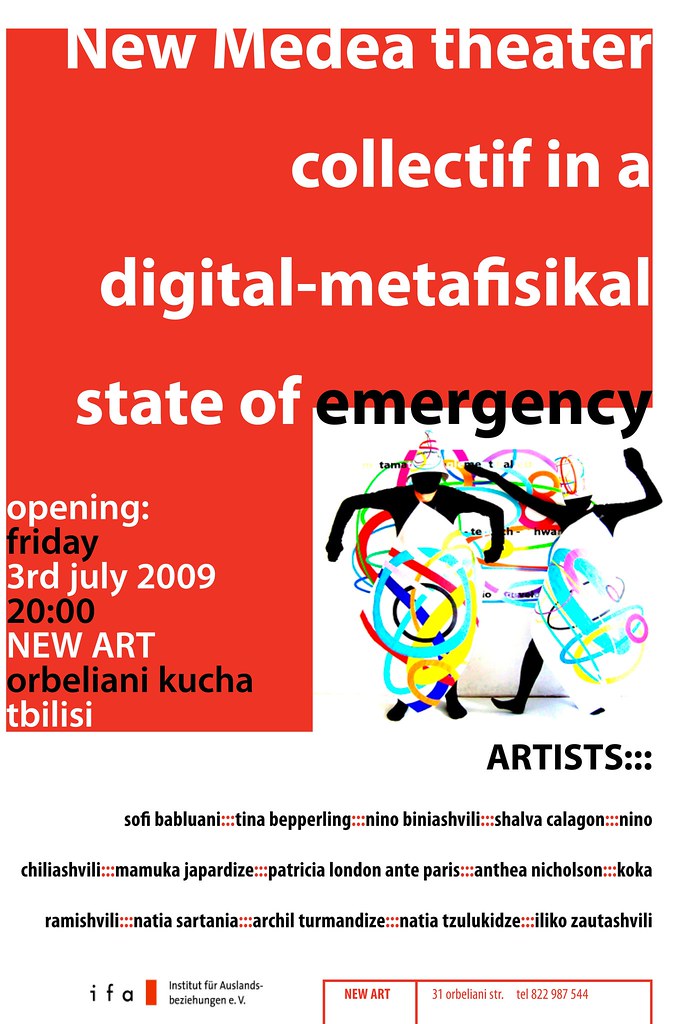
EXHIBITION: "New Medea theater collectif in a digital-metafisikal state of emergency"
You are cordially invited to the show
"New Medea theater collectif in a digital-metafisikal state of emergency"
in New Art Cafe, 31 Orbeliani st.
on Friday 3rd July at 20:00
New Medea Theater collectif...will be shown in Kuenstlerhaus Saarbruecken (germany) from 26 august to 26 september 2009.
with: Sofia Babluani, Tina Pepperling, Nino Biniashvili, Shalva Calagon, Nino Chiliashvili, Mamuka Japaridze, Patricia London Ante Paris, Anthea Nicholson, Koka Ramishvili, Natia Sartania, Achil Tumanidze, Natia Tzulukidze, Iliko Zautrashvili
"New Medea theater collectif in a digital-metafisikal state of emergency"
in New Art Cafe, 31 Orbeliani st.
on Friday 3rd July at 20:00
New Medea Theater collectif...will be shown in Kuenstlerhaus Saarbruecken (germany) from 26 august to 26 september 2009.
with: Sofia Babluani, Tina Pepperling, Nino Biniashvili, Shalva Calagon, Nino Chiliashvili, Mamuka Japaridze, Patricia London Ante Paris, Anthea Nicholson, Koka Ramishvili, Natia Sartania, Achil Tumanidze, Natia Tzulukidze, Iliko Zautrashvili
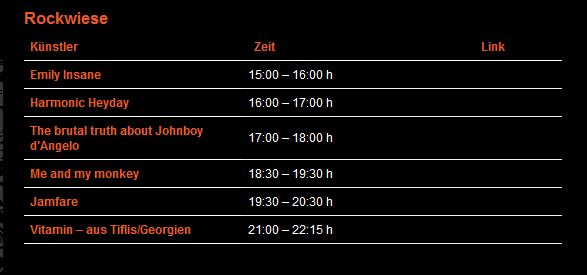
FESTIVAL: Zwei Bands aus Georgien bei der 35. Ausgabe des Saarbrücker Altstadtfestes. (altstadtfest-saarbruecken.de)
05. und 06.07.2009 auf der Rockwiese in Saarbrücken: "Me and My Monkey" and "Vitamin" from Tbilisi
www.myspace.com/medachemimaimuni
Both involved in solo projects before forming MAMM, They joined forces after a chance meeting at a party stirred their drunken spirits and inspired their musical collaboration. Sandro Chicnchaladze had been playing with local Tbilisi act The Neverland, while Gacha Bakradze was part of local band Vietnam Radio. The pair decided to quit their respective solo efforts in 2007 and put their heads together to focus wholeheartedly on MAMM. Officially MAMM was formed at 2007 in capital of Georgia, Tbilisi. Influenced by favorites like Beck, Mogwai, Royksopp, Radiohead and etc … early hard rock sound developed into indie electro-rock complete with catchy synth beats, sweeping atmospherics, and sharp songwriting. After getting favorable reviews at the Rockwise festival in Saarbrucken, MAMM got a producer from Germany and they signed a contract with label “CaucasusRocks” to work on putting together their first record. Staying true to the monkey theme, the duo outfitted their recent May 17th CD release party with free bananas donning MAMM stickers, watching the giddy audience with contained hilarity as a jungle of banana-chomping enthusiasts danced along to their track We Are The Monkeys. Nowadays band is working on their first album “The Starfucker” You may contact MAMM at MeAndMM@Gmail.com
Sandro Chicnchaladze is very activ in the georgian Music Scene. he has got an own Blog and MySpaceSite about the Georgian Live Music: www.myspace.com/geolivemusic
www.myspace.com/vitaminmusic
Members of the band Vitamin had its first gig in 1999 in club U.R. with the project 4U. The project 4U lasted only for 2 years. Leader of the band Dato Gabunia performed with his solo project together with different musician, on music festivals. In the year 2004 Dato started to record his first album. In 2005 he with his solo project participated in annual music festival “Rockweisse” in Saarbrucken, Germany. The band Vitamin was formed in 2005 nowadays the band is planning to release their first album.

www.myspace.com/medachemimaimuni
Both involved in solo projects before forming MAMM, They joined forces after a chance meeting at a party stirred their drunken spirits and inspired their musical collaboration. Sandro Chicnchaladze had been playing with local Tbilisi act The Neverland, while Gacha Bakradze was part of local band Vietnam Radio. The pair decided to quit their respective solo efforts in 2007 and put their heads together to focus wholeheartedly on MAMM. Officially MAMM was formed at 2007 in capital of Georgia, Tbilisi. Influenced by favorites like Beck, Mogwai, Royksopp, Radiohead and etc … early hard rock sound developed into indie electro-rock complete with catchy synth beats, sweeping atmospherics, and sharp songwriting. After getting favorable reviews at the Rockwise festival in Saarbrucken, MAMM got a producer from Germany and they signed a contract with label “CaucasusRocks” to work on putting together their first record. Staying true to the monkey theme, the duo outfitted their recent May 17th CD release party with free bananas donning MAMM stickers, watching the giddy audience with contained hilarity as a jungle of banana-chomping enthusiasts danced along to their track We Are The Monkeys. Nowadays band is working on their first album “The Starfucker” You may contact MAMM at MeAndMM@Gmail.com
Sandro Chicnchaladze is very activ in the georgian Music Scene. he has got an own Blog and MySpaceSite about the Georgian Live Music: www.myspace.com/geolivemusic
www.myspace.com/vitaminmusic
Members of the band Vitamin had its first gig in 1999 in club U.R. with the project 4U. The project 4U lasted only for 2 years. Leader of the band Dato Gabunia performed with his solo project together with different musician, on music festivals. In the year 2004 Dato started to record his first album. In 2005 he with his solo project participated in annual music festival “Rockweisse” in Saarbrucken, Germany. The band Vitamin was formed in 2005 nowadays the band is planning to release their first album.
JOB: Caucasus Programme Assistant (c-r.org)
Conciliation Resources (CR) is an international non-governmental organization with more than 15 years of experience working to prevent and resolve violent conflict. Our practical and policy work is informed by people living in countries affected or threatened by war.
We work with partners in the Caucasus, Colombia, the Democratic Republic of Congo, Fiji, Guinea, India, Liberia, Pakistan, the Philippines, Sierra Leone, Southern Sudan and Uganda. We also publish
Accord: an international review of peace initiatives, and seek to influence government peacemaking policies. We are funded by governments, multilateral agencies, independent trusts and foundations. CR is registered in the UK as a charity (1055436).
Caucasus Programme Assistant Full-time,
London-based, £25,037 plus pension
Closing date: Friday 24 July 2009
Interviews: Wednesday 5 August 2009
Position start date: early September 2009
We are seeking a Russian-speaking Programme Assistant with proven experience in financial management and strong administrative and communication skills. This post represents an ideal opportunity to work with a small, experienced team in a stimulating organization.
The main responsibilities of the post include financial and programme administration, information management and the provision of logistical support in planning events and travel. The post requires
working closely with project partners, programme associates, consultants and service providers. The Caucasus Programme Assistant will play a key support role in achieving the programme objectives.
For a full job description and an application form, visit our website:
http://www.c-r.org/about/jobs.php
Candidates must already be eligible to work in the UK. CR is unable to apply for work permits on behalf of applicants.
We work with partners in the Caucasus, Colombia, the Democratic Republic of Congo, Fiji, Guinea, India, Liberia, Pakistan, the Philippines, Sierra Leone, Southern Sudan and Uganda. We also publish
Accord: an international review of peace initiatives, and seek to influence government peacemaking policies. We are funded by governments, multilateral agencies, independent trusts and foundations. CR is registered in the UK as a charity (1055436).
Caucasus Programme Assistant Full-time,
London-based, £25,037 plus pension
Closing date: Friday 24 July 2009
Interviews: Wednesday 5 August 2009
Position start date: early September 2009
We are seeking a Russian-speaking Programme Assistant with proven experience in financial management and strong administrative and communication skills. This post represents an ideal opportunity to work with a small, experienced team in a stimulating organization.
The main responsibilities of the post include financial and programme administration, information management and the provision of logistical support in planning events and travel. The post requires
working closely with project partners, programme associates, consultants and service providers. The Caucasus Programme Assistant will play a key support role in achieving the programme objectives.
For a full job description and an application form, visit our website:
http://www.c-r.org/about/jobs.
Candidates must already be eligible to work in the UK. CR is unable to apply for work permits on behalf of applicants.
Subscribe to:
Posts (Atom)