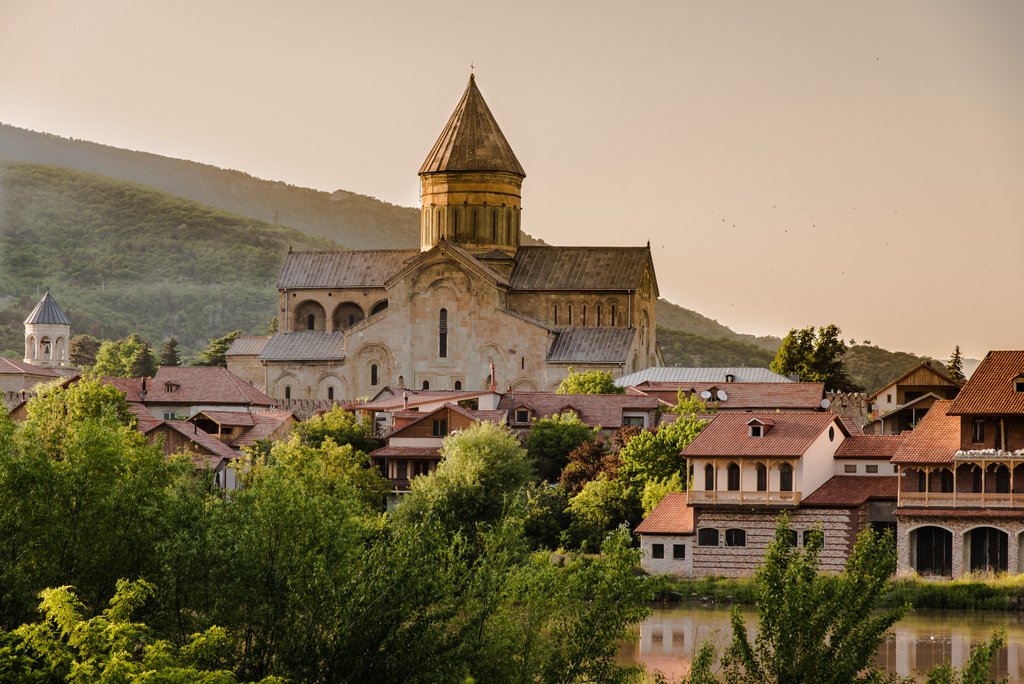
The International Initiative for Georgian Cultural Studies had been established in 2007 by Georgian Arts and Culture Center in cooperation with various local and International bodies.
The aim of the IIGCS is to introduce scholars and professionals working in the fields of Georgian and Caucasian art and culture to each other and to familiarize international audiences with the broad spectrum of scholarly work that exists in the expanding field of Georgian art history, to establish the networking among the scientists working on Georgian art, familiarize international audiences with the broad spectrum of scholarly work that exists in the ever-expanding field of Georgian art history, the updated information on cultural tourism development.
By doing so, the IIGCS intends to increase the level of academic interest on topics concerning Georgian arts and culture, and preservation of cultural heritage, introduce specialists on Georgian cultural scholarship to other colleagues in their fields and provide them with an unprecedented forum for scientific exchange and therefore affect on the cultural tourism development in the region.
IIGCS ACTIVITIES
Symposiums
Scheduled - November 2-9, 2009, Florence, Italy - Share of the Experience in Creativity and Innovationsacross the Europe and Beyond; The Caucaus: Georgia on the Crossroad
June 21-29, Georgia - Georgian Art in the Context of European and Asian Cultures
Conferences
Scheduled - May 5th, 2009; NY,NY,USA - Georgia on the Crossroads of European and Asian Cultures
February 3, 2009, Tbilisi, Georgia - The Cultural Heritage of Georgia - Abkhazeti and Shida Kartli
April 24, 2007, BY, NY, USA - Georgian Culture- Past and Present
Homepage: www.symposiumgeorgia.org
Wednesday, June 17, 2009


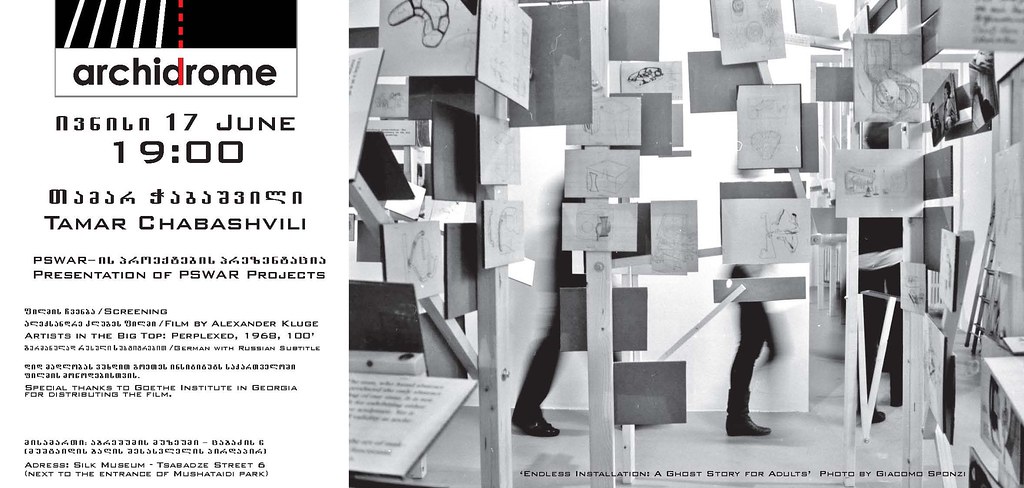
ART: Tamar Chabashvili, Presentation of PSWAR Projects (archidrome.blogspot.com)
Invitation: 17 June, 19:00
Silk - Museum, Tsabadze Street 6
AFTER the presentation FilmScreening
Film by Alexander Kluge - Artists in the Big Top: Perplexed, 1968, 100’
German with Russian Subtitle
Special thanks to Goethe Institute in Georgia for distributing the film.
archidrome.blogspot.com/
geoair.blogspot.com/
Silk - Museum, Tsabadze Street 6
AFTER the presentation FilmScreening
Film by Alexander Kluge - Artists in the Big Top: Perplexed, 1968, 100’
German with Russian Subtitle
Special thanks to Goethe Institute in Georgia for distributing the film.
archidrome.blogspot.com/
geoair.blogspot.com/
Monday, June 15, 2009
BLOG: Armenien / morituri (morituri.at)
Eben habe ich einen netten Blog gefunden. Auf deutsch gibt es dort kleine Episoden und Beobachtungen aus Armenien und Jerevan zu berichten. Fotos sind auch zu sehen. Viel Spass!
link: morituri.at/category/armenien
link: morituri.at/category/armenien
ART: Andro Wekua aus Georgien (saatchi-gallery.co.uk)
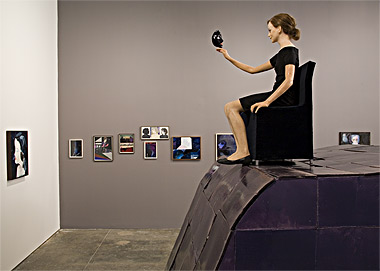 „Auf einem Podest sitzen zwei auffällig geschminkte Mädchen. Sie blicken gebannt auf ihr schwarzes Spiegelbild gegenüber. Gleichermassen im Kunstraum ausgesetzt und auf dem künstlerischen Möbel sorgsam gebettet, erregen sie unsere Aufmerksamkeit. Sie wirken fragil (wenn nicht verletzt) und dennoch bestimmt. Die Installation ist aus Ton gebrannt. Der Glanz der Glasur überzieht die ganze Figur wie eine Imprägnierung gegen die Aussenwelt, nur die Haare sind durchlässig. Als Besucher betritt man die Szenerie und wird augenblicklich mit einer gewissen Intimität konfrontiert. Wie nähert man sich dieser, ihrer Geschichte? Und welche Rolle hält man als betrachtender Akteur inne? Der Titel „Just Kidding“ entwaffnet den sorgenvollen Blick. Oder aber offenbart die Forderung nach einer unbeschwerten Kindheit und Aufrichtigkeit auf phonetischer Ebene (Just Kid).
Andro Wekuas Werk ist durchzogen von einer Form instrumentalisierter Fiktion. Eine spannungsreiche Stimmung bestimmt den künstlerischen Ort der Ausstellung. Die zahlreichen Mysterien sind Kalkül. Wir begegnen „Namenlosen Strassen“ oder „Mary“, einem Mädchen, das, offenbar als Flüchtling, in einem etwas herunter gekommenen Hotel wohnt, „wunderbar, wäre es gewesen.“ Wekua ist ein Meister der Andeutung, der feinen Geste. Seine narrativen Strukturen sind zielgenau und dennoch erstaunlich offen. Es werden Geschichten angedeutet, die im Kopf des Betrachters fertig erzählt werden, die Fantasie des Künstlers aufnehmend.
Einst in Georgien geboren und schon seit langem in Deutschland und der Schweiz lebend, ist Wekua gleichermassen mit der Lebensrealität hier, in der früheren Sowjetunion und im heutigen Georgien vertraut. Das sowjetische Georgien seiner Kindheit bleibt allerdings unerreichbar und begründet eine Art künstlerischen Mythos. Die Heimatstadt Sochumi, einst Feriendestination sowjetischer Funktionäre, malerischer Küstenort mit Zitronenbäumen, ist heute Sperrzone und bleibt auch daher ein Reservoir der Erinnerung: Das Haus der Grossmutter, das Schwarze Meer, politische Wirren, der Pingpong-Tisch hinter dem Haus, das monumentale Frachtschiff am Quai. Aus diesen Fragmenten konstituiert Wekua atmosphärische Bilder. Auf einer Zeichnung steht in krakeliger Schrift „I see“, ein bisschen weiter unten folgt der Zusatz „Black see“. Im Blindflug durchstreifen wir eine geografische und biografische Fiktion, die dem Künstler selbst bisweilen sehr nahe kommt. Geschickt siedelt Wekua seine gezeichneten, collagierten oder gefilmten Bilder im No man’s Land an – zwischen Westen und Osten, Ästhetik und Improvisation, Zuversicht und Trauer. Er konstituiert eigene, bildhafte Drehbücher, die mit seiner Vergangenheit spielen und diese gleichwohl zur Fiktion stilisieren.
Die Kunst von Andro Wekua ist auf sehr direkte Art und Weise „künstlerisch“ (jedoch nicht akademisch). Er begründet eine Form von Realität, die es ausserhalb dieses bestimmten Kontextes nicht gibt. Zu Hilfe kommen ihm dabei sowohl seine bildnerische Fantasie, als auch seine Gabe, auf visueller Ebene Fragilität zu konstituieren.“
Gianni Jetzer, Flash Art, No. 241, March 2005
also in english here >>>
Bildergallerie >>>
weitere links:
www.gladstonegallery.com
www.kunstaspekte.de
www.saatchi-gallery.co.uk
www.saatchi-gallery.co.uk
[PDF] Andro Wekua
www.nieves.ch/catalogue
ARTICLE: ‘Wahhabi’ village in Dagestan (opendemocracy.net)
As human rights violations escalate in the North Caucasus, Tanya Lokshina of Human Rights Watch visits Dagestan, supposedly riven by the struggle between ‘Wahhabis' and the authorities. She visits the so-called ‘Wahhabi' village of Gudben.
full article >>>
full article >>>
BEGEGNUNG: Harald Schluttig zu Gast in Armenien (medienkulturzentrum.de)
Vom 19. Mai bis zum 2. Juni weilte der Leiter des SAEK Fernsehstudios Harald Schluttig zu einem Studienaufenthalt in Gyumri (Armenien). Auf Einladung der Deutschen Botschaft und der Künstlergruppe 5th floor wurde seine Fotoreihe "Kabul - endloser Basar" in Gyumri anlässlich der Deutschlandwochen ausgestellt. Gemeinsam mit Jugendlichen des Kulturzentrums KASA gestaltete Harald Schluttig einen 8 minütigen Videobeitrag über die Stadt, die 1988 von einem verheerenden Erdbeben heimgesucht wurde. Kontakte zu regionalen Fernsehmachern und zum Pädagogischen Institut werden künftig einen Austausch von Videobeiträgen zwischen Gyumri und Dresden ermöglichen. Gleichzeitig ist eine Zusammenarbeit mit dem Dresdner Initiativen "Kulturaktiv" und "Geh8" geplant, die künstlerisch-kulturelle Austauschprojekte u.a. mit Armenien durchführen.
Quelle: www.medienkulturzentrum.de
Quelle: www.medienkulturzentrum.de
STUDY: The Problem of Muslim population of southern Georgia: prospects of deportation and the local resistance. By Nana Sumbadze (policy.hu)
All the above mentioned issues have to be approached holistically. The program of integration of Meskhetians is to be worked out where the strategy, tactics, timing and mechanisms of implementation and as well as ways of monitoring are clearly formulated.
full study here >>>
full study here >>>
ARTICLE: Russia without the Caucasus. By Mikhail Pozharsky, special to Prague Watchdog
The North Caucasus is the most problematic region of modern Russia, a tight cluster of political and economic contradictions. What the censored medium of Russian television shows, of course, is the “restoration of Chechnya”, the “building of a peaceful life” and the last of the insurgents clumsily scrambling out of the bushes in order to receive amnesty from President Kadyrov. Reason, however, refuses to place any credence in this grand scenario – it doesn’t look much like “law and order” when power in the republic is passed on by inheritance, and ex-terrorists form GRU military intelligence battalions that are armed to the teeth.
MOVIE: Trip To Karabakh. By Levan Tutberidze (youtube.com)
A TRIP TO KHARABAKH (GASEIRNEBA KHARABAKHSHI) By Ken Eisner
(GEORGIA) A Studio Remka production. (International sales: Studio Remka, Tbilisi, Georgia.) Produced by Levan Korinteli, Giorgy Kharabadze.
Directed by Levan Tutberidze. Screenplay, Aka Morchiladze, Irakli Solomonashvili, based on a novel by Morchiladze. Camera (color), Goran Pavicevic; editor, Niko Tarielashvili, Boris Machytka; music, Nukri Abashidze; production designers, Gogi Tatishvili, Kote Japaridze; sound (Dolby SRD), Michael Houdek. Reviewed at Seattle Film Festival (Contemporary Cinema), June 18, 2006. Running time: 107 MIN.
With: Levan Doborjnidze, Misha Meskhi, Nutsa Kichianidze, Nino Kasradze, Gogi Kharabdze, Dato Iashvili, Daria Drozdovskaya, Avetik Sanosian, Gagik Melkumov, Artavazd Paloian, Levon Chidilian.
(Georgian, Russian, Armenian dialogue.)
"A Trip to Kharabakh" gets off to a fascinating start, commenting wryly on the tumultuous state of affairs in Georgia and its strife-wracked neighbors. But a shift toward mock heroics and an increasingly vague p.o.v. cause a terminal fuel shortage as it approaches the finish line. This "Trip" requires a good grasp of regional politics to sort out the players and find the humor.
However, even those in the know will find the story gets unnecessarily muddled, which will limit the journey to specialized fests and limited DVD play.
Veteran helmer Levan Tutberidze sets his initially "Mean Streets"-like tale during overlapping civil wars of the early 1990s, but there's little to distinguish what's happening then with what's happening today.
Gio (Levan Doborjnidze) is a handsome, notably unmotivated lynchpin among restless young men in their early 20s. When a relative asks him to travel to a peasant region disputed by Azerbaijan and Armenia, to complete a seemingly simple drug deal, he and goofy pal Gogliko (Misha Meskhi, playing Richard Edson to the protag's Heath Ledger) agree to go.
They take a wrong turn, however, and end up behind Azeri lines.
Eventually Gio busts loose and ends up with friendlier Armenians.
(Both sides say how much they like Georgians --- it's just the other group that's no good.) Gio can't tell if he's a guest or prisoner, but --- as we learn in challengingly structured flashbacks --- it actually makes for a handy break from pressures at home, where his big-enchilada dad (Gogi Kharabdze) has come down hard on him for hooking up with a sad-eyed hooker ("The Good Thief's" Nutsa Kichianidze).
And the old man doesn't realize yet that Gio is also having it off with dad's pretty, if cynical, young wife (Nino Kasradze).
Once ensconced with the Armenians, Gio is offered yet another love interest, a Russian photojournalist (Daria Drozdovskaya) who denies being part of her country's imperialist past since she's Jewish.
Script and Doborjnidze's opaque perf make it hard to grasp why he's so diffident toward the woman, or anyone else, and helmer moves into macho posturing as grittily shot tale goes on, with Rambo-like antics --- albeit possibly satirical --- obscuring the character development and the subtext about relationships between various ethnic groups.
Electro jazzy score helps lift the mood and fits loosely with Gogliko's funny Miles Davis fixation, but it also adds extra cheese factor to "Trip" that already smells a bit overripe toward the end.
Recension By Laura Specker*
The Messenger, Georgia
Jan 13 2006
While waiting to see 'A Trip to Karabakh' (Georgia, 2005) in the crowded Amirani cinema Wednesday night, surrounded by men and women speaking Georgian, I quickly realized that I was quite distinctly the only American in the establishment. Perhaps this should have tipped me off to the kind of cinematic experience I was about to have, but I was not flustered. I was under the impression that the film would be complete with clear English subtitles.
Unfortunately, I had no such luck. As the film began and a flurry of Georgian unaccompanied by a translation confronted me, I was faced with a decision. Do I walk out of the theatre or stick it out? My immediate reaction was to leave and spend my night in a more productive pursuit. But as I sat in the comfortable high-backed chairs, and I watched the screen, something made me stay.
What I had noticed was that the film before me was not usual cinematic fare. I was struck by its flawless cinematography, vivid color, and the expression with which the actors spoke. Even if I could not understand their speech, I felt that I understood their intention.
This is not possible in all films. Many rely on the script, rather than the feelings behind it, to drive the movie forward. But the real heart of cinema lies in the subscript, in the hopes and desires of the characters represented onscreen. When a film is able to access the true nature of its characters, then its purpose will be communicated, whether the words are there or not.
My experience watching 'A Trip to Karabakh' reminded me of when I first saw 'In the Mood For Love', a film by director Wong Kar-Wai.
This film contains almost no dialogue, and yet it clearly conveys the conflicting emotions accompanying the unusual situation that two people in Hong Kong find themselves in. As such, it has become an international cult classic.
In a similar way, I felt that I understood the characters in 'A Trip to Karabakh,' which is directed by Levan Tutberidze and stars Levan Dobordshinidse, Mischa Meskhi, and Nutsa Kutshianidse. Their feelings were apparent on their faces, in their hands, and through various cinematic devices that we normally take for granted. For example, clothing often betrays character. The main character wears dark, plain colors that convey a serious temperament, while his 'sidekick' sports colorful, loose shirts, and his more aloof. Furthermore, the proximity of the camera to an actor's face gives a notion of intimacy, while the wide shot of a landscape gives the sense of possibility. Therefore, I did not need to hear the actors tell me what they felt, because I could see it.
Of course, for Georgians 'A Trip to Karabakh' is not the same as 'In the Mood For Love', because most members of the audience are able to understand the film's rich dialogue. They probably better understood the plot, which (as I understood it) involves two friends traveling from Georgia to the Nagorno-Karabakh region, a de-facto independent Armenian region in Azerbaijan, to buy drugs. Their plans fall through when they are captured by authorities and put in prison, and later separated by enemies of their captors. As the main character struggles with the tumultuous politics of the region, as well as his own romantic politics, he undergoes inner changes and returns to Georgia a different man.
I'm sure that a Georgian's judgment of the film will be different from my own. However, for those English-speakers who are hesitant to explore Georgian culture and art because they don't understand the language, I would advise that language is not always necessary to establish a bond between artist and audience. In the realm of cinema, especially well-made cinema, a world may be found in sights and sounds - no words required.
- Laura is a sophomore student at Williams College in Massachusetts,
U.S.A. She is the Arts Editor of the college newspaper, The Williams Record. She is currently pursuing a degree in philosophy and is interested in international film studies. She can be reached at Laura.E.Specker@williams.edu
This is a very good Georgian movie, about young guys who go to Azerbaijan to buy drugs and end up in the war zone in Karabakh. The war between Armenians And Azeris. (WITH ENGLISH SUBTITLES)
VORTRAG: Georgiens konfliktreiche Abkopplung von Russland. Hegemoniale Ansprüche Moskaus und Verirrungen des georgischen Nationalismus. (bggev.de)
19. 06. 2009, 18:30 Uhr
Vortag von Mariam Parsadanishvili
Berliner Georgische Gesellschaft
Mariam Parsadanishvili, Universität Konstanz, Vortrag
Georgiens konfliktreiche Abkopplung von Russland. Hegemoniale Ansprüche Moskaus und Verirrungen des georgischen Nationalismus
Staatsbibliothek zu Berlin
Potsdamer Str. 33
Konferenzsaal der Generaldirektion
(Eingang über den Pförtner Nord)
Mehr erfahren Sie unter Berliner Georgischen Gesellschaft e.V.
Vortag von Mariam Parsadanishvili
Berliner Georgische Gesellschaft
Mariam Parsadanishvili, Universität Konstanz, Vortrag
Georgiens konfliktreiche Abkopplung von Russland. Hegemoniale Ansprüche Moskaus und Verirrungen des georgischen Nationalismus
Staatsbibliothek zu Berlin
Potsdamer Str. 33
Konferenzsaal der Generaldirektion
(Eingang über den Pförtner Nord)
Mehr erfahren Sie unter Berliner Georgischen Gesellschaft e.V.
Saturday, June 13, 2009
BOOK: The Guns of August 2008. Russia's War in Georgia (georgiandaily.com)
Edited by Svante E. Cornell and S. Frederick Starr
M.E. Sharpe, New York, June 2009, 290pp.
AmazonShop: Books, Maps, Videos, Music & Gifts About The Caucasus
M.E. Sharpe, New York, June 2009, 290pp.
In the summer of 2008, a conflict that appeared to have begun in the breakaway Georgian territory of South Ossetia rapidly escalated to become the most significant crisis in European security in a decade. The implications of the Russian‑Georgian war will be understood differently depending on one’s narrative of what transpired and perspective on the broader context.
This book is designed to present the facts about the events of August 2008 along with comprehensive coverage of the background to those events. It brings together a wealth of expertise on the South Caucasus and Russian foreign policy, with contributions by Russian, Georgian, European, and American experts on the region.
Contents:
1. Introduction
Svante E. Cornell and S. Frederick Starr
2. The Paradox of Living in Paradise: Georgia’s Descent into Chaos
Thomas Goltz
3. Georgian‑Russian Relations in the 1990s
Thornike Gordadze
4. The Russian Leadership’s Preparation for War, 1999‑2008
Andrei Illarionov
5. Georgia’s Rose Revolution: The Break with the Past
Niklas Nilsson
6. From Neglect to Duress: The West and the Georgian Crisis Before the 2008 War
Stephen Blank
7. The Saakashvili Administration’s Reaction to Russian Policies Before the 2008 War
David Smith
8. From Sukhumi to Tskhinvali: The Path to War in Georgia
Johanna Popjanevski
9. After August 7: The Escalation of the Russia‑Georgia War
Pavel Felgenhauer
10. Defining Victory and Defeat: The Information War Between Russia and Georgia
Paul Goble
11. The External Implications of the Russia‑Georgia War
James Sherr
Notes
Index
Praise for the Guns of August 2008:
“This is an important work that places the Russian invasion of Georgia into the larger context of Russian policy since the demise of the Soviet Union. It deserves wide readership among policymakers, specialists, and all those who seek to understand the background, conduct and consequences of the war Russia chose to wage against its small, democratic neighbor in August 2008.”
— John McCain, U.S. Senator
“This commendable volume brings together a group of leading specialists on the Southern Caucasus and Russia’s role therein. The results are superb. The book is essential reading for those who want an easy way to get a clear and balanced understanding of the Georgian crisis of 2008 and its legacies.”
— S. Neil MacFarlane, Oxford University
“This volume is an important contribution to the understanding of one of the most dangerous episodes of the protracted ending of the Cold War. The analyses by some of the foremost Western and Russian experts hold lessons for policymakers everywhere. The contributions will be useful for the European Union in meeting the multiple challenges of overcoming the consequences of the war, preventing confrontation in the future, and building closer ties with the region.”
— Peter Semneby, EU Special Representative for the South Caucasus
“The co‑editors have assembled a first‑rate collection of essays shedding light on the factors underlying the Russo‑Georgian war of August 2008. The war itself and its political aftermath are also discussed in illuminating fashion.”
— John B. Dunlop, Senior Fellow, The Hoover Institution
“The Guns of August 2008 offers a deep analysis of the Russian‑Georgian war of August 2008 and the developments which preceded and underlay it. The book helpfully corrects an erroneous urban legend that Georgia started the war. In July 2008, Russia’s military conducted a full field exercise of an invasion and then launched the real thing. It leads to the disturbing conclusions that Russia may go beyond Georgia to subdue other neighbors, and that it may again use force against Georgia.”
—William H. Courtney, Former U.S. Ambassador to Georgia
AmazonShop: Books, Maps, Videos, Music & Gifts About The Caucasus
LITERATUR: Giwi Margwelaschwili: Der Kantakt (perlentaucher.de)
Giwi Margwelaschwili stellt in seinem neuen Buch einem ungewöhnlichen Liebespaar nach (Wölfchen und Clairchen), um ihm klarzumachen, dass seine Liebe unvergänglich sei ... Lesen Sie hier einen Auszug aus "Der Kantakt".
Giwi Margwelaschwili: Der Kantakt
Aus den Lese-Lebenserfahrungen eines Stadtschreibers
Verbrecher Verlag, Berlin 2009
Gebunden, 800 Seiten, 36,00 Euro
Erscheint am 26. Juni 2009
Hier zur Leseprobe
Mehr Informationen beim Verbrecher Verlag
Klappentext: In "Der Kantakt" wird der große deutsch-georgische Autor Giwi Margwelaschwili erstmals selbst zu einer Figur seiner Lese- und Lebenswelten. 1995 ist er Stadtschreiber von Rheinsberg - folgerichtig liest er dort "Rheinsberg - Ein Bilderbuch für Verliebte" von Kurt Tucholsky.
Und er versucht, mit Tucholskys Liebespaar, Wölfchen und Clairchen, in Kontakt zu treten, um sie darauf aufmerksam zu machen, dass sie Figuren der Literatur sind und ihre Liebe daher unvergänglich ist. Dass sie immer, wenn ein neuer Leser das Buch aufschlägt, ihre wunderbare Romanze neu erleben werden, dass sie also das Glück haben, ganz im "schönen Augenblick" Goethes verweilen zu dürfen.
Doch die Kontaktaufnahme gestaltet sich schwierig. Zunächst begleitet Margwelaschwili das Paar durch Rheinsberg. Dabei erlebt er einige skurrile Situationen. Beispielsweise lernt er "Hintergrundpersonen" der Geschichte kennen und philosophiert mit ihnen über ihre Wirklichkeit. Dem verliebten Paar aber kann er sich zunächst nicht nähern...
In diesem zum Teil autobiografischen Roman geht es zugleich um die Auswirkung der Teilung zur Zeit des Kalten Krieges und um Margwelaschwilis persönliche Lebensumstände, etwa um seinen intellektuellen Werdegang während seines erzwungenen Aufenthaltes in Georgien. Das alles ist miteinander verwirkt und tritt in "Kantakt" zueinander. So befasst sich dieser mit viel Raffinement ausgeklügelte Essayroman mit den Auswirkungen der Politik auf die Literatur und auf das 20. und das beginnende 21. Jahrhundert.
Zum Autor: Giwi Margwelaschwili wurde 1927 als Sohn georgischer Emigranten in Berlin geboren. 1946 wurde er zusammen mit seinem Vater vom sowjetischen Geheimdienst NKWD entführt. Der Vater wurde ermordet, Giwi Margwelaschwili in Sachsenhausen interniert, anschließend nach Georgien verschleppt. Dort lehrte er Deutsch. Erst 1987 konnte er nach Deutschland ausreisen. Ihn begleitete eine Unzahl von in der Emigration auf Deutsch geschriebenen Romanen und Erzählungen. 1994 erhielt er die deutsche Staatsbürgerschaft und ein Ehrenstipendium des Bundespräsidenten, 1995 den Brandenburgischen Literatur-Ehrenpreis für sein Gesamtwerk, 2006 die Goethe-Medaille, 2008 das Bundesverdienstkreuz. Er ist Mitglied des P.E.N. und lebt in Berlin. Werke u.a.: "Muzal - ein georgischer Roman", "Das böse Kapitel", "Kapitän Wakusch", "Der ungeworfene Handschuh". Im Verbrecher Verlag erschienen: "Officer Pembry", Roman; "Zuschauerräume", Lesedrama; "Vom Tod eines alten Lesers", Erzählungen. (Copyright Foto: Verbrecher Verlag)
Leseprobe
AmazonShop: Books, Maps, Videos, Music & Gifts About The Caucasus
Giwi Margwelaschwili: Der Kantakt
Aus den Lese-Lebenserfahrungen eines Stadtschreibers
Verbrecher Verlag, Berlin 2009
Gebunden, 800 Seiten, 36,00 Euro
Erscheint am 26. Juni 2009
Hier zur Leseprobe
Mehr Informationen beim Verbrecher Verlag
Klappentext: In "Der Kantakt" wird der große deutsch-georgische Autor Giwi Margwelaschwili erstmals selbst zu einer Figur seiner Lese- und Lebenswelten. 1995 ist er Stadtschreiber von Rheinsberg - folgerichtig liest er dort "Rheinsberg - Ein Bilderbuch für Verliebte" von Kurt Tucholsky.
Und er versucht, mit Tucholskys Liebespaar, Wölfchen und Clairchen, in Kontakt zu treten, um sie darauf aufmerksam zu machen, dass sie Figuren der Literatur sind und ihre Liebe daher unvergänglich ist. Dass sie immer, wenn ein neuer Leser das Buch aufschlägt, ihre wunderbare Romanze neu erleben werden, dass sie also das Glück haben, ganz im "schönen Augenblick" Goethes verweilen zu dürfen.
Doch die Kontaktaufnahme gestaltet sich schwierig. Zunächst begleitet Margwelaschwili das Paar durch Rheinsberg. Dabei erlebt er einige skurrile Situationen. Beispielsweise lernt er "Hintergrundpersonen" der Geschichte kennen und philosophiert mit ihnen über ihre Wirklichkeit. Dem verliebten Paar aber kann er sich zunächst nicht nähern...
In diesem zum Teil autobiografischen Roman geht es zugleich um die Auswirkung der Teilung zur Zeit des Kalten Krieges und um Margwelaschwilis persönliche Lebensumstände, etwa um seinen intellektuellen Werdegang während seines erzwungenen Aufenthaltes in Georgien. Das alles ist miteinander verwirkt und tritt in "Kantakt" zueinander. So befasst sich dieser mit viel Raffinement ausgeklügelte Essayroman mit den Auswirkungen der Politik auf die Literatur und auf das 20. und das beginnende 21. Jahrhundert.
Zum Autor: Giwi Margwelaschwili wurde 1927 als Sohn georgischer Emigranten in Berlin geboren. 1946 wurde er zusammen mit seinem Vater vom sowjetischen Geheimdienst NKWD entführt. Der Vater wurde ermordet, Giwi Margwelaschwili in Sachsenhausen interniert, anschließend nach Georgien verschleppt. Dort lehrte er Deutsch. Erst 1987 konnte er nach Deutschland ausreisen. Ihn begleitete eine Unzahl von in der Emigration auf Deutsch geschriebenen Romanen und Erzählungen. 1994 erhielt er die deutsche Staatsbürgerschaft und ein Ehrenstipendium des Bundespräsidenten, 1995 den Brandenburgischen Literatur-Ehrenpreis für sein Gesamtwerk, 2006 die Goethe-Medaille, 2008 das Bundesverdienstkreuz. Er ist Mitglied des P.E.N. und lebt in Berlin. Werke u.a.: "Muzal - ein georgischer Roman", "Das böse Kapitel", "Kapitän Wakusch", "Der ungeworfene Handschuh". Im Verbrecher Verlag erschienen: "Officer Pembry", Roman; "Zuschauerräume", Lesedrama; "Vom Tod eines alten Lesers", Erzählungen. (Copyright Foto: Verbrecher Verlag)
Leseprobe
AmazonShop: Books, Maps, Videos, Music & Gifts About The Caucasus

NEWS: 12 Jun 09 | Caucasus Reporting Service 497 (iwpr.net)
Special Report: Karabakh Refugees
Editor's Note
By Oliver Bullough, Caucasus Editor (CRS No. 497, 12-June-09)
Lives Frozen by Conflict
With no sign of Karabakh stand-off being resolved, refugees will remain in legal and economic limbo, their lives frozen by the frozen conflict. By Karine Ohanian in Stepanakert, Seymur Kyazimov in Baku and Gegham Vardanian in Yerevan (CRS No. 497, 12-June-09)
UNHCR Warns of Jobless Despair
Senior aid official says international community needs to improve skills of those displaced by war to improve their employment prospects. By IWPR staff (CRS No. 497, 12-June-09)
Baku Exile Speaks of Fears and Loss
Armenian refugee describes dangers that prompted her to flee – but says she yearns to see her old home again. By Karine Ohanian in Stepanakert (CRS No. 497, 12-June-09)
Grim Prospects for Refugee Children
Azeri refugee in Baku worries about her boys’ future, saying even if they were to return home they wouldn’t fit in. By Seymur Kyazimov in Baku (CRS No. 497, 12-June-09)
Homeless in Yerevan
A decade and a half after the fighting ceased, many refugees are still waiting for proper housing. By Gegham Vardanian in Yerevan (CRS No. 497, 12-June-09)
Editor's Note
By Oliver Bullough, Caucasus Editor (CRS No. 497, 12-June-09)
Lives Frozen by Conflict
With no sign of Karabakh stand-off being resolved, refugees will remain in legal and economic limbo, their lives frozen by the frozen conflict. By Karine Ohanian in Stepanakert, Seymur Kyazimov in Baku and Gegham Vardanian in Yerevan (CRS No. 497, 12-June-09)
UNHCR Warns of Jobless Despair
Senior aid official says international community needs to improve skills of those displaced by war to improve their employment prospects. By IWPR staff (CRS No. 497, 12-June-09)
Baku Exile Speaks of Fears and Loss
Armenian refugee describes dangers that prompted her to flee – but says she yearns to see her old home again. By Karine Ohanian in Stepanakert (CRS No. 497, 12-June-09)
Grim Prospects for Refugee Children
Azeri refugee in Baku worries about her boys’ future, saying even if they were to return home they wouldn’t fit in. By Seymur Kyazimov in Baku (CRS No. 497, 12-June-09)
Homeless in Yerevan
A decade and a half after the fighting ceased, many refugees are still waiting for proper housing. By Gegham Vardanian in Yerevan (CRS No. 497, 12-June-09)
NEWS: 5 Jun 09 | Caucasus Reporting Service 496 (iwpr.net)
Will Kokoity Deliver on Poll Pledges?
South Ossetian leader must improve living conditions for locals in wake of election or risk support switching to opposition, warn analysts. By Alan Tskhurbaev in Tskhinvali (CRS No. 496, 5-June-09)
Yerevan Election Condemned as “Amoral and Cynical”
International watchdog monitoring poll said it “witnessed the collapse of the Armenian electoral system as an institution”. By Sara Khojoian in Yerevan (CRS No. 496, 5-June-09)
South Ossetian leader must improve living conditions for locals in wake of election or risk support switching to opposition, warn analysts. By Alan Tskhurbaev in Tskhinvali (CRS No. 496, 5-June-09)
Yerevan Election Condemned as “Amoral and Cynical”
International watchdog monitoring poll said it “witnessed the collapse of the Armenian electoral system as an institution”. By Sara Khojoian in Yerevan (CRS No. 496, 5-June-09)
ANALYSIS: Steinmeier in Russia
By STEFAN NICOLA (UPI Europe Correspondent)
BERLIN, June 11 (UPI) -- German Foreign Minister Frank-Walter Steinmeier on a visit to Moscow urged the Kremlin to accept a U.S. offer to cooperate on nuclear disarmament.
"With the entry into office of President (Barack) Obama, there is a genuine chance for new cooperation between the United States, the European Union and Russia," Steinmeier said Wednesday in a speech to the Russian Academy of Sciences. "The ghost of the Cold War has been banished."
full analysis >>>
BERLIN, June 11 (UPI) -- German Foreign Minister Frank-Walter Steinmeier on a visit to Moscow urged the Kremlin to accept a U.S. offer to cooperate on nuclear disarmament.
"With the entry into office of President (Barack) Obama, there is a genuine chance for new cooperation between the United States, the European Union and Russia," Steinmeier said Wednesday in a speech to the Russian Academy of Sciences. "The ghost of the Cold War has been banished."
full analysis >>>
TRAVEL: Great journeys: a final toast in wine country - part five (guardian.co.uk)
On the last leg of his Georgian adventure Maxton Walker goes wine tasting in the Alazani valley.
full article >>>
full article >>>
TRAVEL: Great journeys: cha-cha in the mountains - part four (guardian.co.uk)
Continuing his journey across Georgia, Maxton Walker drinks deep with the mountain people.
full article >>>
full article >>>
PHOTOREPORTAGE: Lomisoba by Gela Bedianashvili.
10th of June in Georgia village lomisi people walks to the church of st George in high mountain to pray and cut donation.
full size images you can view here www.eastnews.ru
all rights on images belong to eas tnews photoagency www.eastnews.ru
another slideshow from flickr about Lomisoba >>>
full size images you can view here www.eastnews.ru
all rights on images belong to eas tnews photoagency www.eastnews.ru
another slideshow from flickr about Lomisoba >>>
SPECIAL REPORT: Karabakh Refugees. Lives Frozen by Conflict. (iwpr.net)
With no sign of Karabakh stand-off being resolved, refugees will remain in legal and economic limbo, their lives frozen by the frozen conflict.
By Karine Ohanian in Stepanakert, Seymur Kyazimov in Baku and Gegham Vardanian in Yerevan (CRS No. 497, 12-June-09)
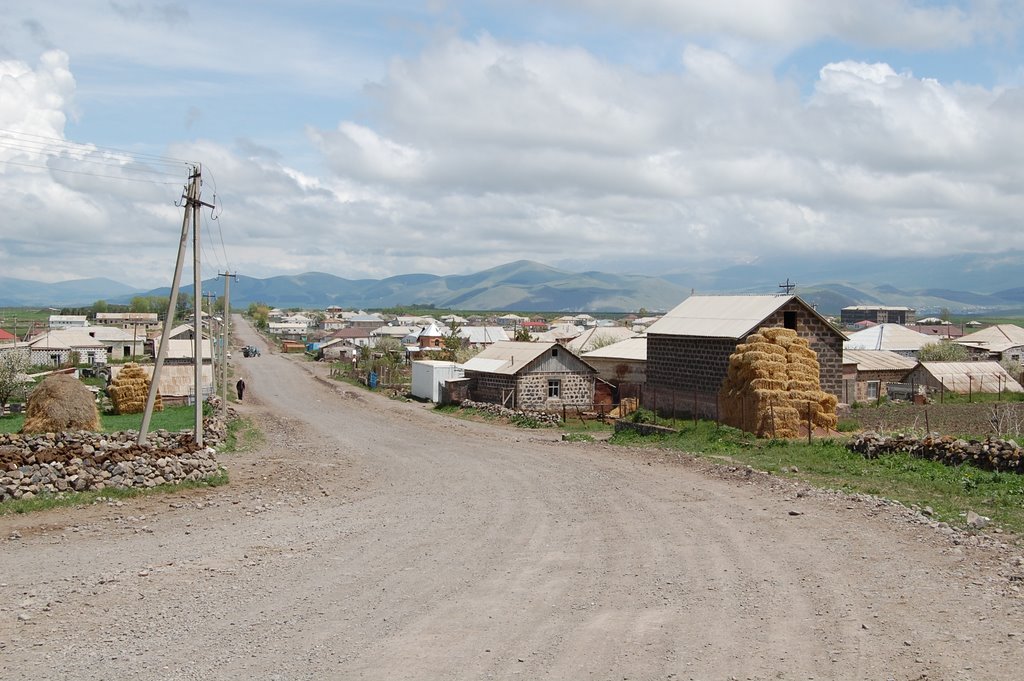
Some 15 years have passed since a ceasefire was signed in the Nagorny Karabakh conflict, yet the people forced out of their homes by the fighting have still not found peace. They still suffer from homesickness, poverty, discomfort and legal difficulties.
Refugees in Armenia, Azerbaijan, and Karabakh – a majority-Armenian territory that broke free of Azeri control with the collapse of the Soviet Union, and unilaterally declared independence – have told IWPR how they feel abandoned in the student hostels, old hotels, schools and offices they now call home.“
Refugees today would like to forget that they are refugees, but this does not happen. What we lived through is unforgettable,” Sarasar Sarian, an Armenian from Baku now living in Karabakh, told IWPR.
full article >>>
By Karine Ohanian in Stepanakert, Seymur Kyazimov in Baku and Gegham Vardanian in Yerevan (CRS No. 497, 12-June-09)
Some 15 years have passed since a ceasefire was signed in the Nagorny Karabakh conflict, yet the people forced out of their homes by the fighting have still not found peace. They still suffer from homesickness, poverty, discomfort and legal difficulties.
Refugees in Armenia, Azerbaijan, and Karabakh – a majority-Armenian territory that broke free of Azeri control with the collapse of the Soviet Union, and unilaterally declared independence – have told IWPR how they feel abandoned in the student hostels, old hotels, schools and offices they now call home.“
Refugees today would like to forget that they are refugees, but this does not happen. What we lived through is unforgettable,” Sarasar Sarian, an Armenian from Baku now living in Karabakh, told IWPR.
full article >>>
Friday, June 12, 2009
EXHIBITION: Against Interpretation with Salome Machaidze (studiovoltaire.org)
I invited last year Salome Machaidze to Leipzig for an exhibition. Now I am very glad that she is a memper of this upcoming show in London soon.
An exhibition curated by Micky Schubert
26th June - 25th July 2009, Wednesday – Saturday, 1 - 6pm
Preview: Thursday 25th June 2009, 7 - 9pm
Marieta Chirulescu/Salome Machaidze/Paul Sietsema/Stephen Sutcliffe/Mark van Yetter/ Maximilian Zentz Zlomovitz
An exhibition curated by Micky Schubert
26th June - 25th July 2009, Wednesday – Saturday, 1 - 6pm
Preview: Thursday 25th June 2009, 7 - 9pm
Marieta Chirulescu/Salome Machaidze/Paul Sietsema/Stephen Sutcliffe/Mark van Yetter/ Maximilian Zentz Zlomovitz

Salome Machaidze DARVINS WEDDING, The King, oil on canvas, 17 .8 x 23.8 cm)
Homepage: www.studiovoltaire.org
STATEMENT: Georgia's Abkhazia less secure without monitors: U.N. (reuters.com)
By Matt RobinsonTBILISI (Reuters) - Failure to extend the United Nation's monitoring presence in Georgia's breakaway Abkhazia region would undermine stability and leave ethnic Georgians there unprotected, the mission head said on Friday.
The mission's mandate expires on June 15, and the U.N. Security Council is split between the West and Russia over the wording of a resolution to extend it.
Russia wants it to reflect Abkhazia's assertion that it is an independent state, recognized by the Kremlin and secured by Russian forces since last year's five-day war between Russia and Georgia over the rebel region of South Ossetia.full article >>>
The mission's mandate expires on June 15, and the U.N. Security Council is split between the West and Russia over the wording of a resolution to extend it.
Russia wants it to reflect Abkhazia's assertion that it is an independent state, recognized by the Kremlin and secured by Russian forces since last year's five-day war between Russia and Georgia over the rebel region of South Ossetia.full article >>>
Subscribe to:
Posts (Atom)